
Social Media Analytics Market Size, Trends and Insights By Component (Software, Services), By Function (Sentiment Analysis, Hashtag Analysis, Competitive Analysis, Dashboard & Visualization, Others), By Application (Sales and Marketing Management, Customer Experience Management, Competitive Intelligence, Risk Management and Fraud Detection, Public Safety and Law Enforcement), By Analytics Type (Predictive Analytics, Diagnostic Analytics, Prescriptive Analytics, Descriptive Analytics), By Industry Vertical (BFSI, Healthcare & Life Sciences, IT & Telecommunications, Retail & Consumer Goods, Media & Entertainment, Government & Public Sector, Travel & Hospitality, Others), and By Region – Global Industry Overview, Statistical Data, Competitive Analysis, Share, Outlook, and Forecast 2026 – 2035
Report Snapshot
CAGR: 23.5%
| Study Period: | 2026-2035 |
| Fastest Growing Market: | Asia Pacific |
| Largest Market: | North America |
Major Players
- IBM Corporation
- Google LLC
- Oracle Corporation
- Salesforce Inc.
- Others
Reports Description
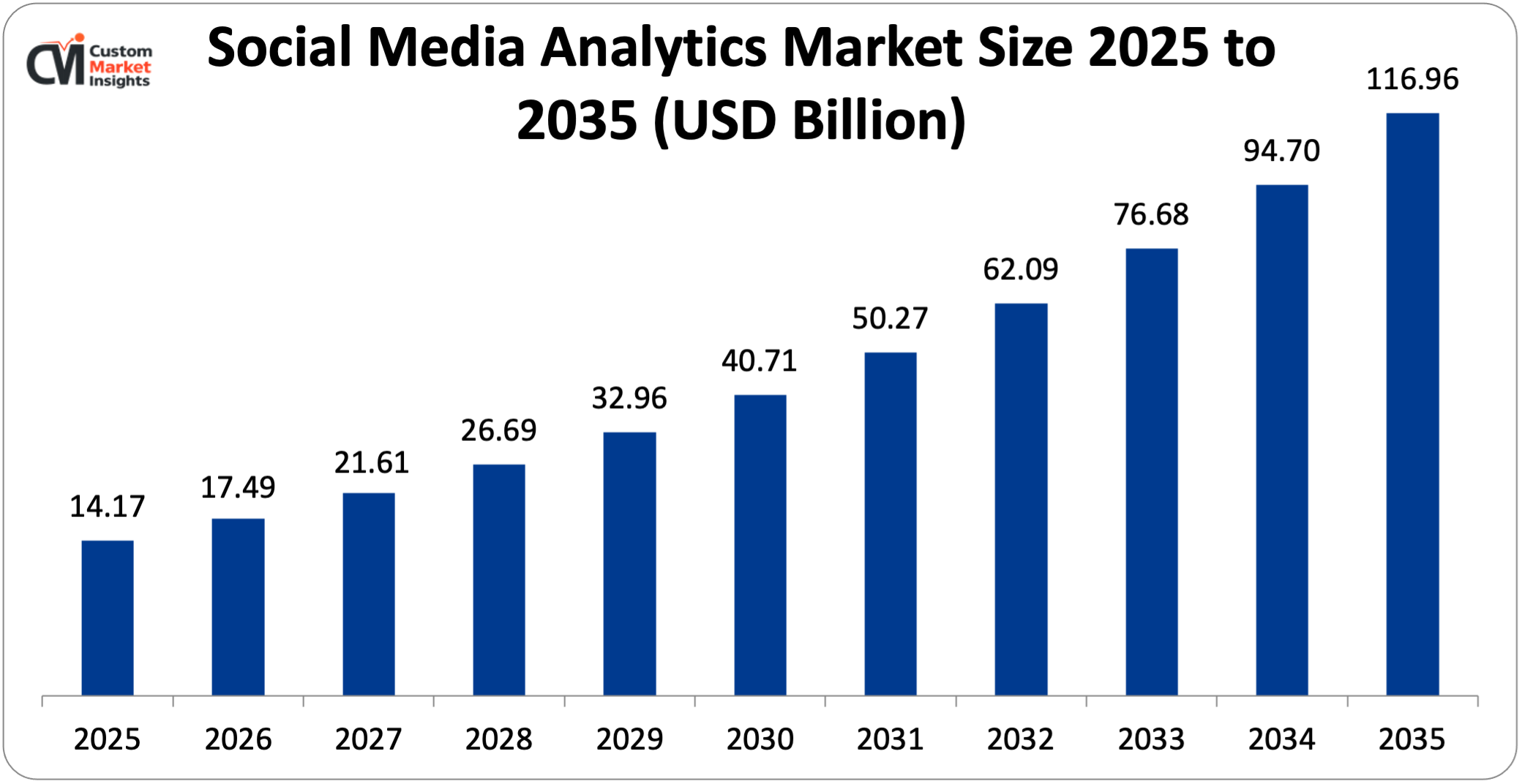
The market size of global social media analytics will be estimated at USD 14.17 billion in 2025 and is expected to grow to between USD 17.49 billion in 2026 and about USD 116.96 billion by 2035, with a current CAGR (compound annual growth rate) of 23.5% during the period of 2026 to 2035.
The process of gathering and analyzing audience data shared on social media networks in order to improve an organization’s strategic business decisions is known as social media analytics. Social media can help businesses by allowing marketers to identify consumer behavior trends that are relevant to a company’s industry and determine marketing efforts’ success.
Another important way Social Media Analytics helps marketing campaigns is by providing data that can be used to calculate a campaign’s return on investment (ROI) based on traffic from various social media channels. Marketers can also examine the performance of various social platforms, such as Facebook, LinkedIn, and Twitter, as well as specific social media posts, to specify which messaging and topics resonate best with a target audience.
Market Highlight
- In 2025, North America will dominate the global market with an estimated market share of 33%. The growing development of advanced products drives the industry growth.
- The Asia Pacific is growing at the highest CAGR over the analysis period. The growing favorable government initiatives towards digitalization.
- By component, the software segment dominated the industry in 2025 with over 58%.
- By function, the sentiment analysis segment captures the largest market share in 2025.
- By application, the risk management and fraud detection segment captures the highest revenue share in 2025.
- By analytics type, the predictive analytics segment captures the highest revenue share in 2025.
- By industry vertical, the media and entertainment segment captures the highest revenue share in 2025.
Significant Growth Factors
The social media analytics market trends present significant growth opportunities due to several factors:
- Rising social media usage & data explosion: Growing penetration of social media (supported by government and intergovernmental organizations’ data sources) is one of the prominent contributing factors for the development of the social media analytics market. As per the reports by the International Telecommunication Union (ITU), a UN organization, the 6 billion people (74% of the population) using the internet in 2025, has increased manifold from previous years. This massive digital inclusion has ensured the substantial development of devices and infrastructure and Government initiatives to improve internet accessibility across the world. Growth of the number of internet users is directly proportionate to the growth of social media users, as there is a good number of real-time unstructured data like status updates, comments, photographs, videos, searches, sms, etc. being generated every second on this digital platform. Governments and other public organizations are also increasing adoption of social media for communicating with the masses for dissemination of policies and additional benefits for the public. The UN‘s previous data had revealed a significant acceleration in internet adoption, with hundreds of millions of new users coming online over very short periods of time, especially in developing countries. This massive growth in the total number of users has contributed to most of the users using social media consistently and thus generating a huge amount of data. This is leading to high investment toward social media analytics tools by organizations of all domains in order to analyze the enormous amount of data to derive consumer insight, monitor sentiments, and be more data driven.
- Increasing focus on customer experience & engagement: The increasing emphasis on customer experience (CX) and engagement is expected to be a key growth driver for the social media analytics market as more companies seek to build individual relationships with their customers as part of their growth strategies. Channels on social media are emerging as vital touch points through which users seek to interact actively with brands in the digital world. Increasing number of companies are deploying social media analytics platforms to examine user conversations and sentiments and take preemptive actions towards fulfilling their needs. Progressive government digital strategies are further strengthening this trend as digital governance and citizen engagement initiatives are centered around real-time communication through social channels. This presents opportunities for public and private organizations alike to use sophisticated monitoring and analytics tools in order to enhance service quality and transparency. The other key contributor to this trend is the rising demand for customization of services and the need for instant communication with consumers. Analysis engines enable companies to understand their target audiences and their preferences and thus deliver targeted information and communication that in turn results in higher engagement and customer satisfaction. Budgetary constraints, cost-effectiveness of such tools, and the increased emphasis on customer experience as a differentiating product offering are thus expected to drive the social media analytics market in the coming years.
What are the Major Advances Changing the Social Media Analytics Market Today?
- AI & machine learning–driven analytics: The use of AI and ML in social media analytics is one of the most important technologies, helping organizations discover insights, make predictions, and connect with customers in new ways. It is demonstrated in a number of launches of some major products by large corporations, indicating the transition from classical intelligence to self-automated and proactive. A notable example is the Salesforce™ Einstein AI and Einstein Copilot, the next-gen intelligent analytics and automation. This product aims at the conversational AI sidekick embedded into the business processes that can probe and analyze giga-scale unstructured data, deliver insights, make recommendations, create summaries, manage complex client journeys, and also automate services so that companies can make more agile decisions. Another example is the debut of Sprinklr‘s (2025) AI enabled products, such as Sprinklr Copilot and AI Agents, which facilitate real-time insights, outlier detection, and automatic analytics across diverse digital channels and allow organizations to obtain their data together, erase barriers, and take instant action based on their customers.
- Predictive & prescriptive analytics: One of the biggest advances in social media analytics is the shift from descriptive analytics (“what happened”) to predictive and prescriptive analytics (“what will happen” and “what should be done”). Applying AI, machine learning, and big data models to natural language processing and deep learning, the new predictive and prescriptive analytics technologies can accurately predict users’ future behavior in campaigns and market trends and prescribe the next best moves—opening up the world of possibilities for strategic decision-makers. One widely used example of this expansion in prescriptive analytics is Adobe Experience Platform AI (including Adobe Customer AI and Adobe Journey AI), which enables organizations to predict customer behavior, probability of churn, and likelihood to engage and then suggest the next best action so that marketers are able to tailor the ongoing campaign and improve ROI through an Automated and Data-derived personalization. Along a similar vein, Salesforce Einstein GPT and predictive analytics are also being rolled out as a key piece of platform innovation by aggregating predictions on sales trends, finding the most high-value individual leads, and recommending personalized customer conversations. Likewise, IBM Watson AI solutions incorporated with predictive and prescriptive analytics are gaining ground in the social media analytics industry for better analyzing social sentiment and behavioral data to understand customer expectations and uncover market risks in advance and then convert them into tactical actions quickly.
Category Wise Insights
By Component
Why Software Hold a Prominent Position in the Market?
The software segment dominated the industry in 2025 of over 58%. As the quantity and rate of social media data are growing, software is emphasizing real-time monitoring features. Thus, the businesses can track and respond quickly to customer feedback, trends, or crises on social media. AI and ML are beginning to be used in social media analytics software. These technologies allow automated data processing and pattern recognition and predictive analytics, which facilitate the business to make some discoveries or improve their social media strategy. Influencer detection and analysis functions are also being built within the social media analytics software. They enable the business to find out the influencer who can promote their product/services and understand the influence that influencer has.
The services segment is growing at the highest CAGR over the analysis period. The drivers of the services industry are related to the specific needs of organizations for specialist skills, customization, and the ongoing service and support when managing complex analytics platforms. As social media data becomes a feature of business organizations, but the resources and skills needed to get value from this huge cascade of information are lacking, the demand for professional services such as consultancy, integration, implementation, and managed analytics solutions will grow. The increasing adoption of AI- and ML-enabled analytical platforms that need ongoing optimization, training, support, and integration with other platforms and business systems will also augment the demand. In addition, organizations want specific solutions aligned to their marketing objectives, customer focus, and business sector. Also, with digital marketing, ROI quantification and real-time measurement of competitiveness play an increasing role, and companies (even SMEs) prefer to use specialist third-party services. Thus, these services are likely to show a growing profitability backed by more digital transformation projects along with the increasing complexity of the social media ecosystems.
By Function
Why Sentiment Analysis Capture the Highest Market Share in the Social Media Analytics Market?
The sentiment analysis segment captures the largest market share in 2025. Researchers and developers are working on the sentiment analytics for detecting emotions, like happiness, sadness, anger, fear, surprise, and disgust, based on social media data. It is combined with other analytics algorithms like topic modeling, network analysis, or identifying influencers. In addition, it will be easier for businesses to understand social media data and get analysis more than one way when the sentiment analysis is combined with other approaches, such as market expansion. The algorithms used for sentiment analysis are being enhanced to understand a better sense of the context of the text. Contextual information is being captured by deep learning and contextual word embedding.
The dashboard & visualization segment is growing at the highest rate over the projected period. Social media data is quickly and constantly growing larger, and therefore real-time data visualization is becoming important. Companies and institutions would like to see what people talk about on social media and what’s trending so they can react in time and keep up with the flow of the current affairs. It would help to understand the structure of social connections, identify the key users and communities, and analyze the flow of information within social media.
By Application
Why Risk Management and Fraud Detection Holds a Prominent Share in the Social Media Analytics Market?
The risk management and fraud detection segment captures the highest revenue share in 2025. Many of the modern techniques used in analytics, such as advanced analytics techniques and AI, are now more useful than ever in the application of risk management and monitoring for fraudulent activity in social media analytics. The real-time processing of enormous amounts of social media data enables faster identification and response to likely threats or fraudulent activity. In addition, NLP technology is also becoming more used in the understanding and extracting of value from social media posts, with organizations able to evaluate social media communications more efficiently, recognize trends, measure sentiment, and identify potential threats or fraudulent activity.
The sales and marketing management segment is growing at a rapid rate over the projected period. This segment is growing at an exponential pace, as Businesses are leveraging the data deluge for improving new customer acquisitions, engagement, and conversions through digital marketing and sales campaigns. Corporations are taking the services of analytics tools for social media marketing to enhance the digital customer journey by means of targeted marketing campaigns and optimized communication. The appropriate message is delivered to a specific customer segment, which further ensures better marketing spend, lead conversions, and campaign analytics as measured effectiveness. Companies are using analytics solutions for segmenting audiences for advertisement and marketing. Usage of AI and Predictive analytics assists companies in planning sales flow by product and formulating marketing campaigns and targeting prospective customers. Furthermore, digital marketing, social commerce, and influencer marketing are propelling this segment at an impressive CAGR as they assist companies to reach clearly identified target audiences better and achieve engagement using personalized content and recommendations.
By Analytics Type
Does the Predictive Analytics Segment dominate the Social Media Analytics Market?
The predictive analytics segment captures the highest revenue share in 2025. Predictive analytics and social media data have been applied to traditional customer segmentations: by analyzing trends in social media interaction and social behavior, as well as consumer demography, a company can achieve seemingly more accurate and dynamic segments. Then, these segments allow the companies to add on to general consumer targeting, area-personalized marketing, and product recommendation, which can lead to increased customer engagement and higher conversion rates. Predictive analytics leverages sentiment analysis, a significant part of social media analytics, to optimize customer experience.
The prescriptive analytics segment is growing at a rapid rate over the projected period. Prescriptive analytics combined with social media analytics allows firms to improve social media programs while they are happening. Through ongoing monitoring of social media metrics and performance indicators, prescriptive analytics can recommend the most effective time, subject matter, and target audience for social media messages. Companies can then promptly shift their campaign responses accordingly in order to maximize engagement, reach, and conversions. Prescriptive analytics can also build on social media analytics to identify customers’ attitudes, interests, and reviews. Effective information can be poured into actionable recommendations of optimizing products or services.
By Industry Vertical
Why the Media and Entertainment Segment dominate the Social Media Analytics Market?
The media and entertainment segment captures the highest revenue share in 2025. Companies in those industries are utilizing social media analytics tools to determine how their content is performing. Some of the metrics that companies within this industry are measuring to better understand viewer reactions and to make data-driven decisions regarding their content strategies include reach, engagement, and sentiment. Media & entertainment companies could utilize social media analytics tools to segment their audiences into target groups based on their demographic, psychographic, geographic, and behavioral characteristics. So, the companies could focus their marketing and content production efforts on those target groups that are more likely to be attracted by their content.
The BFSI segment is growing at a rapid rate over the projected period. The main reason for the growth is the BFSI segment applying social media monitoring and analytics for customer engagement, risk management, and branding purposes (using trend analysis). Present financial companies aggregate social media data to understand customer feedback and sentiment and use this knowledge for designing financial products and services, thus optimizing the customer experience. With an ever-increasing flow of transactions from digital banking and fintech services, the number of customer interactions occurring on social media increases, creating a vast data source for BFSI to analyze. It also allows financial organizations to detect possible frauds and potential threats for reputational risks in real time.
Report Scope
| Feature of the Report | Details |
| Market Size in 2026 | USD 17.49 billion |
| Projected Market Size in 2035 | USD 116.96 billion |
| Market Size in 2025 | USD 14.17 billion |
| CAGR Growth Rate | 23.5% CAGR |
| Base Year | 2025 |
| Forecast Period | 2026-2035 |
| Key Segment | By Component, Function, Application, Analytics Type, Industry Vertical and Region |
| Report Coverage | Revenue Estimation and Forecast, Company Profile, Competitive Landscape, Growth Factors and Recent Trends |
| Regional Scope | North America, Europe, Asia Pacific, Middle East & Africa, and South & Central America |
| Buying Options | Request tailored purchasing options to fulfil your requirements for research. |
Regional Analysis
How Big is North America Social Media Analytics Market Size?
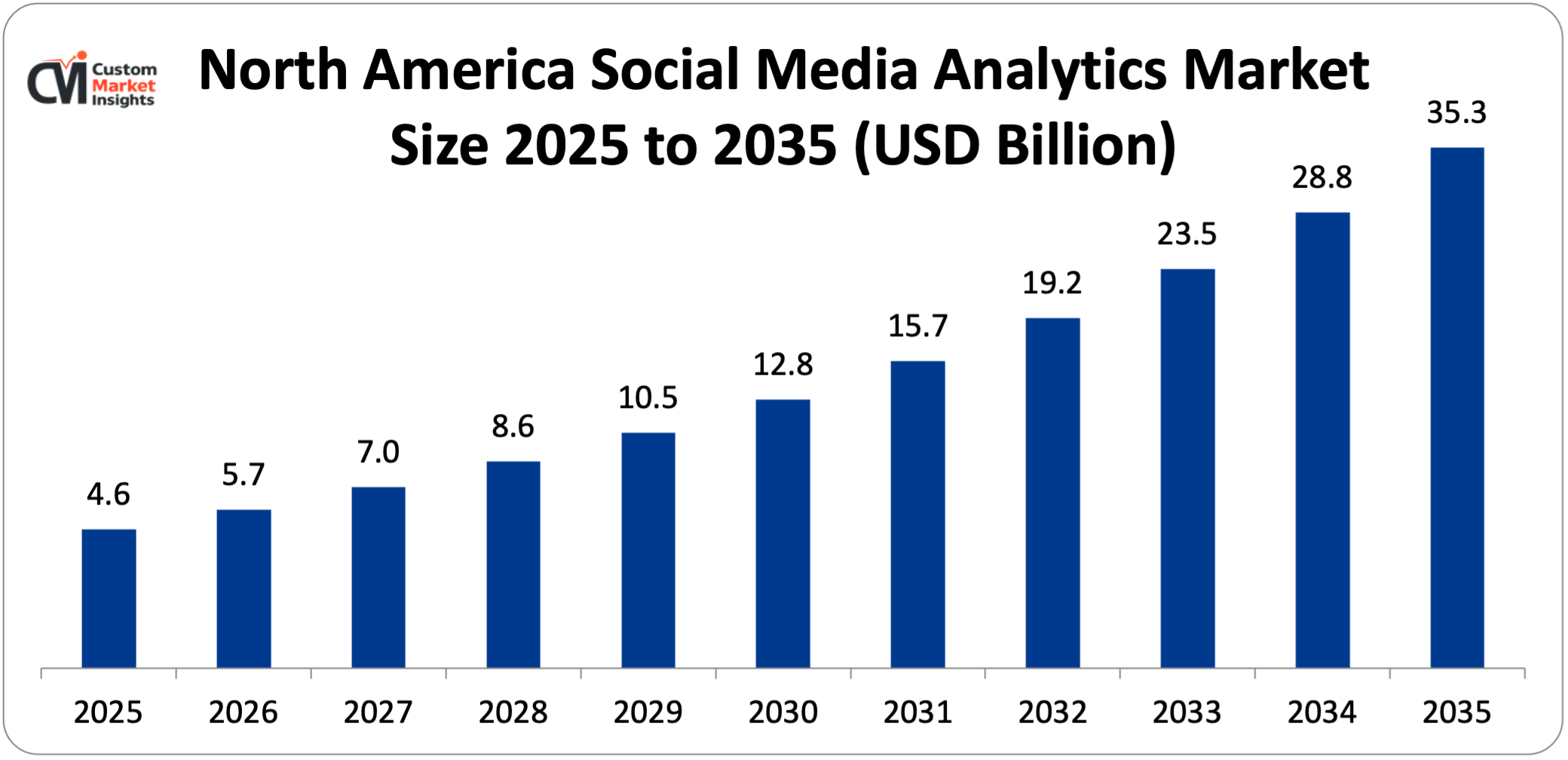
Its market size, in terms of North American social media analytics, is projected to be USD 4.6 billion in 2025 with a growth of about USD 35.3 billion in 2035 with a CAGR of 22.4% between 2026 and 2035.
Why did North America Dominate the Social Media Analytics Market in 2025?
In 2025, North America will dominate the global market with an estimated market share of 33%. It is dominating due to the proliferation of digital marketing, penetration of social media, and advanced analytics tools across businesses in retail, financial, healthcare, and other sectors utilizing real-time analytics to improve customer engagement and campaign performance. Preference towards the integration of ML and AI for sentiment analysis and forecasting with analyzing social data is elevated. Contrastingly, the laws governing data privacy, like California’s, are not spiraling data collection and management.
US Social Media Analytics Market Trends
In the North American region, the US leads the industry expansion over the projected period. With a healthy ecosystem of tech firms and analytics startups. The desire for hyper-personalized messaging, real-time brand monitoring, and influencer identification is creating new opportunities. Vendors are expanding their investment in cross-platform analytics to connect customer data spanning TikTok, Instagram, Twitter (X), and newer platforms. Privacy regulations and ethical AI debates are influencing product design and vendor strategies.
Why is Europe Experiencing Significant Growth in the Social Media Analytics Market?
Europe holds a significant market share in 2025. There is growth in digital transformation among SME companies and a strong focus on compliance with the new GDPR regulation. Companies are aware of ethical transparency in relation to consumer data and are moving towards privacy-first analytics, with Germany, UK and France accounting for the highest spending and growth in investment in multilingual sentiment analysis and country-focused social listening. Spending in analytics for automation of customer service and enhanced omnichannel customer service is also experiencing growth, particularly as companies seek to improve customer experiences and streamline operations in response to the increasing demand for efficient service delivery.
UK Social Media Analytics Market Trends
The UK held the dominant position in the market in 2025. This growth is largely driven by increasing digital advertising spending by UK businesses, which in turn requires sophisticated analytics tools to measure campaign effectiveness and maximize ROI.
Why is the Asia Pacific Growing at the Highest CAGR in the Social Media Analytics Market?
The Asia Pacific is expected to grow at the highest CAGR over the projected period. Most of the growth is driven by the continued explosion in smartphone adoption, the growing popularity of e-commerce, and the acceptance of regional players like WeChat, LINE, TikTok, etc. Countries like China, India, and several Southeast Asian countries are adopting analytics to derive insights from large, diverse user bases. Robust adoption can be seen across sectors like retail, entertainment, and political campaigns, with companies tracking hyperlocal audiences and real-time brand image. Cloud-based analytics solutions are experiencing rapid adoption due to their flexibility and commercial appeal.
China Social Media Analytics Market Trends
China holds the prominent market share in the industry. This is driven by the large user base of over 1 billion users of the internet & social media, generating a huge real-time data pool that companies can leverage to gain insights, and the rapidly growing Chinese social commerce & digital ad ecosystem with WeChat, Douyin, and Weibo.
Why is the Middle East & Africa Region is growing rapidly in the Social Media Analytics?
The MEA region is growing at a steady rate over the projected period. This growth has primarily been driven by the spread of smartphones and cheap internet, which has significantly expanded the number of social media users as well as created huge data sets that can be analyzed. Growing digital economy, e-commerce, and creator economy in the gulf countries, South Africa, and other middle eastern countries are resulting in organizations investing in analytics tools for optimizing campaigns and gaining insights into the overall market. Governments in these countries are spearheading such an initiative in the form of digital economies and smart city programs.
Saudi Arabia Social Media Analytics Market Trends
Saudi Arabia is growing at the highest CAGR during the forecast period. Social media analytics are used in many industries, including retail, telecom, and BFSI for brand tracking, engaging customers, and obtaining immediate insights. Availability of affordable analytics tools driven by artificial intelligence is propelling the growth of social media analytics in Saudi Arabia. Increasing competition within existing industry sectors and time-starved customers are anticipated to further bolster the growth of the Saudi Arabia social media analytics market.
Top Players in the Social Media Analytics Market and Their Offerings
- IBM Corporation
- Google LLC
- Oracle Corporation
- Salesforce Inc.
- Adobe Inc.
- SAS Institute Inc.
- Qualtrics (Clarabridge)
- Sprinklr Inc.
- Brandwatch (Cision)
- Talkwalker
- Hootsuite Inc.
- NetBase Quid Inc.
- Meltwater
- Sprout Social Inc.
- Digimind
- Cision Ltd.
- Emplifi (formerly Socialbakers)
- Zoho Social
- Buffer Inc.
- Rival IQ
- Others
Key Developments
Social media analytics market has experienced considerable changes in the last two years as the market players are trying to diversify their technological aspects and develop product portfolios using strategic approaches.
- In August 2024, X, the social networking platform, introduced a revamped Audience Insights tab exclusively for X Premium subscribers. This updated feature offers a range of new analytics, including demographic data such as audience gender, age, and country of origin. In addition to these insights, it also highlights peak activity times, helping users strategically plan and optimize their posting schedules. (https://www.socialmediatoday.com/news/x-rolls-advanced-analytics-premium-subscribers/724177/)
These strategic measures have enabled the companies to reinforce their competitive positions, increase the product line, boost their technological competencies, and also seize growth opportunities in the fast-growing social media analytics market.
The Social Media Analytics Market is segmented as follows:
By Component
- Software
- Services
By Function
- Sentiment Analysis
- Hashtag Analysis
- Competitive Analysis
- Dashboard & Visualization
- Others
By Application
- Sales and Marketing Management
- Customer Experience Management
- Competitive Intelligence
- Risk Management and Fraud Detection
- Public Safety and Law Enforcement
By Analytics Type
- Predictive Analytics
- Diagnostic Analytics
- Prescriptive Analytics
- Descriptive Analytics
By Industry Vertical
- BFSI
- Healthcare & Life Sciences
- IT & Telecommunications
- Retail & Consumer Goods
- Media & Entertainment
- Government & Public Sector
- Travel & Hospitality
- Others
Regional Coverage:
North America
- U.S.
- Canada
- Mexico
- Rest of North America
Europe
- Germany
- France
- U.K.
- Russia
- Italy
- Spain
- Netherlands
- Rest of Europe
Asia Pacific
- China
- Japan
- India
- New Zealand
- Australia
- South Korea
- Taiwan
- Rest of Asia Pacific
The Middle East & Africa
- Saudi Arabia
- UAE
- Egypt
- Kuwait
- South Africa
- Rest of the Middle East & Africa
Latin America
- Brazil
- Argentina
- Rest of Latin America
Table of Contents
- Chapter 1. Report Introduction
- 1.1. Report Description
- 1.1.1. Purpose of the Report
- 1.1.2. USP & Key Offerings
- 1.2. Key Benefits For Stakeholders
- 1.3. Target Audience
- 1.4. Report Scope
- 1.1. Report Description
- Chapter 2. Market Overview
- 2.1. Report Scope (Segments And Key Players)
- 2.1.1. Social Media Analytics by Segments
- 2.1.2. Social Media Analytics by Region
- 2.2. Executive Summary
- 2.2.1. Market Size & Forecast
- 2.2.2. Social Media Analytics Market Attractiveness Analysis, By Component
- 2.2.3. Social Media Analytics Market Attractiveness Analysis, By Function
- 2.2.4. Social Media Analytics Market Attractiveness Analysis, By Application
- 2.2.5. Social Media Analytics Market Attractiveness Analysis, By Analytics Type
- 2.2.6. Social Media Analytics Market Attractiveness Analysis, By Industry Vertical
- 2.1. Report Scope (Segments And Key Players)
- Chapter 3. Market Dynamics (DRO)
- 3.1. Market Drivers
- 3.1.1. Rising social media usage & data explosion
- 3.1.2. Increasing focus on customer experience & engagement
- 3.2. Market Restraints
- 3.3. Market Opportunities
- 3.5. Pestle Analysis
- 3.6. Porter Forces Analysis
- 3.7. Technology Roadmap
- 3.8. Value Chain Analysis
- 3.9. Government Policy Impact Analysis
- 3.10. Pricing Analysis
- 3.1. Market Drivers
- Chapter 4. Social Media Analytics Market – By Component
- 4.1. Component Market Overview, By Component Segment
- 4.1.1. Social Media Analytics Market Revenue Share, By Component, 2025 & 2035
- 4.1.2. Software
- 4.1.3. Social Media Analytics Share Forecast, By Region (USD Billion)
- 4.1.4. Comparative Revenue Analysis, By Country, 2025 & 2035
- 4.1.5. Key Market Trends, Growth Factors, & Opportunities
- 4.1.6. Services
- 4.1.7. Social Media Analytics Share Forecast, By Region (USD Billion)
- 4.1.8. Comparative Revenue Analysis, By Country, 2025 & 2035
- 4.1.9. Key Market Trends, Growth Factors, & Opportunities
- 4.1. Component Market Overview, By Component Segment
- Chapter 5. Social Media Analytics Market – By Function
- 5.1. Function Market Overview, By Function Segment
- 5.1.1. Social Media Analytics Market Revenue Share, By Function, 2025 & 2035
- 5.1.2. Sentiment Analysis
- 5.1.3. Social Media Analytics Share Forecast, By Region (USD Billion)
- 5.1.4. Comparative Revenue Analysis, By Country, 2025 & 2035
- 5.1.5. Key Market Trends, Growth Factors, & Opportunities
- 5.1.6. Hashtag Analysis
- 5.1.7. Social Media Analytics Share Forecast, By Region (USD Billion)
- 5.1.8. Comparative Revenue Analysis, By Country, 2025 & 2035
- 5.1.9. Key Market Trends, Growth Factors, & Opportunities
- 5.1.10. Competitive Analysis
- 5.1.11. Social Media Analytics Share Forecast, By Region (USD Billion)
- 5.1.12. Comparative Revenue Analysis, By Country, 2025 & 2035
- 5.1.13. Key Market Trends, Growth Factors, & Opportunities
- 5.1.14. Dashboard & Visualization
- 5.1.15. Social Media Analytics Share Forecast, By Region (USD Billion)
- 5.1.16. Comparative Revenue Analysis, By Country, 2025 & 2035
- 5.1.17. Key Market Trends, Growth Factors, & Opportunities
- 5.1.18. Others
- 5.1.19. Social Media Analytics Share Forecast, By Region (USD Billion)
- 5.1.20. Comparative Revenue Analysis, By Country, 2025 & 2035
- 5.1.21. Key Market Trends, Growth Factors, & Opportunities
- 5.1. Function Market Overview, By Function Segment
- Chapter 6. Social Media Analytics Market – By Application
- 6.1. Application Market Overview, By Application Segment
- 6.1.1. Social Media Analytics Market Revenue Share, By Application, 2025 & 2035
- 6.1.2. Sales and Marketing Management
- 6.1.3. Social Media Analytics Share Forecast, By Region (USD Billion)
- 6.1.4. Comparative Revenue Analysis, By Country, 2025 & 2035
- 6.1.5. Key Market Trends, Growth Factors, & Opportunities
- 6.1.6. Customer Experience Management
- 6.1.7. Social Media Analytics Share Forecast, By Region (USD Billion)
- 6.1.8. Comparative Revenue Analysis, By Country, 2025 & 2035
- 6.1.9. Key Market Trends, Growth Factors, & Opportunities
- 6.1.10. Competitive Intelligence
- 6.1.11. Social Media Analytics Share Forecast, By Region (USD Billion)
- 6.1.12. Comparative Revenue Analysis, By Country, 2025 & 2035
- 6.1.13. Key Market Trends, Growth Factors, & Opportunities
- 6.1.14. Risk Management and Fraud Detection
- 6.1.15. Social Media Analytics Share Forecast, By Region (USD Billion)
- 6.1.16. Comparative Revenue Analysis, By Country, 2025 & 2035
- 6.1.17. Key Market Trends, Growth Factors, & Opportunities
- 6.1.18. Public Safety and Law Enforcement
- 6.1.19. Social Media Analytics Share Forecast, By Region (USD Billion)
- 6.1.20. Comparative Revenue Analysis, By Country, 2025 & 2035
- 6.1.21. Key Market Trends, Growth Factors, & Opportunities
- 6.1. Application Market Overview, By Application Segment
- Chapter 7. Social Media Analytics Market – By Analytics Type
- 7.1. Analytics Type Market Overview, By Analytics Type Segment
- 7.1.1. Social Media Analytics Market Revenue Share, By Analytics Type, 2025 & 2035
- 7.1.2. Predictive Analytics
- 7.1.3. Social Media Analytics Share Forecast, By Region (USD Billion)
- 7.1.4. Comparative Revenue Analysis, By Country, 2025 & 2035
- 7.1.5. Key Market Trends, Growth Factors, & Opportunities
- 7.1.6. Diagnostic Analytics
- 7.1.7. Social Media Analytics Share Forecast, By Region (USD Billion)
- 7.1.8. Comparative Revenue Analysis, By Country, 2025 & 2035
- 7.1.9. Key Market Trends, Growth Factors, & Opportunities
- 7.1.10. Prescriptive Analytics
- 7.1.11. Social Media Analytics Share Forecast, By Region (USD Billion)
- 7.1.12. Comparative Revenue Analysis, By Country, 2025 & 2035
- 7.1.13. Key Market Trends, Growth Factors, & Opportunities
- 7.1.14. Descriptive Analytics
- 7.1.15. Social Media Analytics Share Forecast, By Region (USD Billion)
- 7.1.16. Comparative Revenue Analysis, By Country, 2025 & 2035
- 7.1.17. Key Market Trends, Growth Factors, & Opportunities
- 7.1. Analytics Type Market Overview, By Analytics Type Segment
- Chapter 8. Social Media Analytics Market – By Industry Vertical
- 8.1. Industry Vertical Market Overview, By Industry Vertical Segment
- 8.1.1. Social Media Analytics Market Revenue Share, By Industry Vertical, 2025 & 2035
- 8.1.2. BFSI
- 8.1.3. Social Media Analytics Share Forecast, By Region (USD Billion)
- 8.1.4. Comparative Revenue Analysis, By Country, 2025 & 2035
- 8.1.5. Key Market Trends, Growth Factors, & Opportunities
- 8.1.6. Healthcare & Life Sciences
- 8.1.7. Social Media Analytics Share Forecast, By Region (USD Billion)
- 8.1.8. Comparative Revenue Analysis, By Country, 2025 & 2035
- 8.1.9. Key Market Trends, Growth Factors, & Opportunities
- 8.1.10. IT & Telecommunications
- 8.1.11. Social Media Analytics Share Forecast, By Region (USD Billion)
- 8.1.12. Comparative Revenue Analysis, By Country, 2025 & 2035
- 8.1.13. Key Market Trends, Growth Factors, & Opportunities
- 8.1.14. Retail & Consumer Goods
- 8.1.15. Social Media Analytics Share Forecast, By Region (USD Billion)
- 8.1.16. Comparative Revenue Analysis, By Country, 2025 & 2035
- 8.1.17. Key Market Trends, Growth Factors, & Opportunities
- 8.1.18. Media & Entertainment
- 8.1.19. Social Media Analytics Share Forecast, By Region (USD Billion)
- 8.1.20. Comparative Revenue Analysis, By Country, 2025 & 2035
- 8.1.21. Key Market Trends, Growth Factors, & Opportunities
- 8.1.22. Government & Public Sector
- 8.1.23. Social Media Analytics Share Forecast, By Region (USD Billion)
- 8.1.24. Comparative Revenue Analysis, By Country, 2025 & 2035
- 8.1.25. Key Market Trends, Growth Factors, & Opportunities
- 8.1.26. Travel & Hospitality
- 8.1.27. Social Media Analytics Share Forecast, By Region (USD Billion)
- 8.1.28. Comparative Revenue Analysis, By Country, 2025 & 2035
- 8.1.29. Key Market Trends, Growth Factors, & Opportunities
- 8.1.30. Others
- 8.1.31. Social Media Analytics Share Forecast, By Region (USD Billion)
- 8.1.32. Comparative Revenue Analysis, By Country, 2025 & 2035
- 8.1.33. Key Market Trends, Growth Factors, & Opportunities
- 8.1. Industry Vertical Market Overview, By Industry Vertical Segment
- Chapter 9. Social Media Analytics Market – Regional Analysis
- 9.1. Social Media Analytics Market Overview, By Region Segment
- 9.1.1. Global Social Media Analytics Market Revenue Share, By Region, 2025 & 2035
- 9.1.2. Global Social Media Analytics Market Revenue, By Region, 2026 – 2035 (USD Billion)
- 9.1.3. Global Social Media Analytics Market Revenue, By Component, 2026 – 2035
- 9.1.4. Global Social Media Analytics Market Revenue, By Function, 2026 – 2035
- 9.1.5. Global Social Media Analytics Market Revenue, By Application, 2026 – 2035
- 9.1.6. Global Social Media Analytics Market Revenue, By Analytics Type, 2026 – 2035
- 9.1.7. Global Social Media Analytics Market Revenue, By Industry Vertical, 2026 – 2035
- 9.2. North America
- 9.2.1. North America Social Media Analytics Market Revenue, By Country, 2026 – 2035 (USD Billion)
- 9.2.2. North America Social Media Analytics Market Revenue, By Component, 2026 – 2035
- 9.2.3. North America Social Media Analytics Market Revenue, By Function, 2026 – 2035
- 9.2.4. North America Social Media Analytics Market Revenue, By Application, 2026 – 2035
- 9.2.5. North America Social Media Analytics Market Revenue, By Analytics Type, 2026 – 2035
- 9.2.6. North America Social Media Analytics Market Revenue, By Industry Vertical, 2026 – 2035
- 9.2.7. U.S. Social Media Analytics Market Revenue, 2026 – 2035 (USD Billion)
- 9.2.8. Canada Social Media Analytics Market Revenue, 2026 – 2035 (USD Billion)
- 9.2.9. Mexico Social Media Analytics Market Revenue, 2026 – 2035 (USD Billion)
- 9.2.10. Rest of North America Social Media Analytics Market Revenue, 2026 – 2035 (USD Billion)
- 9.3. Europe
- 9.3.1. Europe Social Media Analytics Market Revenue, By Country, 2026 – 2035 (USD Billion)
- 9.3.2. Europe Social Media Analytics Market Revenue, By Component, 2026 – 2035
- 9.3.3. Europe Social Media Analytics Market Revenue, By Function, 2026 – 2035
- 9.3.4. Europe Social Media Analytics Market Revenue, By Application, 2026 – 2035
- 9.3.5. Europe Social Media Analytics Market Revenue, By Analytics Type, 2026 – 2035
- 9.3.6. Europe Social Media Analytics Market Revenue, By Industry Vertical, 2026 – 2035
- 9.3.7. Germany Social Media Analytics Market Revenue, 2026 – 2035 (USD Billion)
- 9.3.8. France Social Media Analytics Market Revenue, 2026 – 2035 (USD Billion)
- 9.3.9. U.K. Social Media Analytics Market Revenue, 2026 – 2035 (USD Billion)
- 9.3.10. Russia Social Media Analytics Market Revenue, 2026 – 2035 (USD Billion)
- 9.3.11. Italy Social Media Analytics Market Revenue, 2026 – 2035 (USD Billion)
- 9.3.12. Spain Social Media Analytics Market Revenue, 2026 – 2035 (USD Billion)
- 9.3.13. Netherlands Social Media Analytics Market Revenue, 2026 – 2035 (USD Billion)
- 9.3.14. Rest of Europe Social Media Analytics Market Revenue, 2026 – 2035 (USD Billion)
- 9.4. Asia Pacific
- 9.4.1. Asia Pacific Social Media Analytics Market Revenue, By Country, 2026 – 2035 (USD Billion)
- 9.4.2. Asia Pacific Social Media Analytics Market Revenue, By Component, 2026 – 2035
- 9.4.3. Asia Pacific Social Media Analytics Market Revenue, By Function, 2026 – 2035
- 9.4.4. Asia Pacific Social Media Analytics Market Revenue, By Application, 2026 – 2035
- 9.4.5. Asia Pacific Social Media Analytics Market Revenue, By Analytics Type, 2026 – 2035
- 9.4.6. Asia Pacific Social Media Analytics Market Revenue, By Industry Vertical, 2026 – 2035
- 9.4.7. China Social Media Analytics Market Revenue, 2026 – 2035 (USD Billion)
- 9.4.8. Japan Social Media Analytics Market Revenue, 2026 – 2035 (USD Billion)
- 9.4.9. India Social Media Analytics Market Revenue, 2026 – 2035 (USD Billion)
- 9.4.10. New Zealand Social Media Analytics Market Revenue, 2026 – 2035 (USD Billion)
- 9.4.11. Australia Social Media Analytics Market Revenue, 2026 – 2035 (USD Billion)
- 9.4.12. South Korea Social Media Analytics Market Revenue, 2026 – 2035 (USD Billion)
- 9.4.13. Taiwan Social Media Analytics Market Revenue, 2026 – 2035 (USD Billion)
- 9.4.14. Rest of Asia Pacific Social Media Analytics Market Revenue, 2026 – 2035 (USD Billion)
- 9.5. The Middle-East and Africa
- 9.5.1. The Middle-East and Africa Social Media Analytics Market Revenue, By Country, 2026 – 2035 (USD Billion)
- 9.5.2. The Middle-East and Africa Social Media Analytics Market Revenue, By Component, 2026 – 2035
- 9.5.3. The Middle-East and Africa Social Media Analytics Market Revenue, By Function, 2026 – 2035
- 9.5.4. The Middle-East and Africa Social Media Analytics Market Revenue, By Application, 2026 – 2035
- 9.5.5. The Middle-East and Africa Social Media Analytics Market Revenue, By Analytics Type, 2026 – 2035
- 9.5.6. The Middle-East and Africa Social Media Analytics Market Revenue, By Industry Vertical, 2026 – 2035
- 9.5.7. Saudi Arabia Social Media Analytics Market Revenue, 2026 – 2035 (USD Billion)
- 9.5.8. UAE Social Media Analytics Market Revenue, 2026 – 2035 (USD Billion)
- 9.5.9. Egypt Social Media Analytics Market Revenue, 2026 – 2035 (USD Billion)
- 9.5.10. Kuwait Social Media Analytics Market Revenue, 2026 – 2035 (USD Billion)
- 9.5.11. South Africa Social Media Analytics Market Revenue, 2026 – 2035 (USD Billion)
- 9.5.12. Rest of the Middle East & Africa Social Media Analytics Market Revenue, 2026 – 2035 (USD Billion)
- 9.6. Latin America
- 9.6.1. Latin America Social Media Analytics Market Revenue, By Country, 2026 – 2035 (USD Billion)
- 9.6.2. Latin America Social Media Analytics Market Revenue, By Component, 2026 – 2035
- 9.6.3. Latin America Social Media Analytics Market Revenue, By Function, 2026 – 2035
- 9.6.4. Latin America Social Media Analytics Market Revenue, By Application, 2026 – 2035
- 9.6.5. Latin America Social Media Analytics Market Revenue, By Analytics Type, 2026 – 2035
- 9.6.6. Latin America Social Media Analytics Market Revenue, By Industry Vertical, 2026 – 2035
- 9.6.7. Brazil Social Media Analytics Market Revenue, 2026 – 2035 (USD Billion)
- 9.6.8. Argentina Social Media Analytics Market Revenue, 2026 – 2035 (USD Billion)
- 9.6.9. Rest of Latin America Social Media Analytics Market Revenue, 2026 – 2035 (USD Billion)
- 9.1. Social Media Analytics Market Overview, By Region Segment
- Chapter 10. Competitive Landscape
- 10.1. Company Market Share Analysis – 2025
- 10.1.1. Global Social Media Analytics Market: Company Market Share, 2025
- 10.2. Global Social Media Analytics Market Company Market Share, 2024
- 10.1. Company Market Share Analysis – 2025
- Chapter 11. Company Profiles
- 11.1. IBM Corporation
- 11.1.1. Company Overview
- 11.1.2. Key Executives
- 11.1.3. Product Portfolio
- 11.1.4. Financial Overview
- 11.1.5. Operating Business Segments
- 11.1.6. Business Performance
- 11.1.7. Recent Developments
- 11.2. Google LLC
- 11.3. Oracle Corporation
- 11.4. Salesforce Inc.
- 11.5. Adobe Inc.
- 11.6. SAS Institute Inc.
- 11.7. Qualtrics (Clarabridge)
- 11.8. Sprinklr Inc.
- 11.9. Brandwatch (Cision)
- 11.10. Talkwalker
- 11.11. Hootsuite Inc.
- 11.12. NetBase Quid Inc.
- 11.13. Meltwater
- 11.14. Sprout Social Inc.
- 11.15. Digimind
- 11.16. Cision Ltd.
- 11.17. Emplifi (formerly Socialbakers)
- 11.18. Zoho Social
- 11.19. Buffer Inc.
- 11.20. Rival IQ
- 11.21. Others.
- 11.1. IBM Corporation
- Chapter 12. Research Methodology
- 12.1. Research Methodology
- 12.2. Secondary Research
- 12.3. Primary Research
- 12.3.1. Analyst Tools and Models
- 12.4. Research Limitations
- 12.5. Assumptions
- 12.6. Insights From Primary Respondents
- 12.7. Why Healthcare Foresights
- Chapter 13. Standard Report Commercials & Add-Ons
- 13.1. Customization Options
- 13.2. Subscription Module For Market Research Reports
- 13.3. Client Testimonials
- Chapter 14. List Of Figures
- 14.1. Figures No 1 to 44
- Chapter 15. List Of Tables
- 15.1. Tables No 1 to 56
Prominent Player
- IBM Corporation
- Google LLC
- Oracle Corporation
- Salesforce Inc.
- Adobe Inc.
- SAS Institute Inc.
- Qualtrics (Clarabridge)
- Sprinklr Inc.
- Brandwatch (Cision)
- Talkwalker
- Hootsuite Inc.
- NetBase Quid Inc.
- Meltwater
- Sprout Social Inc.
- Digimind
- Cision Ltd.
- Emplifi (formerly Socialbakers)
- Zoho Social
- Buffer Inc.
- Rival IQ
- Others
FAQs
The key players in the market are IBM Corporation, Google LLC, Oracle Corporation, Salesforce Inc., Adobe Inc., SAS Institute Inc., Qualtrics (Clarabridge), Sprinklr Inc., Brandwatch (Cision), Talkwalker, Hootsuite Inc., NetBase Quid Inc., Meltwater, Sprout Social Inc., Digimind, Cision Ltd., Emplifi (formerly Socialbakers), Zoho Social, Buffer Inc., Rival IQ, Others.
Government regulations play a crucial role in shaping the social media analytics market by ensuring data privacy, security, and ethical use of consumer information, which drives the adoption of compliant analytics solutions while also influencing how companies collect, process, and utilize social media data.
The price point significantly influences market growth and adoption in the social media analytics market, as affordable and scalable pricing models—especially cloud-based subscriptions—encourage wider adoption among SMEs, while high costs can limit uptake among smaller organizations.
According to the present analysis and forecast modeling, the market of social media analytics will witness a significant growth of about USD 116.9 billion in the year 2035 with the growing innovative product launch, increasing collaboration, and rising government initiatives for digitalization across the globe with a CAGR of 23.5% between the years 2026 and 2035.
It is projected that North America will hold the largest market share in the social media analytics market in the forecast period, with a share of about 33% of the global market share, which is attributed to the region’s presence of major players and increasing product launches.
The Asia Pacific is expected to grow at the highest CAGR during the forecast period. The growth in the region is owing to the favorable government steps towards digitalization.
The surging number of social media users is propelling the Social Media Analytics market and is anticipated to do so throughout 2026-2035.