
Fire Pump Market Size, Trends and Insights By Product Type (Horizontal Split Case, Vertical in Line, Vertical Split Case, End Suction, Vertical Turbine), By Power Source (Diesel Engine Powered, Steam Powered, Electric Motor Powered, Hybrid), By Application (Residential, Industrial, Commercial), and By Region - Global Industry Overview, Statistical Data, Competitive Analysis, Share, Outlook, and Forecast 2026 – 2035
Report Snapshot
CAGR: 5.2%
| Study Period: | 2026-2035 |
| Fastest Growing Market: | North America |
| Largest Market: | Asia Pacific |
Major Players
- Patterson Pump
- Flowserve (SPP)
- Sulzer
- KSB
- Others
Reports Description
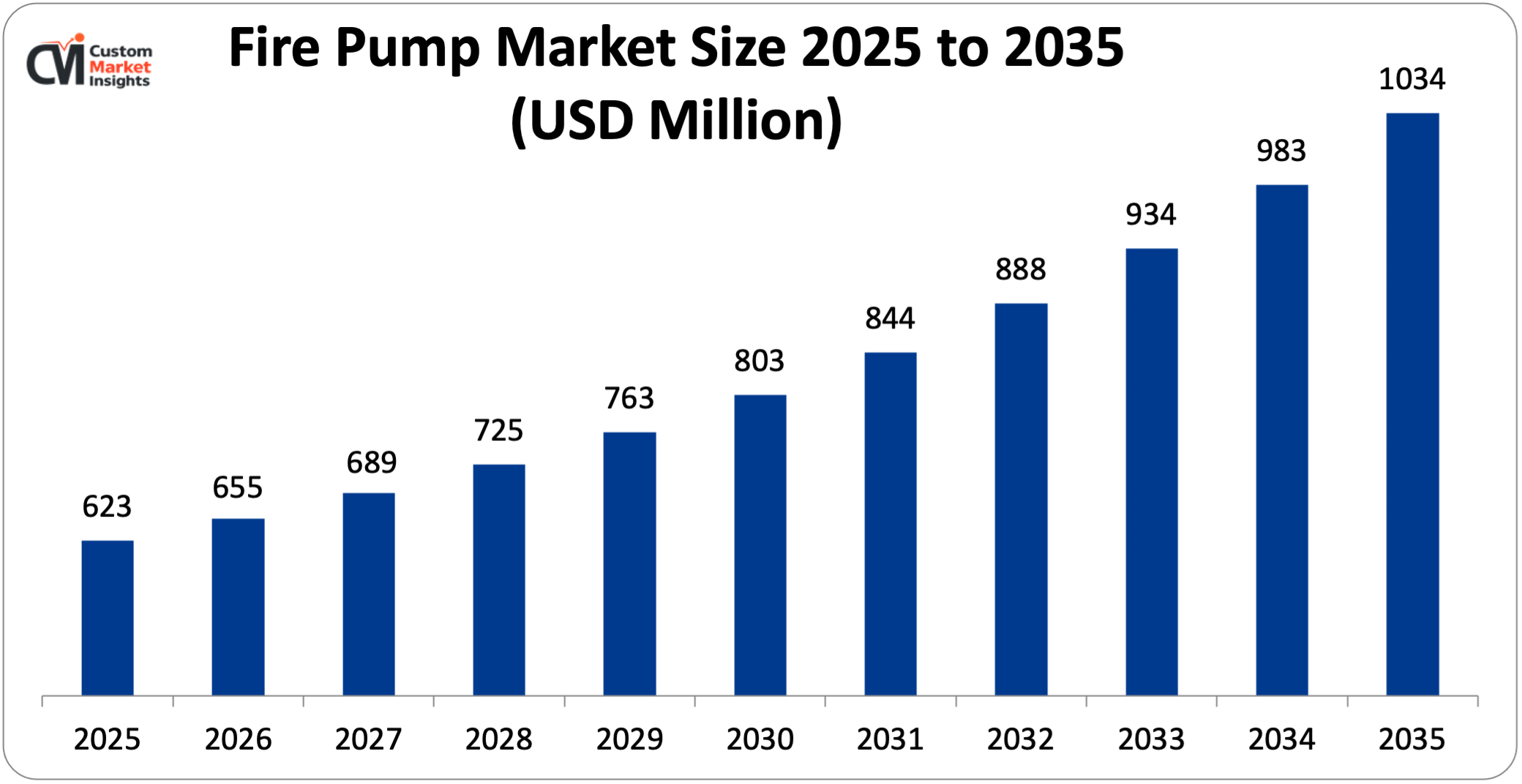
The market size of global fire pumps will be estimated at USD 623 million in 2025 and is expected to grow to between USD 655 million in 2026 and about USD 1034 million by 2035, with a current CAGR (compound annual growth rate) of 5.2% during the period of 2026 to 2035. A fire pump is an essential part of a fire protection system. Fire pump delivers water under pressure to all types of fire protection devices, such as sprinkler systems, standpipes, and fire hydrants.
Generally, a fire pump operates if water pressure is not enough to control or extinguish the fire. Water is pumped from underground tanks, reservoirs, lakes, or municipality water supplies and elevated under pressure. Fire pumps mostly work with electric motors or diesel engines and are used everywhere, including residential, commercial, industrial, and many other infrastructure projects.
Market Highlight
- In 2025, the Asia Pacific will dominate the global market with an estimated market share of 49%. The growing development of advanced products drives the industry growth.
- North America is growing at the highest CAGR over the analysis period. The growing oil & gas sector drives the industry growth.
- By product type, the horizontal split case segment dominated the industry in 2025 with over 38%.
- By power source, the diesel engine powered segment captures the largest market share in 2025 of over 52%.
- By application, the commercial segment captures the highest revenue share in 2025 of 58%.
Significant Growth Factors
The fire pump market trends present significant growth opportunities due to several factors:
- Expansion of Industrial Sectors: The Growth of various industrial sectors is one of the major factors contributing towards the growth of the fire pump market. Oil & gas, power generation, chemicals, manufacturing, and mining industries are characterized by high fire risk owing to the use of flammable chemicals, high temperatures, and exposure to heavy machinery. In addition, fire protection requires robust and high-performing fire pumping systems and firefighting equipment to safeguard operating personnel and business interests. The demand for such systems is increasing with the steady growth of industries across the globe, mainly in emerging economies. The high-pressure pump systems are required to deliver water at high pressure during fire outbreaks and installations of new plants, modernization of the existing plants, and expansion of the existing plants.
- Increasing Awareness Regarding Fire Safety: Awareness of fire safety is another main factor driving the fire pump market worldwide, and now people, local authorities, and companies are giving huge focus to the risk reduction of fire and its related losses. The rise in fire accidents, public safety awareness programs, trainings and other related activities has increased the awareness among general people and organizations of the importance of a reliable firefighting system in case of a fire incident. Thereby, fire pump systems are being increasingly adopted across residential, commercial, and industrial spaces.
What are the Major Advances Changing the Fire Pump Market Today?
- IoT Integration & Smart Monitoring: The emergence of IoT (Internet of Things) and intelligent monitoring will change the face of the fire pump industry, bringing real-time visibility, intelligent predictive maintenance, and automation to fire protection systems. Civil and site managers can view additional critical information in real-time about the operation of the fire pump, such as pressure, flow, temperature, and motor operation, and easily access live data to identify pump alarms away from the site. These also eliminate the need for exhaustive manual inspections to test the fire pump equipment. A cutting-edge product coming soon to the fire pump niche is ‘KirloSmart’ by Kirloskar Brothers Limited, an IoT-based remote fire pump monitoring system for fire pumps. It also facilitates dispatch of alerts & alarms, Web-based visualization of the fleet, Easy to use User interface with centralized access & control, and Secure monitoring platform for fire pumps. The Internet-enabled fire pump knowledge management system makes fire pumps customer-centric and smart.
- Cloud & Data Analytics Integration: Emerging cloud and data analytics integration technology is dramatically evolving the fire pump industry to be more intelligent, data-driven, and safe fire protection systems. With such technologies, firefighting machinery, such as fire pumps, can be simultaneously connected to a cloud platform where the real-time operational data, including pressure, flow rate, vibration, machinery health, and overall system performance, are never-endingly acquired and stored. Just as cloud computing is empowering individuals and businesses all over the globe, a user-friendly dashboard and some smartphone applications can extend the access to the stored data to designated facility operators and safety personnel, who can conveniently track fire pump systems from different buildings no matter where they are geographically. Data analytics is then applied to analyze the acquired data to establish data patterns, identify anomalies, and even predict future failure before it actually happens. The proactive/preventive nature of such futuristic systems minimizes the risk of unscheduled business interruption, reduces maintenance costs, and guarantees the fire protection systems’ availability in the crisis. Cloud and analytics technologies also facilitate automatic report generation, regulatory compliance tracking, and historical data analysis, which are quite critical during periodic maintenance and inspection work or safety audits.
Category Wise Insights
By Product Type
Why Horizontal Split Case Hold a Prominent Position in the Market?
The horizontal split case segment dominated the industry in 2025 with over 38%. The reason for the growth is mainly due to high efficiency, reliability, and the ability to transfer large amounts of water at high flow rates in high-critical fire protection systems. Hence, these pumps are more preferred in commercial complexes, industrial plants, power stations, and municipal infrastructure due to their rugged design and low maintenance requirements, as they have split casing, which facilitates quick access to the internal components without disturbing the piping. Besides its ability to achieve high pressure, it is a suitable pump for larger firefighting systems such as sprinkler networks and hydrant systems. Factors such as headcounts of building construction; proliferation of new industrial facilities, expansion of existing ones; and, notably, expansion in emerging nations such as China and India owing to their high-rise buildings stimulate the growth of this segment. Combined with their high performance, long service life, and global fire safety codes and standards, they are boosting the market growth.
The vertical turbine segment is growing at the highest CAGR over the analysis period. The demand for vertical turbines has increased significantly because they are capable of efficiently lifting water from deep or underground locations (wells, reservoirs, and tanks). Vertical turbines are suitable to operate at those locations where the source of the water is underground. They are also suitable where the level of negative suction lift is beyond the capabilities of other pump types. Tall and narrow in shape, vertical turbines are suited to buildings and industrial estates with restricted floor space, as well as urban infrastructure. The surge in investments in large infrastructure projects, water supply projects, and industrial plants has positively impacted revenue due to the growing demand for vertical turbines in these sectors.
By Power Source
Why Diesel Engine Powered Capture the Highest Market Share in the Fire Pump Market?
The diesel engine powered segment captures the largest market share in 2025 of over 52%. This industry segment has recorded growth based on its superior reliability and absence of reliance on electric power supplies, making it well suited for emergency situations. As many power supplies fail, causing blackouts in many areas, the demand for robust emergency equipment such as diesel fire pumps and fire monitor systems has proven popular. These pumps are very popular in industry, in remote area installations, and in organizations where electricity is not available or has been compromised, such as oil & gas installations, power stations, and warehouses. The ability to operate in extreme conditions under difficult circumstances, along with the fact that the entire system provides a high-quality, reliable, and safe system, ensures that this industry sector has grown significantly and provides increasing revenues. Regulations and fire safety laws requiring backup fire pump provision also have increased the popularity of these machines, particularly in regions where power supplies are unstable.
The hybrid segment is growing at the highest rate over the projected period. Significant growth is seen in the hybrid fire pump segment, as the ability of hybrid systems to emulate both electric and diesel systems is very attractive, as it offers reliability and operational flexibility. The ability of hybrid fire pumps to switch between electric or diesel at a moment’s notice (or when required by the switchover automatically when power fails) makes them optimal for critical Infrastructure, commercial, and industrial structures. With a current and increasing focus on energy conservation and green efficiencies and with the need to comply with set regulations, hybrid systems are being seen in these sectors and are being used to reduce fuel usage and emissions without compromising on the safety levels. With a higher requirement for a smarter, resilient infrastructure and fire protection systems, this segment is expected to show consistent growth.
By Application
Why Commercial Holds a Prominent Share in the Fire Pump Market?
The commercial segment captures the highest revenue share in 2025 of 58%. The segment is witnessing significant growth owing to the growing commercial infrastructure, such as malls, offices, hotels, schools, hospitals, and other commercial and administrative infrastructure projects. Fire protection systems that are installed in these commercial buildings need to be highly reliable, dependable, and compliant with the standards. Fire safety norms and building codes are becoming stringent, requiring the installation of high-end fire pump systems in commercial spaces. The smart buildings in the urban areas and high-rise buildings are also contributing to the segment revenue owing to the requirement for high-pressure fire pumps. The Growing awareness about safety standards and investments in facelifts or renovations are further boosting this segment for steady revenue growth.
The industrial segment is growing at a rapid rate over the projected period. The revenue growth in the Industrial segment is fueled by a rising need for firefighting equipment from high-risk industries like oil & gas, chemicals, power generation, mining, and manufacturing, where the chances of fire are much greater. These industries require reliable and powerful fire pump systems to protect their assets, employees, and operations. Additionally, rules and safety standards require them to invest in backup fire protection systems with fire pumps. Investments in industrial infrastructure and upgrades to existing facilities are also expected to help boost revenue growth.
Report Scope
| Feature of the Report | Details |
| Market Size in 2026 | USD 655 million |
| Projected Market Size in 2035 | USD 1034 million |
| Market Size in 2025 | USD 623 million |
| CAGR Growth Rate | 5.2% CAGR |
| Base Year | 2025 |
| Forecast Period | 2026-2035 |
| Key Segment | By Product Type, Power Source, Application and Region |
| Report Coverage | Revenue Estimation and Forecast, Company Profile, Competitive Landscape, Growth Factors and Recent Trends |
| Regional Scope | North America, Europe, Asia Pacific, Middle East & Africa, and South & Central America |
| Buying Options | Request tailored purchasing options to fulfil your requirements for research. |
Regional Analysis
How Big is the Asia Pacific Fire Pump Market Size?
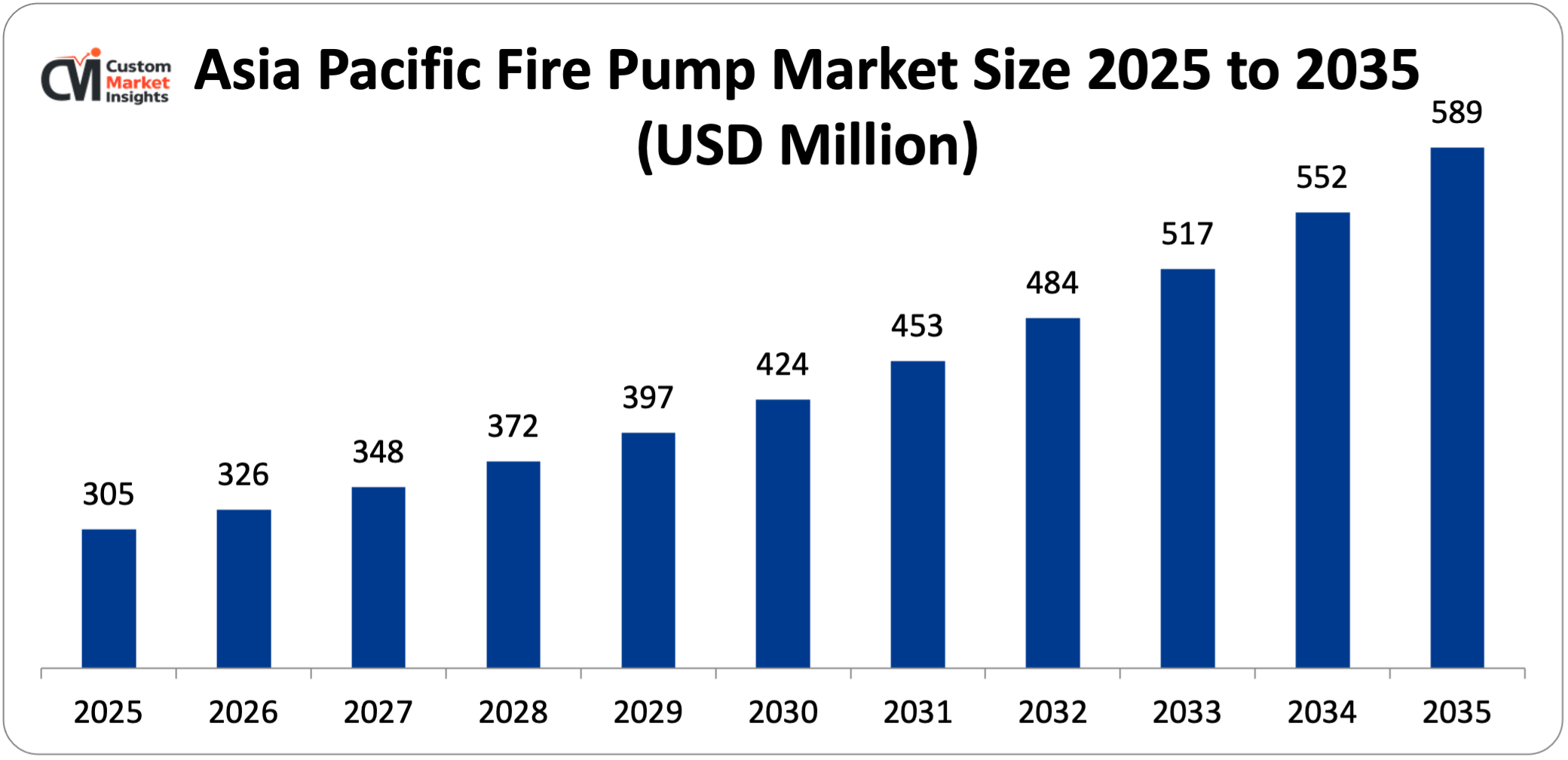
Its market size, in terms of the Asia Pacific fire pump, is projected to be USD 305 million in 2025 with a growth of about USD 589 million in 2035 with a CAGR of 6.8% between 2026 and 2035.
Why did the Asia Pacific Dominate the Fire Pump Market in 2025?
In 2025, the Asia Pacific will dominate the global market with an estimated market share of 49%. This is mainly attributed to the tremendous pace of urbanization, growing industrial activity, and wide-scale infrastructure development taking place in the region. The development of new high-rise residential & commercial buildings, smart cities, and other infrastructure such as airports and metro rails and the growth of high-risk industries such as oil & gas, chemicals, and power generation are significantly supporting the demand for sophisticated fire protection systems such as fire pumps in the region. Authorities in the country are also tightening fire safety norms and building regulations, which is positively affecting the industry demand. The growing awareness regarding fire safety and the rising investments in infrastructure and industrial infrastructure are set to fuel the revenue growth of the APAC fire pump market.
India Fire Pump Market Trends
In the Asia Pacific region, India leads the industry expansion over the projected period. Growth in the country is owing to the increasing urbanization and rapid pace of industrialization. Moreover, the rising infrastructural projects are contributing to the industry expansion.
Why is Europe Experiencing a Significant Growth in the Fire Pump Market?
Europe holds a significant market share in 2025. High growth in Europe is driven by increasing fire safety requirements and mature compliance standards in countries like Germany, UK and France. Regulatory norms and periodic plant inspections drive the use of high-capacity fire safety systems, such as fire pumps, in the residential, commercial, and industrial sectors. The refurbishment and retrofitting of old infrastructure also form a significant part of the growth in the European market as new fire standards are being integrated into old commercial and residential spaces. Industry and energy facilities are prevalent in this region, which also boosts the demand for fire protection systems, including pumps. Further, the increasing focus on designing energy-efficient systems with higher intelligence in the form of smart monitoring and automation aids in long-term revenue growth of the European market.
UK Fire Pump Market Trends
UK held the dominant position in the market in 2025. Growing penetration of energy-efficient and intelligent fire pump solutions and rising consciousness about fire risk management are likely to support a steady increase in sales in the UK fire pump industry.
Why is North America Growing at a Highest CAGR in the Fire Pump Market?
North America is expected to grow at the highest CAGR over the projected period. Strict fire safety regulations and legislative frameworks drive the market across the developed North American region. Both residential and commercial and industrial sectors have mandatory implementation of the code of fire protection authorities in the North American region. The developed regions have established infrastructure and high utilization of the adoption of highly sophisticated fire protection systems.
Moreover, renovation and retrofitting of old buildings are boosting the demand for the most efficient fire pump system, which will cater to the demand for fire protection systems. The developed region comprises high-potential industries such as oil & gas, manufacturing, power & energy, critical infrastructure, and others, which are anticipated to propel the revenue growth of the North America market. Furthermore, the rising investments in smart buildings and significant adoption of innovative technologies, such as IoT fire pumps and automated monitoring systems, are stimulating the revenue size of the North American fire pump market.
US Fire Pump Market Trends
The US holds the prominent market share in the industry. The presence of major industries such as oil & gas, manufacturing, and others drives the country’s market growth. Moreover, the integration of advanced technology in the fire pump flourishes the market growth in the area.
Why is the Middle East & Africa Region is growing rapidly in the Fire Pump?
The MEA region is growing at a steady rate over the projected period. This growth is attributed to the pace of development of the infrastructure in the region leading to urbanization, especially in countries including the UAE, Saudi Arabia, and South Africa. A huge number of large commercial and industrial complexes, airports, hotels, and smart cities are coming up in these regions, effectively building the demand for high-end fire protection systems. The availability of high-value, high-risk industries of Oil &Gas and petrochemicals in the Middle East are teeming with state-of-the-art fire pump systems, resulting in full compliance with statutory regulations.
Saudi Arabia Fire Pump Market Trends
Saudi Arabia is growing at the highest CAGR during the forecast period. Rising awareness of fire risk management and increasing investments in industrial and commercial infrastructure drive the market growth.
Top Players in the Fire Pump Market and Their Offerings
- Pentair (Aurora / Fairbanks Nijhuis)
- Xylem (AC Fire Pump)
- Patterson Pump
- Flowserve (SPP)
- Sulzer
- KSB
- Ruhrpumpen
- NAFFCO
- Grundfos
- Patterson Manufacturing
- Torishima Pump
- Wilo
- Armstrong Fluid Technology
- Peerless Pump
- Kirloskar Brothers
- Shanghai Kaiquan
- Zhongquan Pump
- Ebara
- Shakti Pumps
- Grundfos FireConnect
- Others
Key Developments
Fire pump market has experienced considerable changes in the last two years as the market players are trying to diversify their technological aspects and develop product portfolios using strategic approaches.
- In September 2024, Firefly Fire Pumps, India’s leading manufacturer and exporter of firefighting equipment, announced the expansion of its product range to include state-of-the-art forest fire protection gear. This development reaffirms the company’s dedication to improving wildfire management and safeguarding communities. In collaboration with Vallfirest, a well-known Spanish leader in wildfire technology, Firefly Fire Pumps will now offer over 25 new products that cover all aspects of forest fire protection. This partnership aims to increase firefighting efficiency, protect communities, and better preserve forests as fire risks grow. (https://themachinemaker.com/news/firefly-fire-pumps-expands-product-line-to-strengthen-forest-fire-protection-in-india/)
- In June 2025, Armstrong Fluid Technology announced the launch of a new 750 gpm 5x4x10 PF Vertical-In-Line fire pump model in the United States. The company stated that this model includes its Design Envelope technology, which provides performance tracking, integrated alerts, and remote monitoring. According to Armstrong Fluid Technology, the pump’s startup sequence avoids pressure spikes by gradually increasing output, helping to prevent water hammer and reduce mechanical stress on pipes. The company added that the pump design also reduces installation requirements for electrical cabling and removes the need for pressure-reducing valves and drain lines. (https://fireandsafetyjournalamericas.com/armstrong-launches-750gpm-vertical-fire-pump-in-us-market/)
These strategic measures have enabled the companies to reinforce their competitive positions, increase the product line, boost their technological competencies, and also seize growth opportunities in the fast-growing fire pump market.
The Fire Pump Market is segmented as follows:
By Product Type
- Horizontal Split Case
- Vertical in Line
- Vertical Split Case
- End Suction
- Vertical Turbine
By Power Source
- Diesel Engine Powered
- Steam Powered
- Electric Motor Powered
- Hybrid
By Application
- Residential
- Industrial
- Commercial
Regional Coverage:
North America
- U.S.
- Canada
- Mexico
- Rest of North America
Europe
- Germany
- France
- U.K.
- Russia
- Italy
- Spain
- Netherlands
- Rest of Europe
Asia Pacific
- China
- Japan
- India
- New Zealand
- Australia
- South Korea
- Taiwan
- Rest of Asia Pacific
The Middle East & Africa
- Saudi Arabia
- UAE
- Egypt
- Kuwait
- South Africa
- Rest of the Middle East & Africa
Latin America
- Brazil
- Argentina
- Rest of Latin America
Table of Contents
- Chapter 1. Report Introduction
- 1.1. Report Description
- 1.1.1. Purpose of the Report
- 1.1.2. USP & Key Offerings
- 1.2. Key Benefits For Stakeholders
- 1.3. Target Audience
- 1.4. Report Scope
- 1.1. Report Description
- Chapter 2. Market Overview
- 2.1. Report Scope (Segments And Key Players)
- 2.1.1. Fire Pump by Segments
- 2.1.2. Fire Pump by Region
- 2.2. Executive Summary
- 2.2.1. Market Size & Forecast
- 2.2.2. Fire Pump Market Attractiveness Analysis, By Product Type
- 2.2.3. Fire Pump Market Attractiveness Analysis, By Power Source
- 2.2.4. Fire Pump Market Attractiveness Analysis, By Application
- 2.1. Report Scope (Segments And Key Players)
- Chapter 3. Market Dynamics (DRO)
- 3.1. Market Drivers
- 3.1.1. Expansion of Industrial Sectors
- 3.1.2. Increasing Awareness Regarding Fire Safety
- 3.2. Market Restraints
- 3.3. Market Opportunities
- 3.5. Pestle Analysis
- 3.6. Porter Forces Analysis
- 3.7. Technology Roadmap
- 3.8. Value Chain Analysis
- 3.9. Government Policy Impact Analysis
- 3.10. Pricing Analysis
- 3.1. Market Drivers
- Chapter 4. Fire Pump Market – By Product Type
- 4.1. Product Type Market Overview, By Product Type Segment
- 4.1.1. Fire Pump Market Revenue Share, By Product Type, 2025 & 2035
- 4.1.2. Horizontal Split Case
- 4.1.3. Fire Pump Share Forecast, By Region (USD Million)
- 4.1.4. Comparative Revenue Analysis, By Country, 2025 & 2035
- 4.1.5. Key Market Trends, Growth Factors, & Opportunities
- 4.1.6. Vertical in Line
- 4.1.7. Fire Pump Share Forecast, By Region (USD Million)
- 4.1.8. Comparative Revenue Analysis, By Country, 2025 & 2035
- 4.1.9. Key Market Trends, Growth Factors, & Opportunities
- 4.1.10. Vertical Split Case
- 4.1.11. Fire Pump Share Forecast, By Region (USD Million)
- 4.1.12. Comparative Revenue Analysis, By Country, 2025 & 2035
- 4.1.13. Key Market Trends, Growth Factors, & Opportunities
- 4.1.14. End Suction
- 4.1.15. Fire Pump Share Forecast, By Region (USD Million)
- 4.1.16. Comparative Revenue Analysis, By Country, 2025 & 2035
- 4.1.17. Key Market Trends, Growth Factors, & Opportunities
- 4.1.18. Vertical Turbine
- 4.1.19. Fire Pump Share Forecast, By Region (USD Million)
- 4.1.20. Comparative Revenue Analysis, By Country, 2025 & 2035
- 4.1.21. Key Market Trends, Growth Factors, & Opportunities
- 4.1. Product Type Market Overview, By Product Type Segment
- Chapter 5. Fire Pump Market – By Power Source
- 5.1. Power Source Market Overview, By Power Source Segment
- 5.1.1. Fire Pump Market Revenue Share, By Power Source, 2025 & 2035
- 5.1.2. Diesel Engine Powered
- 5.1.3. Fire Pump Share Forecast, By Region (USD Million)
- 5.1.4. Comparative Revenue Analysis, By Country, 2025 & 2035
- 5.1.5. Key Market Trends, Growth Factors, & Opportunities
- 5.1.6. Steam Powered
- 5.1.7. Fire Pump Share Forecast, By Region (USD Million)
- 5.1.8. Comparative Revenue Analysis, By Country, 2025 & 2035
- 5.1.9. Key Market Trends, Growth Factors, & Opportunities
- 5.1.10. Electric Motor Powered
- 5.1.11. Fire Pump Share Forecast, By Region (USD Million)
- 5.1.12. Comparative Revenue Analysis, By Country, 2025 & 2035
- 5.1.13. Key Market Trends, Growth Factors, & Opportunities
- 5.1.14. Hybrid
- 5.1.15. Fire Pump Share Forecast, By Region (USD Million)
- 5.1.16. Comparative Revenue Analysis, By Country, 2025 & 2035
- 5.1.17. Key Market Trends, Growth Factors, & Opportunities
- 5.1. Power Source Market Overview, By Power Source Segment
- Chapter 6. Fire Pump Market – By Application
- 6.1. Application Market Overview, By Application Segment
- 6.1.1. Fire Pump Market Revenue Share, By Application, 2025 & 2035
- 6.1.2. Residential
- 6.1.3. Fire Pump Share Forecast, By Region (USD Million)
- 6.1.4. Comparative Revenue Analysis, By Country, 2025 & 2035
- 6.1.5. Key Market Trends, Growth Factors, & Opportunities
- 6.1.6. Industrial
- 6.1.7. Fire Pump Share Forecast, By Region (USD Million)
- 6.1.8. Comparative Revenue Analysis, By Country, 2025 & 2035
- 6.1.9. Key Market Trends, Growth Factors, & Opportunities
- 6.1.10. Commercial
- 6.1.11. Fire Pump Share Forecast, By Region (USD Million)
- 6.1.12. Comparative Revenue Analysis, By Country, 2025 & 2035
- 6.1.13. Key Market Trends, Growth Factors, & Opportunities
- 6.1. Application Market Overview, By Application Segment
- Chapter 7. Fire Pump Market – Regional Analysis
- 7.1. Fire Pump Market Overview, By Region Segment
- 7.1.1. Global Fire Pump Market Revenue Share, By Region, 2025 & 2035
- 7.1.2. Global Fire Pump Market Revenue, By Region, 2026 – 2035 (USD Million)
- 7.1.3. Global Fire Pump Market Revenue, By Product Type, 2026 – 2035
- 7.1.4. Global Fire Pump Market Revenue, By Power Source, 2026 – 2035
- 7.1.5. Global Fire Pump Market Revenue, By Application, 2026 – 2035
- 7.2. North America
- 7.2.1. North America Fire Pump Market Revenue, By Country, 2026 – 2035 (USD Million)
- 7.2.2. North America Fire Pump Market Revenue, By Product Type, 2026 – 2035
- 7.2.3. North America Fire Pump Market Revenue, By Power Source, 2026 – 2035
- 7.2.4. North America Fire Pump Market Revenue, By Application, 2026 – 2035
- 7.2.5. U.S. Fire Pump Market Revenue, 2026 – 2035 (USD Million)
- 7.2.6. Canada Fire Pump Market Revenue, 2026 – 2035 (USD Million)
- 7.2.7. Mexico Fire Pump Market Revenue, 2026 – 2035 (USD Million)
- 7.2.8. Rest of North America Fire Pump Market Revenue, 2026 – 2035 (USD Million)
- 7.3. Europe
- 7.3.1. Europe Fire Pump Market Revenue, By Country, 2026 – 2035 (USD Million)
- 7.3.2. Europe Fire Pump Market Revenue, By Product Type, 2026 – 2035
- 7.3.3. Europe Fire Pump Market Revenue, By Power Source, 2026 – 2035
- 7.3.4. Europe Fire Pump Market Revenue, By Application, 2026 – 2035
- 7.3.5. Germany Fire Pump Market Revenue, 2026 – 2035 (USD Million)
- 7.3.6. France Fire Pump Market Revenue, 2026 – 2035 (USD Million)
- 7.3.7. U.K. Fire Pump Market Revenue, 2026 – 2035 (USD Million)
- 7.3.8. Russia Fire Pump Market Revenue, 2026 – 2035 (USD Million)
- 7.3.9. Italy Fire Pump Market Revenue, 2026 – 2035 (USD Million)
- 7.3.10. Spain Fire Pump Market Revenue, 2026 – 2035 (USD Million)
- 7.3.11. Netherlands Fire Pump Market Revenue, 2026 – 2035 (USD Million)
- 7.3.12. Rest of Europe Fire Pump Market Revenue, 2026 – 2035 (USD Million)
- 7.4. Asia Pacific
- 7.4.1. Asia Pacific Fire Pump Market Revenue, By Country, 2026 – 2035 (USD Million)
- 7.4.2. Asia Pacific Fire Pump Market Revenue, By Product Type, 2026 – 2035
- 7.4.3. Asia Pacific Fire Pump Market Revenue, By Power Source, 2026 – 2035
- 7.4.4. Asia Pacific Fire Pump Market Revenue, By Application, 2026 – 2035
- 7.4.5. China Fire Pump Market Revenue, 2026 – 2035 (USD Million)
- 7.4.6. Japan Fire Pump Market Revenue, 2026 – 2035 (USD Million)
- 7.4.7. India Fire Pump Market Revenue, 2026 – 2035 (USD Million)
- 7.4.8. New Zealand Fire Pump Market Revenue, 2026 – 2035 (USD Million)
- 7.4.9. Australia Fire Pump Market Revenue, 2026 – 2035 (USD Million)
- 7.4.10. South Korea Fire Pump Market Revenue, 2026 – 2035 (USD Million)
- 7.4.11. Taiwan Fire Pump Market Revenue, 2026 – 2035 (USD Million)
- 7.4.12. Rest of Asia Pacific Fire Pump Market Revenue, 2026 – 2035 (USD Million)
- 7.5. The Middle-East and Africa
- 7.5.1. The Middle-East and Africa Fire Pump Market Revenue, By Country, 2026 – 2035 (USD Million)
- 7.5.2. The Middle-East and Africa Fire Pump Market Revenue, By Product Type, 2026 – 2035
- 7.5.3. The Middle-East and Africa Fire Pump Market Revenue, By Power Source, 2026 – 2035
- 7.5.4. The Middle-East and Africa Fire Pump Market Revenue, By Application, 2026 – 2035
- 7.5.5. Saudi Arabia Fire Pump Market Revenue, 2026 – 2035 (USD Million)
- 7.5.6. UAE Fire Pump Market Revenue, 2026 – 2035 (USD Million)
- 7.5.7. Egypt Fire Pump Market Revenue, 2026 – 2035 (USD Million)
- 7.5.8. Kuwait Fire Pump Market Revenue, 2026 – 2035 (USD Million)
- 7.5.9. South Africa Fire Pump Market Revenue, 2026 – 2035 (USD Million)
- 7.5.10. Rest of the Middle East & Africa Fire Pump Market Revenue, 2026 – 2035 (USD Million)
- 7.6. Latin America
- 7.6.1. Latin America Fire Pump Market Revenue, By Country, 2026 – 2035 (USD Million)
- 7.6.2. Latin America Fire Pump Market Revenue, By Product Type, 2026 – 2035
- 7.6.3. Latin America Fire Pump Market Revenue, By Power Source, 2026 – 2035
- 7.6.4. Latin America Fire Pump Market Revenue, By Application, 2026 – 2035
- 7.6.5. Brazil Fire Pump Market Revenue, 2026 – 2035 (USD Million)
- 7.6.6. Argentina Fire Pump Market Revenue, 2026 – 2035 (USD Million)
- 7.6.7. Rest of Latin America Fire Pump Market Revenue, 2026 – 2035 (USD Million)
- 7.1. Fire Pump Market Overview, By Region Segment
- Chapter 8. Competitive Landscape
- 8.1. Company Market Share Analysis – 2025
- 8.1.1. Global Fire Pump Market: Company Market Share, 2025
- 8.2. Global Fire Pump Market Company Market Share, 2024
- 8.1. Company Market Share Analysis – 2025
- Chapter 9. Company Profiles
- 9.1. Pentair (Aurora / Fairbanks Nijhuis)
- 9.1.1. Company Overview
- 9.1.2. Key Executives
- 9.1.3. Product Portfolio
- 9.1.4. Financial Overview
- 9.1.5. Operating Business Segments
- 9.1.6. Business Performance
- 9.1.7. Recent Developments
- 9.2. Xylem (AC Fire Pump)
- 9.3. Patterson Pump
- 9.4. Flowserve (SPP)
- 9.5. Sulzer
- 9.6. KSB
- 9.7. Ruhrpumpen
- 9.8. NAFFCO
- 9.9. Grundfos
- 9.10. Patterson Manufacturing
- 9.11. Torishima Pump
- 9.12. Wilo
- 9.13. Armstrong Fluid Technology
- 9.14. Peerless Pump
- 9.15. Kirloskar Brothers
- 9.16. Shanghai Kaiquan
- 9.17. Zhongquan Pump
- 9.18. Ebara
- 9.19. Shakti Pumps
- 9.20. Grundfos FireConnect
- 9.21. Others.
- 9.1. Pentair (Aurora / Fairbanks Nijhuis)
- Chapter 10. Research Methodology
- 10.1. Research Methodology
- 10.2. Secondary Research
- 10.3. Primary Research
- 10.3.1. Analyst Tools and Models
- 10.4. Research Limitations
- 10.5. Assumptions
- 10.6. Insights From Primary Respondents
- 10.7. Why Healthcare Foresights
- Chapter 11. Standard Report Commercials & Add-Ons
- 11.1. Customization Options
- 11.2. Subscription Module For Market Research Reports
- 11.3. Client Testimonials
- Chapter 12. List Of Figures
- 12.1. Figures No 1 to 28
- Chapter 13. List Of Tables
- 13.1. Tables No 1 to 46
Prominent Player
- Pentair (Aurora / Fairbanks Nijhuis)
- Xylem (AC Fire Pump)
- Patterson Pump
- Flowserve (SPP)
- Sulzer
- KSB
- Ruhrpumpen
- NAFFCO
- Grundfos
- Patterson Manufacturing
- Torishima Pump
- Wilo
- Armstrong Fluid Technology
- Peerless Pump
- Kirloskar Brothers
- Shanghai Kaiquan
- Zhongquan Pump
- Ebara
- Shakti Pumps
- Grundfos FireConnect
- Others
FAQs
The key players in the market are Pentair (Aurora / Fairbanks Nijhuis), Xylem (AC Fire Pump), Patterson Pump, Flowserve (SPP), Sulzer, KSB, Ruhrpumpen, NAFFCO, Grundfos, Patterson Manufacturing, Torishima Pump, Wilo, Armstrong Fluid Technology, Peerless Pump, Kirloskar Brothers, Shanghai Kaiquan, Zhongquan Pump, Ebara, Shakti Pumps, Grundfos FireConnect, Others.
Government regulations and legislation have a profound influence on the development of the fire pump market, as they mandate the utilization of fire safety systems in residential, commercial, and industrial facilities. The formulation of strict construction regulations and fire safety benchmarks necessitates the installation, regular testing, and functioning of fire pumps, which in turn stimulates the market. Regulatory restrictions mandate the limit of use of high-quality and approved fire safety systems and compel manufacturers to upgrade and develop their system functionality. The presence of government authorities in the form of regular fire safety audits, inspections, and penal figures rigorously motivates companies to improve their safety standards.
The pricing is one of the key determinants in the development of the fire pump industry, as the purchasing decision is highly affected by it for each type of end user. A high initial cost may prevent the use of sophisticated fire pump systems, especially those equipped with high-level automation and smart technology components in small- and medium-sized companies or small-scale projects. Nonetheless, it is easier for these systems to be adopted in fire companies, where users are less sensitive to price and more concentrated on reliability for safety consequence considerations. Conversely, affordable and energy-saving solutions tend to be easily accepted, especially in developing countries.
According to the present analysis and forecast modeling, the market of fire pumps will witness a significant growth of about USD 1034 million in the year 2035 with the growing innovative product launch, increasing collaboration, and rising government initiatives across the globe with a CAGR of 5.2% between the years 2026 and 2035.
It is projected that the Asia Pacific will hold the largest market share in the fire pump market in the forecast period, with a share of about 49% of the global market share, which is attributed to the region’s presence of major players and increasing industrialization.
North America is expected to grow at the highest CAGR during the forecast period. The growth in the region is owing to the rising product launch.
Fire pump market is mainly driven by the fire safety norms, growth of urbanization & infrastructure, development, and high-risk industries like oil & gas, manufacturing, etc. Along with increasing fire safety awareness, rising fire hazards, emerging smart and energy-saving appliances, ongoing commercial & industrial construction investments, and others in the market.