
Plus Size Clothing Market Size, Trends and Insights By Product (Casual, Inner Wear, Sportswear, Formal, Ethnic Wear, Night Wear, Others), By Gender (Women, Men, Children), By Age Group (Below 15, 16 to 59, 60 & Above), By Pricing (Premium, Mass, Luxury), and By Region - Global Industry Overview, Statistical Data, Competitive Analysis, Share, Outlook, and Forecast 2026 – 2035
Report Snapshot
CAGR: 4.8%
| Study Period: | 2026 – 2035 |
| Fastest Growing Market: | Asia Pacific |
| Largest Market: | North America |
Major Players
- Adidas
- Aditya Birla Fashion
- Arula
- Ashley Stewart
- Others
Reports Description
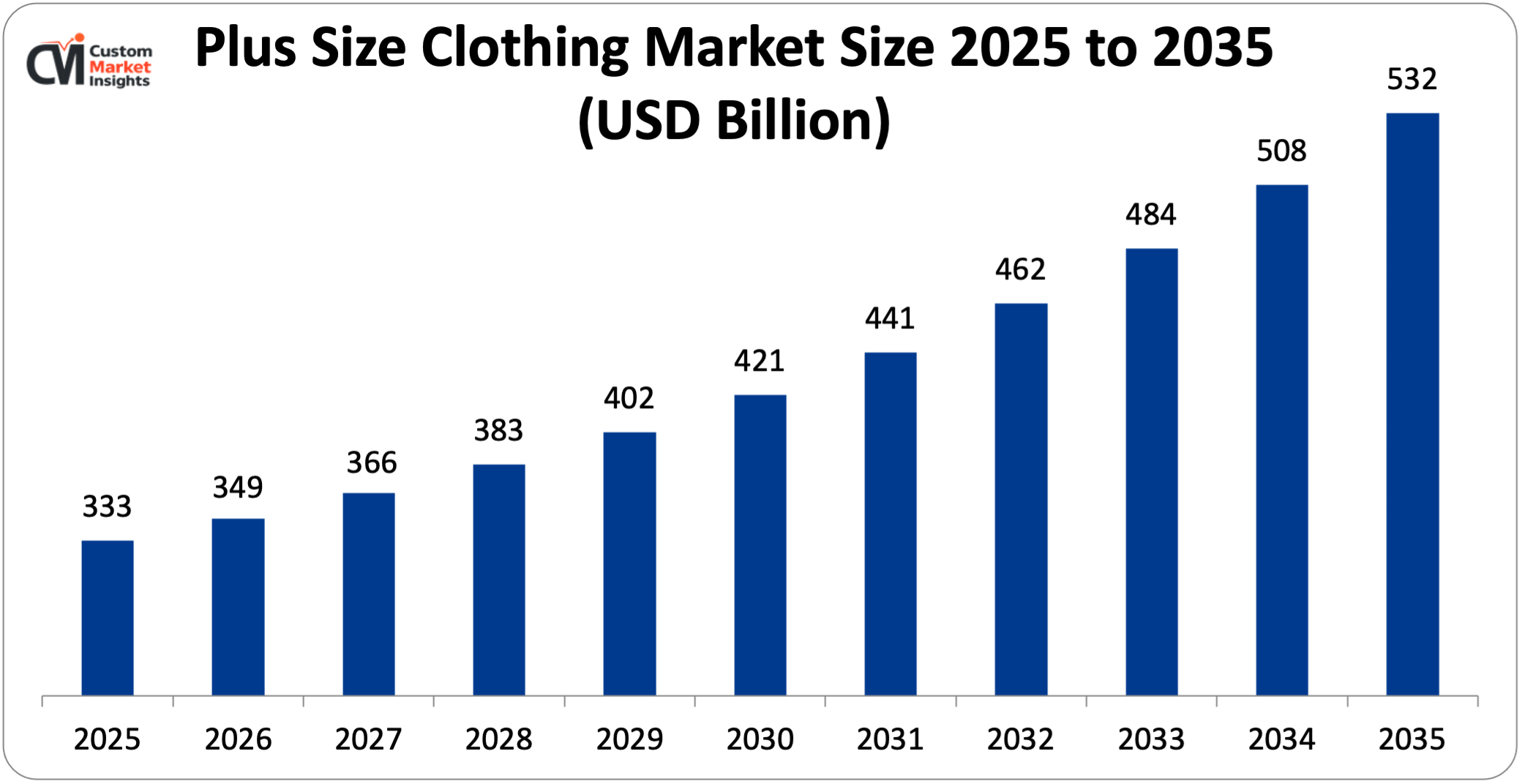
The market size of global plus size clothing will be estimated at USD 333 billion in 2025 and is expected to grow to between USD 349 billion in 2026 and about USD 532 billion by 2035, with a current CAGR (compound annual growth rate) of 4.8% during the period of 2026 to 2035. Plus size clothing is defined as clothing that is particularly designed for people who wear larger than the standard size clothes. The size of the clothes may vary according to the region or brand. This clothing usually starts at a size 12 or 14 and goes up to size 30 and beyond in women’s clothing, whereas in men’s, they start above XL size. The plus-size clothing includes several clothes such as casual wear, formal wear, activewear, outerwear, and others.
This term originated in the fashion industry to describe clothing that accommodates diverse body shapes and sizes beyond that of traditional clothing offered. The plus-size clothing industry market is being driven by several variables such as rising body positivity and inclusivity movements, a growing plus-size population, an increasing obesity rate, increased focus by fashion brands, a rising e-commerce sector, growing social media influence among consumers, and others. However, the high production cost and limited availability and variety might be a major restraining factor for the expansion of the plus size clothing industry.
Market Highlight
- In 2025, North America will dominate the global market with an estimated market share of 44%. The presence of major e-commerce companies.
- The Asia Pacific is growing at the highest CAGR of 5.2% over the analysis period. The growing obese population drives the regional growth.
- By product, the casual segment dominated the industry in 2025 with over 35%.
- By gender, the women segment captures the largest market share in 2025 of over 52%.
- By age group, the below 15 age segment captures the largest revenue share in 2025 of over 15%.
- By pricing, the mass segment captures the largest revenue share in 2025 of over 68%.
Significant Growth Factors
The plus size clothing market trends present significant growth opportunities due to several factors:
- Rising Obesity & Overweight Population: The continued expansion of the overweight and obese population globally remains a key reason driving the growth in the plus size clothing market. Elevated BMI levels mean that consumers require clothing to fit comfortably and in style. As the body-size population shape continues to grow and lifestyles and eating habits change, consumers are no longer willing to accept clothing that is out of fit or of inferior quality. This has created an opportunity in this market for apparel brands to cater to the needs of a larger body-size consumer, necessitating the development of new designs and a focus on fit and fabric technology. Moving forward the growth in this market will be driven by the increased consumer awareness of health issues, lifestyle changes, and the effects of an increasingly sedentary lifestyle in the cities. For instance, UNICEF published its first Child Nutrition Global Report 2025. For the first time, overweight has been reported as the most common type of child malnutrition among the school-aged children and adolescents, exceeding underweight. Globally, 188 million children, or one in ten, are obese.
- Expansion of e-commerce & Digital Retail: The expansion of e-commerce and online shopping is also a significant contributor to the growth of the plus size clothing industry. As the Internet provides better and easier access to more options, consumers are able to browse and try on a wider selection of products and styles that are not available at any plus size brick-and-mortar store. Stores usually carry a limited number of styles, colors, and sizes that are readily available, whereas online ordering allows customers to access more options and more brand choices, resulting in less risk and greater assurance in fit and aesthetics, two important buying considerations as identified in many studies on plus size apparel. For the supply, the Internet allows brands to target more distinct groups by personalized ads, social media campaigns, and brand recommendations based on customers’ searches and purchases. Significantly, this has created many specialized plus size retailers that feature only online retailers and resulted in a subsequent boom of online shopping portals tailored to plus size customers. Technologies of the supply chain that facilitate online retail (even when nearly filled in most developed countries) also keep costs low and increase the number of products by providing cost-efficient sourcing options. With the putative increases in purchase frequency of online shoppers and the extent and details of e-commerce channels, growth in the web-based shopping category will fuel the more rapid growth of the trend in the plus size apparel segment. This is attributable to increased global Internet penetration, more proliferation of mobile devices, and convenient electronic payment applications.
What are the Major Advances Changing the Plus Size Clothing Market Today?
- Fit-tech Revolution (AI & 3D Body Scanning): The revolution that has triggered the plus size market is the Fit-Tech movement, which is stimulated by developments in AI and 3D body scanning. Previously, plus-size consumers faced the dilemma of inconsistent sizing, poor fit, and no choice of well-fitting clothing. Fit-Tech directly addresses this problem by offering truly custom fitting for plus size consumers with far more accuracy and precision. For instance, by utilizing 3D body scanning, plus-size consumers can have their digital projections made up of highly accurate measurements so that the measurements give self-made fitting models and perfectly fitted clothing produced by the brands. With AI fit algorithms plus datasets and data on the fitting characteristics of all consumers, the perfect fitting size will be recommended so precisely. These two Fit-Tech innovations are defining a new buying experience for plus size consumers as they expect less uncertainty of fit, lower cost of return, higher satisfaction of consumers, and personalization by providing made-to-measure clothing at scale for plus size consumers. Since fitness is so crucial for plus size consumers, this Fit-Tech movement will be booming in the plus size clothing market.
- Data-driven Personalization & Retail: Personalization based on data is one of the most innovative developments in revamping the plus size apparel market, as it enables brands to target the individual needs of each and every customer. Brands can collect data using big data, artificial intelligence (AI), and analytics-based tools to gather insights such as the buying patterns and behaviors of consumers, what they purchase, their body shapes and measurements, their style preferences, and much more, to how they want to shop, to create an individualized shopping experience. Once this can be done, the retailer has the ability to recommend to each customer what size, style, cut, and fit is perfect for them, which is the end of the struggle for finding the perfect-fitting clothes. Personalized recommendations not only encourage visitors to click more and convert greater but can also aid in building loyalty and increasing repeat purchases and word-of-mouth recommendations. But aside from increased conversion, what can retailers gain from a personalized shopping experience; easier to manage stocks, as retailers could assess customer data and preferences and choose a select number of stock-keeping units (SKUs) that are most likely to be popular in each store. Personalization can help with marketing and retailing even more, as it can highlight the most popular products, suggest popular products, add to the customer experience, and identify the hottest styles and products of the moment. This power of data is what creates the possibility of buying personalized plus size apparel.
Category Wise Insights
By Product
Why Casual Product Hold a Prominent Position in the Market?
The casual segment dominated the industry in 2025 of over 35%. Demand for plus-size casual wear has increased, as people now opt for more comfortable yet fashionable everyday clothing. As more people work from home and ‘smart casual’ has become common at many workplaces, people are looking for more casual yet still fashionable clothing options. Brands such as Torrid and Lane Bryant have been growing their collections of casual wear with fashionable tops, comfortable jeans, and even stylish dresses.
The sportswear segment is growing at a high CAGR of 4.5% during the forecast period. With the increased attention on health and fitness and body positivity, there is a market for plus size sportswear. Customers are looking for functional, high-performance sportswear that will support and comfort them. Moreover, the popular activewear American design Fabletics, co-founded by Hollywood actress Kate Hudson, also incorporated inclusivity in her brand by designing fashionable activewear in an extensive range of sizes.
By Gender
Why Women Capture the Highest Market Share in the Plus Size Clothing Market?
The women segment captures the largest market share in 2025 of over 52%. The girls’ and women‘s plus-sized clothing industry is fueled by the rising portrayal of sizes other than zero within the media and in advertisements. Women want fashionable clothing that makes them look good regardless of their size.
The children segment is growing at the highest rate over the projected period. Increasing awareness of and demand for plus size sizing in children’s wear has developed. For example, parents want fashionable, comfortable, well-fitting, age-appropriate clothes for their overweight children. Plus size garments are available for children from various brands such as Lands’ End. Plus size children’s jeans, t-shirts, and dresses are sold.
By Age Group
What Factor Causes Below 15 Age Group to Capture the Largest Revenue Share in the Plus Size Clothing Market?
The below-15 age segment captures the largest revenue share in 2025 of over 15%. The fashion industry now includes younger consumers because parents of plus-size children demand more fashion choices. Body positivity has become a trend that creates fashionable yet comfortable clothing options for this age group. Kohl’s and Old Navy offer extended size ranges in their children’s clothing collection, which includes stylish apparel designed for active kids.
The 16 to 59 segment is growing at the highest rate over the projected period. This segment will need to accommodate a wide range of clothing varieties, including casual and business fashions, as well as everything in between. As society continues to become more accepting of various body shapes and sizes, fashionable and practical clothing becomes a necessity for larger individuals in this age bracket.
By Pricing
Why Does the Mass Pricing Garner the Prominent Revenue Share in the Plus Size Clothing Market?
The mass segment captures the largest revenue share in 2025 of over 68%. The market expansion in the mass market sector depends on its ability to deliver affordable products that consumers can easily access. The budget-conscious consumers in this market segment seek stylish yet high-quality products that remain within their financial limits. Walmart and Target provide extensive plus-size product lines that remain affordable for most customers. These brands focus on delivering fashionable yet affordable products that meet the needs of plus-size consumers.
The premium segment is growing at the highest rate over the projected period. Consumers who want to buy premium fashion products that deliver exceptional fit and exceptional product quality drive the demand for this premium market segment. The segment comprises designer labels and high-end brands that offer plus-size fashion products. The brands provide fashion choices that include all body types while maintaining the quality and style standards of premium fashion products. Ralph Lauren offers plus-size customers a collection of sophisticated apparel, which includes both everyday wear and formal attire.
Report Scope
| Feature of the Report | Details |
| Market Size in 2026 | USD 349 billion |
| Projected Market Size in 2035 | USD 532 billion |
| Market Size in 2025 | USD 333 billion |
| CAGR Growth Rate | 4.8% CAGR |
| Base Year | 2025 |
| Forecast Period | 2026-2035 |
| Key Segment | By Product, Gender, Age Group, Pricing and Region |
| Report Coverage | Revenue Estimation and Forecast, Company Profile, Competitive Landscape, Growth Factors and Recent Trends |
| Regional Scope | North America, Europe, Asia Pacific, Middle East & Africa, and South & Central America |
| Buying Options | Request tailored purchasing options to fulfil your requirements for research. |
Regional Analysis
How Big is North America Plus Size Clothing Market Size?
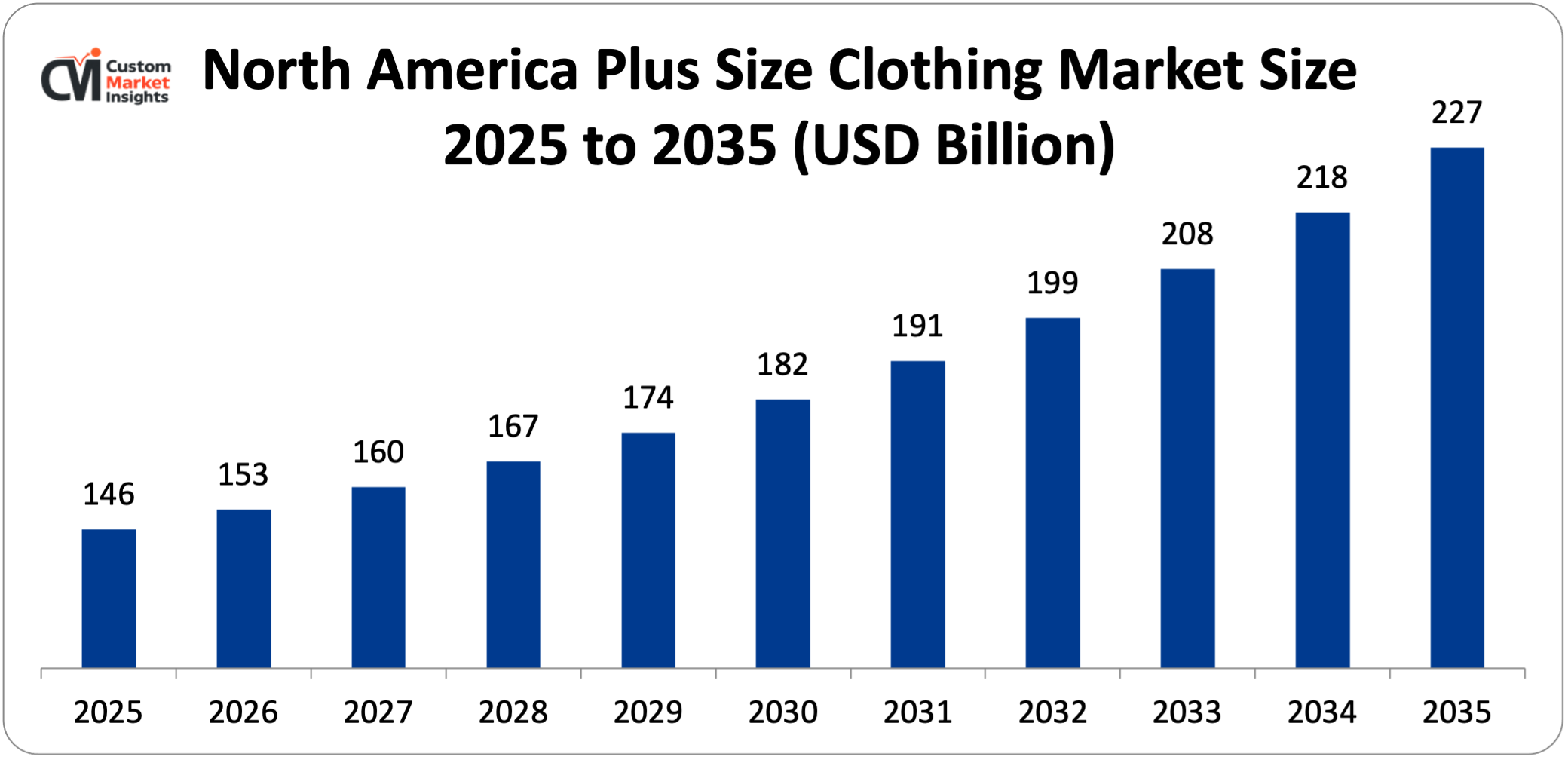
Its market size, in terms of North America plus size clothing, is projected to be USD 146 billion in 2025 with a growth of about USD 227 billion in 2035 with a CAGR of 4.5% between 2026 and 2035.
Why did North America Dominate the Plus Size Clothing Market in 2025?
In 2025, North America will dominate the global market with an estimated market share of 44%. The region of North America that is experiencing the most growth is primarily due to its main demographic group facing significant issues with being overweight and obese, leading to an increased demand for larger-size clothing. With a well-developed level of consumer perceptions about body positivity and inclusivity, plus-size garments have become a mainstream category of apparel, not a market niche anymore.
The country operates a mature omnichannel retail system that allows customers to diversify ranges of products through the country‘s largest retail stores and high standards of its e-commerce sites. The production development from the focus brands, combined with social media digital marketing activities, demands more consumers to engage with the brands while they are purchasing from the brands, thus achieving sales volume and building a strong presence effectively in the competitive fashion industry.
US Plus Size Clothing Market Trends
In the North American region, the US leads the industry expansion over the projected period. The retail market has expanded because major retail chains and e-commerce platforms now operate in the market. The Terra and Sky lines of Walmart and the Universal Thread line of Target both offer customers affordable products that include a wide range of choices.
Why is Europe Experiencing a Significant Growth in the Plus Size Clothing Market?
Europe holds a significant market share in 2025. The fashion industry in this region extends its boundaries through its multiple style elements, which create its unique fashion identity. People are increasingly choosing environmentally sustainable products, which has become a major market trend.
Germany Plus Size Clothing Market Trends
Germany held the dominant position in the market in 2025. Fashion designers now face a growing demand for body size diversity as consumers and brands increasingly understand and embrace body positive and inclusive doctrines; consequently, providers will accommodate a wider range of body types and offer more size options. Fashion- and quality-conscious consumers in Germany now demand a fashionable, trendy plus-size product with a flattering fit rather than settle for the usual product offerings; this increases the demand in the market.
Why is the Asia Pacific Growing at a Highest CAGR in the Plus Size Clothing Market?
The Asia Pacific is expected to grow at a high CAGR of 5.2% over the projected period. This growth is driven by the increase in disposable income levels as well as the growth of the urban population in the region, as they both lead to higher expenditure on apparel, including plus size apparel. The upward skew of middle-class members in Asia has led to greater demand for stylish, well-fitting apparel of premium-quality brands. The recent upsurge of the body positivity and inclusivity movement in the region has also helped change the buying behavior, as consumers prefer apparel that is available in various sizes.
China Plus Size Clothing Market Trends
China holds the prominent market share in the industry. The rapid growth in the e-commerce industry is expected to drive the industry growth over the projected period.
Why is the Middle East & Africa Region is growing rapidly in the Plus Size Clothing?
The MEA region is growing at a steady rate over the projected period. This lifestyle change is mainly led by the awareness and popularity of body positivity and inclusive fashion, which is gaining momentum even in urban markets. Furthermore, the overweight and obese population is growing rapidly, especially in countries in the Gulf Cooperation Council (GCC), providing a sizable consumer base to cater to in the plus size market.
The rapid development of e-commerce and the digital retail environment in the region is also aiding in the transition of fashion consumption to plus size fashion by reducing the availability of plus size clothing in brick-and-mortar retail in emerging African countries. Over and above, urbanization, increasing incomes, and a growing youth population have increased expenditure towards fashion & lifestyle avenues, which can be augmented by social media and international brand presence.
UAE Plus Size Clothing Market Trends
The UAE is growing at the highest CAGR during the forecast period. The increasing e-commerce sector and the established retail brands are expected to foster market growth in the area.
Top Players in the Plus Size Clothing Market and Their Offerings
- Adidas
- Aditya Birla Fashion
- Arula
- Ashley Stewart
- ASOS
- Billoomi Fashion
- City Chic
- FullBeauty Brands
- Hennes & Mauritz
- Lane Bryant
- Mango
- Nike
- Puma
- Ralph Lauren
- Under Armour
- Others
Key Developments
Plus size clothing market has experienced considerable changes in the last two years as the market players are trying to diversify their technological aspects and develop product portfolios using strategic approaches.
- In November 2024, Big Hello, a premier plus-size fashion brand in India, has marked a significant milestone by opening its first store in North India at Phoenix United Mall, Lucknow. This expansion highlights the brand’s commitment to making fashionable, high-quality clothing accessible to plus-size individuals, ensuring inclusivity in the fashion industry. The new store features a diverse collection of clothing, catering to sizes XL to 7XL. From casual everyday wear to formal office attire and festive ethnic options, the range has been thoughtfully curated to meet the varied needs of its customers. Whether it’s western styles or traditional Indian outfits, Big Hello offers trendy designs that blend comfort and style seamlessly. (https://infashionbusiness.com/home/news_details/4320)
- In April 2023, Full Beauty Brands acquired Eloquii Inc., a plus-size apparel label previously owned by Walmart. Eloquii offers clothing in sizes 12W to 44W, cup sizes A to O, bras in band sizes 30 to 58, and medium- to wide-wide footwear. This acquisition enabled Full Beauty Brands to expand its market share in the rapidly growing U.S. plus-size women’s market. (https://www.businesswire.com/news/home/20230421005125/en/FullBeauty-Brands-Proudly-Inclusive-Since-1901-To-Acquire-ELOQUII-Where-Fashion-Doesnt-Stop-at-Size-12)
These strategic measures have enabled the companies to reinforce their competitive positions, increase the product line, boost their technological competencies, and also seize growth opportunities in the fast-growing plus size clothing market.
The Plus Size Clothing Market is segmented as follows:
By Product
- Casual
- Inner Wear
- Sportswear
- Formal
- Ethnic Wear
- Night Wear
- Others
By Gender
- Women
- Men
- Children
By Age Group
- Below 15
- 16 to 59
- 60 & Above
By Pricing
- Premium
- Mass
- Luxury
Regional Coverage:
North America
- U.S.
- Canada
- Mexico
- Rest of North America
Europe
- Germany
- France
- U.K.
- Russia
- Italy
- Spain
- Netherlands
- Rest of Europe
Asia Pacific
- China
- Japan
- India
- New Zealand
- Australia
- South Korea
- Taiwan
- Rest of Asia Pacific
The Middle East & Africa
- Saudi Arabia
- UAE
- Egypt
- Kuwait
- South Africa
- Rest of the Middle East & Africa
Latin America
- Brazil
- Argentina
- Rest of Latin America
Table of Contents
- Chapter 1. Report Introduction
- 1.1. Report Description
- 1.1.1. Purpose of the Report
- 1.1.2. USP & Key Offerings
- 1.2. Key Benefits For Stakeholders
- 1.3. Target Audience
- 1.4. Report Scope
- 1.1. Report Description
- Chapter 2. Market Overview
- 2.1. Report Scope (Segments And Key Players)
- 2.1.1. Plus Size Clothing by Segments
- 2.1.2. Plus Size Clothing by Region
- 2.2. Executive Summary
- 2.2.1. Market Size & Forecast
- 2.2.2. Plus Size Clothing Market Attractiveness Analysis, By Product
- 2.2.3. Plus Size Clothing Market Attractiveness Analysis, By Gender
- 2.2.4. Plus Size Clothing Market Attractiveness Analysis, By Age Group
- 2.2.5. Plus Size Clothing Market Attractiveness Analysis, By Pricing
- 2.1. Report Scope (Segments And Key Players)
- Chapter 3. Market Dynamics (DRO)
- 3.1. Market Drivers
- 3.1.1. Rising Obesity & Overweight Population
- 3.1.2. Expansion of e-commerce & Digital Retail
- 3.2. Market Restraints
- 3.3. Market Opportunities
- 3.5. Pestle Analysis
- 3.6. Porter Forces Analysis
- 3.7. Technology Roadmap
- 3.8. Value Chain Analysis
- 3.9. Government Policy Impact Analysis
- 3.10. Pricing Analysis
- 3.1. Market Drivers
- Chapter 4. Plus Size Clothing Market – By Product
- 4.1. Product Market Overview, By Product Segment
- 4.1.1. Plus Size Clothing Market Revenue Share, By Product, 2025 & 2035
- 4.1.2. Casual
- 4.1.3. Plus Size Clothing Share Forecast, By Region (USD Billion)
- 4.1.4. Comparative Revenue Analysis, By Country, 2025 & 2035
- 4.1.5. Key Market Trends, Growth Factors, & Opportunities
- 4.1.6. Inner Wear
- 4.1.7. Plus Size Clothing Share Forecast, By Region (USD Billion)
- 4.1.8. Comparative Revenue Analysis, By Country, 2025 & 2035
- 4.1.9. Key Market Trends, Growth Factors, & Opportunities
- 4.1.10. Sportswear
- 4.1.11. Plus Size Clothing Share Forecast, By Region (USD Billion)
- 4.1.12. Comparative Revenue Analysis, By Country, 2025 & 2035
- 4.1.13. Key Market Trends, Growth Factors, & Opportunities
- 4.1.14. Formal
- 4.1.15. Plus Size Clothing Share Forecast, By Region (USD Billion)
- 4.1.16. Comparative Revenue Analysis, By Country, 2025 & 2035
- 4.1.17. Key Market Trends, Growth Factors, & Opportunities
- 4.1.18. Ethnic Wear
- 4.1.19. Plus Size Clothing Share Forecast, By Region (USD Billion)
- 4.1.20. Comparative Revenue Analysis, By Country, 2025 & 2035
- 4.1.21. Key Market Trends, Growth Factors, & Opportunities
- 4.1.22. Night Wear
- 4.1.23. Plus Size Clothing Share Forecast, By Region (USD Billion)
- 4.1.24. Comparative Revenue Analysis, By Country, 2025 & 2035
- 4.1.25. Key Market Trends, Growth Factors, & Opportunities
- 4.1.26. Others
- 4.1.27. Plus Size Clothing Share Forecast, By Region (USD Billion)
- 4.1.28. Comparative Revenue Analysis, By Country, 2025 & 2035
- 4.1.29. Key Market Trends, Growth Factors, & Opportunities
- 4.1. Product Market Overview, By Product Segment
- Chapter 5. Plus Size Clothing Market – By Gender
- 5.1. Gender Market Overview, By Gender Segment
- 5.1.1. Plus Size Clothing Market Revenue Share, By Gender, 2025 & 2035
- 5.1.2. Women
- 5.1.3. Plus Size Clothing Share Forecast, By Region (USD Billion)
- 5.1.4. Comparative Revenue Analysis, By Country, 2025 & 2035
- 5.1.5. Key Market Trends, Growth Factors, & Opportunities
- 5.1.6. Men
- 5.1.7. Plus Size Clothing Share Forecast, By Region (USD Billion)
- 5.1.8. Comparative Revenue Analysis, By Country, 2025 & 2035
- 5.1.9. Key Market Trends, Growth Factors, & Opportunities
- 5.1.10. Children
- 5.1.11. Plus Size Clothing Share Forecast, By Region (USD Billion)
- 5.1.12. Comparative Revenue Analysis, By Country, 2025 & 2035
- 5.1.13. Key Market Trends, Growth Factors, & Opportunities
- 5.1. Gender Market Overview, By Gender Segment
- Chapter 6. Plus Size Clothing Market – By Age Group
- 6.1. Age Group Market Overview, By Age Group Segment
- 6.1.1. Plus Size Clothing Market Revenue Share, By Age Group, 2025 & 2035
- 6.1.2. Below 15
- 6.1.3. Plus Size Clothing Share Forecast, By Region (USD Billion)
- 6.1.4. Comparative Revenue Analysis, By Country, 2025 & 2035
- 6.1.5. Key Market Trends, Growth Factors, & Opportunities
- 6.1.6. 16 to 59
- 6.1.7. Plus Size Clothing Share Forecast, By Region (USD Billion)
- 6.1.8. Comparative Revenue Analysis, By Country, 2025 & 2035
- 6.1.9. Key Market Trends, Growth Factors, & Opportunities
- 6.1.10. 60 & Above
- 6.1.11. Plus Size Clothing Share Forecast, By Region (USD Billion)
- 6.1.12. Comparative Revenue Analysis, By Country, 2025 & 2035
- 6.1.13. Key Market Trends, Growth Factors, & Opportunities
- 6.1. Age Group Market Overview, By Age Group Segment
- Chapter 7. Plus Size Clothing Market – By Pricing
- 7.1. Pricing Market Overview, By Pricing Segment
- 7.1.1. Plus Size Clothing Market Revenue Share, By Pricing, 2025 & 2035
- 7.1.2. Premium
- 7.1.3. Plus Size Clothing Share Forecast, By Region (USD Billion)
- 7.1.4. Comparative Revenue Analysis, By Country, 2025 & 2035
- 7.1.5. Key Market Trends, Growth Factors, & Opportunities
- 7.1.6. Mass
- 7.1.7. Plus Size Clothing Share Forecast, By Region (USD Billion)
- 7.1.8. Comparative Revenue Analysis, By Country, 2025 & 2035
- 7.1.9. Key Market Trends, Growth Factors, & Opportunities
- 7.1.10. Luxury
- 7.1.11. Plus Size Clothing Share Forecast, By Region (USD Billion)
- 7.1.12. Comparative Revenue Analysis, By Country, 2025 & 2035
- 7.1.13. Key Market Trends, Growth Factors, & Opportunities
- 7.1. Pricing Market Overview, By Pricing Segment
- Chapter 8. Plus Size Clothing Market – Regional Analysis
- 8.1. Plus Size Clothing Market Overview, By Region Segment
- 8.1.1. Global Plus Size Clothing Market Revenue Share, By Region, 2025 & 2035
- 8.1.2. Global Plus Size Clothing Market Revenue, By Region, 2026 – 2035 (USD Billion)
- 8.1.3. Global Plus Size Clothing Market Revenue, By Product, 2026 – 2035
- 8.1.4. Global Plus Size Clothing Market Revenue, By Gender, 2026 – 2035
- 8.1.5. Global Plus Size Clothing Market Revenue, By Age Group, 2026 – 2035
- 8.1.6. Global Plus Size Clothing Market Revenue, By Pricing, 2026 – 2035
- 8.2. North America
- 8.2.1. North America Plus Size Clothing Market Revenue, By Country, 2026 – 2035 (USD Billion)
- 8.2.2. North America Plus Size Clothing Market Revenue, By Product, 2026 – 2035
- 8.2.3. North America Plus Size Clothing Market Revenue, By Gender, 2026 – 2035
- 8.2.4. North America Plus Size Clothing Market Revenue, By Age Group, 2026 – 2035
- 8.2.5. North America Plus Size Clothing Market Revenue, By Pricing, 2026 – 2035
- 8.2.6. U.S. Plus Size Clothing Market Revenue, 2026 – 2035 (USD Billion)
- 8.2.7. Canada Plus Size Clothing Market Revenue, 2026 – 2035 (USD Billion)
- 8.2.8. Mexico Plus Size Clothing Market Revenue, 2026 – 2035 (USD Billion)
- 8.2.9. Rest of North America Plus Size Clothing Market Revenue, 2026 – 2035 (USD Billion)
- 8.3. Europe
- 8.3.1. Europe Plus Size Clothing Market Revenue, By Country, 2026 – 2035 (USD Billion)
- 8.3.2. Europe Plus Size Clothing Market Revenue, By Product, 2026 – 2035
- 8.3.3. Europe Plus Size Clothing Market Revenue, By Gender, 2026 – 2035
- 8.3.4. Europe Plus Size Clothing Market Revenue, By Age Group, 2026 – 2035
- 8.3.5. Europe Plus Size Clothing Market Revenue, By Pricing, 2026 – 2035
- 8.3.6. Germany Plus Size Clothing Market Revenue, 2026 – 2035 (USD Billion)
- 8.3.7. France Plus Size Clothing Market Revenue, 2026 – 2035 (USD Billion)
- 8.3.8. U.K. Plus Size Clothing Market Revenue, 2026 – 2035 (USD Billion)
- 8.3.9. Russia Plus Size Clothing Market Revenue, 2026 – 2035 (USD Billion)
- 8.3.10. Italy Plus Size Clothing Market Revenue, 2026 – 2035 (USD Billion)
- 8.3.11. Spain Plus Size Clothing Market Revenue, 2026 – 2035 (USD Billion)
- 8.3.12. Netherlands Plus Size Clothing Market Revenue, 2026 – 2035 (USD Billion)
- 8.3.13. Rest of Europe Plus Size Clothing Market Revenue, 2026 – 2035 (USD Billion)
- 8.4. Asia Pacific
- 8.4.1. Asia Pacific Plus Size Clothing Market Revenue, By Country, 2026 – 2035 (USD Billion)
- 8.4.2. Asia Pacific Plus Size Clothing Market Revenue, By Product, 2026 – 2035
- 8.4.3. Asia Pacific Plus Size Clothing Market Revenue, By Gender, 2026 – 2035
- 8.4.4. Asia Pacific Plus Size Clothing Market Revenue, By Age Group, 2026 – 2035
- 8.4.5. Asia Pacific Plus Size Clothing Market Revenue, By Pricing, 2026 – 2035
- 8.4.6. China Plus Size Clothing Market Revenue, 2026 – 2035 (USD Billion)
- 8.4.7. Japan Plus Size Clothing Market Revenue, 2026 – 2035 (USD Billion)
- 8.4.8. India Plus Size Clothing Market Revenue, 2026 – 2035 (USD Billion)
- 8.4.9. New Zealand Plus Size Clothing Market Revenue, 2026 – 2035 (USD Billion)
- 8.4.10. Australia Plus Size Clothing Market Revenue, 2026 – 2035 (USD Billion)
- 8.4.11. South Korea Plus Size Clothing Market Revenue, 2026 – 2035 (USD Billion)
- 8.4.12. Taiwan Plus Size Clothing Market Revenue, 2026 – 2035 (USD Billion)
- 8.4.13. Rest of Asia Pacific Plus Size Clothing Market Revenue, 2026 – 2035 (USD Billion)
- 8.5. The Middle-East and Africa
- 8.5.1. The Middle-East and Africa Plus Size Clothing Market Revenue, By Country, 2026 – 2035 (USD Billion)
- 8.5.2. The Middle-East and Africa Plus Size Clothing Market Revenue, By Product, 2026 – 2035
- 8.5.3. The Middle-East and Africa Plus Size Clothing Market Revenue, By Gender, 2026 – 2035
- 8.5.4. The Middle-East and Africa Plus Size Clothing Market Revenue, By Age Group, 2026 – 2035
- 8.5.5. The Middle-East and Africa Plus Size Clothing Market Revenue, By Pricing, 2026 – 2035
- 8.5.6. Saudi Arabia Plus Size Clothing Market Revenue, 2026 – 2035 (USD Billion)
- 8.5.7. UAE Plus Size Clothing Market Revenue, 2026 – 2035 (USD Billion)
- 8.5.8. Egypt Plus Size Clothing Market Revenue, 2026 – 2035 (USD Billion)
- 8.5.9. Kuwait Plus Size Clothing Market Revenue, 2026 – 2035 (USD Billion)
- 8.5.10. South Africa Plus Size Clothing Market Revenue, 2026 – 2035 (USD Billion)
- 8.5.11. Rest of the Middle East & Africa Plus Size Clothing Market Revenue, 2026 – 2035 (USD Billion)
- 8.6. Latin America
- 8.6.1. Latin America Plus Size Clothing Market Revenue, By Country, 2026 – 2035 (USD Billion)
- 8.6.2. Latin America Plus Size Clothing Market Revenue, By Product, 2026 – 2035
- 8.6.3. Latin America Plus Size Clothing Market Revenue, By Gender, 2026 – 2035
- 8.6.4. Latin America Plus Size Clothing Market Revenue, By Age Group, 2026 – 2035
- 8.6.5. Latin America Plus Size Clothing Market Revenue, By Pricing, 2026 – 2035
- 8.6.6. Brazil Plus Size Clothing Market Revenue, 2026 – 2035 (USD Billion)
- 8.6.7. Argentina Plus Size Clothing Market Revenue, 2026 – 2035 (USD Billion)
- 8.6.8. Rest of Latin America Plus Size Clothing Market Revenue, 2026 – 2035 (USD Billion)
- 8.1. Plus Size Clothing Market Overview, By Region Segment
- Chapter 9. Competitive Landscape
- 9.1. Company Market Share Analysis – 2025
- 9.1.1. Global Plus Size Clothing Market: Company Market Share, 2025
- 9.2. Global Plus Size Clothing Market Company Market Share, 2024
- 9.1. Company Market Share Analysis – 2025
- Chapter 10. Company Profiles
- 10.1. Adidas
- 10.1.1. Company Overview
- 10.1.2. Key Executives
- 10.1.3. Product Portfolio
- 10.1.4. Financial Overview
- 10.1.5. Operating Business Segments
- 10.1.6. Business Performance
- 10.1.7. Recent Developments
- 10.2. Aditya Birla Fashion
- 10.3. Arula
- 10.4. Ashley Stewart
- 10.5. ASOS
- 10.6. Billoomi Fashion
- 10.7. City Chic
- 10.8. FullBeauty Brands
- 10.9. Hennes & Mauritz
- 10.10. Lane Bryant
- 10.11. Mango
- 10.12. Nike
- 10.13. Puma
- 10.14. Ralph Lauren
- 10.15. Under Armour
- 10.16. Others.
- 10.1. Adidas
- Chapter 11. Research Methodology
- 11.1. Research Methodology
- 11.2. Secondary Research
- 11.3. Primary Research
- 11.3.1. Analyst Tools and Models
- 11.4. Research Limitations
- 11.5. Assumptions
- 11.6. Insights From Primary Respondents
- 11.7. Why Healthcare Foresights
- Chapter 12. Standard Report Commercials & Add-Ons
- 12.1. Customization Options
- 12.2. Subscription Module For Market Research Reports
- 12.3. Client Testimonials
- Chapter 13. List Of Figures
- 13.1. Figures No 1 to 34
- Chapter 14. List Of Tables
- 14.1. Tables No 1 to 51
FAQs
The key players in the market are Adidas, Aditya Birla Fashion, Arula, Ashley Stewart, ASOS, Billoomi Fashion, City Chic, FullBeauty Brands, Hennes & Mauritz, Lane Bryant, Mango, Nike, Puma, Ralph Lauren, Under Armour, Others.
Government regulations play an important, though often indirect, role in shaping the development of the plus-size clothing market by influencing manufacturing standards, consumer protection, trade policies, and inclusivity initiatives. One key area is textile and labeling regulations, where governments mandate accurate size labeling, fabric composition disclosure, and quality standards. These rules help ensure transparency and consistency, which are particularly important in plus-size clothing, where fit accuracy is critical for consumer satisfaction.
The price point plays a critical role in shaping both the growth and adoption of the plus-size clothing market by influencing affordability, accessibility, and consumer perception of value. In many cases, plus-size apparel tends to be priced higher due to additional fabric usage, specialized design, and production complexities. This can limit adoption among price-sensitive consumers, particularly in emerging markets, where affordability is a key purchasing factor.
According to the present analysis and forecast modeling, the market of plus-size clothing will witness a significant growth of about USD 532 billion in the year 2035 with the growing innovative product launch, increasing collaboration, rising government initiatives, and presence of major e-commerce industries with a CAGR of 4.8% between the years 2026 and 2035.
It is projected that North America will hold the largest market share in the plus-size clothing market in the forecast period, with a share of about 44% of the global market share, which is attributed to the region’s presence of major players and increasing obese population.
The Asia Pacific is expected to grow at a high CAGR of 5.2% during the forecast period. The growth in the region is owing to the increasing e-commerce industry.
The global shift towards online shopping drives the market growth. E-commerce platforms provide a broader range of size options that allow plus-size consumers to find what they need without facing limited in-store inventory. Online giants like Amazon and Flipkart open specific shops for plus-size people, influencing the market penetration.