
Lithium-Ion Battery Market Size, Trends and Insights By Product (Lithium cobalt oxide (LCO), Lithium Nickel Cobalt Aluminum Oxide (NCA), Lithium iron phosphate (LFP), Lithium Manganese Oxide (LMO), Lithium Titanate, Lithium Nickel Manganese Cobalt (LMC)), By Application (Automotive, Consumer Electronics, Industrial, Energy Storage Systems, Medical Devices), and By Region - Global Industry Overview, Statistical Data, Competitive Analysis, Share, Outlook, and Forecast 2026 – 2035
Report Snapshot
CAGR: 21.2%
| Study Period: | 2026-2035 |
| Fastest Growing Market: | North America |
| Largest Market: | Asia Pacific |
Major Players
- Toshiba Corporation
- Hitachi Energy Ltd.
- Murata Manufacturing Co. Ltd.
- Samsung SDI Co. Ltd.
- Others
Reports Description
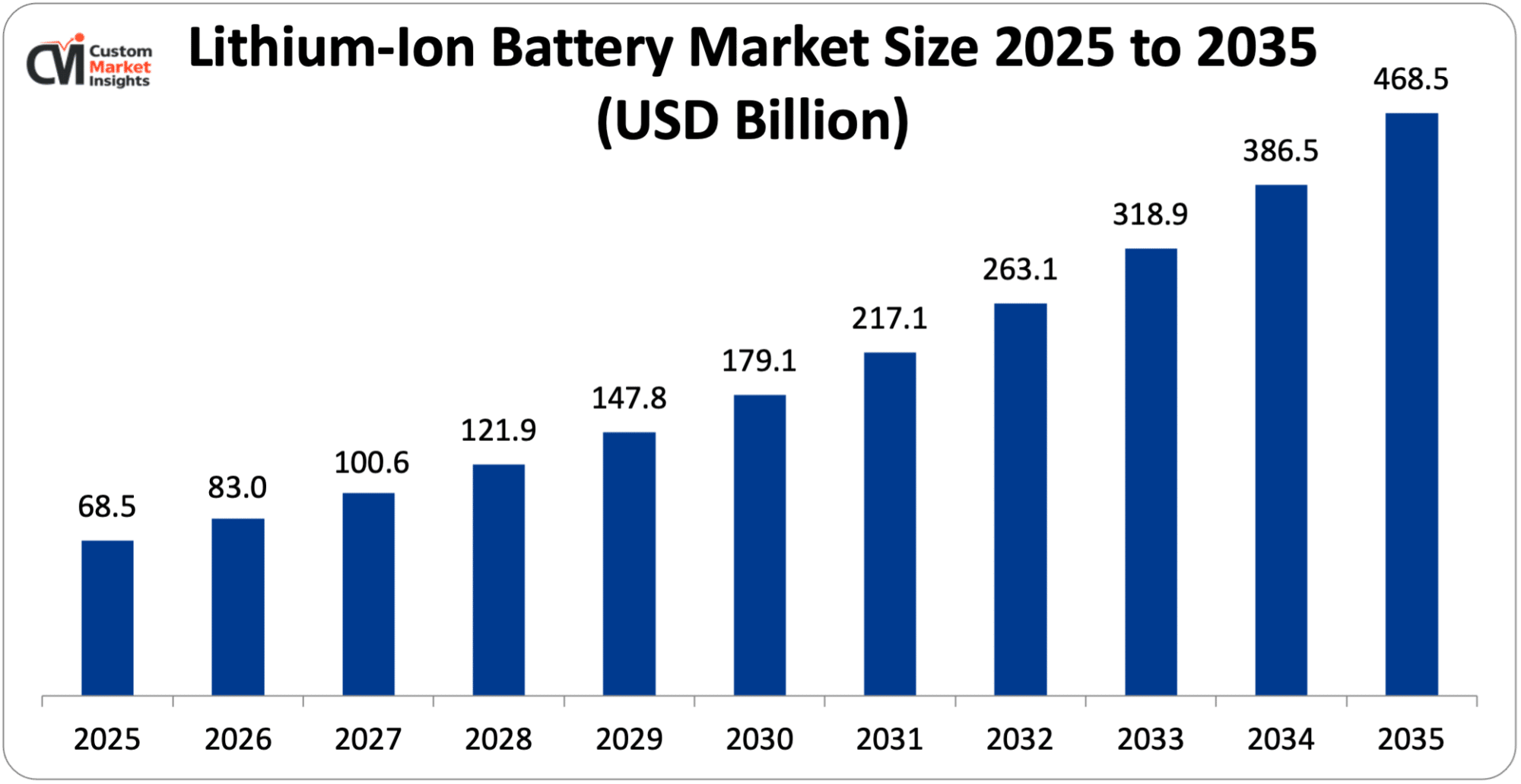
The market size of global lithium-ion battery will be estimated at USD 68.5 billion in 2025 and is expected to grow to between USD 83 billion in 2026 and about USD 468.5 billion by 2035, with a current CAGR (compound annual growth rate) of 21.2% during the period of 2026 to 2035. A lithium-ion battery is a rechargeable battery that uses lithium ions to move from an anode to a cathode as they charge and then from the cathode to the anode to discharge through an electrolyte.
As the battery charges, the lithium ions move from the cathode to the anode thus, they store energy, and then when discharging, they move to the cathode, creating the electric current. They are one of the most popular rechargeable batteries because they have a high energy density, low weight, low self-discharge rate, and long cycle life. Lithium-ion batteries are found commonly in electric cars and other electric vehicles, portable electronics, and storage systems in the home.
Market Highlight
- In 2025, the Asia Pacific will dominate the global market with an estimated market share of 48%. High production of EVs drives the market growth.
- North America is growing at the highest rate over the analysis period. The increasing focus on renewable energy drives the regional growth.
- By product, the Lithium cobalt oxide (LCO) segment dominated the industry in 2025 of over 30%.
- By application, the automotive segment captures the highest market share in 2025 of more than 35%.
Significant Growth Factors
The lithium-ion battery market trends present significant growth opportunities due to several factors:
- Rising Consumer Electronics Demand: The use of consumer electronic devices is another factor that is driving the demand for lithium-ion batteries, as they power electronic devices such as cell phones, laptops, tablets, wearable electronics, wireless accessories, and so forth. Increasing digitalization levels across the world, combined with growing disposable income levels and ongoing product innovation and introduction of new features, has greatly supported the requirement for efficient portable electronic devices and gadgets. Long-running batteries and devices with longer battery lives have also been gaining demand with the advancements in technology for 5G, IOT, Smartphones, and gadgets.
- Declining Battery Cost: One of the most significant organic dynamics shaping the lithium-ion battery industry is the decreasing price of the product, making it more viable for numerous end-use applications. Though current and recent years’ battery price levels are unprecedented, representing a 90% reduction since 2000, this is supported by subsidies and investments in large battery plants by governments. The decreasing prices have resulted in the increased viability of electric vehicles against petro-powered vehicles and the development of batteries integrated with alternative energy sources such as solar and wind. This, in turn, has increased demand for batteries in not only existing end-use markets but also transportation uses.
What are the Major Advances Changing the Lithium-Ion Battery Market Today?
- Solid-state Batteries: The solid-state batteries are used as one of the key technologies for the growth of the lithium-ion battery market, as they replace liquid electrolyte with a solid one, which allows higher safety, performance, and efficiency. This technology appears as a potential solution for an abundance of issues associated with normal lithium-ion batteries, like leakage and thermal runaway, which limits its use in automobile and power utility grid storage. These batteries can also offer a substantial increase in the range of electric vehicles and in the life of electronic devices, as well as provide for quicker charge times. By constantly increasing its investments by governments and automotive manufacturers and through continuous research and development, solid-state battery technology is expected to play a significant role in the growth of this market.
- Battery Recycling & Second-Life Applications: Battery recycling and second-life markets are one of the fastest-growing engines in the Li-ion battery industry, whose potential is to respond to both supply chain constraints and environmental drivers. As the demand for electric vehicles (EVs) and energy storage grows exponentially, so too does the stage of end-of-life batteries exponentially, thus providing new opportunities for the recovery of critical battery elements that include lithium, cobalt, nickel, and copper. New recycling techniques now enable the recovery of in excess of 95% of critical battery elements to be used in new battery packs, thus greatly reducing material costs and waste streams by alleviating the need to mine for new material. Secondly, second-life applications that repurpose used EV batteries to provide a less energetically demanding application, such as grid buffering or backup power, are continuing to increase their use of batteries, maximizing their total value. The use of used batteries in renewable energy applications to buffer power is increasing even more rapidly. Redwood materials has recently attracted over $1 billion in investment to expand battery recycling facilities and convert recovered materials into a new range of rechargeable batteries. The company has also secured a 2-billion-dollar loan through the US DOE to accelerate the development of rapid recycling and a domestic steel-to-steel circular supply chain, thus greatly accelerating the growth of second-life markets.
Category Wise Insights
By Product
Why Lithium cobalt oxide (LCO) Hold a Prominent Position in the Market?
The Lithium cobalt oxide (LCO) segment dominated the industry in 2025 of over 30%. The continued rising demand for high energy density and high-power performance for portable electronic devices is expected to maintain the segment ‘s growth. Lithium cobalt oxide batteries are used in most portable electronic devices such as phones, notebooks, tablets, and wearable devices, which tend to be small and pack a lot of power. The forecast sustained demand for portable electronic devices, as well as ongoing miniaturization and performance enhancements, will support continued demand for cells in this segment. The refinement of cell design and battery management systems will enhance efficiency and safety of batteries in this segment.
The Lithium Iron Phosphate (LiFePO₄) segment is growing at a highest CAGR of 25% during the forecast period. Increased adoption in electric and stationary energy storage systems fuels the growth. Lithium iron phosphate cells provide better thermal stability, improved cycle life, and safety than more well-established cobalt chemistries and are becoming more attractive for high-duty and larger-scale systems. Indeed, the continued rollout of renewable energy projects and grid-scale power storage, coupled with more price-sensitive EV platforms, is driving uptake of this technology segment at an even faster rate. Improved energy densities and manufacturing efficiencies will continue to enhance the growth rate.
By Application
Why Automotive Capture the Highest Market Share in the Lithium-Ion Battery Market?
The automotive segment captures the highest market share in 2025 of more than 35%. Market is observing growth due to the increasing adoption of electric vehicles along with the rising electrification of passenger cars and commercial vehicles. Lithium-ion batteries find extensive use in electric cars, electric buses, and electric two-wheelers due to high energy density, better cycle life, and improving cost competitiveness. Also, government initiatives, emission reduction targets, and enhancing EV charging infrastructure propel the demand for batteries across the automotive industry on a global scale. Breakthroughs in battery chemistry, thermal management, and energy efficiency reaffirm the automotive sector in particular as the dominant end-user of the market.
The energy storage segment is growing at a rapid rate over the projected period. The increasing integration of renewable energy and the growing need for grid stability are driving the utilization of lithium-ion batteries in utility-scale, commercial, and residential energy storage systems to manage intermittency, occurring peak shifts, and strengthen grid robustness. The accelerating investments in solar and wind power, improving energy storage policies, and decreasing battery costs are supplemented by technological advancements in battery management systems, safety, and scalability, further strengthening growth prospects of energy storage applications.
Report Scope
| Feature of the Report | Details |
| Market Size in 2026 | USD 83 billion |
| Projected Market Size in 2035 | USD 468.5 billion |
| Market Size in 2025 | USD 68.5 billion |
| CAGR Growth Rate | 21.2% CAGR |
| Base Year | 2025 |
| Forecast Period | 2026-2035 |
| Key Segment | By Product, Application and Region |
| Report Coverage | Revenue Estimation and Forecast, Company Profile, Competitive Landscape, Growth Factors and Recent Trends |
| Regional Scope | North America, Europe, Asia Pacific, Middle East & Africa, and South & Central America |
| Buying Options | Request tailored purchasing options to fulfil your requirements for research. |
Regional Analysis
How Big is the Asia Pacific Lithium-Ion Battery Market Size?
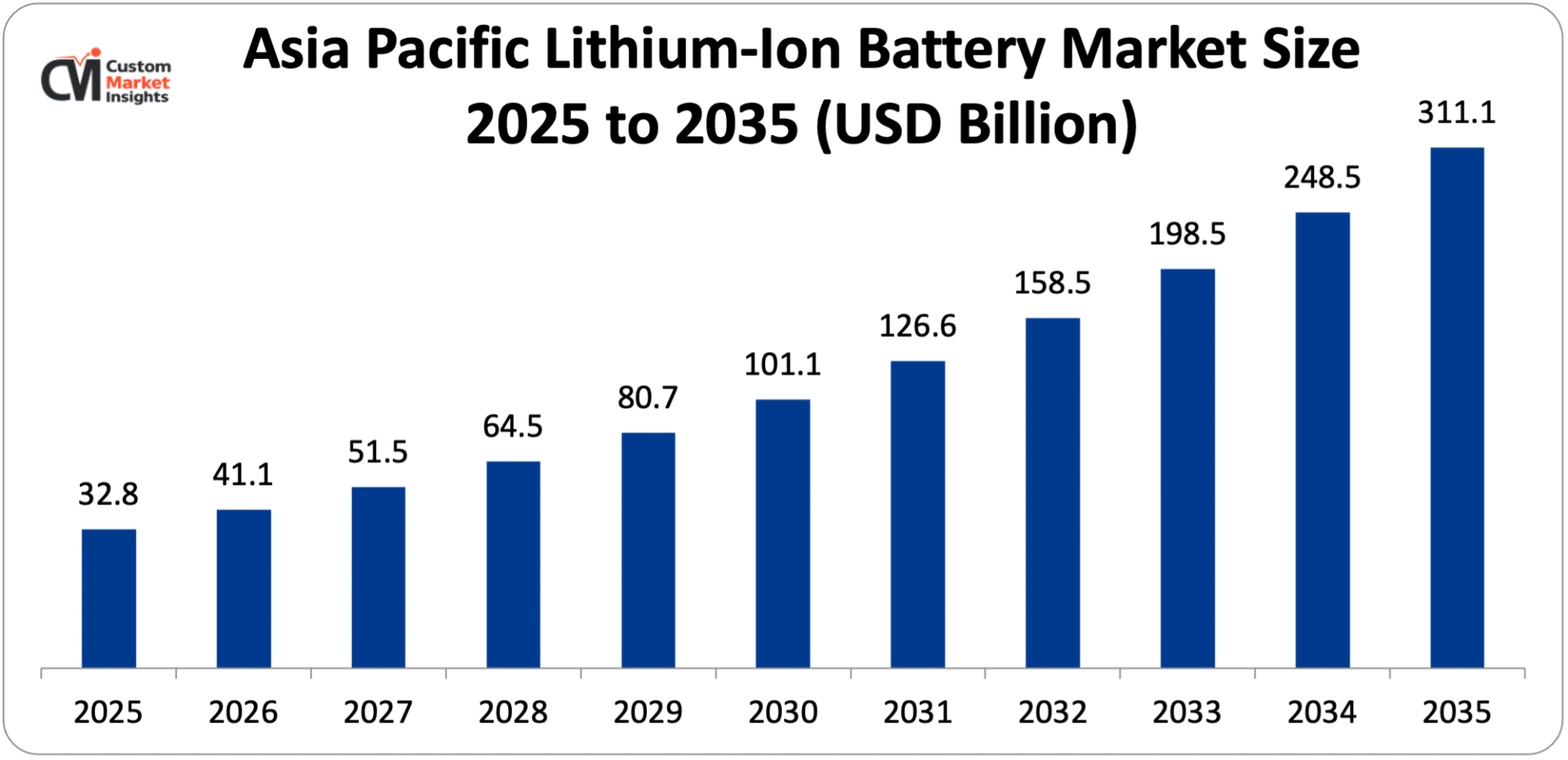
Its market size, in terms of the Asia Pacific lithium-ion battery, is projected to be USD 32.8 billion in 2025 with a growth of about USD 311.1 billion in 2035 with a CAGR of 25.2% between 2026 and 2035.
Why did Asia Pacific Dominate the Lithium-Ion Battery Market in 2025?
In 2025, the Asia Pacific will dominate the global market with an estimated market share of 48%. Manufacturing capacity, the rapid adoption of EVs, and the widespread deployment of energy storage will primarily drive the region’s growth. Led by China, Japan, and South Korea, as they are the biggest battery manufacturers in the globe with evolved supply chains built within constant technological advances and updates. Growing consumer electronics appliance, EV and Grid-scale energy storage segments will benefit from policy incentives and the clean energy wave to ensure the lead in the regional market segment.
India Lithium-Ion Battery Market Trends
In the Asia Pacific region, India leads the industry expansion over the projected period. The transition towards electric mobility and clean energy demand propelled the country further on its growth path. The Indian electric mobility market is growing at a double-digit CAGR, driven by incentives from the government, such as the FAME scheme to incentivize electric vehicle deployment and the production-linked incentive (PLI) scheme for advanced chemistry cell (ACC) manufacturing. Growing volumes of demand for electric two-wheelers, three-wheelers, and passenger cars across the country are a major growth factor. India is aiming to electrify 25% of its commercial vehicles, 40% of its two-wheelers, and 80% of its buses.
Why is Europe Experiencing a Significant Growth in the Lithium-Ion Battery Market?
Europe holds a significant market share in 2025. The lithium-ion market in Europe is driven by ambitious decarbonization targets, high EV adoption rates, and rising investments into renewable energy storage. Countries like Germany, France, the UK, and the Nordics are competing for regional battery cluster ecosystems to cut down on import dependency. EU regulations supporting zero-emission mobility and grid flexibility continue to create stable demand for lithium-ion batteries for both automotive and stationary storage segments.
Germany Lithium-Ion Battery Market Trends
Germany held the dominant position in the market in 2025. This growth was driven by an accelerated uptake of electric cars, encouraged by government subsidies and incentives, as well as an extensive automotive industry with key industry players, including world-wide manufacturers, pouring investments into the level of electrification.
Why is North America Growing at a Highest rate in the Lithium-Ion Battery Market?
North America is expected to grow at a highest rate over the projected period. Increasing EV penetration, growing energy storage deployments, and continued favorable government policies favoring US-based battery manufacturing are fueling this growth, with tax credits and incentives at federal and state levels providing incentives for large battery manufacturing investments and economies of scale for lithium-ion batteries; rising electrification needs for automotive, energy storage, and commercial applications are also helping in the growth of the market across regions.
US Lithium-Ion Battery Market Trends
US holds the prominent market share in the industry. An acceleration of electric vehicles and energy storage gigawatt-scale deployment, along with a growth in battery manufacturing capacity, drives the growth. Progress from policies, including clean energy tax incentives and new funding in US energy transition grant programs, has pushed the development of battery gigafactories and supply chains in the U.S. Forward-looking demand from automakers, computer data centers, and renewable energy developers will continue propelling the deployment of upgraded lithium-ion battery chemistries.
Why is the Middle East & Africa Region is growing rapidly in the Lithium-Ion Battery?
The MEA region is growing at a steady rate over the projected period. This expansion is driven by investments in solar projects, the upgrading of grids, and electric mobility actions. Gulf countries are implementing lithium-ion batteries with large-scale solar projects to improve grid stability, and parts of Africa are starting to use batteries for off-grid and microgrid applications. As the search for diversification and sustainability intensifies, more and more countries are expected to follow suit by embedding this technology within their power mix.
UAE Lithium-Ion Battery Market Trends
UAE is growing at the highest CAGR during the forecast period. The increasing adoption of EVs and growing government initiatives drives the industry growth.
Top Players in the Lithium-Ion Battery Market and Their Offerings
- Contemporary Amperex Technology Co. Ltd. (CATL)
- Toshiba Corporation
- Hitachi Energy Ltd.
- Murata Manufacturing Co. Ltd.
- Samsung SDI Co. Ltd.
- SK On Co. Ltd.
- AESC (Envision AESC Group)
- CALB Co. Ltd.
- Gotion High-Tech Co. Ltd.
- EVE Energy Co. Ltd.
- Farasis Energy Inc.
- Sunwoda Electronic Co. Ltd.
- Panasonic Holdings Corp.
- VARTA AG
- BYD Company Limited
- Saft Groupe SAS
- Northvolt AB
- Microvast Holdings Inc.
- A123 Systems LLC
- LG Energy Solution Ltd.
- Lithium Werks BV
- Tesla Inc. (Battery Division)
- Others
Key Developments
Lithium-Ion Battery market has experienced considerable changes in the last two years as the market players are trying to diversify their technological aspects and develop product portfolio using strategic approaches.
- In October 2025, Toshiba has introduced a new SCiB™ 24V battery pack (P25H20-3), a lithium-ion solution engineered for automotive, marine, and heavy equipment sectors, that also offers the advantage of seamless replacement of conventional lead-acid batteries. This innovative product has already been equipped with “e-Float Terrace,” the electric boat from Yamaha Motor Co., Ltd. (Yamaha Motor), which is scheduled to begin offering cruise experiences in Yokohama, Japan, this October. (https://www.global.toshiba/ww/news/corporate/2025/10/news-20251016-01.html)
- In July 2025, Kalmar has introduced its second-generation lithium-ion (Li-ion) battery solution for its range of electrically powered counter balanced equipment: reachstackers, empty container handlers and forklifts. The new battery system delivers enhanced energy capacity, improved thermal stability, and a longer, more predictable performance curve across a wide range of operating environments. The solution is now available globally with the European standard, while versions for the US and Chinese standards will follow in 2026. (https://www.kalmarglobal.com/news–insights/press_releases/2025/kalmar-launches-next-generation/)
These strategic measures have enabled the companies to reinforce their competitive positions, increase the product line, boost their technological competencies and also seize growth opportunities in the fast-growing lithium-ion battery market.
The Lithium-Ion Battery Market is segmented as follows:
By Product
- Lithium cobalt oxide (LCO)
- Lithium Nickel Cobalt Aluminum Oxide (NCA)
- Lithium iron phosphate (LFP)
- Lithium Manganese Oxide (LMO)
- Lithium Titanate
- Lithium Nickel Manganese Cobalt (LMC)
By Application
- Automotive
- Consumer Electronics
- Industrial
- Energy Storage Systems
- Medical Devices
Regional Coverage:
North America
- U.S.
- Canada
- Mexico
- Rest of North America
Europe
- Germany
- France
- U.K.
- Russia
- Italy
- Spain
- Netherlands
- Rest of Europe
Asia Pacific
- China
- Japan
- India
- New Zealand
- Australia
- South Korea
- Taiwan
- Rest of Asia Pacific
The Middle East & Africa
- Saudi Arabia
- UAE
- Egypt
- Kuwait
- South Africa
- Rest of the Middle East & Africa
Latin America
- Brazil
- Argentina
- Rest of Latin America
Table of Contents
- Chapter 1. Report Introduction
- 1.1. Report Description
- 1.1.1. Purpose of the Report
- 1.1.2. USP & Key Offerings
- 1.2. Key Benefits For Stakeholders
- 1.3. Target Audience
- 1.4. Report Scope
- 1.1. Report Description
- Chapter 2. Market Overview
- 2.1. Report Scope (Segments And Key Players)
- 2.1.1. Lithium-Ion Battery by Segments
- 2.1.2. Lithium-Ion Battery by Region
- 2.2. Executive Summary
- 2.2.1. Market Size & Forecast
- 2.2.2. Lithium-Ion Battery Market Attractiveness Analysis, By Product
- 2.2.3. Lithium-Ion Battery Market Attractiveness Analysis, By Application
- 2.1. Report Scope (Segments And Key Players)
- Chapter 3. Market Dynamics (DRO)
- 3.1. Market Drivers
- 3.1.1. Rising Consumer Electronics Demand
- 3.1.2. Declining Battery Cost
- 3.2. Market Restraints
- 3.3. Market Opportunities
- 3.5. Pestle Analysis
- 3.6. Porter Forces Analysis
- 3.7. Technology Roadmap
- 3.8. Value Chain Analysis
- 3.9. Government Policy Impact Analysis
- 3.10. Pricing Analysis
- 3.1. Market Drivers
- Chapter 4. Lithium-Ion Battery Market – By Product
- 4.1. Product Market Overview, By Product Segment
- 4.1.1. Lithium-Ion Battery Market Revenue Share, By Product, 2025 & 2035
- 4.1.2. Lithium cobalt oxide (LCO)
- 4.1.3. Lithium-Ion Battery Share Forecast, By Region (USD Billion)
- 4.1.4. Comparative Revenue Analysis, By Country, 2025 & 2035
- 4.1.5. Key Market Trends, Growth Factors, & Opportunities
- 4.1.6. Lithium Nickel Cobalt Aluminum Oxide (NCA)
- 4.1.7. Lithium-Ion Battery Share Forecast, By Region (USD Billion)
- 4.1.8. Comparative Revenue Analysis, By Country, 2025 & 2035
- 4.1.9. Key Market Trends, Growth Factors, & Opportunities
- 4.1.10. Lithium iron phosphate (LFP)
- 4.1.11. Lithium-Ion Battery Share Forecast, By Region (USD Billion)
- 4.1.12. Comparative Revenue Analysis, By Country, 2025 & 2035
- 4.1.13. Key Market Trends, Growth Factors, & Opportunities
- 4.1.14. Lithium Manganese Oxide (LMO)
- 4.1.15. Lithium-Ion Battery Share Forecast, By Region (USD Billion)
- 4.1.16. Comparative Revenue Analysis, By Country, 2025 & 2035
- 4.1.17. Key Market Trends, Growth Factors, & Opportunities
- 4.1.18. Lithium Titanate
- 4.1.19. Lithium-Ion Battery Share Forecast, By Region (USD Billion)
- 4.1.20. Comparative Revenue Analysis, By Country, 2025 & 2035
- 4.1.21. Key Market Trends, Growth Factors, & Opportunities
- 4.1.22. Lithium Nickel Manganese Cobalt (LMC)
- 4.1.23. Lithium-Ion Battery Share Forecast, By Region (USD Billion)
- 4.1.24. Comparative Revenue Analysis, By Country, 2025 & 2035
- 4.1.25. Key Market Trends, Growth Factors, & Opportunities
- 4.1. Product Market Overview, By Product Segment
- Chapter 5. Lithium-Ion Battery Market – By Application
- 5.1. Application Market Overview, By Application Segment
- 5.1.1. Lithium-Ion Battery Market Revenue Share, By Application, 2025 & 2035
- 5.1.2. Automotive
- 5.1.3. Lithium-Ion Battery Share Forecast, By Region (USD Billion)
- 5.1.4. Comparative Revenue Analysis, By Country, 2025 & 2035
- 5.1.5. Key Market Trends, Growth Factors, & Opportunities
- 5.1.6. Consumer Electronics
- 5.1.7. Lithium-Ion Battery Share Forecast, By Region (USD Billion)
- 5.1.8. Comparative Revenue Analysis, By Country, 2025 & 2035
- 5.1.9. Key Market Trends, Growth Factors, & Opportunities
- 5.1.10. Industrial
- 5.1.11. Lithium-Ion Battery Share Forecast, By Region (USD Billion)
- 5.1.12. Comparative Revenue Analysis, By Country, 2025 & 2035
- 5.1.13. Key Market Trends, Growth Factors, & Opportunities
- 5.1.14. Energy Storage Systems
- 5.1.15. Lithium-Ion Battery Share Forecast, By Region (USD Billion)
- 5.1.16. Comparative Revenue Analysis, By Country, 2025 & 2035
- 5.1.17. Key Market Trends, Growth Factors, & Opportunities
- 5.1.18. Medical Devices
- 5.1.19. Lithium-Ion Battery Share Forecast, By Region (USD Billion)
- 5.1.20. Comparative Revenue Analysis, By Country, 2025 & 2035
- 5.1.21. Key Market Trends, Growth Factors, & Opportunities
- 5.1. Application Market Overview, By Application Segment
- Chapter 6. Lithium-Ion Battery Market – Regional Analysis
- 6.1. Lithium-Ion Battery Market Overview, By Region Segment
- 6.1.1. Global Lithium-Ion Battery Market Revenue Share, By Region, 2025 & 2035
- 6.1.2. Global Lithium-Ion Battery Market Revenue, By Region, 2026 – 2035 (USD Billion)
- 6.1.3. Global Lithium-Ion Battery Market Revenue, By Product, 2026 – 2035
- 6.1.4. Global Lithium-Ion Battery Market Revenue, By Application, 2026 – 2035
- 6.2. North America
- 6.2.1. North America Lithium-Ion Battery Market Revenue, By Country, 2026 – 2035 (USD Billion)
- 6.2.2. North America Lithium-Ion Battery Market Revenue, By Product, 2026 – 2035
- 6.2.3. North America Lithium-Ion Battery Market Revenue, By Application, 2026 – 2035
- 6.2.4. U.S. Lithium-Ion Battery Market Revenue, 2026 – 2035 (USD Billion)
- 6.2.5. Canada Lithium-Ion Battery Market Revenue, 2026 – 2035 (USD Billion)
- 6.2.6. Mexico Lithium-Ion Battery Market Revenue, 2026 – 2035 (USD Billion)
- 6.2.7. Rest of North America Lithium-Ion Battery Market Revenue, 2026 – 2035 (USD Billion)
- 6.3. Europe
- 6.3.1. Europe Lithium-Ion Battery Market Revenue, By Country, 2026 – 2035 (USD Billion)
- 6.3.2. Europe Lithium-Ion Battery Market Revenue, By Product, 2026 – 2035
- 6.3.3. Europe Lithium-Ion Battery Market Revenue, By Application, 2026 – 2035
- 6.3.4. Germany Lithium-Ion Battery Market Revenue, 2026 – 2035 (USD Billion)
- 6.3.5. France Lithium-Ion Battery Market Revenue, 2026 – 2035 (USD Billion)
- 6.3.6. U.K. Lithium-Ion Battery Market Revenue, 2026 – 2035 (USD Billion)
- 6.3.7. Russia Lithium-Ion Battery Market Revenue, 2026 – 2035 (USD Billion)
- 6.3.8. Italy Lithium-Ion Battery Market Revenue, 2026 – 2035 (USD Billion)
- 6.3.9. Spain Lithium-Ion Battery Market Revenue, 2026 – 2035 (USD Billion)
- 6.3.10. Netherlands Lithium-Ion Battery Market Revenue, 2026 – 2035 (USD Billion)
- 6.3.11. Rest of Europe Lithium-Ion Battery Market Revenue, 2026 – 2035 (USD Billion)
- 6.4. Asia Pacific
- 6.4.1. Asia Pacific Lithium-Ion Battery Market Revenue, By Country, 2026 – 2035 (USD Billion)
- 6.4.2. Asia Pacific Lithium-Ion Battery Market Revenue, By Product, 2026 – 2035
- 6.4.3. Asia Pacific Lithium-Ion Battery Market Revenue, By Application, 2026 – 2035
- 6.4.4. China Lithium-Ion Battery Market Revenue, 2026 – 2035 (USD Billion)
- 6.4.5. Japan Lithium-Ion Battery Market Revenue, 2026 – 2035 (USD Billion)
- 6.4.6. India Lithium-Ion Battery Market Revenue, 2026 – 2035 (USD Billion)
- 6.4.7. New Zealand Lithium-Ion Battery Market Revenue, 2026 – 2035 (USD Billion)
- 6.4.8. Australia Lithium-Ion Battery Market Revenue, 2026 – 2035 (USD Billion)
- 6.4.9. South Korea Lithium-Ion Battery Market Revenue, 2026 – 2035 (USD Billion)
- 6.4.10. Taiwan Lithium-Ion Battery Market Revenue, 2026 – 2035 (USD Billion)
- 6.4.11. Rest of Asia Pacific Lithium-Ion Battery Market Revenue, 2026 – 2035 (USD Billion)
- 6.5. The Middle-East and Africa
- 6.5.1. The Middle-East and Africa Lithium-Ion Battery Market Revenue, By Country, 2026 – 2035 (USD Billion)
- 6.5.2. The Middle-East and Africa Lithium-Ion Battery Market Revenue, By Product, 2026 – 2035
- 6.5.3. The Middle-East and Africa Lithium-Ion Battery Market Revenue, By Application, 2026 – 2035
- 6.5.4. Saudi Arabia Lithium-Ion Battery Market Revenue, 2026 – 2035 (USD Billion)
- 6.5.5. UAE Lithium-Ion Battery Market Revenue, 2026 – 2035 (USD Billion)
- 6.5.6. Egypt Lithium-Ion Battery Market Revenue, 2026 – 2035 (USD Billion)
- 6.5.7. Kuwait Lithium-Ion Battery Market Revenue, 2026 – 2035 (USD Billion)
- 6.5.8. South Africa Lithium-Ion Battery Market Revenue, 2026 – 2035 (USD Billion)
- 6.5.9. Rest of the Middle East & Africa Lithium-Ion Battery Market Revenue, 2026 – 2035 (USD Billion)
- 6.6. Latin America
- 6.6.1. Latin America Lithium-Ion Battery Market Revenue, By Country, 2026 – 2035 (USD Billion)
- 6.6.2. Latin America Lithium-Ion Battery Market Revenue, By Product, 2026 – 2035
- 6.6.3. Latin America Lithium-Ion Battery Market Revenue, By Application, 2026 – 2035
- 6.6.4. Brazil Lithium-Ion Battery Market Revenue, 2026 – 2035 (USD Billion)
- 6.6.5. Argentina Lithium-Ion Battery Market Revenue, 2026 – 2035 (USD Billion)
- 6.6.6. Rest of Latin America Lithium-Ion Battery Market Revenue, 2026 – 2035 (USD Billion)
- 6.1. Lithium-Ion Battery Market Overview, By Region Segment
- Chapter 7. Competitive Landscape
- 7.1. Company Market Share Analysis – 2025
- 7.1.1. Global Lithium-Ion Battery Market: Company Market Share, 2025
- 7.2. Global Lithium-Ion Battery Market Company Market Share, 2024
- 7.1. Company Market Share Analysis – 2025
- Chapter 8. Company Profiles
- 8.1. Contemporary Amperex Technology Co. Ltd. (CATL)
- 8.1.1. Company Overview
- 8.1.2. Key Executives
- 8.1.3. Product Portfolio
- 8.1.4. Financial Overview
- 8.1.5. Operating Business Segments
- 8.1.6. Business Performance
- 8.1.7. Recent Developments
- 8.2. Toshiba Corporation
- 8.3. Hitachi Energy Ltd.
- 8.4. Murata Manufacturing Co. Ltd.
- 8.5. Samsung SDI Co. Ltd.
- 8.6. SK On Co. Ltd.
- 8.7. AESC (Envision AESC Group)
- 8.8. CALB Co. Ltd.
- 8.9. Gotion High-Tech Co. Ltd.
- 8.10. EVE Energy Co. Ltd.
- 8.11. Farasis Energy Inc.
- 8.12. Sunwoda Electronic Co. Ltd.
- 8.13. Panasonic Holdings Corp.
- 8.14. VARTA AG
- 8.15. BYD Company Limited
- 8.16. Saft Groupe SAS
- 8.17. Northvolt AB
- 8.18. Microvast Holdings Inc.
- 8.19. A123 Systems LLC
- 8.20. LG Energy Solution Ltd.
- 8.21. Lithium Werks BV
- 8.22. Tesla Inc. (Battery Division)
- 8.23. Others.
- 8.1. Contemporary Amperex Technology Co. Ltd. (CATL)
- Chapter 9. Research Methodology
- 9.1. Research Methodology
- 9.2. Secondary Research
- 9.3. Primary Research
- 9.3.1. Analyst Tools and Models
- 9.4. Research Limitations
- 9.5. Assumptions
- 9.6. Insights From Primary Respondents
- 9.7. Why Custom Market Insights
- Chapter 10. Standard Report Commercials & Add-Ons
- 10.1. Customization Options
- 10.2. Subscription Module For Market Research Reports
- 10.3. Client Testimonials
List Of Figures
Figures No 1 to 25
List Of Tables
Tables No 1 to 41
Prominent Players
- Contemporary Amperex Technology Co. Ltd. (CATL)
- Toshiba Corporation
- Hitachi Energy Ltd.
- Murata Manufacturing Co. Ltd.
- Samsung SDI Co. Ltd.
- SK On Co. Ltd.
- AESC (Envision AESC Group)
- CALB Co. Ltd.
- Gotion High-Tech Co. Ltd.
- EVE Energy Co. Ltd.
- Farasis Energy Inc.
- Sunwoda Electronic Co. Ltd.
- Panasonic Holdings Corp.
- VARTA AG
- BYD Company Limited
- Saft Groupe SAS
- Northvolt AB
- Microvast Holdings Inc.
- A123 Systems LLC
- LG Energy Solution Ltd.
- Lithium Werks BV
- Tesla Inc. (Battery Division)
- Others
FAQs
The key players in the market are Contemporary Amperex Technology Co. Ltd. (CATL), Toshiba Corporation, Hitachi Energy Ltd., Murata Manufacturing Co. Ltd., Samsung SDI Co. Ltd., SK On Co. Ltd., AESC (Envision AESC Group), CALB Co. Ltd., Gotion High-Tech Co. Ltd., EVE Energy Co. Ltd., Farasis Energy Inc., Sunwoda Electronic Co. Ltd., Panasonic Holdings Corp., VARTA AG, BYD Company Limited, Saft Groupe SAS, Northvolt AB, Microvast Holdings Inc., A123 Systems LLC, LG Energy Solution Ltd., Lithium Werks BV, Tesla Inc. (Battery Division), Others.
Government regulations play a crucial role in shaping the lithium-ion battery market by driving demand through incentives and mandates (such as EV subsidies and emission targets), supporting domestic manufacturing via policies and funding, and ensuring safety, sustainability, and recycling standards that guide industry growth and innovation.
Lower price points significantly boost market growth and adoption by making lithium-ion batteries more affordable, thereby accelerating demand across electric vehicles, consumer electronics, and energy storage applications.
According to the present analysis and forecast modeling, the market of lithium-ion battery will witness a significant growth of about USD 468.5 billion in the year 2035 with the growing innovative product launch, increasing collaboration, growing EVs adoption and increasing government subsidies with a CAGR of 21.2% between the years 2026 and 2035.
It is projected that the Asia Pacific will hold the largest market share in the lithium-ion battery market in the forecast period, with a share of about 48% of the global market share, which is attributed to the growing government initiatives and the high production of EVs.
North America is expected to grow at a highest rate during the forecast period. The growth in the renewable energy sector such as solar and wind drives the market growth.
The key factors driving the market are increasing demand for EVs and increase battery usage in the power grid and energy storage systems.