Sodium-ion Battery Market Size, Trends and Insights By Type (Refurbished Phones, Used Phones), By Price Point (Low-priced Refurbished and Used Mobile Phones (Less than $200), Mid-Priced Refurbished and Used Mobile Phones ($200-$500), Premium Refurbished and Used Mobile Phones (More than $500)), and By Region - Global Industry Overview, Statistical Data, Competitive Analysis, Share, Outlook, and Forecast 2026 – 2035
Report Snapshot
CAGR: 11.8%
| Study Period: | 2026-2035 |
| Fastest Growing Market: | North America |
| Largest Market: | Asia Pacific |
Major Players
- Faradion Ltd
- Natron Energy Inc.
- Altris AB
- TIAMAT SAS
- Others
Reports Description
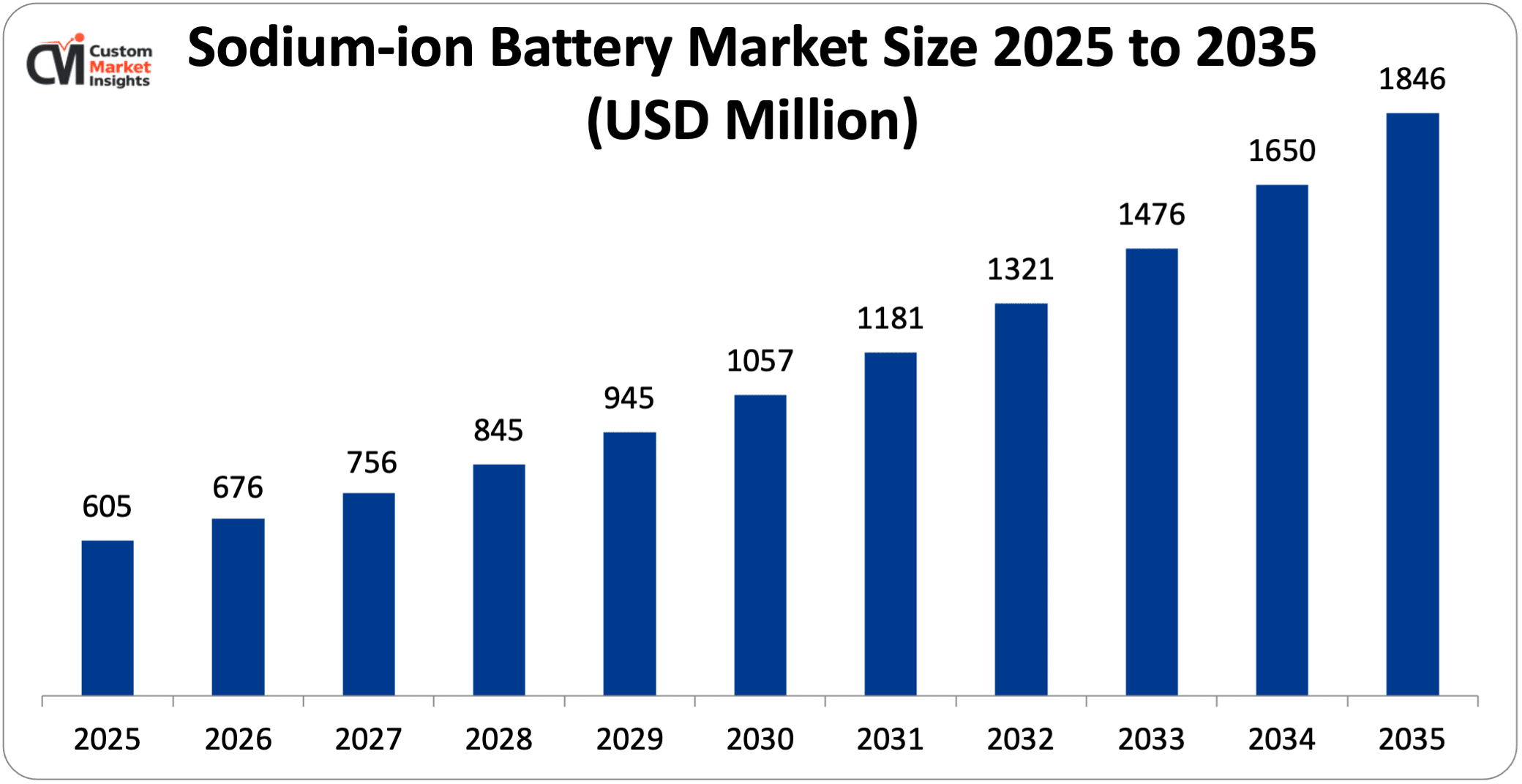
The market size of global sodium-ion batteries will be estimated at USD 605 million in 2025 and is expected to grow to between USD 676 million in 2026 and about USD 1846 million by 2035, with a current CAGR (compound annual growth rate) of 11.8% during the period of 2026 to 2035. A sodium-ion battery is an electrochemical storage device that is similar to a lithium-ion battery in which the cathode and anode are electrically connected but separated in an electrolyte solution. During the charging of the cell, ions migrate from the cathode through an electrolyte to reach the anode. During the discharging, the direction is reversed.
The difference between a sodium-ion battery and the lithium-ion battery is that charge carriers are only sodium ions and not Lithium. Sodium-based formulations have enabled a wider range of raw materials, as they are cheaper and have higher safety. A sodium-ion cell normally is based on a layered metal oxide or polyanionic cathode, a hard carbon anode, and a liquid electrolyte. Due to the abundance of sodium, increased safety characteristics, and their ability to operate at lower temperatures, a sodium-ion cell is applicable to grid energy storage, harvesting renewable energy, and electric vehicles, though sodium ions are less energy dense.
Market Highlight
- In 2025, the Asia Pacific will dominate the global market with an estimated market share of 42%. High production of EVs drives the market growth.
- North America is growing at the highest rate over the analysis period. The increasing renewable energy integration drives the regional growth.
- By technology, the sodium sulfur battery segment dominated the industry in 2025 with over 48%.
- By end-use, the energy storage segment captures the largest market share in 2025 of over 50%.
Significant Growth Factors
The sodium-ion battery market trends present significant growth opportunities due to several factors:
- Rising lithium Price Volatility & Supply Risk: One of the key reasons for the sodium-ion battery market is the increasing price volatility and supply risk associated with lithium. The prices of Lithium have been arbitrarily fluctuating to a large extent over the last few years due to the rising demand from electric vehicles and energy storage power plants, as well as the limited number of geographically localized reserves (most of which are based in Australia, Chile, and China), thus creating supply chain vulnerabilities and cost uncertainties for battery makers. On the contrary, sodium is widely distributed and readily available across the world, thus providing more stability and cost efficiency as compared to lithium.
- Government Support & Energy Transition Policies: Government incentives and energy transition initiatives (such as subsidies, regulations and strategic initiatives) are predicted to enable much support in the sodium-ion battery industry by assisting other battery types through economic, strategic and regulatory benefits. Governments worldwide are also introducing incentives to accelerate the deployment of renewables and a move away from stagnating supply reliance on critical minerals like lithium. In India, the government has budgeted nearly INR 3.57 lakh crore (~USD 43 billion) (~2% of GDP) for energy subsidies in FY2024, clearly signposting the shift towards clean energy investments, which are now being directed into the financing of renewable energy integration, grid storage, and next-generation battery technology like sodium-ion batteries. Even India‘s policy ecosystems such as India‘s PLI scheme are being formalized into accretive economic programs such as a dedicated national research mission for advanced chemistries to help fast track commercialization strategies. Moreover, the recent green light to battery energy storage initiatives, like the 30 GWh BESS capacity being built by the Power Ministry, will help to drive down cost efficiencies for alternative technologies like Sodium-ion batteries. It is projected that by the year 2047, the country‘s energy storage demand will have risen to ~1.3 TWh, largely catering to EVs and utility-scale storage, in turn, creating opportunities for technology diversification away from the current dominance of lithium-ion batteries. Similarly, China is actively incentivizing power utilities to facilitate accelerated deployment of sodium-ion batteries from 2025 to 2027, to accelerate renewable energy blending and reduce reliance on imported critical minerals. Such energy transition initiatives are in accordance with the worldwide movement of decarbonization of power systems and strengthening of energy security and local manufacturing, favoring sodium-ion batteries.
What are the Major Advances Changing the Sodium-ion Battery Market Today?
- Breakthroughs in Cathode & Anode Materials: Innovations in cathode and anode materials are some of the most basic technological innovations having a positive impact on the Sodium-ion battery market development. The cathode material base has evolved from the use of polyanionic compounds such as sodium vanadium phosphate to layered transition metal oxides and vaporous blue analogies with improved energy density, output voltage, cycling stability, and efficiency so as to increase the Sodium-ion battery cycle life and durability. Also, development in sodium-storage (anode) materials (particularly advances in hard carbon properties) has recently replicated the same sodium-storage capacity, efficiency, charge speed, and cycle life of a similar modern sodium-ion battery. The high double-layer interstitial space present in the graphite cathodes (of the Lithium-ion battery) makes its technology incapable of coping with the relatively larger sodium-ion charge, and thus hard carbon has been found as the most suitable replacement. Therefore, innovations in cathode materials are being able to remove all the potential limitations associated with sodium-ion batteries.
- Rapid Improvements in Energy Density: The ability to rapidly develop sodium-ion batteries with greater energy density will be a major factor in the market growth, as this has previously been a major factor limiting the usage of sodium-ion batteries, as they produce less energy per kilogram of the materials. When compared with Li-ion batteries, a sodium-ion battery has traditionally produced a poorer performance, restricting the use of sodium-ion batteries to low-tech applications. However, newer cathode and anode materials have been able to reach significantly higher levels of energy density (approx. 160–175 W/kg) to levels approaching 200 W/kg, which are being soon developed (may be over 200 W/kg), ensuring a more commercially viable product, which can power entry-level electric vehicles and large battery banks for hybrids and grid storage.
Category Wise Insights
By Technology
Why Does a Sodium Sulfur Battery Hold a Prominent Position in the Market?
The sodium sulfur battery segment dominated the industry in 2025 of over 48%. This growth is largely due to compatibility with high-capacity, long-duration energy storage demands. The sodium-sulfur battery‘s high energy density and stability in long discharge times can satisfy the grid balancing, peak shaving, and renewable energy filling demands of utilities. Confronted with more solar and wind farms, utilities will need storage solutions that provide power for a few hours, and sodium sulfur is the answer.
The sodium salt battery segment is growing at a steady rate during the forecast period. Sodium salt batteries are emerging as a flexible, safer solution within the sodium-ion battery area. They operate at considerably lower temperatures and employ thermally stable electrolyte systems when compared to high-temperature chemistries. This, combined with their reliable performance and cycle stability characteristics, makes them ideal for stationary applications such as energy storage and backup power supply within the industrial sector rather than high-energy-density consumer applications. Progress in electrode materials and electrolyte mixtures is helping to improve charge retention and power performance to enhance exploitation.
By End-use
Why Energy Storage Capture the Highest Market Share in the Sodium-ion Battery Market?
The energy storage segment captures the largest market share in 2025 of over 50%. As the utilizable capacity of solar and wind generation increases, grid operators will develop protocols that will facilitate increased use of more stationary energy storage. Sodium-ion batteries are able to satisfy such load-shifting needs, frequency regulation, and peak-shaving requirements efficiently because of their inherently stable charge/discharge behaviors and robust operation in medium- to long-term cycling. In addition, performance of advanced system operation that can operate on-grid in a wide range of temperature ranges will be potentially suitable for utility applications.
The automotive segment is growing at a rapid rate over the projected period. These batteries are highly attractive for low-cost electric mobility and for applications such as 2- and 3-wheelers and hybrid electric vehicles, where access to materials and overall system cost is important. Their thermal stability and better energy density allow them to be safely used in automotive environments such as city mobility and short-range electric vehicles. Improving cathode and anode materials is constraining the performance gap with lithium-ion batteries, which makes them more appropriate for auto platforms.
Report Scope
| Feature of the Report | Details |
| Market Size in 2026 | USD 676 million |
| Projected Market Size in 2035 | USD 1846 million |
| Market Size in 2025 | USD 605 million |
| CAGR Growth Rate | 11.8% CAGR |
| Base Year | 2025 |
| Forecast Period | 2026-2035 |
| Key Segment | By Type, Price Point and Region |
| Report Coverage | Revenue Estimation and Forecast, Company Profile, Competitive Landscape, Growth Factors and Recent Trends |
| Regional Scope | North America, Europe, Asia Pacific, Middle East & Africa, and South & Central America |
| Buying Options | Request tailored purchasing options to fulfil your requirements for research. |
Regional Analysis
How Big is the Asia Pacific Sodium-ion Battery Market Size?
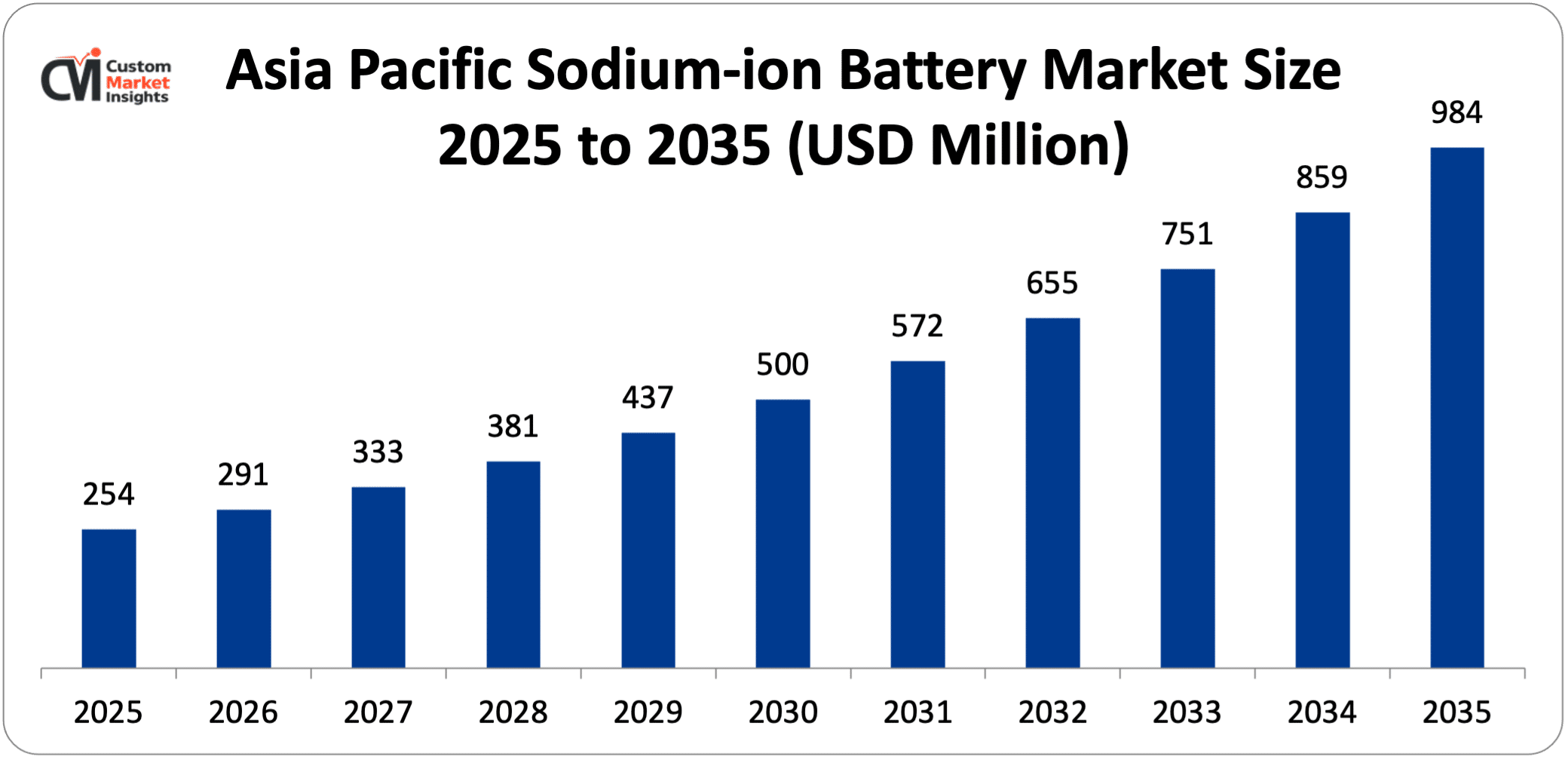
Its market size, in terms of the Asia Pacific sodium-ion battery, is projected to be USD 254 million in 2025 with a growth of about USD 984 million in 2035 with a CAGR of 14.5% between 2026 and 2035.
Why did the Asia-Pacific Dominate the Sodium-ion Battery Market in 2025?
In 2025, the Asia Pacific will dominate the global market with an estimated market share of 42%. Cost sensitivity and supply chain security in the key markets provide the growth engine for the Asia Pacific sodium-ion cell industry, the region has ready access to sodium-based raw materials, which mitigate the impact of increased lithium prices in the region and import dependence, a significant concern for China and India, where legislators and battery manufacturers are finding alternative chemistries to operate on for high-capacity energy grid storage and mass-market personal transportation.
China Sodium-ion Battery Market Trends
In the Asia Pacific region, China leads the industry expansion over the projected period. China is focusing on sodium-based chemistries to avoid having to import expensive lithium and take advantage of its large sodium reserves and mature chemical industry infrastructure. The further development of large, centralized renewable energy installations, especially solar and wind, is creating a need for stationary energy storage, where safety, cost, and long cycle life are required.
Why is Europe Experiencing a Significant Growth in the Sodium-ion Battery Market?
Europe holds a significant market share in 2025. In Europe, the booming sodium-ion industry hinges on aggressive renewable targets and on the quest for reliable grid storage. Countries like Germany, Spain, and the Netherlands are incorporating significant shares of wind and solar into their energy systems, driving the demand for stationary energy storage to deal with the intermittency issues of these sources while stabilizing the electricity grid.
UK Sodium-ion Battery Market Trends
The UK held the dominant position in the market in 2025. The UK is one of the fastest-growing markets for batteries driven by the country‘s ambitious energy transition strategies (including its target to reach net-zero emissions and increase the share of renewable energy generation), which drive increased demand for affordable and scalable battery storage solutions. Growing ownership of electric vehicles and grid-scale energy storage is also driving demand for alternative battery chemistries. The existence of potential domestic competitors such as Faradion and government-sponsored R&D funding and incentives to manufacture batteries domestically will also help to accelerate penetration.
Why is North America Growing at a Highest rate in the Sodium-ion Battery Market?
North America is expected to grow at the highest rate over the projected period. North America has been the focus of sodium-ion battery development due to the large need for inexpensive, reliable energy storage to support the penetration of renewable energy. All across the US and Canada, increasing deployment of new solar and wind capacity is increasing the demand for stationary storage.
US Sodium-ion Battery Market Trends
The US holds the prominent market share in the industry. In the United States, as renewable energy accelerates rapidly, storage at the grid level becomes increasingly essential and increasingly cost-sensitive. High-capacity addition by states as diverse as California and Texas in solar and wind generation systems introduces off-peak and on-peak variability to the grid. Utilities and energy developers are experimenting with various other battery chemistries for stationary storage projects, in which size is less of a consideration than safety and life cycle stability. Sodium-ion batteries have emerged from pilot demonstrations associated with renewable-dense, load-focused methods of peak shaving and load balancing at community energy storage and utility substation sizes.
Why is the Middle East & Africa Region is growing rapidly in the Sodium-ion Battery?
The MEA region is growing at a steady rate over the projected period. All countries in the Gulf are rapidly expanding solar capacity through their national energy transition plans, and there is increased interest in grid-level storage to smooth peaks in load and evening consumption. Several countries are installing off-grid and mini-grid solar projects to improve access, particularly in rural and remote locations where material availability and cost are important factors in battery selection. Sodium-ion batteries are being explored for these applications due to reduced raw material scarcity.
UAE Sodium-ion Battery Market Trends
The UAE is growing at the highest CAGR during the forecast period. The increasing investment in advanced technology drives the market growth.
Top Players in the Sodium-ion Battery Market and Their Offerings
- Contemporary Amperex Technology Co. Limited (CATL)
- Faradion Ltd
- Natron Energy Inc.
- HiNa Battery Technology Co. Ltd
- Altris AB
- TIAMAT SAS
- AMTE Power PLC
- NGK Insulators Ltd
- BYD Co. Ltd
- Northvolt AB
- Clarios International
- Peak Energy
- Panasonic Energy Co.
- BLUETTI Power Inc.
- North American Battery Systems (NABS)
- Sodium Ion Technologies LLC
- Others
Key Developments
Sodium-ion battery market has experienced considerable changes in the last two years as the market players are trying to diversify their technological aspects and develop product portfolios using strategic approaches.
- In February 2026, Changan has announced it will unveil its sodium-ion battery strategy with CATL, marking the first-ever instance of the technology’s adoption at a large scale in passenger vehicles. The automaker will showcase, among other things, the safety advancements it has achieved with the technology at an event in Yakeshi, Inner Mongolia, where temperatures currently sit below minus 30 degrees Celsius. (https://www.automotiveworld.com/news/changan-and-catl-gear-up-for-sodium-ion-battery-launch/)
- In November 2025, Guangde Qingna Technology Co., Ltd. signed an agreement on November 20 for a major 20 GWh sodium-ion battery manufacturing plant in the Suining Economic and Technological Development Zone, Sichuan Province, China. (https://aus.amegroup.com/daily-briefing-detail?p=ur%2FwlG64MIxwAfOhsBh7aptY2IjM6e8AFOAc9zFdFZU%3D)
These strategic measures have enabled the companies to reinforce their competitive positions, increase the product line, boost their technological competencies, and also seize growth opportunities in the fast-growing sodium-ion battery market.
The Sodium-ion Battery Market is segmented as follows:
By Technology
- Sodium Sulfur Battery
- Sodium Salt Battery
- Sodium Air Battery
By End-use
- Consumer Electronics
- Automotive
- Industrial
- Energy Storage
- Others
Regional Coverage:
North America
- U.S.
- Canada
- Mexico
- Rest of North America
Europe
- Germany
- France
- U.K.
- Russia
- Italy
- Spain
- Netherlands
- Rest of Europe
Asia Pacific
- China
- Japan
- India
- New Zealand
- Australia
- South Korea
- Taiwan
- Rest of Asia Pacific
The Middle East & Africa
- Saudi Arabia
- UAE
- Egypt
- Kuwait
- South Africa
- Rest of the Middle East & Africa
Latin America
- Brazil
- Argentina
- Rest of Latin America
Table of Contents
- Chapter 1. Report Introduction
- 1.1. Report Description
- 1.1.1. Purpose of the Report
- 1.1.2. USP & Key Offerings
- 1.2. Key Benefits For Stakeholders
- 1.3. Target Audience
- 1.4. Report Scope
- 1.1. Report Description
- Chapter 2. Market Overview
- 2.1. Report Scope (Segments And Key Players)
- 2.1.1. Sodium-ion Battery by Segments
- 2.1.2. Sodium-ion Battery by Region
- 2.2. Executive Summary
- 2.2.1. Market Size & Forecast
- 2.2.2. Sodium-ion Battery Market Attractiveness Analysis, By Type
- 2.2.3. Sodium-ion Battery Market Attractiveness Analysis, By Price Point
- 2.1. Report Scope (Segments And Key Players)
- Chapter 3. Market Dynamics (DRO)
- 3.1. Market Drivers
- 3.1.1. Rising lithium Price Volatility & Supply Risk
- 3.1.2. Government Support & Energy Transition Policies
- 3.2. Market Restraints
- 3.3. Market Opportunities
- 3.5. Pestle Analysis
- 3.6. Porter Forces Analysis
- 3.7. Technology Roadmap
- 3.8. Value Chain Analysis
- 3.9. Government Policy Impact Analysis
- 3.10. Pricing Analysis
- 3.1. Market Drivers
- Chapter 4. Sodium-ion Battery Market – By Type
- 4.1. Type Market Overview, By Type Segment
- 4.1.1. Sodium-ion Battery Market Revenue Share, By Type, 2025 & 2035
- 4.1.2. Refurbished Phones
- 4.1.3. Sodium-ion Battery Share Forecast, By Region (USD Million)
- 4.1.4. Comparative Revenue Analysis, By Country, 2025 & 2035
- 4.1.5. Key Market Trends, Growth Factors, & Opportunities
- 4.1.6. Used Phones
- 4.1.7. Sodium-ion Battery Share Forecast, By Region (USD Million)
- 4.1.8. Comparative Revenue Analysis, By Country, 2025 & 2035
- 4.1.9. Key Market Trends, Growth Factors, & Opportunities
- 4.1. Type Market Overview, By Type Segment
- Chapter 5. Sodium-ion Battery Market – By Price Point
- 5.1. Price Point Market Overview, By Price Point Segment
- 5.1.1. Sodium-ion Battery Market Revenue Share, By Price Point, 2025 & 2035
- 5.1.2. Low-priced Refurbished and Used Mobile Phones (Less than $200)
- 5.1.3. Sodium-ion Battery Share Forecast, By Region (USD Million)
- 5.1.4. Comparative Revenue Analysis, By Country, 2025 & 2035
- 5.1.5. Key Market Trends, Growth Factors, & Opportunities
- 5.1.6. Mid-Priced Refurbished and Used Mobile Phones ($200-$500)
- 5.1.7. Sodium-ion Battery Share Forecast, By Region (USD Million)
- 5.1.8. Comparative Revenue Analysis, By Country, 2025 & 2035
- 5.1.9. Key Market Trends, Growth Factors, & Opportunities
- 5.1.10. Premium Refurbished and Used Mobile Phones (More than $500)
- 5.1.11. Sodium-ion Battery Share Forecast, By Region (USD Million)
- 5.1.12. Comparative Revenue Analysis, By Country, 2025 & 2035
- 5.1.13. Key Market Trends, Growth Factors, & Opportunities
- 5.1. Price Point Market Overview, By Price Point Segment
- Chapter 6. Sodium-ion Battery Market – Regional Analysis
- 6.1. Sodium-ion Battery Market Overview, By Region Segment
- 6.1.1. Global Sodium-ion Battery Market Revenue Share, By Region, 2025 & 2035
- 6.1.2. Global Sodium-ion Battery Market Revenue, By Region, 2026 – 2035 (USD Million)
- 6.1.3. Global Sodium-ion Battery Market Revenue, By Type, 2026 – 2035
- 6.1.4. Global Sodium-ion Battery Market Revenue, By Price Point, 2026 – 2035
- 6.2. North America
- 6.2.1. North America Sodium-ion Battery Market Revenue, By Country, 2026 – 2035 (USD Million)
- 6.2.2. North America Sodium-ion Battery Market Revenue, By Type, 2026 – 2035
- 6.2.3. North America Sodium-ion Battery Market Revenue, By Price Point, 2026 – 2035
- 6.2.4. U.S. Sodium-ion Battery Market Revenue, 2026 – 2035 (USD Million)
- 6.2.5. Canada Sodium-ion Battery Market Revenue, 2026 – 2035 (USD Million)
- 6.2.6. Mexico Sodium-ion Battery Market Revenue, 2026 – 2035 (USD Million)
- 6.2.7. Rest of North America Sodium-ion Battery Market Revenue, 2026 – 2035 (USD Million)
- 6.3. Europe
- 6.3.1. Europe Sodium-ion Battery Market Revenue, By Country, 2026 – 2035 (USD Million)
- 6.3.2. Europe Sodium-ion Battery Market Revenue, By Type, 2026 – 2035
- 6.3.3. Europe Sodium-ion Battery Market Revenue, By Price Point, 2026 – 2035
- 6.3.4. Germany Sodium-ion Battery Market Revenue, 2026 – 2035 (USD Million)
- 6.3.5. France Sodium-ion Battery Market Revenue, 2026 – 2035 (USD Million)
- 6.3.6. U.K. Sodium-ion Battery Market Revenue, 2026 – 2035 (USD Million)
- 6.3.7. Russia Sodium-ion Battery Market Revenue, 2026 – 2035 (USD Million)
- 6.3.8. Italy Sodium-ion Battery Market Revenue, 2026 – 2035 (USD Million)
- 6.3.9. Spain Sodium-ion Battery Market Revenue, 2026 – 2035 (USD Million)
- 6.3.10. Netherlands Sodium-ion Battery Market Revenue, 2026 – 2035 (USD Million)
- 6.3.11. Rest of Europe Sodium-ion Battery Market Revenue, 2026 – 2035 (USD Million)
- 6.4. Asia Pacific
- 6.4.1. Asia Pacific Sodium-ion Battery Market Revenue, By Country, 2026 – 2035 (USD Million)
- 6.4.2. Asia Pacific Sodium-ion Battery Market Revenue, By Type, 2026 – 2035
- 6.4.3. Asia Pacific Sodium-ion Battery Market Revenue, By Price Point, 2026 – 2035
- 6.4.4. China Sodium-ion Battery Market Revenue, 2026 – 2035 (USD Million)
- 6.4.5. Japan Sodium-ion Battery Market Revenue, 2026 – 2035 (USD Million)
- 6.4.6. India Sodium-ion Battery Market Revenue, 2026 – 2035 (USD Million)
- 6.4.7. New Zealand Sodium-ion Battery Market Revenue, 2026 – 2035 (USD Million)
- 6.4.8. Australia Sodium-ion Battery Market Revenue, 2026 – 2035 (USD Million)
- 6.4.9. South Korea Sodium-ion Battery Market Revenue, 2026 – 2035 (USD Million)
- 6.4.10. Taiwan Sodium-ion Battery Market Revenue, 2026 – 2035 (USD Million)
- 6.4.11. Rest of Asia Pacific Sodium-ion Battery Market Revenue, 2026 – 2035 (USD Million)
- 6.5. The Middle-East and Africa
- 6.5.1. The Middle-East and Africa Sodium-ion Battery Market Revenue, By Country, 2026 – 2035 (USD Million)
- 6.5.2. The Middle-East and Africa Sodium-ion Battery Market Revenue, By Type, 2026 – 2035
- 6.5.3. The Middle-East and Africa Sodium-ion Battery Market Revenue, By Price Point, 2026 – 2035
- 6.5.4. Saudi Arabia Sodium-ion Battery Market Revenue, 2026 – 2035 (USD Million)
- 6.5.5. UAE Sodium-ion Battery Market Revenue, 2026 – 2035 (USD Million)
- 6.5.6. Egypt Sodium-ion Battery Market Revenue, 2026 – 2035 (USD Million)
- 6.5.7. Kuwait Sodium-ion Battery Market Revenue, 2026 – 2035 (USD Million)
- 6.5.8. South Africa Sodium-ion Battery Market Revenue, 2026 – 2035 (USD Million)
- 6.5.9. Rest of the Middle East & Africa Sodium-ion Battery Market Revenue, 2026 – 2035 (USD Million)
- 6.6. Latin America
- 6.6.1. Latin America Sodium-ion Battery Market Revenue, By Country, 2026 – 2035 (USD Million)
- 6.6.2. Latin America Sodium-ion Battery Market Revenue, By Type, 2026 – 2035
- 6.6.3. Latin America Sodium-ion Battery Market Revenue, By Price Point, 2026 – 2035
- 6.6.4. Brazil Sodium-ion Battery Market Revenue, 2026 – 2035 (USD Million)
- 6.6.5. Argentina Sodium-ion Battery Market Revenue, 2026 – 2035 (USD Million)
- 6.6.6. Rest of Latin America Sodium-ion Battery Market Revenue, 2026 – 2035 (USD Million)
- 6.1. Sodium-ion Battery Market Overview, By Region Segment
- Chapter 7. Competitive Landscape
- 7.1. Company Market Share Analysis – 2025
- 7.1.1. Global Sodium-ion Battery Market: Company Market Share, 2025
- 7.2. Global Sodium-ion Battery Market Company Market Share, 2024
- 7.1. Company Market Share Analysis – 2025
- Chapter 8. Company Profiles
- 8.1. Contemporary Amperex Technology Co. Limited (CATL)
- 8.1.1. Company Overview
- 8.1.2. Key Executives
- 8.1.3. Product Portfolio
- 8.1.4. Financial Overview
- 8.1.5. Operating Business Segments
- 8.1.6. Business Performance
- 8.1.7. Recent Developments
- 8.2. Faradion Ltd
- 8.3. Natron Energy Inc.
- 8.4. HiNa Battery Technology Co. Ltd
- 8.5. Altris AB
- 8.6. TIAMAT SAS
- 8.7. AMTE Power PLC
- 8.8. NGK Insulators Ltd
- 8.9. BYD Co. Ltd
- 8.10. Northvolt AB
- 8.11. Clarios International
- 8.12. Peak Energy
- 8.13. Panasonic Energy Co.
- 8.14. BLUETTI Power Inc.
- 8.15. North American Battery Systems (NABS)
- 8.16. Sodium Ion Technologies LLC
- 8.17. Others.
- 8.1. Contemporary Amperex Technology Co. Limited (CATL)
- Chapter 9. Research Methodology
- 9.1. Research Methodology
- 9.2. Secondary Research
- 9.3. Primary Research
- 9.3.1. Analyst Tools and Models
- 9.4. Research Limitations
- 9.5. Assumptions
- 9.6. Insights From Primary Respondents
- 9.7. Why Custom Market Insights
- Chapter 10. Standard Report Commercials & Add-Ons
- 10.1. Customization Options
- 10.2. Subscription Module For Market Research Reports
- 10.3. Client Testimonials
List Of Figures
Figures No 1 to 19
List Of Tables
Tables No 1 to 41
Prominent Players
- Contemporary Amperex Technology Co. Limited (CATL)
- Faradion Ltd
- Natron Energy Inc.
- HiNa Battery Technology Co. Ltd
- Altris AB
- TIAMAT SAS
- AMTE Power PLC
- NGK Insulators Ltd
- BYD Co. Ltd
- Northvolt AB
- Clarios International
- Peak Energy
- Panasonic Energy Co.
- BLUETTI Power Inc.
- North American Battery Systems (NABS)
- Sodium Ion Technologies LLC
- Others
FAQs
The key players in the market are Contemporary Amperex Technology Co. Limited (CATL), Faradion Ltd., Natron Energy Inc., HiNa Battery Technology Co. Ltd., Altris AB, TIAMAT SAS, AMTE Power PLC, NGK Insulators Ltd., BYD Co. Ltd., Northvolt AB, Clarios International, Peak Energy, Panasonic Energy Co., BLUETTI Power Inc., North American Battery Systems (NABS), Sodium Ion Technologies LLC, Others.
Government regulations play a pivotal role in shaping the development of the Sodium-ion battery market by creating a supportive policy environment that encourages innovation, investment, and adoption. Regulations related to clean energy targets, carbon neutrality commitments, and renewable energy integration are driving demand for cost-effective and sustainable energy storage solutions, positioning sodium-ion batteries as a viable alternative to Lithium-ion batteries. Governments are also introducing financial incentives such as subsidies, tax benefits, and production-linked schemes to promote domestic battery manufacturing and reduce reliance on imported critical minerals.
The price point plays a critical role in shaping market growth and adoption of the sodium-ion battery, as its lower material and production costs compared to Lithium-ion battery make it highly attractive for cost-sensitive applications such as grid-scale energy storage and entry-level electric vehicles. The use of abundant and inexpensive raw materials like sodium, iron, and aluminum significantly reduces overall battery costs, enabling manufacturers to offer more affordable energy storage solutions. This cost advantage accelerates adoption in emerging markets and large-scale infrastructure projects, where price competitiveness is a key decision factor.
According to the present analysis and forecast modeling, the market of sodium-ion batteries will witness a significant growth of about USD 1845 million in the year 2035 with the growing innovative product launch, increasing collaboration, growing EV adoption, and increasing renewable energy sector with a CAGR of 11.8% between the years 2026 and 2035.
It is projected that the Asia Pacific will hold the largest market share in the sodium-ion battery market in the forecast period, with a share of about 42% of the global market share, which is attributed to the high production of EVs.
North America is expected to grow at the highest rate during the forecast period. The growth in the region is owing to the growing renewable energy sector.
The growth of the sodium-ion battery market is primarily driven by the abundance and low cost of sodium resources, rising volatility and supply risks associated with lithium, increasing demand for cost-effective energy storage solutions, supportive government policies promoting clean energy transition, and ongoing technological advancements that are improving performance and expanding applications across electric vehicles and grid-scale storage.