
Indonesia Infant Nutrition Market Size, Trends and Insights By Product Category (Infant Formula, Follow-on Formula, Growing-up Milk, Baby Food & Cereals, Special Medical Nutrition), By Age Group (0–6 Months, 6–12 Months, 12–24 Months, Above 24 Months), By Ingredient Type (Dairy-based, Soy-based, Organic & Natural Ingredients, Fortified & Functional Ingredients), By Form (Powder, Liquid, Ready-to-Feed), By Distribution Channel (Supermarkets & Hypermarkets, Pharmacies & Drug Stores, Online Retail, Specialty Baby Stores, Others), and By Region - Industry Overview, Statistical Data, Competitive Analysis, Share, Outlook, and Forecast 2026 – 2035
Report Snapshot
CAGR: 9.4%
| Study Period: | 2026-2035 |
| Fastest Growing Market: | Indonesia |
| Largest Market: | Indonesia |
Major Players
- Nestlé Indonesia
- Danone Indonesia
- Kalbe Farma Tbk
- Kalbe Nutritionals
- Others
Reports Description
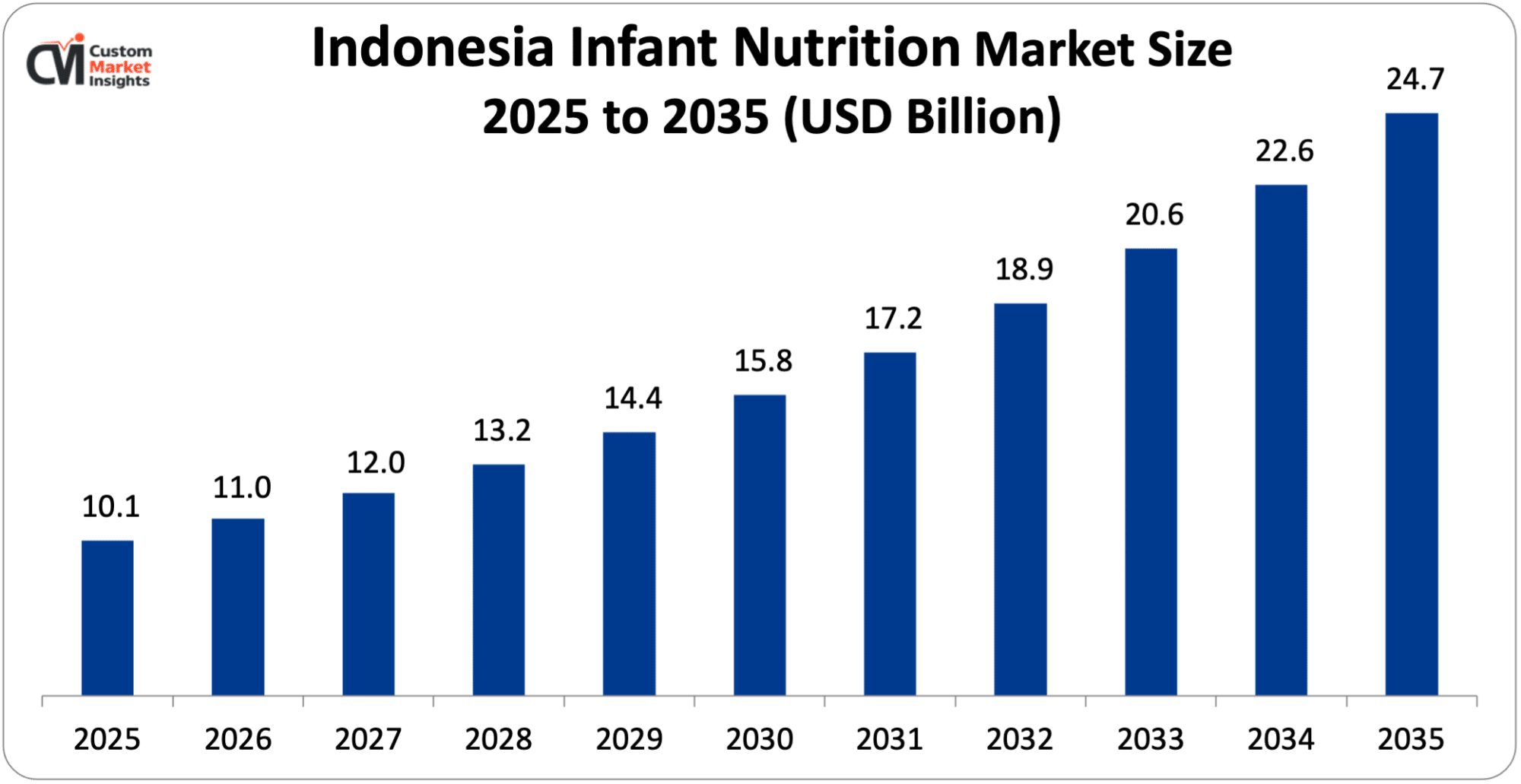
The market size of the Indonesia infant nutrition market is estimated to reach USD 10.1 billion in 2025 and then increase to USD 11 billion in 2026 before attaining approximately USD 24.7 billion in 2035 while experiencing an annual growth rate of 9.4% from 2026 until 2035. The market expansion occurs because Indonesian families become more aware of how nutritional needs during early childhood develop into adulthood while urban areas expand and household incomes increase, and more mothers enter the workforce to provide their children with nutritional meals that meet their dietary needs.
The market expansion receives additional support from government programs that promote maternal and child health while healthcare access increases and consumer demand rises for fortified products and organic items and specialized infant nutrition solutions, which include baby cereals and ready-to-feed foods and infant formula.
Market Highlight
- By product category, infant formula will contribute more than 38.5% of the total market revenue by 2025 as the product is well adopted by urban households and is experiencing the growth in demand of fortified nutrition.
- By age group, the CAGR of a 9.6% increase in the 6-12 months segment during 2026 to 2035 is predicted by increased practice of complementary feeding as well as improved nutritional awareness.
- By type of ingredient, in 2025 the market had consumed about 40% of the total demand by the fortified and functional ingredients category, as there was an increased inclination towards consuming products that are enriched with vitamins, minerals, and probiotics.
- Form Powdered infant nutrition products were also in the range of 50.5% of the total sale in 2025 because of extended shelf life, low prices, and storage convenience.
- By market distribution, in 2025 supermarkets and hypermarkets will have almost 61.2% of the market share, and this will be facilitated by the presence of a wide variety of products and retail penetration in major cities.
Significant Growth Factors
- Rising Awareness of Early-Life Nutrition and Government Support: Unlike other developing countries, the market of infant nutrition in Indonesia is growing at a good pace as more and more awareness is being created regarding the importance of nutrition within the first 1,000 days of life. As UNICEF suggests, around a fifth of children under five years old in Indonesia were stunted in the past years, and the government is now making more of an effort to strengthen national nutrition programs. Programs like the National Strategy to Accelerate Stunting Prevention and increased access to maternal health have greatly contributed to pressure on the demand for fortified infant formulas and complementary foods. The Indonesian Ministry of Health, in collaboration with private nutrition firms, in 2024 aimed to enhance the availability of infant foods with micronutrients in rural areas. These campaigns, along with the growing number of pediatric visits as well as nutrition education programs, are creating pressure on the long-term demand of scientifically developed infant nutrition products nationwide.
- Urbanization, Employed Mothers, and Adoption of Premium Products: The fast urbanization and the increased number of working mothers in Indonesia are transforming the infant feeding behaviors. More than 56 percent of the Indonesian population is currently living in cities, which has caused more and more people to find the need to seek ready-to-use solutions in infant nutrition. The use of infant formula, baby cereals, and ready-to-feed products has gone through the rapid track due to time-constrained situations and dual-income families. In 2024, Nestlé Indonesia added iron- and DHA-enriched formulations in its infant nutrition line that would meet the dieting requirements of Southeast Asia. On the same note, Danone Indonesia also launched new growing-up milk varieties about immune and digestive health. The demand for more expensive and specialized infant nutrition products is going up because of these new product innovations and the fact that parents are spending more money and wanting to be good parents.
- More retail, e-commerce, and healthcare distribution channels: The growth of retail and online commerce is also making it much easier to find baby nutrition products in Indonesia. The retail outlets, including supermarkets, pharmacies, and various online stores like Tokopedia or Shopee, have turned into the key points of sale, specifically in urban and semi-urban locations. In 2024, e-commerce sales of the baby food products increased by more than 30 percent yearly, which is backed by the subscription models and doorstep delivery services. Moreover, pharmacies and hospitals offer more and more suggestions to use branded infant nutrition products, strengthening consumer confidence. Abbott Nutrition 2025 Abbott Nutrition reinforced its distribution channel by collaborating with healthcare providers in Java and Sumatra. These innovations are making products more visible and more affordable and helping in ensuring long-term market growth.
What are the Major Advances Changing the Indonesia infant nutrition market Today?
- Regulatory Restrictions and Breastfeeding Promotion Policies: Indonesia implements stringent regulations on infant formula marketing and promotion in order to safeguard breastfeeding. Government Regulation No. 33/2012 prohibits the advertising and direct marketing of infant formula to infants under the age of six months. Although these policies are in line with the objectives of promoting the health of the populace, they restrict product exposure and market penetration among manufacturers. In 2024, the authorities once again increased the level of monitoring compliance, introducing sanctions on non-compliance. Firms have to be extremely dependent on medical means and educational programs instead of conventional marketing. These regulatory restrictions make operations and marketing even more complicated, especially for international brands entering into the Indonesian market.
- Price Sensitivity and Income Inequality among Regions: Although there is an increase in demand, price sensitivity is still a significant issue in the Indonesian infant nutrition market. The large segment of the population lives in low income and rural regions where affordability is a very important factor in the decisions to purchase. Infant nutrition products of premium and organic quality are usually expensive for the middle- and low-income family. The world bank also states that discretionary spending has been affected by the fact that more than a quarter of Indonesians are still susceptible to economic shocks. As a reaction, a number of manufacturers rolled out smaller pack sizes and value based formulations in 2024. There is however still the challenge of balancing nutrition quality with affordability especially beyond the major cities.
- Supply Chain Limitations and Reliance on Imports of Ingredients: The infant nutrition industry in Indonesia is dependent on imported ingredients with regard to the dependency of whey protein, specialty vitamins, and functional ingredients. The cost of production has been on the rise in recent years due to the supply chain disruption, currency exchange rates, and escalating cost of imports. The global dairy price volatility in 2023-2024 impacted infant formula producers in terms of ingredient costs of the products. In response to this, other firms like Frisian Flag Indonesia declared their investments in domestic sourcing and processing. Nonetheless, full supply chain localization is not easy, as there are high standards of quality. These are difficulties that affect the stability of prices, production planning, and future profits of manufacturers working in the Indonesian market.
Category Wise Insights
By Product Category
What makes Infant Formula Reign Over the Indonesian Infant Nutrition markets?
Infant formula controls the infant nutrition market of Indonesia because of the growing urbanization, growing involvement of women in the labor force and the shift in infant feeding habits. Although breastfeeding is still highly encouraged, infant baby food is highly embraced as a nutritional dietary supplement, particularly in the urban population. Micronutrient deficiency and stunting are highly prevalent, which in turn has further stimulated the demand for fortified infant formulas with added iron, DHA and vitamins. Multinationals and local manufacturers have increased the supply of products via pharmacies, hospitals, and retail chains. There are also the repeated product reformulations suitable to the nutritional requirements and taste preferences of the locals that have strengthened this segment as a dominant force in the Indonesian market.
The reason why Baby Food and Cereals are the fastest-growing product segment?
Baby food and cereals will enjoy a high rate of product development in Indonesia because awareness of complementary feeding after 6 months of age is growing. Pediatric and governmental practices promote the early uptake of solid foods, which stimulates the demand for fortified cereals as well as pureed baby foods. The increasing number of nuclear families and time-starved parents are settling on ready-to-eat and ready-to-cook baby food. Manufacturers are also introducing products with local tastes, organic products, and clean-label formulas, which only increase the adoption. Increase in e-commerce space and the availability of better cold-chain logistics have also facilitated access to packaged baby foods in urban and semi-urban areas.
By Age Group
Why does the 6 12 Months Segment Lead the Market?
The age segment of 6-12 months is the market leader in the infant nutrition sector in Indonesia because this is the time when complementary feeding is important. Young infants at this age need more nutrition other than breast milk to enhance the high speed of physical and cognitive development. The excessive focus on iron, protein, and energy consumption has led to increased demand for infant cereals and the follow up formulas. Nutrition programs and the healthcare industry also have a significant impact on food-feeding behaviors at this phase, which leads to the regular uptake of products. During this time, parents are more ready to pay more for nutritionally enriched products, and it is one of the major segments of revenue.
The 12-24 months segment is the fastest-growing segment, and why?
The 12-24 month group is expanding at a faster rate because toddlers shift to growing-up milk and fortified foodstuffs that help in immunity and the growth of the brain. The growing interest of parents in immunity-enhancing products and healthy digestion has caused the popularity of functional nutrition products. Manufacturers are coming up with more specific formulations of probiotics, prebiotics, and essential minerals that are picking up well in urban markets.
By Distribution Channel
Why are Six Sigma Supermarkets and Hypermarkets?
Distribution is dominated by supermarkets and hypermarkets because they have a good assortment of products, good brand awareness, and consumer loyalty. The physical retail shopping formats are the favorite of the parents because they can confirm the authenticity of the product, expiry dates, and the amounts of nutrients in the products. Sales through this channel are further made by means of promotional offers and in-store consultations.
Categories Why Online Retail is the Rapidly Expanding Channel?
The internet retail is growing fast with the increase of digital use in Indonesia. The e-commerce stores provide convenience and subscription delivery service as well as access to the high-quality and imported infant nutrition products. Digital payments and last-mile delivery have increased the pace of the online penetration, especially among urban parents.
Report Scope
| Feature of the Report | Details |
| Market Size in 2026 | USD 11 billion |
| Projected Market Size in 2035 | USD 24.7 billion |
| Market Size in 2025 | USD 10.1 billion |
| CAGR Growth Rate | 9.4% CAGR |
| Base Year | 2025 |
| Forecast Period | 2026-2035 |
| Key Segment | By Product Category, Age Group, Ingredient Type, Form, Distribution Channel and Region |
| Report Coverage | Revenue Estimation and Forecast, Company Profile, Competitive Landscape, Growth Factors and Recent Trends |
| Buying Options | Request tailored purchasing options to fulfil your requirements for research. |
Top Players in the Market and Their Offerings
- Nestlé Indonesia
- Danone Indonesia
- Kalbe Farma Tbk
- Kalbe Nutritionals
- Frisian Flag Indonesia
- Fonterra Brands Indonesia
- Ausnutria Nutrition
- HiPP GmbH
- Bubs Australia
- Arla Foods Indonesia
- Yili Group
- Others
Key Developments
The Indonesian infant nutrition market has experienced some significant developments, with the major players concentrating on product innovation, capacity building, and portfolio consolidation to appeal to the changing nutritional demands and regulatory imperatives.
- Nestle Indonesia has introduced infant nutrition products with fortified formulations, which address the national child nutrition priorities, in 2025, aiming at iron deficiency and digestive health.
- In 2024, Danone Indonesia (covering Sari Husada and Nutricia) launched new growing-up milk and complementary food products, which were developed to help reinforce toddler immunity and cognitive development.
- In 2024, Kalbe Farma Tbk and Kalbe Nutritionals enhanced their local production and research and development to create infant and toddler nutrition products that would appeal to Indonesian nutritional habits.
Such strategic efforts have seen firms increase product offerings, reinforce distribution channels, better nutritional positioning, and exploit growth prospects in the growing infant nutrition market in Indonesia.
The Indonesia Infant Nutrition Market is segmented as follows:
By Product Category
- Infant Formula
- Follow-on Formula
- Growing-up Milk
- Baby Food & Cereals
- Special Medical Nutrition
By Age Group
- 0–6 Months
- 6–12 Months
- 12–24 Months
- Above 24 Months
By Ingredient Type
- Dairy-based
- Soy-based
- Organic & Natural Ingredients
- Fortified & Functional Ingredients
By Form
- Powder
- Liquid
- Ready-to-Feed
By Distribution Channel
- Supermarkets & Hypermarkets
- Pharmacies & Drug Stores
- Online Retail
- Specialty Baby Stores
- Others
Table of Contents
- Chapter 1. Report Introduction
- 1.1. Report Description
- 1.1.1. Purpose of the Report
- 1.1.2. USP & Key Offerings
- 1.2. Key Benefits For Stakeholders
- 1.3. Target Audience
- 1.4. Report Scope
- 1.1. Report Description
- Chapter 2. Market Overview
- 2.1. Report Scope (Segments And Key Players)
- 2.1.1. Indonesia Infant Nutrition by Segments
- 2.1.2. Indonesia Infant Nutrition by Region
- 2.2. Executive Summary
- 2.2.1. Market Size & Forecast
- 2.2.2. Indonesia Infant Nutrition Market Attractiveness Analysis, By Product Category
- 2.2.3. Indonesia Infant Nutrition Market Attractiveness Analysis, By Age Group
- 2.2.4. Indonesia Infant Nutrition Market Attractiveness Analysis, By Ingredient Type
- 2.2.5. Indonesia Infant Nutrition Market Attractiveness Analysis, By Form
- 2.2.6. Indonesia Infant Nutrition Market Attractiveness Analysis, By Distribution Channel
- 2.1. Report Scope (Segments And Key Players)
- Chapter 3. Market Dynamics (DRO)
- 3.1. Market Drivers
- 3.1.1. Rising Awareness of Early-Life Nutrition and Government Support
- 3.1.2. Urbanization & Employed Mothers
- 3.1.3. and Adoption of Premium Products
- 3.2. Market Restraints
- 3.3. Market Opportunities
- 3.5. Pestle Analysis
- 3.6. Porter Forces Analysis
- 3.7. Technology Roadmap
- 3.8. Value Chain Analysis
- 3.9. Government Policy Impact Analysis
- 3.10. Pricing Analysis
- 3.1. Market Drivers
- Chapter 4. Indonesia Infant Nutrition Market – By Product Category
- 4.1. Product Category Market Overview, By Product Category Segment
- 4.1.1. Indonesia Infant Nutrition Market Revenue Share, By Product Category, 2025 & 2035
- 4.1.2. Infant Formula
- 4.1.3. Indonesia Infant Nutrition Share Forecast, By Region (USD Billion)
- 4.1.4. Comparative Revenue Analysis, By Country, 2025 & 2035
- 4.1.5. Key Market Trends, Growth Factors, & Opportunities
- 4.1.6. Follow-on Formula
- 4.1.7. Indonesia Infant Nutrition Share Forecast, By Region (USD Billion)
- 4.1.8. Comparative Revenue Analysis, By Country, 2025 & 2035
- 4.1.9. Key Market Trends, Growth Factors, & Opportunities
- 4.1.10. Growing-up Milk
- 4.1.11. Indonesia Infant Nutrition Share Forecast, By Region (USD Billion)
- 4.1.12. Comparative Revenue Analysis, By Country, 2025 & 2035
- 4.1.13. Key Market Trends, Growth Factors, & Opportunities
- 4.1.14. Baby Food & Cereals
- 4.1.15. Indonesia Infant Nutrition Share Forecast, By Region (USD Billion)
- 4.1.16. Comparative Revenue Analysis, By Country, 2025 & 2035
- 4.1.17. Key Market Trends, Growth Factors, & Opportunities
- 4.1.18. Special Medical Nutrition
- 4.1.19. Indonesia Infant Nutrition Share Forecast, By Region (USD Billion)
- 4.1.20. Comparative Revenue Analysis, By Country, 2025 & 2035
- 4.1.21. Key Market Trends, Growth Factors, & Opportunities
- 4.1. Product Category Market Overview, By Product Category Segment
- Chapter 5. Indonesia Infant Nutrition Market – By Age Group
- 5.1. Age Group Market Overview, By Age Group Segment
- 5.1.1. Indonesia Infant Nutrition Market Revenue Share, By Age Group, 2025 & 2035
- 5.1.2. 0–6 Months
- 5.1.3. Indonesia Infant Nutrition Share Forecast, By Region (USD Billion)
- 5.1.4. Comparative Revenue Analysis, By Country, 2025 & 2035
- 5.1.5. Key Market Trends, Growth Factors, & Opportunities
- 5.1.6. 6–12 Months
- 5.1.7. Indonesia Infant Nutrition Share Forecast, By Region (USD Billion)
- 5.1.8. Comparative Revenue Analysis, By Country, 2025 & 2035
- 5.1.9. Key Market Trends, Growth Factors, & Opportunities
- 5.1.10. 12–24 Months
- 5.1.11. Indonesia Infant Nutrition Share Forecast, By Region (USD Billion)
- 5.1.12. Comparative Revenue Analysis, By Country, 2025 & 2035
- 5.1.13. Key Market Trends, Growth Factors, & Opportunities
- 5.1.14. Above 24 Months
- 5.1.15. Indonesia Infant Nutrition Share Forecast, By Region (USD Billion)
- 5.1.16. Comparative Revenue Analysis, By Country, 2025 & 2035
- 5.1.17. Key Market Trends, Growth Factors, & Opportunities
- 5.1. Age Group Market Overview, By Age Group Segment
- Chapter 6. Indonesia Infant Nutrition Market – By Ingredient Type
- 6.1. Ingredient Type Market Overview, By Ingredient Type Segment
- 6.1.1. Indonesia Infant Nutrition Market Revenue Share, By Ingredient Type, 2025 & 2035
- 6.1.2. Dairy-based
- 6.1.3. Indonesia Infant Nutrition Share Forecast, By Region (USD Billion)
- 6.1.4. Comparative Revenue Analysis, By Country, 2025 & 2035
- 6.1.5. Key Market Trends, Growth Factors, & Opportunities
- 6.1.6. Soy-based
- 6.1.7. Indonesia Infant Nutrition Share Forecast, By Region (USD Billion)
- 6.1.8. Comparative Revenue Analysis, By Country, 2025 & 2035
- 6.1.9. Key Market Trends, Growth Factors, & Opportunities
- 6.1.10. Organic & Natural Ingredients
- 6.1.11. Indonesia Infant Nutrition Share Forecast, By Region (USD Billion)
- 6.1.12. Comparative Revenue Analysis, By Country, 2025 & 2035
- 6.1.13. Key Market Trends, Growth Factors, & Opportunities
- 6.1.14. Fortified & Functional Ingredients
- 6.1.15. Indonesia Infant Nutrition Share Forecast, By Region (USD Billion)
- 6.1.16. Comparative Revenue Analysis, By Country, 2025 & 2035
- 6.1.17. Key Market Trends, Growth Factors, & Opportunities
- 6.1. Ingredient Type Market Overview, By Ingredient Type Segment
- Chapter 7. Indonesia Infant Nutrition Market – By Form
- 7.1. Form Market Overview, By Form Segment
- 7.1.1. Indonesia Infant Nutrition Market Revenue Share, By Form, 2025 & 2035
- 7.1.2. Powder
- 7.1.3. Indonesia Infant Nutrition Share Forecast, By Region (USD Billion)
- 7.1.4. Comparative Revenue Analysis, By Country, 2025 & 2035
- 7.1.5. Key Market Trends, Growth Factors, & Opportunities
- 7.1.6. Liquid
- 7.1.7. Indonesia Infant Nutrition Share Forecast, By Region (USD Billion)
- 7.1.8. Comparative Revenue Analysis, By Country, 2025 & 2035
- 7.1.9. Key Market Trends, Growth Factors, & Opportunities
- 7.1.10. Ready-to-Feed
- 7.1.11. Indonesia Infant Nutrition Share Forecast, By Region (USD Billion)
- 7.1.12. Comparative Revenue Analysis, By Country, 2025 & 2035
- 7.1.13. Key Market Trends, Growth Factors, & Opportunities
- 7.1. Form Market Overview, By Form Segment
- Chapter 8. Indonesia Infant Nutrition Market – By Distribution Channel
- 8.1. Distribution Channel Market Overview, By Distribution Channel Segment
- 8.1.1. Indonesia Infant Nutrition Market Revenue Share, By Distribution Channel, 2025 & 2035
- 8.1.2. Supermarkets & Hypermarkets
- 8.1.3. Indonesia Infant Nutrition Share Forecast, By Region (USD Billion)
- 8.1.4. Comparative Revenue Analysis, By Country, 2025 & 2035
- 8.1.5. Key Market Trends, Growth Factors, & Opportunities
- 8.1.6. Pharmacies & Drug Stores
- 8.1.7. Indonesia Infant Nutrition Share Forecast, By Region (USD Billion)
- 8.1.8. Comparative Revenue Analysis, By Country, 2025 & 2035
- 8.1.9. Key Market Trends, Growth Factors, & Opportunities
- 8.1.10. Online Retail
- 8.1.11. Indonesia Infant Nutrition Share Forecast, By Region (USD Billion)
- 8.1.12. Comparative Revenue Analysis, By Country, 2025 & 2035
- 8.1.13. Key Market Trends, Growth Factors, & Opportunities
- 8.1.14. Specialty Baby Stores
- 8.1.15. Indonesia Infant Nutrition Share Forecast, By Region (USD Billion)
- 8.1.16. Comparative Revenue Analysis, By Country, 2025 & 2035
- 8.1.17. Key Market Trends, Growth Factors, & Opportunities
- 8.1.18. Others
- 8.1.19. Indonesia Infant Nutrition Share Forecast, By Region (USD Billion)
- 8.1.20. Comparative Revenue Analysis, By Country, 2025 & 2035
- 8.1.21. Key Market Trends, Growth Factors, & Opportunities
- 8.1. Distribution Channel Market Overview, By Distribution Channel Segment
- Chapter 9. Indonesia Infant Nutrition Market – Regional Analysis
- 9.1. Indonesia Infant Nutrition Market Overview, By Region Segment
- 9.1.1. Indonesia Infant Nutrition Market Revenue Share, By Region, 2025 & 2035
- 9.1.2. Indonesia Infant Nutrition Market Revenue, By Region, 2026 – 2035 (USD Billion)
- 9.1.3. Indonesia Infant Nutrition Market Revenue, By Product Category, 2026 – 2035
- 9.1.4. Indonesia Infant Nutrition Market Revenue, By Age Group, 2026 – 2035
- 9.1.5. Indonesia Infant Nutrition Market Revenue, By Ingredient Type, 2026 – 2035
- 9.1.6. Indonesia Infant Nutrition Market Revenue, By Form, 2026 – 2035
- 9.1.7. Indonesia Infant Nutrition Market Revenue, By Distribution Channel, 2026 – 2035
- 9.1. Indonesia Infant Nutrition Market Overview, By Region Segment
- Chapter 10. Competitive Landscape
- 10.1. Company Market Share Analysis – 2025
- 10.1.1. Indonesia Infant Nutrition Market: Company Market Share, 2025
- 10.2. Indonesia Infant Nutrition Market Company Market Share, 2024
- 10.1. Company Market Share Analysis – 2025
- Chapter 11. Company Profiles
- 11.1. Nestlé Indonesia
- 11.1.1. Company Overview
- 11.1.2. Key Executives
- 11.1.3. Product Portfolio
- 11.1.4. Financial Overview
- 11.1.5. Operating Business Segments
- 11.1.6. Business Performance
- 11.1.7. Recent Developments
- 11.2. Danone Indonesia
- 11.3. Kalbe Farma Tbk
- 11.4. Kalbe Nutritionals
- 11.5. Frisian Flag Indonesia
- 11.6. Fonterra Brands Indonesia
- 11.7. Ausnutria Nutrition
- 11.8. HiPP GmbH
- 11.9. Bubs Australia
- 11.10. Arla Foods Indonesia
- 11.11. Yili Group
- 11.12. Others.
- 11.1. Nestlé Indonesia
- Chapter 12. Research Methodology
- 12.1. Research Methodology
- 12.2. Secondary Research
- 12.3. Primary Research
- 12.3.1. Analyst Tools and Models
- 12.4. Research Limitations
- 12.5. Assumptions
- 12.6. Insights From Primary Respondents
- 12.7. Why Custom Market Insights
- Chapter 13. Standard Report Commercials & Add-Ons
- 13.1. Customization Options
- 13.2. Subscription Module For Market Research Reports
- 13.3. Client Testimonials
List Of Figures
Figures No 1 to 36
List Of Tables
Tables No 1 to 2
FAQs
The key players in the market are Nestlé Indonesia, Danone Indonesia, Kalbe Farma Tbk, Kalbe Nutritionals, Frisian Flag Indonesia, Fonterra Brands Indonesia, Ausnutria Nutrition, HiPP GmbH, Bubs Australia, Arla Foods Indonesia, Yili Group, Others.
The market dynamics are determined by government regulations that have a strong control on infant formula marketing, food safety standards, and nutrition labeling whereas national stunting reduction programs promote market development on a long-term basis.
The pricing plays a key role in the adoption, where the premium products are known to have penetrated the urban areas, and affordability plays a critical role in rural regions. Firms are responding to this by using smaller pack sizes and domestic formulations.
Indonesia’s infant nutrition market will be about USD 24.7 billion in 2035, with the help of stable birth rates and the increase in the consumption of fortified and high-end nutrition products.
Java is likely to prevail in the market due to its enormous number of people, increased disposable income, and established healthcare system and retail system.
Kalimantan and Sulawesi are projected to increase the quickest because of enhanced healthcare serviceability, more retail networks, and greater government emphasis on kid nutrition in the up-and-coming areas.
The growth of the market is determined by the increasing awareness of early-life nutrition, the efforts of governments to decrease stunting, the increased urbanization, and the rise of the number of working women. The growth of modern retail and e-commerce and the demand for fortified and convenient infant nutrition products are also contributing to the growth in the market.