
Industrial Microwave Heating Equipment Market Size, Trends and Insights By Product Type (Batch Microwave Systems (Chamber Ovens, Multimode Applicators), Continuous Microwave Systems (Tunnel Ovens, Conveyor Systems), Hybrid Microwave Systems (Microwave-Hot Air, Microwave-Infrared, Microwave-Steam), Other Product Types (Microwave Reactors, Solid-State Microwave Systems)), By Frequency (915 MHz (High-Power Industrial Applications, Large Load Processing), 2,450 MHz (Laboratory Scale, Precision Processing, Pharmaceutical)), By Application (Food Processing & Drying (Pasta, Snacks, Meat, Seafood, Ready Meals), Rubber & Plastics Processing (Vulcanization, Curing, Preheating), Chemical & Pharmaceutical Processing (Synthesis, Granule Drying, Sterilization), Wood & Timber Drying (Lumber Drying, Veneer Treatment), Ceramic & Composite Sintering (Technical Ceramics, Carbon Fiber Composites), Textile & Paper Processing (Drying, Finishing, Curing), Other Applications (Soil Remediation, Mineral Processing)), By End-Use Industry (Food & Beverage, Chemicals & Petrochemicals, Pharmaceuticals & Life Sciences, Automotive & Aerospace (Composite Curing, Rubber Components), Construction & Building Materials (Concrete Curing, Ceramics), Forestry & Wood Products, Other Industries (Mining, Textiles, Defense)), and By Region - Global Industry Overview, Statistical Data, Competitive Analysis, Share, Outlook, and Forecast 2026 – 2035
Report Snapshot
CAGR: 7.6%
| Study Period: | 2026-2035 |
| Fastest Growing Market: | Asia Pacific |
| Largest Market: | Europe |
Major Players
- SAIREM SAS
- Muegge GmbH
- AMTek Microwaves Ltd.
- CEM Corporation
- Others
Reports Description
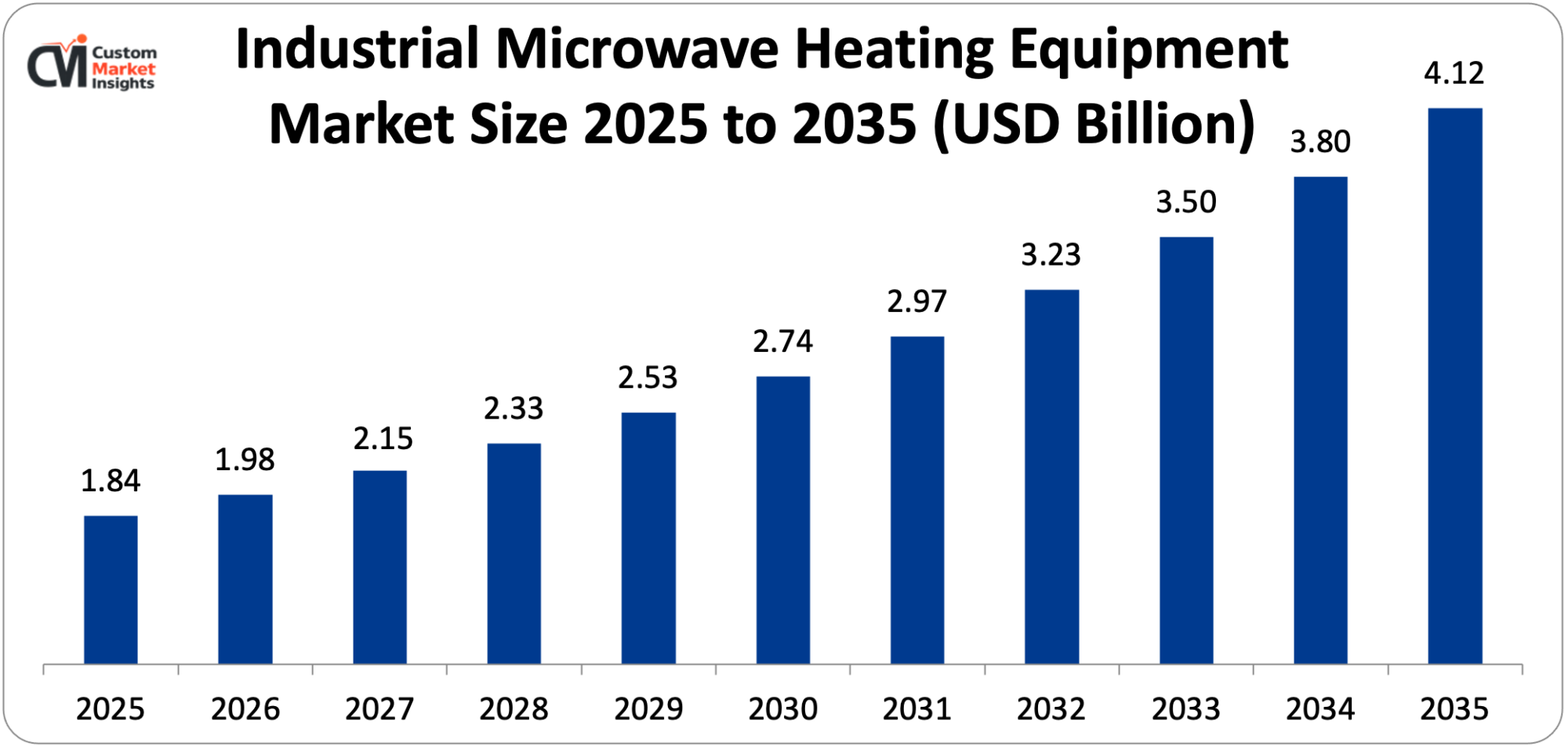
The overall size of the industrial microwave heating equipment market in the world is estimated to reach USD 1.84 billion in the year 2025 and is forecasted to rise from USD 1.98 billion in the year 2026 to about USD 4.12 billion in 2035 with a growth rate of 7.6% in the period between 2026 and 2035.
The increasing industrial use of microwave heating technology in food processing, pharmaceutical manufacturing, chemical synthesis and advanced materials processing applications was driven by the fundamental energy efficiency benefits of microwaves in comparison to conventional thermal heating systems, including volumetric heating, selective heating of specific material constituents and instant on-off controllability and fine-tuning of thermal treatment, which provides product quality and consistency benefits, the rising cost of energy and corporate decarbonization commitments that generate strong commercial incentive towards the use of microwaves instead of conventional thermal heating systems, the increasing application of industrial microwave system investment, and the growing global food industry investment in advanced processing technologies enabling reduced additive use, extended shelf life, and improved nutritional quality through precise thermal treatment collectively drive robust and sustained market growth throughout the forecast period.
Market Highlight
- Europe was dominant in the industrial microwave heating equipment market with a market share of 34% in the year 2025.
- Asia Pacific will have the highest CAGR of 9.4% in 2026-2035.
- By product category, the continuous microwave systems market share was found to take about 46% of the market share in 2025.
- By product type, the hybrid microwave systems segment has the highest CAGR of 10.2% in the period 2026-2035.
- By frequency, the 915 MHz segment was the biggest contributor of market share, 58%, in 2025 with the 2,450 MHz segment projected to experience the highest CAGR of 8.1% throughout the forecast between 2026 and 2035.
- The food processing and drying segment will have the largest market share of 38% in 2025, but the chemical and pharmaceutical processing segment is likely to experience the most rapid CAGR rates of 11.8% between 2026 and 2035.
- By end-use industry, the food and beverage segment had 40% of market share in 2025 whereas, the pharmaceuticals segment is projected to grow with the highest CAGR of 12.4% between 2026 and 2035.
Significant Growth Factors
The Industrial Microwave Heating Equipment Market Trends present significant growth opportunities due to several factors:
- Industrial Energy Efficiency Imperative and Decarbonization Commitments Driving Microwave Adoption:
The overlap of the growing cost of industrial energy due to the European energy crisis and thus the 2022 Russia-Ukraine conflict which has resulted in multi-decade highs in the European industrial energy prices, together with the structural trend of increasing the cost of energy as fossil fuel resources are depleted and carbon pricing continues to rise, with corporate net zero pledges demanding practical industrial energy intensity reduction is generating the greatest commercial and strategic incentive to adopt microwave technology in the industrial sector in the history of the technology. Industrial heating operations, which include drying, sterilization, pasteurization, vulcanization, chemical reaction, and thermal treatment processes throughout the food, pharmaceutical, chemical, and materials manufacturing industries are also considered one of the largest energy consuming categories of industry, with the International Energy Agency estimating that industrial process heat contributes about 20% of all final energy consumption in the world, presenting a huge potential amount of energy savings offered by more efficient heating systems such as microwaves.
The energy efficiency advantage of microwave heating over conventional thermal heating methods lies in the difference in the fundamental mechanism: Colin’s conventional heating involves the transfer of thermal energy between a hot medium or surface and the part being processed by conduction and convection whereas microwave heating produces heat inside the material by the interaction of electromagnetic waves with polar molecules – in particular water – generating heat throughout the material volumetrically in a uniform manner. In published process engineering applications, in food drying, pharmaceutical granule drying, ceramic sintering, and rubber vulcanization applications, invariably, specific energy savings of 30-70% are documented in substituting conventional hot air, steam, or infrared heating with microwave heating, the highest efficiency gains of which are observed in high-moisture-content material processing, where water with its high microwave energy absorption provides an outstanding volumetric heating efficiency.
The carbon footprint gain of the energy efficiency of microwave calculation, expressed as tonnes of CO₂ equivalent of avoided capital emission per year of operation, is now being included in industrial capital investment business cases as corporate sustainability reporting regulations necessitate quantification of capital expenditure carbon footprints, thus the environmental argument in favour of microwave investment is seen to supplement the energy cost reduction business case that has been hitherto predominant in business cases to acquire industrial equipment.
- Food Industry Quality and Clean Label Imperatives Driving Advanced Thermal Processing Investment:
Situated between food safety requirements on one side and consumer demands on the other, the world food industry has embarked on a progressive journey toward improving the quality of food products and services offered to consumers by implementing quality and clean label imperatives that necessitate the application of microwave heating methods to achieve food safety and shelf life extending benefits, eliminating food additives and processing aids that must be sacrificed to improve the quality of food products and services provided to consumers by conventional thermal processing, which damages food products and reduces their flavor, vitamins, and texture characteristics, thereby forfeiting clean labels.
Microwave pasteurization and microwave sterilization Industrial microwave pasteurization and sterilization, where microwave energy rapidly lifts food product temperature to the level of pathogen elimination without prolonging the thermal exposure time during which quality attributes of food products sensitive to different degrees of heat are lost, is proving to have commercially important quality benefits in comparison with conventional retort sterilization and hot-fill pasteurization across an ever-expanding assortment of food product categories such as ready meals, soups, sauces, fresh pasta, and seafood products where organ.
The Microwave-Assisted Thermal Sterilization (MATS) process, created at Washington State University and licensed to food manufacturers and equipment developers has been accepted by the FDA as a novel thermal processing method proving equal lethality of pathogens to conventional retort sterilization and showing significantly better texture, color, and flavor retentivity of processed food products, which is the regulatory validation system upon which food manufacturers can switch to microwave sterilization without concern of regulatory compliance.
The increasing consumer preference in the developed markets towards refrigerated food products as opposed to shelf stable food products with fresh and chilled food categories expanding at the expense of ambient canned and packaged categories is driving a need for industrial microwave pasteurization systems that would allow the fresh food category that supermarket retailers and food service operators are focusing on. Studies of sensory evaluation published comparing microwave-processed and conventionally processed versions of ready meals, fish products and vegetable preparations report a consistent pattern of statistically significant consumer preference for microwave-processed products in terms of texture, color and flavor attributes – consumer preference data that gives food manufacturers a quantifiable commercial incentive to invest in industrial microwave capital beyond the energy efficiency rationale.
What are the Major Advances Changing the Industrial Microwave Heating Equipment Market Today?
- Solid-State Microwave Generator Technology Replacing Magnetron-Based Systems:
Commercial development and progressive commercial market penetration of solid-state microwave power generators which utilize power semiconductor devices such as gallium nitride (GaN) and silicon carbide (SiC) transistors to produce microwave energy as opposed to the vacuum tube magnetron technology which has dominated industrial microwave generation since the commercial introduction of the technology is making a new generation of industrial microwave systems with far better frequency control, power modulation capability, operational lifetime, and process monitoring integration that is changing the ability of industrial microwave to meet the need of precision thermal processing applications in Traditional bulk drying and heating applications of magnetron-based industrial microwave generators at fixed frequencies of either 915 MHz or 2,450 MHz with low power modulation bandwidth and frequency stability that is dependent on magnetron operating temperature and cavity loading offer sufficient performance in conventional bulk drying and heating applications where uniformity in the process is not critical, but fail to provide the fine frequency tuning, high-speed modulation of power, and real-time impedance matching performance demanded in precision pharmaceutical, chemical, and advanced materials processing applications where continuous optimization of the Microwave generators based on solid-state technologies, frequency agility over a specified band 915 MHz or 2450 MHz, milliseconds response to power modulation, and electronic impedance comparable to that, allowing optimal energy coupling as load characteristics vary, make possible an entirely new generation of closed-loop temperature control, millisecond response to dielectric property changes, and adaptive process optimization, impossible to a magnetron system.
The downward trend of the cost of power semiconductor devices using GaN and SiC technologies – due to the volume manufacturing investment of these substances in EV power electronics and wireless communications base station applications sharing production infrastructure with microwave power generator applications – increasingly lowers the capital cost of solid-state generators to 35 times the price of the historically higher magnetic premium of magnetron systems that have limited solid-state application to technical-only applications, which will bring solid-state generator applications to a cost level enabling widespread industrial application. Ampleon solid-state microwave cooking and industrial heating systems, Richardson Electronics solid-state generator systems, and Muegge industrial solid-state microwave systems are the foremost commercial applications of solid-state industrial microwave technology with these companies recording case studies in pharmaceutical drying, food processing, and high-technology ceramics applications where solid-state systems obtain process results inaccessible to magnetron systems.
- Microwave-Assisted Chemical Synthesis and Pharmaceutical Process Intensification:
The broadening of the application of industrial microwave heating to the previously established physical processing industry (drying, pasteurization, sintering – to the business of chemical reaction acceleration and pharmaceutical process intensification) is fostering one of the most valuable and technically advanced growth areas of industrial microwave equipment, which is the capability of microwave to dramatically accelerate reaction rates in chemical reactions by selective heating of reactants and intermediates of the polar reactants and enabling chemical reactions to be completed in a few minutes as opposed to hours and the elimination of the thermal decomposition side reactions that conventional batch reactions Microwave-assisted chemical synthesis is where microwave energy is used to heat mixtures of chemical reactions in order to selectively heat polar solvent molecules and reaction intermediates to produce localized superheating that has been shown to swiftly accelerate the reactions of a wide variety of organic synthesis reactions such as esterification, polymerization, the formation of heterocycles, and catalytic coupling reactions, without increasing the overall temperature of the reactor to levels that can thermally degrade heat-sensitive starting substrates or products.
The use of microwave-assisted synthesis at laboratory scale, with which microwave synthesizers provided by Biotage and CEM Corporation have become commonplace in medicinal chemistry departments at large pharmaceutical corporations, is gradually being applied to manufacturing scale as continuous flow microwave reactors are now allowing the microwave-optimized synthetic route to be extended from laboratory to manufacturing scale without the redesign of fundamental chemistry necessary to scale up reactor-based methods.
The Process Analytical Technology program and continuous manufacturing recommendations of the U.S. FDA, which stimulates pharmaceutical manufacturers to embrace real-time process monitoring and continuous manufacturing technologies, which enable the provision of consistent thermal history per unit of pharmaceutical product processed, are in line with the requirement of regulators to accept regulatory acceptance pathways of microwave-based pharmaceutical manufacturing operations. Industrial microwave chemical reactor systems in SAIREM, microwave synthesis platforms at pharmaceutical scale-up processes in Milestone, and continuous flow microwave systems in CEM Corporation are the most successful commercial applications of the microwave intensification of processes in the pharmaceutical and specialty chemical market.
- Industrial IoT Integration and Process Intelligence Platform Development:
The combination of industrial IoT sensor networks, process optimization algorithms based on machine learning, simulation of digital twins, and monitoring of processes in the clouds with industrial microwave heating systems – turning fixed-parameter industrial microwave heating equipment into adaptive process intelligence platforms with higher consistency in product quality and operational efficiency than conventional microwave heating systems that required manual parameter settings – is changing the industrial microwave systems into platforms that provide high-quality products and are highly efficient in operation. Industrial microwave processes are not only dynamic, as the dielectric properties of the material, its density, and the distribution of its moisture and thermal mass vary continuously over the heating cycle, as the material loses moisture, undergoes chemical reactions, and alters phase as the material changes between production batches, but also provide process control challenges that are inadequately met by traditional fixed-parameter microwave systems, which respond to changes only in an average manner.
Multiple sensor modalities built into industrial microwave systems based on IoT (infrared thermography to map surface temperature and near-infrared spectroscopy to measure moisture in real-time, microwave reflectometry to monitor dielectric property, and weight to estimate endpoint in relation to varying input material properties) include the multivariate real-time process information needed to have the closed-loop control algorithms to maintain a constant product quality despite changing input material properties. Optimization algorithms based on machine learning processes trained on the basis of historical process data between the input material characteristics, microwave power patterns, and output product quality characteristics permit predictive process control, which can adjust parameters in advance at the onset of incoming material characterization instead of responding to quality variation once it has been detected and lead to a reduction in the variability of processes and product quality-rejection rates in pharmaceutical and food processing applications, where consistency is most critical. AMTek Microwaves IoT-connected industrial systems, intelligent microwave platforms of Puechner Microwave power systems, and the continuous microwave ovens with integrated process monitoring of Industrial Microwave Systems (IMS) are the most popular commercial applications of smart industrial microwave technology.
Category Wise Insights
By Product Type
Why Do Continuous Microwave Systems Lead the Market?
Continuous microwave systems dominate in the largest product type segments, with about 46% of total market share in 2025 because they are used in the largest industrial microwave application segments, such as food processing, pasta and snack drying, pharmaceutical continuous manufacturing, and rubber vulcanization, where production economics dictate continuous throughput, not batch processing, between consecutive production cycles that reduces effective production capacity and raises the processing cost per unit. Constant movements of product through a long applicator cavity on a conveyor belt with microwave energy coupled into the waveguide feeds uniformly distributed along the tunnel length result in steady-state thermal conditions that have been shown to afford a constant and predictable quality of products throughout the entire production run with no batch-to-batch variation in temperature distribution or exposure time as seen in batch applicator-generated microwave systems.
The use in the food industry of continuous microwave tunnel systems to dry pasta, snacks, and pet foods (where the production rate of 1,000-10,000 kg/h could not be served by batch processing facilities) is the largest single application of the continuous microwave system by installed capacity, with continuous microwave pasta dryers by Stalam and continuous snack dryers by IMS in use at large food manufacturing companies around the world. The capital cost of continuous microwave systems, which ranges from USD 500,000 to USD 5,000,000 per installation based on power level and throughput, is recouped in volumes of production and in the energy savings, improvement of throughput and quality improvement of products that combine to produce compelling return on investment cases.
By Frequency
Why Does 915 MHz Lead the Market?
The highest frequency (915 MHz) dominates the largest market share at 915 MHz (around 58% in 2025) and represents the strong penetration of 915 MHz in the high-power industrial processing markets where 915 MHz offers the greater penetration depth of 10 to 20 cm in high-moisture food materials over 2450 MHz systems (Volumetric heating) and larger power processing loads (Very Large Loads) in the market, where the higher penetration depth of the 915 MHz frequency band — specifically allocated for industrial, scientific, and medical (ISM) use in North America and increasingly recognized internationally — accommodates the high-power magnetron and solid-state generators of 30–300 kW per unit that large-scale industrial processing requires, with multiple power sources combined in multi-feed tunnel systems achieving total installed power levels of 100–1,000 kW that enable throughput rates required for industrial-scale food, pharmaceutical, and materials processing operations.
The 2,450 MHz segment is experiencing faster growth driven by the pharmaceutical and specialty chemical processing applications that prefer 2,450 MHz for its precise power control characteristics at laboratory and pilot scale, the expanding solid-state microwave generator market where 2,450 MHz solid-state systems are more commercially mature than 915 MHz equivalents, and the growing adoption of 2,450 MHz industrial microwaves for precision applications including pharmaceutical granule drying and advanced ceramics sintering where the shorter wavelength provides better electromagnetic field uniformity in smaller processing chambers.
By Application
Why Does Food Processing & Drying Lead the Market?
Food processing and drying represent the largest application segment at approximately 38% of total market share in 2025, reflecting the food industry’s decades of industrial microwave technology adoption across pasta drying, snack food drying, meat tempering, seafood thawing, ready meal sterilization, and baked goods finishing — applications where microwave heating’s energy efficiency, product quality advantages, and processing time reduction have been validated through extensive commercial installations globally and documented in published food engineering literature that provides the technical credibility supporting continued adoption expansion.
The pasta drying application — in which continuous microwave tunnel systems replace or supplement conventional hot air tunnel dryers for the final low-moisture drying stage of pasta production — represents one of the most commercially mature and extensively documented industrial microwave food applications globally, with microwave pasta dryers from Stalam operating at major pasta producers including Barilla and De Cecco in Italy and equivalent manufacturers in North America and Asia Pacific demonstrating energy savings, drying time reduction, and pasta quality improvement relative to conventional hot air drying. The meat tempering application — in which microwave energy uniformly raises frozen meat blocks from deep-freeze storage temperatures of -18°C to the tempering temperature of -2 to -5°C that enables meat cutting and processing without complete defrosting — represents another high-volume industrial microwave food application where microwave’s penetration depth advantage over surface-thawing methods achieves tempering time reduction from 24–72 hours for conventional tempering to 2–4 hours for microwave, with dramatic reduction in drip loss and microbial growth risk that conventional slow thawing accumulates.
By End-Use Industry
Why Does the Food & Beverage Industry Lead the Market?
The food and beverage industry is the largest end-use at about 40% in 2025 due to decades of industrial adoption of microwaves across the applications above; acute sensitivity of the food industry to the cost of energy, where energy has a large portion of the operating cost of food manufacturing; and the clean label market trend is producing commercial urgency that needs improvement in processing using microwaves to reduce the need for preservatives and other food additives. Pharmaceutical industry FDA continuous manufacturing guidance is converging to present regulatory incentives to modernize processes. Medicine industry willingness to pay significantly more than Pharmaceutical industry willingness to pay is increasing at a CAGR of 12.4 from 2026 to 2035 due to convergence of the FDA continuous manufacturing guidance, the pharmaceutical industry has a high willingness to pay to access processing equipment with demonstrably higher capability at improving the consistency of product quality and regulatory compliance capability. microwave-assisted scale-up of synthesis processes has enabled pharmaceutical manufacturers to process what conventional drying and heating methods cannot match without product degradation risk.
Report Scope
| Feature of the Report | Details |
| Market Size in 2026 | USD 1.98 billion |
| Projected Market Size in 2035 | USD 4.12 billion |
| Market Size in 2025 | USD 1.84 billion |
| CAGR Growth Rate | 7.6% CAGR |
| Base Year | 2025 |
| Forecast Period | 2026-2035 |
| Key Segment | By Product Type, Frequency, Application, End-Use Industry and Region |
| Report Coverage | Revenue Estimation and Forecast, Company Profile, Competitive Landscape, Growth Factors and Recent Trends |
| Regional Scope | North America, Europe, Asia Pacific, Middle East & Africa, and South & Central America |
| Buying Options | Request tailored purchasing options to fulfil your requirements for research. |
Regional Analysis
How Big is the European Market Size?
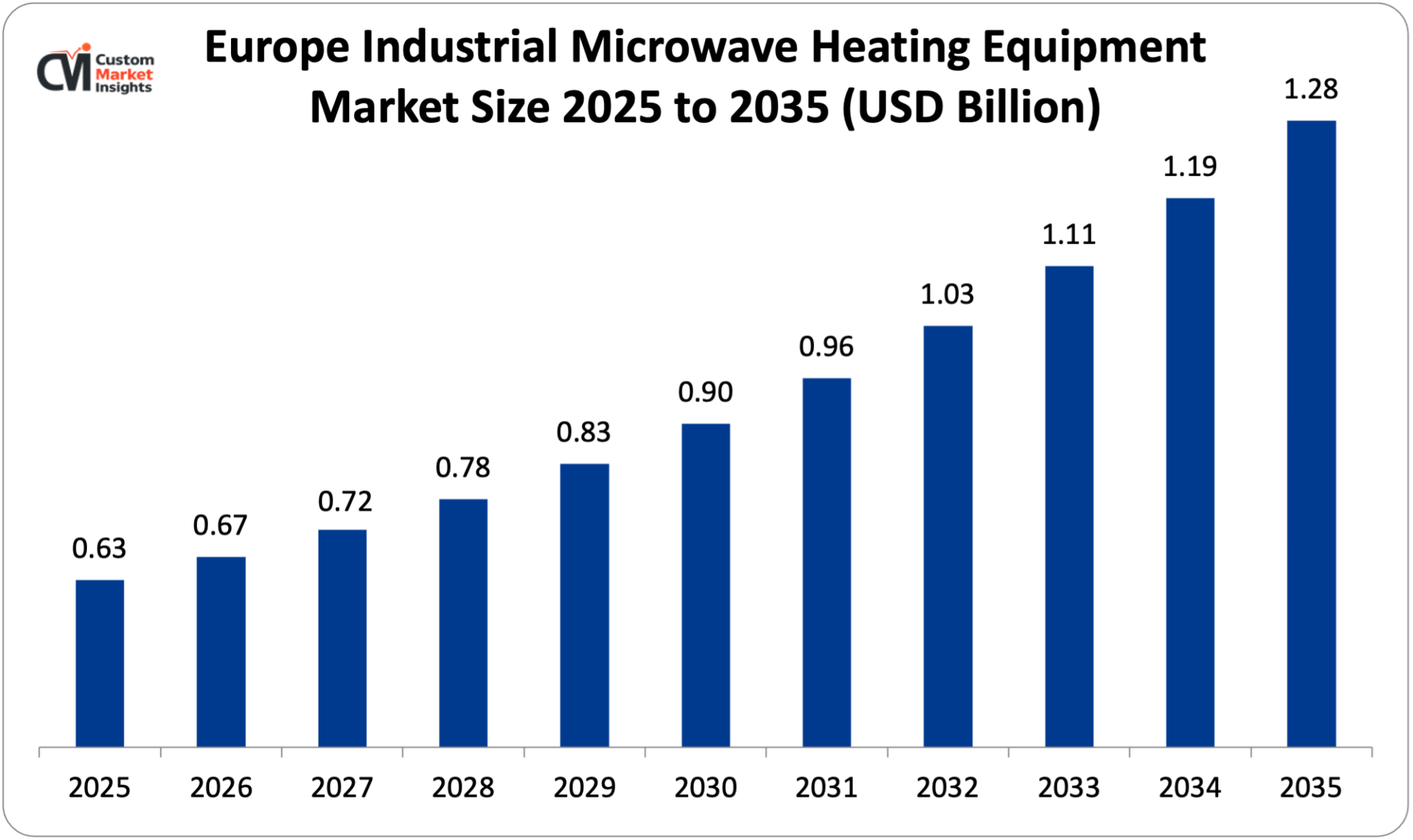
The European industrial microwave heating equipment market size is estimated at USD 626 million in 2025 and is projected to reach approximately USD 1.28 billion by 2035, with a CAGR of 7.4% from 2026 to 2035.
Why Did Europe Dominate the Market in 2025?
Europe controls some 34% of the worldwide market share in 2025 in the form of industrial microwave technology development and production, with the European continent as the global centre of industrial development and manufacture of microwave heating technologies. the majority of the largest industrial manufacturers of industrial microwave equipment headquartered in Europe in Pueschner (Germany), Stalam (Italy), SAIREM (France), Muegge (Germany), and Linn High Therm (Germany) and the industry has the highest energy cost for industrial heating The European energy crisis after the Russian invasion of Ukraine, in which European natural gas prices hit 10 times historical levels and industrial electricity prices rose 3–5 times in 2022, created a commercial urgency in investing in energy efficiency in industries across European manufacturing that was disproportionately favorable to the adoption of microwave heating due to its recorded energy saving of 3070% as compared to conventional gas-fired heating. Germany and Italy are the two largest European national markets in terms of industrial microwave heating equipment, Germany due to its combination of mass chemical, pharmaceutical, and automotive composite manufacturing industries and the aggressive industrial decarbonization agenda of the Energiewende, and Italy due to its ownership of the largest pasta manufacturing industry in the world, which is one of the highest concentrations of ongoing microwave pasta dryers globally. France, the Netherlands, and the United Kingdom are other significant contributors to the European markets.
Why is Asia Pacific the Fastest-Growing Market?
The fastest growing regional market is Asia Pacific, where the CAGR of the food processing market is expected to increase by 9.4% between 2026 and 2035 due to the rapidly expanding food processing market of China, where government-supported modernization of food processing systems is driving investment in energy-efficient processing equipment, Japan and its advanced food and pharmaceutical production sectors, which are adopting precision microwave processing due to its energy efficiency benefits; South Korea with its large food conglomerates and pharmaceutical production and its progressive industrial energy cost increases, which are providing impetus; and As domestic food manufacturers upgrade production facilities to meet quality-conscious Chinese consumer demand, China has the largest food processing industry in the world in terms of volume of production and fast development in reaction to urbanization, increasing incomes, and changes in consumer tastes, which is investing in industrial microwave pasta, snack, and ready meal processing equipment.
The pharmaceutical manufacturing industry of Japan, which is also one of the most technologically advanced and quality-driven in the world, is now moving towards industrial microwave systems to dry pharmaceutical granules, sterilize them, and produce API using the tech at large Japanese pharmaceutical companies such as Takeda, Astellas, and Eisai.
Why is North America an Important Market?
The microwave heating equipment market industry in North America is projected to grow to about USD 386 million by the year 2025 and to about USD 741 million by the year 2035, with a CAGR of 6.7. The large-scale use of industrial microwave tempering and drying by the U.S. food processing industry, the active pursuit of continuous microwave manufacturing by pharmaceutical manufacturing industries facilitated by FDA PAT and continuous manufacturing regulatory regimes, and the advanced uses of microwave curing of carbon fiber composite structures by Boeing, Lockheed Martin and the tier-1 aerospace suppliers anchor the market of North America. Industrial microwave technology has been demonstrated through the support of the IDA Advanced Manufacturing Program as well as the DOE Advanced Manufacturing Office, which has been seen to give government credibility to an energy efficiency claim of a technology as well as help to reduce the risk of adopting the technology by industry players who may be considering making their first microwave investment.
Why is the Middle East & Africa Region an Emerging Market?
The LAMEA region is experiencing a series of market developments following the growth of Saudi Arabia and UAE food processing industries, which can be used in serving the local market and export markets in the gulf region, the acute need for industrial energy efficiency in the Middle East, which is set to drive the energy saving processing technology, and the pharmaceutical manufacturing industry in South Africa, which is set to invest in energy saving processing technology.
Top Players in the Market and Their Offerings
- Püschner Microwave Power Systems GmbH & Co. KG
- Stalam S.p.A.
- Industrial Microwave Systems (IMS) LLC
- SAIREM SAS
- Muegge GmbH
- AMTek Microwaves Ltd.
- CEM Corporation
- Milestone S.r.l.
- Ferrite Microwave Technologies
- Linn High Therm GmbH
- Thermex-Thermatron Systems Inc.
- Others
Key Developments
The market has undergone significant developments as industry participants seek to advance solid-state microwave generator capabilities, expand pharmaceutical processing applications, and respond to the growing industrial demand for energy-efficient heating solutions driven by energy cost escalation and corporate decarbonization commitments globally.
- In September 2024: Stalam commercialized its RF-NEXT radio frequency and microwave single integrated continuous drying system that uses a hybrid applicator with a combination of 27.12 MHz radio frequency energy to deep penetrate the product and 2,450 MHz microwave energy to resolve the moisture on the surface in seconds in a single integrated conveyor tunnel that serves pasta, breakfast cereal, and pet food drying markets.
- In January 2025: SAIREM declared a strategic alliance with a major European pharmaceutical contract manufacturing organization committed to co-development and validation of a continuous system of Microwave granule dryers that met the FDA 21 CFR Part 11 electronic records and GAMP software validation requirements to deploy in GMP pharmaceutical manufacturing facilities, replacing the usual fluid bed dryers in pharmaceutical wet granulation manufacturing lines.
The Industrial Microwave Heating Equipment Market is segmented as follows:
By Product Type
- Batch Microwave Systems (Chamber Ovens, Multimode Applicators)
- Continuous Microwave Systems (Tunnel Ovens, Conveyor Systems)
- Hybrid Microwave Systems (Microwave-Hot Air, Microwave-Infrared, Microwave-Steam)
- Other Product Types (Microwave Reactors, Solid-State Microwave Systems)
By Frequency
- 915 MHz (High-Power Industrial Applications, Large Load Processing)
- 2,450 MHz (Laboratory Scale, Precision Processing, Pharmaceutical)
By Application
- Food Processing & Drying (Pasta, Snacks, Meat, Seafood, Ready Meals)
- Rubber & Plastics Processing (Vulcanization, Curing, Preheating)
- Chemical & Pharmaceutical Processing (Synthesis, Granule Drying, Sterilization)
- Wood & Timber Drying (Lumber Drying, Veneer Treatment)
- Ceramic & Composite Sintering (Technical Ceramics, Carbon Fiber Composites)
- Textile & Paper Processing (Drying, Finishing, Curing)
- Other Applications (Soil Remediation, Mineral Processing)
By End-Use Industry
- Food & Beverage
- Chemicals & Petrochemicals
- Pharmaceuticals & Life Sciences
- Automotive & Aerospace (Composite Curing, Rubber Components)
- Construction & Building Materials (Concrete Curing, Ceramics)
- Forestry & Wood Products
- Other Industries (Mining, Textiles, Defense)
Regional Coverage:
North America
- U.S.
- Canada
- Mexico
- Rest of North America
Europe
- Germany
- France
- U.K.
- Russia
- Italy
- Spain
- Netherlands
- Rest of Europe
Asia Pacific
- China
- Japan
- India
- New Zealand
- Australia
- South Korea
- Taiwan
- Rest of Asia Pacific
The Middle East & Africa
- Saudi Arabia
- UAE
- Egypt
- Kuwait
- South Africa
- Rest of the Middle East & Africa
Latin America
- Brazil
- Argentina
- Rest of Latin America
Table of Contents
- Chapter 1. Report Introduction
- 1.1. Report Description
- 1.1.1. Purpose of the Report
- 1.1.2. USP & Key Offerings
- 1.2. Key Benefits For Stakeholders
- 1.3. Target Audience
- 1.4. Report Scope
- 1.1. Report Description
- Chapter 2. Market Overview
- 2.1. Report Scope (Segments And Key Players)
- 2.1.1. Industrial Microwave Heating Equipment by Segments
- 2.1.2. Industrial Microwave Heating Equipment by Region
- 2.2. Executive Summary
- 2.2.1. Market Size & Forecast
- 2.2.2. Industrial Microwave Heating Equipment Market Attractiveness Analysis, By Product Type
- 2.2.3. Industrial Microwave Heating Equipment Market Attractiveness Analysis, By Frequency
- 2.2.4. Industrial Microwave Heating Equipment Market Attractiveness Analysis, By Application
- 2.2.5. Industrial Microwave Heating Equipment Market Attractiveness Analysis, By End-Use Industry
- 2.1. Report Scope (Segments And Key Players)
- Chapter 3. Market Dynamics (DRO)
- 3.1. Market Drivers
- 3.1.1. Industrial Energy Efficiency Imperative and Decarbonization Commitments Driving Microwave Adoption
- 3.1.2. Food Industry Quality and Clean Label Imperatives Driving Advanced Thermal Processing Investment
- 3.2. Market Restraints
- 3.3. Market Opportunities
- 3.5. Pestle Analysis
- 3.6. Porter Forces Analysis
- 3.7. Technology Roadmap
- 3.8. Value Chain Analysis
- 3.9. Government Policy Impact Analysis
- 3.10. Pricing Analysis
- 3.1. Market Drivers
- Chapter 4. Industrial Microwave Heating Equipment Market – By Product Type
- 4.1. Product Type Market Overview, By Product Type Segment
- 4.1.1. Industrial Microwave Heating Equipment Market Revenue Share, By Product Type, 2025 & 2035
- 4.1.2. Batch Microwave Systems (Chamber Ovens, Multimode Applicators)
- 4.1.3. Industrial Microwave Heating Equipment Share Forecast, By Region (USD Billion)
- 4.1.4. Comparative Revenue Analysis, By Country, 2025 & 2035
- 4.1.5. Key Market Trends, Growth Factors, & Opportunities
- 4.1.6. Continuous Microwave Systems (Tunnel Ovens, Conveyor Systems)
- 4.1.7. Industrial Microwave Heating Equipment Share Forecast, By Region (USD Billion)
- 4.1.8. Comparative Revenue Analysis, By Country, 2025 & 2035
- 4.1.9. Key Market Trends, Growth Factors, & Opportunities
- 4.1.10. Hybrid Microwave Systems (Microwave-Hot Air, Microwave-Infrared, Microwave-Steam)
- 4.1.11. Industrial Microwave Heating Equipment Share Forecast, By Region (USD Billion)
- 4.1.12. Comparative Revenue Analysis, By Country, 2025 & 2035
- 4.1.13. Key Market Trends, Growth Factors, & Opportunities
- 4.1.14. Other Product Types (Microwave Reactors, Solid-State Microwave Systems)
- 4.1.15. Industrial Microwave Heating Equipment Share Forecast, By Region (USD Billion)
- 4.1.16. Comparative Revenue Analysis, By Country, 2025 & 2035
- 4.1.17. Key Market Trends, Growth Factors, & Opportunities
- 4.1. Product Type Market Overview, By Product Type Segment
- Chapter 5. Industrial Microwave Heating Equipment Market – By Frequency
- 5.1. Frequency Market Overview, By Frequency Segment
- 5.1.1. Industrial Microwave Heating Equipment Market Revenue Share, By Frequency, 2025 & 2035
- 5.1.2. 915 MHz (High-Power Industrial Applications, Large Load Processing)
- 5.1.3. Industrial Microwave Heating Equipment Share Forecast, By Region (USD Billion)
- 5.1.4. Comparative Revenue Analysis, By Country, 2025 & 2035
- 5.1.5. Key Market Trends, Growth Factors, & Opportunities
- 5.1.6. 2,450 MHz (Laboratory Scale, Precision Processing, Pharmaceutical)
- 5.1.7. Industrial Microwave Heating Equipment Share Forecast, By Region (USD Billion)
- 5.1.8. Comparative Revenue Analysis, By Country, 2025 & 2035
- 5.1.9. Key Market Trends, Growth Factors, & Opportunities
- 5.1. Frequency Market Overview, By Frequency Segment
- Chapter 6. Industrial Microwave Heating Equipment Market – By Application
- 6.1. Application Market Overview, By Application Segment
- 6.1.1. Industrial Microwave Heating Equipment Market Revenue Share, By Application, 2025 & 2035
- 6.1.2. Food Processing & Drying (Pasta, Snacks, Meat, Seafood, Ready Meals)
- 6.1.3. Industrial Microwave Heating Equipment Share Forecast, By Region (USD Billion)
- 6.1.4. Comparative Revenue Analysis, By Country, 2025 & 2035
- 6.1.5. Key Market Trends, Growth Factors, & Opportunities
- 6.1.6. Rubber & Plastics Processing (Vulcanization, Curing, Preheating)
- 6.1.7. Industrial Microwave Heating Equipment Share Forecast, By Region (USD Billion)
- 6.1.8. Comparative Revenue Analysis, By Country, 2025 & 2035
- 6.1.9. Key Market Trends, Growth Factors, & Opportunities
- 6.1.10. Chemical & Pharmaceutical Processing (Synthesis, Granule Drying, Sterilization)
- 6.1.11. Industrial Microwave Heating Equipment Share Forecast, By Region (USD Billion)
- 6.1.12. Comparative Revenue Analysis, By Country, 2025 & 2035
- 6.1.13. Key Market Trends, Growth Factors, & Opportunities
- 6.1.14. Wood & Timber Drying (Lumber Drying, Veneer Treatment)
- 6.1.15. Industrial Microwave Heating Equipment Share Forecast, By Region (USD Billion)
- 6.1.16. Comparative Revenue Analysis, By Country, 2025 & 2035
- 6.1.17. Key Market Trends, Growth Factors, & Opportunities
- 6.1.18. Ceramic & Composite Sintering (Technical Ceramics, Carbon Fiber Composites)
- 6.1.19. Industrial Microwave Heating Equipment Share Forecast, By Region (USD Billion)
- 6.1.20. Comparative Revenue Analysis, By Country, 2025 & 2035
- 6.1.21. Key Market Trends, Growth Factors, & Opportunities
- 6.1.22. Textile & Paper Processing (Drying, Finishing, Curing)
- 6.1.23. Industrial Microwave Heating Equipment Share Forecast, By Region (USD Billion)
- 6.1.24. Comparative Revenue Analysis, By Country, 2025 & 2035
- 6.1.25. Key Market Trends, Growth Factors, & Opportunities
- 6.1.26. Other Applications (Soil Remediation, Mineral Processing)
- 6.1.27. Industrial Microwave Heating Equipment Share Forecast, By Region (USD Billion)
- 6.1.28. Comparative Revenue Analysis, By Country, 2025 & 2035
- 6.1.29. Key Market Trends, Growth Factors, & Opportunities
- 6.1. Application Market Overview, By Application Segment
- Chapter 7. Industrial Microwave Heating Equipment Market – By End-Use Industry
- 7.1. End-Use Industry Market Overview, By End-Use Industry Segment
- 7.1.1. Industrial Microwave Heating Equipment Market Revenue Share, By End-Use Industry, 2025 & 2035
- 7.1.2. Food & Beverage
- 7.1.3. Industrial Microwave Heating Equipment Share Forecast, By Region (USD Billion)
- 7.1.4. Comparative Revenue Analysis, By Country, 2025 & 2035
- 7.1.5. Key Market Trends, Growth Factors, & Opportunities
- 7.1.6. Chemicals & Petrochemicals
- 7.1.7. Industrial Microwave Heating Equipment Share Forecast, By Region (USD Billion)
- 7.1.8. Comparative Revenue Analysis, By Country, 2025 & 2035
- 7.1.9. Key Market Trends, Growth Factors, & Opportunities
- 7.1.10. Pharmaceuticals & Life Sciences
- 7.1.11. Industrial Microwave Heating Equipment Share Forecast, By Region (USD Billion)
- 7.1.12. Comparative Revenue Analysis, By Country, 2025 & 2035
- 7.1.13. Key Market Trends, Growth Factors, & Opportunities
- 7.1.14. Automotive & Aerospace (Composite Curing, Rubber Components)
- 7.1.15. Industrial Microwave Heating Equipment Share Forecast, By Region (USD Billion)
- 7.1.16. Comparative Revenue Analysis, By Country, 2025 & 2035
- 7.1.17. Key Market Trends, Growth Factors, & Opportunities
- 7.1.18. Construction & Building Materials (Concrete Curing, Ceramics)
- 7.1.19. Industrial Microwave Heating Equipment Share Forecast, By Region (USD Billion)
- 7.1.20. Comparative Revenue Analysis, By Country, 2025 & 2035
- 7.1.21. Key Market Trends, Growth Factors, & Opportunities
- 7.1.22. Forestry & Wood Products
- 7.1.23. Industrial Microwave Heating Equipment Share Forecast, By Region (USD Billion)
- 7.1.24. Comparative Revenue Analysis, By Country, 2025 & 2035
- 7.1.25. Key Market Trends, Growth Factors, & Opportunities
- 7.1.26. Other Industries (Mining, Textiles, Defense)
- 7.1.27. Industrial Microwave Heating Equipment Share Forecast, By Region (USD Billion)
- 7.1.28. Comparative Revenue Analysis, By Country, 2025 & 2035
- 7.1.29. Key Market Trends, Growth Factors, & Opportunities
- 7.1. End-Use Industry Market Overview, By End-Use Industry Segment
- Chapter 8. Industrial Microwave Heating Equipment Market – Regional Analysis
- 8.1. Industrial Microwave Heating Equipment Market Overview, By Region Segment
- 8.1.1. Global Industrial Microwave Heating Equipment Market Revenue Share, By Region, 2025 & 2035
- 8.1.2. Global Industrial Microwave Heating Equipment Market Revenue, By Region, 2026 – 2035 (USD Billion)
- 8.1.3. Global Industrial Microwave Heating Equipment Market Revenue, By Product Type, 2026 – 2035
- 8.1.4. Global Industrial Microwave Heating Equipment Market Revenue, By Frequency, 2026 – 2035
- 8.1.5. Global Industrial Microwave Heating Equipment Market Revenue, By Application, 2026 – 2035
- 8.1.6. Global Industrial Microwave Heating Equipment Market Revenue, By End-Use Industry, 2026 – 2035
- 8.2. North America
- 8.2.1. North America Industrial Microwave Heating Equipment Market Revenue, By Country, 2026 – 2035 (USD Billion)
- 8.2.2. North America Industrial Microwave Heating Equipment Market Revenue, By Product Type, 2026 – 2035
- 8.2.3. North America Industrial Microwave Heating Equipment Market Revenue, By Frequency, 2026 – 2035
- 8.2.4. North America Industrial Microwave Heating Equipment Market Revenue, By Application, 2026 – 2035
- 8.2.5. North America Industrial Microwave Heating Equipment Market Revenue, By End-Use Industry, 2026 – 2035
- 8.2.6. U.S. Industrial Microwave Heating Equipment Market Revenue, 2026 – 2035 (USD Billion)
- 8.2.7. Canada Industrial Microwave Heating Equipment Market Revenue, 2026 – 2035 (USD Billion)
- 8.2.8. Mexico Industrial Microwave Heating Equipment Market Revenue, 2026 – 2035 (USD Billion)
- 8.2.9. Rest of North America Industrial Microwave Heating Equipment Market Revenue, 2026 – 2035 (USD Billion)
- 8.3. Europe
- 8.3.1. Europe Industrial Microwave Heating Equipment Market Revenue, By Country, 2026 – 2035 (USD Billion)
- 8.3.2. Europe Industrial Microwave Heating Equipment Market Revenue, By Product Type, 2026 – 2035
- 8.3.3. Europe Industrial Microwave Heating Equipment Market Revenue, By Frequency, 2026 – 2035
- 8.3.4. Europe Industrial Microwave Heating Equipment Market Revenue, By Application, 2026 – 2035
- 8.3.5. Europe Industrial Microwave Heating Equipment Market Revenue, By End-Use Industry, 2026 – 2035
- 8.3.6. Germany Industrial Microwave Heating Equipment Market Revenue, 2026 – 2035 (USD Billion)
- 8.3.7. France Industrial Microwave Heating Equipment Market Revenue, 2026 – 2035 (USD Billion)
- 8.3.8. U.K. Industrial Microwave Heating Equipment Market Revenue, 2026 – 2035 (USD Billion)
- 8.3.9. Russia Industrial Microwave Heating Equipment Market Revenue, 2026 – 2035 (USD Billion)
- 8.3.10. Italy Industrial Microwave Heating Equipment Market Revenue, 2026 – 2035 (USD Billion)
- 8.3.11. Spain Industrial Microwave Heating Equipment Market Revenue, 2026 – 2035 (USD Billion)
- 8.3.12. Netherlands Industrial Microwave Heating Equipment Market Revenue, 2026 – 2035 (USD Billion)
- 8.3.13. Rest of Europe Industrial Microwave Heating Equipment Market Revenue, 2026 – 2035 (USD Billion)
- 8.4. Asia Pacific
- 8.4.1. Asia Pacific Industrial Microwave Heating Equipment Market Revenue, By Country, 2026 – 2035 (USD Billion)
- 8.4.2. Asia Pacific Industrial Microwave Heating Equipment Market Revenue, By Product Type, 2026 – 2035
- 8.4.3. Asia Pacific Industrial Microwave Heating Equipment Market Revenue, By Frequency, 2026 – 2035
- 8.4.4. Asia Pacific Industrial Microwave Heating Equipment Market Revenue, By Application, 2026 – 2035
- 8.4.5. Asia Pacific Industrial Microwave Heating Equipment Market Revenue, By End-Use Industry, 2026 – 2035
- 8.4.6. China Industrial Microwave Heating Equipment Market Revenue, 2026 – 2035 (USD Billion)
- 8.4.7. Japan Industrial Microwave Heating Equipment Market Revenue, 2026 – 2035 (USD Billion)
- 8.4.8. India Industrial Microwave Heating Equipment Market Revenue, 2026 – 2035 (USD Billion)
- 8.4.9. New Zealand Industrial Microwave Heating Equipment Market Revenue, 2026 – 2035 (USD Billion)
- 8.4.10. Australia Industrial Microwave Heating Equipment Market Revenue, 2026 – 2035 (USD Billion)
- 8.4.11. South Korea Industrial Microwave Heating Equipment Market Revenue, 2026 – 2035 (USD Billion)
- 8.4.12. Taiwan Industrial Microwave Heating Equipment Market Revenue, 2026 – 2035 (USD Billion)
- 8.4.13. Rest of Asia Pacific Industrial Microwave Heating Equipment Market Revenue, 2026 – 2035 (USD Billion)
- 8.5. The Middle-East and Africa
- 8.5.1. The Middle-East and Africa Industrial Microwave Heating Equipment Market Revenue, By Country, 2026 – 2035 (USD Billion)
- 8.5.2. The Middle-East and Africa Industrial Microwave Heating Equipment Market Revenue, By Product Type, 2026 – 2035
- 8.5.3. The Middle-East and Africa Industrial Microwave Heating Equipment Market Revenue, By Frequency, 2026 – 2035
- 8.5.4. The Middle-East and Africa Industrial Microwave Heating Equipment Market Revenue, By Application, 2026 – 2035
- 8.5.5. The Middle-East and Africa Industrial Microwave Heating Equipment Market Revenue, By End-Use Industry, 2026 – 2035
- 8.5.6. Saudi Arabia Industrial Microwave Heating Equipment Market Revenue, 2026 – 2035 (USD Billion)
- 8.5.7. UAE Industrial Microwave Heating Equipment Market Revenue, 2026 – 2035 (USD Billion)
- 8.5.8. Egypt Industrial Microwave Heating Equipment Market Revenue, 2026 – 2035 (USD Billion)
- 8.5.9. Kuwait Industrial Microwave Heating Equipment Market Revenue, 2026 – 2035 (USD Billion)
- 8.5.10. South Africa Industrial Microwave Heating Equipment Market Revenue, 2026 – 2035 (USD Billion)
- 8.5.11. Rest of the Middle East & Africa Industrial Microwave Heating Equipment Market Revenue, 2026 – 2035 (USD Billion)
- 8.6. Latin America
- 8.6.1. Latin America Industrial Microwave Heating Equipment Market Revenue, By Country, 2026 – 2035 (USD Billion)
- 8.6.2. Latin America Industrial Microwave Heating Equipment Market Revenue, By Product Type, 2026 – 2035
- 8.6.3. Latin America Industrial Microwave Heating Equipment Market Revenue, By Frequency, 2026 – 2035
- 8.6.4. Latin America Industrial Microwave Heating Equipment Market Revenue, By Application, 2026 – 2035
- 8.6.5. Latin America Industrial Microwave Heating Equipment Market Revenue, By End-Use Industry, 2026 – 2035
- 8.6.6. Brazil Industrial Microwave Heating Equipment Market Revenue, 2026 – 2035 (USD Billion)
- 8.6.7. Argentina Industrial Microwave Heating Equipment Market Revenue, 2026 – 2035 (USD Billion)
- 8.6.8. Rest of Latin America Industrial Microwave Heating Equipment Market Revenue, 2026 – 2035 (USD Billion)
- 8.1. Industrial Microwave Heating Equipment Market Overview, By Region Segment
- Chapter 9. Competitive Landscape
- 9.1. Company Market Share Analysis – 2025
- 9.1.1. Global Industrial Microwave Heating Equipment Market: Company Market Share, 2025
- 9.2. Global Industrial Microwave Heating Equipment Market Company Market Share, 2024
- 9.1. Company Market Share Analysis – 2025
- Chapter 10. Company Profiles
- 10.1. Püschner Microwave Power Systems GmbH & Co. KG
- 10.1.1. Company Overview
- 10.1.2. Key Executives
- 10.1.3. Product Portfolio
- 10.1.4. Financial Overview
- 10.1.5. Operating Business Segments
- 10.1.6. Business Performance
- 10.1.7. Recent Developments
- 10.2. Stalam S.p.A.
- 10.3. Industrial Microwave Systems (IMS) LLC
- 10.4. SAIREM SAS
- 10.5. Muegge GmbH
- 10.6. AMTek Microwaves Ltd.
- 10.7. CEM Corporation
- 10.8. Milestone S.r.l.
- 10.9. Ferrite Microwave Technologies
- 10.10. Linn High Therm GmbH
- 10.11. Thermex-Thermatron Systems Inc.
- 10.12. Others.
- 10.1. Püschner Microwave Power Systems GmbH & Co. KG
- Chapter 11. Research Methodology
- 11.1. Research Methodology
- 11.2. Secondary Research
- 11.3. Primary Research
- 11.3.1. Analyst Tools and Models
- 11.4. Research Limitations
- 11.5. Assumptions
- 11.6. Insights From Primary Respondents
- 11.7. Why Custom Market Insights
- Chapter 12. Standard Report Commercials & Add-Ons
- 12.1. Customization Options
- 12.2. Subscription Module For Market Research Reports
- 12.3. Client Testimonials
List Of Figures
Figures No 1 to 38
List Of Tables
Tables No 1 to 51
Prominent Player
- Püschner Microwave Power Systems GmbH & Co. KG
- Stalam S.p.A.
- Industrial Microwave Systems (IMS) LLC
- SAIREM SAS
- Muegge GmbH
- AMTek Microwaves Ltd.
- CEM Corporation
- Milestone S.r.l.
- Ferrite Microwave Technologies
- Linn High Therm GmbH
- Thermex-Thermatron Systems Inc.
- Others
FAQs
The key players in the market are Püschner Microwave Power Systems GmbH & Co. KG, Stalam S.p.A., Industrial Microwave Systems (IMS) LLC, SAIREM SAS, Muegge GmbH, AMTek Microwaves Ltd., CEM Corporation, Milestone S.r.l., Ferrite Microwave Technologies, Linn High Therm GmbH, Thermex-Thermatron Systems Inc., Others.
Government regulations affect the microwave heating equipment market in the industry on various fronts; energy efficiency regulation providing a compliance-related investment drive, food safety regulation providing thermal processing prerequisites that must be met by microwave-based technology, pharmaceutical GMP regulation providing the quality system infrastructure necessary to enable the application of the microwave-based technology in drug manufacture. The Energy Efficiency Directive of the EU, which provides binding energy saving targets to the EU member states and energy efficiency obligations to energy companies serving large industrial clients, establishes a regulatory background, which gradually makes the commercial priority of industrial energy efficiency investment including taking up microwave heating into service at EU-regulated industrial facilities. With the EU Industrial Emissions Directive, which obliges large installations to use Best Available Techniques as an energy-saving strategy as stated in BAT Reference Documents, the industrial heat processor would have to conform to compliance obligations to consider and perhaps adopt more energy-saving heating technologies such as microwave where BAT decisions identify microwave as a reference technique to a particular industrial application. Regulatory incentives i.e., the guidance on Advancement of Emerging Technology Applications to Pharmaceutical Innovation and Modernization by the U. S FDA, particularly with regards to continuous manufacturing and PAT implementation, give regulatory encouragement to pharmaceutical manufacturers to adopt advanced manufacturing technologies such as microwave, and the regulatory uncertainty that may have been a barrier to pharmaceutical companies embracing microwave manufacturing, is removed by the active involvement of the regulatory agency in helping the companies develop novel pharmaceutical processes. The thermal processing validation requirements set by food safety regulations such as EU Regulation 852/2004 on food hygiene, as well as the Preventive Controls for Human food rule under FSMA, define the set of requirements to be met by industrial microwave food pasteurization and sterilization systems, the MATS technology having been accepted by the FDA, which forms the regulatory precedent under which commercial microwave food sterilization may be adopted by proving that the technology meets the established pathogen lethality standards. The frequency allocation regulations of ISM (Industrial, Scientific, and Medical) frequency allocation: managed by the ITU on the international level and national telecommunications authorities within nations on the domestic level, define the specific frequencies (915 MHz in North America, 896 MHz in the UK, 2,450 MHz internationally) that can be used without radio frequency interference licensing without limiting the design of industrial microwave equipment to these allocated frequencies, and creating equipment design harmonization that allows industrial microwave equipment to trade globally.
Pharmaceutical GMP continuous microwave installations that comply with 21 CFR Part 11, GAMP 5 and EMA GMP standards – with comprehensive validation documentation, electronic integration of batch records, and regulatory submission assistance command pricing premiums of 40-80% over comparable food-grade installations, owing to the qualification, documentation and validation infrastructure needed by pharmaceutical GMP installations. The overall investment economics of the industrial adaptation of microwaves both in terms of capital cost, installation, validation and the continuing energy, maintenance, and consumable cost over a 10-15 year equipment lifespan, have continued to show a positive return on investment encompassing both energy-intensive applications where 30-70% savings in the cost of energy translate into a payback of 2-5 years, indicating a positive payback at current energy prices and a decrease in the payback period at higher energy prices that will choose the value of the energy saving per kWh or cubic meter of gas displaced.
Prices of industrial microwave heating equipment have a wide range which is based on system configuration, power level, complexity of application and the technology generation. Pharmaceutical and chemical research Laboratory and small-scale batch microwave systems, such as CEM and Milestone synthesizers and small chamber microwave ovens cost USD 20,000150,000 per unit, which offers affordable entry points into microwave technology by pharmaceutical and chemical process development organizations looking to test the technology before making their commitment to an industrial scale investment. Mid-scale batch industrial microwave systems with pilot production and lower volume manufacturing applications – such as chamber systems with a power range of 5-50 kW installed – cost USD 100,000 USD 500,000 apiece, are used by food manufacturers testing new microwave applications, ceramic manufacturers testing new specialty technical ceramics processes, and pharmaceutical manufacturers testing new GMP microwave processes at pilot scale. Full-scale industrial-scale food processing applications of large, continuous, microwave tunnel systems – – including pasta dryers, snack dryers, meat temperers, and ready meal pasteurizers at 50 kW installed power – cost USD 500,000-USD 5,000,000 installed depending upon power level, tunnel length, process complexity and other miscellaneous system integration.
Europe will probably hold the largest share of revenue during the forecast period, commanding about 34% of the world market share in 2025, due to the concentration of the world largest manufacturers of industrial microwave equipment in Germany, Italy, France and the UK, which provides not only the commercial proximity of headquarters to European customers but also the local concentration of technology that ensures the quality leadership of European industrial microwave systems, European industrial energy cost of high cost making the strongest commercial driving forces of energy saving heating investments worldwide, the European progressive industrial decarbonisation regulation establishing compliance incentives, creating markets compliance-driven incentives for lower-carbon processing technology adoption, Europe’s sophisticated pharmaceutical and food processing industries representing the most technically demanding and highest-value industrial microwave markets, and Germany’s and Italy’s large installed base of industrial microwave systems across pharmaceutical, food, and chemical manufacturing generating the replacement and upgrade demand that sustains market revenue alongside new installation growth.
The Asia Pacific region is predicted to experience the highest CAGR of 9.4% in the forecast period due to increasing investments in the food processing industry of China in continuous microwave drying and pasteurization technology to improve the quality of domestic and export products, Japan in adopting microwave granules drying and synthesis applications in the pharmaceutical manufacturing sector, South Korea with the food conglomerates and pharmaceutical companies investments in continuous improvement of energy efficiency in processing equipment through government programs of food processing sector development, and the progressive rise in the industrial energy cost in Asia with Asian energy subsidies are progressively reduced and market-based pricing replaces administered tariffs — creating growing commercial motivation for microwave’s energy efficiency advantages across the region’s large and rapidly growing industrial manufacturing base.
It is estimated that the Global Industrial Microwave Heating Equipment Market is set to grow substantially due to the fact that the IEA estimated that industrial process heat contributes about 20% of the total final energy consumption in the world and the fact that published sensory evaluation studies had proven statistically significant consumer preference of microwave-processed over conventionally-processed food products in the texture, color, and flavor attributes that provide the quantified business case of commercial efficiency of microwave-based sterilization of food products compared to conventional hot air drying as to the characteristics of microwave processing unique over conventionally processed food products across texture, color, and flavor attributes providing quantified commercial motivation for food industry investment, the FDA’s Microwave-Assisted Thermal Sterilization technology acceptance providing regulatory validation enabling food manufacturers to transition to microwave sterilization with confirmed compliance confidence, microwave-assisted chemical synthesis demonstrating reaction time reductions of 10–1,000 fold creating compelling process efficiency business cases for specialty chemical and pharmaceutical manufacturers, Stalam’s RF-NEXT system demonstrating 35–42% specific energy consumption reduction versus conventional hot air drying with simultaneous pasta quality improvements validated across European commercial installations, and solid-state microwave generator cost reduction driven by GaN and SiC semiconductor manufacturing scale for EV and communications applications progressively enabling solid-state adoption beyond the most technically demanding precision processing applications toward broader industrial deployment.