
Pediatric Non-invasive Wearables Market Size, Trends and Insights By Product Type (Smartwatches, Fitness Bands, Patches), By Application (Health Monitoring, Fitness Tracking, Remote Patient Monitoring), By End-user (Hospitals, Homecare Settings, Specialty Clinics), and By Region - Global Industry Overview, Statistical Data, Competitive Analysis, Share, Outlook, and Forecast 2026 – 2035
Report Snapshot
CAGR: 13.12%
| Study Period: | 2026-2035 |
| Fastest Growing Market: | Asia Pacific |
| Largest Market: | North America |
Major Players
- Philips Healthcare
- GE HealthCare
- Medtronic
- Apple
- Others
Reports Description
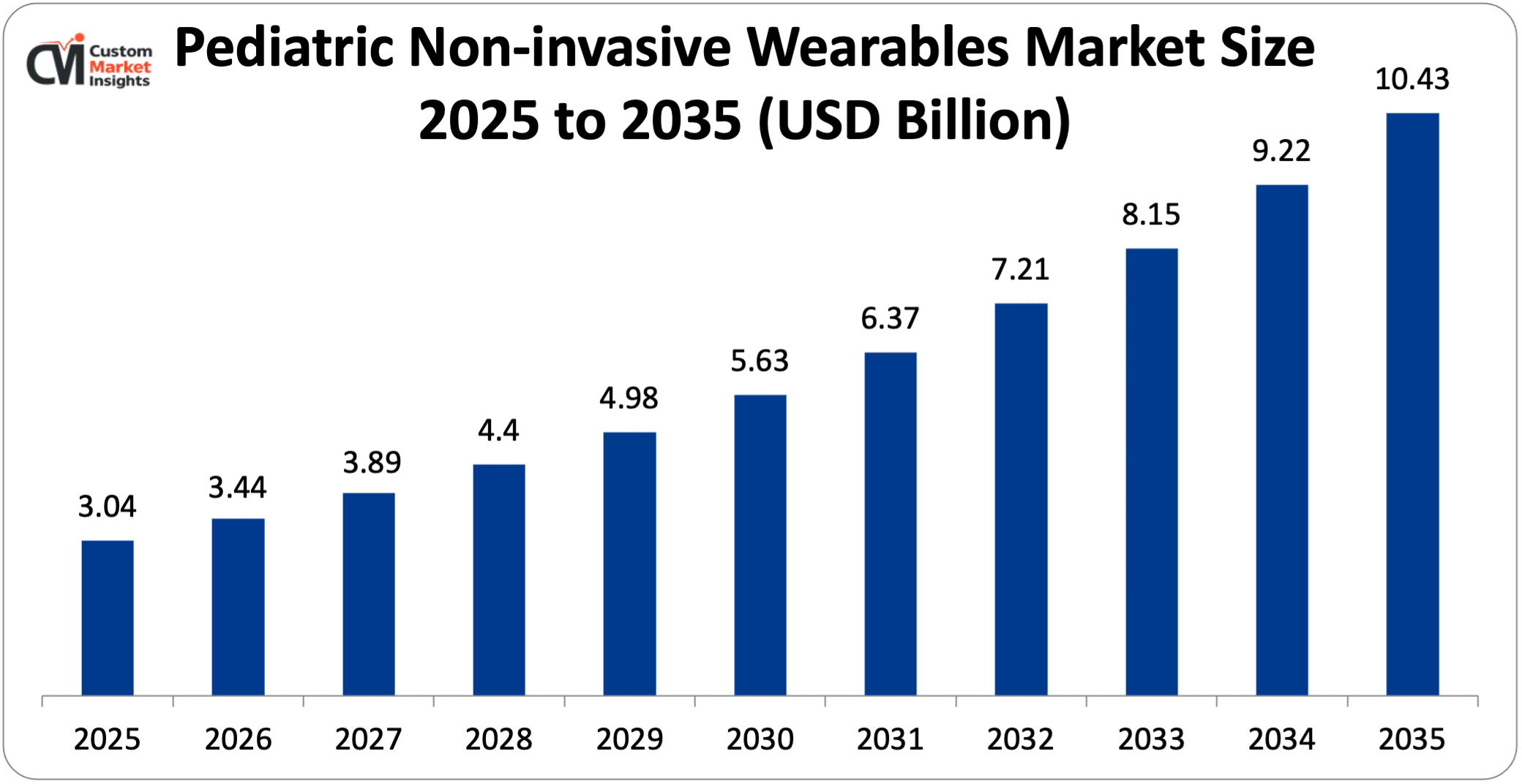
As per the pediatric non-invasive wearables market analysis conducted by the CMI team, the pediatric non-invasive wearables market is expected to record a CAGR of 13.12% from 2026 to 2035. In 2026, the market size was USD 3.44 Billion. By 2035, the valuation is anticipated to reach USD 10.43 Billion. The market is expanding due to increased demand for real-time, continuous health monitoring solutions for children and infants devoid of risks linked with invasive devices. Rising prevalence of acute pediatric conditions like sleep apnea, respiratory disorders, and congenital heart issues is driving wearable sensors’ adoption with the objective of tracking vital signs such as oxygen saturation, heart rate, respiration, and temperature.
Advancements in AI-powered analytics, IoT-enabled healthcare devices, and remote patient monitoring systems are accelerating expansion of the market, especially as telehealth gets integrated into pediatric care. Plus, rising parental awareness regarding early disease detection with preventive healthcare in the emerging economies is poised to bolster the market during the forecast period, with both – home care settings and hospitals contributing to the continual demand.
Market Highlights
- North America dominated the pediatric non-invasive wearables market in 2025 with 61.34% of the overall share.
- The Asia Pacific is expected to witness the fastest CAGR of 13.5% in the pediatric non-invasive wearables market during the forecast period.
- By product type, smartwatches held around 54.37% of the market share by 2025.
- By product type, fitness bands are expected to witness the fastest CAGR of 12.34% between 2026 and 2035.
- Through application, health monitoring dominated in 2025 with 47.23% of the overall market share.
- By application, fitness tracking is expected to witness the fastest CAGR of 11.97% between 2026 and 2035.
- By end-user, the hospitals segment dominated in 2025 with 47.64% of the overall market share.
- By end-user, home care settings are expected to witness the fastest CAGR of 10.34% between 2026 and 2035.
Significant Growth Factors
- Advancements in Connected Healthcare Technologies
The market growth is driven by speedy advancements in the connected healthcare technologies, especially the IoT-enabled sensors, real-time data analytics, and AI. Such innovations facilitate precise, continuous monitoring of vital pediatric health parameters like oxygen saturation, heart rate, sleep patterns, and temperature without the need for invasive procedures, thereby rendering them suitable for young children and infants. Integration of wearable devices with cloud platforms, smartphones, and telehealth systems lets healthcare providers remotely track the conditions of patients, detect the early warning signs, and intervene in a prompt manner, thereby enhancing clinical outcomes. Plus, increasing miniaturization, reliability, and energy efficiency of the wearable components are making such devices more durable, comfortable, and child-friendly, which notably improves adoption in home care and hospital environments.
- Emphasis on Early Diagnosis and Preventive Healthcare
Parents are visibly going for continuous monitoring solutions providing real-time insights into the health of their child, particularly for the ones battling chronic conditions, cardiac and respiratory risks, or premature birth complications. Additionally, expansion of remote patient monitoring and telemedicine services is expediting demand, especially in the regions that have limited access to exclusive pediatric care. The governments are also promoting digital health apart from increased collaborations between medical device companies and healthcare providers. The emerging markets are bound to strongly contribute to digital health’s increased penetration.
What are the Major Advancements Changing the Pediatric Non-invasive Wearables Market Today?
- Integration of Advanced Sensor Technologies with Real-time Data Analytics and AI
Modern day wearable devices are capable of constantly monitoring multiple parameters like respiratory rate, heart rate, temperature, oxygen saturation, and sleep patterns with minimal discomfort and a higher level of precision. Such devices do use AI algorithms for detecting anomalies, predicting potential health risks, and providing actionable insights to healthcare professionals and caregivers. Incorporating wireless connectivity, smartphone integration, and cloud computing has facilitated smooth remote patient monitoring, thereby letting pediatricians track the health status of a child in real time without the need of repeated hospital visits. Plus, enhancements in battery life, miniaturization, and flexible materials have rendered wearables more lightweight, comfortable, and suitable for young children’s and infants’ prolonged use, thereby sizably improving user adoption.
- Development of Condition-specific, Specialized Wearable Conditions
The major players are increasingly emphasizing the creation of devices tailored for specified wearable conditions like asthma management, neonatal monitoring, and cardiac care, whereby they ensure more effective and targeted health tracking. Hypoallergenic and skin-friendly materials, waterproof designs, and soft, path-based, or textile-integrated wearables are catering to concerns revolving around usability for sensitive infant skin. Moreover, integration of caregiver notification features and alert systems ascertains immediate response in case the readings are abnormal, thereby enhancing safety outcomes. Sterner quality standards and regulatory advancements are also compelling the manufacturers to design reliable and clinically validated devices, thereby fostering a higher level of trust amongst the healthcare providers.
Category Wise insights
By Product Type
- Why are smartwatches dominating the pediatric non-invasive wearables market?
Smartwatches are dominating the pediatric non-invasive wearables market owing to their multifunctionality, being simple to use, and widespread acceptance amongst parents and children as daily devices. Such wearables do combine health monitoring features like sleep analysis, heart rate tracking, activity monitoring, and, in certain cases, oxygen saturation with safety and communication functionalities such as SOS alerts, GPS tracking, and mobile connectivity, thereby making them practical for continuous use. Their interactive interfaces and familiar design enhance user engagement as well as compliance amongst children, while the parents do value location-tracing capacities and real-time health insights. Also, app integration has strengthened the adoption of smartwatches.
By Application
- How is health monitoring leading the pediatric non-invasive wearables market?
Health monitoring is leading the pediatric non-invasive wearables market, as it does address the critical requirement of real-time, continuous tracking of vital signs of children in a non-invasive and safe manner, thereby facilitating earlier detection of timely medical intervention and potential health concerns. Wearable devices that are equipped with sensors for oxygen saturation, heart rate, respiratory rate, temperature, and sleep patterns allow for healthcare providers and caregivers to closely monitor the condition of a child without frequent visits to the hospitals. Rising adoption of telehealth integration, remote patient monitoring, and data-driven healthcare is strengthening the segment further.
By End-user
- Why does the hospital segment dominate the pediatric non-invasive wearables market?
The hospitals segment does dominate the pediatric non-invasive wearables market, as hospitals are amongst the primary points of care for diagnosis, critical monitoring, and treatment of children and infants, particularly the ones with chronic or acute conditions that need continuous supervision. Such settings have access to skilled healthcare professionals, advanced infrastructure, and higher budgets, facilitating sophisticated wearable technologies’ adoption for monitoring of vital signs in real time. The hospitals are also driving demand through pediatric and neonatal ICUs, wherein non-invasive, continuous monitoring is necessary for clinical decision-making and patient safety.
Report Scope
| Feature of the Report | Details |
| Market Size in 2026 | USD 3.44 Billion |
| Projected Market Size in 2035 | USD 10.43 Billion |
| Market Size in 2025 | USD 3.04 Billion |
| CAGR Growth Rate | 13.12% CAGR |
| Base Year | 2025 |
| Forecast Period | 2026-2035 |
| Key Segment | By Product Type, Application, End-user and Region |
| Report Coverage | Revenue Estimation and Forecast, Company Profile, Competitive Landscape, Growth Factors and Recent Trends |
| Regional Scope | North America, Europe, Asia Pacific, Middle East & Africa, and South & Central America |
| Buying Options | Request tailored purchasing options to fulfil your requirements for research. |
Regional Analysis
How big is North America’s pediatric non-invasive wearables market size?
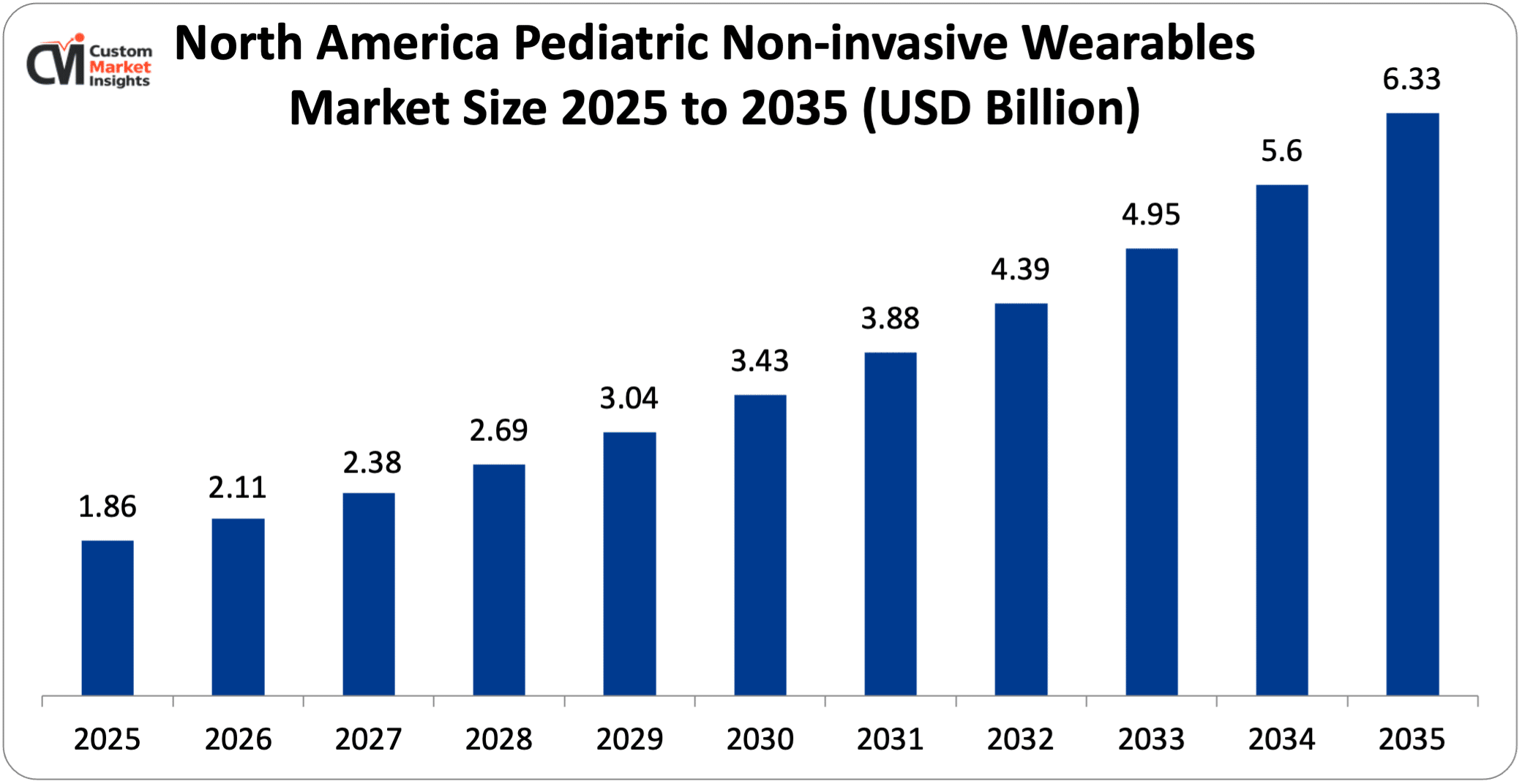
North America’s pediatric non-invasive wearables market was worth USD 1.86 Billion in 2025 and is expected to reach USD 6.33 Billion by 2035 at a CAGR of 12.99% between 2025 and 2035.
Why did North America Dominate the Pediatric Non-invasive Wearables Market in 2025?
North America dominated the pediatric non-invasive wearables market in 2025 owing to it being home to advanced healthcare infrastructure, a strong presence of leading medical technology and device companies, and digital health technologies’ higher adoption. The region does benefit from remote patient monitoring’s widespread use, notable healthcare spending, and earlier integration of AI- and IoT-enabled wearable solutions regarding pediatric care. Besides, a higher level of awareness amongst healthcare providers and parents regarding continuous monitoring and preventive healthcare is accelerating adoption of these wearables.
What is the Size of the U.S. Pediatric Non-invasive Wearables Market?
The market size of the U.S. pediatric non-invasive wearables was USD 1.42 Billion in 2025 and is expected to reach USD 4.77 Billion in 2035, witnessing a CAGR of 12.87% between 2026 and 2035.
U.S. Pediatric Non-invasive Wearables Market Trends
The U.S. pediatric non-invasive wearables market is driven by rising adoption of digital health technologies coupled with a robust shift toward home-based pediatric care and remote patient monitoring. The growing incidences of chronic conditions like obesity, asthma, and sleep disorders amongst children are expediting the demand for real-time, continuous health tracking solutions. Plus, rising parental awareness pertaining to preventive healthcare combined with early diagnosis is extending support to smart wearable devices’ uptake. These devices do monitor various vital parameters such as oxygen levels, heart rate, and activity patterns. Various technological advancements like enhanced sensor precision, AI-enabled analytics, and smooth integration with telehealth platforms are further improving device usability and effectiveness. Besides, expansion of insurance coverage is adding to the revenue.
Why is the Asia Pacific experiencing the fastest growth in the pediatric non-invasive wearables market?
The Asia Pacific is witnessing the fastest growth in the pediatric non-invasive wearables market owing to its exploding pediatric population, speedy expansion of healthcare infrastructure, and increased healthcare awareness across economies like India, China, and Southeast Asian economies. Rising urbanization is also enabling a higher level of adoption of digital health technologies, while rising penetration of internet connectivity and smartphones lends support to the use of connected wearable devices. The governments are also promulgating digital health initiatives. Demand for affordable wearable devices is supported by the proliferation of robust home based care.
China Pediatric Non-invasive Wearables Market Trends
China’s pediatric non-invasive wearables market is expected to witness speedy growth during the forecast period, basically driven by expansion of healthcare infrastructure, increased adoption of digital healthcare, and a rising pediatric population. Growing parental awareness regarding early disease detection and continual health monitoring are driving the demand for wearable devices tracking vital parameters like oxygen levels, heart rate, and sleep patterns. Market expansion is further accelerated by a stronger push toward smarter healthcare in the form of governments’ investments in IoT, AI, and telemedicine. The domestic manufacturers are playing a prime role by offering technologically advanced and cost-effective solutions.
Where does Europe stand with respect to pediatric non-invasive wearables market?
Europe holds a noticeable position in the pediatric non-invasive wearables market. This is credited to continuous growth driven by higher awareness of child health monitoring, well-developed healthcare systems, and robust regulatory standards ensuring product reliability and stability. Economies like the U.K., Germany, and France are the leading contributors owing to higher spending on healthcare coupled with early adoption of innovative wearable solutions.
Germany Pediatric Non-invasive Wearables Market Trends
Germany’s pediatric non-invasive wearables market is expected to witness steadiness during the forecast period due to the region’s stronger emphasis on high class healthcare infrastructure, technological precision, and earlier adoption of the advanced medical devices. Germany’s emphasis on integration of digital health technologies inclusive of data-driven healthcare and connected monitoring systems is accelerating the adoption further. Plus, increased awareness of preventive pediatric care, advancements in sensor precision, and rising applications of remote monitoring are contributing to market consistency.
Where is the Middle East & Africa regarding the pediatric non-invasive wearables market?
The Middle East & Africa is witnessing a rising adoption of wearable healthcare technologies, basically driven by increased investments in healthcare infrastructure, rising awareness of remote patient monitoring, and expansion of digital health initiatives. The economies on the forefront include South Africa, Saudi Arabia, the UAE, and likewise.
Brazil Pediatric Non-invasive Wearables Market Trends
Brazil’s pediatric non-invasive wearables market is driven by the expansion of government initiatives and telehealth services aimed at the improvement of child healthcare outcomes. Plus, rising smartphone penetration, enhanced access to pediatric care, and a switch to home-based monitoring are poised to strengthen the adoption of pediatric non-invasive wearables.
Top players in the Pediatric Non-invasive Wearables Market and their Offerings
- Philips Healthcare
- GE HealthCare
- Medtronic
- Apple
- Masimo
- Aitbit (Google)
- Garmin
- AliveCor
- Wthings
- iRhythm
- BioTelemetry
- Owlet Baby Care
- OMRON Healthcare
- Nanit
- Snuza
- Empatica
- Biofourmis (Everion)
- Alba Health
- Others
Key Developments
Pediatric non-invasive wearables market has experienced considerable changes in the last few years as the market players are trying to diversify their technological aspects and develop product portfolios using strategic approaches.
- In June 2025, the U.S. FDA approved Sonu Band (introduced by SoundHealth) as the first drug-free, wearable treatment for nasal congestion (moderate-to-severe) in children aged 12 and above.
These strategic measures have enabled the companies to reinforce their competitive positions, increase the product line, boost their technological competencies, and also seize growth opportunities in the fast-growing pediatric non-invasive wearables market.
The Pediatric Non-invasive Wearables Market is segmented as follows:
By Product Type
- Smartwatches
- Fitness Bands
- Patches
By Application
- Health Monitoring
- Fitness Tracking
- Remote Patient Monitoring
By End-user
- Hospitals
- Homecare Settings
- Specialty Clinics
Regional Coverage:
North America
- U.S.
- Canada
- Mexico
- Rest of North America
Europe
- Germany
- France
- U.K.
- Russia
- Italy
- Spain
- Netherlands
- Rest of Europe
Asia Pacific
- China
- Japan
- India
- New Zealand
- Australia
- South Korea
- Taiwan
- Rest of Asia Pacific
The Middle East & Africa
- Saudi Arabia
- UAE
- Egypt
- Kuwait
- South Africa
- Rest of the Middle East & Africa
Latin America
- Brazil
- Argentina
- Rest of Latin America
Table of Contents
- Chapter 1. Report Introduction
- 1.1. Report Description
- 1.1.1. Purpose of the Report
- 1.1.2. USP & Key Offerings
- 1.2. Key Benefits For Stakeholders
- 1.3. Target Audience
- 1.4. Report Scope
- 1.1. Report Description
- Chapter 2. Market Overview
- 2.1. Report Scope (Segments And Key Players)
- 2.1.1. Pediatric Non-invasive Wearables by Segments
- 2.1.2. Pediatric Non-invasive Wearables by Region
- 2.2. Executive Summary
- 2.2.1. Market Size & Forecast
- 2.2.2. Pediatric Non-invasive Wearables Market Attractiveness Analysis, By Product Type
- 2.2.3. Pediatric Non-invasive Wearables Market Attractiveness Analysis, By Application
- 2.2.4. Pediatric Non-invasive Wearables Market Attractiveness Analysis, By End-user
- 2.1. Report Scope (Segments And Key Players)
- Chapter 3. Market Dynamics (DRO)
- 3.1. Market Drivers
- 3.1.1. Advancements in Connected Healthcare Technologies
- 3.1.2. Emphasis on Early Diagnosis and Preventive Healthcare
- 3.2. Market Restraints
- 3.3. Market Opportunities
- 3.5. Pestle Analysis
- 3.6. Porter Forces Analysis
- 3.7. Technology Roadmap
- 3.8. Value Chain Analysis
- 3.9. Government Policy Impact Analysis
- 3.10. Pricing Analysis
- 3.1. Market Drivers
- Chapter 4. Pediatric Non-invasive Wearables Market – By Product Type
- 4.1. Product Type Market Overview, By Product Type Segment
- 4.1.1. Pediatric Non-invasive Wearables Market Revenue Share, By Product Type , 2025 & 2035
- 4.1.2. Smartwatches
- 4.1.3. Pediatric Non-invasive Wearables Share Forecast, By Region (USD Billion)
- 4.1.4. Comparative Revenue Analysis, By Country, 2025 & 2035
- 4.1.5. Key Market Trends, Growth Factors, & Opportunities
- 4.1.6. Fitness Bands
- 4.1.7. Pediatric Non-invasive Wearables Share Forecast, By Region (USD Billion)
- 4.1.8. Comparative Revenue Analysis, By Country, 2025 & 2035
- 4.1.9. Key Market Trends, Growth Factors, & Opportunities
- 4.1.10. Patches
- 4.1.11. Pediatric Non-invasive Wearables Share Forecast, By Region (USD Billion)
- 4.1.12. Comparative Revenue Analysis, By Country, 2025 & 2035
- 4.1.13. Key Market Trends, Growth Factors, & Opportunities
- 4.1. Product Type Market Overview, By Product Type Segment
- Chapter 5. Pediatric Non-invasive Wearables Market – By Application
- 5.1. Application Market Overview, By Application Segment
- 5.1.1. Pediatric Non-invasive Wearables Market Revenue Share, By Application, 2025 & 2035
- 5.1.2. Health Monitoring
- 5.1.3. Pediatric Non-invasive Wearables Share Forecast, By Region (USD Billion)
- 5.1.4. Comparative Revenue Analysis, By Country, 2025 & 2035
- 5.1.5. Key Market Trends, Growth Factors, & Opportunities
- 5.1.6. Fitness Tracking
- 5.1.7. Pediatric Non-invasive Wearables Share Forecast, By Region (USD Billion)
- 5.1.8. Comparative Revenue Analysis, By Country, 2025 & 2035
- 5.1.9. Key Market Trends, Growth Factors, & Opportunities
- 5.1.10. Remote Patient Monitoring
- 5.1.11. Pediatric Non-invasive Wearables Share Forecast, By Region (USD Billion)
- 5.1.12. Comparative Revenue Analysis, By Country, 2025 & 2035
- 5.1.13. Key Market Trends, Growth Factors, & Opportunities
- 5.1. Application Market Overview, By Application Segment
- Chapter 6. Pediatric Non-invasive Wearables Market – By End-user
- 6.1. End-user Market Overview, By End-user Segment
- 6.1.1. Pediatric Non-invasive Wearables Market Revenue Share, By End-user, 2025 & 2035
- 6.1.2. Hospitals
- 6.1.3. Pediatric Non-invasive Wearables Share Forecast, By Region (USD Billion)
- 6.1.4. Comparative Revenue Analysis, By Country, 2025 & 2035
- 6.1.5. Key Market Trends, Growth Factors, & Opportunities
- 6.1.6. Homecare Settings
- 6.1.7. Pediatric Non-invasive Wearables Share Forecast, By Region (USD Billion)
- 6.1.8. Comparative Revenue Analysis, By Country, 2025 & 2035
- 6.1.9. Key Market Trends, Growth Factors, & Opportunities
- 6.1.10. Specialty Clinics
- 6.1.11. Pediatric Non-invasive Wearables Share Forecast, By Region (USD Billion)
- 6.1.12. Comparative Revenue Analysis, By Country, 2025 & 2035
- 6.1.13. Key Market Trends, Growth Factors, & Opportunities
- 6.1. End-user Market Overview, By End-user Segment
- Chapter 7. Pediatric Non-invasive Wearables Market – Regional Analysis
- 7.1. Pediatric Non-invasive Wearables Market Overview, By Region Segment
- 7.1.1. Global Pediatric Non-invasive Wearables Market Revenue Share, By Region, 2025 & 2035
- 7.1.2. Global Pediatric Non-invasive Wearables Market Revenue, By Region, 2026 – 2035 (USD Billion)
- 7.1.3. Global Pediatric Non-invasive Wearables Market Revenue, By Product Type , 2026 – 2035
- 7.1.4. Global Pediatric Non-invasive Wearables Market Revenue, By Application, 2026 – 2035
- 7.1.5. Global Pediatric Non-invasive Wearables Market Revenue, By End-user, 2026 – 2035
- 7.2. North America
- 7.2.1. North America Pediatric Non-invasive Wearables Market Revenue, By Country, 2026 – 2035 (USD Billion)
- 7.2.2. North America Pediatric Non-invasive Wearables Market Revenue, By Product Type , 2026 – 2035
- 7.2.3. North America Pediatric Non-invasive Wearables Market Revenue, By Application, 2026 – 2035
- 7.2.4. North America Pediatric Non-invasive Wearables Market Revenue, By End-user, 2026 – 2035
- 7.2.5. U.S. Pediatric Non-invasive Wearables Market Revenue, 2026 – 2035 (USD Billion)
- 7.2.6. Canada Pediatric Non-invasive Wearables Market Revenue, 2026 – 2035 (USD Billion)
- 7.2.7. Mexico Pediatric Non-invasive Wearables Market Revenue, 2026 – 2035 (USD Billion)
- 7.2.8. Rest of North America Pediatric Non-invasive Wearables Market Revenue, 2026 – 2035 (USD Billion)
- 7.3. Europe
- 7.3.1. Europe Pediatric Non-invasive Wearables Market Revenue, By Country, 2026 – 2035 (USD Billion)
- 7.3.2. Europe Pediatric Non-invasive Wearables Market Revenue, By Product Type , 2026 – 2035
- 7.3.3. Europe Pediatric Non-invasive Wearables Market Revenue, By Application, 2026 – 2035
- 7.3.4. Europe Pediatric Non-invasive Wearables Market Revenue, By End-user, 2026 – 2035
- 7.3.5. Germany Pediatric Non-invasive Wearables Market Revenue, 2026 – 2035 (USD Billion)
- 7.3.6. France Pediatric Non-invasive Wearables Market Revenue, 2026 – 2035 (USD Billion)
- 7.3.7. U.K. Pediatric Non-invasive Wearables Market Revenue, 2026 – 2035 (USD Billion)
- 7.3.8. Russia Pediatric Non-invasive Wearables Market Revenue, 2026 – 2035 (USD Billion)
- 7.3.9. Italy Pediatric Non-invasive Wearables Market Revenue, 2026 – 2035 (USD Billion)
- 7.3.10. Spain Pediatric Non-invasive Wearables Market Revenue, 2026 – 2035 (USD Billion)
- 7.3.11. Netherlands Pediatric Non-invasive Wearables Market Revenue, 2026 – 2035 (USD Billion)
- 7.3.12. Rest of Europe Pediatric Non-invasive Wearables Market Revenue, 2026 – 2035 (USD Billion)
- 7.4. Asia Pacific
- 7.4.1. Asia Pacific Pediatric Non-invasive Wearables Market Revenue, By Country, 2026 – 2035 (USD Billion)
- 7.4.2. Asia Pacific Pediatric Non-invasive Wearables Market Revenue, By Product Type , 2026 – 2035
- 7.4.3. Asia Pacific Pediatric Non-invasive Wearables Market Revenue, By Application, 2026 – 2035
- 7.4.4. Asia Pacific Pediatric Non-invasive Wearables Market Revenue, By End-user, 2026 – 2035
- 7.4.5. China Pediatric Non-invasive Wearables Market Revenue, 2026 – 2035 (USD Billion)
- 7.4.6. Japan Pediatric Non-invasive Wearables Market Revenue, 2026 – 2035 (USD Billion)
- 7.4.7. India Pediatric Non-invasive Wearables Market Revenue, 2026 – 2035 (USD Billion)
- 7.4.8. New Zealand Pediatric Non-invasive Wearables Market Revenue, 2026 – 2035 (USD Billion)
- 7.4.9. Australia Pediatric Non-invasive Wearables Market Revenue, 2026 – 2035 (USD Billion)
- 7.4.10. South Korea Pediatric Non-invasive Wearables Market Revenue, 2026 – 2035 (USD Billion)
- 7.4.11. Taiwan Pediatric Non-invasive Wearables Market Revenue, 2026 – 2035 (USD Billion)
- 7.4.12. Rest of Asia Pacific Pediatric Non-invasive Wearables Market Revenue, 2026 – 2035 (USD Billion)
- 7.5. The Middle-East and Africa
- 7.5.1. The Middle-East and Africa Pediatric Non-invasive Wearables Market Revenue, By Country, 2026 – 2035 (USD Billion)
- 7.5.2. The Middle-East and Africa Pediatric Non-invasive Wearables Market Revenue, By Product Type , 2026 – 2035
- 7.5.3. The Middle-East and Africa Pediatric Non-invasive Wearables Market Revenue, By Application, 2026 – 2035
- 7.5.4. The Middle-East and Africa Pediatric Non-invasive Wearables Market Revenue, By End-user, 2026 – 2035
- 7.5.5. Saudi Arabia Pediatric Non-invasive Wearables Market Revenue, 2026 – 2035 (USD Billion)
- 7.5.6. UAE Pediatric Non-invasive Wearables Market Revenue, 2026 – 2035 (USD Billion)
- 7.5.7. Egypt Pediatric Non-invasive Wearables Market Revenue, 2026 – 2035 (USD Billion)
- 7.5.8. Kuwait Pediatric Non-invasive Wearables Market Revenue, 2026 – 2035 (USD Billion)
- 7.5.9. South Africa Pediatric Non-invasive Wearables Market Revenue, 2026 – 2035 (USD Billion)
- 7.5.10. Rest of the Middle East & Africa Pediatric Non-invasive Wearables Market Revenue, 2026 – 2035 (USD Billion)
- 7.6. Latin America
- 7.6.1. Latin America Pediatric Non-invasive Wearables Market Revenue, By Country, 2026 – 2035 (USD Billion)
- 7.6.2. Latin America Pediatric Non-invasive Wearables Market Revenue, By Product Type , 2026 – 2035
- 7.6.3. Latin America Pediatric Non-invasive Wearables Market Revenue, By Application, 2026 – 2035
- 7.6.4. Latin America Pediatric Non-invasive Wearables Market Revenue, By End-user, 2026 – 2035
- 7.6.5. Brazil Pediatric Non-invasive Wearables Market Revenue, 2026 – 2035 (USD Billion)
- 7.6.6. Argentina Pediatric Non-invasive Wearables Market Revenue, 2026 – 2035 (USD Billion)
- 7.6.7. Rest of Latin America Pediatric Non-invasive Wearables Market Revenue, 2026 – 2035 (USD Billion)
- 7.1. Pediatric Non-invasive Wearables Market Overview, By Region Segment
- Chapter 8. Competitive Landscape
- 8.1. Company Market Share Analysis – 2025
- 8.1.1. Global Pediatric Non-invasive Wearables Market: Company Market Share, 2025
- 8.2. Global Pediatric Non-invasive Wearables Market Company Market Share, 2024
- 8.1. Company Market Share Analysis – 2025
- Chapter 9. Company Profiles
- 9.1. Philips Healthcare
- 9.1.1. Company Overview
- 9.1.2. Key Executives
- 9.1.3. Product Portfolio
- 9.1.4. Financial Overview
- 9.1.5. Operating Business Segments
- 9.1.6. Business Performance
- 9.1.7. Recent Developments
- 9.2. GE HealthCare
- 9.3. Medtronic
- 9.4. Apple
- 9.5. Masimo
- 9.6. Aitbit (Google)
- 9.7. Garmin
- 9.8. AliveCor
- 9.9. Wthings
- 9.10. iRhythm
- 9.11. BioTelemetry
- 9.12. Owlet Baby Care
- 9.13. OMRON Healthcare
- 9.14. Nanit
- 9.15. Snuza
- 9.16. Empatica
- 9.17. Biofourmis (Everion)
- 9.18. Alba Health
- 9.19. Others.
- 9.1. Philips Healthcare
- Chapter 10. Research Methodology
- 10.1. Research Methodology
- 10.2. Secondary Research
- 10.3. Primary Research
- 10.3.1. Analyst Tools and Models
- 10.4. Research Limitations
- 10.5. Assumptions
- 10.6. Insights From Primary Respondents
- 10.7. Why Healthcare Foresights
- Chapter 11. Standard Report Commercials & Add-Ons
- 11.1. Customization Options
- 11.2. Subscription Module For Market Research Reports
- 11.3. Client Testimonials
- Chapter 12. List Of Figures
- 12.1. Figures No 1 to 25
- Chapter 13. List Of Tables
- 13.1. Tables No 1 to 46
Prominent Player
- Philips Healthcare
- GE HealthCare
- Medtronic
- Apple
- Masimo
- Aitbit (Google)
- Garmin
- AliveCor
- Wthings
- iRhythm
- BioTelemetry
- Owlet Baby Care
- OMRON Healthcare
- Nanit
- Snuza
- Empatica
- Biofourmis (Everion)
- Alba Health
- Others
FAQs
The key players in the market are Philips Healthcare, GE HealthCare, Medtronic, Apple, Masimo, Fitbit (Google), Garmin, AliveCor, Withings, iRhythm, BioTelemetry, Owlet Baby Care, OMRON Healthcare, Nanit, Snuza, Empatica, Biofourmis (Everion), Alba Health, Others.
Regulatory frameworks call for rigorous testing, approvals, and certifications before entry of products into the market. This ensures that the devices are safe for continuous pediatric use and lessens risks linked with device malfunction and incorrect readings. Such regulations also impact product design, thereby driving usage of the biocompatible materials, secure data handling systems, and child-friendly features.
Affordable devices encourage widespread production, especially in the emerging markets as well as home care settings wherein cost sensitivity is higher, thereby facilitating caregivers and parents in investing in continuous health monitoring solutions. The competitive pricing also extends support to bulk procurement by clinics and hospitals, thereby expanding institutional usage.
The market for pediatric non-invasive wearables is expected to witness a significant growth of about USD 10.43 Billion in the year 2035 with a CAGR of 13.12% between the years 2026 and 2035 due to rising demand for real-time, continuous health monitoring of children; growing adoption of remote patient care; and advancements pertaining to wearable technology that facilitate comfortable, safe, and precise tracking of the vital signs.
It is projected that North America will hold the largest market share in the pediatric non-invasive wearables market during the forecast period. This is credited to the presence of advanced healthcare infrastructure, robust adoption of cutting-edge digital health technologies, and noticeable investments in R&D activities by the leading medical devices/technology companies. Also, conducive regulatory frameworks, followed by earlier integration of IoT, AI, and wearable technologies into clinical practice, are accelerating market growth.
The Asia Pacific is expected to witness the fastest growth rate of about 13.5% in the forecast period due to a growing pediatric population, growing adoption of digital health technologies across India and China, and faster improvements in healthcare infrastructure. Plus, robust government initiatives extending support to advanced medical device adoption apart from rapid expansion of home healthcare solutions and remote patient monitoring are visibly accelerating the growth of the market.
The growth of the pediatric non-invasive wearables market is basically driven by growing demand for real-time, continuous health monitoring solutions that are comfortable and safe for children, particularly in order to manage acute and chronic conditions like cardiac and respiratory disorders. Rising adoption of telehealth and remote monitoring services is facilitating healthcare providers and caregivers to track the vital signs without repeated hospital visits, thereby enhancing clinical convenience and outcomes. Technological advancements in miniaturization, sensor precision, smartphone integration, and AI-driven analytics are improving device usability and functionality further. Besides, rising parental awareness regarding preventive healthcare is accelerating market growth.