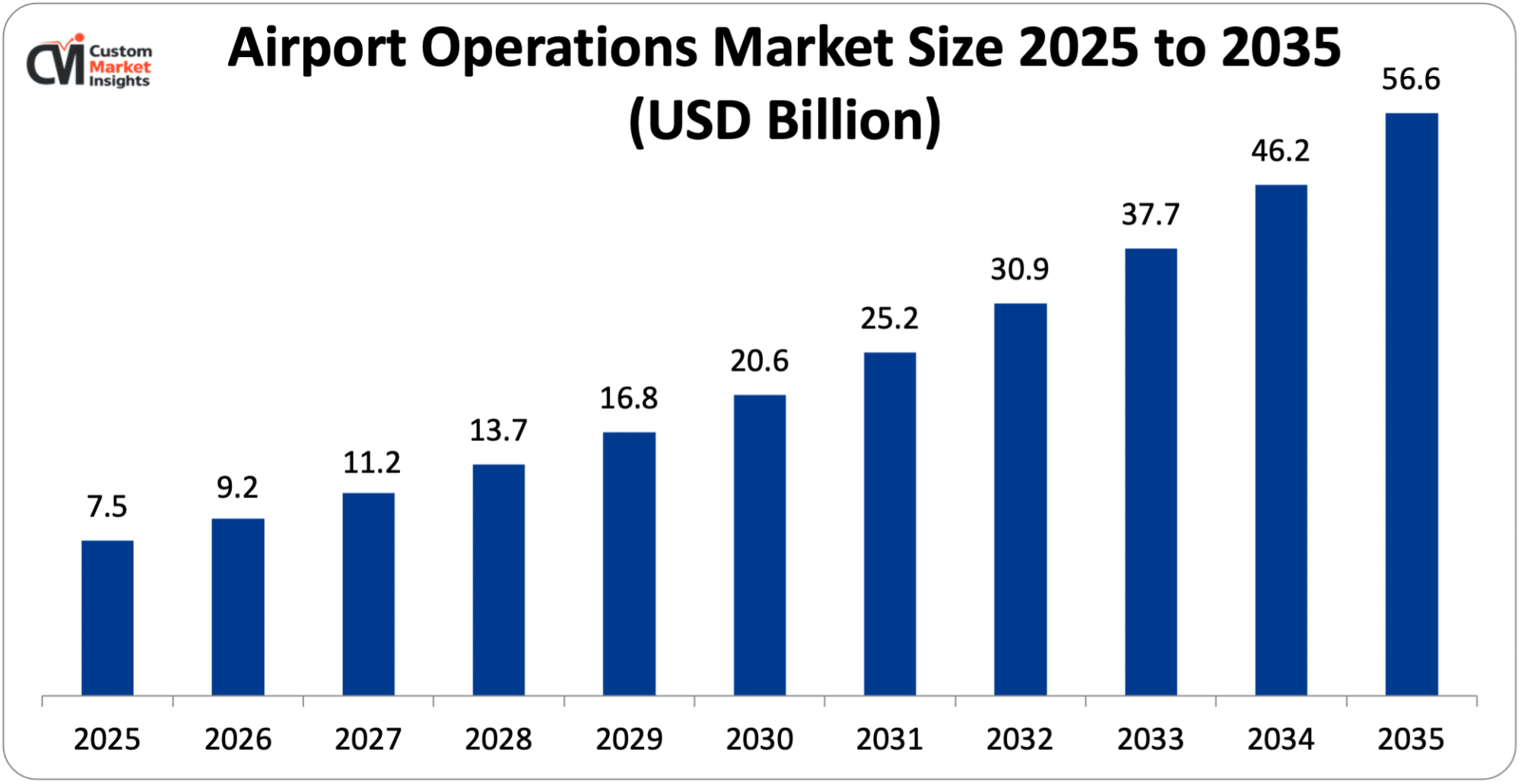
Valued at USD 9.2 Bn in 2026, the market is projected to reach USD 56.6 Bn by 2035, growing at a 22.4% CAGR. North America holds the largest share, while Asia Pacific grows fastest. The report is segmented by airport size and operation.
The global airport operations market was valued at USD 9.2 Bn in 2026 and is projected to reach USD 56.6 Bn by 2035, growing at a CAGR of 22.4%. North America is the largest regional market and Asia Pacific is growing fastest.
The market size of global airport operations will be estimated at USD 7.5 billion in 2025 and is expected to grow to between USD 9.2 billion in 2026 and about USD 56.6 billion by 2035, with a current CAGR (compound annual growth rate) of 22.4% during the period of 2026 to 2035. Airport Operations refer to the complete range of activities, systems and services that airports need to operate safely, efficiently and to maintain smooth airport operations. The operations include airside activities which involve aircraft takeoff, landing, taxiing and ground handling operations together with landside functions which handle passenger processing, baggage handling, security screening and terminal management. Airport operations require different stakeholders to work together because their duties include maintaining safety standards, managing traffic operations and providing better service to passengers. The operations include infrastructure maintenance together with emergency response management and the use of advanced technologies which help to improve operational efficiency and capacity utilization.
In 2025, North America will dominate the global market with an estimated market share of 38%. This growth is driven by the region’s growing air passenger traffic.
The Asia Pacific is growing at a highest CAGR over the analysis period. The increasing digitalization in aerospace sector drives the industry growth.
By type, the beverages Airport Operations segment accounted for the highest revenue share in 2025 of over 40%.
By airport size, the Class A segment accounted for the highest revenue share in 2025.
By operation, the baggage screening segment would have the highest share of the market in 2025.
Significant Growth Factors
The airport operations market trends present significant growth opportunities due to several factors:
Rising Air Passenger Traffic: The airport operations market experiences growth because worldwide air passenger traffic keeps increasing. The rise in disposable incomes together with the growing middle-class population, increasing tourism and business travel has resulted in higher worldwide air travel rates. Airports face an urgent challenge to handle growing passenger numbers while they need to operate safely and deliver quality service. Airports now spend more money on modern operating systems which include automated check-in, smart security screening and better baggage handling systems to create less congestion and faster service times. The airport sector moves toward modern operating systems because passengers want faster processing times and uninterrupted travel experiences which drives market expansion. For instance, according to the International Air Transport Association (IATA), Asia-Pacific airlines achieved an 8.6% year-on-year increase in demand. Capacity increased 7.3% year-on-year, and the load factor was 86.6% (+1.0 ppt compared to February 2025).
Adoption of Advanced Technology: The airport operations market experiences growth because more airports implement advanced technological systems. Airports improve their operational efficiency and process efficiency through the implementation of artificial intelligence AI, Internet of Things IoT, biometric, cloud computing and automation solutions. The technologies provide airports with real-time data monitoring, predictive maintenance capabilities and resource allocation optimization which results in decreased operational expenses and delay times. Biometric systems and automated check-in kiosks enhance passenger processing speed and accuracy while smart baggage handling systems decrease both errors and lost items. Airport stakeholders use advanced analytics and digital platforms to improve their decision-making processes and operational coordination efforts. The implementation of these technologies at airports which move towards smart airport systems enhances operational performance, passenger security and overall travel experience which results in faster industry expansion.
What are the Major Advances Changing the Airport Operations Market Today?
Digital Identity & Mobile-first Travel: Digital identity and mobile-first travel are gradually becoming revolutionary milestones in the airport operations market, bringing in a new way of a more seamless, efficient, and customer-centric traveler experience. With growing usage and acceptance of digital IDs, e-passports, and mobile boarding passes, there is a shift towards enabling traveler check-in, security, and boarding through mobile or biometric identification, without the inconvenience of presenting physical documentation. This is thereby turning over less waiting time, less manual intervention, and enabling the airport authorities to streamline operations. Also, mobile-first solutions are giving the travelers several benefits like real-time location updates, navigation, consolidated digital payments, automated kiosk controls, and eventually a higher convenience quotient. Airports can now leverage the benefits of mobile-first mobilization technologies in terms of efficient data collection, smoother passenger flow management, and subsequently, better resource management.
Advanced Air Mobility (AAM) Integration: Next-generation air mobility (AAM) will significantly redefine airport efficiencies, and further, we will see a new paradigm emerge in how we deploy airspace, infrastructure, and passengers. These new AAM vehicle types (e.g. Electric verti-take off and landing (eVTOL), air taxis, drone logistics) will propel the efficiency of air transportation above and beyond urban boundary areas. Airports are migrating to poly-modal transportation centers that will guide the shared pathways of traditional as well as new air mobility vehicles. New airside infrastructure such as vertiports, landing zones, and air traffic control will be introduced to enable the safe management of low-altitude urban AAM vehicle operations. Digital airline platforms and automation technology will be employed to facilitate seamless integration of new transportation systems and existing land infrastructure. Improved mobility, alleviated congestion, and greatly shortened journey times will be a major benefit of AAM particularly to congested urban areas.
Category Wise Insights
By Airport Size
Why Class A Hold a Prominent Position in the Market?
The Class A segment accounted for the highest revenue share in 2025. The increasing need for large-scale airport infrastructure which can handle high passenger volumes and complex flight operations systems has become the main factor driving airport growth. Class A airports—typical major international hubs—need operational systems which use advanced air traffic management, automated baggage handling, biometric security solutions and integrated digital platforms. Airports need to expand and modernize their facilities because of the growing demand for international and long-haul air travel which creates demand for expensive operational technologies and services.
The Class C segment is growing at a highest CAGR during the forecast period. The increasing demand for affordable airlines results in greater expansion needs for Class C airports because these airlines choose to operate their flights from smaller regional airports. The organization has decided to invest more resources to enhance their fundamental infrastructure which includes upgrading their basic systems and implementing digital check-in solutions and developing efficient baggage handling systems that operate for medium passenger traffic.
By Operation
Why Baggage Screening Capture the Highest Market Share in the Airport Operations Market?
The baggage screening segment would have the highest share of the market in 2025. The aviation industry shows growth because of two factors which are enhanced security measures, increased worldwide passenger and cargo movement. Airports need to handle more checked and carry-on bags because global air travel keeps growing while they must ensure security through their operations. The industry now invests more in advanced baggage screening systems which include computed tomography (CT) scanners, automated explosive detection systems and AI-based image analysis technology because these systems improve threat detection results and decrease the need for human work.
The terminal infrastructure maintenance and upgrade segment is growing at a rapid rate over the projected period. The expansion of the airport industry results from the growing need to upgrade outdated airport systems which must handle increasing numbers of travelers. Airports in developed areas are making substantial investments to rebuild their terminals and improve passenger services while increasing their capacity to meet rising travel demands. The upgrades will enhance operational efficiency and passenger experience through better check-in counters, security lanes, boarding gates, lounges and retail spaces.
Report Scope
Feature of the Report
Details
Market Size in 2026
USD 9.2 billion
Projected Market Size in 2035
USD 56.6 billion
Market Size in 2025
USD 7.5 billion
CAGR Growth Rate
22.4% CAGR
Base Year
2025
Forecast Period
2026-2035
Key Segment
By Airport Size, Operation and Region
Report Coverage
Revenue Estimation and Forecast, Company Profile, Competitive Landscape, Growth Factors and Recent Trends
Regional Scope
North America, Europe, Asia Pacific, Middle East & Africa, and South & Central America
Buying Options
Request tailored purchasing options to fulfil your requirements for research.
Regional Analysis
How Big is North America Airport Operations Market Size?
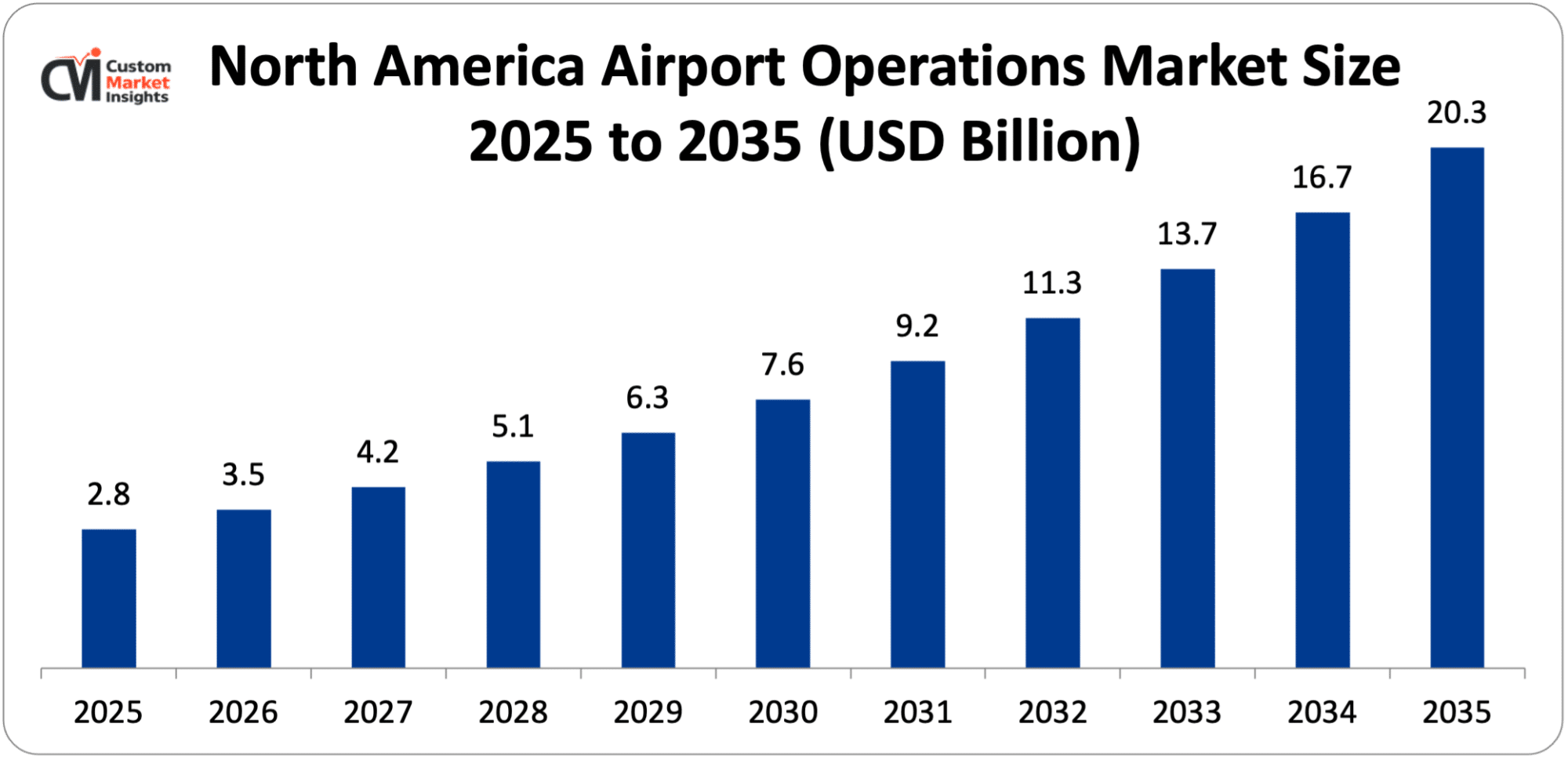
Its market size, in terms of North America Airport Operations, is projected to be USD 2.8 billion in 2025 with a growth of about USD 20.3 billion in 2035 with a CAGR of 21.7% between 2026 and 2035.
Why did North America Dominate the Airport Operations Market in 2025?
In 2025, North America will dominate the global market with an estimated market share of 38%. The region experiences its growth because of its high air traffic volume and ongoing infrastructure upgrades and swift implementation of new technologies. The United States contains some of the world's busiest airports which create a permanent need for airport operations systems that can handle high demand and growth. Airports are expanding their automation, advanced security systems, new baggage handling technologies because of increased passenger travel which results from domestic and international flights.
US Airport Operations Market Trends
In North America region, US is expected to dominate the market over the projected period. The present airport expansion and renovation projects at major hubs and regional airports receive funding from various initiatives while construction programs develop new airport infrastructure. The combination of digital platforms, cloud-based systems and real-time data analytics enhances airport stakeholder coordination while improving the efficiency of their decision-making processes.
Why is Europe Experiencing a Significant Growth in the Airport Operations Market?
Europe holds a significant market share in 2025. The growth is driven by increasing air passenger traffic, ongoing airport modernization efforts and strong intra-regional connectivity. The region benefits from a dense network of international and regional airports which receives support through two factors: the expansion of low-cost carriers and the increasing tourism which targets major destinations. Airports must improve their operational efficiency because passenger volumes are rising and they need to implement advanced technologies which include automation, biometric systems and AI-driven analytics.
UK Airport Operations Market Trends
UK held the dominant position in the market in 2025. Rising collaboration among the market players drives the market growth. In November 2025, NATS and Indra Group announced the signing of a Memorandum of Understanding (MoU) to establish a new Joint Venture that will redefine airport tower operations worldwide. The proposed venture will unite Indra’s market leading digital tower systems with NATS’ world-class operational expertise and the advanced digital and AI solutions of Searidge Technologies, a wholly owned subsidiary of NATS. The partnership will design and deliver next generation, fully integrated digital airport tower control solutions.
Why is the Asia Pacific Growing at a Highest CAGR in the Airport Operations Market?
The Asia Pacific is expected to grow at a highest CAGR over the projected period. The growing air passenger traffic and the launch of advanced technology in aerospace sector drives the market growth.
India Airport Operations Market Trends
India holds the prominent market share in the industry. India is experiencing rapid implementation of modern technologies through its use of biometric passenger processing systems, automated baggage handling systems and digital airport platforms which improve operational efficiency and customer service. The development of greenfield airports together with public-private partnerships which support funding and operation of airport modernization initiatives helps to drive market expansion.
Why is the Middle East & Africa Region is growing rapidly in the Airport Operations?
The MEA region is growing at a steady rate over the projected period. The government is dedicated to developing airports into smart sustainable hubs which operate at increased capacity because e-commerce growth has led to rising air cargo demands throughout the nation.
UAE Airport Operations Market Trends
UAE is growing at the highest CAGR during the forecast period. The growing integration of advanced technology drives the industry growth.
Top Players in the Airport Operations Market and Their Offerings
Das Handling LTD
Honeywell International Inc.
Royal Schiphol Group N.V.
Thales S.A.
AECOM Technology Corporation
Amadeus IT Group SA
Aena S.M.E. S.A.
Daifuku Co. Ltd.
Fraport AG
Collins Aerospace
Société Internationale de Télécommunications Aéronautiques SC.
Flughafen Zürich AG
TAV Airports Holding A.Ş.
Changi Airport Group (Singapore) Pte. Ltd.
ADELTE GROUP S.L
Siemens AG
GMR Airports Limited
AviAlliance GmbH
The Manchester Airports Group plc
SITA (SITA Ltd.)
Others
Key Developments
Airport operations market has experienced considerable changes in the last two years as the market players are trying to diversify their technological aspects and develop product portfolio using strategic approaches.
In November 2025,NATS announced the full market launch of Intelligent Stand Manager, its groundbreaking stand allocation solution, at the International Airport Summit in Berlin.
In May 2025, Swissport has partnered with UK-based Aurrigo International plc to conduct its first-ever global pilot of autonomous ground handling technologies at Zurich Airport, marking an important step in Swissport’s innovation roadmap. The initiative includes the deployment of a digital simulation platform, and a live trial of a fully autonomous electric vehicle designed to explore new efficiencies in airside logistics.
These strategic measures have enabled the companies to reinforce their competitive positions, increase the product line, boost their technological competencies and also seize growth opportunities in the fast-growing airport operations market.
Who are the key players in the Airport Operations market?
The key players in the market are Das Handling LTD, Honeywell International Inc., Royal Schiphol Group N.V., Thales S.A., AECOM Technology Corporation, Amadeus IT Group SA, Aena S.M.E. S.A., Daifuku Co. Ltd., Fraport AG, Collins Aerospace, Société Internationale de Télécommunications Aéronautiques SC., Flughafen Zürich AG, TAV Airports Holding A.Ş., Changi Airport Group (Singapore) Pte. Ltd., ADELTE GROUP S.L, Siemens AG, GMR Airports Limited, AviAlliance GmbH, The Manchester Airports Group plc, SITA (SITA Ltd.), Others.
What role do government regulations play in shaping this market's development?
Government regulations play a critical role in shaping the airport operations market by establishing strict safety, security, and operational standards, driving the adoption of advanced technologies, and influencing infrastructure investments, while also ensuring compliance, efficiency, and sustainable development across airports.
How does the price point impact market growth and adoption?
Higher price points can limit adoption by increasing capital investment barriers, while competitive and scalable pricing accelerates market growth by enabling wider deployment across airports of all sizes.
What is the projected market size by the end of the forecast period?
According to the present analysis and forecast modeling, the market of airport operations will witness a significant growth of about USD 56.6 billion in the year 2035 with the growing innovative product launch, increasing collaboration, increasing air passenger traffic with a CAGR of 22.4% between the years 2026 and 2035.
Which region is anticipated to dominate the market during the forecast period?
It is projected that North America will hold the largest market share in the airport operations market in the forecast period, with a share of about 38% of the global market share, which is owing to the presence of major players and increasing integration of advanced technology.
Which region is expected to grow at the fastest CAGR in this market?
The Asia Pacific is expected to grow at a highest rate during the forecast period. The increasing air passenger traffic and innovative product launch drives the market growth.
What are the key driving factors influencing the growth of the Airport Operations market?
The key factors driving the market are rising consumer demand for modern airport operations and the rising use of smartphones and other smart devices, the adoption of total airport management (TAM) technology to control aviation traffic will create new market opportunities.
Ayush Kadam is a Senior Market Research Analyst at Custom Market Insights, with over seven years of experience in syndicated and custom market research. He specializes in market sizing, competitive intelligence, industry trends, forecasting, and strategic insights, helping clients turn complex data into actionable business decisions.