
Disabled and Elderly Assistive Technology Market Size, Trends and Insights By Product (Mobility Assistance Aids, Wheelchairs, Mobility Scooters, Crutches & Canes, Patient Mechanical Lift Handling, Walkers & Rollators, Others, Assistive Furniture, Medical Beds, Riser Reclining Chairs, Railings & Bar, Door Openers, Others, Bathroom Safety & Assistive Products, Commodes Chairs, Shower Chairs, Ostomy Products, Others, Communication Aids, Speech & Writing Therapy Devices, Hearing Aids, Canal Hearing Aids, Receiver-in-the-Ear (RITE) Aids, Cochlear Implants, Behind-the-Ear (BTE) Aids, Bone Anchored Hearing Aids (BAHA), In-the-Ear (ITE) Aids, Vision & Reading Aids, Reading Machines, Video Magnifiers, Braille Translators, Others), By End User (Hospitals, Homecare, Elderly Nursing Homes, Others), and By Region - Global Industry Overview, Statistical Data, Competitive Analysis, Share, Outlook, and Forecast 2026 – 2035
Report Snapshot
| Study Period: | 2026-2035 |
| Fastest Growing Market: | Asia-Pacific |
| Largest Market: | North America |
Major Players
- Invacare Corporation
- Ottobock SE & Co. KGaA
- Sunrise Medical LLC
- Sonova Holding AG
- Others
Reports Description
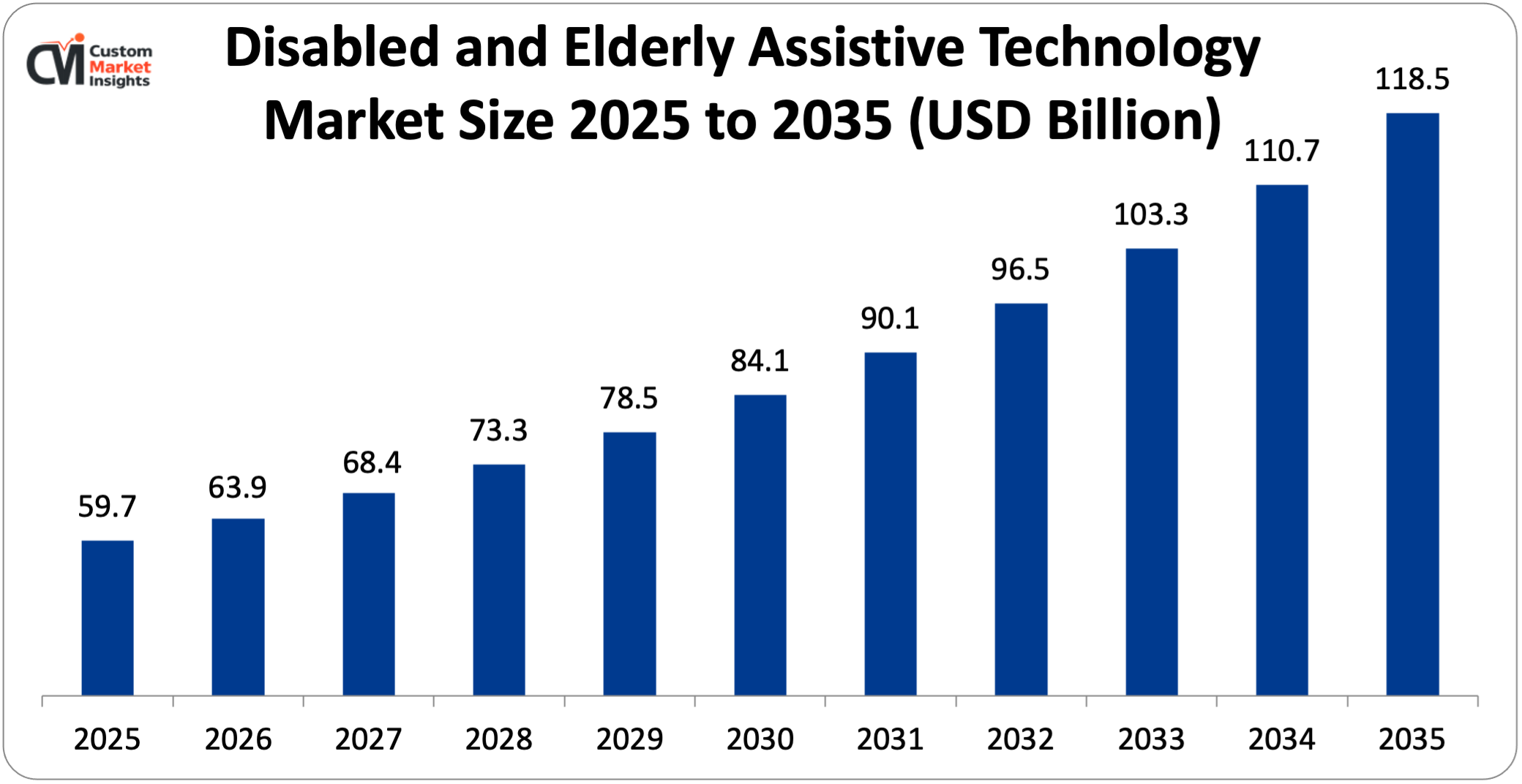
The market size of global disabled and elderly assistive technology will be estimated at USD 59.7 billion in 2025 and is expected to grow to between USD 63.9 billion in 2026 and about USD 118.5 billion by 2035, with a current CAGR (compound annual growth rate) of 7.1% during the period of 2026 to 2035. Disabled and elderly assistive technology includes a broad spectrum of products, interfaces, and systems designed to help people with motor, sensory, or cognitive disabilities and those who are aging to achieve greater independence and safety in their daily activities.
These can include aids and appliances for mobility and communication at home or body-mounted devices, as well as appliances and interfaces that enhance accessibility and life quality. With technology-based assistance will come less dependence and higher capacity, both keys to inclusion and self-efficacy.
Market Highlight
- In 2025, North America will dominate the global market with an estimated market share of 44%. The increasing investment in R&D drives the market growth.
- The Asia Pacific is growing at the highest CAGR over the analysis period. The increasing elderly population.
- By product, the mobility assistance aids segment dominated the industry in 2025.
- By end user, the hospitals segment captures the largest market share in 2025.
Significant Growth Factors
The disabled and elderly assistive technology market trends present significant growth opportunities due to several factors:
- Growing Geriatric Population: The rapid growth of the aging population is considered one of the largest contributors to the disabled and elderly assistive technology market, as the aging demographic will have increasing needs for mobility, hearing, vision, and daily living aids. Already 12% of the population in India is considered to be elderly (Government of India, via LASI report), and the number is expected to reach around 319 million by 2050, which is steadily increasing each year. Furthermore, the United Nations Population Fund statistics report that the elderly population (aged 60+) in India is expected to account for more than 20% of the total population by 2050, doubling from present levels. This survey implies that a dramatic change in life expectancy is not only expected to result in higher dependency ratios but also a huge progression in the elderly assistive technology market. Globally, the population of people aged 60+ is expected to more than double, from about 962 million in 2017 to over 2.1 billion by 2050, with similar trends apparent worldwide. This increase of the elderly is specifically influencing the growth of the elderly assistive technology market by increasing needs in the implementation of mobility aids, smart monitoring systems, hearing technology, and home-care innovations.
- Rising Prevalence Of Disabilities: The rising number of disabilities worldwide is one of the main factors contributing towards the growth of the disabled and elderly assistive technology market as the number of disabled persons increases. According to the World Health Organization (WHO), there are estimated to be in excess of 1.3 billion disabled persons worldwide, around 16% of the world’s population, and this shows that there is a significant rise in the need for assistive technologies. In India, the National Sample Survey (NSS) implemented by government organizations shows the number of people affected by locomotor, visual, hearing, and mental disabilities stands at various levels, with a higher number of affected people in the aging population group and those living in rural areas. Furthermore, the incidence of NCDs, such as diabetes, cardiovascular disorders, stroke, and neurological disorders, is increasing, with long-term disabilities resulting in an increased need for assistive devices. This heavy burden will be for the rise in demand for various assistive technologies, including mobility aids, hearing aids, wheelchairs, prosthetics, communication aids, communication devices, etc. This will further escalate the growth of the assistive technologies market.
What are the Major Advances Changing the Disabled and Elderly Assistive Technology Market Today?
- Wearable Assistive Technologies: Wearable assistive technologies are some of the most innovative in the elderly and disabled assistive technology sector, as their wireless and continuous nature enables real-time monitoring and support. Consumer electronic wearable devices such as smartwatches, fitness bands, smart glasses, ear wearables, and even advanced exoskeletons and mobility aids can help with the mobility, safety, and health needs of consumers by capturing vital signs, detecting falls and atypical body movement, sending immediate alerts to users, and enabling use in an emergency situation, which is an effective way to increase the safety of aging consumers living alone. Additionally, as wearable exoskeletons and assistive wearables for hearing and eyesight aid in the regain of sensory function, wearable assistive devices and exoskeletons for mobility can help people walk and perform basic routines, thereby increasing the active population, growing the wearable segment, and opening up new avenues in health, safety, and mobility aspects.
- Data-driven & Personalized Care: Data-driven and personalized solutions are one of the biggest innovations that are revolutionizing the market for the disabled and elderly by enabling personalized, responsive solutions to their needs, limitations, and health preferences. Advanced assistive devices today are increasingly collecting data in real-time on users’ body motions and postures, eye motions, vital signs, sleep states, sleep quality, daily activities, location, and physiological functions, which are then processed by sophisticated analytics and artificial intelligence to provide personalized and customized suggestions, warnings, and other adaptive features to the user. This results in increased safety, a corrected system based on the user data, the fit and comfort of solutions, and even predictive features like fall alerts and medication reminders based on the daily activities of the user. The sharing of this data remotely with caregivers and health professionals further supports more proactive, precise, and preventive healthcare solutions.
Category Wise Insights
By Product
Why Mobility Assistance Aids Hold a Prominent Position in the Market?
The mobility assistance aids segment dominated the industry in 2025. The segment is expanding because of the large and growing proportion of the population that is elderly and the growing incidence of impairing conditions such as arthritis, osteoporosis, and neurological conditions resulting from spinal cord injuries and other conditions that impair physical function. With aging and the related decline in physical function, there is a higher use of or need for mobility-related assistive products such as wheelchairs, walkers, mobility scooters, and canes. Advancements such as a lighter-weight product frame, collapsibility, electric mobility scooters, and comfort and convenience features on existing mobility aids such as smart wheelchairs will lead to higher usage of these devices. Consumer and care provider preferences for staying in the home environment and living independently, coupled with an increased ability of consumers to buy these products through e-commerce and increased general awareness about these products, will continue to increase sales and revenue growth for the segment.
The communication aids segment is growing at the highest CAGR over the analysis period. The disabled and elderly assistive technology segment of the communication aids market is experiencing strong revenue growth as the ability of users to communicate with one another increases. The use of communication aids among individuals with speech, language, and cognitive impairments is undoubtedly increasing, as cases of neurological impairment related to autism, amyotrophic lateral sclerosis (ALS), stroke, and neurocognitive impairment among the elderly age group continue to rise. Industry forecasts state that computer hardware and software enabling augmentative and alternative communication (AAC) devices for use in the home is on the rise and that these tools are becoming an ever more important way for individuals with communication difficulties to express emotions, needs, and thoughts.
The article attributes part of this industry growth to the effective commercialization of new communication technology in 2025. For example, the launch of more user-friendly innovative new speech-generating devices (or SGDs) and mobile AAC applications is helping to make new communication technology easier to use. As an illustration, innovation and launches like sophisticated new AAC apps and new cloud platforms, which allow relatively inexpensive mobile devices and tablets to be used as communication aids, are transforming communication devices of all form factors so they are affordable to all consumers worldwide, all contributing to market growth with aid technology.
Other recent launches, such as the Monarch AAC communication device (launch 2026) or the SMF VoXAI artificial voice system (launch 2026), show an increased focus on human-like speech generation and individual user preference catered to in this communications aid industry. With initiatives like the Palm-size PC usage trial using context-aware AAC devices assisting with real-world verbal communication situations in 2025, as well as innovative new product launches such as the purchase of new AAC equipment for use with BCI technologies in 2026, this industry continues to see new product development and launches in this space.
By End User
Why Hospitals Capture the Highest Market Share the Disabled and Elderly Assistive Technology Market?
The hospitals segment captures the largest market share in 2025. This segment is expected to show high growth on account of the rising population of elderly patients with age-related degenerative conditions, disabilities, and chronic diseases who require continuous hospital care and rehabilitation. Through the provision of aids, hospitals are the key end-users of home health, rehabilitation, and mobility aid products, which would have a significant impact on increasing hospital revenues and efficiency. Rising hospital admissions among the elderly, coupled with an aging population base that includes a large number of stroke patients, orthopedic traumas, neurological conditions, and cancer, are expected to propel the use of technology to increase in clinical settings.
Hospitals are seeking to use technological advances, including intelligent monitoring systems, intelligent rehabilitation devices, and connected aids and devices, to enhance the quality of care while reducing the caregiver’s workload and improving the efficiency of hospital stays. The favorable effect of improvement in healthcare infrastructure, policymakers’ initiatives to promote the provision of better healthcare, and an increase in the expenditure on healthcare would fuel the hospital segment’s revenue growth.
The homecare segment is growing rapidly over the projected period. The increase is mainly attributed to the increasing trend of aging-in-place and home-based care for elderly and disabled people. With advancements in medical sciences, people are aware of their long hospital stays and the higher cost associated with that, which makes them choose homecare as the best option of treatment. Assistive technologies like movement assistance & other mobility aids, remote monitoring devices, fall detector devices, and others, and in-home assistance & daily living devices will allow the elderly and disabled to live safely and independently at their homes.
The overall geriatric population is increasing, and so is the number of elderly suffering from chronic disease. Hence, improved healthcare technologies, including IoT-enabled devices, wearable health monitors, and Telehealth technologies, which allow users to monitor their health condition in real time and transmit the information to the physician in real time, also enable the application of homecare-based treatments. Government policies covering home healthcare, availability of in-home assistive aids through e-Commerce websites, and increased awareness among home caregivers will help the market to grow rapidly. Overall, providing for the needs of cost-effective, convenient, and more-ideal care alternatives will help the revenue of the market to grow massively.
Report Scope
| Feature of the Report | Details |
| Market Size in 2026 | USD 63.9 billion |
| Projected Market Size in 2035 | USD 118.5 billion |
| Market Size in 2025 | USD 59.7 billion |
| CAGR Growth Rate | 7.1% CAGR |
| Base Year | 2025 |
| Forecast Period | 2026-2035 |
| Key Segment | By Product, End User and Region |
| Report Coverage | Revenue Estimation and Forecast, Company Profile, Competitive Landscape, Growth Factors and Recent Trends |
| Regional Scope | North America, Europe, Asia Pacific, Middle East & Africa, and South & Central America |
| Buying Options | Request tailored purchasing options to fulfil your requirements for research. |
Regional Analysis
How Big is North America Disabled and Elderly Assistive Technology Market Size?
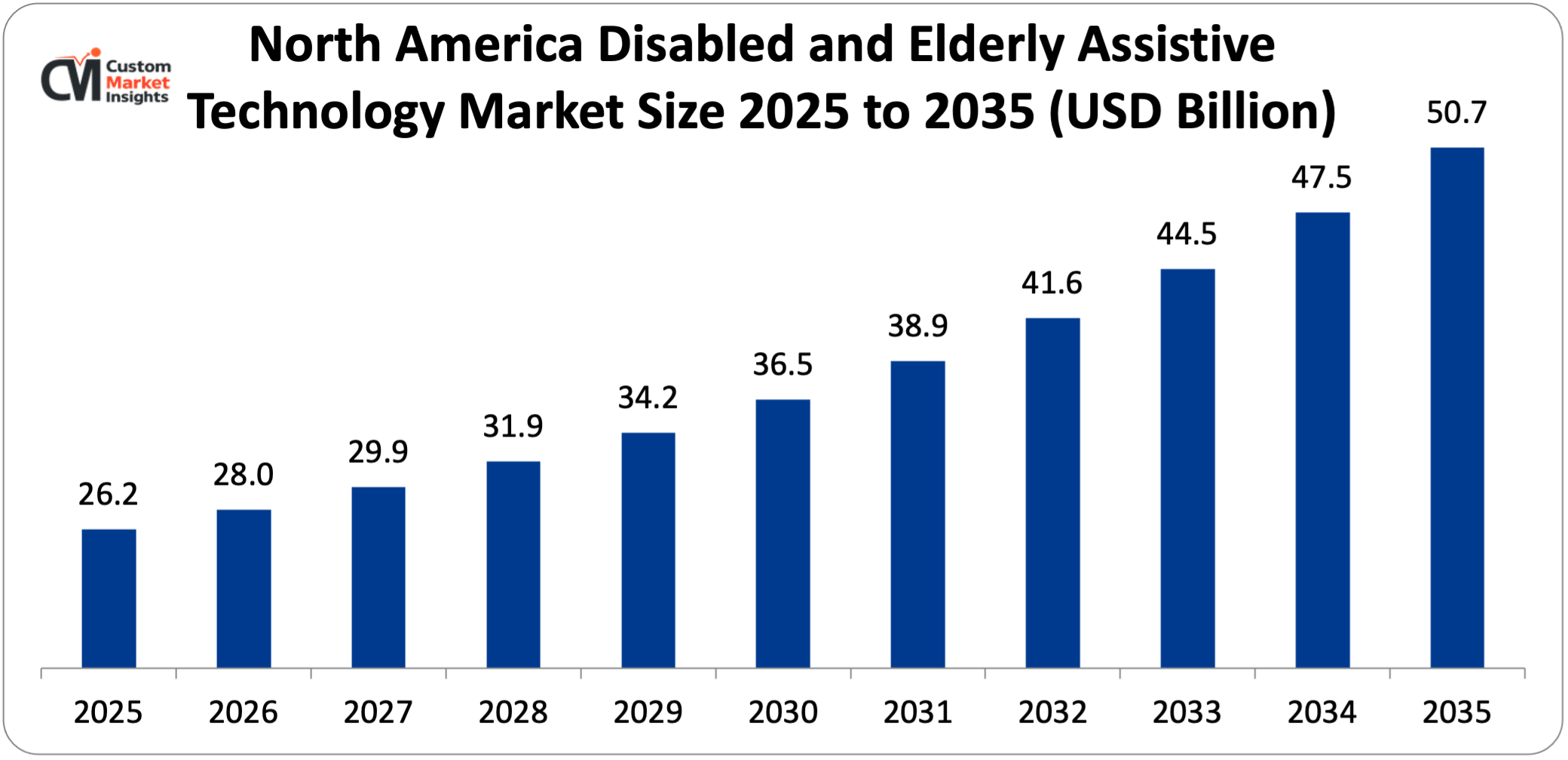
Its market size, in terms of North American disabled and elderly assistive technology, is projected to be USD 26.3 billion in 2025 with a growth to about USD 50.7 billion in 2035 with a CAGR of 6.8% between 2026 and 2035.
Why did North America Dominate the Disabled and Elderly Assistive Technology Market in 2025?
In 2025, North America will dominate the global market with an estimated market share of 44%. A rapidly aging population and a high prevalence of chronic diseases and disabilities characterize the North American market. Growing incidences of arthritis, hearing impairment, visual impairment, and neurological disorders in the USA and Canada are expected to bolster market sales of assistive devices such as mobility aids, hearing aids, and smart home-based solutions. Furthermore, North Americans have access to high-quality healthcare infrastructure, high healthcare expenditures, and a sustained focus on healthcare-related research and development areas, which makes them quick in adopting advanced assistive living innovations such as AI-enabled devices, wearable health monitors, and connected care systems.
Affordable reimbursement and government welfare programs such as disability welfare and insurance for assistive devices are further spurring utilization. Additionally, the presence of market leaders and ongoing product innovations, as well as major user awareness towards home care and independent living solutions, are facilitating the market entrance of several such innovations, which in turn is boosting the revenue growth of the North American assistive technology market for the disabled & elderly.
US Disabled and Elderly Assistive Technology Market Trends
In the North America region, the US leads the industry expansion over the projected period. The high and growing prevalence of disability and the aging population fuel the growth. The CDC estimates that more than ¼ of all American adults, some 61 million people, have at least one disability, creating an enormous need for assistive devices such as mobility aids, communication and hearing aids, and monitoring technology. The need is even greater in the senior population, with far higher rates of disability. According to government data, approximately 40–44% of Americans age 65+ have a disability. In addition to the need for ongoing support, age-related risks such as falling (by far the leading cause of injury death among older Americans, with an estimated 14 million+ injurious falls each year; 1 in 4 Americans aged 65+) are also contributing to growth in this industry.
Why is Europe Experiencing a Significant Growth in the Disabled and Elderly Assistive Technology Market?
Europe holds a significant market share in 2025. The market is forecasted to grow due to the aging world populations and increased incidence of chronic conditions and age-related conditions among nations such as Germany, France, Italy, and the UK. Eurostat data indicates that 21.8% of the EU population is aged 65, with the numbers expected to grow, which will create an increased demand for AT devices to be used at home or in institutional settings, such as mobility equipment, hearing equipment, and ADL aids. Furthermore, the European region is government supported with mature social welfare programs that fund, reimburse, and provide access to several AT devices. National interest in accessing inclusion and independent living policies will also propel the development of the market.
UK Disabled and Elderly Assistive Technology Market Trends
The UK held the dominant position in the market in 2025. Market is underpinned by excellent government initiatives and its healthcare support through the NHS providing funding and enabling access to a range of assistive devices and rehabilitation services. Additionally, aging in place focus, growing home care services, as well as development of digital health and smart monitoring are also increasing accessibility and ease of use.
Why is the Asia Pacific Growing at a Rapid Rate in the Disabled and Elderly Assistive Technology Market?
The Asia Pacific is expected to grow at the highest CAGR over the projected period. Regionally, the market is being propelled by the increasing trend of healthcare expenditure and improvement of healthcare infrastructure. Improved disposable income and rising awareness about various assistive devices like hearing aids, vision aids, and powered wheelchairs are also contributing as crucial factors of the regional market.
China Disabled and Elderly Assistive Technology Market Trends
China is growing at a significant rate in the market. One of the major determinants behind this development is the fast-tracking rate of technological innovation and new product launches in China. For example, in 2026, China approved the world’s first BCI device that was commercially available for improving the communication and hand movements of paralyzed patients, thereby leading the race among nations for newer and better assistive technology devices for disabled people. Moreover, new product launches in the sector of AI-enabled elderly-friendly products, such as smart glasses with voice navigation, reading aids, and a smart home system that enables remote caregiving, continue to increase their penetration into the lives of older adults.
Why is the Middle East & Africa Region is growing rapidly in the Disabled and Elderly Assistive Technology?
The MEA region is growing at a steady rate over the projected period. The ease of access to modern assistive technology, driven by rising healthcare expenditure, growing urbanization, and a rise in awareness programs, is rapidly improving in the Gulf Countries. With continuous product development and rising adoption of technologically advanced assistive devices, this factor is supporting continuous revenue growth in the MEA disabled and elderly assistive technology market.
UAE Disabled and Elderly Assistive Technology Market Trends
The UAE is growing at the highest CAGR during the forecast period. The increasing investment in advanced devices is the main factor driving the market growth.
Top Players in the Disabled and Elderly Assistive Technology Market and Their Offerings
- Invacare Corporation
- Ottobock SE & Co. KGaA
- Sunrise Medical LLC
- Drive DeVilbiss Healthcare (Drive Medical)
- Sonova Holding AG
- William Demant Holding A/S (Demant A/S)
- GN ReSound Group (GN Store Nord A/S)
- Starkey Hearing Technologies
- Widex Ltd. (WS Audiology)
- Pride Mobility Products Corporation
- Permobil AB
- Medline Industries Inc.
- Karma Medical Products Co. Ltd.
- GF Health Products Inc.
- Medical Depot Inc. (Drive brand)
- Freedom Scientific Inc.
- AI Squared (Ai Squared)
- DynaVox (Dynavox Systems LLC)
- MED-EL Medical Electronics
- Bausch + Lomb
- Others
Key Developments
Disabled and elderly assistive technology market has experienced considerable changes in the last two years as the market players are trying to diversify their technological aspects and develop product portfolios using strategic approaches.
- In August 2025, as part of its ongoing commitment to supporting innovation and promoting digital inclusion for persons with disabilities and the elderly, the Qatar Assistive Technology Center—”Mada”—has officially announced the launch of the 2025 edition of the Mada Innovation Award. This strategic initiative aims to foster the development of innovative technological solutions that improve the quality of life for target groups, with a focus on solutions powered by artificial intelligence (AI). (https://qna.org.qa/en/news/news-details?id=mada-launches-2025-mada-innovation-award-toward-a-more-inclusive-digital-future-for-persons-with-disabilities-the-elderly&date=7/08/2025)
These strategic measures have enabled the companies to reinforce their competitive positions, increase the product line, boost their technological competencies, and also seize growth opportunities in the fast-growing disabled and elderly assistive technology market.
The Disabled and Elderly Assistive Technology Market is segmented as follows:
By Product
- Mobility Assistance Aids
- Wheelchairs
- Mobility Scooters
- Crutches & Canes
- Patient Mechanical Lift Handling
- Walkers & Rollators
- Others
- Assistive Furniture
- Medical Beds
- Riser Reclining Chairs
- Railings & Bar
- Door Openers
- Others
- Bathroom Safety & Assistive Products
- Commodes Chairs
- Shower Chairs
- Ostomy Products
- Others
- Communication Aids
- Speech & Writing Therapy Devices
- Hearing Aids
- Canal Hearing Aids
- Receiver-in-the-Ear (RITE) Aids
- Cochlear Implants
- Behind-the-Ear (BTE) Aids
- Bone Anchored Hearing Aids (BAHA)
- In-the-Ear (ITE) Aids
- Vision & Reading Aids
- Reading Machines
- Video Magnifiers
- Braille Translators
- Others
By End User
- Hospitals
- Homecare
- Elderly Nursing Homes
- Others
Regional Coverage:
North America
- U.S.
- Canada
- Mexico
- Rest of North America
Europe
- Germany
- France
- U.K.
- Russia
- Italy
- Spain
- Netherlands
- Rest of Europe
Asia Pacific
- China
- Japan
- India
- New Zealand
- Australia
- South Korea
- Taiwan
- Rest of Asia Pacific
The Middle East & Africa
- Saudi Arabia
- UAE
- Egypt
- Kuwait
- South Africa
- Rest of the Middle East & Africa
Latin America
- Brazil
- Argentina
- Rest of Latin America
Table of Contents
- Chapter 1. Report Introduction
- 1.1. Report Description
- 1.1.1. Purpose of the Report
- 1.1.2. USP & Key Offerings
- 1.2. Key Benefits For Stakeholders
- 1.3. Target Audience
- 1.4. Report Scope
- 1.1. Report Description
- Chapter 2. Market Overview
- 2.1. Report Scope (Segments And Key Players)
- 2.1.1. Disabled and Elderly Assistive Technology by Segments
- 2.1.2. Disabled and Elderly Assistive Technology by Region
- 2.2. Executive Summary
- 2.2.1. Market Size & Forecast
- 2.2.2. Disabled and Elderly Assistive Technology Market Attractiveness Analysis, By Product
- 2.2.3. Disabled and Elderly Assistive Technology Market Attractiveness Analysis, By End User
- 2.1. Report Scope (Segments And Key Players)
- Chapter 3. Market Dynamics (DRO)
- 3.1. Market Drivers
- 3.1.1. Growing Geriatric Population
- 3.1.2. Rising Prevalence Of Disabilities
- 3.2. Market Restraints
- 3.3. Market Opportunities
- 3.5. Pestle Analysis
- 3.6. Porter Forces Analysis
- 3.7. Technology Roadmap
- 3.8. Value Chain Analysis
- 3.9. Government Policy Impact Analysis
- 3.10. Pricing Analysis
- 3.1. Market Drivers
- Chapter 4. Disabled and Elderly Assistive Technology Market – By Product
- 4.1. Product Market Overview, By Product Segment
- 4.1.1. Disabled and Elderly Assistive Technology Market Revenue Share, By Product, 2025 & 2035
- 4.1.2. Mobility Assistance Aids
- 4.1.2.1. Wheelchairs
- 4.1.2.2. Mobility Scooters
- 4.1.2.3. Crutches & Canes
- 4.1.2.4. Patient Mechanical Lift Handling
- 4.1.2.5. Walkers & Rollators
- 4.1.2.6. Others
- 4.1.3. Disabled and Elderly Assistive Technology Share Forecast, By Region (USD Billion)
- 4.1.4. Comparative Revenue Analysis, By Country, 2025 & 2035
- 4.1.5. Key Market Trends, Growth Factors, & Opportunities
- 4.1.6. Assistive Furniture
- 4.1.6.1. Medical Beds
- 4.1.6.2. Riser Reclining Chairs
- 4.1.6.3. Railings & Bar
- 4.1.6.4. Door Openers
- 4.1.6.5. Others
- 4.1.7. Disabled and Elderly Assistive Technology Share Forecast, By Region (USD Billion)
- 4.1.8. Comparative Revenue Analysis, By Country, 2025 & 2035
- 4.1.9. Key Market Trends, Growth Factors, & Opportunities
- 4.1.10. Bathroom Safety & Assistive Products
- 4.1.10.1. Commodes Chairs
- 4.1.10.2. Shower Chairs
- 4.1.10.3. Ostomy Products
- 4.1.10.4. Others
- 4.1.11. Disabled and Elderly Assistive Technology Share Forecast, By Region (USD Billion)
- 4.1.12. Comparative Revenue Analysis, By Country, 2025 & 2035
- 4.1.13. Key Market Trends, Growth Factors, & Opportunities
- 4.1.14. Communication Aids
- 4.1.14.1. Speech & Writing Therapy Devices
- 4.1.14.2. Hearing Aids
- 4.1.14.3. Canal Hearing Aids
- 4.1.14.4. Receiver-in-the-Ear (RITE) Aids
- 4.1.14.5. Cochlear Implants
- 4.1.14.6. Behind-the-Ear (BTE) Aids
- 4.1.14.7. Bone Anchored Hearing Aids (BAHA)
- 4.1.14.8. In-the-Ear (ITE) Aids
- 4.1.15. Disabled and Elderly Assistive Technology Share Forecast, By Region (USD Billion)
- 4.1.16. Comparative Revenue Analysis, By Country, 2025 & 2035
- 4.1.17. Key Market Trends, Growth Factors, & Opportunities
- 4.1.18. Vision & Reading Aids
- 4.1.18.1. Reading Machines
- 4.1.18.2. Video Magnifiers
- 4.1.18.3. Braille Translators
- 4.1.18.4. Others
- 4.1.19. Disabled and Elderly Assistive Technology Share Forecast, By Region (USD Billion)
- 4.1.20. Comparative Revenue Analysis, By Country, 2025 & 2035
- 4.1.21. Key Market Trends, Growth Factors, & Opportunities
- 4.1. Product Market Overview, By Product Segment
- Chapter 5. Disabled and Elderly Assistive Technology Market – By End User
- 5.1. End User Market Overview, By End User Segment
- 5.1.1. Disabled and Elderly Assistive Technology Market Revenue Share, By End User, 2025 & 2035
- 5.1.2. Hospitals
- 5.1.3. Disabled and Elderly Assistive Technology Share Forecast, By Region (USD Billion)
- 5.1.4. Comparative Revenue Analysis, By Country, 2025 & 2035
- 5.1.5. Key Market Trends, Growth Factors, & Opportunities
- 5.1.6. Homecare
- 5.1.7. Disabled and Elderly Assistive Technology Share Forecast, By Region (USD Billion)
- 5.1.8. Comparative Revenue Analysis, By Country, 2025 & 2035
- 5.1.9. Key Market Trends, Growth Factors, & Opportunities
- 5.1.10. Elderly Nursing Homes
- 5.1.11. Disabled and Elderly Assistive Technology Share Forecast, By Region (USD Billion)
- 5.1.12. Comparative Revenue Analysis, By Country, 2025 & 2035
- 5.1.13. Key Market Trends, Growth Factors, & Opportunities
- 5.1.14. Others
- 5.1.15. Disabled and Elderly Assistive Technology Share Forecast, By Region (USD Billion)
- 5.1.16. Comparative Revenue Analysis, By Country, 2025 & 2035
- 5.1.17. Key Market Trends, Growth Factors, & Opportunities
- 5.1. End User Market Overview, By End User Segment
- Chapter 6. Disabled and Elderly Assistive Technology Market – Regional Analysis
- 6.1. Disabled and Elderly Assistive Technology Market Overview, By Region Segment
- 6.1.1. Global Disabled and Elderly Assistive Technology Market Revenue Share, By Region, 2025 & 2035
- 6.1.2. Global Disabled and Elderly Assistive Technology Market Revenue, By Region, 2026 – 2035 (USD Billion)
- 6.1.3. Global Disabled and Elderly Assistive Technology Market Revenue, By Product, 2026 – 2035
- 6.1.4. Global Disabled and Elderly Assistive Technology Market Revenue, By End User, 2026 – 2035
- 6.2. North America
- 6.2.1. North America Disabled and Elderly Assistive Technology Market Revenue, By Country, 2026 – 2035 (USD Billion)
- 6.2.2. North America Disabled and Elderly Assistive Technology Market Revenue, By Product, 2026 – 2035
- 6.2.3. North America Disabled and Elderly Assistive Technology Market Revenue, By End User, 2026 – 2035
- 6.2.4. U.S. Disabled and Elderly Assistive Technology Market Revenue, 2026 – 2035 (USD Billion)
- 6.2.5. Canada Disabled and Elderly Assistive Technology Market Revenue, 2026 – 2035 (USD Billion)
- 6.2.6. Mexico Disabled and Elderly Assistive Technology Market Revenue, 2026 – 2035 (USD Billion)
- 6.2.7. Rest of North America Disabled and Elderly Assistive Technology Market Revenue, 2026 – 2035 (USD Billion)
- 6.3. Europe
- 6.3.1. Europe Disabled and Elderly Assistive Technology Market Revenue, By Country, 2026 – 2035 (USD Billion)
- 6.3.2. Europe Disabled and Elderly Assistive Technology Market Revenue, By Product, 2026 – 2035
- 6.3.3. Europe Disabled and Elderly Assistive Technology Market Revenue, By End User, 2026 – 2035
- 6.3.4. Germany Disabled and Elderly Assistive Technology Market Revenue, 2026 – 2035 (USD Billion)
- 6.3.5. France Disabled and Elderly Assistive Technology Market Revenue, 2026 – 2035 (USD Billion)
- 6.3.6. U.K. Disabled and Elderly Assistive Technology Market Revenue, 2026 – 2035 (USD Billion)
- 6.3.7. Russia Disabled and Elderly Assistive Technology Market Revenue, 2026 – 2035 (USD Billion)
- 6.3.8. Italy Disabled and Elderly Assistive Technology Market Revenue, 2026 – 2035 (USD Billion)
- 6.3.9. Spain Disabled and Elderly Assistive Technology Market Revenue, 2026 – 2035 (USD Billion)
- 6.3.10. Netherlands Disabled and Elderly Assistive Technology Market Revenue, 2026 – 2035 (USD Billion)
- 6.3.11. Rest of Europe Disabled and Elderly Assistive Technology Market Revenue, 2026 – 2035 (USD Billion)
- 6.4. Asia Pacific
- 6.4.1. Asia Pacific Disabled and Elderly Assistive Technology Market Revenue, By Country, 2026 – 2035 (USD Billion)
- 6.4.2. Asia Pacific Disabled and Elderly Assistive Technology Market Revenue, By Product, 2026 – 2035
- 6.4.3. Asia Pacific Disabled and Elderly Assistive Technology Market Revenue, By End User, 2026 – 2035
- 6.4.4. China Disabled and Elderly Assistive Technology Market Revenue, 2026 – 2035 (USD Billion)
- 6.4.5. Japan Disabled and Elderly Assistive Technology Market Revenue, 2026 – 2035 (USD Billion)
- 6.4.6. India Disabled and Elderly Assistive Technology Market Revenue, 2026 – 2035 (USD Billion)
- 6.4.7. New Zealand Disabled and Elderly Assistive Technology Market Revenue, 2026 – 2035 (USD Billion)
- 6.4.8. Australia Disabled and Elderly Assistive Technology Market Revenue, 2026 – 2035 (USD Billion)
- 6.4.9. South Korea Disabled and Elderly Assistive Technology Market Revenue, 2026 – 2035 (USD Billion)
- 6.4.10. Taiwan Disabled and Elderly Assistive Technology Market Revenue, 2026 – 2035 (USD Billion)
- 6.4.11. Rest of Asia Pacific Disabled and Elderly Assistive Technology Market Revenue, 2026 – 2035 (USD Billion)
- 6.5. The Middle-East and Africa
- 6.5.1. The Middle-East and Africa Disabled and Elderly Assistive Technology Market Revenue, By Country, 2026 – 2035 (USD Billion)
- 6.5.2. The Middle-East and Africa Disabled and Elderly Assistive Technology Market Revenue, By Product, 2026 – 2035
- 6.5.3. The Middle-East and Africa Disabled and Elderly Assistive Technology Market Revenue, By End User, 2026 – 2035
- 6.5.4. Saudi Arabia Disabled and Elderly Assistive Technology Market Revenue, 2026 – 2035 (USD Billion)
- 6.5.5. UAE Disabled and Elderly Assistive Technology Market Revenue, 2026 – 2035 (USD Billion)
- 6.5.6. Egypt Disabled and Elderly Assistive Technology Market Revenue, 2026 – 2035 (USD Billion)
- 6.5.7. Kuwait Disabled and Elderly Assistive Technology Market Revenue, 2026 – 2035 (USD Billion)
- 6.5.8. South Africa Disabled and Elderly Assistive Technology Market Revenue, 2026 – 2035 (USD Billion)
- 6.5.9. Rest of the Middle East & Africa Disabled and Elderly Assistive Technology Market Revenue, 2026 – 2035 (USD Billion)
- 6.6. Latin America
- 6.6.1. Latin America Disabled and Elderly Assistive Technology Market Revenue, By Country, 2026 – 2035 (USD Billion)
- 6.6.2. Latin America Disabled and Elderly Assistive Technology Market Revenue, By Product, 2026 – 2035
- 6.6.3. Latin America Disabled and Elderly Assistive Technology Market Revenue, By End User, 2026 – 2035
- 6.6.4. Brazil Disabled and Elderly Assistive Technology Market Revenue, 2026 – 2035 (USD Billion)
- 6.6.5. Argentina Disabled and Elderly Assistive Technology Market Revenue, 2026 – 2035 (USD Billion)
- 6.6.6. Rest of Latin America Disabled and Elderly Assistive Technology Market Revenue, 2026 – 2035 (USD Billion)
- 6.1. Disabled and Elderly Assistive Technology Market Overview, By Region Segment
- Chapter 7. Competitive Landscape
- 7.1. Company Market Share Analysis – 2025
- 7.1.1. Global Disabled and Elderly Assistive Technology Market: Company Market Share, 2025
- 7.2. Global Disabled and Elderly Assistive Technology Market Company Market Share, 2024
- 7.1. Company Market Share Analysis – 2025
- Chapter 8. Company Profiles
- 8.1. Invacare Corporation
- 8.1.1. Company Overview
- 8.1.2. Key Executives
- 8.1.3. Product Portfolio
- 8.1.4. Financial Overview
- 8.1.5. Operating Business Segments
- 8.1.6. Business Performance
- 8.1.7. Recent Developments
- 8.2. Ottobock SE & Co. KGaA
- 8.3. Sunrise Medical LLC
- 8.4. Drive DeVilbiss Healthcare (Drive Medical)
- 8.5. Sonova Holding AG
- 8.6. William Demant Holding A/S (Demant A/S)
- 8.7. GN ReSound Group (GN Store Nord A/S)
- 8.8. Starkey Hearing Technologies
- 8.9. Widex Ltd. (WS Audiology)
- 8.10. Pride Mobility Products Corporation
- 8.11. Permobil AB
- 8.12. Medline Industries Inc.
- 8.13. Karma Medical Products Co. Ltd.
- 8.14. GF Health Products Inc.
- 8.15. Medical Depot Inc. (Drive brand)
- 8.16. Freedom Scientific Inc.
- 8.17. AI Squared (Ai Squared)
- 8.18. DynaVox (Dynavox Systems LLC)
- 8.19. MED-EL Medical Electronics
- 8.20. Bausch + Lomb
- 8.21. Others.
- 8.1. Invacare Corporation
- Chapter 9. Research Methodology
- 9.1. Research Methodology
- 9.2. Secondary Research
- 9.3. Primary Research
- 9.3.1. Analyst Tools and Models
- 9.4. Research Limitations
- 9.5. Assumptions
- 9.6. Insights From Primary Respondents
- 9.7. Why Healthcare Foresights
- Chapter 10. Standard Report Commercials & Add-Ons
- 10.1. Customization Options
- 10.2. Subscription Module For Market Research Reports
- 10.3. Client Testimonials
- Chapter 11. List Of Figures
- 11.1. Figures No 1 to 50
- Chapter 12. List Of Tables
- 12.1. Tables No 1 to 41
Prominent Player
- Invacare Corporation
- Ottobock SE & Co. KGaA
- Sunrise Medical LLC
- Drive DeVilbiss Healthcare (Drive Medical)
- Sonova Holding AG
- William Demant Holding A/S (Demant A/S)
- GN ReSound Group (GN Store Nord A/S)
- Starkey Hearing Technologies
- Widex Ltd. (WS Audiology)
- Pride Mobility Products Corporation
- Permobil AB
- Medline Industries Inc.
- Karma Medical Products Co. Ltd.
- GF Health Products Inc.
- Medical Depot Inc. (Drive brand)
- Freedom Scientific Inc.
- AI Squared (Ai Squared)
- DynaVox (Dynavox Systems LLC)
- MED-EL Medical Electronics
- Bausch + Lomb
- Others
FAQs
The key players in the market are Invacare Corporation, Ottobock SE & Co. KGaA, Sunrise Medical LLC, Drive DeVilbiss Healthcare (Drive Medical), Sonova Holding AG, William Demant Holding A/S (Demant A/S), GN ReSound Group (GN Store Nord A/S), Starkey Hearing Technologies, Widex Ltd. (WS Audiology), Pride Mobility Products Corporation, Permobil AB, Medline Industries Inc., Karma Medical Products Co. Ltd., GF Health Products Inc., Medical Depot Inc. (Drive brand), Freedom Scientific Inc., AI Squared (Ai Squared), DynaVox (Dynavox Systems LLC), MED-EL Medical Electronics, Bausch + Lomb, and Others.
Government policies have a dual influence on the expansion of the assistive technology market for the disabled and elderly. On one hand, regulations imposed by the government about the quality, safety, and accessibility of the products provide consumers with confidence in the device and let the niche flourish. On the other hand, government initiatives, including subsidies, reimbursements, and disability laws, allow more disabled and elderly people to access the products and thus grow the market.
The price of the devices is key in enabling the market expansion and diffusion. Expensive devices are less accessible, resulting in reduced market penetration; in contrast, inexpensive devices, along with the availability of insurance and reimbursement plans, incentivize accessibility, leading to increased market penetration and a more inclusive market for a larger number of people.
According to the present analysis and forecast modeling, the market of disabled and elderly assistive technology will witness a significant growth of about USD 118.5 billion in the year 2035 with the growing innovative product launch, increasing collaboration, and rising disabilities cases with a CAGR of 7.1% between the years 2026 and 2035.
It is projected that North America will hold the largest market share in the disabled and elderly assistive technology market in the forecast period, with a share of about 44% of the global market share, which is attributed to the region’s presence of major players and increasing investment in advanced technology.
The Asia Pacific is expected to grow at the highest CAGR during the forecast period. The growth in the region is owing to the growing older population and increasing disposable income.
The forecasted expansion of the market for disability and senior assistive devices is supported by a mixture of demographical, technological, and medical-related factors. The most prominent factor for this growth is the fast growth of the world‘s geriatric population, which implies an increase of age-related illnesses such as mobility conditions, deafness, and sight impairments and, therefore, the employment of assistive devices. Also, the increase of disabilities and chronic illnesses, like neurological diseases, diabetes, and cardiovascular conditions, also increases the potential market for assistive technology.