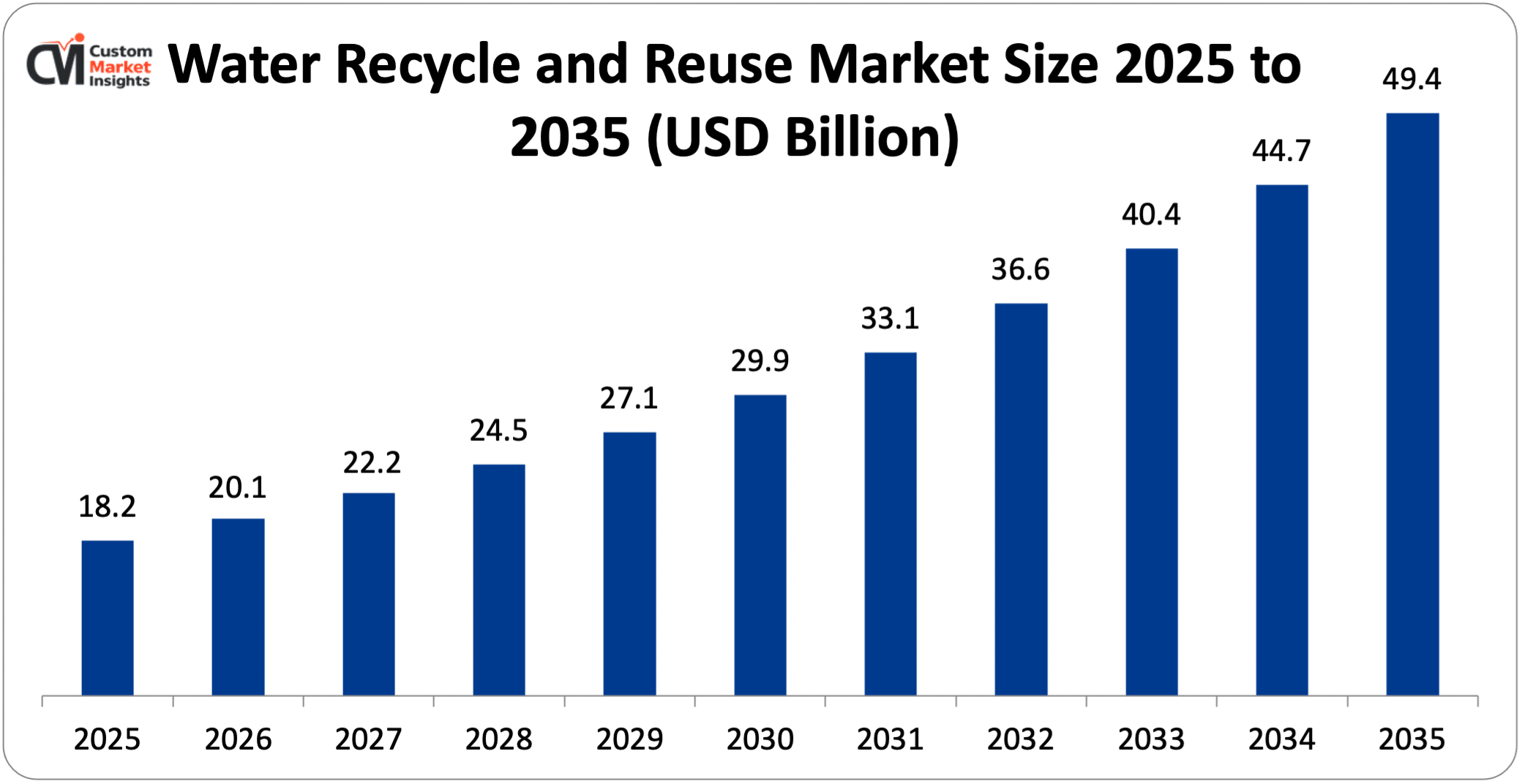
Valued at USD 20.1 Bn in 2026, the market is projected to reach USD 49.4 Bn by 2035, growing at a 10.5% CAGR. Asia Pacific holds the largest share, while North America grows fastest. The report is segmented by equipment and end use.
The global water recycle and reuse market was valued at USD 20.1 Bn in 2026 and is projected to reach USD 49.4 Bn by 2035, growing at a CAGR of 10.5%. Asia Pacific is the largest regional market and North America is growing fastest.
The market size of global water recycling and reuse will be estimated at USD 18.2 billion in 2025 and is expected to grow to between USD 20.1 billion in 2026 and about USD 49.4 billion by 2035, with a current CAGR (compound annual growth rate) of 10.5% during the period of 2026 to 2035. Water recycling and reuse is a concept of treatment of wastewater generated by domestic, industrial, and agricultural use for various reuses rather than disposal into the environment. There are several types of treatment processes involved, including physical, chemical, and biological processes to remove the parameters that are not desirable.
Several water use options are available for the treated water, including advanced water recycling and reuse, groundwater recharge, industrial cooling, landscape irrigation, and potable use in advanced water reuse systems. Water reuse can be direct (reuse of treated effluent) or indirect (indirect potable reuse in the case of advanced water treatment processes) use for non-potable purposes such as irrigation, toilet flushing, cooling, etc. The main purpose of water recycling and reuse is to reduce the pressure on the amount of water drawn from the natural resources and optimize the water efficiencies. With expanding demand for water and related impacts of growth and climate change, water recycling and reuse have become an integral part of long-term water security.
In 2025, the Asia Pacific will dominate the global market with an estimated market share of 37%. The rising number of water projects in the area drives the market growth.
North America is growing at a steady rate over the analysis period. The increasing product launch drives the regional growth.
By equipment, the filtration segment dominated the industry in 2025 with more than 35%.
By end use, the industrial segment would have the highest share of the market in 2025 of over 45%.
Significant Growth Factors
The water recycling and reuse market trends present significant growth opportunities due to several factors:
Increasing Water Scarcity: One of the most important factors is the growing water scarcity situation, which is highlighted in various government and intergovernmental reports. As per the reports published by UN-Water, water scarcity is considered to be one of the biggest challenges facing the world. It is reported that if the water withdrawal is above 25% of the renewable water resource, the region is said to be water-stressed. As per the reports, many regions already experience this situation. It is also reported by the United Nations that billions of people experience water scarcity at least once a year. As per the government reports, the situation is much worse in the case of the Indian subcontinent. It is reported that 600 million people experience high to extreme water stress in the region. Moreover, the region holds only 4% of the global water resources and supports 17% of the global population. As per the government reports published in the country, the water availability per capita is already reduced to 1,486 cubic meters (2021), which is already less than the water stress threshold. Moreover, the water availability is expected to reduce to 1,140 cubic meters by the year 2050. It is also reported that the water demand-supply gap is expected to be 40% by the year 2030. As per the government reports, the Jal Shakti Abhiyan program is being implemented by the Ministry of Jal Shakti to address the water scarcity situation. As per the government reports, the Uttar Pradesh government has published the wastewater reuse policy in the year 2026, which aims to achieve the reuse of 100% wastewater by the year 2035.
Industrial Demand for Water Efficiency: One of the major factors propelling the growth of the Water Recycle and Reuse Market is the growing demand for water efficiency in the industry sector. Industry is one of the largest consumers of water globally. As per the data collected by the United Nations Industrial Development Organization (UNIDO) and environmental agencies in different nations, the industry sector consumes approximately 20% of the global water supply. This percentage is much higher in the case of emerging economies. For example, the water demand is expected to grow at a rapid rate in the case of the Indian economy due to the expansion of the industry sector. It includes the power generation sector, the chemical sector, the textile sector, the food processing sector, and the manufacturing sector. Moreover, the government and the regulatory agencies are making it mandatory to ensure the efficient usage of water. For example, the Central Pollution Control Board (CPCB), which is the environmental agency of the Indian government, has set up strict guidelines for the discharge of water in the case of the textile industry and the tannery industry, which are the highly polluting industries. Moreover, the global scenario is also focusing on the sustainable usage of water in the industry sector. It is one of the parameters set by the United Nations for the sustainable usage of water under the Sustainable Development Goals, which are Sustainable Development Goals (Clean Water and Sanitation). From the industry point of view, the cost of water is on the rise. As water is scarce globally, the supply is also uncertain. Moreover, the cost is also high. It is not economically and operationally viable to depend on water. Hence, the industry is adopting the water recycling method to ensure the sustainable usage of water. It is being used for the production process. For instance, the power generation and oil refinery sectors are utilizing the water recycling method. Moreover, the industry is also focusing on the Environment, Social, and Governance (ESG) parameters. It is one of the parameters set by the United Nations to ensure the sustainable usage of water.
What are the Major Advances Changing the Water Recycle and Reuse Market Today?
Advanced Membrane Technologies: Advanced membrane technology has been identified as a significant innovation in the Water Recycle and Reuse Market. Advanced membrane technology has completely transformed the recycling and reuse of wastewater. Reverse osmosis technology, ultrafiltration technology, nanofiltration technology, and membrane bioreactors are some of the membrane technologies used in the recycling and reuse of wastewater. These membrane technologies use semi-permeable membranes, which are efficient in separating contaminants and dissolved solids from wastewater. This results in high-quality recycled water, which can be reused for various industrial and municipal purposes, including drinking water purposes. The advantages of membrane technology can be listed as follows: membrane technology can efficiently provide better filtration results than conventional technology. Reverse osmosis technology can remove up to 99% of dissolved salts and impurities from wastewater. Therefore, this technology is a significant innovation in achieving high-quality recycled water, which can be reused for various industrial purposes. In addition, membrane bioreactors can efficiently treat wastewater in compact spaces due to the combination of both biological and membrane filtration processes. This is a significant advantage in urban areas, where space is a major constraint in implementing wastewater recycling and reuse technologies. The government and other environmental organizations have also come to realize the significance of membrane technology in addressing the problem of water scarcity in different parts of the world. For instance, in India, the government has formulated different regulatory policies in different parts of the country through different government institutions such as the Central Pollution Control Board (CPCB), which have encouraged different industries in the country to adopt different membrane technologies in different industries involved in water recycling and reuse, especially those industries where water is a major factor in the production process. The United Nations has also recognized the significance of advanced membrane technology in addressing the problem of water sustainability in different parts of the world. From a commercial point of view, it is clear that membrane technology is a major innovation in the water recycle and reuse market due to the cost efficiency of the technology compared to other conventional technologies in the long run. Though the cost of investment in membrane technology is high, the technology is efficient in reducing costs in the long run by reducing costs associated with the purchase of fresh water and wastewater discharge.
Energy-efficient Treatment Solutions: Energy-efficient treatment solutions are another significant development in the Water Recycle and Reuse Market, as industries and municipalities are increasingly looking for solutions to overcome the high energy consumption of traditional water and wastewater treatment technologies. Conventional water and wastewater treatment technologies such as thermal distillation and evaporation are not only costly but also consume a high level of energy. Therefore, the development of new and energy-efficient technologies is a significant leap forward in water and wastewater treatment. The development of new products is a clear reflection of the growing need for energy-efficient solutions in water and wastewater treatment. Toray Industries developed new and advanced reverse osmosis membranes for use in water and wastewater treatment systems. The new technology is designed to operate at low pressure, thereby reducing the overall energy consumption of the process. Another new product developed by Hydranautics is the ESNA5-LD membrane, which is designed to improve contaminant removal while reducing energy consumption in industrial water and wastewater treatment systems. Pall Corporation developed a new Membralox ceramic membrane system that provides high permeability for efficient water and wastewater treatment systems. Another new product developed by Asahi Kasei is the Microza-based membrane systems for water and wastewater treatment systems. The new product significantly reduces energy consumption and greenhouse gas emissions compared to traditional distillation-based water and wastewater treatment systems. The product is particularly useful for pharmaceutical water treatment systems. Another new product developed by Memsift Innovations and Murugappa Group is the GOSEP ultrafiltration membrane for sustainable and low-energy industrial water reuse systems. Another significant development in water and wastewater treatment is POM-branes developed by CSMCRI and IIT Gandhinagar. The new product provides significantly high efficiency and low energy consumption compared to traditional water and wastewater treatment systems.
Category Wise Insights
By Equipment
Why Filtration Hold a Prominent Position in the Market?
The filtration segment dominated the industry in 2025 of more than 35%. The introduction of innovative product launch drives the market growth. In April 2025, Toray Industries, Inc., announced the launch of the PTC.SLV household water purifier cartridge in early April. This offering swiftly filters 16 substances designated under the Japanese Industrial Standard (JIS) and lasts three times longer than existing counterparts. The company will simultaneously release the Torayvino(TM) PT307SLV, a water-filter pitcher that employs this cartridge. The PTC.SLV cartridge is also fully compatible for other Torayvino pitchers.
The tanks segment is growing at a highest CAGR during the forecast period. This is mainly because water needs to be stored after it is treated, so a tank is a must in centralized and decentralized water reuse systems. Due to increasing water shortage and increase in water reuse, industries and municipalities are in need of large-capacity, corrosion-free, and durable tanks to store high volumes of reuse water.
By End Use
Why Industrial Capture the Highest Market Share in the Water Recycle and Reuse Market?
The industrial segment would have the highest share of the market in 2025 of over 45%. The rising reliance of industries (power, chemicals, pharmaceuticals, oil, and gas) on water recycling and reuse solutions is providing growth opportunities for the water recycling and reuse systems market.
The commercial segment is growing at a rapid rate over the projected period. One of the driving forces for this growth is the increased focus on decentralized and on-site water reuse systems in commercial complexes, which are used to not only minimize reliance on municipal supplies but also to reduce operational costs.
Report Scope
Feature of the Report
Details
Market Size in 2026
USD 20.1 billion
Projected Market Size in 2035
USD 49.4 billion
Market Size in 2025
USD 18.2 billion
CAGR Growth Rate
10.5% CAGR
Base Year
2025
Forecast Period
2026-2035
Key Segment
By Equipment, End Use and Region
Report Coverage
Revenue Estimation and Forecast, Company Profile, Competitive Landscape, Growth Factors and Recent Trends
Regional Scope
North America, Europe, Asia Pacific, Middle East & Africa, and South & Central America
Buying Options
Request tailored purchasing options to fulfil your requirements for research.
Regional Analysis
How Big is the Asia Pacific Water Recycle and Reuse Market Size?
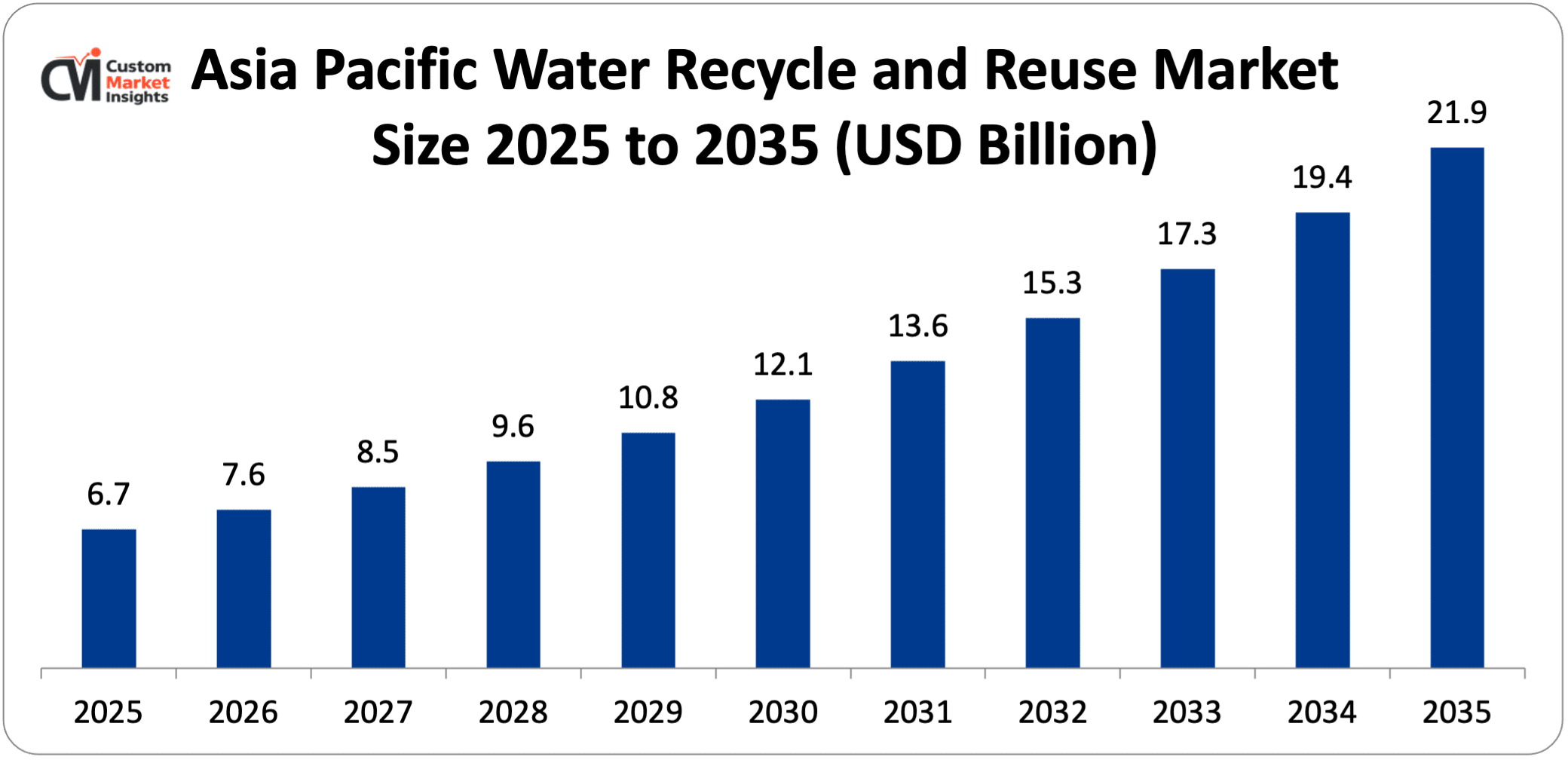
Its market size, in terms of the Asia Pacific water recycle and reuse, is projected to be USD 6.7 billion in 2025 with a growth of about USD 21.9 billion in 2035 with a CAGR of 12.5% between 2026 and 2035.
Why did the Asia Pacific Dominate the Water Recycle and Reuse Market in 2025?
In 2025, the Asia Pacific will dominate the global market with an estimated market share of 37%. Water reuse market in this region is developing at a rapid pace on account of urbanization, growing industrialization, and increasing water scarcity. Governments are likely to invest heavily in water infrastructure and promote industries for maximum use of water in a closed-loop system. As technology is gaining ground, emphasis is on affordable and scalable solutions with the needs of different areas in mind.
China Water Recycle and Reuse Market Trends
In the Asia Pacific region, China leads the industry expansion over the projected period. Water reuse is gaining prominence as a strategy for managing water resources in China. Industry accounts for much of the uptake of water reuse technology, with government encouraging investment in infrastructure that will facilitate the treatment and reuse of water on a broad scale. Urban areas are embracing the practice, using reclaimed water for irrigation and cleaning or for cooling in industry.
Why is Europe Experiencing Significant Growth in the Water Recycle and Reuse Market?
Europe holds a significant market share in 2025. The European water recycle & reuse industry is highly developed, as the continent is a pioneer in water reuse, high regulation, circular economy, and climate resilience plans. The region is adopting the latest technologies to make water reuse for farming, industry, and urban end-uses possible; therefore, sustainability and water EU Directives are fostering innovation and complementarity.
Germany Water Recycle and Reuse Market Trends
Germany held the dominant position in the market in 2025. Germany's water recycle & reuse industry-- is fueled by the increased technological advancement and adoption of intelligent monitoring systems to maintain maximum water quality and minimize environmental concerns. Moreover, urban areas are paying greater attention to stormwater reuse and decentralized water management.
Why is North America Growing at a Highest CAGR in the Water Recycle and Reuse Market?
North America is expected to grow at a steady rate over the projected period. Growing concerns about water scarcity and environmental sustainability are influencing the development of the water recycle & reuse industry in North America. Industries and municipalities are investing in advanced treatment technologies for water conservation and groundwater independence. Enabled by positive legislation and public awareness, decentralized and smart water reuse systems are gaining popularity in North America as they offer innovative solutions to address water scarcity and improve environmental sustainability.
US Water Recycle and Reuse Market Trends
The US holds the prominent market share in the industry. Proactive state policies and strict environmental standards will stimulate the market by promoting sustainable water usage, which will lead states to develop new policies for recycling industrial and municipal water, while the implementation of technology will focus on addressing issues in membrane filtration and intelligent monitoring to maximize efficiency.
Why is the Middle East & Africa Region is growing rapidly in the Water Recycle and Reuse?
The MEA region is growing at a steady rate over the projected period. The growing water scarcity in the area is the main reason for the market development.
UAE Water Recycle and Reuse Market Trends
The UAE is growing at the highest CAGR during the forecast period. The launch of advanced technology is expected to drive industry growth.
Top Players in the Water Recycle and Reuse Market and Their Offerings
NEWater China
Evoqua Technologies & Solutions
Fluence Corporation Limited
Hydraloop
Hitachi Ltd.
Kubota Corporation
Siemens
Alfa Laval
Dow Corporate
Membracon
Toshiba Infrastructure Systems & Solutions Corporation
Genesis Water Technologies Inc.
Veolia
Aquatech
Suez Group
Xylem
Others
Key Developments
Water recycle and reuse market has experienced considerable changes in the last two years as the market players are trying to diversify their technological aspects and develop product portfolios using strategic approaches.
In March 2025,El Paso Water broke ground on the Pure Water Center in Texas, marking the nation's first direct-to-distribution potable reuse facility. The project is set to be built by a joint venture between PCL and Sundt Construction and will treat secondary effluent from the Roberto R. Bustamante Wastewater Treatment Plant to produce up to 10 million gallons of high-quality purified water per day. With construction now underway, the facility is expected to be operational by 2028.
In April 2023, Hydraloop launched water recycling systems for residential purposes, which recycle water from baths, showers, and laundry activities. The new system enables the reuse of water for flushing toilets and irrigation of gardens and landscaping.
These strategic measures have enabled the companies to reinforce their competitive positions, increase the product line, boost their technological competencies, and also seize growth opportunities in the fast-growing water recycle and reuse market.
The Water Recycle and Reuse Market is segmented as follows:
Who are the key players in the Water Recycle and Reuse market?
The key players in the market are NEWater China, Evoqua Technologies & Solutions, Fluence Corporation Limited, Hydraloop, Hitachi Ltd., Kubota Corporation, Siemens, Alfa Laval, Dow Corporate, Membracon, Toshiba Infrastructure Systems & Solutions Corporation, Genesis Water Technologies Inc., Veolia, Aquatech, Suez Group, Xylem, Others.
What role do government regulations play in shaping this market's development?
Government regulations play a crucial role in shaping the market by mandating wastewater treatment, enforcing discharge limits, and promoting water reuse policies, which drive adoption of recycling technologies and accelerate overall market growth.
How does the price point impact market growth and adoption?
Higher price points can slow adoption by increasing upfront costs, while cost-effective solutions accelerate market growth by improving affordability and return on investment.
What is the projected market size by the end of the forecast period?
According to the present analysis and forecast modeling, the market of water recycling and reuse will witness a significant growth of about USD 49.4 billion in the year 2035 with the growing innovative product launch, increasing collaboration, and rising water scarcity with a CAGR of 10.5% between the years 2026 and 2035.
Which region is anticipated to dominate the market during the forecast period?
It is projected that the Asia Pacific will hold the largest market share in the Water Recycle and Reuse market in the forecast period, with a share of about 37% of the global market share, which is attributed to the presence of major players and increasing investment in advanced technology.
Which region is expected to grow at the fastest CAGR in this market?
North America is expected to grow at the highest rate during the forecast period. The growth in the region is owing to the increasing government initiatives.
What are the key driving factors influencing the growth of the Water Recycle and Reuse market?
The key factors driving the market are environmental concerns and scarcity of water & surging water scarcity.
Ayush Kadam is a Senior Market Research Analyst at Custom Market Insights, with over seven years of experience in syndicated and custom market research. He specializes in market sizing, competitive intelligence, industry trends, forecasting, and strategic insights, helping clients turn complex data into actionable business decisions.