
Global Warehousing Market Size Likely to Grow at a CAGR of 8.3% By 2035
 Ayush KadamSr. Research AnalystPublished Source Custom Market Insights
Key highlights
- The warehousing function is concerned with the efficient storage, movement, and handling of products within a warehouse building, or warehousing.
- North America held the highest market share in 2025.
- In July 2025, Storage Solutions is part of the Godrej Enterprises Group and India’s leading Company in industrial storage, warehousing & intralogistics solutions.
The market size of global warehousing will be estimated at USD 1.5 trillion in 2025 and is expected to grow to between USD 1.6 trillion in 2026 and about USD 3.3 trillion by 2035, with a current CAGR (compound annual growth rate) of 8.3% during the period of 2026 to 2035.
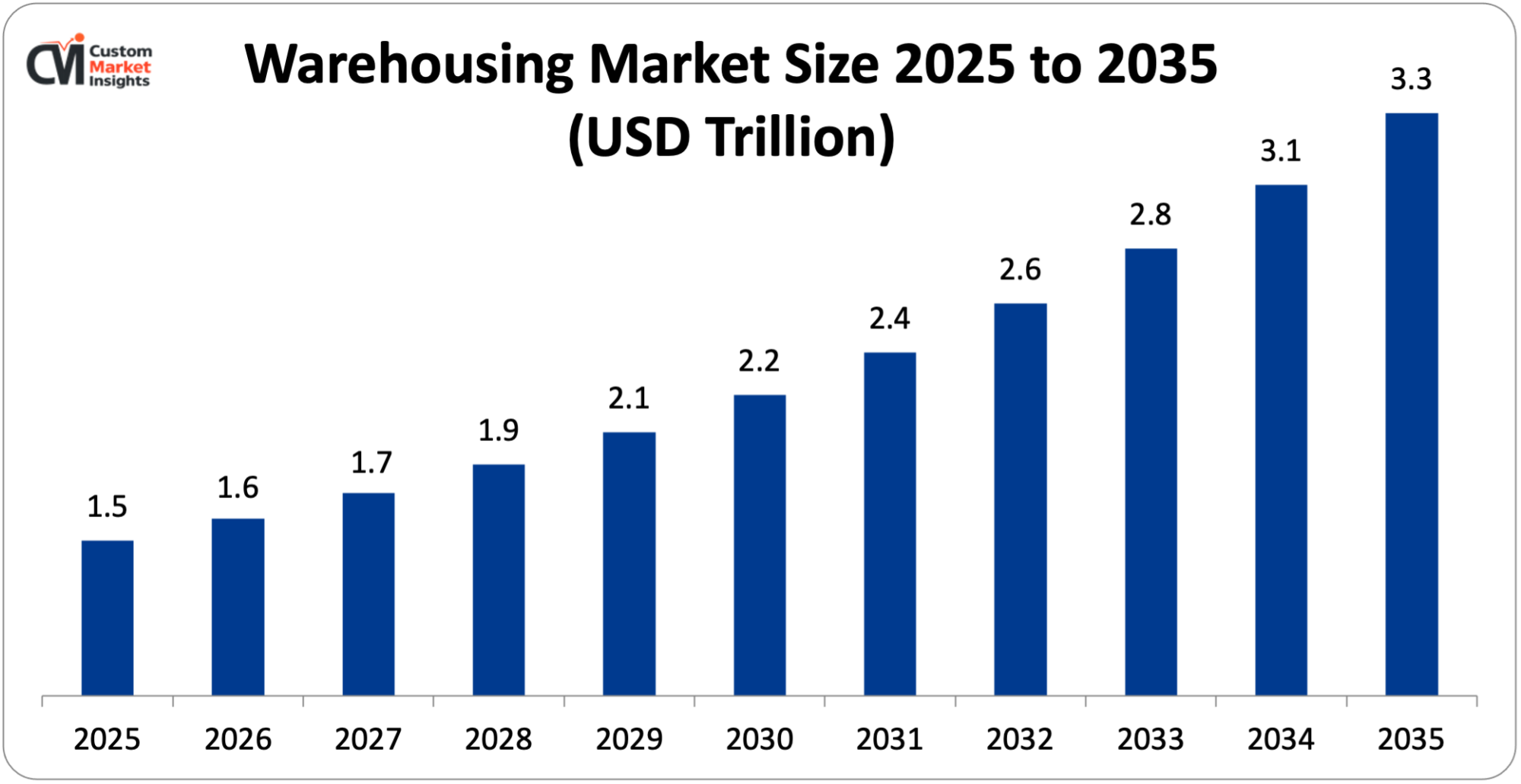
To learn more about this report - request a sample report PDF
Source: Custom Market Insights analysis.
Warehousing Market Revenue and Trends
The warehousing function is concerned with the efficient storage, movement, and handling of products within a warehouse building, or warehousing. Warehousing is more than storing products, since all incoming stock is sorted through a number of different processes (receipting, put-away, stock control, picking/packing, and dispatch) so that the correct quantity of stock is available to meet the needs of customers. The products may be stored for only a short period of time, for example, ski equipment for ski season or fast-moving consumables, or for any length of time, for example, raw materials, spare parts, or slow-moving stock. The activity in the warehouse may be supported by shelving, insulated storage and refrigeration, and security systems such as CCTV.
What are the Factors That Have a Significant Contribution to the Growth of the Warehousing Market?
Penetration of urban settlements and expansion of retail business are some of the important factors responsible for the growth of the warehousing market. Growing urban populations must lead to increased consumption of consumer goods, food products, supplies, and accessories. With the growth of retail chains, shopping malls, and supermarket chains, there will be higher requirements of distribution centers and shopping center distribution warehousing. Also, the growth of organized retailing and omnichannel sales has increased the need for warehousing at urban locations.
Also, government investments and support to develop logistics infrastructure also heavily stimulate growth of the warehousing industry, as most of the government is pouring investments into the development of highways, rail systems, ports, airports, and logistics parks to improve the transportation and supply chain networks. Development of these infrastructures has improved connectivity between factories, distribution centers, and consumer markets and has led to increased demand for modern warehousing and storage facilities. Additionally, the establishment of industrial corridors, free trade zones, and dedicated logistics parks are other factors prompting companies to set up distribution centers at prime logistical locations. For instance, according to the Georgetown Journal of International Affairs, India‘s logistics business—a $200 billion industry that transports 4.6 billion tons of freight annually, 65 percent of which is through roads and 27 percent of which is through railways—is believed to have last-mile delivery (the last stage in transit where the goods are delivered to the end user) accounting for about 40 percent of the overall logistics cost. Consequently, Logistics accounts for 13 to 14 percent of India‘s GDP instead of 8 to 11 percent as in most of the developed economies.
Regional Insights
North America held the highest market share in 2025. Growth in the region is being driven by the boom in online shopping, growing demands from the business customer base for excellent supply chain management, and aggressive investment in high-tech logistics infrastructure. The market is maturing with Greater demand for larger distribution centers coupled with increased investment in automation and high-technology warehousing properties by retailers, manufacturers, and 3PL providers to handle growing order demands. As online shopping and omni-channel order fulfillment strategies are gaining popularity, there is an increased demand for local warehouse facilities close to markets for customers for both quicker delivery times and for inventory optimization.
Besides, the Asia Pacific market has the highest rate of growth in the warehousing market. The rising government initiatives for logistics infrastructure and rapid pace of urbanization followed by quick e-commerce growth driving market expansion.
Report Scope
| Feature of the Report | Details |
| Market Size in 2026 | USD 1.6 trillion |
| Projected Market Size in 2035 | USD 3.3 trillion |
| Market Size in 2025 | USD 1.5 trillion |
| CAGR Growth Rate | 8.3% CAGR |
| Base Year | 2025 |
| Forecast Period | 2026-2035 |
| Key Segment | By Warehouse Type, End-use and Region |
| Report Coverage | Revenue Estimation and Forecast, Company Profile, Competitive Landscape, Growth Factors and Recent Trends |
| Regional Scope | North America, Europe, Asia Pacific, Middle East & Africa, and South & Central America |
| Buying Options | Request tailored purchasing options to fulfil your requirements for research. |
Recent Developments
- In July 2025, Storage Solutions is part of the Godrej Enterprises Group and India’s leading Company in industrial storage, warehousing & intralogistics solutions. The company stands registered to have a presence at CeMAT Australia 2025 which is scheduled to be held at The Dome, Sydney Olympic Park, during 22-24 July 2015. The firm will be exhibiting at the booth. I39v will demonstrate its various products & solutions catering to the needs of the warehousing requirements of Australia. This leading Indian conglomerate has its eyes firmly focused on the needs of the future and will display Racking and Shelving solutions that are not only structurally sound & safe but also highly functional according to the certification of AS 4084. (https://www.prnewswire.com/apac/news-releases/leading-indian-conglomerate-godrej-showcases-advanced-warehousing-technologies-at-cemat-australia-2025-302508680.html)
List of the prominent players in the Warehousing Market:
- Deutsche Post AG
- BrightKey Inc.
- GEODIS
- NIPPON EXPRESS HOLDINGS INC.
- FedEx
- RXO Inc.
- XPO Inc.
- Ryder System Inc.
- Mitsubishi Logistics Corporation
- H. Robinson Worldwide Inc.
- Americold Logistics Inc.
- Lineage Inc.
- Kuehne+Nagel
- P. Moller - Maersk
- NewCold
- Others
The Warehousing Market is segmented as follows:
By Warehouse Type
- General Warehousing
- Cold Storage Warehousing
- Specialized Warehousing
By End-use
- Retail
- Chemicals
- Food & Beverages
- Others
Regional Coverage:
North America
- U.S.
- Canada
- Mexico
- Rest of North America
Europe
- Germany
- France
- U.K.
- Russia
- Italy
- Spain
- Netherlands
- Rest of Europe
Asia Pacific
- China
- Japan
- India
- New Zealand
- Australia
- South Korea
- Taiwan
- Rest of Asia Pacific
The Middle East & Africa
- Saudi Arabia
- UAE
- Egypt
- Kuwait
- South Africa
- Rest of the Middle East & Africa
Latin America
- Brazil
- Argentina
- Rest of Latin America
Ayush Kadam
Sr. Research AnalystAyush Kadam is a Senior Market Research Analyst at Custom Market Insights, with over seven years of experience in syndicated and custom market research. He specializes in market sizing, competitive intelligence, industry trends, forecasting, and strategic insights, helping client
View profile and reportsAbout Custom Market Insights
Custom Market Insights is a market research and advisory company. It publishes syndicated reports across 18+ industries and delivers custom research, feasibility studies and market entry strategy for companies, investors and consultancies.
###