
Global Peer to Peer P2P Lending Market Size Likely to Grow at a CAGR of 17.5% By 2035
Key highlights
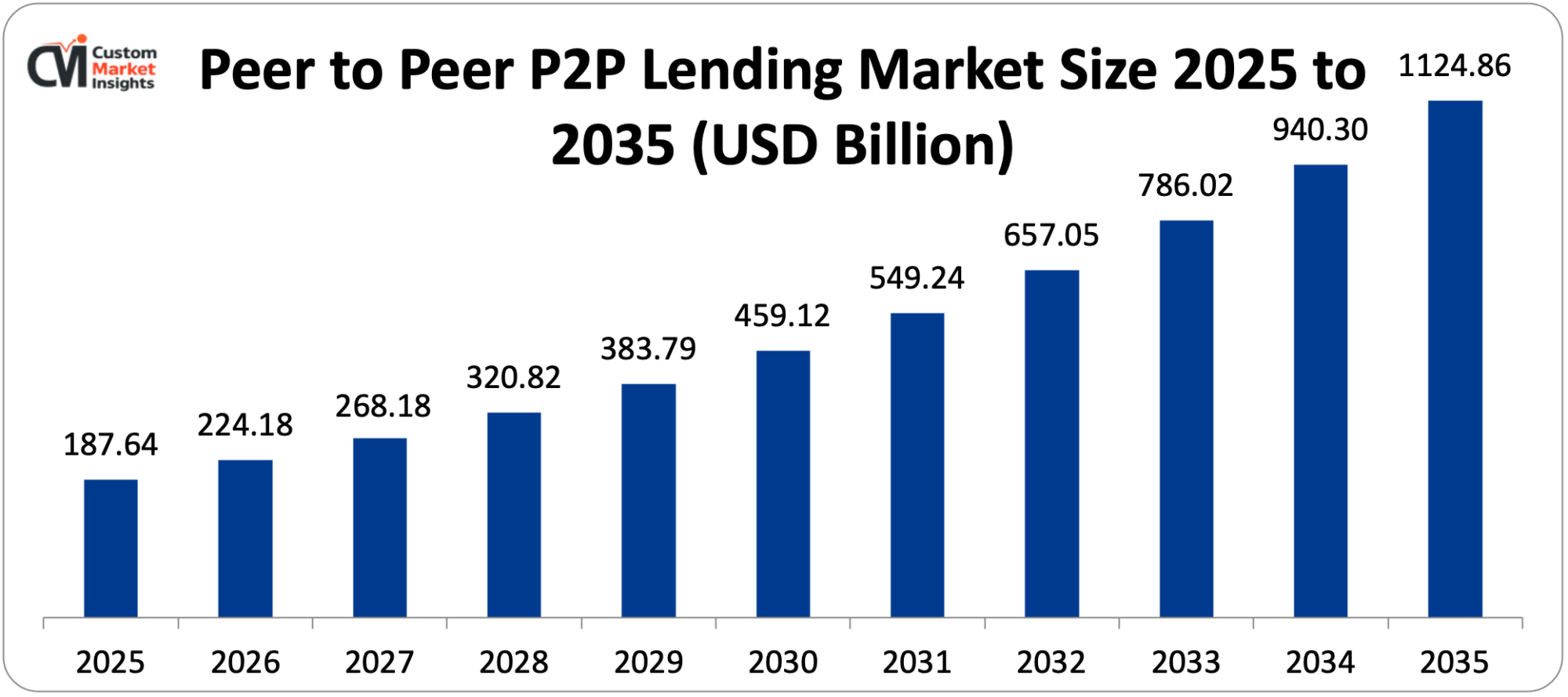
- Market valued at USD 224 Bn in 2026, projected to reach USD 1,125 Bn by 2035.
- Expected to grow at a CAGR of 17.5% over 2026-2035.
- Asia Pacific is the largest regional market; Asia Pacific grows fastest.
The worldwide peer to peer P2P lending market size is estimated to be worth USD 187.64 billion in the year 2025. Expected growth is steep: The market is expected to grow to reach USD 224.18 billion in 2026 and to reach around USD 1,124.86 billion by 2035 and will grow at a 17.5% compound annual growth rate (CAGR) between 2026 and 2035.
To learn more about this report - request a sample report PDF
Peer-to-Peer P2P Lending Market Revenue and Trends
Peer-to-peer (P2P) lending in the global market includes online marketplace platforms directing individual and institutional lenders to consumers as well as in financing small businesses, debt consolidation, student loans, and real estate loans through automated credit scoring, risk assessment algorithms and digital matching in the absence of traditional bank intermediaries. The peer-to-peer P2P lending industry in the world is expanding at a fast rate, which is due to the digital transformation of the financial sector, the growing need of easy and alternative credit services, the rise of the internet and smartphones, the development of innovations in fintech, and the prominence of favorable financial regulation of the alternative credit provision by non-bank frauds in the world.
What are the Factors That Have a Significant Contribution to the Growth of the peer-to-peer P2P lending market?
The growth in the demand of fast, flexible and unsecured financing options to traditional banking led by the lack of credit access to SMEs and individuals, increased rates of rejection in traditional lenders and the attractiveness of competitive returns to retail investors have increased uptake. Industry reports highlight that the transition to digital platforms has increased due to the post-pandemic requirements of financial inclusion and differences in the availability of alternative investments. With the economic insecurity and the increase in the cost of borrowing, lenders and borrowers want to find an effective and transparent marketplace that gives faster approvals and reduced overheads.
It has enhanced trust, efficiency, and scalability by technological advances such as AI-powered credit scoring, blockchain to secure transactions, mobile-first applications, which match instantly, and data analytics to manage risk in real-time. Others consist of an increased interest in addressing financial inclusion in underserved markets, greater regulatory clarity in marketplace lending, and government action and private investments to establish fintech ecosystems in both the developed and emerging markets.
Segment Insight
By Product Type
Consumer lending constituted the prevailing portion of the peer-to-peer P2P lending market as of 2025 because the product demanded personal loans, debt-consolidation loans, and short-term credit by individuals who needed quick and easy capital. These products are fundamental to regular borrowers and retail investors who want good yield and have high growth due to advancements in automated underwriting and profile of risk (generally considered by users and platform significant in making high volume deals and retaining platforms).
By Distribution Channel
Direct access platform provider is the biggest market share and is the chief platform provider in the provision of borrower-lender matching, subscription or fee-based services, technical support and compliance tools. Individual investors, borrowers, and institutional participants managing diversified portfolios make these channels the preferred channel of fintech users to manage digital, high-volume lending processes.
Regional Insights
The peer-to-peer P2P lending market is most developed in North America because of the developed fintech ecosystem, positive regulatory environment, level of digitalization among consumers and SMEs, and availability of established platforms, such as LendingClub and Prosper. The location enjoys good investor involvement, developed credit facilities, and the initial adoption of AI and blockchain that propel the constant platform development and entry of the market.
In the meantime, the Asia Pacific region has the most significant increase in peer-to-peer P2P lending market due to the high rate of digitalization, growing fintech startups, increasing SME financing demand, and favorable government policies on alternative lending in such countries as China and India. The use of easy-to-use platforms is increasing in countries such as China, India and Japan due to the improved investment, internet penetration and local adaptations in the regulatory environment. The market expansion in Asia Pacific is further encouraged by urbanization, financial inclusion driving forces, and e-commerce expansion.
Report Scope
| Feature of the Report | Details |
| Market Size in 2026 | USD 224.18 billion |
| Projected Market Size in 2035 | USD 1,124.86 billion |
| Market Size in 2025 | USD 187.64 billion |
| CAGR Growth Rate | 17.5% CAGR |
| Base Year | 2025 |
| Forecast Period | 2026-2035 |
| Key Segment | By Lending Type, End-User, Business Model and Region |
| Report Coverage | Revenue Estimation and Forecast, Company Profile, Competitive Landscape, Growth Factors and Recent Trends |
| Regional Scope | North America, Europe, Asia Pacific, Middle East & Africa, and South & Central America |
| Buying Options | Request tailored purchasing options to fulfil your requirements for research. |
Recent Developments
- In September 2025: Funding Circle also made a USD 348 million forward flow agreement with TPG Angelo Gordon and Barclays to make credit more accessible to small businesses, bolstering its role in the P2P lending ecosystem.
List of the prominent players in the Peer to Peer P2P Lending Market:
- LendingClub Corporation
- Prosper Marketplace Inc.
- Funding Circle Holdings plc
- Zopa Bank Ltd.
- Mintos Marketplace AS
- Faircent (FINCFRIENDS Private Limited)
- Lufax Holding Ltd.
- Yirendai Ltd.
- LenDenClub (Innofin Solutions Pvt. Ltd.)
- Kabbage Inc. (American Express)
- RateSetter (Metro Bank)
- Others
The Peer to Peer P2P Lending Market is segmented as follows:
By Lending Type
- Consumer Lending (Personal Loans, Debt Consolidation, Medical, Home Improvement)
- Business Lending (SME Working Capital, Invoice Financing, Trade Finance, Equipment)
- Real Estate Lending (Residential, Commercial, Bridge Loans, Development Finance)
- Student Loan Refinancing
- Agricultural Lending
- Other Lending Types (Auto, Green Finance, Microloans)
By End-User
- Individual Borrowers (Employed Individuals, Self-Employed, Gig Economy Workers)
- Small & Medium Enterprises (Micro, Small, Medium Businesses)
- Real Estate Developers
- Agricultural Borrowers
- Other End-Users (Non-Profits, Government-Linked Entities)
By Business Model
- Marketplace/Platform Model (Investor-Funded, Originate-to-Distribute)
- Balance Sheet Model (Platform Retains Loan Exposure)
- Hybrid Model (Mixed Funding and Retention)
- Other Business Models (Notary Model, Guaranteed Return Models)
Regional Coverage:
North America
- U.S.
- Canada
- Mexico
- Rest of North America
Europe
- Germany
- France
- U.K.
- Russia
- Italy
- Spain
- Netherlands
- Rest of Europe
Asia Pacific
- China
- Japan
- India
- New Zealand
- Australia
- South Korea
- Taiwan
- Rest of Asia Pacific
The Middle East & Africa
- Saudi Arabia
- UAE
- Egypt
- Kuwait
- South Africa
- Rest of the Middle East & Africa
Latin America
- Brazil
- Argentina
- Rest of Latin America

Rushikesh Dorge
Head - Client RelationsRushikesh Dorge is a seasoned Market Research and Business Consulting Professional with over six years of experience in market intelligence, competitive analysis, forecasting, and business strategy. At Custom Market Insights, he helps organizations identify growth opportunities a
View profile and reportsAbout Custom Market Insights
Custom Market Insights is a market research and advisory company. It publishes syndicated reports across 18+ industries and delivers custom research, feasibility studies and market entry strategy for companies, investors and consultancies.
###