
4-Bromobenzoic Acid Market Size, Trends and Insights By Grade (Pharmaceutical Grade, Industrial Grade, Research Grade), By Application (Pharmaceuticals & Agrochemicals, API Synthesis, Agrochemical Intermediates, Organic Synthesis, Cross-Coupling Reactions, Liquid Crystal Polymer Precursors, Metal-Organic Framework Synthesis, Dyes & Pigments, Others), By Distribution Channel (Direct Sales, Distributors & Traders, E-Commerce and Online Platforms, Retail Chemical Suppliers), and By Region - Global Industry Overview, Statistical Data, Competitive Analysis, Share, Outlook, and Forecast 2026 – 2035
Report Snapshot
CAGR: 6.2%
| Study Period: | 2026-2035 |
| Fastest Growing Market: | North America |
| Largest Market: | Asia Pacific |
Major Players
- Sigma-Aldrich (Merck KGaA)
- TCI Chemicals
- Oakwood Chemical
- Combi-Blocks Inc.
- Others
Reports Description
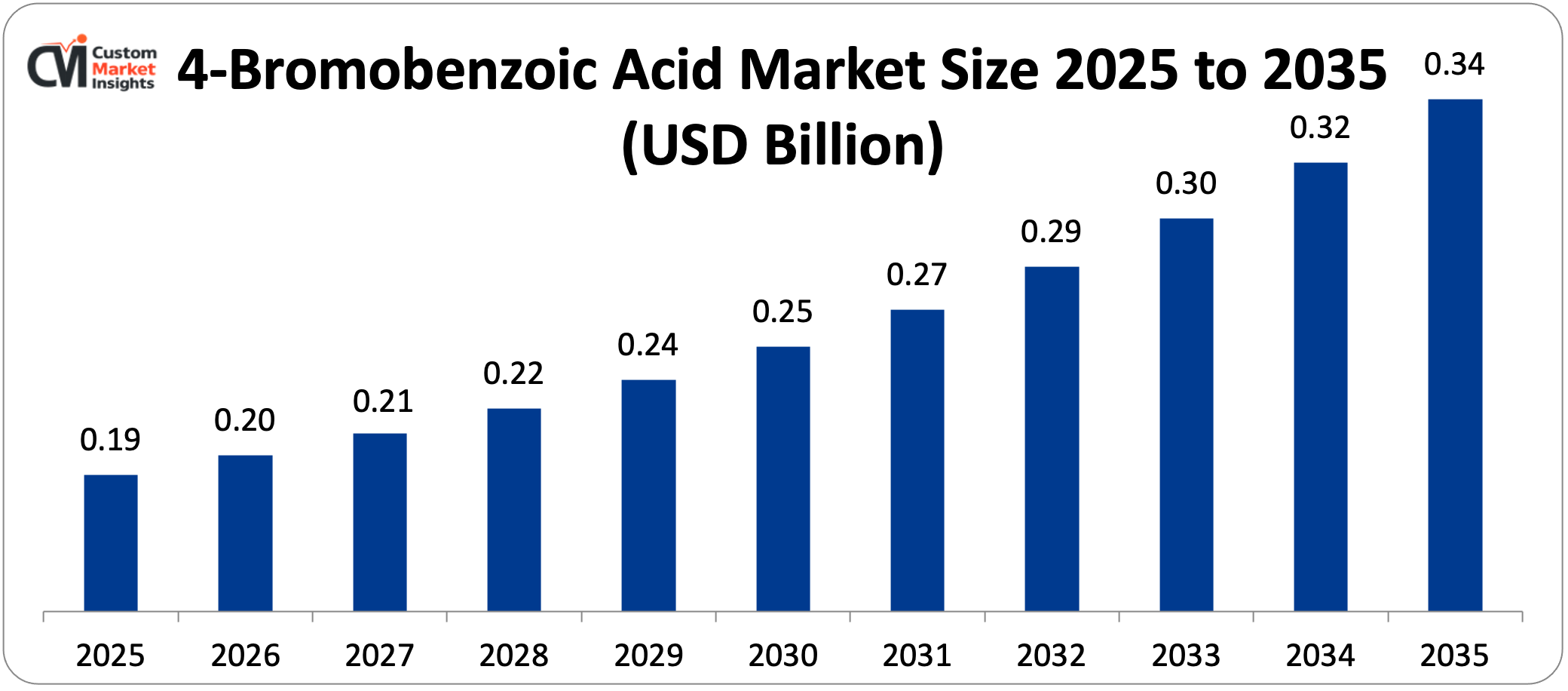
The 4-Bromobenzoic Acid market size in the world is estimated at USD 185.4 million in 2025 and is forecasted to grow from USD 198.6 million in 2026 to about USD 342.7 million in 2035, at a CAGR of 6.2% from 2026 to 2035. Developing demand for high-technology pharmaceutical intermediates, increasing production of agrochemicals, increasing investment in specialty chemicals manufacturing, and increasing the pace of research and development in organic production all contribute to the growth of the market.
Market Highlight
- The Asia Pacific dominated the market of the 4-Bromobenzoic Acid with a market share of 46% in the year 2025.
- North America is expected to experience the highest growth of CAGR of 7.1% between 2026 and 2035 among the developed regions.
- By grade, the pharmaceutical grade portion managed to take about 54% of the market share in 2025.
- By application, the pharmaceuticals and agrochemicals segment was dominating with 58% of the total market share in 2025.
- By distribution channel, the direct sales segment will have the biggest market share of 44% in 2025 and the e-commerce segment will have a CAGR of 9.8% within the estimable period of 2026 to 2035.
- China had more than 38% of the total world capacity of producing 4-Bromobenzoic Acid in 2025.
Significant Growth Factors
The 4-Bromobenzoic Acid Market Trends present significant growth opportunities due to several factors:
- Expanding Pharmaceutical and Agrochemical Applications: The increased number of pharmaceutical development pipelines is the most urgent demand factor of 4-Bromobenzoic Acid, which is a versatile aromatic brominated compound that has been used as an important building block in the production of active pharmaceutical ingredients (APIs). In 2025, pharmaceutical R&D spending worldwide is estimated to have exceeded USD 250 billion, and small molecule drugs, to which 4-Bromobenzoic Acid has become a key intermediate, account for a third of all drugs in any development pipeline. The bromine substituent of the compound allows selective cross-coupling reactions such as Suzuki, Negishi, and Kumada cross-couplings, which are essential in the synthesis of antifungal agents, anti-inflammatory drugs, and cardiovascular therapeutics. In the agro chemical industry, the increasing global food security issues are driving the advancement of herbicides and fungicides and the global agrochemical market is estimated at USD 260 billion in 2024 and is projected to be over USD 320 billion by 2030. The 4-Bromobenzoic Acid derivatives are also important in the development of the next-generation crop protection agents as an intermediate in the product development process. The compound is especially applicable in the production of substituted benzimidazoles, benzoate esters and analogs on which many commercial fungicides and plant-growth regulators are based. Moreover, the trend of development of targeted therapeutics and precision medicine around the globe is growing, increasing the number of novel drug candidates that use benzoic acid scaffolds, which offer long-term downstream demand. Chemical procurement statistics indicate that 4-Bromobenzoic Acid used in pharmaceutical products is consumed at a rate of about 7.4% per annum globally between 2021 and 2024, and the increase is projected to be at a higher rate throughout the forecast period.
- Growth of Specialty Chemicals and Organic Synthesis Demand: The wider specialty chemicals sector, of which 4-Bromobenzoic Acid is a major component, is projected to have a world market value of USD 630 billion in 2024 with an equivalent projected to rise to USD 950 billion in 2033 at a CAGR of about 4.7%. In this, the sub-segment with most growth is in fine chemicals and pharmaceutical intermediates. 4-Bromobenzoic acid is widely utilized in the synthesis of liquid crystal polymers (LCPs), which are high-performance materials necessary in 5G telecommunications infrastructure, flexible electronics, and modern display technology. The global LCP market is estimated to increase in the future by a cumulative of more than 9% CAGR till 2030 and the impact of this directly translates into more demands of brominated aromatic compounds. Also, 4-Bromobenzoic Acid is used as a building block to form azo dyes, reactive dyes, and specialty pigments in the dyes and pigments industry, with the worldwide demand of dyes and pigments expected to reach 12 million metric tons in 2024. The growth of the textile industry in South and Southeast Asia is another confirmation of this demand channel. Another important consumer is research and academic institutions of the world, where the compound is also used as a standard reagent in exploratory synthetic chemistry and polymer science and materials research. Settled, large-volume demand of fine chemical intermediates such as 4-Bromobenzoic Acid has been boosted by the emergence of contract research organizations (CROs) and contract development and manufacturing organizations (CDMOs), whose combined worldwide market worth is greater than USD 180 billion in 2024, which adds further stability and development to demand.
What are the Major Advances Changing the 4-Bromobenzoic Acid Market Today?
- Green Chemistry and Sustainable Bromination Processes: Corporate sustainability and environmental regulations are radically transforming production procedures of halogenated fine chemicals. Conventional bromination methods with elemental bromine or hydrobromic acid produce large amounts of hazardous waste streams which are becoming the subject of a growing regulatory burden in the European Union, United States, and China. Manufacturers in turn are developing catalytic electrophilic bromination processes, solvent recovery systems, solvent recycling, and closed-loop bromine management systems that help to reduce considerably the environmental footprints. This is enhancing the economic competitiveness of sustainable production paths with the adoption of green chemistry such as optimization of atom economy and minimization of solvents. A number of major manufacturers of fine chemicals have recorded a 20-35% cut in the quantity of hazardous wastes generated after using next-generation bromination platforms. The EU regulations on REACH and CLP still have more stringent requirements for handling, labelling and emissions of brominated compounds, forcing international suppliers to modernize manufacturing facilities or face limitations on market entry. These regulatory forces are both raising the compliance costs among smaller manufacturers and developing competitive advantages among environmentally forward-looking manufacturers that can achieve the utmost standards in various geographies.
- Continuous Flow Chemistry and Process Intensification: The move to continuous flow production is changing the economics of production of 4-Bromobenzoic Acid and other fine chemicals. Continuous flow reactors facilitate a tight control of temperature in exothermic reactions involving bromination, lowering the risk of runaway reactions, enhancing selectivity and purity, and providing uniform quality of the product with less variability of product quality per batch. Research studies have shown that continuous flow processes could eliminate the reaction times of hours and improve the yields by 10-25% and also save a lot of energy when compared to the traditional batch processing. Continuous flow platforms dedicated to halogenated aromatic intermediates have been introduced by the major chemical producers in Germany, Japan and China leading to the reduction of costs by 15-30% per kilogram of product. Flow chemistry scalability benefits are especially useful in the production of pharmaceutical-grade 4-Bromobenzoic Acid, in which purity requirements (often exceeding 99%) and regulatory reporting demands are the most demanding. Continuous manufacturing investment will likely increase at a faster rate than the forecast period due to the economic incentives as well as the operational risk minimization value that is increasingly being appreciated by pharmaceutical end-users.
- Increasing Role in Liquid Crystal Polymer and Advanced Materials Manufacturing: The strategic importance of 4-Bromobenzoic Acid in the high-end materials business is that it is used as a raw material in the production of liquid crystal monomers in high-performance LCP resins. The LCPs are essential components of next-generation 5G antenna elements, millimeter-wave circuit boards, and miniaturized electronic connectors in need of excellent dimensional stability at higher temperatures. The introduction of 5G infrastructure across the world has resulted in an unprecedented demand for LCP materials with more than 3 million 5G base stations projected to be in place across the globe by 2026 and this is a direct boost to 4-Bromobenzoic Acid manufacturers. The compound is also used in the synthesis of specialty coordination polymers and metal-organic frameworks (MOFs) that are the focus of a significant amount of scholarly and commercial attention in gas storage, catalysis, and drug delivery applications. The market of MOF is expected to expand by about USD 400 million in 2024 to more than USD 1.8 billion in 2033 and 4-bromobenzoate-functionalized MOFs are one of the spheres where the research investment is made.
- Digital Procurement Platforms and Supply Chain Digitization: There is a structural change in the fine chemicals distribution landscape with the digital procurement platform, online marketplace, and electronic tendering system challenging buyer-seller relationships. In 2024, e-commerce and digital channels of distribution took about 18% of the fine chemical procurement transactions, which is projected to rise to 28% in 2030. The digital platforms have proven to be very useful with such benefits as real time visibility of inventory, simplified regulatory documentation, competitive price discovery, and faster order fulfillment, which can be very useful especially in research-grade procurement by academic and CRO clients. In the case of 4-Bromobenzoic Acid in particular, there has been a reduction in the obstacles to sourcing globally due to the adoption of digital channels, which have resulted in smaller buyers in the emerging economies having access to high-purity material provided by international suppliers. Yet, with the shift towards digital procurement, price transparency and distributor competition are further intensified, driving consolidation between regional intermediaries who are ill-equipped to provide services beyond logistics due to the lack of scale.
Category Wise Insights
By Grade
Why Does Pharmaceutical Grade Dominate the Market?
The biggest segment is 4-Bromobenzoic Acid in pharmaceutical grade, which constitutes about 54% of the market share in 2025. This supremacy is supported by the fact that this compound is one of the most valuable synthetic intermediates in drug discovery and API production – end uses that have the most stringent purity requirements, which are normally 99.0% as determined by HPLC analysis, and extensive certificates of analysis (CoA), residual solvent profiles, and heavy metal documentation, which meets ICH Q3D requirements. Pharmaceutical clients, such as global innovator pharmaceutical firms, generic API firms, and CDMOs, are seeking consistent, traceable supply chains, supplier qualification audits, GMF-compliant documentation; and, in many cases, second-source supplier validation, which are priced at a premium that further consolidates revenue in this sector.
Pharmaceutical grade fine chemical intermediates market was estimated to be USD 28 billion worldwide in 2024 and is expected to increase at a rate of about 7.2% CAGR until 2033, with the larger global pharmaceutical development pipeline. The usefulness of 4-Bromobenzoic Acid in Suzuki-Miyaura and Buchwald-Hartwig cross-coupling reactions – methodologies used in contemporary medicinal chemistry – guarantee a long-term demand as pharmaceutical developers grow to use these reactions to build complex molecular structures. Strictness of purity of pharmaceutical grade material, where the impurity limits of residual solvent and heavy metals are significantly more strict than the technical grade counterparts, provides barriers to entry that protect strong suppliers.
Industrial grade material, which has a market share of about 28%, is used in dye production, polymer production, and the general use of organic chemistry where documentation is not so strict. Research grade material, with the highest share of 18%, but increasing fastest among the academic and CRO clientele, focuses on confirmed identity and supply in small packs rather than on supply at production scale. The research grade segment is estimated to grow at an average of 8.5% CAGR by 2035 due to the growth of the CRO sector and increase in academic R&D expenditure in the world.
By Distribution Channel
Why Direct Sales Lead Distribution?
The distribution channel with the highest share of the market is direct sales channels, which are expected to contribute around 44% of the market share in 2025. This leadership indicates the bias of big drug manufacturers, large chemical firms and established CDMOs towards direct procurement contacts with the manufacturers so as to negotiate pricing based on quantities, customized technical help, tailored packaging, and specification alignment and to facilitate smooth supply security with long-term structure arrangements. The specific procurement of pharmaceutical grade needs direct interaction of quality control departments of the buyer and supplier organizations in the aid of audit, document sharing and compliance with regulations, which are hard to administer on an intermediary basis.
Distributors and traders control about 38% of the market share, with the mid-sized and smaller buyers that enjoy inventory holding by the distributors, regional warehousing, consolidated logistics and local regulatory expertise. The distributors are especially significant in regions like India, Southeast Asia and Latin America where smaller fine chemical purchasers do not have the purchasing infrastructure necessary to handle direct international supplier links. Distributors are also important in offering material in non-standard pack sizes and making it possible to satisfy urgent research requirements.
Channels E-commerce channels have the highest growth at 9.8% CAGR (2026-2035) due to adoption of digital procurement platforms by CROs, academic institutions and smaller specialty chemical buyers. COVID-19 hastened the adoption of online fine chemical procurement, and customers got used to buying online through the platform that provides real time inventory, digital certificates of analysis and easy logistics tracking. Nevertheless, the use of pharmaceutical grade procurement via solely digital mediums is constrained by the requirements of the suppliers to be qualified and thus requires hybrid designs where digital transactions are underpinned by recognized quality relationships with approved suppliers.
Report Scope
| Feature of the Report | Details |
| Market Size in 2026 | USD 198.6 million |
| Projected Market Size in 2035 | USD 342.7 million |
| Market Size in 2025 | USD 185.4 million |
| CAGR Growth Rate | 6.2% CAGR |
| Base Year | 2025 |
| Forecast Period | 2026-2035 |
| Key Segment | By Grade, Application, Distribution Channel and Region |
| Report Coverage | Revenue Estimation and Forecast, Company Profile, Competitive Landscape, Growth Factors and Recent Trends |
| Regional Scope | North America, Europe, Asia Pacific, Middle East & Africa, and South & Central America |
| Buying Options | Request tailored purchasing options to fulfil your requirements for research. |
Regional Analysis
How Big is the Asia Pacific 4-Bromobenzoic Acid Market Size?
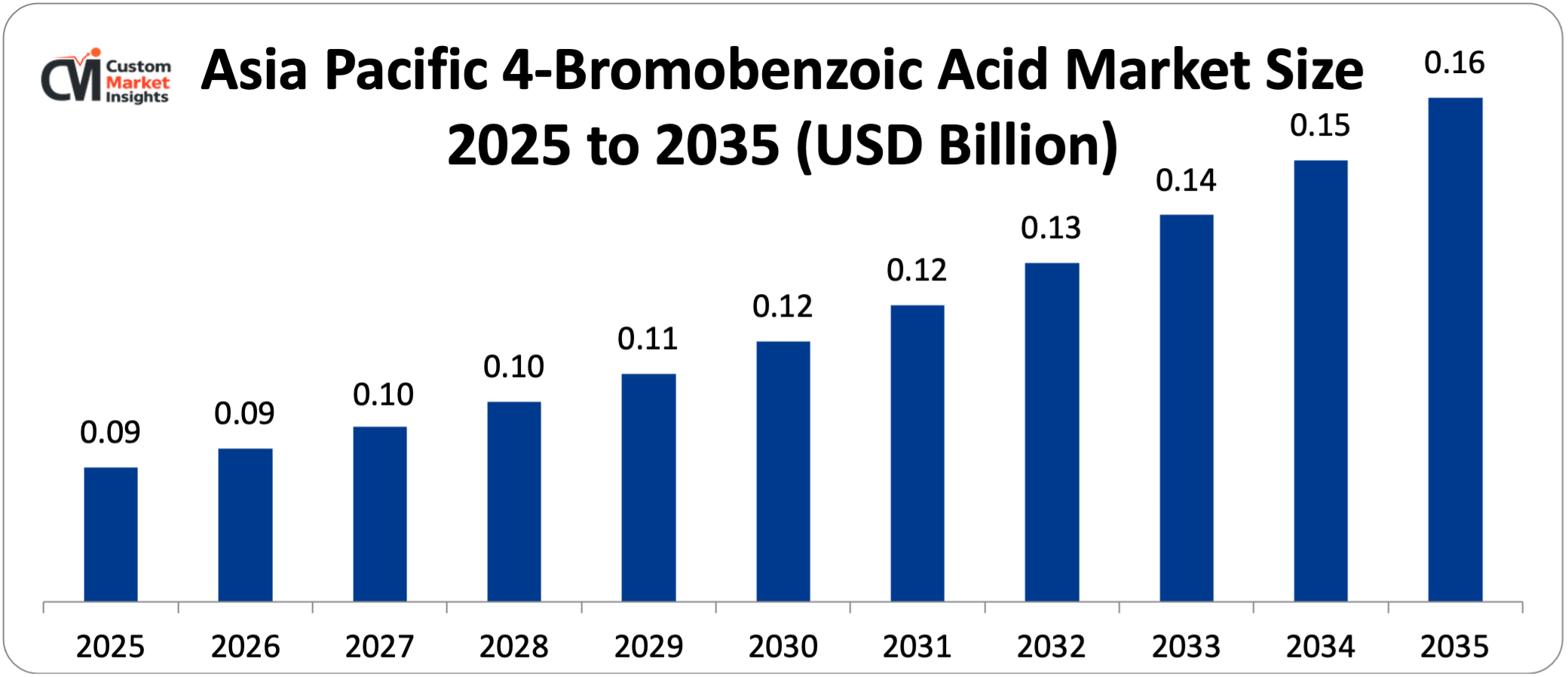
The Asia Pacific 4-Bromobenzoic Acid market size is estimated at USD 85.3 million in 2025 and is projected to reach approximately USD 158.2 million by 2035, with a CAGR of 6.4% from 2026 to 2035.
Why did Asia Pacific Dominate the 4-Bromobenzoic Acid Market in 2025?
The leading world market is Asia Pacific with an expected market share of around 46% in 2025, which is due to the concentration of global manufacturing capacity of fine chemical and pharmaceutical intermediates in China and India, the booming domestic pharmaceutical industry, and huge agrochemical production plants. In 2025, China contributed more than 38% of the global capacity of 4-Bromobenzoic Acid, with cost-competitive production in the country, established industrial chemical infrastructure in such provinces as Shandong, Jiangsu, and Zhejiang, and integrated bromine supply chain due to the fact that China produced more than 200,000 metric tons of bromine a The bulk drug manufacturing industry of India, with its hubs of Genome Valley in Hyderabad and the PCPIR hubs of Andhra Pradesh and Gujarat, is a large regional center of consumption, with Indian API manufacturers taking in larger amounts of brominated aromatic intermediates to fuel both local and export pharmaceutical markets.
Why is North America Entering a New Era of Growth?
The North American 4-Bromobenzoic Acid market will reach USD 38.4 million by 2025 and has the highest rate of growth of 7.1% at the fastest CAGR of the market, which will reach USD 76.8 million by 2035. This has been fueled by the strong pharmaceutical development ecosystem in the U.S. and the FDA has approved 55 novel drugs in 2023 alone and has a rich pipeline of small molecule drugs in need of complex intermediate chemistry. The growth of local pharmaceutical production as a supply chain resilience measure is being accelerated by post-COVID reshoring efforts and the CHIPS and Science Act investments in developed manufacturing, creating a new need for high-quality domestic and North American-sourced chemical intermediates. The U.S. CRO and CDMO sectors, which collectively have a combined market value of more than USD 90 billion, are also large consumers that lead to the demand for pharmaceutical-grade fine chemicals.
Why is Europe a Significant Market for 4-Bromobenzoic Acid?
Europe is a premium regional market, which pays attention to quality, compliance with regulations, and sustainability qualifications. The European fine chemicals market is advantaged with the developed pharmaceutical and specialty chemicals market in Germany, Switzerland, France and the United Kingdom. The European demand is typified by a high level of demand for the REACH compliant, sustainably produced material which has full SVHC documentation; thus, there is differentiated demand where suppliers with high environmental management systems are preferred. The chemical industry of Germany, which is the largest in Europe and the fourth-largest in the world, has large volumes of usage in agrochemical research and development and pharmaceutical production. The European Green Deal and chemicals sourcing strategy are making a difference in sourcing preferences with buyers increasingly demanding life cycle assessment information and carbon footprint information in addition to the normal quality specifications.
Germany Market Trends
The competitive standing of Germany in the European market can be justified by the fact that the country boasts a world-leading pharmaceutical and agrochemical sector with major corporations that have headquarters in the country and carry out widespread intermediate chemistry processes involving brominated aromatics. Research and development activities are another source of demand as the pharmaceutical research institutions and biotech clusters are concentrated in Munich, Frankfurt and the Rhine-Ruhr region.
Why is LAMEA Showing Accelerating Adoption?
The LAMEA region presents itself as an emerging area with slow growth of demand owing to the increasing local pharmaceutical production in Brazil and Saudi Arabia, government efforts to support its domestic chemical sectors, and the enhancement of the regulatory infrastructure which is allowing high value specialty chemical manufacturing. The pharmaceutical market in Brazil, estimated to be USD 30 billion in 2024, offers an attractive downstream base of demand, and the countries of the Gulf Cooperation Council are diversifying their economies to include petrochemical and other specialty chemicals.
Top Players in the 4-Bromobenzoic Acid Market and Their Offerings
- Sigma-Aldrich (Merck KGaA)
- TCI Chemicals
- Alfa Aesar (Thermo Fisher Scientific)
- Tokyo Chemical Industry Co. Ltd.
- Oakwood Chemical
- Combi-Blocks Inc.
- AK Scientific Inc.
- Bosche Scientific
- Haihang Industry Co. Ltd.
- Yancheng Longshen Chemical Co. Ltd.
- Others
Key Developments
The 4-Bromobenzoic Acid market has experienced tremendous growth within the last two years as the players in the industry look forward to the expansion capabilities and product line diversification.
- In March 2025: a major manufacturer of fine chemicals has announced the construction of a new continuous flow bromination plant in Shandong Province, China, that will produce high-purity pharmaceutical-grade halogenated aromatic intermediates with a capacity of 2,000 metric tons per year.
- In January 2025: a major European distributor of specialty chemicals added to its pharmaceutical-grade fine chemical portfolio the supply contracts of certified GMP-compliant 4-Bromobenzoic Acid with two Asian manufacturers to meet its growing demand of customers in European CDMOs requiring dual sourcing of essential intermediates.
Such strategic operations have enabled businesses to consolidate market positions, increase production capacity, improve product quality and documentation levels, and get a grip of the growth opportunities in the growing 4-Bromobenzoic Acid Market.
The 4-Bromobenzoic Acid Market is segmented as follows:
By Grade
- Pharmaceutical Grade
- Industrial Grade
- Research Grade
By Application
- Pharmaceuticals & Agrochemicals
- API Synthesis
- Agrochemical Intermediates
- Organic Synthesis
- Cross-Coupling Reactions
- Liquid Crystal Polymer Precursors
- Metal-Organic Framework Synthesis
- Dyes & Pigments
- Others
By Distribution Channel
- Direct Sales
- Distributors & Traders
- E-Commerce and Online Platforms
- Retail Chemical Suppliers
Regional Coverage:
North America
- U.S.
- Canada
- Mexico
- Rest of North America
Europe
- Germany
- France
- U.K.
- Russia
- Italy
- Spain
- Netherlands
- Rest of Europe
Asia Pacific
- China
- Japan
- India
- New Zealand
- Australia
- South Korea
- Taiwan
- Rest of Asia Pacific
The Middle East & Africa
- Saudi Arabia
- UAE
- Egypt
- Kuwait
- South Africa
- Rest of the Middle East & Africa
Latin America
- Brazil
- Argentina
- Rest of Latin America
Table of Contents
- Chapter 1. Report Introduction
- 1.1. Report Description
- 1.1.1. Purpose of the Report
- 1.1.2. USP & Key Offerings
- 1.2. Key Benefits For Stakeholders
- 1.3. Target Audience
- 1.4. Report Scope
- 1.1. Report Description
- Chapter 2. Market Overview
- 2.1. Report Scope (Segments And Key Players)
- 2.1.1. 4-Bromobenzoic Acid by Segments
- 2.1.2. 4-Bromobenzoic Acid by Region
- 2.2. Executive Summary
- 2.2.1. Market Size & Forecast
- 2.2.2. 4-Bromobenzoic Acid Market Attractiveness Analysis, By Grade
- 2.2.3. 4-Bromobenzoic Acid Market Attractiveness Analysis, By Application
- 2.2.4. 4-Bromobenzoic Acid Market Attractiveness Analysis, By Distribution Channel
- 2.1. Report Scope (Segments And Key Players)
- Chapter 3. Market Dynamics (DRO)
- 3.1. Market Drivers
- 3.1.1. Expanding Pharmaceutical and Agrochemical Applications
- 3.1.2. Growth of Specialty Chemicals and Organic Synthesis Demand
- 3.2. Market Restraints
- 3.3. Market Opportunities
- 3.5. Pestle Analysis
- 3.6. Porter Forces Analysis
- 3.7. Technology Roadmap
- 3.8. Value Chain Analysis
- 3.9. Government Policy Impact Analysis
- 3.10. Pricing Analysis
- 3.1. Market Drivers
- Chapter 4. 4-Bromobenzoic Acid Market – By Grade
- 4.1. Grade Market Overview, By Grade Segment
- 4.1.1. 4-Bromobenzoic Acid Market Revenue Share, By Grade, 2025 & 2035
- 4.1.2. Pharmaceutical Grade
- 4.1.3. 4-Bromobenzoic Acid Share Forecast, By Region (USD Million)
- 4.1.4. Comparative Revenue Analysis, By Country, 2025 & 2035
- 4.1.5. Key Market Trends, Growth Factors, & Opportunities
- 4.1.6. Industrial Grade
- 4.1.7. 4-Bromobenzoic Acid Share Forecast, By Region (USD Million)
- 4.1.8. Comparative Revenue Analysis, By Country, 2025 & 2035
- 4.1.9. Key Market Trends, Growth Factors, & Opportunities
- 4.1.10. Research Grade
- 4.1.11. 4-Bromobenzoic Acid Share Forecast, By Region (USD Million)
- 4.1.12. Comparative Revenue Analysis, By Country, 2025 & 2035
- 4.1.13. Key Market Trends, Growth Factors, & Opportunities
- 4.1. Grade Market Overview, By Grade Segment
- Chapter 5. 4-Bromobenzoic Acid Market – By Application
- 5.1. Application Market Overview, By Application Segment
- 5.1.1. 4-Bromobenzoic Acid Market Revenue Share, By Application, 2025 & 2035
- 5.1.2. Pharmaceuticals & Agrochemicals
- 5.1.2.1. API Synthesis
- 5.1.2.2. Agrochemical Intermediates
- 5.1.3. 4-Bromobenzoic Acid Share Forecast, By Region (USD Million)
- 5.1.4. Comparative Revenue Analysis, By Country, 2025 & 2035
- 5.1.5. Key Market Trends, Growth Factors, & Opportunities
- 5.1.6. Organic Synthesis
- 5.1.6.1. Cross-Coupling Reactions
- 5.1.6.2. Liquid Crystal Polymer Precursors
- 5.1.6.3. Metal-Organic Framework Synthesis
- 5.1.7. 4-Bromobenzoic Acid Share Forecast, By Region (USD Million)
- 5.1.8. Comparative Revenue Analysis, By Country, 2025 & 2035
- 5.1.9. Key Market Trends, Growth Factors, & Opportunities
- 5.1.10. Dyes & Pigments
- 5.1.11. 4-Bromobenzoic Acid Share Forecast, By Region (USD Million)
- 5.1.12. Comparative Revenue Analysis, By Country, 2025 & 2035
- 5.1.13. Key Market Trends, Growth Factors, & Opportunities
- 5.1.14. Others
- 5.1.15. 4-Bromobenzoic Acid Share Forecast, By Region (USD Million)
- 5.1.16. Comparative Revenue Analysis, By Country, 2025 & 2035
- 5.1.17. Key Market Trends, Growth Factors, & Opportunities
- 5.1. Application Market Overview, By Application Segment
- Chapter 6. 4-Bromobenzoic Acid Market – By Distribution Channel
- 6.1. Distribution Channel Market Overview, By Distribution Channel Segment
- 6.1.1. 4-Bromobenzoic Acid Market Revenue Share, By Distribution Channel, 2025 & 2035
- 6.1.2. Direct Sales
- 6.1.3. 4-Bromobenzoic Acid Share Forecast, By Region (USD Million)
- 6.1.4. Comparative Revenue Analysis, By Country, 2025 & 2035
- 6.1.5. Key Market Trends, Growth Factors, & Opportunities
- 6.1.6. Distributors & Traders
- 6.1.7. 4-Bromobenzoic Acid Share Forecast, By Region (USD Million)
- 6.1.8. Comparative Revenue Analysis, By Country, 2025 & 2035
- 6.1.9. Key Market Trends, Growth Factors, & Opportunities
- 6.1.10. E-Commerce and Online Platforms
- 6.1.11. 4-Bromobenzoic Acid Share Forecast, By Region (USD Million)
- 6.1.12. Comparative Revenue Analysis, By Country, 2025 & 2035
- 6.1.13. Key Market Trends, Growth Factors, & Opportunities
- 6.1.14. Retail Chemical Suppliers
- 6.1.15. 4-Bromobenzoic Acid Share Forecast, By Region (USD Million)
- 6.1.16. Comparative Revenue Analysis, By Country, 2025 & 2035
- 6.1.17. Key Market Trends, Growth Factors, & Opportunities
- 6.1. Distribution Channel Market Overview, By Distribution Channel Segment
- Chapter 7. 4-Bromobenzoic Acid Market – Regional Analysis
- 7.1. 4-Bromobenzoic Acid Market Overview, By Region Segment
- 7.1.1. Global 4-Bromobenzoic Acid Market Revenue Share, By Region, 2025 & 2035
- 7.1.2. Global 4-Bromobenzoic Acid Market Revenue, By Region, 2026 – 2035 (USD Million)
- 7.1.3. Global 4-Bromobenzoic Acid Market Revenue, By Grade, 2026 – 2035
- 7.1.4. Global 4-Bromobenzoic Acid Market Revenue, By Application, 2026 – 2035
- 7.1.5. Global 4-Bromobenzoic Acid Market Revenue, By Distribution Channel, 2026 – 2035
- 7.2. North America
- 7.2.1. North America 4-Bromobenzoic Acid Market Revenue, By Country, 2026 – 2035 (USD Million)
- 7.2.2. North America 4-Bromobenzoic Acid Market Revenue, By Grade, 2026 – 2035
- 7.2.3. North America 4-Bromobenzoic Acid Market Revenue, By Application, 2026 – 2035
- 7.2.4. North America 4-Bromobenzoic Acid Market Revenue, By Distribution Channel, 2026 – 2035
- 7.2.5. U.S. 4-Bromobenzoic Acid Market Revenue, 2026 – 2035 (USD Million)
- 7.2.6. Canada 4-Bromobenzoic Acid Market Revenue, 2026 – 2035 (USD Million)
- 7.2.7. Mexico 4-Bromobenzoic Acid Market Revenue, 2026 – 2035 (USD Million)
- 7.2.8. Rest of North America 4-Bromobenzoic Acid Market Revenue, 2026 – 2035 (USD Million)
- 7.3. Europe
- 7.3.1. Europe 4-Bromobenzoic Acid Market Revenue, By Country, 2026 – 2035 (USD Million)
- 7.3.2. Europe 4-Bromobenzoic Acid Market Revenue, By Grade, 2026 – 2035
- 7.3.3. Europe 4-Bromobenzoic Acid Market Revenue, By Application, 2026 – 2035
- 7.3.4. Europe 4-Bromobenzoic Acid Market Revenue, By Distribution Channel, 2026 – 2035
- 7.3.5. Germany 4-Bromobenzoic Acid Market Revenue, 2026 – 2035 (USD Million)
- 7.3.6. France 4-Bromobenzoic Acid Market Revenue, 2026 – 2035 (USD Million)
- 7.3.7. U.K. 4-Bromobenzoic Acid Market Revenue, 2026 – 2035 (USD Million)
- 7.3.8. Russia 4-Bromobenzoic Acid Market Revenue, 2026 – 2035 (USD Million)
- 7.3.9. Italy 4-Bromobenzoic Acid Market Revenue, 2026 – 2035 (USD Million)
- 7.3.10. Spain 4-Bromobenzoic Acid Market Revenue, 2026 – 2035 (USD Million)
- 7.3.11. Netherlands 4-Bromobenzoic Acid Market Revenue, 2026 – 2035 (USD Million)
- 7.3.12. Rest of Europe 4-Bromobenzoic Acid Market Revenue, 2026 – 2035 (USD Million)
- 7.4. Asia Pacific
- 7.4.1. Asia Pacific 4-Bromobenzoic Acid Market Revenue, By Country, 2026 – 2035 (USD Million)
- 7.4.2. Asia Pacific 4-Bromobenzoic Acid Market Revenue, By Grade, 2026 – 2035
- 7.4.3. Asia Pacific 4-Bromobenzoic Acid Market Revenue, By Application, 2026 – 2035
- 7.4.4. Asia Pacific 4-Bromobenzoic Acid Market Revenue, By Distribution Channel, 2026 – 2035
- 7.4.5. China 4-Bromobenzoic Acid Market Revenue, 2026 – 2035 (USD Million)
- 7.4.6. Japan 4-Bromobenzoic Acid Market Revenue, 2026 – 2035 (USD Million)
- 7.4.7. India 4-Bromobenzoic Acid Market Revenue, 2026 – 2035 (USD Million)
- 7.4.8. New Zealand 4-Bromobenzoic Acid Market Revenue, 2026 – 2035 (USD Million)
- 7.4.9. Australia 4-Bromobenzoic Acid Market Revenue, 2026 – 2035 (USD Million)
- 7.4.10. South Korea 4-Bromobenzoic Acid Market Revenue, 2026 – 2035 (USD Million)
- 7.4.11. Taiwan 4-Bromobenzoic Acid Market Revenue, 2026 – 2035 (USD Million)
- 7.4.12. Rest of Asia Pacific 4-Bromobenzoic Acid Market Revenue, 2026 – 2035 (USD Million)
- 7.5. The Middle-East and Africa
- 7.5.1. The Middle-East and Africa 4-Bromobenzoic Acid Market Revenue, By Country, 2026 – 2035 (USD Million)
- 7.5.2. The Middle-East and Africa 4-Bromobenzoic Acid Market Revenue, By Grade, 2026 – 2035
- 7.5.3. The Middle-East and Africa 4-Bromobenzoic Acid Market Revenue, By Application, 2026 – 2035
- 7.5.4. The Middle-East and Africa 4-Bromobenzoic Acid Market Revenue, By Distribution Channel, 2026 – 2035
- 7.5.5. Saudi Arabia 4-Bromobenzoic Acid Market Revenue, 2026 – 2035 (USD Million)
- 7.5.6. UAE 4-Bromobenzoic Acid Market Revenue, 2026 – 2035 (USD Million)
- 7.5.7. Egypt 4-Bromobenzoic Acid Market Revenue, 2026 – 2035 (USD Million)
- 7.5.8. Kuwait 4-Bromobenzoic Acid Market Revenue, 2026 – 2035 (USD Million)
- 7.5.9. South Africa 4-Bromobenzoic Acid Market Revenue, 2026 – 2035 (USD Million)
- 7.5.10. Rest of the Middle East & Africa 4-Bromobenzoic Acid Market Revenue, 2026 – 2035 (USD Million)
- 7.6. Latin America
- 7.6.1. Latin America 4-Bromobenzoic Acid Market Revenue, By Country, 2026 – 2035 (USD Million)
- 7.6.2. Latin America 4-Bromobenzoic Acid Market Revenue, By Grade, 2026 – 2035
- 7.6.3. Latin America 4-Bromobenzoic Acid Market Revenue, By Application, 2026 – 2035
- 7.6.4. Latin America 4-Bromobenzoic Acid Market Revenue, By Distribution Channel, 2026 – 2035
- 7.6.5. Brazil 4-Bromobenzoic Acid Market Revenue, 2026 – 2035 (USD Million)
- 7.6.6. Argentina 4-Bromobenzoic Acid Market Revenue, 2026 – 2035 (USD Million)
- 7.6.7. Rest of Latin America 4-Bromobenzoic Acid Market Revenue, 2026 – 2035 (USD Million)
- 7.1. 4-Bromobenzoic Acid Market Overview, By Region Segment
- Chapter 8. Competitive Landscape
- 8.1. Company Market Share Analysis – 2025
- 8.1.1. Global 4-Bromobenzoic Acid Market: Company Market Share, 2025
- 8.2. Global 4-Bromobenzoic Acid Market Company Market Share, 2024
- 8.1. Company Market Share Analysis – 2025
- Chapter 9. Company Profiles
- 9.1. Sigma-Aldrich (Merck KGaA)
- 9.1.1. Company Overview
- 9.1.2. Key Executives
- 9.1.3. Product Portfolio
- 9.1.4. Financial Overview
- 9.1.5. Operating Business Segments
- 9.1.6. Business Performance
- 9.1.7. Recent Developments
- 9.2. TCI Chemicals
- 9.3. Alfa Aesar (Thermo Fisher Scientific)
- 9.4. Tokyo Chemical Industry Co. Ltd.
- 9.5. Oakwood Chemical
- 9.6. Combi-Blocks Inc.
- 9.7. AK Scientific Inc.
- 9.8. Bosche Scientific
- 9.9. Haihang Industry Co. Ltd.
- 9.10. Yancheng Longshen Chemical Co. Ltd.
- 9.11. Others.
- 9.1. Sigma-Aldrich (Merck KGaA)
- Chapter 10. Research Methodology
- 10.1. Research Methodology
- 10.2. Secondary Research
- 10.3. Primary Research
- 10.3.1. Analyst Tools and Models
- 10.4. Research Limitations
- 10.5. Assumptions
- 10.6. Insights From Primary Respondents
- 10.7. Why Healthcare Foresights
- Chapter 11. Standard Report Commercials & Add-Ons
- 11.1. Customization Options
- 11.2. Subscription Module For Market Research Reports
- 11.3. Client Testimonials
- Chapter 12. List Of Figures
- 12.1. Figures No 1 to 32
- Chapter 13. List Of Tables
- 13.1. Tables No 1 to 46
Prominent Player
- Sigma-Aldrich (Merck KGaA)
- TCI Chemicals
- Alfa Aesar (Thermo Fisher Scientific)
- Tokyo Chemical Industry Co. Ltd.
- Oakwood Chemical
- Combi-Blocks Inc.
- AK Scientific Inc.
- Bosche Scientific
- Haihang Industry Co. Ltd.
- Yancheng Longshen Chemical Co. Ltd.
- Others
FAQs
The key players in the market are Sigma-Aldrich (Merck KGaA), TCI Chemicals, Alfa Aesar (Thermo Fisher Scientific), Tokyo Chemical Industry Co. Ltd., Oakwood Chemical, Combi-Blocks Inc., AK Scientific Inc., Bosche Scientific, Haihang Industry Co. Ltd., Yancheng Longshen Chemical Co. Ltd., Others.
Various effects of environmental regulations are significant in that they affect market dynamics: the European Union REACH regulation has made hazard assessment and registration of brominated compounds used in the EU costly to external suppliers; the enforcement of environmental regulations in China has increased operating costs of small-scale domestic manufacturers, which leads to capacity consolidation; the Toxic Substances Control Act (TSCA) by the U.S. EPA has made reporting and testing of All of these regulatory dynamics have the effect of making barriers to entry harder, distinguishing environmentally progressive manufacturers, and establishing incentives to innovate processes that minimize the environmental footprint of the 4-Bromobenzoic Acid production.
The synthesis of 4-Bromobenzoic Acid requires a regular supply of benzoic acid and bromine, as an element. The world is geographically concentrated with the production of bromine, with Israel, China, and the United States pooling it to about 90% of the world output. Interruptions in supply, fluctuation in the price of elemental bromine that ranged between USD 2,800 and USD 4,200 per metric ton in 2022-2024, and environmental regulations of bromine mining can significantly affect the production costs and supply safety. Recycling and recovery of bromine are being sought more and more by manufacturers as a way of limiting cost exposure as well as meeting environmental standards, with more sophisticated manufacturers recycling bromine at 60 to 80% in closed-loop production processes.
The market size of 4-Bromobenzoic Acid will be about USD 342.7 million in 2035, and this will be increasing by USD 198.6 million in 2026 with a CAGR of 6.2%. The growth will be fueled by the increasing pharmaceutical and agrochemical end-use demand, the increasing utilization in advanced materials production, the continuous growth of the process economics, and the increased specialty chemical R&D investments in the world.
Asia Pacific is presumed to have the largest share of revenue, of about 46% of world market share, and this is supported by the fact that China has the largest production power of over 38% globally and India has developed a pharmaceutical manufacturing industry, has fast-growing domestic specialty chemical markets, and has an affordable manufacturing industry. The strong brominated aromatic chemistry know-how and the integrated chain of supply of bromine in the area support the competitive advantage.
It is expected that major regions with the highest CAGR of 7.1% will be seen in North America due to the strong activity in the development of pharmaceuticals in the U.S., supply chain reshoring efforts that will generate new domestic demand in chemical intermediates, and the growing CRO/CDMO industry. Compared to other emerging markets, Asia Pacific will have the highest absolute market share and continue growing well due to the growing pharmaceutical API production in China and India.
The global 4-Bromobenzoic Acid market is also expected to grow significantly because of the increase in pharmaceutical R&D spending (over USD 250 billion/year) and the growing agrochemical industry (projected to exceed USD 320 billion/year) as well as the growing use of continuous flow manufacturing technologies that enhance the economics of production coupled with the growing CRO and CDMO sector demand of high-quality chemicals. All these lead to a projection of the CAGR of 6.2% between 2026-2035.