
AI-Powered Website Builder Market Size, Trends and Insights By Type (Template-Based AI Builders, Custom AI Code Generators, E-Commerce AI Website Builders, AI Portfolio & Personal Site Builders, Other Types), By Deployment Mode (Cloud-Based, On-Premise), By End-User (Small & Medium Enterprises (SMEs), Large Enterprises, Individual Users & Freelancers, Agencies & Web Development Firms, Others), By Application (Business Websites, E-Commerce Storefronts, Portfolio & Personal Sites, Blog & Content Platforms, Landing Pages & Lead Generation, Other Applications), and By Region - Global Industry Overview, Statistical Data, Competitive Analysis, Share, Outlook, and Forecast 2026 – 2035
Report Snapshot
| Study Period: | 2026-2035 |
| Fastest Growing Market: | Asia Pacific |
| Largest Market: | North America |
Major Players
- Wix.com Ltd.
- Squarespace Inc.
- GoDaddy Inc.
- Shopify Inc.
- Others
Reports Description
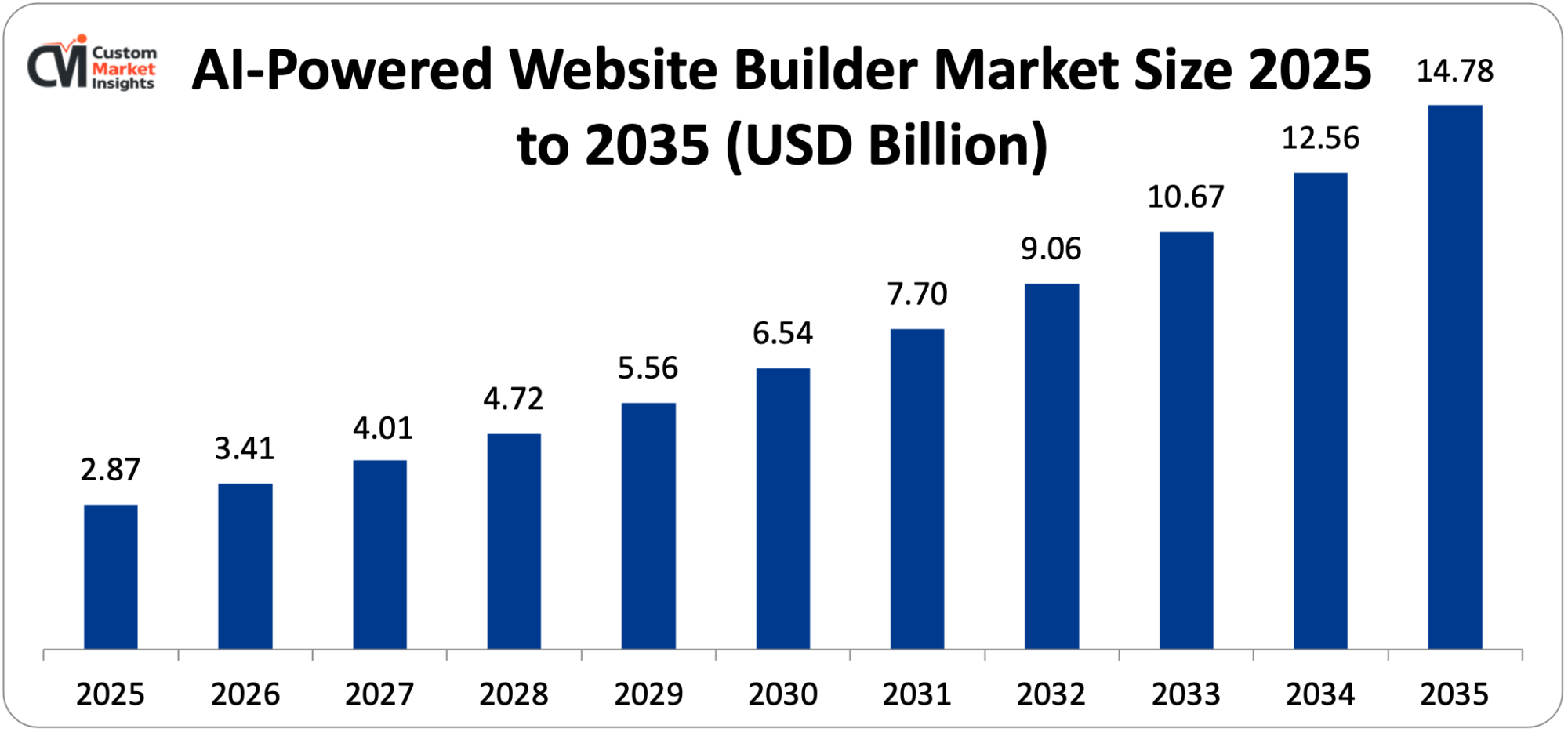
The market size of the AI-powered web-building industry in the world is estimated to be USD 2.87 billion in 2025 and is projected to grow to between USD 3.41 billion in 2026 and USD 14.78 billion in 2035, with a CAGR of 17.7% between 2026 and 2035.
The propulsive expansion of small and medium enterprises creating online footprints, the democratization of web development through artificial intelligence-assisted web page designing and code generation, the fast maturation of large language models (LLMs) and generative artificial intelligence functionality as part of the web building tools and services, and the increasing demand of personalized and conversion-oriented web experiences contribute to strong market growth during the forecast period.
Market Highlight
- North America had a 38% market share in 2025, leading the AI-driven website-building sector.
- Asia Pacific will grow at the highest CAGR of 21.4% between 2026 and 2035.
- As of 2025, the captured market share by type by the template-based AI builders is a bit over 43%.
- The segment of the custom AI code generator is experiencing the highest CAGR of 22.3% between 2026 and 2035 by type.
- By end-user, the small and medium enterprises (SME) segment had the highest market share of 49% in 2025 with the large enterprise expected to be the fastest growing segment at 19.8% during the forecasted duration between 2025 and 2035.
- By mode of deployment, the cloud based segment is taking 87% of market share in 2025.
- In 2024, AI-based website builders had a market share in the total website builder market of 23.6%, compared to around 11% in 2022, as AI is being more widely adopted in the industry.
Significant Growth Factors
The AI-Powered Website Builder Market Trends present significant growth opportunities due to several factors:
- Surging Global Digital Transformation and SME Website Adoption:
The most significant structural force behind the market of AI-driven website builders is the fast-paced digitalization of business processes in all verticals because organizations of all sizes are becoming aware that a professional online presence is no longer a luxury but a prerequisite to business survivability in an increasingly digital economy. As of 2024, the number of internet users around the world stands at 5.4 billion (according to the International Telecommunication Union, ITU), which is 67% of the entire world population, and the number of internet users keeps increasing at an average rate of 100 million per year in the developing economies. This growing generation of the digital population is directly proportional to the commercial explosion of business venturing into professional web presence.
The World Bank projects there are about 330 million small and medium enterprises in the world, and only one out of three of them now has a functioning, professionally created webpage web address to serve, which can be viewed as a huge untapped market of ready, AI-enabled website generation systems. An analysis of GoDaddy conducted in 2024 revealed that SMEs that had a strong online presence increased revenue by 51% more than other businesses of the same nature that had no online presence, providing strong economic incentives for adopting websites. AI-driven website builders are also perfectly poised to cater to such an underserved SME market by removing the technical complexity, time, and cost burden that has traditionally put small businesses out of reach of developing a professional presence on the web. Whereas conventional custom website development requires USD 3,000 – USD 30,000 and requires weeks to months, the current AI website builders allow the development of functional and professional websites in minutes at USD 10-50 monthly subscriptions. eMarketer estimates that the global e-commerce market will grow to USD 12.4 trillion by 2030, but the demand is accelerated further as traders are in need of e-commerce capable websites to engage in online retailing, as its market is currently valued at USD 6.3 trillion (2024). Considerable additional demand impetus is being generated by governments in emerging economies, such as the Digital India initiative in India, the Making Indonesia 4.0 program in Indonesia, and many other African government digitalization programs that actively subsidized the adoption of digital technologies by SMEs.
- Generative AI Maturation Enabling True No-Code Website Creation: Generative AI Maturation The next stage of AI-assisted template customization will be eliminated as AI-based website builders will clearly provide more services in the future, as they will be able to easily create websites based on their natural language specifications or even build websites by conversing with them. GPT-4, Claude, Gemini, and domain-specific AI models embedded into the website-building platforms allow users nowadays to describe their business, target audience, and design preferences using plain language and have a fully structured, copy-generated, visually designed website within minutes. In a 2024 Stanford AI Index Report, code generation AI performance in terms of benchmark performance had advanced by about 48% between 2022 and 2024, which specifically allowed website builders to produce cleaner and more functional code by using prompts in natural language. Wix, which incorporated its AI Site Generator throughout its platform in 2023-2024, reported that websites built with the aid of AI tools drove 40% more user engagement in the first year than manually built websites on the platform, due to AI-driven layout structures and content placement. Framer, Durable, 10Web, and Hostinger, among others, are competing on the complexity of their AI generation technology, with Durable boasting of full business websites, complete with copy, graphics, and contact forms, produced within less than half of a minute. Bloomberg Intelligence estimates the global market in generative AI to increase at a CAGR of 39.6% to USD 967 billion in 2032, up from USD 67 billion in 2024, with the creation of websites being one of the largest and most commercially reachable areas of application of generative AI due to the presence of website requirements at every business and individual level.
What are the Major Advances Changing the AI-Powered Website Builder Market Today?
- Conversational AI and Natural Language Interface Design: The most disruptive technological innovation that has changed the competitive nature of the site builder market is the integration of conversational AI interfaces, which has allowed users to construct, edit, and optimize websites based on a natural language chat interface, as opposed to visual drag-and-drop builders. Top platforms are implementing AI chat interfaces that act as virtual web developers and designers and present users with clarifying queries regarding their business aims, brand appearance, target markets, and content needs, and automatically develop entire web architectures, content hierarchies, text, image selections, and responsive designs. In 2024, the AI platform of Wix, serving more than 250 million users worldwide, launched conversational AI site generation, allowing users to describe their business in a conversational tone and get a multi-page content-filled site within minutes. The AI part of Framer enables designers to define the UI in plain English and generates production-ready, animated React components, which transforms the workflow of designing a website by orders of magnitude. Data in the industry shows that AI-based website builders save an average of 70-80% of the time it would take to get a new business website up and running in comparison to conventional website creation methods, and that some websites have an average time to create a business site of less than five minutes under average business web content. The next-generation AI systems are multimodal, i.e. able to process text, image, and even video inputs in tandem, which is allowing more advanced design direction, with users able to enter brand images, competitor sites, or mood board photos as sources of style information that AI systems can analyze and translate into consistent directions of aesthetic appearance of websites.
- AI-Driven Personalization and Conversion Rate Optimization: In addition to original site development, AI-driven personalization engines and AI-driven conversion rate optimization (CRO) offerings dynamically advance personalization engines and piece rate conversion engines in place of engagement and business conversion to visitors, respectively. Such AI CRO systems can run multivariate tests on headline copy, call-to-action button text and placement, choice of hero image, page layouts, and navigation structures in continuous experiments, with reinforcement learning algorithms defining what performance changes are statistically significant and automatically deploying winning variants without the need of manual A/B testing configuration by website owners. The results of VWO and Optimizely show that actively engaged conversion optimization businesses increase their revenues by 20-40% of the current traffic volumes, which is tantamount to colossal commercial potential – and AI automation opens these opportunities to companies of the SME category that have not had the technical means to apply manual optimization programs. Personalization AI systems examine visitor behavioral indicators such as source of entry, type of device, geographic placement, browsing history, and behavior on-site and adjust the content, images, product suggestions, and promotional messages of websites in real-time based on the individual visitor contexts. By 2030, the world web analytics and personalization market will reach USD 28.9 Billion with a CAGR of 13.4% as artificial intelligence native website builders are starting to provide these features as part of the integrated platform and not as a third-party tool integration. Shopify, the USD 235 billion GMF based commerce platform serving more than 2 million merchants worldwide in 2024, has put significant investments in AI commerce features such as personalized product recommendation engines and AI-generated email and SMS campaigns, which are directly integrated with merchant websites.
- AI-Powered SEO and Content Generation Integration: The addition of AI content generation and search engine optimization services to the website builder platforms is forming a new value chain that is no longer limited to the creation of websites but instead to the continuous marketing of the content and the search traffic acquisition within the organic search. In the past, the delivery of SEO-friendly content on a website involved the cost of professional copywriters (average cost of USD 0.10-0.50 per word to get quality content) or a lot of time researching and writing manually. The current state of AI content generation that works with website builders allows visually generating SEO-optimized blog posts, product descriptions, landing page content, and even meta tags at virtually no marginal cost, which significantly alters the costs and benefits of content marketing among SMEs. Weblogic AI blog post generators have been incorporated into platforms such as Wix, Hostinger, and Squarespace and generate structured and keyword-rich content with LSI (Latent Semantic Indexing) variations on keywords, relevant heading structure, and internal connection recommendations based on the structure of the websites. The BrightEdge (2024) report concluded that two-thirds of the online experience started with a search engine, and organic search contributes 53% of all web traffic on average, placing SEO functionality at the heart of competitive feature sets within website building providers targeting SME clients who rely on organic finding. The global market in SEO services was estimated to be USD 80 billion in 2024 and it is expected to grow to USD 171 billion by 2032, with the introduction of AI-native SEO features within website builders being a major market disruption in democratizing the practice of SEO. Website builders with automated technical SEO (such as schema markup generation, sitemap generation, page speed optimization, and Core Web Vitals optimization) are especially useful to SME customers who have no technical knowledge to apply these techniques to their websites.
- Multimodal AI Design Generation and Brand Identity Creation: With the advent of AI image generation models such as DALL-E 3, Stable Diffusion, Midjourney, and proprietary models, which are being implemented into website building platforms, AI website makers have been empowered to create brand identity and visual design production end-to-end alongside the structure of the website, the only remaining barrier to DIY web building: professional photography, custom illustrations, and cohesive visual branding resources. Several websites like Adobe Express, Canva web builder, and Wix are built-in text-to-image creators and are also adding features to create websites, and in the process of creating a hero image, product image, or other illustrative image, they receive an image that matches their brand style in a few seconds based on a description they enter. In 2023, the AI image generation market is estimated to be USD 299 million, with its continuous growth to USD 917 million by 2028 and a CAGR of 25.1, with website building being one of the biggest application spheres. In addition to imagery, AI design systems are producing entire brand identity packages, such as logo ideas, color and suggested color palettes, typography, and brand voice guidelines, which make the content of the webpage and other marketing communications look distinctly related. It is a pure democratization of professional brand designing services that used to need interactions with the design agencies that charged USD 2,000 to 20,000 to carry out the brand identity projects. The next tier of AI-driven web design improvement will be the incorporation of video AI features as platforms already start to provide use of AI-generated video demonstrations of products, animated sections of a hero, and custom video content that can be embedded into a website.
Category Wise Insights
By Type
Why Do Template-Based AI Builders Lead the Market?
The template-based AI builders form the smallest type of segment, as they will occupy about 43% of the overall market in 2025. This preeminence is indicative of the extensive accessibility and ease of use of template-based workflows enhanced with AI customization, whereby users can build on professionally created layout bases and leave the remainder of the copy, image, color scheme, and structural changes to be performed with the assistance of AI personalization, tailored to their own brand and business needs.
The three largest platforms in terms of active websites (Wix, Squarespace, and GoDaddy) base their AI experience on template-driven workflow with AI content and design intelligence. As of 2024, the Wix site data platform shows on its platform that there are over 250 million websites that have been built on its platform and that upward of 60% of new site builds have an AI-assisted creation workflow. In 2024 user data, Squarespace claimed that, with the help of AI, the time-to-publish on template customization shortened by 65% in comparison with editing template templates only through manual means. The strength of template-based AI builders is that they offer professional design guardrails to avoid the visual inconsistencies found in fully open-ended AI generation, and they give the user aesthetically sensible results even without design knowledge. The scale has a strong network effect since already existing platforms are continually learning to engage and convert millions of live websites, such that the quality and relevance of AI-generated content and layout suggestions get better with scale.
The most active market is custom AI code generators, with a CAGR of 22.3% between 2026 and 2035, as more developers and advanced users that are more technically minded are now interested in having AI speed up web development to professional standards without limiting creativity to the template format. Integrations of web frameworks with platforms such as Framer, Builder.io, and GitHub Copilot are allowing developers to define UI components, page sections, and interaction behaviors in natural language and get production-quality HTML, CSS, JavaScript, and React code that can be immediately deployed or refined to completion. According to Evans Data Corporation, the number of software developers in the world is due to increase to above 45 million by 2030 and AI code generation tools are becoming the standard productivity infrastructure of this expanding professional population, increasing by 28.7 million in 2024. A 2024 survey by GitHub detected that code completion, on average, was found to be 55% faster by developers who used AI code generation tools, and one of the most common AI code generation applications was web front-end code.
By End-User
Why Do Small & Medium Enterprises Dominate the Market?
The largest end-user group is SMEs, which will consume about 49% of the total market share in 2025, and indicates the extreme fit of the value proposition of AI website builders to the resource constraints and technical skills and budget sensitivities of the small business operator. The OECD estimates that about 90% of all businesses in the world and 70% of all employment is made up of SMEs, which is an enormous market that is in dire need of digital presence but has historically not been served by web development solutions, which require technical skills or engagement of a professional agency. According to a 2024 survey by Clutch, one out of every five small businesses (29) did not have a website, with cost (28), technical complexity (23), and time (19) being the most frequently cited obstacles to the websites, which AI website builders specifically target. The returning average revenue per user (ARPU) of the AI website builder services dedicated to SMEs is USD 1202 (USD 600 yearly) with e-commerce-enabled services worth USD 2402 (USD 1200 yearly) due to the high value of the services provided in comparison to other options. The SME demand is also very strong in service verticals such as restaurants, salons, medical practices, law firms, and real estate firms, where local visibility of search through localized professional websites with optimized local search engines translates to customer acquisition.
The most robust growth is the huge enterprise segment at a CAGR of 19.8% from 2026 to 2035 due to corporate adoption of AI website building features to do landing page web pages, campaign microsites, regional market websites, and internal portal development to supplement core enterprise CMS deployments. The enterprise adoption is specifically high in terms of AI-driven landing page and campaign microsite development, where marketing teams need fast website development options that do not rely on the resource allocation of the engineering department. Gartner states that by 2024, 75% of enterprise marketing professionals will say that AI-generated content and AI-generated web tools have caused them to stop needing to rely on web development team resources to carry out their campaigns, a huge shift in the enterprise digital workflow dynamics. Most AI website builder installations are now enterprise-tiered, with even the likes of Salesforce, HubSpot, and Adobe Experience Cloud growing their AI website building functionality and integrating it with marketing technology stacks such as CRM platforms, marketing automation systems, and analytics infrastructure via API connections.
By Deployment Mode
Why Does Cloud-Based Deployment Dominate?
The deployment of applications based on cloud-based AI site builders captures an unbelievable 87% of the market share in 2025, which reflects the inherent design of modern SaaS website-building infrastructure that derives its core value from ever-changing AI models, globally scaled content delivery networks, automatic security patching, and real-time collaboration functionality, which are inherently cloud-native. The cloud deployment model allows platform providers to make continuous enhancements to AI functionality – the release of new language models, better design of AI systems, and better personalization algorithms – without having the customer change software or maintain infrastructure, generating compounding value delivery that is impossible to achieve with on-premise deployment. The worldwide cloud computing industry has been estimated at USD 676 billion in 2024, and is anticipated to achieve USD 1.44 trillion by 2029 with a CAGR of 16.4 with SaaS applications, including web builders, being one of the most developed and commercially established categories of cloud applications. The broadly accessible nature of AI website builders using cloud deployment allows the business model economics that allow their infrastructure costs to be distributed among millions of platform users to allow per-seat subscription pricing that can be afforded by individual SMEs and individual users. Premises-based AI site builder products enjoy a niche presence largely in government agencies, financial services companies, and healthcare organizations that have data residency and sovereignty demands that prohibit cloud hosting of some types of content, a structurally limited but defensible category of the market.
Report Scope
| Feature of the Report | Details |
| Market Size in 2026 | USD 3.41 billion |
| Projected Market Size in 2035 | USD 14.78 billion |
| Market Size in 2025 | USD 2.87 billion |
| CAGR Growth Rate | 17.7% CAGR |
| Base Year | 2025 |
| Forecast Period | 2026-2035 |
| Key Segment | By Type, Deployment Mode, End-User, Application and Region |
| Report Coverage | Revenue Estimation and Forecast, Company Profile, Competitive Landscape, Growth Factors and Recent Trends |
| Regional Scope | North America, Europe, Asia Pacific, Middle East & Africa, and South & Central America |
| Buying Options | Request tailored purchasing options to fulfil your requirements for research. |
Regional Analysis
How Big is the North America Market Size?
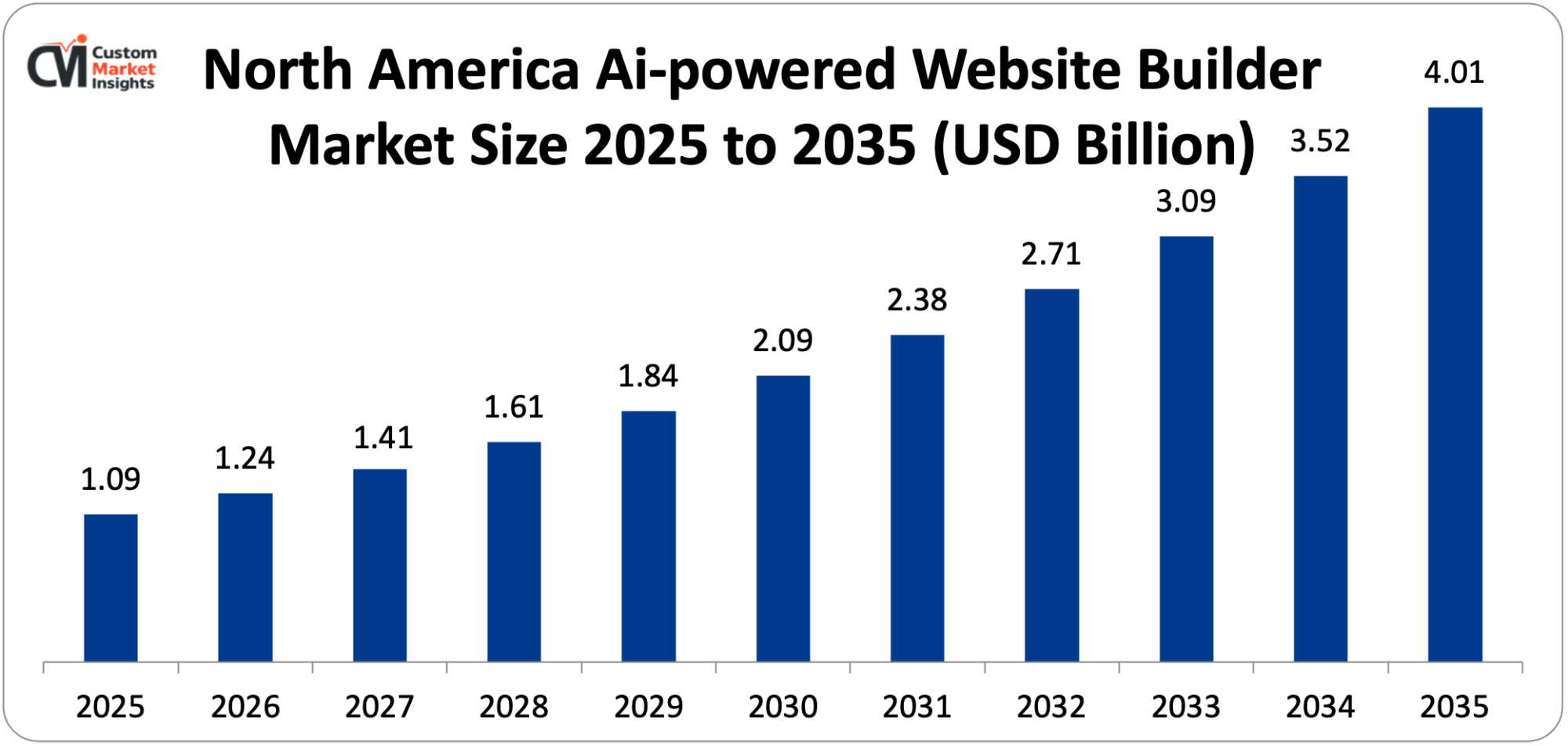
The North America AI-powered website builder market size is estimated at USD 1.09 billion in 2025 and is projected to reach approximately USD 4.01 billion by 2035, with a 14.0% CAGR from 2026 to 2035.
Why Did North America Dominate the Market in 2025?
North America has about 38% of the world market share in 2025, which is attributed to its presence of most of the leading AI-powered site builder platforms in the world, such as Wix (NASDAQ listed, headquartered in Tel Aviv with dominant penetration of the U.S. market), Squarespace, GoDaddy, Shopify, Webflow, and Framer, as well as the fact that the region has a high digital economy, a high density of SMEs, and a high adoption rate of SaaS tools. The United States itself has nearly 33.3 million small enterprises as per the U.S. Small Business Administration, which is a highly saturated domestic market in which digital presence is virtually a requirement to be competitive in commercial activities. In 2024, U.S. digital advertising investment is USD 271 billion (eMarketer), which sets the business in a good commercial incentive to invest in quality websites that can effectively convert paid traffic. This has been guaranteed by the concentration of the large technology firms, venture capital investment, and the AI research talent in North America, so that the major AI website builder sites can command access to world-class AI engineering, as well as the capital to invest aggressively in the creation of AI features. In 2023-2024, PitchBook records indicate that more than USD 1.8 billion of venture capital was invested in AI-native web development tools and website-building software over the world, most of which was concentrated in companies in North America, increasing platform innovation.
What is the Size of the U.S. Market?
The U.S. AI-powered website builder market size is calculated at approximately USD 890 million in 2025 and is expected to reach nearly USD 3.32 billion in 2035, advancing at a CAGR of 14.1% between 2026 and 2035.
U.S. Market Trends
The American market will be characterized by fierce platform competition, speedy AI feature development, and a maturing free-to-paid upgrading business model in which platforms are heavily funding AI abilities to stimulate upgrade rates. The AI-powered website builder of GoDaddy, which has more than 21 million customers in its global base with the U.S. market being highly concentrated, reported that in 2024, the website creator was 10 times faster than the conventional GoDaddy website building systems. Another feature of the U.S. market is high vertical specialization, where AI website builders are industry-focused (e.g., restaurants, Toast, Square Online for healthcare, etc.), and the AI features and industry templates are purpose-built and industry-specific.
Why is Asia Pacific Experiencing the Fastest Growth?
The fastest-growing regional market is the Asia Pacific (-10.2-10.7), with a projected CAGR of 21.4% in the years 2026-2035 due to the growing internet penetration and the massive growth of mobile commerce, especially in China, India, Indonesia, and Southeast Asia, creating demand on websites; governmental digitalization efforts actively encouraging the adoption of SME web presence to the market; and the development of regional AI site builder platforms that would meet the language and cultural needs of its local markets. DataReportal estimates that Asia Pacific will increase internet users by around 220 million in 2023-2024, most of whom are first time digital business players who have generated instant demand on websites. The number of internet users in India is 759 million, but it is expected to reach 900 million by 2027, as the government initiatives Startup India and Digital India programs are actively supporting entrepreneurship and the establishment of digital businesses, leading to the adoption of AI website builders. Statista estimates the Asia Pacific e-commerce market expanding from USD 2.6 trillion in 2024 to USD 5.2 trillion in 2030 at a CAGR of 12.3 and millions of merchants need websites that can handle e-commerce as a prerequisite investment in commerce infrastructure.
China Market Trends
The AI-powered site builder market in China demonstrates the unique dynamics of the local digital ecosystem as local platforms, like MAKA, Webflow options offered by the Alibaba Cloud and Tencent ecosystem, and Kingdee Web control the local market alongside the international market participants with localized solutions. The 48.3 million registered small enterprises in China, according to the current statistics of the National Bureau of Statistics of China, signify a huge domestic market, and the strategy of developing the digital economy as a part of the 14th Five-Year Plan actively promotes the use of digital by SMEs. Large language models in Chinese AI have been developed swiftly, with Baidu and Alibaba competing with their own ERNIE and Qwen and other models, as well as models created in China, as competitive AI infrastructure providers to Chinese website building platforms.
Why is Europe Experiencing Strong Regulatory-Influenced Growth?
The market size and market growth in the European AI-based web builder are large and are being shaped by the GDPR compliance needs, which create a demand on privacy-by-design web architectures AI platforms have invested in offering; by the powerful SME digitalization funding through EU Digital Decade programs, which serve 90% of EU SMEs with basic digital intensity by 2030; and by the advanced enterprise market, which is seeking AI-enabled web building features with GDPR compliance infrastructure. The subsidized digital tools offered through the Digital Europe Programme, which include the EUR 3 billion SME digitalization support programs integrated in the EU, are producing demand in the member states for digital tools such as AI website builders. Mitchellstand, the backbone of about 3.5 million SMEs that constitute 99% of enterprises in Germany, is of particular interest as a target market of AI-facilitated website-generation solutions.
Why is the Middle East & Africa Region Emerging as a High-Potential Market?
The LAMEA region is an emerging high growth prospect due to the economic diversification programs of Saudi Arabia and the UAE (Vision 2030 and Vision 2071 that incorporate large scale SME formation and digital economy development agendas, the fast growing mobile internet penetration and related growth of mobile-first digital companies in Sub-Saharan Africa, and the dynamic startup ecosystem in Brazil, Mexico, and Colombia with one of the highest rates of digital-native SME formation. The youthful, technologically oriented Middle East population with a median age of 28 years in the GCC demonstrates a high level of very self-service oriented digital technologies, which poses good demographic backgrounds to adopt AI website builders. The mobile-first internet environment of Africa is defining the demand for AI-powered website builders to create and design mobile creation and mobile viewing experiences, for which platforms that focus on mobile-responsive output are well positioned to cater to this market.
Top Players in the Market and Their Offerings
- Wix.com Ltd.
- Squarespace Inc.
- GoDaddy Inc.
- Shopify Inc.
- Webflow Inc.
- Framer B.V.
- Durable Technologies Inc.
- 10Web Inc.
- Hostinger International Ltd.
- Adobe Inc. (Adobe Express)
- Weebly (Square/Block Inc.)
- Others
Key Developments
The market has undergone significant developments as industry participants seek to expand AI capabilities and capture growing demand across SME and enterprise segments.
- In January 2026: Wix also wrote about the launch of its more powerful AI Site Generator 2.0, which offers multimodal input features, enabling users to add brand images and describe their business in speech, as well as use rival sites as design inspiration for their sites. The new system results in the production of full multi-page sites along with copy and designed AI-powered images, as well as formatted data markup in just under 90 seconds. Wix stated that the early adopters of the upgraded system experienced a 34% higher 30-day site retention than those who had created their own Wix websites, which means they had better early quality and user satisfaction success.
- In March 2025: Squarespace released Blueprint AI, its biggest product draw in a long time post its 2021 IPO, an AI-based conversational structure-based design, which substitutes the conventional template-choice procedure with a facilitated dialogue to gather business context, aesthetic inclination, and content needs to produce a completely personalized structure. In its Q4 2024 earnings call, Squarespace published the figure of 45% of all new paid subscriptions created with the help of AI, compared to around 20% in Q1 2024, indicating that it has been compelled to adopt AI creation processes unconsciously among its customer base.
These strategic actions have helped companies leverage market strengths, compete on AI depth capability, attract venture capital to continue creating innovative technology, and exploit the massive growth potential as AI-assisted website creation turns into a distinguishing attribute to become a feature on the market platform.
The AI-Powered Website Builder Market is segmented as follows:
By Type
- Template-Based AI Builders
- Custom AI Code Generators
- E-Commerce AI Website Builders
- AI Portfolio & Personal Site Builders
- Other Types
By Deployment Mode
- Cloud-Based
- On-Premise
By End-User
- Small & Medium Enterprises (SMEs)
- Large Enterprises
- Individual Users & Freelancers
- Agencies & Web Development Firms
- Others
By Application
- Business Websites
- E-Commerce Storefronts
- Portfolio & Personal Sites
- Blog & Content Platforms
- Landing Pages & Lead Generation
- Other Applications
Regional Coverage:
North America
- U.S.
- Canada
- Mexico
- Rest of North America
Europe
- Germany
- France
- U.K.
- Russia
- Italy
- Spain
- Netherlands
- Rest of Europe
Asia Pacific
- China
- Japan
- India
- New Zealand
- Australia
- South Korea
- Taiwan
- Rest of Asia Pacific
The Middle East & Africa
- Saudi Arabia
- UAE
- Egypt
- Kuwait
- South Africa
- Rest of the Middle East & Africa
Latin America
- Brazil
- Argentina
- Rest of Latin America
Table of Contents
- Chapter 1. Report Introduction
- 1.1. Report Description
- 1.1.1. Purpose of the Report
- 1.1.2. USP & Key Offerings
- 1.2. Key Benefits For Stakeholders
- 1.3. Target Audience
- 1.4. Report Scope
- 1.1. Report Description
- Chapter 2. Market Overview
- 2.1. Report Scope (Segments And Key Players)
- 2.1.1. AI-Powered Website Builder by Segments
- 2.1.2. AI-Powered Website Builder by Region
- 2.2. Executive Summary
- 2.2.1. Market Size & Forecast
- 2.2.2. AI-Powered Website Builder Market Attractiveness Analysis, By Type
- 2.2.3. AI-Powered Website Builder Market Attractiveness Analysis, By Deployment Mode
- 2.2.4. AI-Powered Website Builder Market Attractiveness Analysis, By End-User
- 2.2.5. AI-Powered Website Builder Market Attractiveness Analysis, By Application
- 2.1. Report Scope (Segments And Key Players)
- Chapter 3. Market Dynamics (DRO)
- 3.1. Market Drivers
- 3.1.1. Surging Global Digital Transformation and SME Website Adoption
- 3.1.2. Generative AI Maturation Enabling True No-Code Website Creation
- 3.2. Market Restraints
- 3.3. Market Opportunities
- 3.5. Pestle Analysis
- 3.6. Porter Forces Analysis
- 3.7. Technology Roadmap
- 3.8. Value Chain Analysis
- 3.9. Government Policy Impact Analysis
- 3.10. Pricing Analysis
- 3.1. Market Drivers
- Chapter 4. AI-Powered Website Builder Market – By Type
- 4.1. Type Market Overview, By Type Segment
- 4.1.1. AI-Powered Website Builder Market Revenue Share, By Type, 2025 & 2035
- 4.1.2. Template-Based AI Builders
- 4.1.3. AI-Powered Website Builder Share Forecast, By Region (USD Billion)
- 4.1.4. Comparative Revenue Analysis, By Country, 2025 & 2035
- 4.1.5. Key Market Trends, Growth Factors, & Opportunities
- 4.1.6. Custom AI Code Generators
- 4.1.7. AI-Powered Website Builder Share Forecast, By Region (USD Billion)
- 4.1.8. Comparative Revenue Analysis, By Country, 2025 & 2035
- 4.1.9. Key Market Trends, Growth Factors, & Opportunities
- 4.1.10. E-Commerce AI Website Builders
- 4.1.11. AI-Powered Website Builder Share Forecast, By Region (USD Billion)
- 4.1.12. Comparative Revenue Analysis, By Country, 2025 & 2035
- 4.1.13. Key Market Trends, Growth Factors, & Opportunities
- 4.1.14. AI Portfolio & Personal Site Builders
- 4.1.15. AI-Powered Website Builder Share Forecast, By Region (USD Billion)
- 4.1.16. Comparative Revenue Analysis, By Country, 2025 & 2035
- 4.1.17. Key Market Trends, Growth Factors, & Opportunities
- 4.1.18. Other Types
- 4.1.19. AI-Powered Website Builder Share Forecast, By Region (USD Billion)
- 4.1.20. Comparative Revenue Analysis, By Country, 2025 & 2035
- 4.1.21. Key Market Trends, Growth Factors, & Opportunities
- 4.1. Type Market Overview, By Type Segment
- Chapter 5. AI-Powered Website Builder Market – By Deployment Mode
- 5.1. Deployment Mode Market Overview, By Deployment Mode Segment
- 5.1.1. AI-Powered Website Builder Market Revenue Share, By Deployment Mode, 2025 & 2035
- 5.1.2. Cloud-Based
- 5.1.3. AI-Powered Website Builder Share Forecast, By Region (USD Billion)
- 5.1.4. Comparative Revenue Analysis, By Country, 2025 & 2035
- 5.1.5. Key Market Trends, Growth Factors, & Opportunities
- 5.1.6. On-Premise
- 5.1.7. AI-Powered Website Builder Share Forecast, By Region (USD Billion)
- 5.1.8. Comparative Revenue Analysis, By Country, 2025 & 2035
- 5.1.9. Key Market Trends, Growth Factors, & Opportunities
- 5.1. Deployment Mode Market Overview, By Deployment Mode Segment
- Chapter 6. AI-Powered Website Builder Market – By End-User
- 6.1. End-User Market Overview, By End-User Segment
- 6.1.1. AI-Powered Website Builder Market Revenue Share, By End-User, 2025 & 2035
- 6.1.2. Small & Medium Enterprises (SMEs)
- 6.1.3. AI-Powered Website Builder Share Forecast, By Region (USD Billion)
- 6.1.4. Comparative Revenue Analysis, By Country, 2025 & 2035
- 6.1.5. Key Market Trends, Growth Factors, & Opportunities
- 6.1.6. Large Enterprises
- 6.1.7. AI-Powered Website Builder Share Forecast, By Region (USD Billion)
- 6.1.8. Comparative Revenue Analysis, By Country, 2025 & 2035
- 6.1.9. Key Market Trends, Growth Factors, & Opportunities
- 6.1.10. Individual Users & Freelancers
- 6.1.11. AI-Powered Website Builder Share Forecast, By Region (USD Billion)
- 6.1.12. Comparative Revenue Analysis, By Country, 2025 & 2035
- 6.1.13. Key Market Trends, Growth Factors, & Opportunities
- 6.1.14. Agencies & Web Development Firms
- 6.1.15. AI-Powered Website Builder Share Forecast, By Region (USD Billion)
- 6.1.16. Comparative Revenue Analysis, By Country, 2025 & 2035
- 6.1.17. Key Market Trends, Growth Factors, & Opportunities
- 6.1.18. Others
- 6.1.19. AI-Powered Website Builder Share Forecast, By Region (USD Billion)
- 6.1.20. Comparative Revenue Analysis, By Country, 2025 & 2035
- 6.1.21. Key Market Trends, Growth Factors, & Opportunities
- 6.1. End-User Market Overview, By End-User Segment
- Chapter 7. AI-Powered Website Builder Market – By Application
- 7.1. Application Market Overview, By Application Segment
- 7.1.1. AI-Powered Website Builder Market Revenue Share, By Application, 2025 & 2035
- 7.1.2. Business Websites
- 7.1.3. AI-Powered Website Builder Share Forecast, By Region (USD Billion)
- 7.1.4. Comparative Revenue Analysis, By Country, 2025 & 2035
- 7.1.5. Key Market Trends, Growth Factors, & Opportunities
- 7.1.6. E-Commerce Storefronts
- 7.1.7. AI-Powered Website Builder Share Forecast, By Region (USD Billion)
- 7.1.8. Comparative Revenue Analysis, By Country, 2025 & 2035
- 7.1.9. Key Market Trends, Growth Factors, & Opportunities
- 7.1.10. Portfolio & Personal Sites
- 7.1.11. AI-Powered Website Builder Share Forecast, By Region (USD Billion)
- 7.1.12. Comparative Revenue Analysis, By Country, 2025 & 2035
- 7.1.13. Key Market Trends, Growth Factors, & Opportunities
- 7.1.14. Blog & Content Platforms
- 7.1.15. AI-Powered Website Builder Share Forecast, By Region (USD Billion)
- 7.1.16. Comparative Revenue Analysis, By Country, 2025 & 2035
- 7.1.17. Key Market Trends, Growth Factors, & Opportunities
- 7.1.18. Landing Pages & Lead Generation
- 7.1.19. AI-Powered Website Builder Share Forecast, By Region (USD Billion)
- 7.1.20. Comparative Revenue Analysis, By Country, 2025 & 2035
- 7.1.21. Key Market Trends, Growth Factors, & Opportunities
- 7.1.22. Other Applications
- 7.1.23. AI-Powered Website Builder Share Forecast, By Region (USD Billion)
- 7.1.24. Comparative Revenue Analysis, By Country, 2025 & 2035
- 7.1.25. Key Market Trends, Growth Factors, & Opportunities
- 7.1. Application Market Overview, By Application Segment
- Chapter 8. AI-Powered Website Builder Market – Regional Analysis
- 8.1. AI-Powered Website Builder Market Overview, By Region Segment
- 8.1.1. Global AI-Powered Website Builder Market Revenue Share, By Region, 2025 & 2035
- 8.1.2. Global AI-Powered Website Builder Market Revenue, By Region, 2026 – 2035 (USD Billion)
- 8.1.3. Global AI-Powered Website Builder Market Revenue, By Type, 2026 – 2035
- 8.1.4. Global AI-Powered Website Builder Market Revenue, By Deployment Mode, 2026 – 2035
- 8.1.5. Global AI-Powered Website Builder Market Revenue, By End-User, 2026 – 2035
- 8.1.6. Global AI-Powered Website Builder Market Revenue, By Application, 2026 – 2035
- 8.2. North America
- 8.2.1. North America AI-Powered Website Builder Market Revenue, By Country, 2026 – 2035 (USD Billion)
- 8.2.2. North America AI-Powered Website Builder Market Revenue, By Type, 2026 – 2035
- 8.2.3. North America AI-Powered Website Builder Market Revenue, By Deployment Mode, 2026 – 2035
- 8.2.4. North America AI-Powered Website Builder Market Revenue, By End-User, 2026 – 2035
- 8.2.5. North America AI-Powered Website Builder Market Revenue, By Application, 2026 – 2035
- 8.2.6. U.S. AI-Powered Website Builder Market Revenue, 2026 – 2035 (USD Billion)
- 8.2.7. Canada AI-Powered Website Builder Market Revenue, 2026 – 2035 (USD Billion)
- 8.2.8. Mexico AI-Powered Website Builder Market Revenue, 2026 – 2035 (USD Billion)
- 8.2.9. Rest of North America AI-Powered Website Builder Market Revenue, 2026 – 2035 (USD Billion)
- 8.3. Europe
- 8.3.1. Europe AI-Powered Website Builder Market Revenue, By Country, 2026 – 2035 (USD Billion)
- 8.3.2. Europe AI-Powered Website Builder Market Revenue, By Type, 2026 – 2035
- 8.3.3. Europe AI-Powered Website Builder Market Revenue, By Deployment Mode, 2026 – 2035
- 8.3.4. Europe AI-Powered Website Builder Market Revenue, By End-User, 2026 – 2035
- 8.3.5. Europe AI-Powered Website Builder Market Revenue, By Application, 2026 – 2035
- 8.3.6. Germany AI-Powered Website Builder Market Revenue, 2026 – 2035 (USD Billion)
- 8.3.7. France AI-Powered Website Builder Market Revenue, 2026 – 2035 (USD Billion)
- 8.3.8. U.K. AI-Powered Website Builder Market Revenue, 2026 – 2035 (USD Billion)
- 8.3.9. Russia AI-Powered Website Builder Market Revenue, 2026 – 2035 (USD Billion)
- 8.3.10. Italy AI-Powered Website Builder Market Revenue, 2026 – 2035 (USD Billion)
- 8.3.11. Spain AI-Powered Website Builder Market Revenue, 2026 – 2035 (USD Billion)
- 8.3.12. Netherlands AI-Powered Website Builder Market Revenue, 2026 – 2035 (USD Billion)
- 8.3.13. Rest of Europe AI-Powered Website Builder Market Revenue, 2026 – 2035 (USD Billion)
- 8.4. Asia Pacific
- 8.4.1. Asia Pacific AI-Powered Website Builder Market Revenue, By Country, 2026 – 2035 (USD Billion)
- 8.4.2. Asia Pacific AI-Powered Website Builder Market Revenue, By Type, 2026 – 2035
- 8.4.3. Asia Pacific AI-Powered Website Builder Market Revenue, By Deployment Mode, 2026 – 2035
- 8.4.4. Asia Pacific AI-Powered Website Builder Market Revenue, By End-User, 2026 – 2035
- 8.4.5. Asia Pacific AI-Powered Website Builder Market Revenue, By Application, 2026 – 2035
- 8.4.6. China AI-Powered Website Builder Market Revenue, 2026 – 2035 (USD Billion)
- 8.4.7. Japan AI-Powered Website Builder Market Revenue, 2026 – 2035 (USD Billion)
- 8.4.8. India AI-Powered Website Builder Market Revenue, 2026 – 2035 (USD Billion)
- 8.4.9. New Zealand AI-Powered Website Builder Market Revenue, 2026 – 2035 (USD Billion)
- 8.4.10. Australia AI-Powered Website Builder Market Revenue, 2026 – 2035 (USD Billion)
- 8.4.11. South Korea AI-Powered Website Builder Market Revenue, 2026 – 2035 (USD Billion)
- 8.4.12. Taiwan AI-Powered Website Builder Market Revenue, 2026 – 2035 (USD Billion)
- 8.4.13. Rest of Asia Pacific AI-Powered Website Builder Market Revenue, 2026 – 2035 (USD Billion)
- 8.5. The Middle-East and Africa
- 8.5.1. The Middle-East and Africa AI-Powered Website Builder Market Revenue, By Country, 2026 – 2035 (USD Billion)
- 8.5.2. The Middle-East and Africa AI-Powered Website Builder Market Revenue, By Type, 2026 – 2035
- 8.5.3. The Middle-East and Africa AI-Powered Website Builder Market Revenue, By Deployment Mode, 2026 – 2035
- 8.5.4. The Middle-East and Africa AI-Powered Website Builder Market Revenue, By End-User, 2026 – 2035
- 8.5.5. The Middle-East and Africa AI-Powered Website Builder Market Revenue, By Application, 2026 – 2035
- 8.5.6. Saudi Arabia AI-Powered Website Builder Market Revenue, 2026 – 2035 (USD Billion)
- 8.5.7. UAE AI-Powered Website Builder Market Revenue, 2026 – 2035 (USD Billion)
- 8.5.8. Egypt AI-Powered Website Builder Market Revenue, 2026 – 2035 (USD Billion)
- 8.5.9. Kuwait AI-Powered Website Builder Market Revenue, 2026 – 2035 (USD Billion)
- 8.5.10. South Africa AI-Powered Website Builder Market Revenue, 2026 – 2035 (USD Billion)
- 8.5.11. Rest of the Middle East & Africa AI-Powered Website Builder Market Revenue, 2026 – 2035 (USD Billion)
- 8.6. Latin America
- 8.6.1. Latin America AI-Powered Website Builder Market Revenue, By Country, 2026 – 2035 (USD Billion)
- 8.6.2. Latin America AI-Powered Website Builder Market Revenue, By Type, 2026 – 2035
- 8.6.3. Latin America AI-Powered Website Builder Market Revenue, By Deployment Mode, 2026 – 2035
- 8.6.4. Latin America AI-Powered Website Builder Market Revenue, By End-User, 2026 – 2035
- 8.6.5. Latin America AI-Powered Website Builder Market Revenue, By Application, 2026 – 2035
- 8.6.6. Brazil AI-Powered Website Builder Market Revenue, 2026 – 2035 (USD Billion)
- 8.6.7. Argentina AI-Powered Website Builder Market Revenue, 2026 – 2035 (USD Billion)
- 8.6.8. Rest of Latin America AI-Powered Website Builder Market Revenue, 2026 – 2035 (USD Billion)
- 8.1. AI-Powered Website Builder Market Overview, By Region Segment
- Chapter 9. Competitive Landscape
- 9.1. Company Market Share Analysis – 2025
- 9.1.1. Global AI-Powered Website Builder Market: Company Market Share, 2025
- 9.2. Global AI-Powered Website Builder Market Company Market Share, 2024
- 9.1. Company Market Share Analysis – 2025
- Chapter 10. Company Profiles
- 10.1. Wix.com Ltd.
- 10.1.1. Company Overview
- 10.1.2. Key Executives
- 10.1.3. Product Portfolio
- 10.1.4. Financial Overview
- 10.1.5. Operating Business Segments
- 10.1.6. Business Performance
- 10.1.7. Recent Developments
- 10.2. Squarespace Inc.
- 10.3. GoDaddy Inc.
- 10.4. Shopify Inc.
- 10.5. Webflow Inc.
- 10.6. Framer B.V.
- 10.7. Durable Technologies Inc.
- 10.8. 10Web Inc.
- 10.9. Hostinger International Ltd.
- 10.10. Adobe Inc. (Adobe Express)
- 10.11. Weebly (Square/Block Inc.)
- 10.12. Others.
- 10.1. Wix.com Ltd.
- Chapter 11. Research Methodology
- 11.1. Research Methodology
- 11.2. Secondary Research
- 11.3. Primary Research
- 11.3.1. Analyst Tools and Models
- 11.4. Research Limitations
- 11.5. Assumptions
- 11.6. Insights From Primary Respondents
- 11.7. Why Custom Market Insights
- Chapter 12. Standard Report Commercials & Add-Ons
- 12.1. Customization Options
- 12.2. Subscription Module For Market Research Reports
- 12.3. Client Testimonials
List Of Figures
Figures No 1 to 36
List Of Tables
Tables No 1 to 51
Prominent Player
- Wix.com Ltd.
- Squarespace Inc.
- GoDaddy Inc.
- Shopify Inc.
- Webflow Inc.
- Framer B.V.
- Durable Technologies Inc.
- 10Web Inc.
- Hostinger International Ltd.
- Adobe Inc. (Adobe Express)
- Weebly (Square/Block Inc.)
- Others
FAQs
The key players in the market are Wix.com Ltd., Squarespace Inc., GoDaddy Inc., Shopify Inc., Webflow Inc., Framer B.V., Durable Technologies Inc., 10Web Inc., Hostinger International Ltd., Adobe Inc. (Adobe Express), Weebly (Square/Block Inc.), Others.
Government regulations have a significant impact on various aspects of the AI-driven site builder market. The European GDPR and new privacy laws in California (CCPA), Brazil (LGPD), India (DPDP Act), and other countries mandate websites to have conforming cookie consent forms and privacy statements, as well as data handling procedures, thus incurring a need for AI website builders that will generate automated compliant legal pages and cookie consent forms. The transparency requirements of AI-generated content introduced in the EU AI Act that came into effect in 2024 are starting to affect how AI website builder platforms reveal AI generation to end users and the visitors to the websites. The SME digitalization funding schemes in the EU, UK, India, and Southeast Asia are generating an artificial demand at subsidized rates, which significantly increases the size of the addressable market, especially in the case of micro-enterprises that would not otherwise afford paid subscriptions with web builders. Legal accessibility mandates such as the EU Web Accessibility Directive and the U.S. Americans with Disabilities Act (ADA) are creating a market demand for AI web builder tools that automatically create WCAG 2.1-conformant websites, which are gradually being implemented in the AI generation workflows of more prominent websites.
AI-based website builder interfaces have implemented both free entry tiers (limited features, branded domains by the platform) to professional tiers at USD 10-USD 50 per month and e-commerce tiers at USD 20-USD 100 per month, with enterprise and agency tiers ranging from USD 200-USD 2000+ per month in terms of feature depth, number of seats, and tier of support. This wide pricing range has helped to democratize the professional website creation process, with AI functionality becoming more embedded in the pricing range instead of premium plans being used by the upper end of the pricing structure as sites compete fiercely to draw in more users. Freemium model (where a user can create basic AI websites for free and make profit by connecting to custom domains, getting rid of platform branding, possessing e-commerce transactions, and using superior analytics) has been very successful in accumulating a massive following that eventually turns into subscriptions when business websites are fully developed. The trend in platform ARPU has been on the increase whereby AI-enabled premium functionalities such as advanced SEO tools, AI-generated content credits, and personalization options are sold under the medium- and high-end packages that customers are willing to pay for provided they are shown to be generating ROI.
According to the current assessment, the market size is expected to reach about USD 14.78 billion in 2035, with the growing access to AI in nearly all major website building systems making AI not a differentiator but a standard-level infrastructure; the ongoing growth of internet penetration and digital business creation in the emerging economies; AI customization and CRO functionalities providing quantifiable revenue benefits that would justify high-priced platform subscriptions; and the advancement of AI functionality to more advanced capabilities such as video creation, real-time personalization, and predictive analytics into website builder platforms and enterprises.
The highest share of revenue is projected to be maintained by North America, with a share of about 2030, with the region capturing about 38% of the world in 2025, based on its concentration of the most prominent AI website building platforms, the USD 271 billion domestic digital advertising market developing powerful commercial site investment incentives, the 33.3 million small businesses in the United States of America representing a high level of concentration of a dense high-ARPU market, and the region’s advanced culture of SaaS implementation and developed payment infrastructure commercializing the subscription model. Asia Pacific is expected to bridge the gap and hence close by greatly in the forecast period due to its high growth rate.
Asia Pacific is expected to have the highest CAGR of 21.4% in the forecast period due to the addition of approximately 220 million new internet users in the forecast period, which comprises first-time digital business operators. India has an internet user base of over 900 million, projected to grow to over 1000 million in 2027 with active government promotion of digital entrepreneurship. Asia Pacific e-commerce will reach USD 5.2 trillion by 2030 which will need the infrastructural support of merchant websites and the active promotion of SME digital adoption with funding and incentive programs.
The Global AI-Powered Website Builder Market is projected to be able to grow substantially, as the global population comprising 330 million SMEs, of which less than 30% have a professional website, represents a significant addressable market; the global e-commerce market is projected to rise to USD 12.4 trillion by 2030, which drives the demand for merchant websites; generative AI benchmark performance is estimated to have improved by about 48% between 2022 and 2024; the 5.4 billion people around the globe are internet users in 2024 with 100 million new users joining annually from developing economies, creating new digital business formation; and venture capital investment in AI web development tools exceeded USD 1.8 billion globally in 2023–2024 accelerating platform innovation.