Brazil Tea and Coffee Botanical Ingredients Market
Brazil Tea and Coffee Botanical Ingredients Market 2026 – 2035
Brazil Tea and Coffee Botanical Ingredients Market Size, Trends and Insights By Ingredient Type (Whole & Cut Botanicals, Milled & Powdered Botanicals, Botanical Extracts, Oleoresins (Non-Volatile Resin Extracts), Natural Botanical Colorants), and By Region - Industry Overview, Statistical Data, Competitive Analysis, Share, Outlook, and Forecast 2026–2035
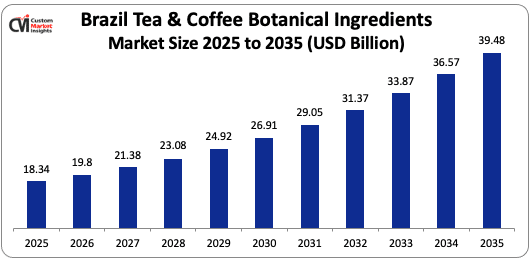
The Brazil tea and coffee botanical ingredients market was valued at USD 19.8 Bn in 2026 and is projected to reach USD 39.48 Bn by 2035, growing at a CAGR of 7.97%.
Brazil Tea and Coffee Botanical Ingredients Market 2026 – 2035
Brazil's tea & coffee botanical ingredients market is expected to record a CAGR of 7.97% from 2026 to 2035. In 2026, the market size was USD 19.8 Billion. By 2035, the valuation is anticipated to reach USD 39.48 Billion. The market is growing due to increased demand for clean-label products, functional beverages, and plant-based ingredients across nutraceutical, food, and beverage verticals.
Coffee- and tea-derived botanicals like powders, extracts, and natural caffeine sources are witnessing a higher demand owing to rising consumer preference for natural and health-oriented formulations, particularly in dietary supplements and beverages. Brazil is known as one of the largest producers of coffee and also boasts a robust tea consumption base.
By ingredient type, botanical ingredients held around 34% of the market share in 2025.
By ingredients, the natural botanical colorants are expected to witness the fastest CAGR of 8.12% between 2026 and 2035.
Significant Growth Factors
Increased Preference for Clean-Label, Functional, and Plant-based Products
With the rise in awareness about healthcare, the consumers are asking for supplements and beverages abreast with natural sources of antioxidants, caffeine, and bioactive compounds derived from coffee beans and tea leaves. This has substantially bolstered demand for green tea extracts, natural caffeine, and chlorogenic acids in dietary supplements, functional drinks, and cosmetics. Speedy expansion of RTD (ready-to-drink) beverages, wellness-focused formulations, and energy drinks is amplifying these botanicals’ use further. Plus, a shift away from the synthetic additives toward the ingredients that are naturally sourced is driving manufacturers toward investments in botanical formulations, thereby positioning coffee and tea extracts as the vital components in product innovation across several sectors.
Robust Farming and Supply-side Benefits
Sizable supply-side and farming advantage, especially with Brazil’s global leadership in coffee production, ascertains consistent cost competitiveness and availability of raw materials. This, apart from supporting domestic manufacturing, does strengthen the economy’s position as one of the exporters of high class botanical ingredients. Advancements pertaining to extraction technologies like cold-brew processing and supercritical CO₂ extraction are enhancing traceability, sustainability, and ethical sourcing are encouraging companies to opt for environmentally responsible practices. Government’s support for farming-related innovation followed by a rise in foreign investments in the food & beverages sector of Brazil, is also adding to the market expansion.
What are the Major Advancements Changing Brazil Tea and Coffee Botanical Ingredients Market Today?
Evolution of Processing and Extraction Technologies
Techniques like ultrasound-assisted extraction, supercritical CO₂extraction, and cold-brew processing are letting manufacturers obtain better yields of various bioactive compounds such as flavonoids, polyphenols, and natural caffeine while safeguarding their functional properties. Such innovations are enhancing stability and purity of the botanical ingredients and also expanding applicability on their part across sectors such as nutraceuticals, functional beverages, and cosmetics. Plus, nano-delivery and microencapsulation systems are increasingly being adopted for improving ingredients’ solubility and shelf life, thereby making coffee and tea extracts more effective regarding advanced formulations. This type of technological progress is letting companies develop high-performance, premium ingredients catering to rising demand for clean-label and health-focused products.
Integrating Sustainability-driven Practices and Digital Technologies Across Supply Chain
Adopting IoT, AI, and blockchain is facilitating better predictive analysis, crop monitoring, and end-to-end traceability, thereby ensuring transparency and consistent quality, right from farms to final product. Such technologies help in the optimization of resource use, reduction of operational costs, and meeting the strict global standards for exports. Also, there is a stronger push for sustainable sourcing inclusive of regenerative agriculture, organic farming, and eco-friendly processing methods, driven by consumer expectations and regulatory pressures. The companies are visibly investing in ethical sourcing initiatives and certifications for enhancing the brand's credibility in the markets at the global level. Also, ongoing innovation regarding product formats like liquid concentrates, ready-to-mix powders, and fortified RTD beverages is driving the expansion of the commercial scope of the coffee and tea botanical ingredients market in Brazil.
Impact of AI on Brazil's Tea and Coffee Botanical Ingredients Market
AI-powered analytics are increasingly being used in precision farming for optimizing tea and coffee cultivation through monitoring of weather patterns, soil health, and crop yields in real time, thereby reducing waste and enhancing raw material consistency. AI, in extraction and processing, does aid in refining techniques by analyzing the data for maximizing yield, bioactive compound retention, and purity in the botanical ingredients. Plus, AI-driven consumer insight tools and demand forecasting help manufacturers in identifying clean-label formulations or functional beverages. Supply chain optimization using AI also ensures better sustainability compliance and traceability, which are vital for export markets.
Category Wise Insights
By Ingredient
Why do Botanical Extracts Dominate Brazil Tea and Coffee Botanical Ingredients Market?
Botanical extracts lead Brazil tea & coffee botanical ingredients market as they offer standardized, concentrated, and bioactive compounds’ exceptionally functional forms that are broadly used across nutraceutical, food, beverage, and personal care sectors. The extracts that are derived from coffee and tea – like coffee-based chlorogenic acids/natural caffeine, catechins, and green tea polyphenols – do provide better solubility, improved potency, and longer shelf life in comparison with minimally processed or raw forms, thereby rendering them ideal for industrial use at a larger scale. Besides, advancements pertaining to extraction technologies have facilitated manufacturers to go for clean-label, high-purity ingredients aligning with rising consumer demand for health-promoting and natural products. Versatility on their part regarding formulation, ease of incorporation into supplements, RTD beverages, and functional foods coupled with consistent dosage control and consistent quality does strengthen their superiority in the Brazilian market.
Report Scope
Feature of the Report
Details
Market Size in 2026
USD 19.8 Billion
Projected Market Size in 2035
USD 39.48 Billion
Market Size in 2025
USD 18.34 Billion
CAGR Growth Rate
7.97% CAGR
Base Year
2025
Forecast Period
2026-2035
Key Segment
By Ingredient Type and Region
Report Coverage
Revenue Estimation and Forecast, Company Profile, Competitive Landscape, Growth Factors and Recent Trends
Buying Options
Request tailored purchasing options to fulfil your requirements for research.
Top Players in Brazil Tea and Coffee Botanical Ingredients Market and Their Offerings
Herboflora
Amazonia Botanicals
Leorganic
Matte Leão
Companhia Cacique de Café Solúvel
Cocam Cia de Café Solúvel e Derivados
IGUAÇU Coffee
Sensient Technologies Corporation
Döhler
IFF (International Flavors & Fragrances)
Finlays
Others
Key Developments
Brazil's tea & coffee botanical ingredient market has experienced considerable changes in the last two years as the market players are trying to diversify their technological aspects and develop product portfolios using strategic approaches.
Multinational organizations such as Nestlé are visibly expanding their footprint in Brazil. It has plans to invest close to USD 1.3 Billion from 2025 to 2028 to facilitate premium product development.
Who are the key players in the Brazil Tea & Coffee Botanical Ingredients market?
The key players in the market are Herboflora, Amazonia Botanicals, Leorganic, Matte Leão, Companhia Cacique de Café Solúvel, Cocam Cia de Café Solúvel e Derivados, IGUAÇU Coffee, Sensient Technologies Corporation, Döhler, IFF (International Flavors & Fragrances), Finlays, and Others.
What role do government regulations play in shaping this market's development?
Regulatory frameworks that are governing food safety, usage of botanical extracts in nutraceuticals and beverages, and labeling are influencing the way manufacturers formulate as well as market their products, thereby needing compliance with stringent approval processes and transparency in ingredients. Plus, policies that promote environmental protection, sustainable agriculture, and traceability are encouraging the producers to adopt eco-friendly processing methods and cultivation, which are vital for competitiveness at the export level.
How does the price point impact market growth and adoption?
Price point plays a crucial role in determining adoption and growth of Brazil's tea & coffee botanical ingredients market. The premium-priced botanical extracts, particularly the ones that are certified as sustainable and organic or produced using the advanced extraction technologies, have the tendency of appealing to high class applications like functional beverages, nutraceuticals, and cosmetics, wherein the consumers are showing willingness in paying more for health and quality benefits. However, the higher costs could limit penetration regarding mass-market products, especially in the price-sensitive segments. On the other hand, a robust domestic supply of coffee aids in moderating the costs.
What is the projected market size by the end of the forecast period?
Brazil's tea & coffee botanical ingredients market is expected to reach USD 39.48 Billion by 2035, growing at a CAGR of 7.97% from 2026 to 2035 due to increased demand for functional, natural, and clean-label ingredients supported by rising health awareness, abundant production of coffee, and expanding applications in nutraceuticals, beverages, and personal care products.
What are the key driving factors influencing the growth of Brazil tea & coffee botanical ingredients market?
Brazil's tea & coffee botanical ingredients market’s growth is basically driven by rising consumer demand for functional, natural, and clean-label products across nutraceuticals, beverages, and personal care sectors. The rising awareness about healthcare is catalyzing adoption of coffee and tea extracts that are rich in polyphenols, antioxidants, and natural caffeine, especially in dietary supplements, energy drinks, and wellness formulations. Brazil is known as one of the leading producers of coffee, which assures an abundance of raw material with cost advantages, thereby extending support to domestic production as well as export potential. Advancements in processing and extraction technologies are enhancing botanical ingredients’ potency, quality, and application versatility. Also, there is an increased popularity of RTD beverages with rising interest in sustainable and plant-based ingredients.
Rushikesh Dorge is a seasoned Market Research and Business Consulting Professional with over six years of experience in market intelligence, competitive analysis, forecasting, and business strategy. At Custom Market Insights, he helps organizations identify growth opportunities and make informed decisions by transforming complex market data into actionable insights.