
Carbon Footprint Tracker Market Size, Trends and Insights By Type (Software/Platform-Based (SaaS Carbon Management Platforms, Enterprise ESG Software), Hardware-Integrated (IoT Sensor Networks, Smart Meter Integration, Fleet Telematics), Other Types (Blockchain-Based Verification, AI-Embedded Analytics Modules)), By Deployment Mode (Cloud-Based (SaaS, Public Cloud, Hybrid Cloud), On-Premise (Enterprise Installation, Private Data Center)), By End-User (Enterprises & Corporations (Large Multinational, Listed Companies), SMEs (Small and Medium Enterprises), Government & Public Sector (Municipal Authorities, National Agencies), Individual Consumers (Personal Carbon Footprint Apps)), By Application (Supply Chain & Procurement (Scope 3 Measurement, Supplier Engagement), Energy Management (Scope 1 and Scope 2, Renewable Energy Procurement), Transportation & Logistics (Fleet Emissions, Business Travel, Freight), Manufacturing & Operations (Process Emissions, Industrial Facilities), Real Estate & Buildings (Commercial Property Portfolio, Facilities Management), Other Applications (Product Carbon Footprint, Employee Engagement)), and By Region - Global Industry Overview, Statistical Data, Competitive Analysis, Share, Outlook, and Forecast 2026 – 2035
Report Snapshot
| Study Period: | 2026-2035 |
| Fastest Growing Market: | Asia Pacific |
| Largest Market: | North America |
Major Players
- Watershed Technology Inc.
- Persefoni AI Inc.
- Greenly SAS
- Sweep SAS
- Others
Reports Description
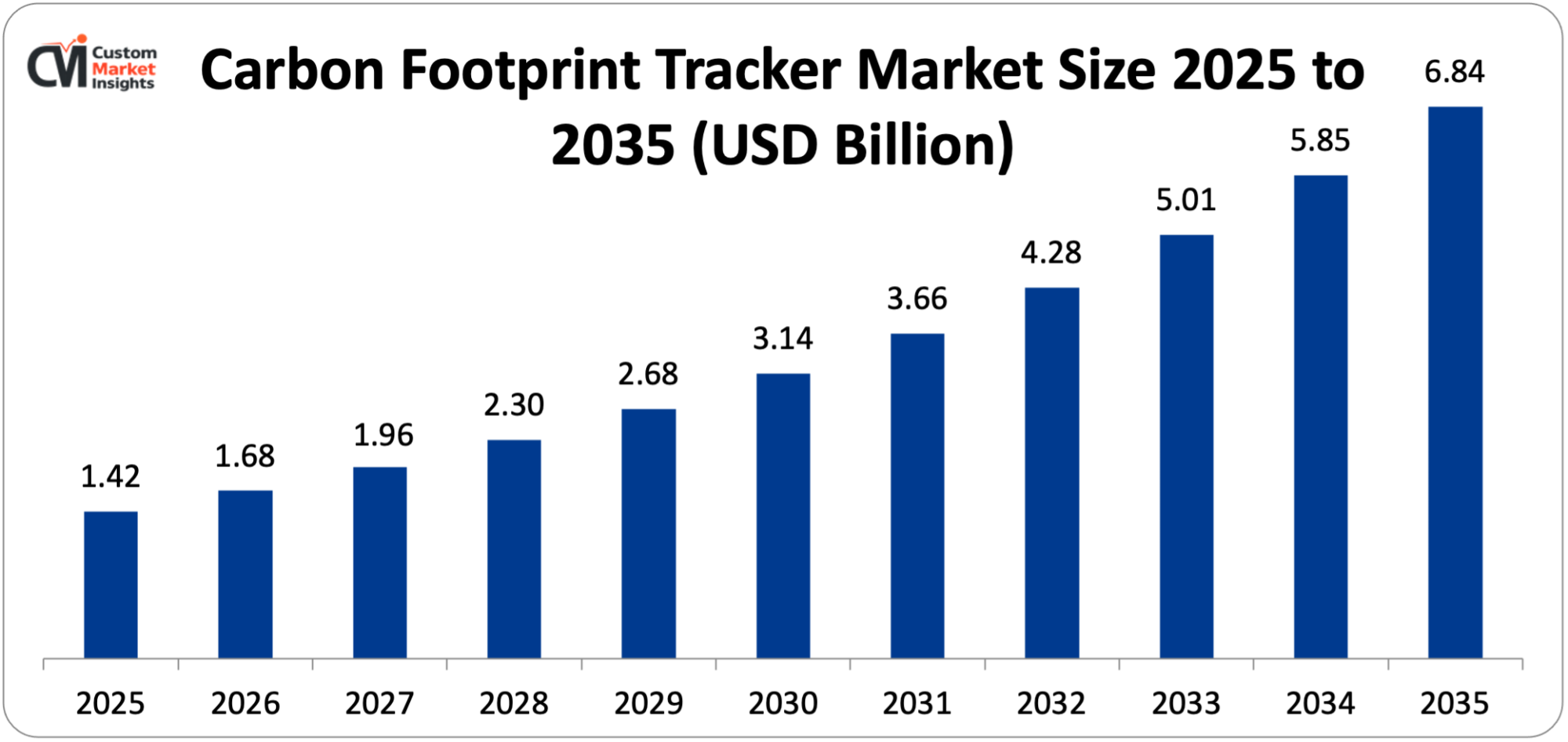
The market size of the global carbon footprint tracker is estimated at USD 1.42 billion in 2025 and it is estimated to grow by USD 1.68 billion to USD 6.84 billion between the years 2026 and 2035 with a CAGR of 15.1%. The rise in the rate of global regulatory requirements that compel companies to disclose and report their greenhouse gas emission, the increasing pressure of investors and stakeholders on corporations to quantify and report their carbon footprint under the environmental, social, and governance frameworks, the gradual increase in the adoption of carbon pricing protocols such as emissions trading schemes and carbon taxes that provide direct financial incentives to quantify and reduce their carbon footprints, and the ongoing development of carbon footprint tracking platform functionalities in automation, information integration, and AI-enhanced emissions reduction recommendations all increase the market growth rate steadily through the forecast period.
Market Highlight
- North America was the leader in the carbon footprint tracker market with a 38% market share in 2025.
- Asia Pacific is projected to be the fastest changing, with a CAGR of 18.4% in the period between 2026 and 2035.
- By type, the software/platform-based segment shared the market share by about 74% in the year 2025.
- Hardware-integrated segments by type are increasing faster (16.8% CAGR) since 2026 to 2035.
- Overall, the cloud based segment led in market share with 68% in 2025 with the cloud based segment also growing at the highest CAGR of 16.2% between 2026 and 2035.
- By end-user, the enterprises’ and corporations’ market share will be the highest at 52% in 2025, with the SMEs segment projected to have the quickest CAGR between the years 2026 and 2035.
- Application: The supply chain and procurement segment generated the highest market share of 34% in 2025, and the energy management segment will have the highest CAGR in the forecasted period of 2026-2035 of 17.8%.
Significant Growth Factors
The Carbon Footprint Tracker Market Trends present significant growth opportunities due to several factors:
- Mandatory Corporate Emissions Disclosure Regulations Creating Structural Market Demand:
The most significant structural factor in driving carbon footprint tracker market demand is the progressive global expansion of mandatory corporate greenhouse gas emissions disclosure requirements, which have been established by securities regulators, as well as by environmental and stock exchange listing regulations, which mandate regulatory compliance requirements that transform the voluntary exercise of sustainability reporting to a legally compulsory and statutory data management role and mandate that professional carbon footprint tracking platforms specifically provide.
The Corporate Sustainability Reporting Directive of the European Union, that will come into force on large public interest entities beginning in January 2024 and phase out to all large companies and finally listed SMEs by 2028, mandates the disclosure of greenhouse gas emissions in Scope 1 (direct emissions), Scope 2 (purchased energy emissions), and Scope 3 (value chain emissions) under the European Sustainability Reporting Standards formulated by the EFRAG that will create a full and audited mandatory reporting of emissions by companies with large populations in This is because the CSRD requires third-party assurance of sustainability reporting, in which limited assurance is required at the outset and reasonable assurance is required in future reporting periods. It raises the data quality standard of their requirements with regard to emissions reporting to be that of auditability, the quality standard of financial reporting, which in turn demands professional carbon footprint tracking platforms that provide the audit trails, transparency in calculations, and data governance documentation on which assurance providers rely.
The climate-related disclosure rule by the U.S. Securities and Exchange Commission. — which was finalized in March 2024 and mandates major Scope 1 and Scope 2 emissions to be disclosed by publicly traded companies with Scope 3 registration obligations — expands the mandatory climate disclosure to the approximately 7,000 SEC-registered public companies, the largest single expansion of corporate reporting of carbon emissions disclosure in the world. Combined with the UK Corporate Sustainability Reporting requirements which match CSRD equivalence, the Streamlined Energy and Carbon Reporting requirements in the UK, which have been compulsory in large UK companies since 2019 but is increasingly applied to more companies, form parallels of mandatory emissions disclosure obligations of companies operating in the UK market. Singapore which is required to report its climate under the SGX listing regulations, the climate-related financial disclosure laws in Australia and the revised Corporate Governance Code in Japan which have shown a trend of promoting mandatory emissions disclosure is an indication of how the world is converging on mandatory climate disclosure.
- Carbon Pricing Mechanisms and Net Zero Commitments Creating Financial Incentives for Precision Measurement:
The increasing avaricious international development of carbon pricing systems, such as the European Union Emissions Trading System, the UK Emissions Trading Scheme, the Cap-and-Trade Program in California, and the national carbon market in China, along with carbon tax systems in more than 40 countries, are generating direct financial incentives to corporate accuracy in measuring emissions beyond the compliance required of regulation but to commercial optimization of the cost of carbon, with every tonne of CO₂ precisely measured and offset yielding direct financial gains at the carbon price in place which give indirect measurable benefits on investment by carbon footprint track The carbon price in the EU ETS which has in the previous years of the scheme traded between EUR 50 and EUR 100 a tonne of CO₂ in the scheme is a direct financial calculation of the cost of the slog of carbon footprint tracking and makes the corporate finance functions analyze the tracker platform investment in the same commercial terms as the other cost reduction technology investments.
The national determined contributions of the Paris Agreement, in which most of the nations of the world have signed to achieve a certain level of greenhouse gas reduction, form the policy environment through which carbon pricing and emissions regulation become increasingly stricter over time, which offers long-term commercial visibility to carbon footprint tracker markets to justify investments in platform development and customer implementation infrastructure by vendors over a time period. Voluntary but commercially binding commitments to emissions measurement Corporate net zero commitments Corporate net zero commitments with more than 5,000 companies worldwide having made net zero commitments through the Science Based Targets initiative as of published data, which means that the net neutral obligation to measure emissions is mandatory, although not legally binding, give rise to the use of carbon footprint trackers without mandatory regulatory requirements. The Corporate Net Zero Standard of the Science Based Targets initiative, which obliges companies to show their ability to measure emissions, establish Scope 1, 2, and 3 targets, and disclose their annual progress, is based on 1.5 degrees Celsius pathways.
What are the Major Advances Changing the Carbon Footprint Tracker Market Today?
- AI-Powered Emissions Analytics and Reduction Pathway Optimization:
The addition of both artificial intelligence and machine learning services to carbon footprint tracking environments, beyond data collection and computation to predictive emissions forecasting, automatic anomaly detection, root cause analysis of emission hotspots, and efficient decarbonization pathway recommendations, is changing carbon footprint trackers from passive data collection and reporting tools to active intelligence systems that generate actionable information that can prompt measurable changes in emissions and create significantly greater business value and competitive advantage when adopted by platforms that have implemented advanced analytics beyond the past data management and reporting services offered by the platform. The classic carbon footprint tracking systems have been mainly preoccupied with data ingestion, factors of emissions, implementation of a methodology of calculation, and report generation, functions that provide regulatory compliance capacity but little operational insight in terms of emissions reduction decision making besides giving the biggest categories of emissions.
Predictive models built into AI-enhanced platforms predict future emissions paths subject to various operational conditions — allowing corporate sustainability teams to simulate the emissions impact of supply chain reconfiguration, energy procurement decisions, fleet electrification and operational efficiency improvement prior to implementation, thus providing the forward-looking emissions intelligence that turns carbon management into history reporting as it becomes opportunity. Machine learning anomaly detection or the detection of unexpected increases in certain emission sources, facilities or nodes in a supply chain that might indicate an inefficient operation process, a data quality problem, or an unforeseen change to operations is offered to provide automated monitoring of emissions that will detect the start of a decline in performance before it is compounded into significant emissions offsets to a reduction target. The ability to extract emissions-relevant information from unstructured documents (such as supplier sustainability reports, utility bills, logistics invoices, and procurement contracts) with the help of natural language processing helps alleviate the manual workload on data collection that is the key operational issue of Scope 3 emissions measurement across complex supply chains. The Net Zero Cloud sold by Salesforce, Microsoft Cloud for Sustainability, and Environmental Intelligence Suite offered by IBM are some of the most prominent enterprise platform applications of AI-enhanced carbon footprint tracking.
- Scope 3 Supply Chain Emissions Measurement Technology Advancement:
Technically mature and commercially scalable solutions to measure Scope 3 supply chain emissions the most complex and information intensive element of corporate greenhouse gas accounting, including purchased goods and services, business travel, employee commuting, upstream transportation, downstream product use, and end-of-life treatment across the full value chain, are solving the largest remaining technical obstacle to full corporate carbon footprint measurement and are the basis of the supply chain decarbonization programs that constitute the largest source of emissions reduction that most corporate organizations have. Scope 3 emissions, historically constituting 70–90% of the total greenhouse gas footprints of a corporate organization as reported by published sustainability research have traditionally been estimated based on spend-based approximation methods, which use the averaged emissions intensity factors against procurement expenditure groups, which is not accurate enough to provide any performance benchmarks to suppliers or permit accurate product-level carbon footprinting or robust science-based target determination.
The shift to the activity-based Scope 3 measurement, where average emission factors are replaced with actual supplier emissions data, product specific life cycle assessment data, and logistics activity data, necessitates data collection infrastructure where corporate procurement systems identify with supplier emissions reporting platforms, product environmental data exchanges, and logistics carbon measurement systems, which are developing as core platform features through specialist Scope 3 platforms such as Watershed, Persefoni, and Greenly. The spread of supplier sustainability data exchange networks such as CDP Supply Chain, the Together for Sustainability initiative in the chemicals market, RMI in its SteelZero and AluminiumZero programs, and industry-specific supplier emissions disclosure programs is increasingly providing primary supplier emissions data that can support the measurement of its activities of Scope 3 without relying on spend-based estimates but increasing the accuracy of the recording of corporate supply chain emissions. The dual materiality of the EU CSRD, the companies must not only evaluate the impacts of climate change on their business but also evaluate the impact of their business on climate through its value chain.
- Real-Time IoT Integration and Automated Emissions Data Collection:
The operational efficiency and quality of data collected by carbon footprint measurements is revolutionizing the operational efficiency and data quality of carbon footprint measurement with the integration of Internet of Things sensor networks, smart meter data, building management system output, industrial process data systems, and fleet telematics into carbon footprint tracking platforms, which allow automated and real-time collection of emissions data about physical operations, not by manual data entry to periodic energy bills and activity logs but by automated data collection systems, thus making comprehensive emissions tracking a labor-intensive task historically and at the same time improving the frequency, granularity, and accuracy of emissions Conventional carbon footprint monitoring has been based on periodic manual data collection such as obtaining monthly or quarterly utility bills, receipts of the purchase of fuels, business travel records, and logs of production activities and entering them manually or uploading them in tracking systems, resulting in data latency of weeks to months, risk of manual entry errors, and limited granularity to real time monitoring of operational emissions.
Carbon tracking platforms that are IoT-integrated will sample continuous data feeds on smart electricity meters, natural gas flow meters, production line energy monitoring, refrigerant leak detection sensors, vehicle GPS and fuel consumption telematics, and building automation systems – provide real-time emissions dashboards that in turn allow the facility managers and sustainability teams real-time visibility of the current rate of emissions and immediate notifications of anomalies that indicate process inefficiency or equipment malfunctions. The fast-growing smart building segment, in which building management systems are beginning to add energy monitoring, HVAC optimization, and occupancy-responsive control generating continuous streams of energy consumption data that can directly be ingested by carbon tracking systems, is establishing an IoT data integration option, which allows automated tracking of Scope 1 and Scope 2 emissions of commercial real estate portfolios without the overhead of manually compiling data to track these metrics. EcoStruxure Resource Advisor platform by Schneider Electric, Siemens Teamcenter Sustainability, and Honeywell Forge Energy Optimization are the examples of major commercial deployments of IoT-built enterprise sustainability platforms that combine real-time operational data with carbon footprint calculation and reporting.
Category Wise Insights
By Type
Why Does Software/Platform-Based Lead the Market?
Carbon footprint trackers based on software and platforms are the largest type by market share with about 74% of total market share in 2025 due to the best known commercial architecture of the carbon footprint tracking market, where cloud-deployed SaaS platforms offering emissions data ingestion, calculation, reporting, and analytics services are used in the vast majority of business, SME, and governmental corporate carbon accounting needs with no hardware purchase and implementation overhead of the IoT-networked alternative. The SaaS carbon management platform model, introduced by other companies such as Watershed, Persefoni, and Greenly as well as the enterprise sustainability modules introduced by Salesforce, Microsoft, and SAP, offers no hardware acquisition, subscription fees with corporate software acquisition inclinations, recurring features with new regulatory demands without customer IT investment, and API connectivity with current enterprise resource planning, energy oversight and procurement solutions that automate information input into enterprise IT environments that already exist in corporate IT environments. Enterprise carbon management solutions market is a wide range of solution sophistication – starting with simple emissions calculation and annual reporting tools serving SMEs and smaller businesses with USD 5,000-USD 50,000/year subscription fees to full scale Scope 1, 2, and 3 management systems serving multinational companies with multi-geographic, multi entity reporting needs with USD 100,000-USD 500,000 /year. The regulatory reporting role – whereby the carbon footprint tracking systems would produce the standardized emissions disclosure reports as mandated by CSRD, SEC climate disclosure, CDP reporting frameworks, and GRI Standards.
By Deployment Mode
Why Does Cloud-Based Deployment Lead the Market?
In the current carbon footprint tracking market, with its advantages of instantaneous deployment with no internal IT infrastructure investment, automatic incorporation of regulatory updates with a changing disclosure regime, and multi-user access allowing sustainability teams across geographies to make contributions to one centralized repository of emissions data, cloud-based deployment refers to the majority mode at around 68% of market share in 2025. The regulatory update feature of the cloud deployment model is especially attractive to the carbon footprint tracking market with the current and swift changes in the nature of the emissions reporting frameworks, carbon footprint reporting standards see reforms in the GHG Protocol, the CSRD ESRS, the SEC climate rule, and the methodology of the Science Based Targets initiative that require changes in the cloud platform.
By End-User
Why Do Enterprises & Corporations Lead the Market?
Enterprises and corporations will be the largest end-user segment with approximations of 52% of total market share in 2025 indicating the combination of the highest regulatory exposure the primary targets of CSRD, SEC climate disclosure and similar mandatory emissions reporting requirements, the largest absolute emissions footprint to generate the greatest carbon pricing financial exposure incentivizing accurate measurement and management investment, and the most complex multi-geography, multi-entity, multi-scope emissions accounting requirements creating commercial demand on professional platform solutions instead of manual spreadsheets. The Fortune 500 and other large multinationals, who represent the most commercially important customers of an enterprise carbon footprint tracker, are moving to platforms with the capability to capture thousands of sources of emissions across hundreds of facilities and subsidiaries in multiple countries, and the choice of which platform is being influenced more and more by the need to integrate with existing ERP, procurement and financial reporting systems as opposed to isolated emissions calculation capability.
By Application
Why Does Supply Chain & Procurement Lead the Market?
Supply chain and procurement is the biggest area of application with a share of some 34% of all market share in 2025, since Scope 3 emissions reflect the prevailing place of supply chain emissions in most corporate greenhouse gas footprints, the majority of which represent 70-90% of total corporate emissions, and the regulatory and commercial demands of measuring supply chain emissions that CSRD value chain reporting requirements, SBTi FLAG and corporate net zero programs impose. Supply chain carbon footprint measurement includes the most commercially complex and data-intensive carbon tracking application one which involves data collection among thousands of tier-1 and tier-2 suppliers, application of product-specific or category-specific emission factors, allocation of multi-product supplier emissions to specific purchased product categories and aggregation of upstream supply chain emissions across hundreds of procurement categories which is the largest-scale professional platform requirement of any carbon tracking application.
The fastest growth at 17.8% CAGR between 2026 and 2035 is in the energy management application, as corporate renewable energy procurement growth needs to track and report energy attribute certificates, power purchase agreements, and renewable electricity consumption directly determining Scope 2 emissions under market-based accounting, real-time IoT integration to achieve continuous energy monitoring making available operational efficiency optimization beyond reporting compliance, and the increasingly complex nature of energy market procurement, including virtual PPAs, corporate renewable energy auction, and 24/7 carbon-free energy matching.
Report Scope
| Feature of the Report | Details |
| Market Size in 2026 | USD 1.68 billion |
| Projected Market Size in 2035 | USD 6.84 billion |
| Market Size in 2025 | USD 1.42 billion |
| CAGR Growth Rate | 15.1% CAGR |
| Base Year | 2025 |
| Forecast Period | 2026-2035 |
| Key Segment | By Type, Deployment Mode, End-User, Application and Region |
| Report Coverage | Revenue Estimation and Forecast, Company Profile, Competitive Landscape, Growth Factors and Recent Trends |
| Regional Scope | North America, Europe, Asia Pacific, Middle East & Africa, and South & Central America |
| Buying Options | Request tailored purchasing options to fulfil your requirements for research. |
Regional Analysis
How Big is the North America Market Size?
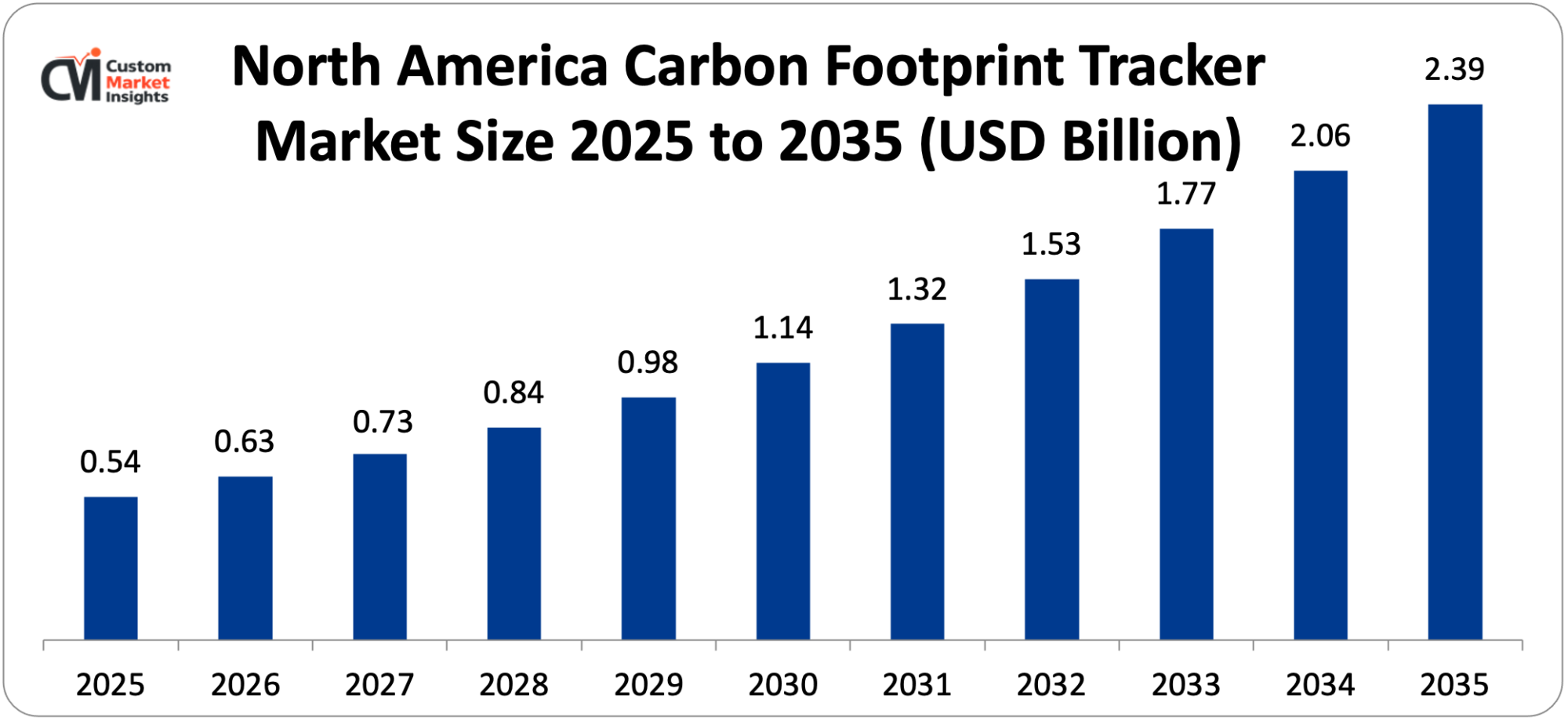
The North America carbon footprint tracker market size is estimated at USD 540 million in 2025 and is projected to reach approximately USD 2.39 billion by 2035, with a CAGR of 15.8% from 2026 to 2035.
Why Did North America Dominate the Market in 2025?
In 2025, the market share in the United States is about 38% of the world market, as the United States is considered the motherland of the largest agglomeration of multinational corporations having voluntary and mandatory reporting of emissions, the most vibrant real-world environment software investment ecosystem with most of the major carbon footprint tracking software vendors headquartered or having major commercial business operations in the United States, the SEC-finalized climate-related disclosure rule establishing mandatory emissions reporting requirements on approximately 7,000 publicly traded companies, the Cap-and-Tr Investment in carbon management software by the U.S. venture capital ecosystem, including Watershed (USD 100 million in Series B funding) and Persefoni (USD 101 million in Series B funding) and several other carbon technology startups (which received significant venture capital investment), has funded the creation of the most technically advanced and commercially competitive carbon footprint tracking platform ecosystem in the world, with U.S. based platforms controlling the high-end enterprise market segment of the market. The federal carbon pricing system in Canada, which involves the imposition of a carbon tax on the combustion of fuels in the various Canadian provinces that lack the same provincial systems, provides direct financial incentives on the measurement of carbon footprint among the corporations in Canada in supporting the overall carbon tracker market leadership in North America.
Why is Europe a Strategically Important Market?
In 2025, the European carbon footprint tracker market is expected to be approximately USD 384 million and by 2035, the market will be approximately USD 1.71 billion with a CAGR of 16.1. Europe is by far the most highly developed carbon footprint tracking regulatory market in the world – because of the compulsory implementation of the CSRD for about 50,000 companies that require the cost of third-party assurances, which compel the quality of emissions data to auditable financial reporting standards, the EU ETS carbon price that offers direct financial incentives to the measurement of emissions accuracy, and the EU Taxonomy Regulation, which mandates the corporate reporting of the share of revenues, capital expenditure and operating expenditure in line with environmentally sustainable economic operations that requires the provision of granular data. Germany and France are the two largest European carbon footprint tracker markets – due to the large corporate base that is subject to CSRD; Germany as an industrial base for carbon pricing via EU ETS, and the presence of large concentrations of major European enterprise sustainability software vendors such as Plan A (Germany) and Sweep and Greenly (France), offering significant venture capital investment and expanding their platform capabilities to serve the growing European regulatory compliance market. The SECR provisions of the UK and TCFD scenario climate reporting in the UK Listing Rules and Companies Act amendments form a holistic mandatory disclosure of carbon emissions regime on UK public companies, large private firms, and asset managers that is independently propelling the adoption of carbon trackers by the enterprise across the UK market, irrespective of the circumstance of EU CSRD applicability.
Why is Asia Pacific the Fastest-Growing Market?
The fastest-growing regional market is the Asia Pacific, with an expected CAGR of 18.4 through 2035, because of the mandatory climate disclosure framework in Japan under the Corporate Governance Code of the Tokyo Stock Exchange mandatory climate disclosure requirements that are also mandatory climate-relevant financial disclosure requirements from 2025 under Australia’s Treasury Laws Amendment (Financial Market Infrastructure and Other Measures) Act and mandatory climate-related financial disclosure requirements from 2026 under the Singapore Stock Exchange mandatory climate reporting policies under the Scope 3 disclosure from 2026, Australia’s Treasury Laws Amendment (Financial Market Infrastructure and Other Measures) Act establishing mandatory climate-related financial disclosure from 2025.
The mandatory disclosure roadmap of the ESG situation of South Korea that requires the listed companies to disclose climate-related information gradually by 2025; the rising interest of the ESG investors in the A-share listed companies in China and the increasing China national carbon market that generates incentives to measure the emissions of the covered industrial enterprises. The expansion of regulatory disclosures in the Asia Pacific region that has seen numerous major economies adopt a wave of mandatory or near-mandatory climate disclosure obligations simultaneously is creating a concentration effect in the adoption of carbon footprint tracking solutions that is driving the region to experience an unprecedented growth rate higher than the global market rate. The carbon tracker market in Japan is also noteworthy as the Japanese corporate level of carbon neutral commitment is very large, and Toyota, Sony, Panasonic, and large Japanese companies have already made carbon neutral pledges that demand carbon neutral emissions measurement infrastructure.
Why is the Middle East & Africa Region an Emerging Market?
The LAMEA region can be shown as a region with increasing market development due to the need to develop the Net Zero 2050 strategic program by the UAE and develop a carbon management software development capability by its sophisticated technology sector alongside the adoption of the international platform and the need by Saudi Arabia for sustainability commitments in its vision 2030 which drives the adoption of ESG reporting by corporations in the country, such as its Johannesburg Stock Exchange integrated reporting requirements and carbon tax developing corporate emissions measurement obligations, and Brazil’s growing sustainable finance market with B3 stock exchange ESG disclosure frameworks encouraging climate reporting among Brazilian listed companies.
Top Players in the Market and Their Offerings
- Salesforce Inc. (Net Zero Cloud)
- Microsoft Corporation (Cloud for Sustainability)
- IBM Corporation (Environmental Intelligence Suite)
- Watershed Technology Inc.
- Persefoni AI Inc.
- Greenly SAS
- Sweep SAS
- Plan A Earth GmbH
- Sphera Solutions Inc.
- Enablon (Wolters Kluwer)
- Benchmark ESG (formerly Cority)
- Others
Key Developments
The market has undergone significant developments as industry participants seek to advance AI-powered emissions analytics, expand Scope 3 supply chain measurement capabilities, and respond to the accelerating global regulatory mandate landscape for corporate climate disclosure.
- In November 2024: Watershed introduced its Supplier Engagement Hub – an integrated supplier emissions data collection and data management system within the Watershed carbon management system – that allows corporate customers to send custom data collection requests to their supplier networks, track the completion of supplier responses, and validate providers.
- In January 2025: Microsoft publicly launches its expanded Cloud for Sustainability platform, including a new AI-based decarbonization insights module powered by Azure OpenAI Service, allowing corporate users to pose queries to their emissions data in natural language and get computer-generated suggestions.
The Carbon Footprint Tracker Market is segmented as follows:
By Type
- Software/Platform-Based (SaaS Carbon Management Platforms, Enterprise ESG Software)
- Hardware-Integrated (IoT Sensor Networks, Smart Meter Integration, Fleet Telematics)
- Other Types (Blockchain-Based Verification, AI-Embedded Analytics Modules)
By Deployment Mode
- Cloud-Based (SaaS, Public Cloud, Hybrid Cloud)
- On-Premise (Enterprise Installation, Private Data Center)
By End-User
- Enterprises & Corporations (Large Multinational, Listed Companies)
- SMEs (Small and Medium Enterprises)
- Government & Public Sector (Municipal Authorities, National Agencies)
- Individual Consumers (Personal Carbon Footprint Apps)
By Application
- Supply Chain & Procurement (Scope 3 Measurement, Supplier Engagement)
- Energy Management (Scope 1 and Scope 2, Renewable Energy Procurement)
- Transportation & Logistics (Fleet Emissions, Business Travel, Freight)
- Manufacturing & Operations (Process Emissions, Industrial Facilities)
- Real Estate & Buildings (Commercial Property Portfolio, Facilities Management)
- Other Applications (Product Carbon Footprint, Employee Engagement)
Regional Coverage:
North America
- U.S.
- Canada
- Mexico
- Rest of North America
Europe
- Germany
- France
- U.K.
- Russia
- Italy
- Spain
- Netherlands
- Rest of Europe
Asia Pacific
- China
- Japan
- India
- New Zealand
- Australia
- South Korea
- Taiwan
- Rest of Asia Pacific
The Middle East & Africa
- Saudi Arabia
- UAE
- Egypt
- Kuwait
- South Africa
- Rest of the Middle East & Africa
Latin America
- Brazil
- Argentina
- Rest of Latin America
Table of Contents
- Chapter 1. Report Introduction
- 1.1. Report Description
- 1.1.1. Purpose of the Report
- 1.1.2. USP & Key Offerings
- 1.2. Key Benefits For Stakeholders
- 1.3. Target Audience
- 1.4. Report Scope
- 1.1. Report Description
- Chapter 2. Market Overview
- 2.1. Report Scope (Segments And Key Players)
- 2.1.1. Carbon Footprint Tracker by Segments
- 2.1.2. Carbon Footprint Tracker by Region
- 2.2. Executive Summary
- 2.2.1. Market Size & Forecast
- 2.2.2. Carbon Footprint Tracker Market Attractiveness Analysis, By Type
- 2.2.3. Carbon Footprint Tracker Market Attractiveness Analysis, By Deployment Mode
- 2.2.4. Carbon Footprint Tracker Market Attractiveness Analysis, By End-User
- 2.2.5. Carbon Footprint Tracker Market Attractiveness Analysis, By Application
- 2.1. Report Scope (Segments And Key Players)
- Chapter 3. Market Dynamics (DRO)
- 3.1. Market Drivers
- 3.1.1. Mandatory Corporate Emissions Disclosure Regulations Creating Structural Market Demand
- 3.1.2. Carbon Pricing Mechanisms and Net Zero Commitments Creating Financial Incentives for Precision Measurement
- 3.2. Market Restraints
- 3.3. Market Opportunities
- 3.5. Pestle Analysis
- 3.6. Porter Forces Analysis
- 3.7. Technology Roadmap
- 3.8. Value Chain Analysis
- 3.9. Government Policy Impact Analysis
- 3.10. Pricing Analysis
- 3.1. Market Drivers
- Chapter 4. Carbon Footprint Tracker Market – By Type
- 4.1. Type Market Overview, By Type Segment
- 4.1.1. Carbon Footprint Tracker Market Revenue Share, By Type, 2025 & 2035
- 4.1.2. Software/Platform-Based (SaaS Carbon Management Platforms, Enterprise ESG Software)
- 4.1.3. Carbon Footprint Tracker Share Forecast, By Region (USD Billion)
- 4.1.4. Comparative Revenue Analysis, By Country, 2025 & 2035
- 4.1.5. Key Market Trends, Growth Factors, & Opportunities
- 4.1.6. Hardware-Integrated (IoT Sensor Networks, Smart Meter Integration, Fleet Telematics)
- 4.1.7. Carbon Footprint Tracker Share Forecast, By Region (USD Billion)
- 4.1.8. Comparative Revenue Analysis, By Country, 2025 & 2035
- 4.1.9. Key Market Trends, Growth Factors, & Opportunities
- 4.1.10. Other Types (Blockchain-Based Verification, AI-Embedded Analytics Modules)
- 4.1.11. Carbon Footprint Tracker Share Forecast, By Region (USD Billion)
- 4.1.12. Comparative Revenue Analysis, By Country, 2025 & 2035
- 4.1.13. Key Market Trends, Growth Factors, & Opportunities
- 4.1. Type Market Overview, By Type Segment
- Chapter 5. Carbon Footprint Tracker Market – By Deployment Mode
- 5.1. Deployment Mode Market Overview, By Deployment Mode Segment
- 5.1.1. Carbon Footprint Tracker Market Revenue Share, By Deployment Mode, 2025 & 2035
- 5.1.2. Cloud-Based (SaaS, Public Cloud, Hybrid Cloud)
- 5.1.3. Carbon Footprint Tracker Share Forecast, By Region (USD Billion)
- 5.1.4. Comparative Revenue Analysis, By Country, 2025 & 2035
- 5.1.5. Key Market Trends, Growth Factors, & Opportunities
- 5.1.6. On-Premise (Enterprise Installation, Private Data Center)
- 5.1.7. Carbon Footprint Tracker Share Forecast, By Region (USD Billion)
- 5.1.8. Comparative Revenue Analysis, By Country, 2025 & 2035
- 5.1.9. Key Market Trends, Growth Factors, & Opportunities
- 5.1. Deployment Mode Market Overview, By Deployment Mode Segment
- Chapter 6. Carbon Footprint Tracker Market – By End-User
- 6.1. End-User Market Overview, By End-User Segment
- 6.1.1. Carbon Footprint Tracker Market Revenue Share, By End-User, 2025 & 2035
- 6.1.2. Enterprises & Corporations (Large Multinational, Listed Companies)
- 6.1.3. Carbon Footprint Tracker Share Forecast, By Region (USD Billion)
- 6.1.4. Comparative Revenue Analysis, By Country, 2025 & 2035
- 6.1.5. Key Market Trends, Growth Factors, & Opportunities
- 6.1.6. SMEs (Small and Medium Enterprises)
- 6.1.7. Carbon Footprint Tracker Share Forecast, By Region (USD Billion)
- 6.1.8. Comparative Revenue Analysis, By Country, 2025 & 2035
- 6.1.9. Key Market Trends, Growth Factors, & Opportunities
- 6.1.10. Government & Public Sector (Municipal Authorities, National Agencies)
- 6.1.11. Carbon Footprint Tracker Share Forecast, By Region (USD Billion)
- 6.1.12. Comparative Revenue Analysis, By Country, 2025 & 2035
- 6.1.13. Key Market Trends, Growth Factors, & Opportunities
- 6.1.14. Individual Consumers (Personal Carbon Footprint Apps)
- 6.1.15. Carbon Footprint Tracker Share Forecast, By Region (USD Billion)
- 6.1.16. Comparative Revenue Analysis, By Country, 2025 & 2035
- 6.1.17. Key Market Trends, Growth Factors, & Opportunities
- 6.1. End-User Market Overview, By End-User Segment
- Chapter 7. Carbon Footprint Tracker Market – By Application
- 7.1. Application Market Overview, By Application Segment
- 7.1.1. Carbon Footprint Tracker Market Revenue Share, By Application, 2025 & 2035
- 7.1.2. Supply Chain & Procurement (Scope 3 Measurement, Supplier Engagement)
- 7.1.3. Carbon Footprint Tracker Share Forecast, By Region (USD Billion)
- 7.1.4. Comparative Revenue Analysis, By Country, 2025 & 2035
- 7.1.5. Key Market Trends, Growth Factors, & Opportunities
- 7.1.6. Energy Management (Scope 1 and Scope 2, Renewable Energy Procurement)
- 7.1.7. Carbon Footprint Tracker Share Forecast, By Region (USD Billion)
- 7.1.8. Comparative Revenue Analysis, By Country, 2025 & 2035
- 7.1.9. Key Market Trends, Growth Factors, & Opportunities
- 7.1.10. Transportation & Logistics (Fleet Emissions, Business Travel, Freight)
- 7.1.11. Carbon Footprint Tracker Share Forecast, By Region (USD Billion)
- 7.1.12. Comparative Revenue Analysis, By Country, 2025 & 2035
- 7.1.13. Key Market Trends, Growth Factors, & Opportunities
- 7.1.14. Manufacturing & Operations (Process Emissions, Industrial Facilities)
- 7.1.15. Carbon Footprint Tracker Share Forecast, By Region (USD Billion)
- 7.1.16. Comparative Revenue Analysis, By Country, 2025 & 2035
- 7.1.17. Key Market Trends, Growth Factors, & Opportunities
- 7.1.18. Real Estate & Buildings (Commercial Property Portfolio, Facilities Management)
- 7.1.19. Carbon Footprint Tracker Share Forecast, By Region (USD Billion)
- 7.1.20. Comparative Revenue Analysis, By Country, 2025 & 2035
- 7.1.21. Key Market Trends, Growth Factors, & Opportunities
- 7.1.22. Other Applications (Product Carbon Footprint, Employee Engagement)
- 7.1.23. Carbon Footprint Tracker Share Forecast, By Region (USD Billion)
- 7.1.24. Comparative Revenue Analysis, By Country, 2025 & 2035
- 7.1.25. Key Market Trends, Growth Factors, & Opportunities
- 7.1. Application Market Overview, By Application Segment
- Chapter 8. Carbon Footprint Tracker Market – Regional Analysis
- 8.1. Carbon Footprint Tracker Market Overview, By Region Segment
- 8.1.1. Global Carbon Footprint Tracker Market Revenue Share, By Region, 2025 & 2035
- 8.1.2. Global Carbon Footprint Tracker Market Revenue, By Region, 2026 – 2035 (USD Billion)
- 8.1.3. Global Carbon Footprint Tracker Market Revenue, By Type, 2026 – 2035
- 8.1.4. Global Carbon Footprint Tracker Market Revenue, By Deployment Mode, 2026 – 2035
- 8.1.5. Global Carbon Footprint Tracker Market Revenue, By End-User, 2026 – 2035
- 8.1.6. Global Carbon Footprint Tracker Market Revenue, By Application, 2026 – 2035
- 8.2. North America
- 8.2.1. North America Carbon Footprint Tracker Market Revenue, By Country, 2026 – 2035 (USD Billion)
- 8.2.2. North America Carbon Footprint Tracker Market Revenue, By Type, 2026 – 2035
- 8.2.3. North America Carbon Footprint Tracker Market Revenue, By Deployment Mode, 2026 – 2035
- 8.2.4. North America Carbon Footprint Tracker Market Revenue, By End-User, 2026 – 2035
- 8.2.5. North America Carbon Footprint Tracker Market Revenue, By Application, 2026 – 2035
- 8.2.6. U.S. Carbon Footprint Tracker Market Revenue, 2026 – 2035 (USD Billion)
- 8.2.7. Canada Carbon Footprint Tracker Market Revenue, 2026 – 2035 (USD Billion)
- 8.2.8. Mexico Carbon Footprint Tracker Market Revenue, 2026 – 2035 (USD Billion)
- 8.2.9. Rest of North America Carbon Footprint Tracker Market Revenue, 2026 – 2035 (USD Billion)
- 8.3. Europe
- 8.3.1. Europe Carbon Footprint Tracker Market Revenue, By Country, 2026 – 2035 (USD Billion)
- 8.3.2. Europe Carbon Footprint Tracker Market Revenue, By Type, 2026 – 2035
- 8.3.3. Europe Carbon Footprint Tracker Market Revenue, By Deployment Mode, 2026 – 2035
- 8.3.4. Europe Carbon Footprint Tracker Market Revenue, By End-User, 2026 – 2035
- 8.3.5. Europe Carbon Footprint Tracker Market Revenue, By Application, 2026 – 2035
- 8.3.6. Germany Carbon Footprint Tracker Market Revenue, 2026 – 2035 (USD Billion)
- 8.3.7. France Carbon Footprint Tracker Market Revenue, 2026 – 2035 (USD Billion)
- 8.3.8. U.K. Carbon Footprint Tracker Market Revenue, 2026 – 2035 (USD Billion)
- 8.3.9. Russia Carbon Footprint Tracker Market Revenue, 2026 – 2035 (USD Billion)
- 8.3.10. Italy Carbon Footprint Tracker Market Revenue, 2026 – 2035 (USD Billion)
- 8.3.11. Spain Carbon Footprint Tracker Market Revenue, 2026 – 2035 (USD Billion)
- 8.3.12. Netherlands Carbon Footprint Tracker Market Revenue, 2026 – 2035 (USD Billion)
- 8.3.13. Rest of Europe Carbon Footprint Tracker Market Revenue, 2026 – 2035 (USD Billion)
- 8.4. Asia Pacific
- 8.4.1. Asia Pacific Carbon Footprint Tracker Market Revenue, By Country, 2026 – 2035 (USD Billion)
- 8.4.2. Asia Pacific Carbon Footprint Tracker Market Revenue, By Type, 2026 – 2035
- 8.4.3. Asia Pacific Carbon Footprint Tracker Market Revenue, By Deployment Mode, 2026 – 2035
- 8.4.4. Asia Pacific Carbon Footprint Tracker Market Revenue, By End-User, 2026 – 2035
- 8.4.5. Asia Pacific Carbon Footprint Tracker Market Revenue, By Application, 2026 – 2035
- 8.4.6. China Carbon Footprint Tracker Market Revenue, 2026 – 2035 (USD Billion)
- 8.4.7. Japan Carbon Footprint Tracker Market Revenue, 2026 – 2035 (USD Billion)
- 8.4.8. India Carbon Footprint Tracker Market Revenue, 2026 – 2035 (USD Billion)
- 8.4.9. New Zealand Carbon Footprint Tracker Market Revenue, 2026 – 2035 (USD Billion)
- 8.4.10. Australia Carbon Footprint Tracker Market Revenue, 2026 – 2035 (USD Billion)
- 8.4.11. South Korea Carbon Footprint Tracker Market Revenue, 2026 – 2035 (USD Billion)
- 8.4.12. Taiwan Carbon Footprint Tracker Market Revenue, 2026 – 2035 (USD Billion)
- 8.4.13. Rest of Asia Pacific Carbon Footprint Tracker Market Revenue, 2026 – 2035 (USD Billion)
- 8.5. The Middle-East and Africa
- 8.5.1. The Middle-East and Africa Carbon Footprint Tracker Market Revenue, By Country, 2026 – 2035 (USD Billion)
- 8.5.2. The Middle-East and Africa Carbon Footprint Tracker Market Revenue, By Type, 2026 – 2035
- 8.5.3. The Middle-East and Africa Carbon Footprint Tracker Market Revenue, By Deployment Mode, 2026 – 2035
- 8.5.4. The Middle-East and Africa Carbon Footprint Tracker Market Revenue, By End-User, 2026 – 2035
- 8.5.5. The Middle-East and Africa Carbon Footprint Tracker Market Revenue, By Application, 2026 – 2035
- 8.5.6. Saudi Arabia Carbon Footprint Tracker Market Revenue, 2026 – 2035 (USD Billion)
- 8.5.7. UAE Carbon Footprint Tracker Market Revenue, 2026 – 2035 (USD Billion)
- 8.5.8. Egypt Carbon Footprint Tracker Market Revenue, 2026 – 2035 (USD Billion)
- 8.5.9. Kuwait Carbon Footprint Tracker Market Revenue, 2026 – 2035 (USD Billion)
- 8.5.10. South Africa Carbon Footprint Tracker Market Revenue, 2026 – 2035 (USD Billion)
- 8.5.11. Rest of the Middle East & Africa Carbon Footprint Tracker Market Revenue, 2026 – 2035 (USD Billion)
- 8.6. Latin America
- 8.6.1. Latin America Carbon Footprint Tracker Market Revenue, By Country, 2026 – 2035 (USD Billion)
- 8.6.2. Latin America Carbon Footprint Tracker Market Revenue, By Type, 2026 – 2035
- 8.6.3. Latin America Carbon Footprint Tracker Market Revenue, By Deployment Mode, 2026 – 2035
- 8.6.4. Latin America Carbon Footprint Tracker Market Revenue, By End-User, 2026 – 2035
- 8.6.5. Latin America Carbon Footprint Tracker Market Revenue, By Application, 2026 – 2035
- 8.6.6. Brazil Carbon Footprint Tracker Market Revenue, 2026 – 2035 (USD Billion)
- 8.6.7. Argentina Carbon Footprint Tracker Market Revenue, 2026 – 2035 (USD Billion)
- 8.6.8. Rest of Latin America Carbon Footprint Tracker Market Revenue, 2026 – 2035 (USD Billion)
- 8.1. Carbon Footprint Tracker Market Overview, By Region Segment
- Chapter 9. Competitive Landscape
- 9.1. Company Market Share Analysis – 2025
- 9.1.1. Global Carbon Footprint Tracker Market: Company Market Share, 2025
- 9.2. Global Carbon Footprint Tracker Market Company Market Share, 2024
- 9.1. Company Market Share Analysis – 2025
- Chapter 10. Company Profiles
- 10.1. Salesforce Inc. (Net Zero Cloud)
- 10.1.1. Company Overview
- 10.1.2. Key Executives
- 10.1.3. Product Portfolio
- 10.1.4. Financial Overview
- 10.1.5. Operating Business Segments
- 10.1.6. Business Performance
- 10.1.7. Recent Developments
- 10.2. Microsoft Corporation (Cloud for Sustainability)
- 10.3. IBM Corporation (Environmental Intelligence Suite)
- 10.4. Watershed Technology Inc.
- 10.5. Persefoni AI Inc.
- 10.6. Greenly SAS
- 10.7. Sweep SAS
- 10.8. Plan A Earth GmbH
- 10.9. Sphera Solutions Inc.
- 10.10. Enablon (Wolters Kluwer)
- 10.11. Benchmark ESG (formerly Cority)
- 10.12. Others.
- 10.1. Salesforce Inc. (Net Zero Cloud)
- Chapter 11. Research Methodology
- 11.1. Research Methodology
- 11.2. Secondary Research
- 11.3. Primary Research
- 11.3.1. Analyst Tools and Models
- 11.4. Research Limitations
- 11.5. Assumptions
- 11.6. Insights From Primary Respondents
- 11.7. Why Custom Market Insights
- Chapter 12. Standard Report Commercials & Add-Ons
- 12.1. Customization Options
- 12.2. Subscription Module For Market Research Reports
- 12.3. Client Testimonials
List Of Figures
Figures No 1 to 33
List Of Tables
Tables No 1 to 51
Prominent Player
- Salesforce Inc. (Net Zero Cloud)
- Microsoft Corporation (Cloud for Sustainability)
- IBM Corporation (Environmental Intelligence Suite)
- Watershed Technology Inc.
- Persefoni AI Inc.
- Greenly SAS
- Sweep SAS
- Plan A Earth GmbH
- Sphera Solutions Inc.
- Enablon (Wolters Kluwer)
- Benchmark ESG (formerly Cority)
- Others
FAQs
The key players in the market are Salesforce Inc. (Net Zero Cloud), Microsoft Corporation (Cloud for Sustainability), IBM Corporation (Environmental Intelligence Suite), Watershed Technology Inc., Persefoni AI Inc., Greenly SAS, Sweep SAS, Plan A Earth GmbH, Sphera Solutions Inc., Enablon (Wolters Kluwer), Benchmark ESG (formerly Cority), Others.
The most significant consequence driver of the market demand of carbon footprint trackers is government regulations, which work by way of obligatory disclosure provisions, carbon pricing, procurement, and financial regulation such that there is a compliance obligation, financial incentive, and market infrastructure under which corporate carbon footprint tracking investment choices are formulated. The most significant single regulatory demand driver, the CSRD, the single most comprehensive mandatory corporate sustainability reporting regulation globally, by its own roll-out to some 50,000 businesses, the third-party assurance qualification criteria and the doubled materiality threshold produce a multi-year enterprise platform adoption wave across the European corporate markets which is further swamped by a wave of value chain disclosure requirements that cascades to millions of global supplier SMEs. The GHG Protocol Corporate Accounting and Reporting Standard, which is upheld by the World Resources Institute and WBCSD, is the methodological basis that is cited in almost all mandatory and voluntary corporate emissions disclosure models around the world, and whose scope 1, 2, and 3 boundary definitions, calculation procedures, and data quality pyramid form the technical specification criteria that carbon footprint tracking tools must comply with to create regulatory-conformant emissions inventories. Carbon pricing laws: The EU ETS, UK ETS, California Cap-and-Trade, and China ETS provide financial incentives to the precision of emissions measurement beyond regulatory compliance, and in each case, the saving is made directly in financial terms at the price that applies to the carbon price, which makes it possible to calculate a finance function analysis of the balance sheet that justifies the purchase of the platform. The IFRS S2 Climate-related Disclosures standard by the International Sustainability Standards Board, which is relied upon to impose the climate disclosure requirements in Australia, Singapore, the UK, and a number of other jurisdictions.
The range of prices of carbon footprint trackers is large due to the level of sophistication of the platform, the size of the organization, and the depth of features. Personal carbon footprint tracking applications, such as Joro, Klima, and other personal carbon calculator apps are offered at zero to USD 10 per month to the individual consumer market being targeted with the basic estimate of their lifestyle carbon emissions but with a low market potential in terms of revenue compared to the enterprise sector. Carbon management platforms targeting SMEs, such as the SME tier with Greenly, the starter plans with Plan A, or the SME offering with Sweep are priced around USD 2,000 – USD 20,000/year, which includes automated carbon emissions calculation, the starter plans with Plan A, or the SME offering with Sweep, and an estimation of Scope 3 in line with the needs of a small organization entering the carbon tracking process for the first time due to customer demand or regulatory pressure. Mid-market enterprise platforms, which serve companies with USD 100 million to USD 1 billion in revenue with multiple facilities and jurisdictions, are priced at USD 30,000-USD 150,000/year, hence offering full multi-scope emission management, regulatory report generation, and integration with large-scale ERP systems. Carbon management platforms based on large enterprises Large enterprises with thousands of sources of emissions, hundreds of subsidiaries, and complex multi-regulatory disclosure environments, with the highest price being based on the sophisticated data model of the platform, the breadth of its regulatory compliance library, the professional implementation support of its services, and the third-party assurance documentation capability. The overall cost of ownership of enterprise carbon footprint tracking includes platform license, implementation consulting, system integration, employee training, and continuing carbon accounting support.
According to the current analysis, the market is expected to expand to around USD 6.84 billion by 2035, as the progressive global shift to mandatory corporate climate disclosure with CSRD, SEC, Australian, Singaporean, and Japanese requirements covering the majority of large and listed corporations in the major economies of the world by the beginning of the 2030s forces a progressive change in small and medium SMEs needing to adopt the SME market, and the voluntary carbon market development creates carbon credit procurement and retirement tracking value that goes beyond regulatory compliance to overall carbon management of footprint trackers from compliance tools to strategic decarbonization intelligence platforms that deliver financial value beyond regulatory compliance and justify expanded platform investment, IoT integration enabling automated real-time emissions monitoring at industrial scale as sensor network costs decline and smart building and factory infrastructure proliferates, and the voluntary carbon market’s growth creating carbon credit procurement and retirement tracking demand that extends platform utility beyond operational emissions measurement to comprehensive carbon portfolio management, at a CAGR of 15.1% from 2026 to 2035.
The highest revenue share is forecasted to belong to North America, which will control about 38% of the global market share during the forecast period, with the United States being the home to the largest grouping of multinational corporate headquarters to invest in enterprise sustainability software, Watershed and Persefoni, and a host of other additional U.S.-based software platforms attracting hundreds of millions of venture capital to support ongoing platform innovation; the adoption of the SEC climate disclosure rule creating a concentrated wave of adoption among the 7,000-plus registered corporations producing large-scale disclosure obligations; and the U.S. corporate commitment to Science Based Targets—representing the world’s largest national aggregate of SBTi corporate commitments—creating widespread voluntary emissions measurement obligations independent of mandatory regulatory requirements.
Asia Pacific is estimated to achieve the highest CAGR of 18.4% over the forecast period due to the TSE Prime Market Corporate Governance Code in Japan being very encouraging of TCFD-appropriate disclosure by around 1,800 listed companies; the mandatory climate-related financial disclosure legislation in Australia being strongly enforced, creating measurement needs in additional industrial sectors; and the carbon footprint tracker market in China being estimated to grow to approximately USD 98 million in 2025 with a forecasted CAGR of 19.8% as domestic calibration to Chinese carbon accounting standards and national carbon market requirements develop alongside international platform adoption.
The Global Carbon Footprint Tracker Market is estimated to undergo a significant growth because of the Corporate Sustainability Reporting Directive administered by the EU in which most of the 50,000 Cycle companies with third-party assurance requirements have elevated the quality of emissions data to auditable financial report standards, the finalized SEC climate-related disclosure rule mandating 7,000 U.S. public companies to registration and registering their companies under the SGX listing criteria requiring them to disclose the quality of their emissions data to auditable financial reporting standards, the Science Based Targets initiative reporting over 5,000 global corporate net zero commitments requiring verified emissions measurement as the foundational prerequisite for target-setting and progress tracking, Scope 3 supply chain emissions representing 70–90% of most corporate greenhouse gas footprints creating the largest and most technically demanding carbon tracking application driving professional platform adoption over manual approaches, Watershed’s Supplier Engagement Hub demonstrating 40–65% primary data coverage in Category 1 Scope 3 emissions achievable within a single annual collection cycle validating the commercial case for dedicated supply chain emissions platform investment, and the EU ETS carbon price trading in the EUR 50–EUR 100 per tonne range creating direct financial return on investment calculations for corporate emissions precision measurement that enable finance function business case approval for carbon tracker platform procurement.