
Collation Shrink Films Market Size, Trends and Insights By Product Type (Printed Films, Unprinted Films, Perforated Films, High-Clarity Films), By Material Type (PE (Polyethylene), PP (Polypropylene), POF (Polyolefin), Sustainable / Recycled Films), By End-Use Industry (Food & Beverages, Consumer Goods, Healthcare, Logistics, Retail & E-commerce), By Packaging Function (Product Protection, Tamper Evidence, Moisture Resistance, Branding Enhancement), By Packaging Technology (Manual Systems, Semi-Automatic Systems, Fully Automatic Systems), and By Region - Global Industry Overview, Statistical Data, Competitive Analysis, Share, Outlook, and Forecast 2026 – 2035
Report Snapshot
| Study Period: | 2026-2035 |
| Fastest Growing Market: | Asia Pacific |
| Largest Market: | Asia Pacific |
Major Players
- Amcor plc
- Berry Global Group, Inc.
- Sealed Air Corporation
- Dow Inc.
- Others
Reports Description
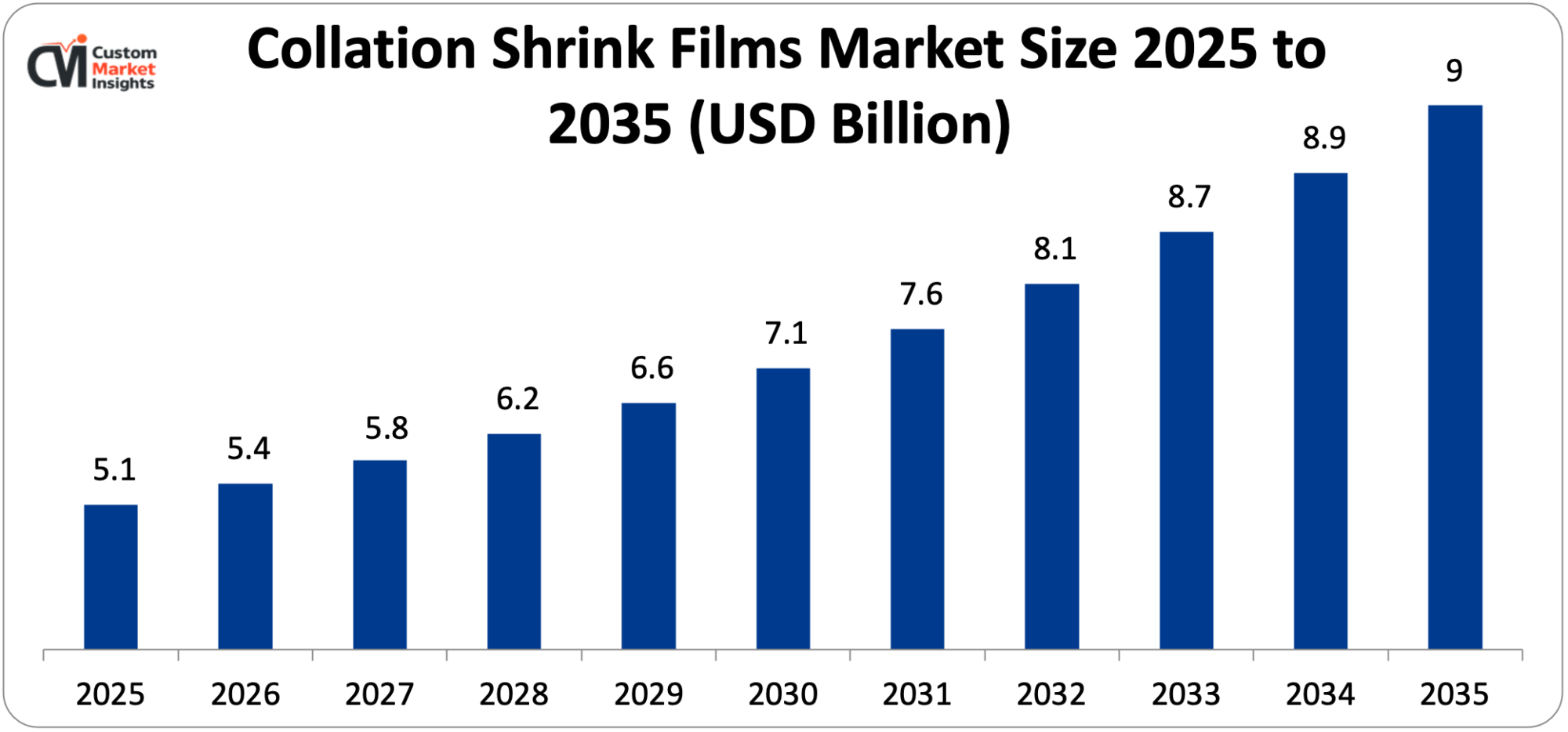
The Collation Shrink Films Market of the world is estimated to be around USD 5.4 billion in 2026 and is projected to be in 2026, with a CAGR of 7% at a forecast period of 2026-2035. The main market growth driver is increasing demand for efficient multipack bundling solutions in the food and beverage industry especially in bottled water, fizzy drinks, dairy products and packaged foods.
The growing focus on the safety of goods, balance of loading, and the affordability of transportation packages is further accelerating the adoption. Also, emerging trends in the market include high growth rates of structured retail and e-commerce systems and the increasing popularity of lightweight, high-clarity, and recyclable packaging materials, which is also driving market momentum. The development of high performance polyethylene films, innovation in shrink technology and introduction of automated systems with high speed packaging lines are also playing a significant role in terms of overall growth of the collation shrink films market.
Market Highlight
- By Asia Pacific: It is projected that the Collation Shrink Films Market will be dominated by Asia Pacific with a market share of 41% in the year 2025, as a result of the fast pace of beverage production, the increase in the number of retail outlets, and the volume of demand for multipack packaging solutions.
- By North America: Is expected to experience a CAGR of 7.3% throughout the forecast period 2026-2035 due to the use of advanced packaging mechanisms and the usage of more and more recyclable shrink films.
- According to Product Type: The segment with the largest market share of 42.5% in 2025 was the printed collation shrink films segment because of the high demand for beverage and consumer goods multipacks with improved branding and shelf visibility.
- By Material Type: The polyethylene (PE) had 40.65% of market share in 2025 due to its affordability, strength, and excellent performance of shrinkage whereas sustainable and recycled films are projected to grow rapidly within the forecast period.
- By End-Use Industry: Food and beverages industry would experience the highest share of 55.5% in the year 2025 due to high consumption of bottled beverages and packed food products and the healthcare and pharmaceuticals industry will experience the highest CAGR of between 2026 and 2035 because of the increasing demands of secure and tamper-evident bundling.
- According to Packaging Technology: Fully automatic shrink wrapping systems in the market share were 46.8% in 2025 due to efficiency, scalability and the ability to fit into high-speed 47 percent market share of 2025 in comparison with the alternatives.
Significant Growth Factors
The Collation Shrink Films Market continues to record a consistent growth in the market owing to the growing need for efficient multipack bundling, supplementary product security and eco-packaging technologies within the food and beverage, consumer products and healthcare sectors.
- The Currently Rising Demand of Multipack Beverage and FMCG Packaging: An increased usage of bottled water, soft drinks, dairy products, and home cleaning products is largely contributing to the use of collation shrink films to multipack bundle. The growth of supermarkets, hypermarkets, and online shopping in Asia Pacific, North America, and Europe has expanded the demand for durable, high-clarity, and tamper evident secondary container solutions. The adoption is further increasing due to bulk purchasing tools and promotional packaging plans particularly in the high speed automated packaging system. Berry global, in May 2024, indicated the development of manufacturing capacity of high-performance shrink bundling film in North America to meet the growing demand of beverage multipacks, which fuels the high growth expectations of the market.
- The Company Must Focus on Switching to the Use of Sustainable and Recyclable Shrink Film Solutions:Sustainability continues to be a leader in terms of growth driver, since governments and brand owners focus on carbon cutoffs and the concept of the circular economy. The mono-material polyethylene (PE) shrink film manufacturers are currently expanding and adding post-consumer recycled (PCR) material to improve recyclability. Light weighting activities are also contributing to the minimization of the total plastic consumption without affecting the load stability and strength. In October 2023, Amcor introduced a recyclable collation shrink film system targeted at beverage multipacks that will minimise the use of virgin plastic but maintain the high levels of clarity and performance. It is hoped that such innovations will enhance the switch to an environmentally responsible shrink packaging format in the future.
The Major Innovations that are Transforming the Collation Shrink Films Market of the Modern World.
- High-Speed Shrink Bundling Systems, Automation: Shrink film packaging lines are also carried out in the automation system with improved speed, accuracy in sealing and minimum energy use. The growth of advanced servo-controlled systems, smart heat tunnels and instantaneous monitoring systems is assisting manufacturers in enhancing the throughput and reducing the film waste, in addition to the time wasted on operations. The innovations play an important role particularly in high volume production of beverages and FMCG multipacks. KHS Group has also launched a new high-speed bundled shrinker in March 2024 that is designed to maximise the use of energy and help lightweight polyethylene-based film used in beverage multipacks to optimize efficiency in high-volume production facilities.
- Current Strategies and Growth: The company has 500 buses presently and more are bound to be introduced in the next few years. Manufacturers are raising extrusion levels to meet the growing demand in the world, and more advanced lines of shrink films are being constructed. The resiliency of the supply chains is being improved by the capacity additions, which are also supporting the switching to the recyclable and downgauged solutions using the film. In later July 2023, the capacity of Berry Global to produce more polyethylene shrink film in Europe was announced to satisfy the growing demand for sustainable collation shrink films in beverages and retail multipacks.
- Innovation of high-performance and green films will be made using sustainable techniques: Performance standards of collation shrink films are being changed by the improvements made in the mono-material recyclable films, downgauged structures and high strength formulations. In an attempt to build a brand name, businesses are endeavoring to reduce material usage without reduced stability and clarity of loads. In October 2023, Amcor introduced a shrink film product that is recyclable and has been designed to be enclosed with beverage multipacks and will reduce the usage of virgin plastic and nevertheless achieve high performance in terms of bundling and transparency.
Category Wise Insights
By Type
And Why Are Printed Films of the Market?
The market of Collation Shrink Films in 2025 has the largest share occupied by Printed Films. Their supremacy is mainly due to the rising significance of branding, product differentiation, and promotional packaging in the food beverage, and consumer goods industries. Increasingly manufacturers are replacing the secondary labels with printed shrink films to print logos, nutritional information, promotional graphics, and barcodes on multipack bundles, which saves the cost incurred in secondary labeling and also saves money on the cost of the entire packaging.
The growth of the organized retail chain and supermarket distribution networks has only enhanced the use of the printed films further. Multi-pack packaging which is visually appealing plays a great role in decision making among consumers in a highly competitive retail environment. Printing technologies like flexographic and rotogravure printing are of high quality and thus improve the vibrancy of the colors, durability, and the ability not to smudge during storage and transportation.
In the meantime, high clarity movies will experience rapid growth in the future between 2026 and 2035 as more consumers will be in need of transparent packaging where they can see clearly the content of the bundle. Perforated films also are making inroads into selected applications that need ventilation and moisture control.
By Material Type
The Preference of PE and POF Materials?
Polyethylene (PE) will be the most popular material in 2025 because the material is flexible, durable, economical, and has good shrinkage characteristics. PE-based collation shrink films are widely utilized in beverage multipacks and industrial goods bundling where they offer great stability and puncture resistance of loads in transport and handling. Another strength that enhances their market strength is their resistance to the changing environmental factors.
Polyolefin (POF) films are becoming one of the fastest expanding sections of materials, particularly in the food and consumer goods wrappings. POF has high levels of clarity and balanced shrinkage, good sealing performance and is compatible with high-speed automated packaging lines. These characteristics render it exceptionally applicable in the premium retail packaging applications where both looks and functionality hold equal roles.
The lowest growth is expected to be recorded by sustainable and recycled films during the forecast period. Growing environmental policies, efforts to reduce plastic waste, and a growing need among consumers to use environmentally friendly packaging are driving manufacturers towards a more recyclable mono-material format and the use of post-consumer recycled (PCR) shrink films in order to move towards circular economy goals.
By End-Use Industry
Why is Food and Beverages Industry conquering the Market?
The Food and Beverages market is the largest to consume the Collated Shrink Films market in the year 2025. The increase is nurtured by the increasing global demand for packaged food, bottled drinks and multipacks of bulk retail. Shrink films offer safe packaging, defense against dust and water, and enhanced stability of loads, which are important in logistics and warehouses in supply chains.
Manufacturers of beverages widely utilize collation shrink wraps in wrapping water bottles, carbonated beverages, and juices as well as milk products. Demand in this segment has also been enhanced by the growing popularity of the warehouse retail format and the trend of bulk purchasing. Also, large food processing plants are adopting automated shrink-wrapping systems to package their products faster and minimize labor requirements.
The health and pharmaceutical industries are also set to register a consistent growth up to the year 2035. Shrink films offer secondary packaging that is tamper-evident and contamination-resistant to the medical devices and pharmaceutical products, providing the safety of products and guaranteeing the conformity to rules.
By Packaging Function
Why is the Product Protection the Critical Growth Engine?
Demand of collation shrink films is mainly caused by product protection which is the leading role of the films. In these films, several units are tightly packed and are not allowed to move, break, or be damaged during transportation and warehousing. They are also resistant to dust, moisture and slight mechanical effects, thus producing products that are received by retailers in the best condition possible.
Another important role that leads to growth in the market is tamper evidence. The visibility of tears or any other type of damage in the shrink film means that there is a possibility of interference with the product, which is better to increase consumer confidence and safety. This is very essential especially in food, beverage and pharmaceutical applications where the standards of safety are high.
Improvement in branding is also important in shaping purchasing behavior. High-gloss and printed shrink films enhance the presentation and visibility of products on the retail shelves, and this value addition is beneficial to the brand positioning activities in competitive markets.
By Packaging Technology
Why then are Fully Automatic Systems Ruling the Market?
We believe that Fully Automatic Systems will take over the market in 2025 because of their great efficiency, scalability and their ability to cope with high production volume lines. These systems allow high package speeds, a uniform level of sealing quality, and minimum material waste, thus being suitable when dealing with large beverage producers and the FMCG firms working on a large scale.
Robots can make manufacturers less dependent on labor as they can cut the cost of labor, decrease downtime, and build digital monitoring devices to control the production process better. With corporations now concentrating on operational productivity and cost reduction, fully automated shrink-wrapping lines are becoming the new preference in both developed and emerging markets.
Semi-automatic systems are still utilized by small and medium sized businesses since they provide flexibility and less capital investment. The manual systems are still applicable in low volume/custom packaging tasks and also in areas where automation has yet to be fully practiced.
Report Scope
| Feature of the Report | Details |
| Market Size in 2026 | USD 5.4 billion |
| Projected Market Size in 2035 | USD 9 billion |
| Market Size in 2025 | USD 5.1 billion |
| CAGR Growth Rate | 7% CAGR |
| Base Year | 2025 |
| Forecast Period | 2026-2035 |
| Key Segment | By Product Type, Material Type, End-Use Industry, Packaging Function, Packaging Technology and Region |
| Report Coverage | Revenue Estimation and Forecast, Company Profile, Competitive Landscape, Growth Factors and Recent Trends |
| Regional Scope | North America, Europe, Asia Pacific, Middle East & Africa, and South & Central America |
| Buying Options | Request tailored purchasing options to fulfil your requirements for research. |
Regional Analysis
The Asia Pacific Market Size: What is it?
The region is the fastest-growing, largest market in the world with good support of the rapid industrialization, increasing food processing capacity, and robust growth of the organized retail networks.
Demand is significantly being driven by the growing intake of packaged food, bottled drinks and multiple pack formats. There is also a positive long-term growth prospect of the region owing to better logistics infrastructure and increased investments in automated packaging systems.
Why in 2025 did Asia Pacific Take Over the Market?
In 2025, the Asia-Pacific had almost 58 percent of the world market share, which was mainly fueled by the high rate of urbanization, increase in disposable incomes, and the middle-class population. The change in retail format whereby supermarkets and hypermarkets have taken over has fueled the need to have packaged solutions like collation shrink films to package beverages, dairy, and processed food products.
The consumption of packaged food and beverages is growing very well in countries like China, India, Japan, and South Korea. The growth of cold chain logistics and warehousing systems has also contributed to the increased demand for secondary packaging that is durable and moisture resistant. Shrink films allow the stability of products during the transportation of the long distance and export.
In addition, efficiency and cost savings as a result of rapidly implemented fully automated shrink-wrapping systems in large manufacturing facilities are enhancing the leading position of Asia Pacific in the market during the forecast period.
China Market Trends
China has the highest share in the Asia Pacific, as it has a huge base of manufacturing food and beverages as well as a growing retail market. The high demand in the country of bottled water, carbonated drinks, dairy products, and multipack consumer goods is a good indicator of the growth of collation shrink films.
The intense modernization of the packaging machines and local manufacturing of high-performance shrink films have enhanced the competitive advantage of China. Also, there is growing regulatory attention on sustainable packaging that is promoting the creation of recyclable and down-gauged shrink films.
Another factor increasing the popularity of high strength shrink films is the increasing exports of packaged beverages and food products that require the stability of the load and protection in international shipping.
What is Powering the Continued North American Growth?
The packaging industry of North America is mature but still innovative, and therefore, the region is expected to experience a steady CAGR of about 7.5% in the coming years (2026-2035). There is also a high rate of consumption of bottled drinks, processed foods, and multipacks from warehouses in the region, which need to be well packed in terms of packaging.
High quality cold chain facilities and superior logistics networks also enhance the need to have tough cold chain shrink films that preserve bundle integrity throughout transit. Also, retailers are focusing on tamper-evident and attractive appearance packaging, which favors the application of printed and transparent shrink films.
Market growth is also being impacted on by sustainability initiatives, with manufacturers moving towards recyclable and post-consumer recycled (PCR) shrink films in order to meet the environmental requirements.
How Big is the U.S. Market?
It is projected to reach USD 1.2 billion in 2025 and this is set to rise at a CAGR of approximately 7.3% between the years 2024 and 2035, in the United States Collation Shrink Films market. The nation is the greatest contributor in North America, as it has a large beverage manufacturing sector and good retail distribution network.
U.S. Market Trends
Water in bottles, soft drinks, energy drinks and dairy multipacks are the main factors that drive demand. Consumption of the shrink film is further boosted by levels of bulk buying and warehouse retail styles. Moreover, the emergence of e-commerce grocery systems necessitated the level of secure bundling to facilitate last-mile delivery.
Investments in automation and the substitution of the older manual line of packaging by fully automatic shrink-wrapping systems are increasing the efficiency of the operations and contributing to the stable development of the market.
Why is Europe Obsessive over Sustainability and Efficiency?
Europe is a substantial portion of the world market of collation shrink films because of the strict environmental policies and sustainability dedication. Germany, France, the United Kingdom, and Italy are working on recyclable mono-material solutions in packaging with principal country objectives being to achieve the goals of a circular economy.
The food and beverage industry is well established in the region, and this creates a steady demand for the shrink films in the multipack segment. Premium and visually appealing packaging is also popular with the European consumers, which is pushing the use of high-clarity and printed shrink films
Full automation with energy efficient packaging mechanisms is common in most manufacturing plants in Europe and they have been seen to assist in minimizing the operational cost and carbon emissions of the manufacturing process whilst ensuring high production quality.
Germany Market Trends
Germany is a major country in Europe because of the refined food processing industry and good packaging machinery industry. The nation is known to have innovation in high-efficiency shrink-wrapping systems and sustainable packaging material.
The German manufacturers are pursuing the downgauging of film thickness without reducing their strength, enhancing their recyclability and the production emissions. The long-term growth in the German market is anticipated to be achieved by continuous investments in automated packing lines and integration of Industry 4.0.
What Is Spurring Middle East and African Growth?
The Middle East & Africa area is undergoing a gradual growth with the increase in urbanization and growth of the modern retail structures. The growing imports of packaged foods and beverages are placing pressure on the need to have secondary packaging systems like collation shrink films that can be relied upon.
GCC countries especially Saudi Arabia and the United Arab Emirates are making significant investments in food security programs, cold storage systems, and local food processing sectors. This is an infrastructure development that is opening new growth opportunities to the manufacturers of shrink films.
Market development in Africa is being facilitated by gradual market expansion through supermarket expansion, as well as better food safety standards. Due to the rising consumption of packaged products in the region, there is a high demand for durable and cost-effective bundling solutions, and it is projected to rise steadily within the forecast period.
Top Players in the Market and Their Offerings
- Amcor plc
- Berry Global Group, Inc.
- Sealed Air Corporation
- Dow Inc.
- Coveris Holdings S.A.
- Intertape Polymer Group
- Nova Chemicals Corporation
- Mondi plc
- AEP Industries Inc.
- Polypak Packaging
- Schur Flexibles Holding
- Buergofol GmbH
- Others
Key Developments
Continuous innovation is being experienced in the Collation Shrink Films market, which is currently experiencing innovation in automation, sustainable materials, and high-performance shrink solutions to enhance their competitive advantages and address the changing demands in the industry.
- In April 2025, Polypak Packaging increased its capacity to produce high-performance collation shrink films made of high-density polyethylene. The company also came up with downgauged, recyclable film solutions that aimed at enhancing the load stability and puncture resistance while minimizing the amount of materials used. The growth favors beverage and FMCG producers who have high-speed automated lines that package their products.
- Schur Flexibles Holding introduced a new series of mono-material and recyclable shrink bundling films in the context of the circular economy in February 2025. The films provide greater clarity, excellent sealing capabilities, and food, personal care, and pharmaceutical multipack compatibility, as well as allow individualized branding with high printing capabilities.
These strategic directions indicate how the industry is working on sustainability, efficiency, and improving performance to satisfy the increasing global demand in industries of food and beverages, healthcare, logistics, and retail.
The Collation Shrink Films Market is segmented as follows:
By Product Type
- Printed Films
- Unprinted Films
- Perforated Films
- High-Clarity Films
By Material Type
- PE (Polyethylene)
- PP (Polypropylene)
- POF (Polyolefin)
- Sustainable / Recycled Films
By End-Use Industry
- Food & Beverages
- Consumer Goods
- Healthcare
- Logistics
- Retail & E-commerce
By Packaging Function
- Product Protection
- Tamper Evidence
- Moisture Resistance
- Branding Enhancement
By Packaging Technology
- Manual Systems
- Semi-Automatic Systems
- Fully Automatic Systems
Regional Coverage:
North America
- U.S.
- Canada
- Mexico
- Rest of North America
Europe
- Germany
- France
- U.K.
- Russia
- Italy
- Spain
- Netherlands
- Rest of Europe
Asia Pacific
- China
- Japan
- India
- New Zealand
- Australia
- South Korea
- Taiwan
- Rest of Asia Pacific
The Middle East & Africa
- Saudi Arabia
- UAE
- Egypt
- Kuwait
- South Africa
- Rest of the Middle East & Africa
Latin America
- Brazil
- Argentina
- Rest of Latin America
Table of Contents
- Chapter 1. Report Introduction
- 1.1. Report Description
- 1.1.1. Purpose of the Report
- 1.1.2. USP & Key Offerings
- 1.2. Key Benefits For Stakeholders
- 1.3. Target Audience
- 1.4. Report Scope
- 1.1. Report Description
- Chapter 2. Market Overview
- 2.1. Report Scope (Segments And Key Players)
- 2.1.1. Collation Shrink Films by Segments
- 2.1.2. Collation Shrink Films by Region
- 2.2. Executive Summary
- 2.2.1. Market Size & Forecast
- 2.2.2. Collation Shrink Films Market Attractiveness Analysis, By Product Type
- 2.2.3. Collation Shrink Films Market Attractiveness Analysis, By Material Type
- 2.2.4. Collation Shrink Films Market Attractiveness Analysis, By End-Use Industry
- 2.2.5. Collation Shrink Films Market Attractiveness Analysis, By Packaging Function
- 2.2.6. Collation Shrink Films Market Attractiveness Analysis, By Packaging Technology
- 2.1. Report Scope (Segments And Key Players)
- Chapter 3. Market Dynamics (DRO)
- 3.1. Market Drivers
- 3.1.1. The currently rising demand of Multipack Beverage and FMCG Packaging
- 3.1.2. The company must focus on switching to the use of sustainable and recyclable shrink film solutions
- 3.2. Market Restraints
- 3.3. Market Opportunities
- 3.5. Pestle Analysis
- 3.6. Porter Forces Analysis
- 3.7. Technology Roadmap
- 3.8. Value Chain Analysis
- 3.9. Government Policy Impact Analysis
- 3.10. Pricing Analysis
- 3.1. Market Drivers
- Chapter 4. Collation Shrink Films Market – By Product Type
- 4.1. Product Type Market Overview, By Product Type Segment
- 4.1.1. Collation Shrink Films Market Revenue Share, By Product Type, 2025 & 2035
- 4.1.2. Printed Films
- 4.1.3. Collation Shrink Films Share Forecast, By Region (USD Billion)
- 4.1.4. Comparative Revenue Analysis, By Country, 2025 & 2035
- 4.1.5. Key Market Trends, Growth Factors, & Opportunities
- 4.1.6. Unprinted Films
- 4.1.7. Collation Shrink Films Share Forecast, By Region (USD Billion)
- 4.1.8. Comparative Revenue Analysis, By Country, 2025 & 2035
- 4.1.9. Key Market Trends, Growth Factors, & Opportunities
- 4.1.10. Perforated Films
- 4.1.11. Collation Shrink Films Share Forecast, By Region (USD Billion)
- 4.1.12. Comparative Revenue Analysis, By Country, 2025 & 2035
- 4.1.13. Key Market Trends, Growth Factors, & Opportunities
- 4.1.14. High-Clarity Films
- 4.1.15. Collation Shrink Films Share Forecast, By Region (USD Billion)
- 4.1.16. Comparative Revenue Analysis, By Country, 2025 & 2035
- 4.1.17. Key Market Trends, Growth Factors, & Opportunities
- 4.1. Product Type Market Overview, By Product Type Segment
- Chapter 5. Collation Shrink Films Market – By Material Type
- 5.1. Material Type Market Overview, By Material Type Segment
- 5.1.1. Collation Shrink Films Market Revenue Share, By Material Type, 2025 & 2035
- 5.1.2. PE (Polyethylene)
- 5.1.3. Collation Shrink Films Share Forecast, By Region (USD Billion)
- 5.1.4. Comparative Revenue Analysis, By Country, 2025 & 2035
- 5.1.5. Key Market Trends, Growth Factors, & Opportunities
- 5.1.6. PP (Polypropylene)
- 5.1.7. Collation Shrink Films Share Forecast, By Region (USD Billion)
- 5.1.8. Comparative Revenue Analysis, By Country, 2025 & 2035
- 5.1.9. Key Market Trends, Growth Factors, & Opportunities
- 5.1.10. POF (Polyolefin)
- 5.1.11. Collation Shrink Films Share Forecast, By Region (USD Billion)
- 5.1.12. Comparative Revenue Analysis, By Country, 2025 & 2035
- 5.1.13. Key Market Trends, Growth Factors, & Opportunities
- 5.1.14. Sustainable / Recycled Films
- 5.1.15. Collation Shrink Films Share Forecast, By Region (USD Billion)
- 5.1.16. Comparative Revenue Analysis, By Country, 2025 & 2035
- 5.1.17. Key Market Trends, Growth Factors, & Opportunities
- 5.1. Material Type Market Overview, By Material Type Segment
- Chapter 6. Collation Shrink Films Market – By End-Use Industry
- 6.1. End-Use Industry Market Overview, By End-Use Industry Segment
- 6.1.1. Collation Shrink Films Market Revenue Share, By End-Use Industry, 2025 & 2035
- 6.1.2. Food & Beverages
- 6.1.3. Collation Shrink Films Share Forecast, By Region (USD Billion)
- 6.1.4. Comparative Revenue Analysis, By Country, 2025 & 2035
- 6.1.5. Key Market Trends, Growth Factors, & Opportunities
- 6.1.6. Consumer Goods
- 6.1.7. Collation Shrink Films Share Forecast, By Region (USD Billion)
- 6.1.8. Comparative Revenue Analysis, By Country, 2025 & 2035
- 6.1.9. Key Market Trends, Growth Factors, & Opportunities
- 6.1.10. Healthcare
- 6.1.11. Collation Shrink Films Share Forecast, By Region (USD Billion)
- 6.1.12. Comparative Revenue Analysis, By Country, 2025 & 2035
- 6.1.13. Key Market Trends, Growth Factors, & Opportunities
- 6.1.14. Logistics
- 6.1.15. Collation Shrink Films Share Forecast, By Region (USD Billion)
- 6.1.16. Comparative Revenue Analysis, By Country, 2025 & 2035
- 6.1.17. Key Market Trends, Growth Factors, & Opportunities
- 6.1.18. Retail & E-commerce
- 6.1.19. Collation Shrink Films Share Forecast, By Region (USD Billion)
- 6.1.20. Comparative Revenue Analysis, By Country, 2025 & 2035
- 6.1.21. Key Market Trends, Growth Factors, & Opportunities
- 6.1. End-Use Industry Market Overview, By End-Use Industry Segment
- Chapter 7. Collation Shrink Films Market – By Packaging Function
- 7.1. Packaging Function Market Overview, By Packaging Function Segment
- 7.1.1. Collation Shrink Films Market Revenue Share, By Packaging Function, 2025 & 2035
- 7.1.2. Product Protection
- 7.1.3. Collation Shrink Films Share Forecast, By Region (USD Billion)
- 7.1.4. Comparative Revenue Analysis, By Country, 2025 & 2035
- 7.1.5. Key Market Trends, Growth Factors, & Opportunities
- 7.1.6. Tamper Evidence
- 7.1.7. Collation Shrink Films Share Forecast, By Region (USD Billion)
- 7.1.8. Comparative Revenue Analysis, By Country, 2025 & 2035
- 7.1.9. Key Market Trends, Growth Factors, & Opportunities
- 7.1.10. Moisture Resistance
- 7.1.11. Collation Shrink Films Share Forecast, By Region (USD Billion)
- 7.1.12. Comparative Revenue Analysis, By Country, 2025 & 2035
- 7.1.13. Key Market Trends, Growth Factors, & Opportunities
- 7.1.14. Branding Enhancement
- 7.1.15. Collation Shrink Films Share Forecast, By Region (USD Billion)
- 7.1.16. Comparative Revenue Analysis, By Country, 2025 & 2035
- 7.1.17. Key Market Trends, Growth Factors, & Opportunities
- 7.1. Packaging Function Market Overview, By Packaging Function Segment
- Chapter 8. Collation Shrink Films Market – By Packaging Technology
- 8.1. Packaging Technology Market Overview, By Packaging Technology Segment
- 8.1.1. Collation Shrink Films Market Revenue Share, By Packaging Technology, 2025 & 2035
- 8.1.2. Manual Systems
- 8.1.3. Collation Shrink Films Share Forecast, By Region (USD Billion)
- 8.1.4. Comparative Revenue Analysis, By Country, 2025 & 2035
- 8.1.5. Key Market Trends, Growth Factors, & Opportunities
- 8.1.6. Semi-Automatic Systems
- 8.1.7. Collation Shrink Films Share Forecast, By Region (USD Billion)
- 8.1.8. Comparative Revenue Analysis, By Country, 2025 & 2035
- 8.1.9. Key Market Trends, Growth Factors, & Opportunities
- 8.1.10. Fully Automatic Systems
- 8.1.11. Collation Shrink Films Share Forecast, By Region (USD Billion)
- 8.1.12. Comparative Revenue Analysis, By Country, 2025 & 2035
- 8.1.13. Key Market Trends, Growth Factors, & Opportunities
- 8.1. Packaging Technology Market Overview, By Packaging Technology Segment
- Chapter 9. Collation Shrink Films Market – Regional Analysis
- 9.1. Collation Shrink Films Market Overview, By Region Segment
- 9.1.1. Global Collation Shrink Films Market Revenue Share, By Region, 2025 & 2035
- 9.1.2. Global Collation Shrink Films Market Revenue, By Region, 2026 – 2035 (USD Billion)
- 9.1.3. Global Collation Shrink Films Market Revenue, By Product Type, 2026 – 2035
- 9.1.4. Global Collation Shrink Films Market Revenue, By Material Type, 2026 – 2035
- 9.1.5. Global Collation Shrink Films Market Revenue, By End-Use Industry, 2026 – 2035
- 9.1.6. Global Collation Shrink Films Market Revenue, By Packaging Function, 2026 – 2035
- 9.1.7. Global Collation Shrink Films Market Revenue, By Packaging Technology, 2026 – 2035
- 9.2. North America
- 9.2.1. North America Collation Shrink Films Market Revenue, By Country, 2026 – 2035 (USD Billion)
- 9.2.2. North America Collation Shrink Films Market Revenue, By Product Type, 2026 – 2035
- 9.2.3. North America Collation Shrink Films Market Revenue, By Material Type, 2026 – 2035
- 9.2.4. North America Collation Shrink Films Market Revenue, By End-Use Industry, 2026 – 2035
- 9.2.5. North America Collation Shrink Films Market Revenue, By Packaging Function, 2026 – 2035
- 9.2.6. North America Collation Shrink Films Market Revenue, By Packaging Technology, 2026 – 2035
- 9.2.7. U.S. Collation Shrink Films Market Revenue, 2026 – 2035 (USD Billion)
- 9.2.8. Canada Collation Shrink Films Market Revenue, 2026 – 2035 (USD Billion)
- 9.2.9. Mexico Collation Shrink Films Market Revenue, 2026 – 2035 (USD Billion)
- 9.2.10. Rest of North America Collation Shrink Films Market Revenue, 2026 – 2035 (USD Billion)
- 9.3. Europe
- 9.3.1. Europe Collation Shrink Films Market Revenue, By Country, 2026 – 2035 (USD Billion)
- 9.3.2. Europe Collation Shrink Films Market Revenue, By Product Type, 2026 – 2035
- 9.3.3. Europe Collation Shrink Films Market Revenue, By Material Type, 2026 – 2035
- 9.3.4. Europe Collation Shrink Films Market Revenue, By End-Use Industry, 2026 – 2035
- 9.3.5. Europe Collation Shrink Films Market Revenue, By Packaging Function, 2026 – 2035
- 9.3.6. Europe Collation Shrink Films Market Revenue, By Packaging Technology, 2026 – 2035
- 9.3.7. Germany Collation Shrink Films Market Revenue, 2026 – 2035 (USD Billion)
- 9.3.8. France Collation Shrink Films Market Revenue, 2026 – 2035 (USD Billion)
- 9.3.9. U.K. Collation Shrink Films Market Revenue, 2026 – 2035 (USD Billion)
- 9.3.10. Russia Collation Shrink Films Market Revenue, 2026 – 2035 (USD Billion)
- 9.3.11. Italy Collation Shrink Films Market Revenue, 2026 – 2035 (USD Billion)
- 9.3.12. Spain Collation Shrink Films Market Revenue, 2026 – 2035 (USD Billion)
- 9.3.13. Netherlands Collation Shrink Films Market Revenue, 2026 – 2035 (USD Billion)
- 9.3.14. Rest of Europe Collation Shrink Films Market Revenue, 2026 – 2035 (USD Billion)
- 9.4. Asia Pacific
- 9.4.1. Asia Pacific Collation Shrink Films Market Revenue, By Country, 2026 – 2035 (USD Billion)
- 9.4.2. Asia Pacific Collation Shrink Films Market Revenue, By Product Type, 2026 – 2035
- 9.4.3. Asia Pacific Collation Shrink Films Market Revenue, By Material Type, 2026 – 2035
- 9.4.4. Asia Pacific Collation Shrink Films Market Revenue, By End-Use Industry, 2026 – 2035
- 9.4.5. Asia Pacific Collation Shrink Films Market Revenue, By Packaging Function, 2026 – 2035
- 9.4.6. Asia Pacific Collation Shrink Films Market Revenue, By Packaging Technology, 2026 – 2035
- 9.4.7. China Collation Shrink Films Market Revenue, 2026 – 2035 (USD Billion)
- 9.4.8. Japan Collation Shrink Films Market Revenue, 2026 – 2035 (USD Billion)
- 9.4.9. India Collation Shrink Films Market Revenue, 2026 – 2035 (USD Billion)
- 9.4.10. New Zealand Collation Shrink Films Market Revenue, 2026 – 2035 (USD Billion)
- 9.4.11. Australia Collation Shrink Films Market Revenue, 2026 – 2035 (USD Billion)
- 9.4.12. South Korea Collation Shrink Films Market Revenue, 2026 – 2035 (USD Billion)
- 9.4.13. Taiwan Collation Shrink Films Market Revenue, 2026 – 2035 (USD Billion)
- 9.4.14. Rest of Asia Pacific Collation Shrink Films Market Revenue, 2026 – 2035 (USD Billion)
- 9.5. The Middle-East and Africa
- 9.5.1. The Middle-East and Africa Collation Shrink Films Market Revenue, By Country, 2026 – 2035 (USD Billion)
- 9.5.2. The Middle-East and Africa Collation Shrink Films Market Revenue, By Product Type, 2026 – 2035
- 9.5.3. The Middle-East and Africa Collation Shrink Films Market Revenue, By Material Type, 2026 – 2035
- 9.5.4. The Middle-East and Africa Collation Shrink Films Market Revenue, By End-Use Industry, 2026 – 2035
- 9.5.5. The Middle-East and Africa Collation Shrink Films Market Revenue, By Packaging Function, 2026 – 2035
- 9.5.6. The Middle-East and Africa Collation Shrink Films Market Revenue, By Packaging Technology, 2026 – 2035
- 9.5.7. Saudi Arabia Collation Shrink Films Market Revenue, 2026 – 2035 (USD Billion)
- 9.5.8. UAE Collation Shrink Films Market Revenue, 2026 – 2035 (USD Billion)
- 9.5.9. Egypt Collation Shrink Films Market Revenue, 2026 – 2035 (USD Billion)
- 9.5.10. Kuwait Collation Shrink Films Market Revenue, 2026 – 2035 (USD Billion)
- 9.5.11. South Africa Collation Shrink Films Market Revenue, 2026 – 2035 (USD Billion)
- 9.5.12. Rest of the Middle East & Africa Collation Shrink Films Market Revenue, 2026 – 2035 (USD Billion)
- 9.6. Latin America
- 9.6.1. Latin America Collation Shrink Films Market Revenue, By Country, 2026 – 2035 (USD Billion)
- 9.6.2. Latin America Collation Shrink Films Market Revenue, By Product Type, 2026 – 2035
- 9.6.3. Latin America Collation Shrink Films Market Revenue, By Material Type, 2026 – 2035
- 9.6.4. Latin America Collation Shrink Films Market Revenue, By End-Use Industry, 2026 – 2035
- 9.6.5. Latin America Collation Shrink Films Market Revenue, By Packaging Function, 2026 – 2035
- 9.6.6. Latin America Collation Shrink Films Market Revenue, By Packaging Technology, 2026 – 2035
- 9.6.7. Brazil Collation Shrink Films Market Revenue, 2026 – 2035 (USD Billion)
- 9.6.8. Argentina Collation Shrink Films Market Revenue, 2026 – 2035 (USD Billion)
- 9.6.9. Rest of Latin America Collation Shrink Films Market Revenue, 2026 – 2035 (USD Billion)
- 9.1. Collation Shrink Films Market Overview, By Region Segment
- Chapter 10. Competitive Landscape
- 10.1. Company Market Share Analysis – 2025
- 10.1.1. Global Collation Shrink Films Market: Company Market Share, 2025
- 10.2. Global Collation Shrink Films Market Company Market Share, 2024
- 10.1. Company Market Share Analysis – 2025
- Chapter 11. Company Profiles
- 11.1. Amcor plc
- 11.1.1. Company Overview
- 11.1.2. Key Executives
- 11.1.3. Product Portfolio
- 11.1.4. Financial Overview
- 11.1.5. Operating Business Segments
- 11.1.6. Business Performance
- 11.1.7. Recent Developments
- 11.2. Berry Global Group Inc.
- 11.3. Sealed Air Corporation
- 11.4. Dow Inc.
- 11.5. Coveris Holdings S.A.
- 11.6. Intertape Polymer Group
- 11.7. Nova Chemicals Corporation
- 11.8. Mondi plc
- 11.9. AEP Industries Inc.
- 11.10. Polypak Packaging
- 11.11. Schur Flexibles Holding
- 11.12. Buergofol GmbH
- 11.13. Others.
- 11.1. Amcor plc
- Chapter 12. Research Methodology
- 12.1. Research Methodology
- 12.2. Secondary Research
- 12.3. Primary Research
- 12.3.1. Analyst Tools and Models
- 12.4. Research Limitations
- 12.5. Assumptions
- 12.6. Insights From Primary Respondents
- 12.7. Why Custom Market Insights
- Chapter 13. Standard Report Commercials & Add-Ons
- 13.1. Customization Options
- 13.2. Subscription Module For Market Research Reports
- 13.3. Client Testimonials
List Of Figures
Figures No 1 to 40
List Of Tables
Tables No 1 to 56
Prominent Player
- Amcor plc
- Berry Global Group, Inc.
- Sealed Air Corporation
- Dow Inc.
- Coveris Holdings S.A.
- Intertape Polymer Group
- Nova Chemicals Corporation
- Mondi plc
- AEP Industries Inc.
- Polypak Packaging
- Schur Flexibles Holding
- Buergofol GmbH
- Others
FAQs
The key players in the market are Amcor plc, Berry Global Group, Inc., Sealed Air Corporation, Dow Inc., Coveris Holdings S.A., Intertape Polymer Group, Nova Chemicals Corporation, Mondi plc, AEP Industries Inc., Polypak Packaging, Schur Flexibles Holding, Buergofol GmbH, Others.
The government regulations have a big impact on the Collation Shrink Films market by means of packaging safety regulations, labeling regulations, and environmental sustainability policy. Laws that encourage food safety and tamper-evident packaging are driving up the need to find secure bundling in the food, beverage, and pharmaceutical sectors. The growing trend is the use of recyclable, mono-material, and bio-based shrink films which are being developed by environmental policies to minimize plastic waste. Sustainable packaging is gaining momentum through the use of circular economy initiatives especially in Europe and North America. Also, food waste reduction and supply chain efficiency regulations are indirectly contributing to the uptake of collation shrink film packaging technologies in the global market.
The price factor is a factor relevant to the development of the market because the collation shrink film systems demand middle or high initial investments according to the degree of automatization. Manual and semi-automatic systems are less expensive, and most small and medium sized manufacturers operate on them, whereas fully automatic shrink-wrapping lines are more expensive to purchase but more productive and save money in long-term operations. Even though high-performance movies and improved packing machines are relatively expensive, they are able to lower product damage, logistical losses, and food wastage, thus making it cost-efficient overtime. Leasing and financing programs are also assisting manufacturers to embrace the new packaging technology with the advanced technology without bearing the high cost of acquiring it.
The Collation Shrink Films market in the world is projected to hit USD 9.0 billion in 2035 with a CAGR of about 7.0% in the period between 2026 and 2035. Rising demand for high-quality multipack packaging, the development of automated package plants, and growing sustainability awareness are contributing to growth. Recyclable, downgauged and high-clarity shrink films are also being developed thus facilitating adoption in the market in industries. The overall market expansion is also being assisted by the development of retail ready packaging formats that maximize the visibility of the products and also maximize branding.
Among the top revenue share markets in the Global Collated Shrink Films market, Asia Pacific is projected to lead the market as the firm has a strong food and beverage production hub and a growing retail system. China has continued to be a significant contributor due to its large scale beverage production, good meat processing industry, and rapid product packaging systems. India and the Southeast Asian countries are also coming out as high-growth markets by virtue of urbanization, increased consumption of packaged foods, and increased penetration of supermarkets. The supply chain infrastructure and modernization of logistics and positive food safety regulations are likely to continue the market dominance of Asia Pacific over the forecast period.
Asia Pacific will experience the highest CAGR at the forecast period since there is rapid industrialization, population, and rising disposable incomes. Industries and distribution networks of food products are increasing, leading to high demand for collation shrink films, particularly for packaged beverages, dairy, and protein products. The emerging markets like China and India are experiencing an increase in the consumption of packaged foods as well as the penetration of supermarkets and online groceries. Growth of the regional markets is also being enhanced because of the development of cold chain logistics and export-oriented food industries. The expansion of investments into automated packaging equipment and environmentally friendly packaging technologies is also contributing to the development of the market in the long term in the region.
The Collation Shrink Films market is increasing in the world because of the increased number of multipack packaging in the food and beverage as well as consumer goods markets. The rise in usage of bottled drinks, dairy items, and prepared ready-to-eat is fueling the provision of durable secondary packaging that will protect the products and provide transport stability. The increasing number of organized retail chains and e-commerce grocery sites is further increasing the demand as well as rapid urbanization and the changing lifestyles. Market expansion is also supported by technological innovations like high-barrier multilayer films, automation of shrink-wrapping machines and sustainable recyclable packaging solutions. To further that, the medical industry is also causing demand in terms of secure and tamper-evident medical packaging solutions.