
Fashion Rental Market Size, Trends and Insights By Product Type (Apparel (Dresses, Suits, Casualwear, Formalwear, Activewear), Accessories & Jewelry (Handbags, Watches, Fine Jewelry, Scarves), Footwear (Designer Heels, Boots, Sneakers), Other Product Types (Outerwear, Bridal Wear, Maternity)), By Rental Model (Subscription-Based (Monthly Plans, Unlimited Swap), One-Time Rental (Occasion-Based, Event-Specific), Peer-to-Peer Rental (Marketplace Platforms), Other Models (Corporate/Workplace Rental, Styling Box)), By End-User (Women, Men, Children), By Distribution Channel (Online/E-Commerce (Mobile App, Website), Offline/In-Store (Physical Rental Boutiques, Department Store Partnerships), Other Channels (Corporate and B2B, Brand Direct)), and By Region - Global Industry Overview, Statistical Data, Competitive Analysis, Share, Outlook, and Forecast 2026 – 2035
Report Snapshot
| Study Period: | 2026-2035 |
| Fastest Growing Market: | Asia Pacific |
| Largest Market: | North America |
Major Players
- Rent the Runway Inc.
- HURR Collective Ltd.
- Nuuly (Urban Outfitters Inc.)
- My Wardrobe HQ
- Others
Reports Description
Global fashion rental market is estimated at USD 2.47 billion in 2025 and the market is expected to grow between USD 2.84 billion in 2026 and USD 9.18 billion in 2035 with a CAGR of 12.4% between 2026 and 2035.
The rapid global consumer transformation to models based on access over ownership due to sustainability consciousness and the environmentally unsustainable price tag of fast fashion, the increasing use of millennial and Generation Z groups of fast fashion products enjoying wardrobe accessibility without the financial and environmental cost involved in ownership, the increasing digital infrastructure that has simplified online discovery of rentals, booking, and logistics management, the increasing trend where fashion rental is used as a special event and everyday wear in both high-end and low-end market segments, and the ongoing trend where environmental awareness is boosting circular fashion consumption that is shifting away from niche behavior to mainstream lifestyle choice collectively drive robust and sustained market growth throughout the forecast period.
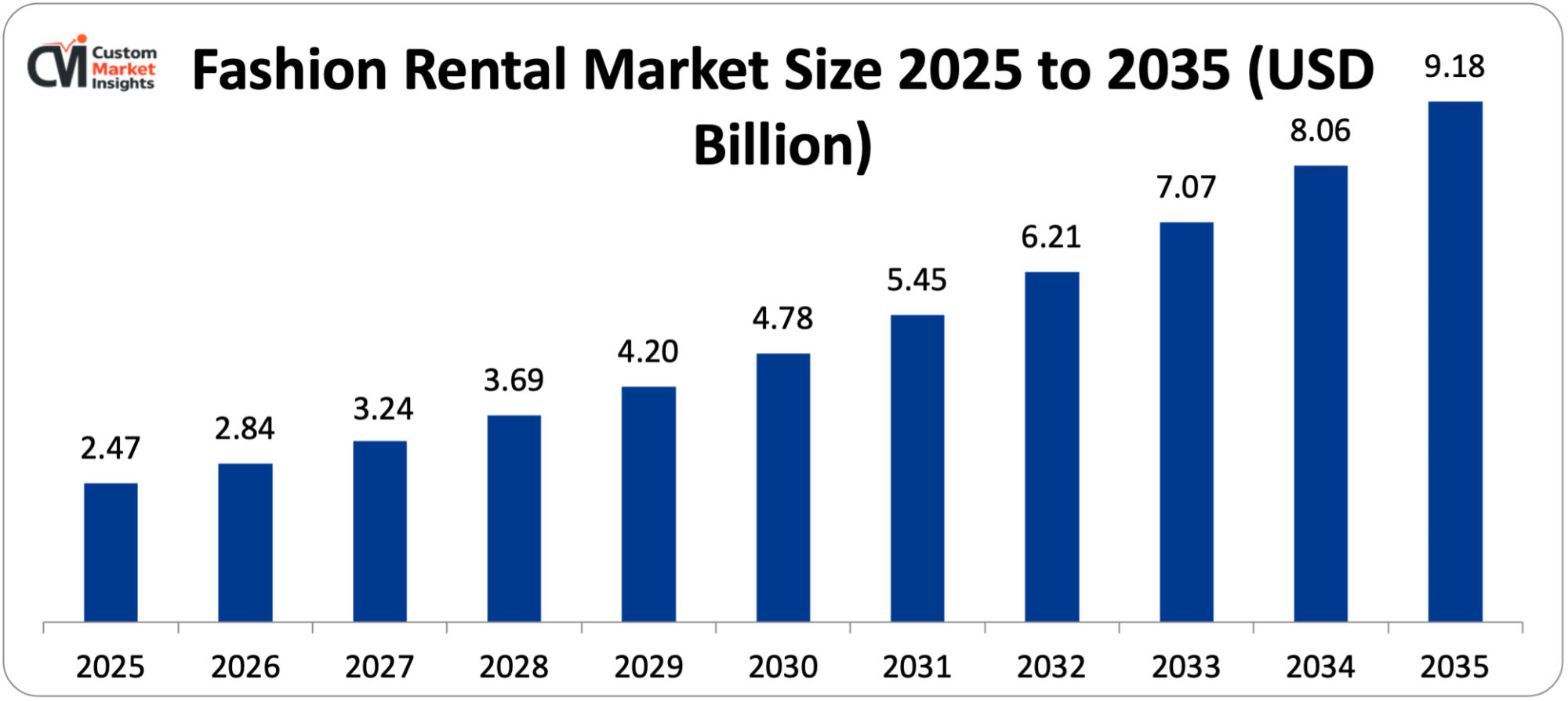
Market Highlight
- A 36% market share in 2025 in the fashion rental market was dominated by North America.
- The 2026-2035 growth of the Asia-Pacific is projected to be the highest at 15.8%.
- By the type of product, the apparel segment had an estimated market share of 68% in 2025.
- By the type of product, accessories and jewelry are increasing with the highest CAGR of 14.2% between 2026 and 2035.
- By rental model, the subscription-based market segment would generate the largest market share of 44% in 2025 with the peer-to-peer rental market segment projected to grow at the fastest CAGR of 17.6% within the forecasted time frame of 2026 and 2035.
- End-user The women segment recorded the largest market share of 74% in 2025, and the men segment is projected to have the highest CAGR of 13.8% between 2026 and 2035.
- By distribution channel, the online/e-commerce segment will gain 71% market share in 2025 and the online segment will move at the highest rate at 13.6% CAGR between 2026 and 2035.
Significant Growth Factors
The Fashion Rental Market Trends present significant growth opportunities due to several factors:
- Sustainability Imperative and Fast Fashion Backlash Driving Structural Consumer Behavior Change:
The increasing consumer awareness of the fashion industry’s environmental impact, with the United Nations Environment Programme estimating that fashion contributes about 10% of the annual global carbon emissions and 20% of the world’s wastewater, is already establishing a paradigm and accelerating consumer response to changes in clothing consumption that is the most significant structural driver of fashion rental market expansion, with rental possessing a natural resource efficiency through garment sharing directly addressing the environmental concerns that are increasingly driving consumption behavior change among the millennial generation and generation z demographic segments that are the largest current fashion rental customer segments and largest future consumer market.
The Ellen MacArthur Foundation has recorded that one garbage truck of textiles is discarded or burned every second in the world, and the average garment is used 7-10 times but discarded in developed markets, and fashion rental directly reflects this situation by having each garment used by several renters instead of just a single wearer and thus increases the duration of the usage. The reputational crisis that the fast fashion industry has been facing, enhanced by investigative journalism on the conditions in its supply chain, the viral social media discussion on the issue of overconsumption, and the increasing mainstream press interest in textile waste, has raised a cultural context in which the idea of fashion rental has positive social signifying value as a sustainable way of life, especially to the younger demographic where environmental identity is a significant part of self-expression and social status.
The idea of the cost-per-wear-calculation, whereby consumers are more and more basing their clothing purchases on the overall number of wearings per purchase price, in a manner that is analogous to the cost-per-wear-calculation, which posits that the value of clothing purchases is more accurately determined by the number of wearings per purchase price, is establishing cognitive consistency with the value proposition of fashion rental, where the number of wearings per purchase price is explicitly optimized by the rental price, relative to the effective cost of ownership when the purchase price is amortized across the few number Published consumer research by The State of Fashion report by McKinsey and Company has continued to record that sustainability has been the highest affecting factor in fashion purchasing decisions among consumers aged less than 35 years across the world with environmental concern reporting in survey responses translating into behavioral changes as increasing numbers of platforms become available, become more aware and their rental behaviour is socially accepted.
The regulatory tailwinds of the Sustainable Products Regulation of the European Union and the EU Strategy of Sustainable and Circular Textiles – which is aimed at promoting the idea of textile reuse, repair, and extending the life of the garments as part of the circular economy action plan in the EU – are already establishing the regulatory background that formally justifies fashion rental as the business model and places the rental platforms in favorable positions within the textile sustainability regulatory framework that the EU is currently developing.
- Digital Platform Maturity and Seamless Consumer Experience Enabling Mass Market Adoption:
The gradual tech maturation of digital fashion rental platform technology, including mobile application user experience, AI-based style recommendation algorithms, real-time inventory management systems, on-demand logistics integration, and frictionless payment processing, is decelerating fashion rental from the category that necessitates consumer tolerance to operational friction to that of a frictionless experience comparable to that of online fashion retail and is breaking down the barrier of consumer adoption to the slowing of the adoption process traditionally required of fashion rental by those consumers inclined towards adopting a luxury version of fashion retailing instead of its economic and environmental benefits.
The initial fashion rental services made consumers search through manual booking, accept low visibility of inventory, deal with unreliable delivery, and deal with a complex system of garment returns that caused significant friction compared to the one-click purchase experience of Amazon Fashion and similar online fashion retailing. Modern fashion rental services, such as Rent the Runway, HURR Collective, My Wardrobe HQ, and Rotaro, are mobile-first, have real-time inventory availability, include custom algorithms for fit recommendations that use customer measurement profiles and prior customer feedback, include integrated logistics like prepaid return labels and scheduled collection, include professional dry cleaning and inspection between rentals, and allow flexibility in subscription plans that allow adjusting plans, pausing, and canceling without penalty that collectively form a customer experience seamless enough to warrant trial among mainstream and not exclusively early adopter customers.
The use of artificial intelligence throughout the fashion renting platform stack, such as computer vision-based garment condition checking instead of manual inspection, machine learning-based demand forecasting that maximizes inventory investment and rental availability, personalization algorithms that improve customer satisfaction and turnover, and dynamic price engines that maximize revenue per garment day, is enhancing the economics of unit operations and customer experience of the platform, generating the operational efficiencies that make models of fashion rental increasingly scalable. The combination of fashion rental services and social media, allowing renters to post their outfits and add rental attribution to the post to enable authentic peer marketing, has the highest likelihood of viral growth loops that have historically been one of the primary drivers of user acquisition of the leading fashion rental platforms on Instagram, TikTok, and Pinterest, where fashion content has historically received one of the highest organic engagement rates of any content type.
What are the Major Advances Changing the Fashion Rental Market Today?
- Luxury Fashion Rental Democratization and Premium Brand Participation:
The increasing involvement of luxury fashion brands and high-end designer brands in the fashion rental sector, both operating their own rental businesses and via collaboration with established fashion rental businesses, is both broadening the market that can be addressed by fashion rental and legitimizing fashion rental as a value chain that is available to provide aspirational luxury products to consumers who could not afford them in full-price retail and as a channel that is not brand-diluting or threatening to the full-price retail model adopted by luxury brands.
The luxury fashion rental value proposition: the consumers receive a variety of Chanel handbags, Oscar de la Renta gowns, Valentino dresses, and other similar designer items at USD 50-USD 500/day rental pricing instead of USD 2000-USD 50000 retail pricing, which would be a strong consumer value play to both high-income consumers who want variety in their wardrobe but cannot afford to own them and aspirational consumers who have yet to be able to access luxury experiences due to financial constraints. The discussion of its development of circular fashion models such as its involvement in the development of the second hand luxury platforms and its open recognition of the concept of rental as an authoritative distribution channel of luxury goods to specific events, are the most commercially important signs of luxury conglomerates that have undergone the acceptance of fashion rental, which have gradually undermined the stigma of the category of goods that cannot be placed in the luxury niche.
The Project Earth initiative by Selfridges, which has explicitly made rental one of its pillars of its sustainability strategy, and the establishment of its own rental service and collaboration with third-party rental strategies indicate that even the luxury retail institutions are actively integrating the concept of rental into their business model, instead of pursuing it as a potential threat to its competitiveness. Such luxury accessories as handbag rental – including designer handbag rental services such as Bag Borrow or Steal, Vivrelle, and Cocoon – is showing a particularly good commercial momentum since handbags have an ideal business model target of high retail price, low sizing complexity relative to clothing, high aspirational brand awareness among fashion customers, and numerous occasions a year that justify their rental over ownership, making them a perfect product category on which to overlay rental business model economics.
- Peer-to-Peer Fashion Rental Platform Growth and the Sharing Economy Extension:
The fast emergence of peer-to-peer fashion rental services (where individual customers list their own collections in rental services) is establishing a massively differentiated and disruptive paradigm in the fashion rental market that takes advantage of the breadth of selection that could not be offered by any single-inventory professional rental service and is also more sustainable because of its ability to monetize and exploit the distributed inventory of millions of individual wardrobes instead of having to invest in new inventory. P2P fashion rental platforms (such as HURR Collective, By Rotation, Onloan, and Loanhood in the UK, and Tulerie and StyleLend in the United States) are based on the sharing economy concept of Airbnb in accommodation and Turo in the personal vehicle renting business and use the same framework to apply to the fashion industry: through these platforms, the owners of garments receive USD 20-USD 200 per loan, and the borrowers receive access to personally curated wardrobes of real-life dressers whose style they admire on The inventory benefit of the peer-to-peer fashion rental model, where major platforms list tens of thousands of individual pieces representing a range of styles, sizes, events, and prices that often exceeds the inventory range of any professional rental shop by far, provides a selection depth that is especially attractive to the consumers with particular needs in specific items, who need to turn to a specific occasion, and the representational range of a particular item that will often not be readily found in the more professional range of items in the owned selections of more professional rental shops.
The social aspect of peer-to-peer rental, where renters share in the personal narratives of individual garment owners, the history of provenance and provenience of particular objects, and the genuine personal style of the real people instead of mass-market rental platforms, is designed to elicit a unique and emotionally appealing experience of renting clothes that has a particularly strong appeal to the consumer who is interested in fashion but finds the personal aspect and authenticity of the real-life experience hard to recreate in mass-market rental models. Particular platform challenges related to peer-to-peer fashion rental, such as quality and condition verification of garments not professionally checked, identity validation and trust formation between individuals not professionally, damage liability resolution, and logistics coordination to collect and deliver to personal residences are progressively solved by major platforms through renter review schemes, deposit schemes, insurance, and integrated logistic suite solutions to make peer-to-peer transactions appear like they were made by a professional platform.
- Subscription Model Innovation and Customer Lifetime Value Optimization:
The development of subscription-based fashion rental models, such as the initial fixed number of items in a monthly subscription system introduced by Rent the Runway into flexible and more personalised and high-value subscription architecture including, but not limited to, styling services, unlimited swap privileges, opt-to-buy of rented items, and customer loyalty rewards, is enhancing customer lifetime value and reducing the churn rates that had historically challenged subscription based fashion rentals’ economics, developing more sustainable business models that are drawing renewed investor confidence in the long-term commercial viability of the subscription rental model.
The subscription model of Rent the Runway, whereby subscribers pay USD 94-USD 235 to access a specified number of garment shipments each month, showed the ability of the mass market to adopt subscription fashion rental on a large scale, reaching up to 170,000 active subscribers at its height, but also had to deal with the churn management challenges of a subscription-based model where customer engagement will naturally rise and fall based on lifestyle events, seasonal changes in social calendars, and wardrobe rotation satisfaction demands.
The movement of unlimited swap subscriptions, where a monthly fee gives the customer access to unlimited wardrobe rotation without a specified limit on the number of items, takes the cognitive load of inventory management off the consumer and enhances the experience of eliminating the calculation of when to return and reorder in the fixed item allowances. A service aspect, whereby the personal styling services are integrated into fashion rental subscriptions, whereby professional stylists select the items to be included in the rental service guided by the customer’s style profile, future calendar events, and trend guidance, will be a service aspect that makes premium subscription rental more attractive than the fast fashion retail service as well as self-service rental services.
The purchase option feature that operates on the major subscription platforms, allowing customers to purchase at the discount a piece of the rented material that they happen to like in particular, provides a hybridized revenue business model that generates incremental purchase revenue among the highly engaged customers as well as operates as a type of conversion mechanism that generates customer satisfaction by ensuring that they do not have to switch to subscription rotation where they might not attach to a particular piece of rented material that they like.
Category Wise Insights
By Product Type
Why Does Apparel Lead the Market?
In 2025, fashion apparel represents the largest segment of product type with about 68% of the total market share because clothing is the core of the original fashion rental value proposition, including the occasion dresses, designer gowns, formal suits, and high-quality casual apparel that generate the largest consumer rental demand of all types of model formats. The occasion apparel category – wedding guest dresses, cocktail and evening gowns, bridesmaid dresses, and formal event dress rentals – are the highest-revenue-per-transaction apparel rental category, with individual occasion dress rentals priced USD 30-USD 500 by designer, retail value, and rental duration, and the predictable demand peaks of specific occasions resulting in consistent demand spikes that can be planned by the platform operators.
The most prevalent apparel rental segment in terms of the number of transactions is the daily subscription category, where customers apply monthly fashion rental subscriptions as an alternative or supplement to regular retail clothes, and where they use subscription services to rent out millions of individual garments each month as part of their active subscriber base. Designer clothes rental has the highest unit rental rate and the annual revenue per garment by year of rental and premium designer clothes in brands such as Zimmermann, Self-Portrait, Reformation, and Faithfull the Brand have trial rental rates of 6080% of available rental days on established rental services when priced at 1015% of retail value per rental event.
By Rental Model
Why Does Subscription-Based Rental Lead the Market?
The most successful model segment is the subscription-based rental, which is the largest segment at about 44% of market share in 2025, the reason being the model is effective in generating recurring revenues, high consumer engagement due to continuous wardrobe rotation, and economics of platform advantage of predictable monthly revenue that allows inventory investment planning and optimization of logistics at scale which would not have been possible through transaction-by-transaction one-time models of rental. The consumer value proposition of the subscription model, giving consumers access to a constantly rotating wardrobe of high-end and designer items at a fixed monthly fee equated to the cost of a high-street retail purchase (or two), has the potential to resonate well with the fashion-engaged consumers in the 25–40 age range who are interested in variety within their wardrobe and have established career-based income that makes subscription rental socially desirable as opposed to fast fashion retail. The subscription model of Rent the Runway, the oldest and largest subscription fashion rental system in the world, has proved that consumers are willing to use active fashion rental subscriptions over a long period when the service can provide the appropriate selection of styles, reliable logistics, and quality of clothes that warrants the monthly charge, and the average tenure of the subscribers as reported on the platform gives a clue about the retention dynamics of mature subscription fashion rental systems with a well-tuned customer experience.
By End-User
Why Does the Women’s Segment Lead the Market?
The women’s category forms the largest end-user segment with an estimated market share of 74% in 2025, due to the feminine prevalence in the former as a means of self-definition and self-establishment; the much larger market size in women’s fashion than in men’s retail and rental; the social imperative of dressing up at recurrent events such as weddings, work-related, and social events, which make repeat-wear more socially expensive among women than men in most cultural settings, and the historical focus of fashion rental platform development on the women’s segment due to the initial market.
The demand of the women in the fashion rental market is focused on the occasion clothes to attend social events – the wedding season generates high demand in occasion dresses, jumpsuits, and formal coordinates on a yearly basis, professional clothes for women at the career stage who need variety in their wardrobes but do not need to spend as much money, and the everyday casual clothes for subscribers who want an unlimited supply of styles by the premium brands at an accessible price less than those of the retail stores. The men’s segment is growing at the quickest rate of 13.8% between 2026 and 2035 due to the increasing men’s occasion wear rental market, the normalization of suit rental among younger male customers, the continued expansion of the men’s fashion engagement segment into the women’s segment, and the ongoing addition of men-focused fashion rental services to the underserved male fashion rental market.
By Distribution Channel
Why Does Online/E-Commerce Lead the Market?
Online and e-commerce distribution: The leading channel will be approximately 71% of the market share in 2025, the fundamental digital nativity of fashion rental, in which the discovery, selection, booking, logistical coordination and return management capabilities of the fashion rental can best be fulfilled using mobile app and web platform interfaces that offer the inventory visibility, fit guidance, and schedule flexibility that cannot be matched by physical store rental in corresponding scale. It has been revealed that the mobile app has become the most important touchpoint of the fashion-rental consumer interaction with major platforms reporting that most of the rental booking, subscription management, and customer engagement interactions are seen in their native app instead of desktop or in-store platforms, which allows the app to keep consumers constantly aware of the top-of-mind when it comes to rental occasions through personalized push notifications, new arrivals, and content designed as inspiration to stay styled.
The online channel logistics infrastructure, which employs the courier and delivery systems to offer next-day or same-day delivery in large urban markets, prepaid return labels that eliminate the friction of collection, and real-time delivery tracking that offers occasional certainty, has reached a level of maturity in North America and Europe such that online fashion rental logistics can be depended upon to meet the time-sensitive needs of occasion planning, eliminating the delivery uncertainty that historically served as an adoption barrier to online fashion rental in the consumer who needs to plan an occasion in advance market.
Report Scope
| Feature of the Report | Details |
| Market Size in 2026 | USD 2.84 billion |
| Projected Market Size in 2035 | USD 9.18 billion |
| Market Size in 2025 | USD 2.47 billion |
| CAGR Growth Rate | 12.4% CAGR |
| Base Year | 2025 |
| Forecast Period | 2026-2035 |
| Key Segment | By Product Type, Rental Model, End-User, Distribution Channel and Region |
| Report Coverage | Revenue Estimation and Forecast, Company Profile, Competitive Landscape, Growth Factors and Recent Trends |
| Regional Scope | North America, Europe, Asia Pacific, Middle East & Africa, and South & Central America |
| Buying Options | Request tailored purchasing options to fulfil your requirements for research. |
Regional Analysis
How Big is the North America Market Size?
The North America fashion rental market size is estimated at USD 889 million in 2025 and is projected to reach approximately USD 2.94 billion by 2035, with a CAGR of 12.7% from 2026 to 2035.
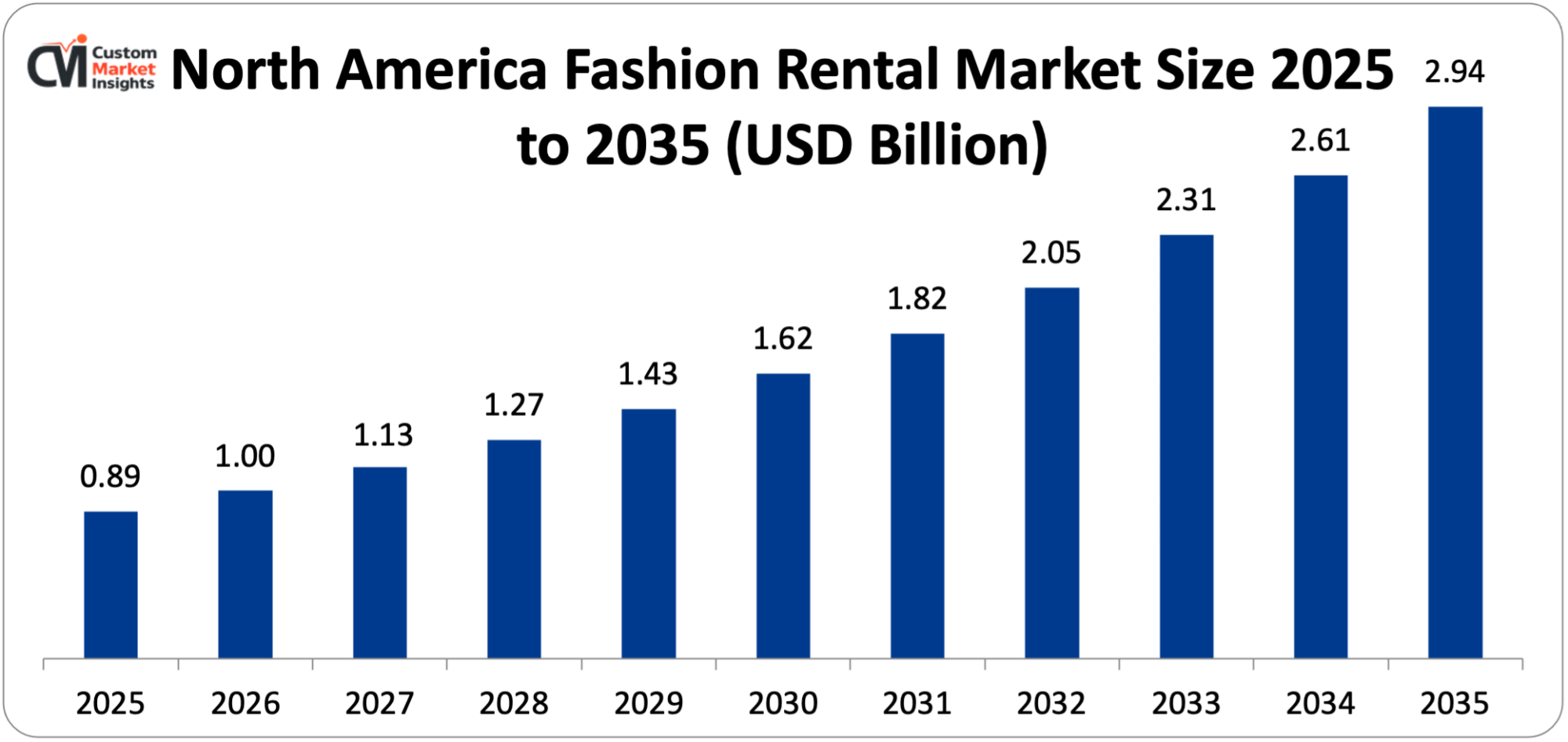
Why Did North America Dominate the Market in 2025?
In 2025, North America is assumed to command about 36% of the global market share, which reflects that the United States is the most mature and commercially developed fashion rental market in the world, with the extensive and fashion-conscious urban consumer base in major urban centers such as New York, Los Angeles, San Francisco, and Chicago taking up the concentrated concentration of fashion rental customers and the healthy venture capital base that has financed the development and expansion of several fashion rental platforms giving it a chance to compete effectively in the market.
The commercial proof of concept Rent the Runway is the first and largest all-fashion rental subscription service in the world and was founded in 2009, successfully establishing the consumer willingness to pay recurring subscription fees to access designer-native clothes, establishing the operational infrastructure to clean, inspect, and manage large volumes of clothing, and establishing the brand relationships with more than 800 designer brands whose inclusion in fashion rental demonstrates fashion rental as a valid method alongside traditional wholesale and direct-to-consumer retail. An additional competitor to Rent the Runway, which provides premium fashion rental, is Nuuly Urban Outfitters subscription fashion rental service, a service launched in 2019 and reaching scale numbers of subscribers in 2024, which focuses on the lower end of the price and consumer demographic segments in the fashion rental market, appealing to younger consumers more than the upmarket positioning of Rent the Runway does.
Why is Europe a Strategically Important Market?
The European fashion rental industry is expected to reach close to USD 617 million in 2025 and close to USD 2.06 billion by 2035 with a CAGR of 12.8. Europe is a market of exceptional strategic value due to the presence of the United Kingdom as Europe’s most mature fashion rental market – underpinned by HURR Collective, By Rotation, Rotaro, My Wardrobe HQ and various smaller platforms that serve the London-based fashion rental consumer base, which represents the highest fashion rental penetration rate in Europe and due to the high fashion cultural heritage of France, Italy, and Germany, which offers consumer desire for high-value fashion experiences that can be accessed in rental and the fact that the high fashion label ecosystem whose products are natural candidates to be listed in a rental platform inventory.
The UK fashion rental market is considered to be the largest single market in Europe, in terms of the concentration of fashion interested consumers with high disposable incomes; the UK’s strong environmental consumer culture creating receptive adopters in the rental market; and the relatively high cost of quality fashion in the UK marketplace making the economics of rental attractive as compared to the purchase alternatives. The fashion rental sector in France is smaller than in the UK, but has the advantage of the most prestigious luxury fashion heritage in the world and the sophisticated interaction of the consumer of Paris with the quality of fashions that forms an instinctive connection with the quality and craftsmanship of the garments in the fashion rental business as opposed to the quantity of fashions in fast fashion. Regulatory environments brought about by the Right to Repair and Ecodesign for Sustainable Products Regulation of the EU, which, among other things, will force fashion products to meet de facto minimum standards in durability and product information that will support product reuse and repair, in turn will provide a regulatory frame favorable to the business model of rental that also implicitly presupposes value and maintenance of garment quality through professional care programs.
Why is Asia Pacific the Fastest-Growing Market?
The fastest-growing regional market is Asia Pacific, which is projected to grow 15.8% in the period between 2026 and 2035 due by the rising urban middle class of China and the creation of the aspirational fashion consumer market most likely to adopt luxury fashion rental as a luxury experience; the youthful and fashion-aware urban population of India as the largest and untapped potential market to be penetrated by the fashion rental business as an accessible luxury experience; and the sophisticated and environmentally mindful consumer culture of Japan as providing potential adopters of fashion rental as a sustainable consumption behavior, Style Theory, the Singapore-based fashion rental service with operations in Singapore, Indonesia, and Hong Kong, has proven the business feasibility of the subscription fashion rental business in the Southeast Asian markets, where it serves tens of thousands of subscribers in its operating markets and has confirmed the interest of the urban middle class in Asia Pacific in fashion consumption via the access model. Although the fashion rental market in China is still at a relatively early commercial development phase compared to North America and Europe, the sheer magnitude of the population of urban consumers in China, with hundreds of millions of consumers of fashion-interested youth in large metropolitan areas, is phenomenal.
Why is the Middle East & Africa Region an Emerging Market?
The LAMEA region is showing an increasing market potential due to the presence of a fashion-inspired and luxury-aspirational consumer population in the United Arab Emirates, especially Dubai, which is an international resident population in high-fashion-engagement countries such as the United Kingdom, France, and Lebanon, which create a fashion rental consumer base with already familiarity with rental concepts in their country of origin. The rapidly changing consumer culture of Saudi Arabia, driven by the social liberalization policies of Vision 2030 that have greatly increased the consumption occasions in entertainment, hospitality, and fashion by Saudi consumers including the large female consumer segment, is causing the development of increasing fashion rental demand among the consumers of Saudi Arabia with a rapidly increasing frequency of social occasions and a strong fashion desire but a limited experience with rental consumption models. The urban fashion market of Brazil, and in particular, the largest, most commercially relevant fashion retail market in Latin America, is beginning to see the activity of fashion rental platforms with domestic startup platforms targeting the Brazilian wedding and occasion market, which has exceptionally strong wedding culture and where the retail price of quality occasion wear is incredibly high in the Brazilian market.
Top Players in the Market and Their Offerings
- Rent the Runway Inc.
- HURR Collective Ltd.
- Nuuly (Urban Outfitters Inc.)
- My Wardrobe HQ
- By Rotation
- Rotaro
- Vivrelle LLC
- Tulerie Inc.
- Bag Borrow or Steal Inc.
- Le Tote (Lord & Taylor)
- Style Theory Pte. Ltd.
- Others
Key Developments
The market has undergone significant developments as industry participants seek to advance platform technology, expand brand partnerships, and respond to the growing global consumer demand for sustainable fashion access models across subscription, peer-to-peer, and occasion rental formats.
- In January 2023: Rent the Runway declared a strategic alliance with Amazon Fashion- allowing the Rent the Runway rental catalog to be found and booked in the Amazon fashion shopping system- the biggest distribution channel expansion in the firm’s history and exposing the Rent the Runway rental offering to the hundreds of millions of active buyers in the Amazon fashion shopping platform who may not have previously used dedicated fashion rental platforms.
- In March 2025: Selfridges has confirmed that its Rental edit, the curated fashion rental service offered by Selfridges via its online platform and integrated into the physical Oxford Street flagship store, will be expanded to over 2,000 individual rental items across womenswear, menswear, and accessories collections by more than 120 designer brands, and it will be the largest brand-based fashion rental service offered by a traditional luxury department store in the world.
The Fashion Rental Market is segmented as follows:
By Product Type
- Apparel (Dresses, Suits, Casualwear, Formalwear, Activewear)
- Accessories & Jewelry (Handbags, Watches, Fine Jewelry, Scarves)
- Footwear (Designer Heels, Boots, Sneakers)
- Other Product Types (Outerwear, Bridal Wear, Maternity)
By Rental Model
- Subscription-Based (Monthly Plans, Unlimited Swap)
- One-Time Rental (Occasion-Based, Event-Specific)
- Peer-to-Peer Rental (Marketplace Platforms)
- Other Models (Corporate/Workplace Rental, Styling Box)
By End-User
- Women
- Men
- Children
By Distribution Channel
- Online/E-Commerce (Mobile App, Website)
- Offline/In-Store (Physical Rental Boutiques, Department Store Partnerships)
- Other Channels (Corporate and B2B, Brand Direct)
Regional Coverage:
North America
- U.S.
- Canada
- Mexico
- Rest of North America
Europe
- Germany
- France
- U.K.
- Russia
- Italy
- Spain
- Netherlands
- Rest of Europe
Asia Pacific
- China
- Japan
- India
- New Zealand
- Australia
- South Korea
- Taiwan
- Rest of Asia Pacific
The Middle East & Africa
- Saudi Arabia
- UAE
- Egypt
- Kuwait
- South Africa
- Rest of the Middle East & Africa
Latin America
- Brazil
- Argentina
- Rest of Latin America
Table of Contents
- Chapter 1. Report Introduction
- 1.1. Report Description
- 1.1.1. Purpose of the Report
- 1.1.2. USP & Key Offerings
- 1.2. Key Benefits For Stakeholders
- 1.3. Target Audience
- 1.4. Report Scope
- 1.1. Report Description
- Chapter 2. Market Overview
- 2.1. Report Scope (Segments And Key Players)
- 2.1.1. Fashion Rental by Segments
- 2.1.2. Fashion Rental by Region
- 2.2. Executive Summary
- 2.2.1. Market Size & Forecast
- 2.2.2. Fashion Rental Market Attractiveness Analysis, By Product Type
- 2.2.3. Fashion Rental Market Attractiveness Analysis, By Rental Model
- 2.2.4. Fashion Rental Market Attractiveness Analysis, By End-User
- 2.2.5. Fashion Rental Market Attractiveness Analysis, By Distribution Channel
- 2.1. Report Scope (Segments And Key Players)
- Chapter 3. Market Dynamics (DRO)
- 3.1. Market Drivers
- 3.1.1. Sustainability Imperative and Fast Fashion Backlash Driving Structural Consumer Behavior Change
- 3.1.2. Digital Platform Maturity and Seamless Consumer Experience Enabling Mass Market Adoption
- 3.2. Market Restraints
- 3.3. Market Opportunities
- 3.5. Pestle Analysis
- 3.6. Porter Forces Analysis
- 3.7. Technology Roadmap
- 3.8. Value Chain Analysis
- 3.9. Government Policy Impact Analysis
- 3.10. Pricing Analysis
- 3.1. Market Drivers
- Chapter 4. Fashion Rental Market – By Product Type
- 4.1. Product Type Market Overview, By Product Type Segment
- 4.1.1. Fashion Rental Market Revenue Share, By Product Type, 2025 & 2035
- 4.1.2. Apparel (Dresses, Suits, Casualwear, Formalwear, Activewear)
- 4.1.3. Fashion Rental Share Forecast, By Region (USD Billion)
- 4.1.4. Comparative Revenue Analysis, By Country, 2025 & 2035
- 4.1.5. Key Market Trends, Growth Factors, & Opportunities
- 4.1.6. Accessories & Jewelry (Handbags, Watches, Fine Jewelry, Scarves)
- 4.1.7. Fashion Rental Share Forecast, By Region (USD Billion)
- 4.1.8. Comparative Revenue Analysis, By Country, 2025 & 2035
- 4.1.9. Key Market Trends, Growth Factors, & Opportunities
- 4.1.10. Footwear (Designer Heels, Boots, Sneakers)
- 4.1.11. Fashion Rental Share Forecast, By Region (USD Billion)
- 4.1.12. Comparative Revenue Analysis, By Country, 2025 & 2035
- 4.1.13. Key Market Trends, Growth Factors, & Opportunities
- 4.1.14. Other Product Types (Outerwear, Bridal Wear, Maternity)
- 4.1.15. Fashion Rental Share Forecast, By Region (USD Billion)
- 4.1.16. Comparative Revenue Analysis, By Country, 2025 & 2035
- 4.1.17. Key Market Trends, Growth Factors, & Opportunities
- 4.1. Product Type Market Overview, By Product Type Segment
- Chapter 5. Fashion Rental Market – By Rental Model
- 5.1. Rental Model Market Overview, By Rental Model Segment
- 5.1.1. Fashion Rental Market Revenue Share, By Rental Model, 2025 & 2035
- 5.1.2. Subscription-Based (Monthly Plans, Unlimited Swap)
- 5.1.3. Fashion Rental Share Forecast, By Region (USD Billion)
- 5.1.4. Comparative Revenue Analysis, By Country, 2025 & 2035
- 5.1.5. Key Market Trends, Growth Factors, & Opportunities
- 5.1.6. One-Time Rental (Occasion-Based, Event-Specific)
- 5.1.7. Fashion Rental Share Forecast, By Region (USD Billion)
- 5.1.8. Comparative Revenue Analysis, By Country, 2025 & 2035
- 5.1.9. Key Market Trends, Growth Factors, & Opportunities
- 5.1.10. Peer-to-Peer Rental (Marketplace Platforms)
- 5.1.11. Fashion Rental Share Forecast, By Region (USD Billion)
- 5.1.12. Comparative Revenue Analysis, By Country, 2025 & 2035
- 5.1.13. Key Market Trends, Growth Factors, & Opportunities
- 5.1.14. Other Models (Corporate/Workplace Rental, Styling Box)
- 5.1.15. Fashion Rental Share Forecast, By Region (USD Billion)
- 5.1.16. Comparative Revenue Analysis, By Country, 2025 & 2035
- 5.1.17. Key Market Trends, Growth Factors, & Opportunities
- 5.1. Rental Model Market Overview, By Rental Model Segment
- Chapter 6. Fashion Rental Market – By End-User
- 6.1. End-User Market Overview, By End-User Segment
- 6.1.1. Fashion Rental Market Revenue Share, By End-User, 2025 & 2035
- 6.1.2. Women
- 6.1.3. Fashion Rental Share Forecast, By Region (USD Billion)
- 6.1.4. Comparative Revenue Analysis, By Country, 2025 & 2035
- 6.1.5. Key Market Trends, Growth Factors, & Opportunities
- 6.1.6. Men
- 6.1.7. Fashion Rental Share Forecast, By Region (USD Billion)
- 6.1.8. Comparative Revenue Analysis, By Country, 2025 & 2035
- 6.1.9. Key Market Trends, Growth Factors, & Opportunities
- 6.1.10. Children
- 6.1.11. Fashion Rental Share Forecast, By Region (USD Billion)
- 6.1.12. Comparative Revenue Analysis, By Country, 2025 & 2035
- 6.1.13. Key Market Trends, Growth Factors, & Opportunities
- 6.1. End-User Market Overview, By End-User Segment
- Chapter 7. Fashion Rental Market – By Distribution Channel
- 7.1. Distribution Channel Market Overview, By Distribution Channel Segment
- 7.1.1. Fashion Rental Market Revenue Share, By Distribution Channel, 2025 & 2035
- 7.1.2. Online/E-Commerce (Mobile App, Website)
- 7.1.3. Fashion Rental Share Forecast, By Region (USD Billion)
- 7.1.4. Comparative Revenue Analysis, By Country, 2025 & 2035
- 7.1.5. Key Market Trends, Growth Factors, & Opportunities
- 7.1.6. Offline/In-Store (Physical Rental Boutiques, Department Store Partnerships)
- 7.1.7. Fashion Rental Share Forecast, By Region (USD Billion)
- 7.1.8. Comparative Revenue Analysis, By Country, 2025 & 2035
- 7.1.9. Key Market Trends, Growth Factors, & Opportunities
- 7.1.10. Other Channels (Corporate and B2B, Brand Direct)
- 7.1.11. Fashion Rental Share Forecast, By Region (USD Billion)
- 7.1.12. Comparative Revenue Analysis, By Country, 2025 & 2035
- 7.1.13. Key Market Trends, Growth Factors, & Opportunities
- 7.1. Distribution Channel Market Overview, By Distribution Channel Segment
- Chapter 8. Fashion Rental Market – Regional Analysis
- 8.1. Fashion Rental Market Overview, By Region Segment
- 8.1.1. Global Fashion Rental Market Revenue Share, By Region, 2025 & 2035
- 8.1.2. Global Fashion Rental Market Revenue, By Region, 2026 – 2035 (USD Billion)
- 8.1.3. Global Fashion Rental Market Revenue, By Product Type, 2026 – 2035
- 8.1.4. Global Fashion Rental Market Revenue, By Rental Model, 2026 – 2035
- 8.1.5. Global Fashion Rental Market Revenue, By End-User, 2026 – 2035
- 8.1.6. Global Fashion Rental Market Revenue, By Distribution Channel, 2026 – 2035
- 8.2. North America
- 8.2.1. North America Fashion Rental Market Revenue, By Country, 2026 – 2035 (USD Billion)
- 8.2.2. North America Fashion Rental Market Revenue, By Product Type, 2026 – 2035
- 8.2.3. North America Fashion Rental Market Revenue, By Rental Model, 2026 – 2035
- 8.2.4. North America Fashion Rental Market Revenue, By End-User, 2026 – 2035
- 8.2.5. North America Fashion Rental Market Revenue, By Distribution Channel, 2026 – 2035
- 8.2.6. U.S. Fashion Rental Market Revenue, 2026 – 2035 (USD Billion)
- 8.2.7. Canada Fashion Rental Market Revenue, 2026 – 2035 (USD Billion)
- 8.2.8. Mexico Fashion Rental Market Revenue, 2026 – 2035 (USD Billion)
- 8.2.9. Rest of North America Fashion Rental Market Revenue, 2026 – 2035 (USD Billion)
- 8.3. Europe
- 8.3.1. Europe Fashion Rental Market Revenue, By Country, 2026 – 2035 (USD Billion)
- 8.3.2. Europe Fashion Rental Market Revenue, By Product Type, 2026 – 2035
- 8.3.3. Europe Fashion Rental Market Revenue, By Rental Model, 2026 – 2035
- 8.3.4. Europe Fashion Rental Market Revenue, By End-User, 2026 – 2035
- 8.3.5. Europe Fashion Rental Market Revenue, By Distribution Channel, 2026 – 2035
- 8.3.6. Germany Fashion Rental Market Revenue, 2026 – 2035 (USD Billion)
- 8.3.7. France Fashion Rental Market Revenue, 2026 – 2035 (USD Billion)
- 8.3.8. U.K. Fashion Rental Market Revenue, 2026 – 2035 (USD Billion)
- 8.3.9. Russia Fashion Rental Market Revenue, 2026 – 2035 (USD Billion)
- 8.3.10. Italy Fashion Rental Market Revenue, 2026 – 2035 (USD Billion)
- 8.3.11. Spain Fashion Rental Market Revenue, 2026 – 2035 (USD Billion)
- 8.3.12. Netherlands Fashion Rental Market Revenue, 2026 – 2035 (USD Billion)
- 8.3.13. Rest of Europe Fashion Rental Market Revenue, 2026 – 2035 (USD Billion)
- 8.4. Asia Pacific
- 8.4.1. Asia Pacific Fashion Rental Market Revenue, By Country, 2026 – 2035 (USD Billion)
- 8.4.2. Asia Pacific Fashion Rental Market Revenue, By Product Type, 2026 – 2035
- 8.4.3. Asia Pacific Fashion Rental Market Revenue, By Rental Model, 2026 – 2035
- 8.4.4. Asia Pacific Fashion Rental Market Revenue, By End-User, 2026 – 2035
- 8.4.5. Asia Pacific Fashion Rental Market Revenue, By Distribution Channel, 2026 – 2035
- 8.4.6. China Fashion Rental Market Revenue, 2026 – 2035 (USD Billion)
- 8.4.7. Japan Fashion Rental Market Revenue, 2026 – 2035 (USD Billion)
- 8.4.8. India Fashion Rental Market Revenue, 2026 – 2035 (USD Billion)
- 8.4.9. New Zealand Fashion Rental Market Revenue, 2026 – 2035 (USD Billion)
- 8.4.10. Australia Fashion Rental Market Revenue, 2026 – 2035 (USD Billion)
- 8.4.11. South Korea Fashion Rental Market Revenue, 2026 – 2035 (USD Billion)
- 8.4.12. Taiwan Fashion Rental Market Revenue, 2026 – 2035 (USD Billion)
- 8.4.13. Rest of Asia Pacific Fashion Rental Market Revenue, 2026 – 2035 (USD Billion)
- 8.5. The Middle-East and Africa
- 8.5.1. The Middle-East and Africa Fashion Rental Market Revenue, By Country, 2026 – 2035 (USD Billion)
- 8.5.2. The Middle-East and Africa Fashion Rental Market Revenue, By Product Type, 2026 – 2035
- 8.5.3. The Middle-East and Africa Fashion Rental Market Revenue, By Rental Model, 2026 – 2035
- 8.5.4. The Middle-East and Africa Fashion Rental Market Revenue, By End-User, 2026 – 2035
- 8.5.5. The Middle-East and Africa Fashion Rental Market Revenue, By Distribution Channel, 2026 – 2035
- 8.5.6. Saudi Arabia Fashion Rental Market Revenue, 2026 – 2035 (USD Billion)
- 8.5.7. UAE Fashion Rental Market Revenue, 2026 – 2035 (USD Billion)
- 8.5.8. Egypt Fashion Rental Market Revenue, 2026 – 2035 (USD Billion)
- 8.5.9. Kuwait Fashion Rental Market Revenue, 2026 – 2035 (USD Billion)
- 8.5.10. South Africa Fashion Rental Market Revenue, 2026 – 2035 (USD Billion)
- 8.5.11. Rest of the Middle East & Africa Fashion Rental Market Revenue, 2026 – 2035 (USD Billion)
- 8.6. Latin America
- 8.6.1. Latin America Fashion Rental Market Revenue, By Country, 2026 – 2035 (USD Billion)
- 8.6.2. Latin America Fashion Rental Market Revenue, By Product Type, 2026 – 2035
- 8.6.3. Latin America Fashion Rental Market Revenue, By Rental Model, 2026 – 2035
- 8.6.4. Latin America Fashion Rental Market Revenue, By End-User, 2026 – 2035
- 8.6.5. Latin America Fashion Rental Market Revenue, By Distribution Channel, 2026 – 2035
- 8.6.6. Brazil Fashion Rental Market Revenue, 2026 – 2035 (USD Billion)
- 8.6.7. Argentina Fashion Rental Market Revenue, 2026 – 2035 (USD Billion)
- 8.6.8. Rest of Latin America Fashion Rental Market Revenue, 2026 – 2035 (USD Billion)
- 8.1. Fashion Rental Market Overview, By Region Segment
- Chapter 9. Competitive Landscape
- 9.1. Company Market Share Analysis – 2025
- 9.1.1. Global Fashion Rental Market: Company Market Share, 2025
- 9.2. Global Fashion Rental Market Company Market Share, 2024
- 9.1. Company Market Share Analysis – 2025
- Chapter 10. Company Profiles
- 10.1. Runway Inc.
- 10.1.1. Company Overview
- 10.1.2. Key Executives
- 10.1.3. Product Portfolio
- 10.1.4. Financial Overview
- 10.1.5. Operating Business Segments
- 10.1.6. Business Performance
- 10.1.7. Recent Developments
- 10.2. HURR Collective Ltd.
- 10.3. Nuuly (Urban Outfitters Inc.)
- 10.4. My Wardrobe HQ
- 10.5. By Rotation
- 10.6. Rotaro
- 10.7. Vivrelle LLC
- 10.8. Tulerie Inc.
- 10.9. Bag Borrow or Steal Inc.
- 10.10. Le Tote (Lord & Taylor)
- 10.11. Style Theory Pte. Ltd.
- 10.12. Others.
- 10.1. Runway Inc.
- Chapter 11. Research Methodology
- 11.1. Research Methodology
- 11.2. Secondary Research
- 11.3. Primary Research
- 11.3.1. Analyst Tools and Models
- 11.4. Research Limitations
- 11.5. Assumptions
- 11.6. Insights From Primary Respondents
- 11.7. Why Custom Market Insights
- Chapter 12. Standard Report Commercials & Add-Ons
- 12.1. Customization Options
- 12.2. Subscription Module For Market Research Reports
- 12.3. Client Testimonials
List Of Figures
Figures No 1 to 32
List Of Tables
Tables No 1 to 51
Prominent Player
- Rent the Runway Inc.
- HURR Collective Ltd.
- Nuuly (Urban Outfitters Inc.)
- My Wardrobe HQ
- By Rotation
- Rotaro
- Vivrelle LLC
- Tulerie Inc.
- Bag Borrow or Steal, Inc.
- Le Tote (Lord & Taylor)
- Style Theory Pte. Ltd.
- Others
FAQs
The key players in the market are Rent the Runway Inc., HURR Collective Ltd., Nuuly (Urban Outfitters Inc.), My Wardrobe HQ, By Rotation, Rotaro, Vivrelle LLC, Tulerie Inc., Bag Borrow or Steal Inc., Le Tote (Lord & Taylor), Style Theory Pte. Ltd., Others.
Government policies increasingly become a significant underpinning of the fashion rental market development, acting in the form of sustainability requirements that provide favorable commercial conditions to the business models of circular fashion, extended producer responsibility, which is encouraging long-term garments instead of disposal, and consumer protection frameworks that define the fairness and transparency of rental contracts. The Strategy of Sustainable and Circular Textiles by the EU (published as a part of the action plan of the circular economy associated with the European Green Deal) specifically notes textile reuse, including rental, as a priority intervention to reduce the environmental impact of the fashion industry, guiding EU policy support, public procurement preferences, and even future regulatory demands towards business models that extend the useful life of garments to multiple users, which creates an institutional support of fashion rental that gradually persuades consumer perception and retail industry strategy within European markets. The quality standards established by the Ecodesign of Sustainable Products Regulation of the EU that will impose minimum-durability, minimum-repair, and minimum-recycled levels in the textile garments that will be offered in the EU fashion market implicitly favor high-quality, long-lasting garments that those who operate a professional fashion rental business invest in over the low-durability, fast fashion garments that cannot be subjected to the business’s multi-rental lifetime cycle, which provides a regulatory tailwind that elevates the quality floor of the EU fashion market towards the garment standards. The most progressive fashion legislation in the world is that of France, the AGEC Law, which since 2022 forbids the destruction of unsold non-food items such as clothing, thus establishing economic incentives to encourage fashion brands to operate their inventory as a legitimate inventory control method and not as a competitive threat through the use of rental and resale as well as donation methods. Long-term producer responsibility initiatives of textiles.
Prices of fashion rentals cover a wide range as they depend on the type of product, the level of designer trend, its rental period and form of model. The cost of fashion rental based on subscription will range from USD 35-USD 235 a month depending on the platform, item selections per shipment, and brand level access – accessible platforms such as Nuuly at the low end allow trial by a wide consumer income demographic, and high-end platforms like the top tiers of Rent the Runway aim at fashion-interested consumers with an established level of discretionary income. One-time occasion dress rental has a price of USD 30 – USD 500 per rental of foregone garments of generally 4-8 days, representing 8-15% of the usual retail price that makes rental economically competitive in situations where one-time and twice-wear garments are required. For specialty rental companies, luxury handbags are charged between USD 50 and USD 500 a week based on brand awareness and retail price. Chanel, Hermes, and Louis Vuitton bags have the highest rental prices based on both retail interests and aspirational demand. Pricing by peer-to-peer rental is typically 10–15% of the retail price per rental period, charged by individual garment owners, and much differentiated by the desirability of pieces, brand, and market features of platforms. The accessibility to the cost of fashion rental that the fashion rental creates compared to buying clothes is the underlying consumer value proposition that leads to adoption – that fashion rental can provide access to clothes at 5-15% of purchase cost in a single event wear – and the gradual decline in the operational costs of platforms in automating technology and optimization of logistics supports platforms developing in improving gross margins and keeping or lowering rental prices to consumers that scalability in the market requires with regard to volume.
According to the existing analysis, it is expected that the market will grow to USD 9.18 billion by 2035 due to the gradual process of fashion rental being normalized into mainstream consumer behavior by the millennial and Generation Z consumer cohorts whose adulthood in the fashion consumption sector is today being enacted within the context of the availability of fashion rental platforms, peer-to-peer rental as a form of sharing economy culture percolating into fashion rental across the developed and developing markets contemporaneously, Asia Pacific market maturation adding the large urban consumer populations of China and India to the large urban consumer populations to the active fashion rental adoption wave as platform infrastructure and consumer awareness develop, luxury brand participation deepening as fashion houses and luxury conglomerates incorporate rental into their distribution strategies rather than treating it as a threat, men’s fashion rental market development expanding the addressable consumer base significantly beyond the women-dominated current market, and the EU regulatory framework for sustainable textiles creating formal commercial advantages for circular business models including fashion rental that progressively influence consumer behavior across European markets, at a CAGR of 12.4% from 2026 to 2035.
It is projected that North America will retain the largest proportion of revenue share over the forecast period, controlling about 36% of the global market share by 2025, based upon the maturity of the Rent the Runway platform and brand partnership ecosystem, comprising over 800 designer labels, establishing the most advanced fashion rental commercial infrastructure in the world, the growing subscriber base at Nuuly, indicating the presence of accessible price-point fashion rental opportunities beyond the high-end designer segment, the established consumer behavior of the U.S. which consolidates subscription economy, subscription media and software expenditure, the large fashion-engaged urban consumer population in major U.S. metropolitan areas representing the highest-density fashion rental customer concentrations globally, and the venture capital ecosystem that continues funding fashion rental platform development and scaling in the United States, supporting competitive market dynamism that accelerates consumer awareness and adoption.
Asia Pacific is expected to experience the highest CAGR of 15.8% within the forecast period, attributed to the growth of the fashion rental market in China, estimated at about USD 187 million in 2025 with a 17.2% CAGR and Style Theory commercialization of subscription fashion rental in Singapore, Indonesia, and Hong Kong, which proves that the Asia Pacific market is receptive to rental and that younger consumers are prone to fashion engagement and subsequent rental openness, and South Korea’s K-fashion cultural impact creating a natural fit to the sustainability occasion wear rental portfolios and rental openness among younger consumers; Japan’s environmental consumer consciousness creating natural alignment with rental’s sustainability proposition; and China’s super-app ecosystem integration potential dramatically reducing fashion rental platform discovery and onboarding friction relative to standalone app models in Western markets.
The Global Fashion Rental Market is expected to grow significantly since the United Nations Environment Programme has recognized fashion to contribute to around 10% of the overall yearly carbon emissions globally creating the environmental awareness driving consumer behavior change towards rental, the Ellen MacArthur Foundation documenting the same amount of garbage truck of textile landfilled or burnt annually worldwide, McKinsey documenting sustainability as a top purchasing consideration among consumers under 35 years old globally making a generational fit with the environmental proposition of rental, By Rotation reporting growth in active listing of 300% annually during its high-growth phase demonstrating peer-to-peer fashion rental’s platform scalability through network effects, Rent the Runway’s Amazon Fashion partnership exposing rental to hundreds of millions of additional potential customers through mainstream e-commerce channel integration, the EU’s Sustainable Products Regulation and EU Strategy for Sustainable and Circular Textiles creating regulatory tailwinds formally validating rental’s circular business model, and luxury brand participation — including Selfridges’ Project Earth rental initiative and LVMH’s circular fashion model exploration — legitimizing rental as a distribution channel compatible with premium brand positioning.