
Green Methanol Ships Market Size, Trends and Insights By Vessel Type (Container Ships, Bulk Carriers, Tankers, Ferries, Ro-Ro Vessels, Cruise Ships, Offshore Support Vessels), By Ship Type (Newbuild Vessels, Retrofitted/Converted Vessels), By Fuel Type (Bio-Methanol, E-Methanol, Dual-Fuel Systems), By Propulsion System (Dual-Fuel Engines, Methanol-Dedicated Engines, Auxiliary Power Systems), By Application (Deep-Sea Shipping, Short-Sea Shipping, Inland Waterways, Offshore Operations), By End User (Commercial Shipping Companies, Cargo & Logistics Operators, Passenger Transport Operators, Offshore Energy Companies), By Technology & Infrastructure (Methanol-Ready Engine Technology, Onboard Fuel Storage Systems, Fuel Handling & Safety Systems, Methanol Bunkering Infrastructure, Port Fuel Supply Networks), and By Region - Global Industry Overview, Statistical Data, Competitive Analysis, Share, Outlook, and Forecast 2026 – 2035
Report Snapshot
| Study Period: | 2026-2035 |
| Fastest Growing Market: | Asia Pacific |
| Largest Market: | Europe |
Major Players
- CMA CGM
- COSCO Shipping
- MAN Energy Solutions
- WinGD
- Others
Reports Description
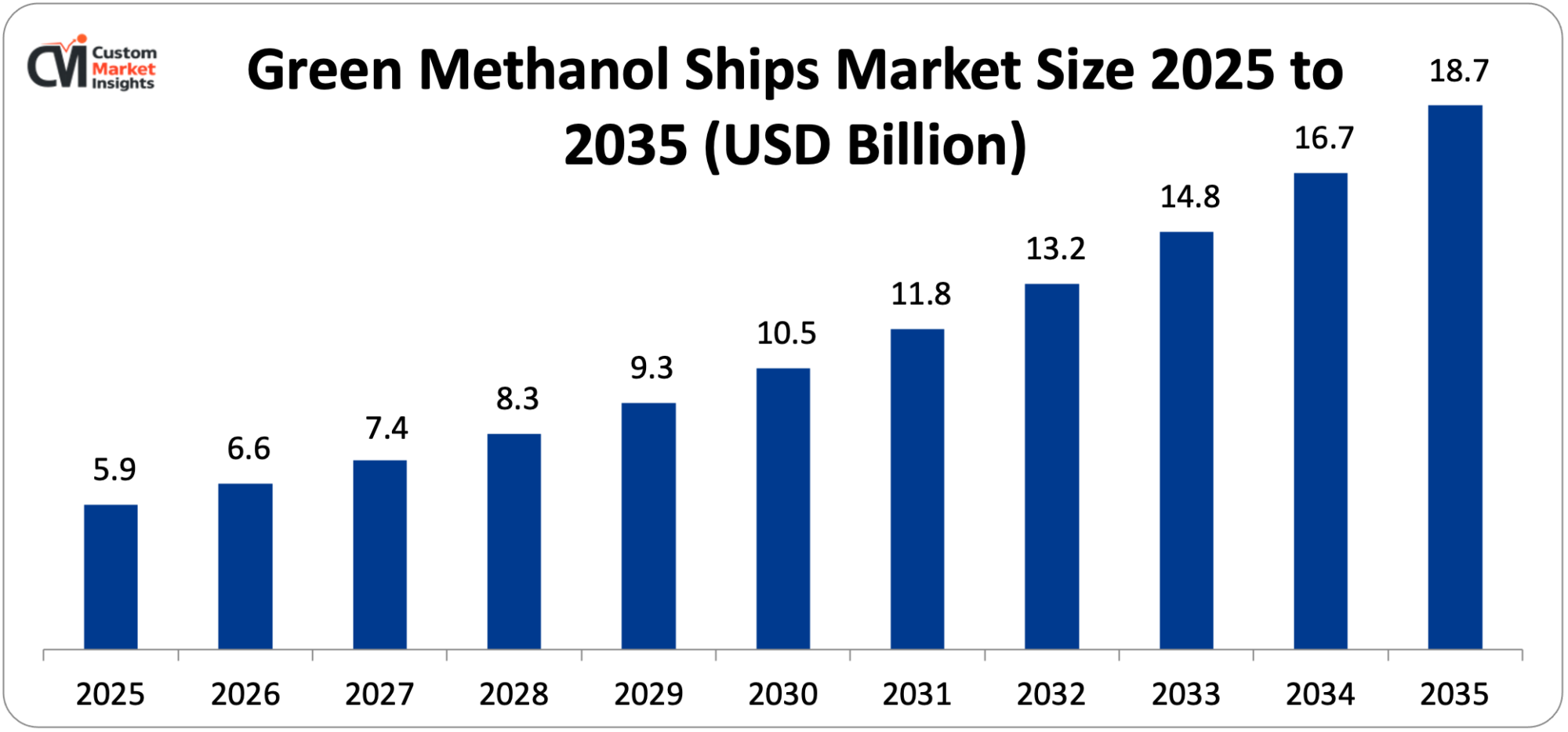
The Green Methanol Ships Market in the world is projected to hit USD 6.6 billion in the year 2026 and is estimated to reach USD 18.7 billion in the year 2035 having the CAGR projected to be 13.7% in the future of 2026-2035. The market is growing because of the increased demand for low-carbon and sustainable marine fuels, the high demand of strict environmental regulations, decarbonization targets, and the desire of the maritime industry to lower greenhouse gas emissions.
The advent of the market is further escalated by greater investments in green methanol production, newbuild vessels being ordered to run on methanol, and the retrofitting of the existing fleet. Also, the studies in dual-fuel engine technology and the development of their infrastructure, methanol bunkering, and the favorable attitude of shipping companies and port authorities also play a vital part in the general market development.
Market Highlight
- The Green Methanol Ships Market in 2025 is dominated by the Asia Pacific with a market share of 43% due to the robust shipbuilding industry, the increasing orders of methanol-powered vessels, and the favourable decarbonization policies.
- Europe shall experience the highest CAGR of 14.1% in the period of forecast 2026-2035 because of the strict maritime regulation and high-scale investment in the manufacturing and storing of green methanol.
- The container ships segment had the greatest market share of 39.5% in 2025 because more large capacity vessels are going to be powered by methanol and sent to the international trade, whereas the ferry and Ro-Ro vessels segment had the highest CAGR of 13.6% between 2026 and 2035 as more vessels are set to be commissioned to run on low-emission engines.
- By Ship Type, newbuild vessels powered by methane captured 62.3% of the market share in 2025 as shipping companies are actively investing in the next-generation dual-fuel vessels, but retrofitted/converted ones are predicted to enjoy strong growth throughout the forecast period.
- By Fuel Type bio-methanol dominated the market with 48.6% of total market share in 2025 because of its instant availability and the ability to use it with current engine technologies but e-methanol is expected to experience the highest CAGR by 2035 following the proliferation of green hydrogen initiatives.
- Concerning Propulsion System, the percentage of dual-fuel engines is 55.3 in the market in 2025 due to the flexibility of operation, although there is a significant growth forecast in the use of methanol-dedicated engines in the years to come.
- By Application, deep-sea shipping will dominate with a 46.8% market share in 2025, with the assistance of the expanding use of large-size methanol-powered vessels, but short-sea and inland waterways will steadily increase owing to regional emission requirements.
- In Technology & Infrastructure, both methanol-ready engine technology and onboard fuel storage systems each had half the market in 2025 with bunkering infrastructure expected to grow at the strongest rate in 2026–2035 as the world network of ports continues the rapid uptake of methanol fuel.
Significant Growth Factors
It is mainly the rapid decarbonization endeavors by the maritime industry, the mounting pressure on the industry to cut down on the emission of greenhouse gases, mega investments in alternative marine fuels, and other marine infrastructure that have propelled the strong growth in the Green Methanol Ships Market.
- Increasing Orders of Methanol-powered Vessel: The increase in the orders of methanol-fueled vessels by the major shipping companies all over the world is one of the significant growth drivers. In June 2023, AP Moller -Maersk declared that the first methanol-powered container ship would be introduced to operate along one of the largest trade routes, which represented a breakthrough in the sphere of low-emission shipping. In March 2023, CMA CGM already announced orders of another series of dual-fuel methanol shipping containers to promote its net-zero carbon approach. Equally, in October 2023, COSCO Shipping announced it was planning to increase its fleet with methanol-powered ships as it plans its roadmap to green transformation. These projects show a paradigm change towards deep sea shipping using alternative fuels and this would greatly increase the need for engines and vessels that run on green methanol.
- Green Methanol Production & Bunkering Infrastructure Expansion: Infrastructure preparedness is the other important growth determinant. Methanex Corporation in May 2023 unveiled strategic measures to provide renewable methanol to the marine fuel business that will enhance fuel supply. European Energy started producing e-methanol in large quantities in December of 2023 at its Kassou plant as a way of supplying shipping customers. Also, in 2024, MAN Energy Solutions stated that it was making more deliveries of dual-fuel methanol engines to newbuild vessels, indicating an increasing use of technology. Increasing port bunkering capacity, the development of green fuel production facilities in parallel with the growth of technology to meet the requirements of methanol-ready engines, and the development of green methanol ships is speeding up the commercial viability of green ships worldwide.
The Major Innovations That are Transforming the Green Methanol Ships Market of the Modern World.
- Next-Generation Methanol Engine and Dual-Fuel Technology: Engine builders are quickly expanding the sphere of innovation in order to make the methanol-powered ships more efficient and their work more flexible. In February 2023, MAN Energy Solutions announced that it was beginning a commercial test of the ME-LGIM two-stroke two-fuel methanol engine that will be installed in large container ships to provide a meaningful reduction in CO₂. In June 2024, WinGD had reported that it was successfully testing and delivering its X-DF-M methanol-powered engine platform, which is more economical in its range of fuel and also its methane slip is less than systems made in conventional ways. These inventions are also assisting shipowners to adopt scalable propulsion systems, which are future-oriented, and also to comply with the tightening IMO emission regulations.
- Introduction of Green Methanol Vessels and Fleet Growth: The commercial shipping vessels and shipbuilding companies are initiating commercial-scale vessels using methanol. In June 2023, AP Moller -Maersk launched the first container feeder ship operated by methanol in the world, which is a significant advancement in the alternative marine fuels system. Orders for container ships with complex fuel storage and safety systems powered by methanol were received at HD Hyundai Heavy Industries in September 2024. These developments indicate strong faith of the industry in methanol as a possible marine fuel and a long-run solution.
- Capacity Building on production and strategic Partnerships: The supply chain system is being improved by green methanol production. In March 2024, European Energy began its large-scale e-methanol plant in Denmark in order to supply shipping customers. In July 2023, OCI Global announced the intention of expanding production of renewable methanol as the producer of marine fuels. Such capacity expansions and the long term offtake agreements between the fuel producers and shipping companies are improving the availability of fuels in addition to accelerating the commercialization of green methanol shipping vessels in the world.
Category Wise Insights
By Vessel Type
What is Making Container Ships a Market Leader?
It is projected that in 2025, container ships will have the biggest market share in the Green Methanol Ships Market. The two main motivational factors of this leadership are the decarbonization intentions of large international liner operators and the heavy fuel use of large container vessels shipping on the deep-sea routes. With the growth in international trade and the establishment of new regulatory regimes like IMO emission targets, shipping firms are now placing orders for the acquisition of methanol-powered container vessels to lower carbon intensity and meet the environmental requirements.
Methanol should be especially adopted by container vessels due to the fact that their routes are fixed, which allows the fuel supply planning and the development of the bunkering infrastructure to become more viable. There is also a design of large new-build container vessels with dual-fuel engines and methanol-capable systems so that they will be flexible in terms of long-term operations.
The ferries and Ro-Ro vessels division is also expected to have the highest CAGR in the period of 2026-2035 because of the increasing regional emission standards and the increasing demand for low-emission short-haul shipping options, in particular, in Europe and in some parts of Asia.
By Ship Type
Why Newbuild Vessels control the market?
The market is expected to be dominated in 2025 by the largest portion of newbuild vessels because shipowners are investing in methanol-powered ships of the next generation instead of retrofitting older vessels. Newbuilds permit the placement of fuel tanks in the most optimum way, the combination of safety systems, and more modern dual-fuel engine designs, which increase efficiency and adherence to new environmental requirements.
The retrofitted and converted vessels, however, are likely to experience a gradual growth in the forecast period, with operators aiming at finding cost-effective solutions to prolong the lifespan of the current ships and to decrease carbon emissions. Retrofitting is also very appealing to the fairly young ships that have plenty of operational life before them.
By Fuel Type
Why Bio-Methanol Makes Headway and E-Methanol Wins Ground?
Bio-methanol will have the highest market share in 2025 because it can be commercialized and works with the available dual-fuel engine technology. It gives immediate reduction benefits and is a practical transition fuel to shipping companies.
E-methanol, which is produced using green hydrogen and trapped CO₂, is expected to record the most growth rate during the period between 2026 and 2035. The growth of renewable energy investments and power-to-x plants promises to increase its availability, which can be considered one of the primary long-term solutions to the development of net-zero in the marine industry.
Dual-fuel systems are also an important consideration to ensure that the vessels can alternate between methanol and traditional marine fuels to increase the flexibility of their operation and minimize the risks of fuel supply.
By Propulsion System
The Dual-Fuel Engines are taking over? Why?
In 2025, the market is dominated by the use of dual-fuel engines, which are flexible, reliable, and less risky in terms of transition. Such systems allow the ships to run on methanol and maintain the capacity to use conventional fuel where needed, which means that the operations will not be disrupted in the initial phases of development of the fuel infrastructure.
There is a prospect that methanol-specific engines will become popular in the long term with the rampant production of green methanol in the world. Onboard energy consumption also produces emissions and augmented by systems that utilize methanol-compatible technology, auxiliary power systems are becoming central to minimizing the emission.
By Application
Why is Deep-Sea Shipping a Segment Leader?
The deep-sea shipping is projected to take the highest market share in 2025, as it will be fuelled by the use of large container ships that run on methanol along major international shipping routes. Long-haul ships use immense amounts of fuel, and they become the priority of the decarbonization efforts.
The short-sea shipping and the inland waterways are expected to increase gradually considering the tightening of regional emission standards and government stimulation of cleaner marine fuels. Methanol-powered support vessels are also slowly becoming a common practice among offshore operations as a method of mitigating the emissions during maritime operations that consume a lot of energy.
By End User
Why are Commercial Shipping Companies Dominating?
The biggest end-user group in 2025 is commercial shipping companies which have large fleets and are under pressure by regulators, investors and cargo owners to decarbonize supply chains. The large logistics players are focusing on low-carbon shipping solutions to fulfill ESG obligations and customer sustainability demands.
The ferry operators, as well as the cruise operators are projected to experience huge growth with people inclined to environmentally friendly transport. The offshore energy companies are also slowly incorporating methanol-powered ships into their fleet in an effort to comply with the corporate sustainability objectives.
Technology and Infrastructure.
Why Methanol-Ready Engine Technology and Bunkering Infrastructure Is so Important?
The future in 2025 is dominated by methanol-ready engine technology where shipowners are even requesting vessels that will allow a future-fueling option. Rapid onboard fuel storage and handling products ensure safe containment and distribution of methanol that possesses varying chemical characteristics with conventional marine fuels.
The fastest growth should be documented in the sphere of methanol bunkering infrastructure in 2026–2035. Massive growth in port fuel supply chains and the investment in specific storage facilities of methanol are both necessary to facilitate large-scale adoption. With the advancement of infrastructure, the operational barriers will reduce, and the world will shift faster to green-powered shipping using methanol.
Report Scope
| Feature of the Report | Details |
| Market Size in 2026 | USD 6.6 billion |
| Projected Market Size in 2035 | USD 18.7 billion |
| Market Size in 2025 | USD 5.9 billion |
| CAGR Growth Rate | 13.7% CAGR |
| Base Year | 2025 |
| Forecast Period | 2026-2035 |
| Key Segment | By Vessel Type, Ship Type, Fuel Type, Propulsion System, Application, End User, Technology & Infrastructure and Region |
| Report Coverage | Revenue Estimation and Forecast, Company Profile, Competitive Landscape, Growth Factors and Recent Trends |
| Regional Scope | North America, Europe, Asia Pacific, Middle East & Africa, and South & Central America |
| Buying Options | Request tailored purchasing options to fulfil your requirements for research. |
Regional Analysis
What Is the Size of the Asia Pacific Market?
The Asia Pacific Green Methanol Ships Market is estimated to reach USD 2.15 billion in 2025, recording a CAGR of 14.2% in 2026-2035. It is the largest and fastest-growing market in the world with the strong shipbuilding capacity, growing maritime trading, and growing commitments of the governments to decarbonize the shipping industry.
Why Did Asia Pacific Dominate the Market in 2025?
Asia Pacific contributed to approximately 35.85% of the total global market share in the year 2025 majorly because of the existence of a great number of shipbuilding nations which included China, South Korea and Japan. It has the advantage of mass capacity of building vessels, pioneering the development of alternative marine fuels, and careful investment in the production of green methanol. The increase in shipping infrastructure, high rates of export-based economies, and rapid industrialization have also heightened the need to have low-emission vessels.
Moreover, they are also being boosted by friendly government policies, carbon non-emission goals, and collaborations between ship constructors and engine producers to hasten the adoption of ships powered by methanol, bulk carriers, and tankers. The leadership of the region is anticipated to persist in the forecast period as shipyards continue to produce more and more vessels that are methanol ready and those that can run on dual fuels.
China Market Trend
China dominates the Asia Pacific market because of its superiority in world shipbuilding and heavy investment in other marine fuel technologies. There is an increase in the use of methanol-powered container ships and bulk carriers in the country, which is facilitated by the state-sponsored decarbonization programs and the growth of local plants that produce green methanol. Heightened cooperation among shipbuilders, fuel producers, and port authorities is also enhancing the market prospect of China.
What Is Fueling the Continued North American Growth?
The growth of North America is projected to rise steadily with a CAGR of 13.8% in 2026-2035 owing to the growing ESG commitments of shipping operators and the rise in investments in renewable fuel facilities. There is an increased demand for methanol as a transitional marine energy in the region because of its reduced emissions profile and capability to operate with the current engine technology.
The powerful presence of marine fuel producers, the advancement of technological moving engines in dual fuel systems, and the governmental incentives towards cleaner shipping are leading to expansion in the region. The port authorities are also considering methanol bunkering infrastructure to facilitate vessel demand in the future.
How Big is the U.S. Market?
U.S. Green Methanol Ships Market: the market is projected to be USD 1.2 Billion in 2025 and is anticipated to expand by 14.2% in terms of CAGR between 2026 and 2035.
U.S. Market Trends
The U.S. market is motivated due to regulatory focus on reducing maritime emissions and modernizing commercial fleets, which is on the increase. Domestic fuels are becoming more capable of supplying domestic fuel as a result of increasing investments in green hydrogen and renewable methanol production projects. Further, transatlantic and coastal shipping companies are slowly changing to dual-fuel methanol ships to comply with the sustainability goals.
What is the Reason Why Europe is so Concentrated on Sustainability and Maritime Decarbonization?
Europe constitutes a considerable portion of the world Green Methanol Ships Market as it has rather strict environmental policies and a range of goals related to achieving carbon neutrality. The emission trading programs of the European Union and maritime fuel standards are hastening the utilization of low-carbon fuels including green methanol.
Germany, Denmark, and the Netherlands are among some of the countries that are investing actively in e-methanol production plants and port bunkering equipment. It is also shown that the region experiences high use of dual-fuel engines and methanol-ready vessels especially in container shipping and short-sea transport.
Germany Market Trends
Germany is important in Europe because it has a competitive marine engineering industry and is in the forefront of advanced propulsion technologies. German manufacturers are also concentrating on high-performance two-fuel engines, fuel management and sustainable ship design solutions which will help grow the market in the long term.
What Drives Growth in the Middle East and Africa?
Middle East Africa is undergoing slow growth with growth in maritime trade, modernization of ports, and diversification policies other than the reliance on fossil fuels. The Gulf nations are also investing in the production of green hydrogen and renewable fuels, especially Saudi Arabia and the United Arab Emirates, which would be used in future e-methanol supply chains.
In Africa, the avenue of growth is the boost in the port infrastructure and the increasing need to find cleaner shipping options in the main trade routes. Although the adoption remains at the preliminary phase, the enhanced availability of the fuel and international shipping alliances is likely to open up new possibilities to the use of green methanol-powered vessels over the forecast period.
Top Players in the Market and Their Offerings
- CMA CGM
- COSCO Shipping
- MAN Energy Solutions
- WinGD
- HD Hyundai Heavy Industries
- Mitsubishi Heavy Industries
- Methanex Corporation
- European Energy
- OCI Global
- Proman
- Stena Line
- Others
Key Developments
The Green Methanol Ships Market has seen tremendous progress as major shipping operators, engine makers, and fuel suppliers hasten their investment in alternative marine fuels, dual-fuel propulsion systems and green methanol production capacity as a way to consolidate their competitive positioning and decarbonization strategies.
- Increased commercial adoption of its ME-LGIM dual-fuel methanol engines in large container vessels by shipowners MAN Energy Solutions announced in February 2023 that its engines are increasingly being commercialized to help shipowners cut their carbon emissions and retain the flexibility of fuel usage.
- Methanex Corporation– May 2023 Methanex Corporation announced plans to increase the supply of renewable methanol as a marine fuel to ease the world fuel supply as the fleet of methanol-powered vessels continues to grow.
These strategic developments have seen companies increase technological capacities, improve production capacity of green methanol, enhance bunkering facilities, and improve the global adoption of low-emission marine transportation.
The Green Methanol Ships Market is segmented as follows:
By Vessel Type
- Container Ships
- Bulk Carriers
- Tankers
- Ferries
- Ro-Ro Vessels
- Cruise Ships
- Offshore Support Vessels
By Ship Type
- Newbuild Vessels
- Retrofitted/Converted Vessels
By Fuel Type
- Bio-Methanol
- E-Methanol
- Dual-Fuel Systems
By Propulsion System
- Dual-Fuel Engines
- Methanol-Dedicated Engines
- Auxiliary Power Systems
By Application
- Deep-Sea Shipping
- Short-Sea Shipping
- Inland Waterways
- Offshore Operations
By End User
- Commercial Shipping Companies
- Cargo & Logistics Operators
- Passenger Transport Operators
- Offshore Energy Companies
By Technology & Infrastructure
- Methanol-Ready Engine Technology
- Onboard Fuel Storage Systems
- Fuel Handling & Safety Systems
- Methanol Bunkering Infrastructure
- Port Fuel Supply Networks
Regional Coverage:
North America
- U.S.
- Canada
- Mexico
- Rest of North America
Europe
- Germany
- France
- U.K.
- Russia
- Italy
- Spain
- Netherlands
- Rest of Europe
Asia Pacific
- China
- Japan
- India
- New Zealand
- Australia
- South Korea
- Taiwan
- Rest of Asia Pacific
The Middle East & Africa
- Saudi Arabia
- UAE
- Egypt
- Kuwait
- South Africa
- Rest of the Middle East & Africa
Latin America
- Brazil
- Argentina
- Rest of Latin America
Table of Contents
- Chapter 1. Report Introduction
- 1.1. Report Description
- 1.1.1. Purpose of the Report
- 1.1.2. USP & Key Offerings
- 1.2. Key Benefits For Stakeholders
- 1.3. Target Audience
- 1.4. Report Scope
- 1.1. Report Description
- Chapter 2. Market Overview
- 2.1. Report Scope (Segments And Key Players)
- 2.1.1. Green Methanol Ships by Segments
- 2.1.2. Green Methanol Ships by Region
- 2.2. Executive Summary
- 2.2.1. Market Size & Forecast
- 2.2.2. Green Methanol Ships Market Attractiveness Analysis, By Vessel Type
- 2.2.3. Green Methanol Ships Market Attractiveness Analysis, By Ship Type
- 2.2.4. Green Methanol Ships Market Attractiveness Analysis, By Fuel Type
- 2.2.5. Green Methanol Ships Market Attractiveness Analysis, By Propulsion System
- 2.2.6. Green Methanol Ships Market Attractiveness Analysis, By Application
- 2.2.7. Green Methanol Ships Market Attractiveness Analysis, By End User
- 2.2.8. Green Methanol Ships Market Attractiveness Analysis, By Technology & Infrastructure
- 2.1. Report Scope (Segments And Key Players)
- Chapter 3. Market Dynamics (DRO)
- 3.1. Market Drivers
- 3.1.1. Increasing Orders of Methanol-powered Vessel
- 3.1.2. Green Methanol Production & Bunkering Infrastructure Expansion
- 3.2. Market Restraints
- 3.3. Market Opportunities
- 3.5. Pestle Analysis
- 3.6. Porter Forces Analysis
- 3.7. Technology Roadmap
- 3.8. Value Chain Analysis
- 3.9. Government Policy Impact Analysis
- 3.10. Pricing Analysis
- 3.1. Market Drivers
- Chapter 4. Green Methanol Ships Market – By Vessel Type
- 4.1. Vessel Type Market Overview, By Vessel Type Segment
- 4.1.1. Green Methanol Ships Market Revenue Share, By Vessel Type, 2025 & 2035
- 4.1.2. Container Ships
- 4.1.3. Green Methanol Ships Share Forecast, By Region (USD Billion)
- 4.1.4. Comparative Revenue Analysis, By Country, 2025 & 2035
- 4.1.5. Key Market Trends, Growth Factors, & Opportunities
- 4.1.6. Bulk Carriers
- 4.1.7. Green Methanol Ships Share Forecast, By Region (USD Billion)
- 4.1.8. Comparative Revenue Analysis, By Country, 2025 & 2035
- 4.1.9. Key Market Trends, Growth Factors, & Opportunities
- 4.1.10. Tankers
- 4.1.11. Green Methanol Ships Share Forecast, By Region (USD Billion)
- 4.1.12. Comparative Revenue Analysis, By Country, 2025 & 2035
- 4.1.13. Key Market Trends, Growth Factors, & Opportunities
- 4.1.14. Ferries
- 4.1.15. Green Methanol Ships Share Forecast, By Region (USD Billion)
- 4.1.16. Comparative Revenue Analysis, By Country, 2025 & 2035
- 4.1.17. Key Market Trends, Growth Factors, & Opportunities
- 4.1.18. Ro-Ro Vessels
- 4.1.19. Green Methanol Ships Share Forecast, By Region (USD Billion)
- 4.1.20. Comparative Revenue Analysis, By Country, 2025 & 2035
- 4.1.21. Key Market Trends, Growth Factors, & Opportunities
- 4.1.22. Cruise Ships
- 4.1.23. Green Methanol Ships Share Forecast, By Region (USD Billion)
- 4.1.24. Comparative Revenue Analysis, By Country, 2025 & 2035
- 4.1.25. Key Market Trends, Growth Factors, & Opportunities
- 4.1.26. Offshore Support Vessels
- 4.1.27. Green Methanol Ships Share Forecast, By Region (USD Billion)
- 4.1.28. Comparative Revenue Analysis, By Country, 2025 & 2035
- 4.1.29. Key Market Trends, Growth Factors, & Opportunities
- 4.1. Vessel Type Market Overview, By Vessel Type Segment
- Chapter 5. Green Methanol Ships Market – By Ship Type
- 5.1. Ship Type Market Overview, By Ship Type Segment
- 5.1.1. Green Methanol Ships Market Revenue Share, By Ship Type, 2025 & 2035
- 5.1.2. Newbuild Vessels
- 5.1.3. Green Methanol Ships Share Forecast, By Region (USD Billion)
- 5.1.4. Comparative Revenue Analysis, By Country, 2025 & 2035
- 5.1.5. Key Market Trends, Growth Factors, & Opportunities
- 5.1.6. Retrofitted/Converted Vessels
- 5.1.7. Green Methanol Ships Share Forecast, By Region (USD Billion)
- 5.1.8. Comparative Revenue Analysis, By Country, 2025 & 2035
- 5.1.9. Key Market Trends, Growth Factors, & Opportunities
- 5.1. Ship Type Market Overview, By Ship Type Segment
- Chapter 6. Green Methanol Ships Market – By Fuel Type
- 6.1. Fuel Type Market Overview, By Fuel Type Segment
- 6.1.1. Green Methanol Ships Market Revenue Share, By Fuel Type, 2025 & 2035
- 6.1.2. Bio-Methanol
- 6.1.3. Green Methanol Ships Share Forecast, By Region (USD Billion)
- 6.1.4. Comparative Revenue Analysis, By Country, 2025 & 2035
- 6.1.5. Key Market Trends, Growth Factors, & Opportunities
- 6.1.6. E-Methanol
- 6.1.7. Green Methanol Ships Share Forecast, By Region (USD Billion)
- 6.1.8. Comparative Revenue Analysis, By Country, 2025 & 2035
- 6.1.9. Key Market Trends, Growth Factors, & Opportunities
- 6.1.10. Dual-Fuel Systems
- 6.1.11. Green Methanol Ships Share Forecast, By Region (USD Billion)
- 6.1.12. Comparative Revenue Analysis, By Country, 2025 & 2035
- 6.1.13. Key Market Trends, Growth Factors, & Opportunities
- 6.1. Fuel Type Market Overview, By Fuel Type Segment
- Chapter 7. Green Methanol Ships Market – By Propulsion System
- 7.1. Propulsion System Market Overview, By Propulsion System Segment
- 7.1.1. Green Methanol Ships Market Revenue Share, By Propulsion System, 2025 & 2035
- 7.1.2. Dual-Fuel Engines
- 7.1.3. Green Methanol Ships Share Forecast, By Region (USD Billion)
- 7.1.4. Comparative Revenue Analysis, By Country, 2025 & 2035
- 7.1.5. Key Market Trends, Growth Factors, & Opportunities
- 7.1.6. Methanol-Dedicated Engines
- 7.1.7. Green Methanol Ships Share Forecast, By Region (USD Billion)
- 7.1.8. Comparative Revenue Analysis, By Country, 2025 & 2035
- 7.1.9. Key Market Trends, Growth Factors, & Opportunities
- 7.1.10. Auxiliary Power Systems
- 7.1.11. Green Methanol Ships Share Forecast, By Region (USD Billion)
- 7.1.12. Comparative Revenue Analysis, By Country, 2025 & 2035
- 7.1.13. Key Market Trends, Growth Factors, & Opportunities
- 7.1. Propulsion System Market Overview, By Propulsion System Segment
- Chapter 8. Green Methanol Ships Market – By Application
- 8.1. Application Market Overview, By Application Segment
- 8.1.1. Green Methanol Ships Market Revenue Share, By Application, 2025 & 2035
- 8.1.2. Deep-Sea Shipping
- 8.1.3. Green Methanol Ships Share Forecast, By Region (USD Billion)
- 8.1.4. Comparative Revenue Analysis, By Country, 2025 & 2035
- 8.1.5. Key Market Trends, Growth Factors, & Opportunities
- 8.1.6. Short-Sea Shipping
- 8.1.7. Green Methanol Ships Share Forecast, By Region (USD Billion)
- 8.1.8. Comparative Revenue Analysis, By Country, 2025 & 2035
- 8.1.9. Key Market Trends, Growth Factors, & Opportunities
- 8.1.10. Inland Waterways
- 8.1.11. Green Methanol Ships Share Forecast, By Region (USD Billion)
- 8.1.12. Comparative Revenue Analysis, By Country, 2025 & 2035
- 8.1.13. Key Market Trends, Growth Factors, & Opportunities
- 8.1.14. Offshore Operations
- 8.1.15. Green Methanol Ships Share Forecast, By Region (USD Billion)
- 8.1.16. Comparative Revenue Analysis, By Country, 2025 & 2035
- 8.1.17. Key Market Trends, Growth Factors, & Opportunities
- 8.1. Application Market Overview, By Application Segment
- Chapter 9. Green Methanol Ships Market – By End User
- 9.1. End User Market Overview, By End User Segment
- 9.1.1. Green Methanol Ships Market Revenue Share, By End User, 2025 & 2035
- 9.1.2. Commercial Shipping Companies
- 9.1.3. Green Methanol Ships Share Forecast, By Region (USD Billion)
- 9.1.4. Comparative Revenue Analysis, By Country, 2025 & 2035
- 9.1.5. Key Market Trends, Growth Factors, & Opportunities
- 9.1.6. Cargo & Logistics Operators
- 9.1.7. Green Methanol Ships Share Forecast, By Region (USD Billion)
- 9.1.8. Comparative Revenue Analysis, By Country, 2025 & 2035
- 9.1.9. Key Market Trends, Growth Factors, & Opportunities
- 9.1.10. Passenger Transport Operators
- 9.1.11. Green Methanol Ships Share Forecast, By Region (USD Billion)
- 9.1.12. Comparative Revenue Analysis, By Country, 2025 & 2035
- 9.1.13. Key Market Trends, Growth Factors, & Opportunities
- 9.1.14. Offshore Energy Companies
- 9.1.15. Green Methanol Ships Share Forecast, By Region (USD Billion)
- 9.1.16. Comparative Revenue Analysis, By Country, 2025 & 2035
- 9.1.17. Key Market Trends, Growth Factors, & Opportunities
- 9.1. End User Market Overview, By End User Segment
- Chapter 10. Green Methanol Ships Market – By Technology & Infrastructure
- 10.1. Technology & Infrastructure Market Overview, By Technology & Infrastructure Segment
- 10.1.1. Green Methanol Ships Market Revenue Share, By Technology & Infrastructure, 2025 & 2035
- 10.1.2. Methanol-Ready Engine Technology
- 10.1.3. Green Methanol Ships Share Forecast, By Region (USD Billion)
- 10.1.4. Comparative Revenue Analysis, By Country, 2025 & 2035
- 10.1.5. Key Market Trends, Growth Factors, & Opportunities
- 10.1.6. Onboard Fuel Storage Systems
- 10.1.7. Green Methanol Ships Share Forecast, By Region (USD Billion)
- 10.1.8. Comparative Revenue Analysis, By Country, 2025 & 2035
- 10.1.9. Key Market Trends, Growth Factors, & Opportunities
- 10.1.10. Fuel Handling & Safety Systems
- 10.1.11. Green Methanol Ships Share Forecast, By Region (USD Billion)
- 10.1.12. Comparative Revenue Analysis, By Country, 2025 & 2035
- 10.1.13. Key Market Trends, Growth Factors, & Opportunities
- 10.1.14. Methanol Bunkering Infrastructure
- 10.1.15. Green Methanol Ships Share Forecast, By Region (USD Billion)
- 10.1.16. Comparative Revenue Analysis, By Country, 2025 & 2035
- 10.1.17. Key Market Trends, Growth Factors, & Opportunities
- 10.1.18. Port Fuel Supply Networks
- 10.1.19. Green Methanol Ships Share Forecast, By Region (USD Billion)
- 10.1.20. Comparative Revenue Analysis, By Country, 2025 & 2035
- 10.1.21. Key Market Trends, Growth Factors, & Opportunities
- 10.1. Technology & Infrastructure Market Overview, By Technology & Infrastructure Segment
- Chapter 11. Green Methanol Ships Market – Regional Analysis
- 11.1. Green Methanol Ships Market Overview, By Region Segment
- 11.1.1. Global Green Methanol Ships Market Revenue Share, By Region, 2025 & 2035
- 11.1.2. Global Green Methanol Ships Market Revenue, By Region, 2026 – 2035 (USD Billion)
- 11.1.3. Global Green Methanol Ships Market Revenue, By Vessel Type, 2026 – 2035
- 11.1.4. Global Green Methanol Ships Market Revenue, By Ship Type, 2026 – 2035
- 11.1.5. Global Green Methanol Ships Market Revenue, By Fuel Type, 2026 – 2035
- 11.1.6. Global Green Methanol Ships Market Revenue, By Propulsion System, 2026 – 2035
- 11.1.7. Global Green Methanol Ships Market Revenue, By Application, 2026 – 2035
- 11.1.8. Global Green Methanol Ships Market Revenue, By End User, 2026 – 2035
- 11.1.9. Global Green Methanol Ships Market Revenue, By Technology & Infrastructure, 2026 – 2035
- 11.2. North America
- 11.2.1. North America Green Methanol Ships Market Revenue, By Country, 2026 – 2035 (USD Billion)
- 11.2.2. North America Green Methanol Ships Market Revenue, By Vessel Type, 2026 – 2035
- 11.2.3. North America Green Methanol Ships Market Revenue, By Ship Type, 2026 – 2035
- 11.2.4. North America Green Methanol Ships Market Revenue, By Fuel Type, 2026 – 2035
- 11.2.5. North America Green Methanol Ships Market Revenue, By Propulsion System, 2026 – 2035
- 11.2.6. North America Green Methanol Ships Market Revenue, By Application, 2026 – 2035
- 11.2.7. North America Green Methanol Ships Market Revenue, By End User, 2026 – 2035
- 11.2.8. North America Green Methanol Ships Market Revenue, By Technology & Infrastructure, 2026 – 2035
- 11.2.9. U.S. Green Methanol Ships Market Revenue, 2026 – 2035 (USD Billion)
- 11.2.10. Canada Green Methanol Ships Market Revenue, 2026 – 2035 (USD Billion)
- 11.2.11. Mexico Green Methanol Ships Market Revenue, 2026 – 2035 (USD Billion)
- 11.2.12. Rest of North America Green Methanol Ships Market Revenue, 2026 – 2035 (USD Billion)
- 11.3. Europe
- 11.3.1. Europe Green Methanol Ships Market Revenue, By Country, 2026 – 2035 (USD Billion)
- 11.3.2. Europe Green Methanol Ships Market Revenue, By Vessel Type, 2026 – 2035
- 11.3.3. Europe Green Methanol Ships Market Revenue, By Ship Type, 2026 – 2035
- 11.3.4. Europe Green Methanol Ships Market Revenue, By Fuel Type, 2026 – 2035
- 11.3.5. Europe Green Methanol Ships Market Revenue, By Propulsion System, 2026 – 2035
- 11.3.6. Europe Green Methanol Ships Market Revenue, By Application, 2026 – 2035
- 11.3.7. Europe Green Methanol Ships Market Revenue, By End User, 2026 – 2035
- 11.3.8. Europe Green Methanol Ships Market Revenue, By Technology & Infrastructure, 2026 – 2035
- 11.3.9. Germany Green Methanol Ships Market Revenue, 2026 – 2035 (USD Billion)
- 11.3.10. France Green Methanol Ships Market Revenue, 2026 – 2035 (USD Billion)
- 11.3.11. U.K. Green Methanol Ships Market Revenue, 2026 – 2035 (USD Billion)
- 11.3.12. Russia Green Methanol Ships Market Revenue, 2026 – 2035 (USD Billion)
- 11.3.13. Italy Green Methanol Ships Market Revenue, 2026 – 2035 (USD Billion)
- 11.3.14. Spain Green Methanol Ships Market Revenue, 2026 – 2035 (USD Billion)
- 11.3.15. Netherlands Green Methanol Ships Market Revenue, 2026 – 2035 (USD Billion)
- 11.3.16. Rest of Europe Green Methanol Ships Market Revenue, 2026 – 2035 (USD Billion)
- 11.4. Asia Pacific
- 11.4.1. Asia Pacific Green Methanol Ships Market Revenue, By Country, 2026 – 2035 (USD Billion)
- 11.4.2. Asia Pacific Green Methanol Ships Market Revenue, By Vessel Type, 2026 – 2035
- 11.4.3. Asia Pacific Green Methanol Ships Market Revenue, By Ship Type, 2026 – 2035
- 11.4.4. Asia Pacific Green Methanol Ships Market Revenue, By Fuel Type, 2026 – 2035
- 11.4.5. Asia Pacific Green Methanol Ships Market Revenue, By Propulsion System, 2026 – 2035
- 11.4.6. Asia Pacific Green Methanol Ships Market Revenue, By Application, 2026 – 2035
- 11.4.7. Asia Pacific Green Methanol Ships Market Revenue, By End User, 2026 – 2035
- 11.4.8. Asia Pacific Green Methanol Ships Market Revenue, By Technology & Infrastructure, 2026 – 2035
- 11.4.9. China Green Methanol Ships Market Revenue, 2026 – 2035 (USD Billion)
- 11.4.10. Japan Green Methanol Ships Market Revenue, 2026 – 2035 (USD Billion)
- 11.4.11. India Green Methanol Ships Market Revenue, 2026 – 2035 (USD Billion)
- 11.4.12. New Zealand Green Methanol Ships Market Revenue, 2026 – 2035 (USD Billion)
- 11.4.13. Australia Green Methanol Ships Market Revenue, 2026 – 2035 (USD Billion)
- 11.4.14. South Korea Green Methanol Ships Market Revenue, 2026 – 2035 (USD Billion)
- 11.4.15. Taiwan Green Methanol Ships Market Revenue, 2026 – 2035 (USD Billion)
- 11.4.16. Rest of Asia Pacific Green Methanol Ships Market Revenue, 2026 – 2035 (USD Billion)
- 11.5. The Middle-East and Africa
- 11.5.1. The Middle-East and Africa Green Methanol Ships Market Revenue, By Country, 2026 – 2035 (USD Billion)
- 11.5.2. The Middle-East and Africa Green Methanol Ships Market Revenue, By Vessel Type, 2026 – 2035
- 11.5.3. The Middle-East and Africa Green Methanol Ships Market Revenue, By Ship Type, 2026 – 2035
- 11.5.4. The Middle-East and Africa Green Methanol Ships Market Revenue, By Fuel Type, 2026 – 2035
- 11.5.5. The Middle-East and Africa Green Methanol Ships Market Revenue, By Propulsion System, 2026 – 2035
- 11.5.6. The Middle-East and Africa Green Methanol Ships Market Revenue, By Application, 2026 – 2035
- 11.5.7. The Middle-East and Africa Green Methanol Ships Market Revenue, By End User, 2026 – 2035
- 11.5.8. The Middle-East and Africa Green Methanol Ships Market Revenue, By Technology & Infrastructure, 2026 – 2035
- 11.5.9. Saudi Arabia Green Methanol Ships Market Revenue, 2026 – 2035 (USD Billion)
- 11.5.10. UAE Green Methanol Ships Market Revenue, 2026 – 2035 (USD Billion)
- 11.5.11. Egypt Green Methanol Ships Market Revenue, 2026 – 2035 (USD Billion)
- 11.5.12. Kuwait Green Methanol Ships Market Revenue, 2026 – 2035 (USD Billion)
- 11.5.13. South Africa Green Methanol Ships Market Revenue, 2026 – 2035 (USD Billion)
- 11.5.14. Rest of the Middle East & Africa Green Methanol Ships Market Revenue, 2026 – 2035 (USD Billion)
- 11.6. Latin America
- 11.6.1. Latin America Green Methanol Ships Market Revenue, By Country, 2026 – 2035 (USD Billion)
- 11.6.2. Latin America Green Methanol Ships Market Revenue, By Vessel Type, 2026 – 2035
- 11.6.3. Latin America Green Methanol Ships Market Revenue, By Ship Type, 2026 – 2035
- 11.6.4. Latin America Green Methanol Ships Market Revenue, By Fuel Type, 2026 – 2035
- 11.6.5. Latin America Green Methanol Ships Market Revenue, By Propulsion System, 2026 – 2035
- 11.6.6. Latin America Green Methanol Ships Market Revenue, By Application, 2026 – 2035
- 11.6.7. Latin America Green Methanol Ships Market Revenue, By End User, 2026 – 2035
- 11.6.8. Latin America Green Methanol Ships Market Revenue, By Technology & Infrastructure, 2026 – 2035
- 11.6.9. Brazil Green Methanol Ships Market Revenue, 2026 – 2035 (USD Billion)
- 11.6.10. Argentina Green Methanol Ships Market Revenue, 2026 – 2035 (USD Billion)
- 11.6.11. Rest of Latin America Green Methanol Ships Market Revenue, 2026 – 2035 (USD Billion)
- 11.1. Green Methanol Ships Market Overview, By Region Segment
- Chapter 12. Competitive Landscape
- 12.1. Company Market Share Analysis – 2025
- 12.1.1. Global Green Methanol Ships Market: Company Market Share, 2025
- 12.2. Global Green Methanol Ships Market Company Market Share, 2024
- 12.1. Company Market Share Analysis – 2025
- Chapter 13. Company Profiles
- 13.1. CMA CGM
- 13.1.1. Company Overview
- 13.1.2. Key Executives
- 13.1.3. Product Portfolio
- 13.1.4. Financial Overview
- 13.1.5. Operating Business Segments
- 13.1.6. Business Performance
- 13.1.7. Recent Developments
- 13.2. COSCO Shipping
- 13.3. MAN Energy Solutions
- 13.4. WinGD
- 13.5. HD Hyundai Heavy Industries
- 13.6. Mitsubishi Heavy Industries
- 13.7. Methanex Corporation
- 13.8. European Energy
- 13.9. OCI Global
- 13.10. Proman
- 13.11. Stena Line
- 13.12. Others.
- 13.1. CMA CGM
- Chapter 14. Research Methodology
- 14.1. Research Methodology
- 14.2. Secondary Research
- 14.3. Primary Research
- 14.3.1. Analyst Tools and Models
- 14.4. Research Limitations
- 14.5. Assumptions
- 14.6. Insights From Primary Respondents
- 14.7. Why Custom Market Insights
- Chapter 15. Standard Report Commercials & Add-Ons
- 15.1. Customization Options
- 15.2. Subscription Module For Market Research Reports
- 15.3. Client Testimonials
List Of Figures
Figures No 1 to 52
List Of Tables
Tables No 1 to 66
Prominent Player
- CMA CGM
- COSCO Shipping
- MAN Energy Solutions
- WinGD
- HD Hyundai Heavy Industries
- Mitsubishi Heavy Industries
- Methanex Corporation
- European Energy
- OCI Global
- Proman
- Stena Line
- Others
FAQs
The key players in the market are CMA CGM, COSCO Shipping, MAN Energy Solutions, WinGD, HD Hyundai Heavy Industries , Mitsubishi Heavy Industries, Methanex Corporation, European Energy, OCI Global, Proman, Stena Line, Others.
The government regulations are important in spearheading the Green Methanol Ships Market. The Emission reduction targets provided by the International Maritime Organization (IMO), regional emission trading schemes, and fuel intensity standards are forcing shipping firms to adopt cleaner fuels. The further growth of the market is encouraged by the policies of renewable fuel production, green hydrogen projects, and decarbonization initiatives in ports. The low-emission vessel incentives, tighter sulfur and carbon rules, and sustainability requirements throughout the global trade routes are hastening the move to the use of green methanol as a possible alternative to marine fuel.
The initial capital investment in green-powered methanol vessels is more than in conventional vessels because of sophisticated dual-fuel engines, special fuel storage systems, and safety technologies. Nevertheless, the investment is well rewarded by long-term operations gains, including regulatory compliance, carbon levies, higher ESG ratings, and future fuel flexibility. By retrofitting existing vessels also provides a cost efficient transitional solution, and through financial incentives, green shipping funds and sustainability based financing structures shipowners are coping with upfront expenses.
Market growth will be provided by the further implementation of the use of methanol-powered vessels, the expansion of renewable methanol production, the development of infrastructures to store and bunker products, and the growing need to use low-emission maritime transportation technologies in commercial shipping, as well as in offshore activities.
This is projected to make the Asia Pacific lead in revenue share in the global Green Methanol Ships Market. High capacity shipbuilding in countries like china, south Korea and Japan and the growing maritime trade activities are the advantages of the region. The regional leadership is being led by increasing newbuilds of methanol-powered container vessels and bulk carriers, as well as supporting initiatives by governments to promote the cleanliness of shipping. The long-term supremacy of the Asia Pacific is further reinforced by the rapid development of port infrastructure and the preparation of the alternative fuels.
The CAGR of Europe is projected to be the highest within the forecast period of 2026–2035 because of the strict environmental policies, carbon pricing schemes, and forceful decarbonization of maritime transport in the region under the regional climate policies. The availability of major shipping vessels, engine manufacturers, and renewable fuel producers as well as massive investments in e-methanol production and e-methanol bunkering systems are boosting the growth rates in the region. High-growth market Europe is being positioned as a high-growth market with the strong policy alignment towards sustainable marine fuels.
It is expected that the worldwide Green Methanol Ships Market will experience robust growth because of the growing pressure to decarbonize the shipping industry, strict IMO emission policies, and the growing efforts of shipping corporations to become net-neutral. Increased world trade and excessive use of fuel in deep-sea shipping are compelling operators to consider low-carbon options like bio-methanol and e-methanol. Moreover, increasing investments in the green hydrogen and renewable methanol manufacturing facilities are enhancing the supply of fuels. There is also increased adoption through technological development of dual-fuel engines, vessels that are methanol-ready, and onboard fuel handling systems. Growth of methanol bunkering infrastructure in key ports and growth of sustainable fleet funding sources as well are also major sources of growth.