
In-Car Wireless Charging Market Size, Trends and Insights By Technology (Inductive Power Transfer, Conductive Charging, Magnetic Resonance Charging), By Device Type (Smartphones, Other Devices), By Distribution (OEM, Aftermarket), By Vehicle Type (Fuel Based, Electric Vehicle, Hybrid Vehicles), By Charging Standards (Qi Standard, PMA Standards), and By Region - Global Industry Overview, Statistical Data, Competitive Analysis, Share, Outlook, and Forecast 2026 – 2035
Report Snapshot
CAGR: 46.8%
| Study Period: | 2026-2035 |
| Fastest Growing Market: | Asia-Pacific |
| Largest Market: | North America |
Major Players
- Aircharge
- Mojo Mobility Inc.
- Power Square
- Zens
- Others
Reports Description
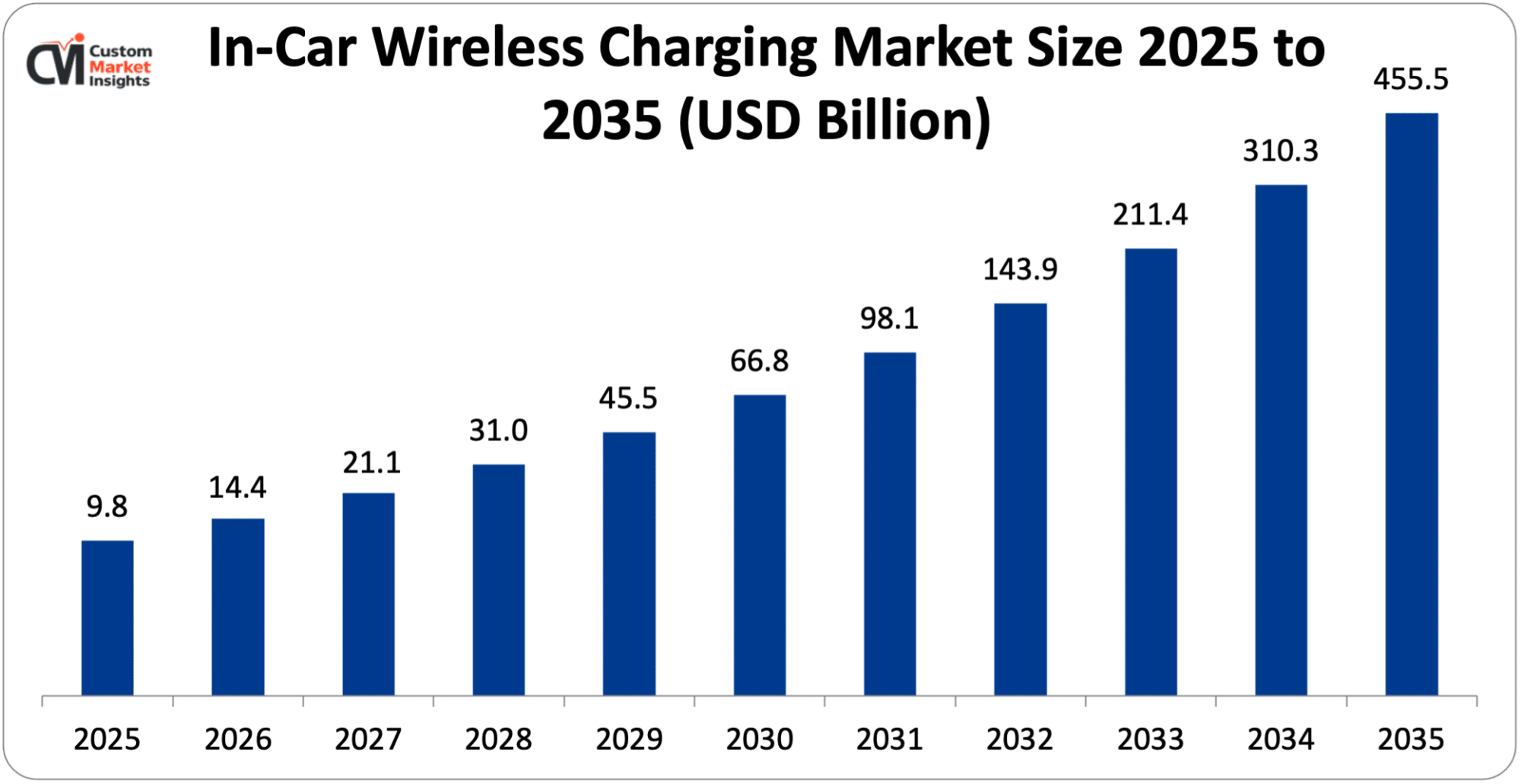
The market size of global in-car wireless charging will be estimated at USD 9.8 billion in 2025 and is expected to grow to between USD 14.4 billion in 2026 and about USD 455.5 billion by 2035, with a current CAGR (compound annual growth rate) of 46.8% during the period of 2026 to 2035. In-car wireless charging has become an increasingly desirable option for vehicles and involves having the ability to charge electronic devices (mostly smartphones) in a cable-free fashion by means of electromagnetic induction. While there are many different proprietary solutions on the market, most wireless charging in cars operates on the Qi standard, which involves placing the device on a charging pad located normally in the center console or dashboard.
Once the device is placed on the pad, energy is transferred wirelessly via inductive coupling between a transmitter coil in the car and a receiver coil in the device. Wireless charging in vehicles allows users to more easily connect and charge their devices without the clutter of cables and allows for easier interaction with the device due to less dislodging of the device or connector jamming. In-car wireless charging is a feature that is becoming more and more common as today‘s cars are loaded with more technologies and systems to interact with, namely infotainment such as navigation and media.
Market Highlight
- In 2025, North America will dominate the global market with an estimated market share of 44%. Increasing consumer preference for convenience drives the regional expansion.
- The Asia Pacific is growing at the highest CAGR over the analysis period. The increasing adoption of EVs drives the industry growth.
- By technology, the inductive power transfer segment accounted for the highest revenue share in 2025.
- By device type, the smartphones segment would have the highest share of the market in 2025.
- By distribution, the OEM segment would have the highest share of the market in 2025.
- By vehicle type, the electric vehicle segment would have the highest share of the market in 2025.
- By charging standards, the Qi standard segment would have the highest share of the market in 2025.
Significant Growth Factors
The in-car wireless charging market trends present significant growth opportunities due to several factors:
- Rising Smartphone Penetration & Usage in Vehicles: The sharp hike in penetration of smartphones all over the world drives the market for in-car wireless charging. Smartphones have become an inseparable part of people’s daily routines. We use it anywhere for our convenience, from navigation tracks to real-time call and app usage. As smartphone usage in cars increases, the demand for easy charging solutions has also grown, leading to the development of in-car wireless charging systems. Most of the systems are based on the Qi standard of wireless charging. Automakers will inevitably and increasingly put wireless charging modules in mid-range and premium vehicles to give consumers a more connected and comfortable driving experience, thereby boosting the market.
- Rising Consumer Preference for Convenience & Safety: Increasing consumer demand for comfort and safety will push growth of the in-car wireless charging market. More emphasis is beginning to be put on driver convenience, with a current emphasis on technological developments that make interfaces more user-friendly. In-car wireless charging (using the Qi standard) allows the device to be charged by simply placing it on a charging pad and without the need to connect it by wire while driving or be distracted while searching for a plug to plug the cord into. Also, managing less tangle and not having a bundle of cords is likely to resonate with consumers’ demands for a nice, ergonomic interior cabin. Unfussiness coupled with the absence of the worry of making sure one always has a phone charged enough to use their i-Path navigation and/or applications is likely to be a big selling point. As more consumers become aware of smarter and safer driving and have higher expectations of what comfort in a car should be like, it is expected that automakers will make the wireless charging feature either optional or standard.
What are the Major Advances Changing the In-Car Wireless Charging Market Today?
- Faster Wireless Charging (Qi2 & High-power Upgrades): The Qi2 wireless charging standard, together with the high-power charging system upgrades, which enable faster wireless charging, creates new opportunities for technological progress in automotive wireless charging systems. The older systems could only operate between 5W and 15W which resulted in charging problems because of their slow charging time, but Qi2 and its newest version have developed better performance capabilities through their ability to deliver 25W power while using magnetic alignment technology for improved efficiency and stability. The industry has progressed through several significant product launches together with key developments that occurred within it. Apple Inc. launched its next-generation MagSafe chargers, which operate within the Qi2 ecosystem to deliver improved wireless charging performance while establishing new standards for magnetic alignment and power efficiency. The Wireless Power Consortium introduced Qi2 and Qi2.2 standards, which created a worldwide charging system that enables high-speed wireless charging through multiple international charging stations. Panasonic Automotive Systems developed its advanced moving coil wireless charging technology, which enables drivers to maintain their vehicle’s optimal charging position while driving, which results in improved charging speed and reliability. The automotive industry now implements wireless charging systems with high power capabilities through their dual fast-charging pads, which use active cooling technology to provide higher power output than before. The new solutions solve previous challenges that affected charging speed and efficiency for wireless charging because they enable high-speed wireless charging as an efficient solution that automotive manufacturers now implement in their newest vehicles.
- Integration as a Standard Feature in Vehicles: The in-car wireless charging market has reached its current state because automotive manufacturers now include wireless charging as a standard feature in vehicles instead of offering it as an expensive optional extra. Automotive manufacturers have started to install wireless charging systems inside vehicles, which they place in either the center console or dashboard area so drivers can charge their devices without needing third-party charging products. The Qi wireless charging standard has achieved widespread adoption, which enables users to charge their smartphones and other devices through this technology. Major automotive manufacturers, together with Tier-1 suppliers, which include Continental AG and HARMAN International and Panasonic Automotive Systems, are currently implementing high-efficiency wireless charging modules into their infotainment and cockpit systems. The standardization process requires consumers to expect both convenient access to products and availability of connected car features and maintenance-free vehicle interiors. Wireless charging technology now serves as a standard feature for mid-range and entry-level vehicles because it began as a luxury feature that has now become common across the automotive market.
Category Wise Insights
By Technology
Why Does Inductive Power Transfer Hold a Prominent Position in the Market?
The inductive power transfer segment accounted for the highest revenue share in 2025. The growth is due to its widespread adoption across modern vehicles. Inductive power transfer enables efficient cable-free energy transmission between a vehicle charging pad and a compatible device, which uses the Qi wireless charging standard for interoperability with smartphones and automotive systems. The revenue growth of this segment exists because more people use smartphones in their vehicles to navigate and communicate and watch entertainment shows, which creates a demand for easy-to-use charging solutions that work all the time.
The magnetic resonance charging segment is growing at the highest CAGR during the forecast period. The in-car wireless charging market is experiencing significant revenue growth because more people are starting to use Magnetic Resonance Charging technology, which provides better charging options than standard inductive systems. Magnetic resonance charging enables devices to receive power from multiple charging points because it requires no perfect alignment between devices and charging stations. The system now provides better user reliability because it solves one crucial problem that existed in earlier wireless charging technologies: the inability to maintain a consistent charge when devices were not perfectly aligned with the charging pad. The demand for continuous and uninterrupted charging solutions drives revenue growth in this market segment because consumers use their smartphones for navigation purposes and entertainment activities and communication needs while driving.
By Device Type
Why Do Smartphones Capture the Highest Market Share in the In-Car Wireless Charging Market?
The smartphones segment would have the highest share of the market in 2025. The growth of the market sector occurs because users who rely on smartphones for their daily tasks drive its expansion. People now use their smartphones more when they drive because they want to use navigation systems and music services and communication apps and various applications, which has led to increased battery use on their devices during trips. People require charging solutions that allow them to power their devices while driving. In-car wireless charging systems, which use Qi wireless charging technology, enable users to wirelessly charge their devices through their integrated charging pads. The company experiences revenue growth because of two factors: increasing global smartphone usage and better wireless charging technology together with new battery charging systems that car manufacturers have started to include as standard features in their vehicles.
The other devices segment is growing at a rapid rate over the projected period. Although a relatively smaller portion is catered to other devices in the market, such devices as wearables or tablets also give a nudge.
By Distribution
Why do OEMs Capture the Highest Market Share in the In-Car Wireless Charging Market?
The OEM segment would have the highest share of the market in 2025. The expansion of the business market occurs because automotive manufacturers now develop wireless charging systems for their vehicles. Major automotive manufacturers like General Motors and BMW and Toyota Motor Corporation currently install wireless charging systems as standard equipment in their vehicles’ primary interior areas, which include both center consoles and dashboards. The automotive manufacturers (OEMs) who drive this technology development process create integration solutions that deliver enhanced design performance and system reliability while achieving complete compatibility with car entertainment systems. The revenue growth results from customers moving toward integrated systems instead of using aftermarket products, which provide easier access to features within both premium and mid-range vehicle models.
The aftermarket segment is growing at a rapid rate over the projected period. The rising demand for retrofit solutions among consumers who own vehicles without built-in wireless charging systems drives the growth. A large portion of the global vehicle fleet still lacks factory-installed charging pads, which creates a significant opportunity for aftermarket players such as Scosche, Belkin, and Anker Innovations to offer plug-and-play wireless charging mounts, pads, and adapters. These solutions provide cost-effective and easily installable alternatives that need only basic vehicle modifications to operate. The revenue growth in this segment is fueled by increasing smartphone usage in vehicles and growing consumer awareness of wireless charging convenience and the affordability and accessibility of aftermarket products through e-commerce and retail channels.
By Vehicle Type
Why Electric Vehicle Capture the Largest Market Share in the In-Car Wireless Charging Market?
The electric vehicle segment would have the highest share of the market in 2025. The global electric vehicle market drives industry growth through its market demand. The main electric vehicle manufacturers Tesla Inc., BYD Company, and NIO Inc. allocate their research efforts to create new in-vehicle technologies that will enhance user satisfaction through their implementation of wireless charging as a standard feature. EV design follows a digital ecosystem approach that utilizes connected technologies because drivers and passengers need to use smartphones for their navigation functions and vehicle control applications and entertainment and communication purposes, which creates a need for charging solutions that offer continuous operation. The automotive industry provides charging solutions through in-car wireless charging systems, which use the Qi wireless charging standard to transmit power without requiring customers to use physical cables.
The hybrid vehicles segment is growing at a rapid rate over the projected period. The increasing acceptance of hybrid vehicles which merge traditional internal combustion engines and electric powertrains with modern vehicle technologies has started to generate financial expansion. The hybrid models of Toyota Motor Corporation and Honda Motor Co. Ltd. and Ford Motor Company feature modern connectivity through wireless charging which helps users and meets evolving consumer requirements. Hybrid vehicles serve as a transitional pathway towards complete electrification because they display digital technologies and comfort features that match electric vehicle standards through their advanced infotainment systems and driver-assistance technologies. Hybrid vehicles now require drivers to have permanent charging solutions because drivers use smartphones for navigation and entertainment and communication purposes. The in-car wireless charging systems which use the Qi wireless charging standard allow users to charge their devices while keeping them operational without needing cables.
By Charging Standards
Why Qi Standard Capture the Largest Market Share in the In-Car Wireless Charging Market?
The Qi standard segment would have the highest share of the market in 2025. The Qi wireless charging standard has become the main technology for in-vehicle wireless power transfer, which has led to revenue growth for the company. The Wireless Power Consortium developed the Qi standard, which enables charging pads to work with all smartphones and devices by solving the interoperability problems that stopped users from adopting the technology. Automotive OEMs and component manufacturers now maintain high confidence when they adopt wireless charging systems because standardization ensures compatibility with most consumer devices.
The PMA standards segment is growing at a rapid rate over the projected period. The project development process requires the adoption of PMA-based technology which began with its first implementation of wireless charging. The Power Matters Alliance developed the PMA standard which allowed wireless charging systems to function throughout both public areas and vehicle systems. PMA technology enables inductive wireless charging through secure wireless connections between devices and charging pads, which safeguards power transfer and device verification processes. The need for reliable charging solutions enabled car manufacturers and technology companies to start using new technology when it first became available. The Qi standard now dominates the market but PMA built essential systems that enabled industry partners to work together while educating the public about wireless charging systems. The initial revenue growth for in-car wireless charging systems achieved its targets because these elements created an environment where businesses could test new technologies without risk.
Report Scope
| Feature of the Report | Details |
| Market Size in 2026 | USD 14.4 billion |
| Projected Market Size in 2035 | USD 455.5 billion |
| Market Size in 2025 | USD 9.8 billion |
| CAGR Growth Rate | 46.8% CAGR |
| Base Year | 2025 |
| Forecast Period | 2026-2035 |
| Key Segment | By Technology, Device Type, Distribution, Vehicle Type, Charging Standards and Region |
| Report Coverage | Revenue Estimation and Forecast, Company Profile, Competitive Landscape, Growth Factors and Recent Trends |
| Regional Scope | North America, Europe, Asia Pacific, Middle East & Africa, and South & Central America |
| Buying Options | Request tailored purchasing options to fulfil your requirements for research. |
Regional Analysis
How Big is North America In-Car Wireless Charging Market Size?
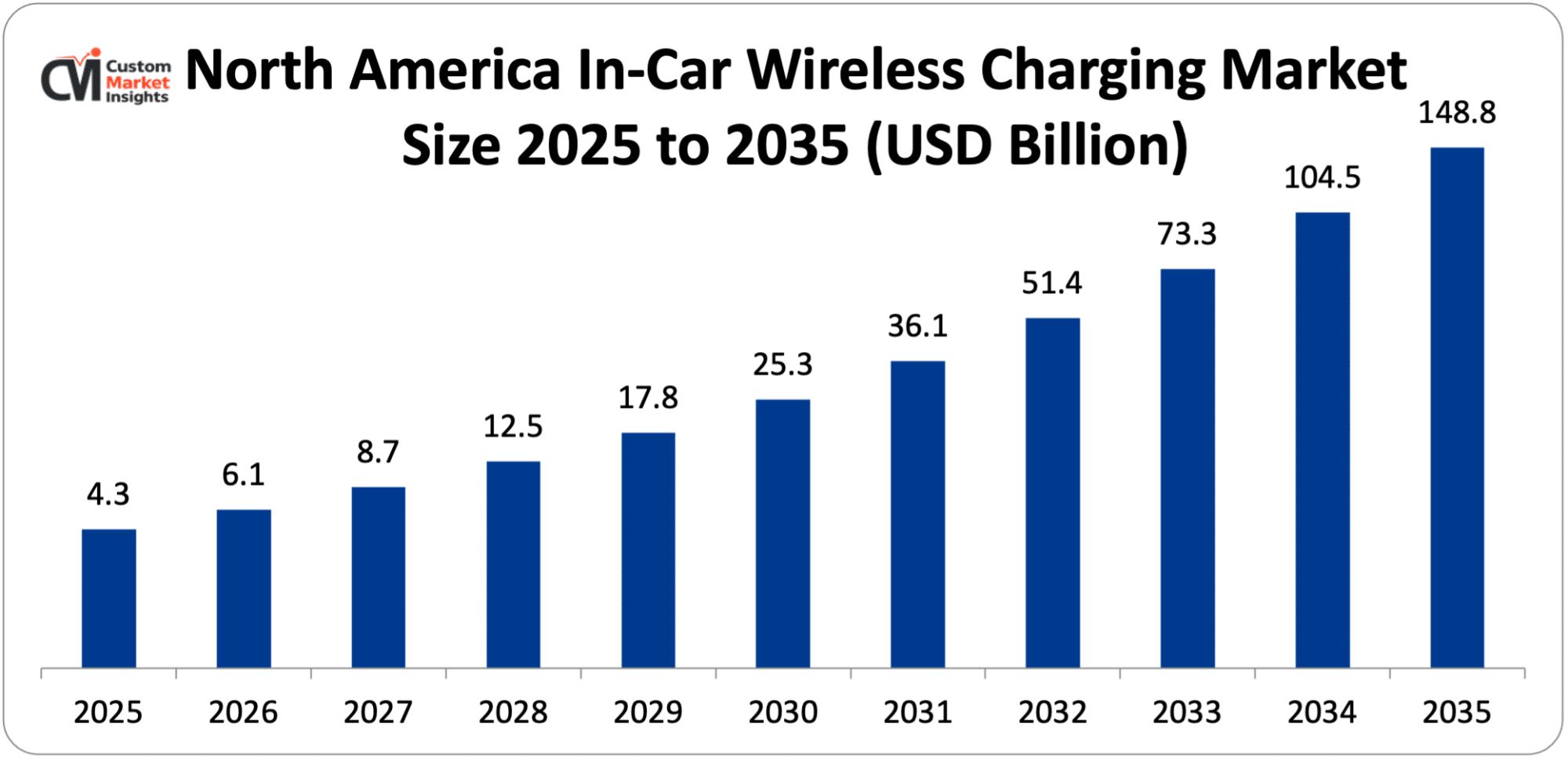
Its market size, in terms of North American in-car wireless charging, is projected to be USD 4.3 billion in 2025 with a growth of about USD 148.8 billion in 2035 with a CAGR of 42.5% between 2026 and 2035.
Why did North America Dominate the In-Car Wireless Charging Market in 2025?
In 2025, North America will dominate the global market with an estimated market share of 44%. High smartphone usage, advanced automotive technology and the initial implementation of connected car systems are creating economic growth in the region. US consumers who possess technological skills use their smartphones to drive while they search for directions and watch videos and send messages which creates a higher demand for in-car charging systems that are simple to operate. Car manufacturers automatically start using wireless charging systems because they maintain strong business relationships with General Motors and Ford Motor Company and Qualcomm Technologies Inc. The Qi wireless charging standard has achieved widespread acceptance which allows different devices to work together and enables people to adopt the technology at high rates. The market experiences growth because three factors work together which include the rising demand for electric and hybrid vehicles and the increasing consumer preference for premium features and the existence of a strong aftermarket market.
US In-Car Wireless Charging Market Trends
In the North American region, the US is growing at a significant rate over the projected period. The growing product launch by the key market players in the area drives the revenue growth in the country. For instance, in December 2025, Nissan has announced that it will offer Qi2 wireless charging in the 2026 Pathfinder and 2026 Murano, making it the first automaker in the United States to offer the technology in these vehicle segments. The Qi2 wireless charger features a raised magnetic circle that holds compatible smartphones in place, including iPhones 12 and newer, Google Pixels 10 and newer, and Android devices with compatible cases. The magnetic alignment enables users to position their devices correctly, which leads to maximum charging efficiency.
Why is Europe Experiencing a Significant Growth in the In-Car Wireless Charging Market?
Europe holds a significant market share in 2025. The region’s growth is driven by strict environmental regulations and the development of electric mobility systems. The German and French governments implement initiatives that facilitate electric vehicle adoption together with its related technologies such as wireless charging systems. The European Union’s Green Deal supports this transition by creating opportunities for automotive technology innovation. The German market together with the French and UK markets, leads the wireless charging industry because Volkswagen and BMW make significant investments in this technology. The automotive industry competition involves partnerships between car manufacturers and technology firms which work together to improve charging efficiency and enhance user experience. The increasing public understanding of wireless charging systems will lead to higher demand for these systems in vehicles.
UK In-Car Wireless Charging Market Trends
The UK held the dominant position in the market in 2025. The growth of the industry is driven by two factors, which include the rising adoption of connected vehicles and premium vehicles and the fact that consumers use smartphones at high rates.
Why is the Asia Pacific Growing at the Highest Rate in the In-Car Wireless Charging Market?
The Asia Pacific is expected to grow at the highest rate over the projected period. The region expands because more vehicles are produced and people have more money to spend and they choose to drive electric cars. China and Japan lead the trend because their governments provide funding for electric vehicle charging stations and support advancements in their car manufacturing sectors. The active automotive market in the region produces a powerful force that drives the creation of wireless charging solutions. The region has two main markets, which include China and Japan, and major automotive companies such as Toyota and Nissan are currently working on developing wireless charging solutions. The market environment consists of domestic and international firms that battle to acquire business opportunities. The automotive industry will soon establish wireless charging systems as a standard feature because consumers demand products that offer convenience and innovative capabilities.
China In-Car Wireless Charging Market Trends
China holds the prominent market share in the industry. The high production of electric vehicles and increasing demand for convenience drive the market growth.
Why is the Middle East & Africa Region is growing rapidly in the In-Car Wireless Charging?
The MEA region is growing at a steady rate over the projected period. The premium vehicle market has been expanding continuously during key economic periods due to rising demand for luxury cars, increased smartphone use, and ongoing improvements in automotive technology. The United Arab Emirates and Saudi Arabian markets show strong demand for luxury vehicles because their customers now expect advanced in-cabin features such as wireless charging technology. The rising smartphone usage for navigation and entertainment and communication during driving creates demand for wireless charging solutions, which are effectively solved by Qi wireless charging standard systems.
UAE In-Car Wireless Charging Market Trends
The UAE is growing at the highest CAGR during the forecast period. The rising innovative product launches and integration of advanced technology drive the industry growth.
Top Players in the In-Car Wireless Charging Market and Their Offerings
- Powermat Technologies Ltd.
- Aircharge
- Mojo Mobility Inc.
- Power Square
- Zens
- Wieson Automotive Co. Ltd.
- Scosche
- Infineon Technologies AG
- Monolithic Power Systems Inc.
- Qualcomm Technologies Inc.
- General Motors
- Hella KGaA Hueck & Co.
- Molex
- Continental AG
- Harman International
- Apple Inc.
- Samsung Electronics Co. Ltd.
- Others
Key Developments
In-car wireless charging market has experienced considerable changes in the last two years as the market players are trying to diversify their technological aspects and develop product portfolios using strategic approaches.
- In January 2025, Qi2 adoption continues expanding exponentially with new wireless power applications rolling out throughout 2025, including an acceleration in Qi2 Android devices, according to the Wireless Power Consortium (WPC). (https://www.businesswire.com/news/home/20250106397777/en/Qi2s-Wireless-Charging-Benefits-Spurring-Continued-Expansion)
These strategic measures have enabled the companies to reinforce their competitive positions, increase the product line, boost their technological competencies, and also seize growth opportunities in the fast-growing in-car wireless charging market.
The In-Car Wireless Charging Market is segmented as follows:
By Technology
- Inductive Power Transfer
- Conductive Charging
- Magnetic Resonance Charging
By Device Type
- Smartphones
- Other Devices
By Distribution
- OEM
- Aftermarket
By Vehicle Type
- Fuel Based
- Electric Vehicle
- Hybrid Vehicles
By Charging Standards
- Qi Standard
- PMA Standards
Regional Coverage:
North America
- U.S.
- Canada
- Mexico
- Rest of North America
Europe
- Germany
- France
- U.K.
- Russia
- Italy
- Spain
- Netherlands
- Rest of Europe
Asia Pacific
- China
- Japan
- India
- New Zealand
- Australia
- South Korea
- Taiwan
- Rest of Asia Pacific
The Middle East & Africa
- Saudi Arabia
- UAE
- Egypt
- Kuwait
- South Africa
- Rest of the Middle East & Africa
Latin America
- Brazil
- Argentina
- Rest of Latin America
Table of Contents
- Chapter 1. Report Introduction
- 1.1. Report Description
- 1.1.1. Purpose of the Report
- 1.1.2. USP & Key Offerings
- 1.2. Key Benefits For Stakeholders
- 1.3. Target Audience
- 1.4. Report Scope
- 1.1. Report Description
- Chapter 2. Market Overview
- 2.1. Report Scope (Segments And Key Players)
- 2.1.1. In-Car Wireless Charging by Segments
- 2.1.2. In-Car Wireless Charging by Region
- 2.2. Executive Summary
- 2.2.1. Market Size & Forecast
- 2.2.2. In-Car Wireless Charging Market Attractiveness Analysis, By Technology
- 2.2.3. In-Car Wireless Charging Market Attractiveness Analysis, By Device Type
- 2.2.4. In-Car Wireless Charging Market Attractiveness Analysis, By Distribution
- 2.2.5. In-Car Wireless Charging Market Attractiveness Analysis, By Vehicle Type
- 2.2.6. In-Car Wireless Charging Market Attractiveness Analysis, By Charging Standards
- 2.1. Report Scope (Segments And Key Players)
- Chapter 3. Market Dynamics (DRO)
- 3.1. Market Drivers
- 3.1.1. Rising Smartphone Penetration & Usage in Vehicles
- 3.1.2. Rising Consumer Preference for Convenience & Safety
- 3.2. Market Restraints
- 3.3. Market Opportunities
- 3.5. Pestle Analysis
- 3.6. Porter Forces Analysis
- 3.7. Technology Roadmap
- 3.8. Value Chain Analysis
- 3.9. Government Policy Impact Analysis
- 3.10. Pricing Analysis
- 3.1. Market Drivers
- Chapter 4. In-Car Wireless Charging Market – By Technology
- 4.1. Technology Market Overview, By Technology Segment
- 4.1.1. In-Car Wireless Charging Market Revenue Share, By Technology, 2025 & 2035
- 4.1.2. Inductive Power Transfer
- 4.1.3. In-Car Wireless Charging Share Forecast, By Region (USD Billion)
- 4.1.4. Comparative Revenue Analysis, By Country, 2025 & 2035
- 4.1.5. Key Market Trends, Growth Factors, & Opportunities
- 4.1.6. Conductive Charging
- 4.1.7. In-Car Wireless Charging Share Forecast, By Region (USD Billion)
- 4.1.8. Comparative Revenue Analysis, By Country, 2025 & 2035
- 4.1.9. Key Market Trends, Growth Factors, & Opportunities
- 4.1.10. Magnetic Resonance Charging
- 4.1.11. In-Car Wireless Charging Share Forecast, By Region (USD Billion)
- 4.1.12. Comparative Revenue Analysis, By Country, 2025 & 2035
- 4.1.13. Key Market Trends, Growth Factors, & Opportunities
- 4.1. Technology Market Overview, By Technology Segment
- Chapter 5. In-Car Wireless Charging Market – By Device Type
- 5.1. Device Type Market Overview, By Device Type Segment
- 5.1.1. In-Car Wireless Charging Market Revenue Share, By Device Type, 2025 & 2035
- 5.1.2. Smartphones
- 5.1.3. In-Car Wireless Charging Share Forecast, By Region (USD Billion)
- 5.1.4. Comparative Revenue Analysis, By Country, 2025 & 2035
- 5.1.5. Key Market Trends, Growth Factors, & Opportunities
- 5.1.6. Other Devices
- 5.1.7. In-Car Wireless Charging Share Forecast, By Region (USD Billion)
- 5.1.8. Comparative Revenue Analysis, By Country, 2025 & 2035
- 5.1.9. Key Market Trends, Growth Factors, & Opportunities
- 5.1. Device Type Market Overview, By Device Type Segment
- Chapter 6. In-Car Wireless Charging Market – By Distribution
- 6.1. Distribution Market Overview, By Distribution Segment
- 6.1.1. In-Car Wireless Charging Market Revenue Share, By Distribution, 2025 & 2035
- 6.1.2. OEM
- 6.1.3. In-Car Wireless Charging Share Forecast, By Region (USD Billion)
- 6.1.4. Comparative Revenue Analysis, By Country, 2025 & 2035
- 6.1.5. Key Market Trends, Growth Factors, & Opportunities
- 6.1.6. Aftermarket
- 6.1.7. In-Car Wireless Charging Share Forecast, By Region (USD Billion)
- 6.1.8. Comparative Revenue Analysis, By Country, 2025 & 2035
- 6.1.9. Key Market Trends, Growth Factors, & Opportunities
- 6.1. Distribution Market Overview, By Distribution Segment
- Chapter 7. In-Car Wireless Charging Market – By Vehicle Type
- 7.1. Vehicle Type Market Overview, By Vehicle Type Segment
- 7.1.1. In-Car Wireless Charging Market Revenue Share, By Vehicle Type, 2025 & 2035
- 7.1.2. Fuel Based
- 7.1.3. In-Car Wireless Charging Share Forecast, By Region (USD Billion)
- 7.1.4. Comparative Revenue Analysis, By Country, 2025 & 2035
- 7.1.5. Key Market Trends, Growth Factors, & Opportunities
- 7.1.6. Electric Vehicle
- 7.1.7. In-Car Wireless Charging Share Forecast, By Region (USD Billion)
- 7.1.8. Comparative Revenue Analysis, By Country, 2025 & 2035
- 7.1.9. Key Market Trends, Growth Factors, & Opportunities
- 7.1.10. Hybrid Vehicles
- 7.1.11. In-Car Wireless Charging Share Forecast, By Region (USD Billion)
- 7.1.12. Comparative Revenue Analysis, By Country, 2025 & 2035
- 7.1.13. Key Market Trends, Growth Factors, & Opportunities
- 7.1. Vehicle Type Market Overview, By Vehicle Type Segment
- Chapter 8. In-Car Wireless Charging Market – By Charging Standards
- 8.1. Charging Standards Market Overview, By Charging Standards Segment
- 8.1.1. In-Car Wireless Charging Market Revenue Share, By Charging Standards, 2025 & 2035
- 8.1.2. Qi Standard
- 8.1.3. In-Car Wireless Charging Share Forecast, By Region (USD Billion)
- 8.1.4. Comparative Revenue Analysis, By Country, 2025 & 2035
- 8.1.5. Key Market Trends, Growth Factors, & Opportunities
- 8.1.6. PMA Standards
- 8.1.7. In-Car Wireless Charging Share Forecast, By Region (USD Billion)
- 8.1.8. Comparative Revenue Analysis, By Country, 2025 & 2035
- 8.1.9. Key Market Trends, Growth Factors, & Opportunities
- 8.1. Charging Standards Market Overview, By Charging Standards Segment
- Chapter 9. In-Car Wireless Charging Market – Regional Analysis
- 9.1. In-Car Wireless Charging Market Overview, By Region Segment
- 9.1.1. Global In-Car Wireless Charging Market Revenue Share, By Region, 2025 & 2035
- 9.1.2. Global In-Car Wireless Charging Market Revenue, By Region, 2026 – 2035 (USD Billion)
- 9.1.3. Global In-Car Wireless Charging Market Revenue, By Technology, 2026 – 2035
- 9.1.4. Global In-Car Wireless Charging Market Revenue, By Device Type, 2026 – 2035
- 9.1.5. Global In-Car Wireless Charging Market Revenue, By Distribution, 2026 – 2035
- 9.1.6. Global In-Car Wireless Charging Market Revenue, By Vehicle Type, 2026 – 2035
- 9.1.7. Global In-Car Wireless Charging Market Revenue, By Charging Standards, 2026 – 2035
- 9.2. North America
- 9.2.1. North America In-Car Wireless Charging Market Revenue, By Country, 2026 – 2035 (USD Billion)
- 9.2.2. North America In-Car Wireless Charging Market Revenue, By Technology, 2026 – 2035
- 9.2.3. North America In-Car Wireless Charging Market Revenue, By Device Type, 2026 – 2035
- 9.2.4. North America In-Car Wireless Charging Market Revenue, By Distribution, 2026 – 2035
- 9.2.5. North America In-Car Wireless Charging Market Revenue, By Vehicle Type, 2026 – 2035
- 9.2.6. North America In-Car Wireless Charging Market Revenue, By Charging Standards, 2026 – 2035
- 9.2.7. U.S. In-Car Wireless Charging Market Revenue, 2026 – 2035 (USD Billion)
- 9.2.8. Canada In-Car Wireless Charging Market Revenue, 2026 – 2035 (USD Billion)
- 9.2.9. Mexico In-Car Wireless Charging Market Revenue, 2026 – 2035 (USD Billion)
- 9.2.10. Rest of North America In-Car Wireless Charging Market Revenue, 2026 – 2035 (USD Billion)
- 9.3. Europe
- 9.3.1. Europe In-Car Wireless Charging Market Revenue, By Country, 2026 – 2035 (USD Billion)
- 9.3.2. Europe In-Car Wireless Charging Market Revenue, By Technology, 2026 – 2035
- 9.3.3. Europe In-Car Wireless Charging Market Revenue, By Device Type, 2026 – 2035
- 9.3.4. Europe In-Car Wireless Charging Market Revenue, By Distribution, 2026 – 2035
- 9.3.5. Europe In-Car Wireless Charging Market Revenue, By Vehicle Type, 2026 – 2035
- 9.3.6. Europe In-Car Wireless Charging Market Revenue, By Charging Standards, 2026 – 2035
- 9.3.7. Germany In-Car Wireless Charging Market Revenue, 2026 – 2035 (USD Billion)
- 9.3.8. France In-Car Wireless Charging Market Revenue, 2026 – 2035 (USD Billion)
- 9.3.9. U.K. In-Car Wireless Charging Market Revenue, 2026 – 2035 (USD Billion)
- 9.3.10. Russia In-Car Wireless Charging Market Revenue, 2026 – 2035 (USD Billion)
- 9.3.11. Italy In-Car Wireless Charging Market Revenue, 2026 – 2035 (USD Billion)
- 9.3.12. Spain In-Car Wireless Charging Market Revenue, 2026 – 2035 (USD Billion)
- 9.3.13. Netherlands In-Car Wireless Charging Market Revenue, 2026 – 2035 (USD Billion)
- 9.3.14. Rest of Europe In-Car Wireless Charging Market Revenue, 2026 – 2035 (USD Billion)
- 9.4. Asia Pacific
- 9.4.1. Asia Pacific In-Car Wireless Charging Market Revenue, By Country, 2026 – 2035 (USD Billion)
- 9.4.2. Asia Pacific In-Car Wireless Charging Market Revenue, By Technology, 2026 – 2035
- 9.4.3. Asia Pacific In-Car Wireless Charging Market Revenue, By Device Type, 2026 – 2035
- 9.4.4. Asia Pacific In-Car Wireless Charging Market Revenue, By Distribution, 2026 – 2035
- 9.4.5. Asia Pacific In-Car Wireless Charging Market Revenue, By Vehicle Type, 2026 – 2035
- 9.4.6. Asia Pacific In-Car Wireless Charging Market Revenue, By Charging Standards, 2026 – 2035
- 9.4.7. China In-Car Wireless Charging Market Revenue, 2026 – 2035 (USD Billion)
- 9.4.8. Japan In-Car Wireless Charging Market Revenue, 2026 – 2035 (USD Billion)
- 9.4.9. India In-Car Wireless Charging Market Revenue, 2026 – 2035 (USD Billion)
- 9.4.10. New Zealand In-Car Wireless Charging Market Revenue, 2026 – 2035 (USD Billion)
- 9.4.11. Australia In-Car Wireless Charging Market Revenue, 2026 – 2035 (USD Billion)
- 9.4.12. South Korea In-Car Wireless Charging Market Revenue, 2026 – 2035 (USD Billion)
- 9.4.13. Taiwan In-Car Wireless Charging Market Revenue, 2026 – 2035 (USD Billion)
- 9.4.14. Rest of Asia Pacific In-Car Wireless Charging Market Revenue, 2026 – 2035 (USD Billion)
- 9.5. The Middle-East and Africa
- 9.5.1. The Middle-East and Africa In-Car Wireless Charging Market Revenue, By Country, 2026 – 2035 (USD Billion)
- 9.5.2. The Middle-East and Africa In-Car Wireless Charging Market Revenue, By Technology, 2026 – 2035
- 9.5.3. The Middle-East and Africa In-Car Wireless Charging Market Revenue, By Device Type, 2026 – 2035
- 9.5.4. The Middle-East and Africa In-Car Wireless Charging Market Revenue, By Distribution, 2026 – 2035
- 9.5.5. The Middle-East and Africa In-Car Wireless Charging Market Revenue, By Vehicle Type, 2026 – 2035
- 9.5.6. The Middle-East and Africa In-Car Wireless Charging Market Revenue, By Charging Standards, 2026 – 2035
- 9.5.7. Saudi Arabia In-Car Wireless Charging Market Revenue, 2026 – 2035 (USD Billion)
- 9.5.8. UAE In-Car Wireless Charging Market Revenue, 2026 – 2035 (USD Billion)
- 9.5.9. Egypt In-Car Wireless Charging Market Revenue, 2026 – 2035 (USD Billion)
- 9.5.10. Kuwait In-Car Wireless Charging Market Revenue, 2026 – 2035 (USD Billion)
- 9.5.11. South Africa In-Car Wireless Charging Market Revenue, 2026 – 2035 (USD Billion)
- 9.5.12. Rest of the Middle East & Africa In-Car Wireless Charging Market Revenue, 2026 – 2035 (USD Billion)
- 9.6. Latin America
- 9.6.1. Latin America In-Car Wireless Charging Market Revenue, By Country, 2026 – 2035 (USD Billion)
- 9.6.2. Latin America In-Car Wireless Charging Market Revenue, By Technology, 2026 – 2035
- 9.6.3. Latin America In-Car Wireless Charging Market Revenue, By Device Type, 2026 – 2035
- 9.6.4. Latin America In-Car Wireless Charging Market Revenue, By Distribution, 2026 – 2035
- 9.6.5. Latin America In-Car Wireless Charging Market Revenue, By Vehicle Type, 2026 – 2035
- 9.6.6. Latin America In-Car Wireless Charging Market Revenue, By Charging Standards, 2026 – 2035
- 9.6.7. Brazil In-Car Wireless Charging Market Revenue, 2026 – 2035 (USD Billion)
- 9.6.8. Argentina In-Car Wireless Charging Market Revenue, 2026 – 2035 (USD Billion)
- 9.6.9. Rest of Latin America In-Car Wireless Charging Market Revenue, 2026 – 2035 (USD Billion)
- 9.1. In-Car Wireless Charging Market Overview, By Region Segment
- Chapter 10. Competitive Landscape
- 10.1. Company Market Share Analysis – 2025
- 10.1.1. Global In-Car Wireless Charging Market: Company Market Share, 2025
- 10.2. Global In-Car Wireless Charging Market Company Market Share, 2024
- 10.1. Company Market Share Analysis – 2025
- Chapter 11. Company Profiles
- 11.1. Powermat Technologies Ltd.
- 11.1.1. Company Overview
- 11.1.2. Key Executives
- 11.1.3. Product Portfolio
- 11.1.4. Financial Overview
- 11.1.5. Operating Business Segments
- 11.1.6. Business Performance
- 11.1.7. Recent Developments
- 11.2. Aircharge
- 11.3. Mojo Mobility Inc.
- 11.4. Power Square
- 11.5. Zens
- 11.6. Wieson Automotive Co. Ltd.
- 11.7. Scosche
- 11.8. Infineon Technologies AG
- 11.9. Monolithic Power Systems Inc.
- 11.10. Qualcomm Technologies Inc.
- 11.11. General Motors
- 11.12. Hella KGaA Hueck & Co.
- 11.13. Molex
- 11.14. Continental AG
- 11.15. Harman International
- 11.16. Apple Inc.
- 11.17. Samsung Electronics Co. Ltd.
- 11.18. Others.
- 11.1. Powermat Technologies Ltd.
- Chapter 12. Research Methodology
- 12.1. Research Methodology
- 12.2. Secondary Research
- 12.3. Primary Research
- 12.3.1. Analyst Tools and Models
- 12.4. Research Limitations
- 12.5. Assumptions
- 12.6. Insights From Primary Respondents
- 12.7. Why Custom Market Insights
- Chapter 13. Standard Report Commercials & Add-Ons
- 13.1. Customization Options
- 13.2. Subscription Module For Market Research Reports
- 13.3. Client Testimonials
List Of Figures
Figures No 1 to 32
List Of Tables
Tables No 1 to 56
Prominent Players
- Powermat Technologies Ltd.
- Aircharge
- Mojo Mobility Inc.
- Power Square
- Zens
- Wieson Automotive Co. Ltd.
- Scosche
- Infineon Technologies AG
- Monolithic Power Systems Inc.
- Qualcomm Technologies Inc.
- General Motors
- Hella KGaA Hueck & Co.
- Molex
- Continental AG
- Harman International
- Apple Inc.
- Samsung Electronics Co. Ltd.
- Others
FAQs
The key players in the market are Powermat Technologies Ltd., Aircharge, Mojo Mobility Inc., Power Square, Zens, Wieson Automotive Co. Ltd., Scosche, Infineon Technologies AG, Monolithic Power Systems Inc., Qualcomm Technologies Inc., General Motors, Hella KGaA Hueck & Co., Molex, Continental AG, Harman International, Apple Inc., Samsung Electronics Co. Ltd., Others.
Government regulations play a significant role in shaping the development of the in-car wireless charging market by influencing technology standards, safety requirements, and the broader adoption of advanced automotive features. Regulatory bodies and standardization organizations such as the Wireless Power Consortium help establish widely accepted frameworks like the Qi wireless charging standard, ensuring interoperability, safety, and performance consistency across devices and vehicles.
The price point plays a crucial role in influencing the growth and adoption of the in-car wireless charging market by directly affecting consumer accessibility and OEM integration strategies. Higher-cost wireless charging systems—especially those with fast charging, magnetic alignment, and advanced thermal management—are typically integrated into premium and luxury vehicles, limiting their initial adoption to high-end segments. However, as technology matures and production costs decline, wireless charging modules are becoming more affordable, enabling their inclusion in mid-range and entry-level vehicles, thereby expanding the overall market.
According to the present analysis and forecast modeling, the market of in-car wireless charging will witness a significant growth of about USD 455.5 billion in the year 2035 with the growing innovative product launch, increasing collaboration, and rising disposable income with a CAGR of 46.8% between the years 2026 and 2035.
It is projected that North America will hold the largest market share in the In-Car Wireless Charging market in the forecast period, with a share of about 44% of the global market share, which is attributed to the increasing prevalence of major players and growing demand for convenience.
The Asia Pacific is expected to grow at the highest rate during the forecast period. The growth in the region is owing to the increasing adoption of EVs.
The growth of the in-car wireless charging market is driven by several key factors, including the rising use of smartphones for navigation, communication, and entertainment, which increases the need for continuous in-vehicle charging; the growing demand for premium and connected vehicles equipped with advanced in-cabin technologies; ongoing advancements in the Qi wireless charging standard that enhance charging speed, efficiency, and compatibility; increasing consumer preference for convenience, safety, and clutter-free interiors; the integration of wireless charging as a standard feature by automotive OEMs; the rapid adoption of electric and hybrid vehicles; the expansion of affordable aftermarket solutions; improvements in alignment and thermal management technologies; and the seamless integration of wireless charging with infotainment and connectivity systems, all of which collectively contribute to the market’s sustained growth.