
Nicotinic Acid Market Size, Trends and Insights By Source (Natural, Synthetic), By Form (Dry, Liquid), By Application (Animal Feed, Food & Beverages, Pharmaceutical, Cosmetics), and By Region - Global Industry Overview, Statistical Data, Competitive Analysis, Share, Outlook, and Forecast 2026 – 2035
Report Snapshot
| Study Period: | 2026-2035 |
| Fastest Growing Market: | Asia Pacific |
| Largest Market: | North America |
Major Players
- Jubilant Life Sciences Ltd.
- DSM
- Glanbia plc
- NutraScience Labs
- Others
Reports Description
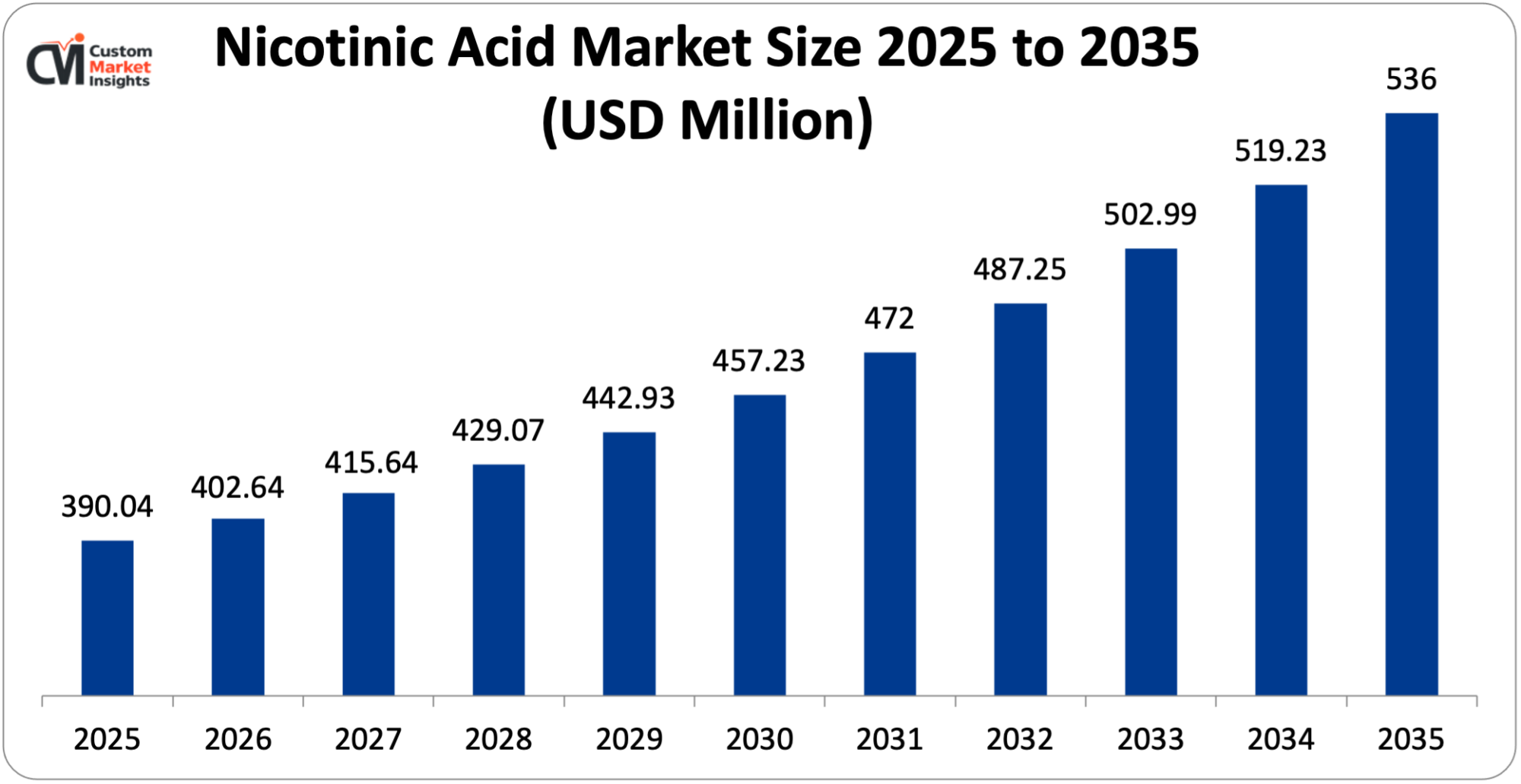
As per the nicotinic acid market analysis conducted by the CMI research team, the nicotinic acid market is expected to record a CAGR of 3.23% from 2026 to 2035. In 2026, the market size was USD 402.64 Million. By 2035, the valuation is anticipated to reach USD 536 Million.
The market is expanding due to growing awareness of a plethora of health benefits of nicotinic acid (also called niacin or vitamin B3), such as management of cholesterol levels, promotion of the nervous system’s and skin’s health, and supporting metabolism. The expansion of fortified food and nutraceutical industries, coupled with raised demand for animal nutrition and preventive healthcare products, is also contributing to the growth of the nicotinic acid market.
Market Highlights
- North America dominated the nicotinic acid market in 2025 with 31.32% of the overall share.
- The Asia Pacific is expected to witness the fastest CAGR of 3.65% in the nicotinic acid market during the forecast period.
- By source, the natural source held around 93.67% of the market share in 2025.
- By source, the synthetic source is expected to witness the fastest CAGR of 3.34% between 2026 and 2035.
- By form, the dry nicotinic acid held around 82.34% of the market share in 2025.
- In the form of liquid nicotinic acid, it is expected to witness the fastest CAGR of 3.54% during the forecast period.
- By application, animal feed dominated in 2025 with 58.54% of the market share.
- By application, cosmetics are expected to witness the fastest CAGR of 5.12% during the forecast period.
Significant Growth Factors
The Nicotinic Acid Market Trends signify the following:
- Rising Demand for Fortified Foods and Nutritional Supplements: Nicotinic acid plays a vital role in extending support to metabolism, enhancing levels of cholesterol, and maintaining healthy nervous system and skin functions. As an outcome, it is broadly incorporated into multivitamins, dietary supplements, and various functional food products. The increased focus on wellness and health worldwide, apart from rising incidences of lifestyle-related conditions like cardiovascular diseases and high cholesterol has encouraged the consumers to opt for nutritional supplementation as one of the preventive approaches. This is especially observed in the developed economies wherein health-conscious consumers and aging population are actively asking for products that are enriched with vitamins, thereby driving demand for vitamin B3 across nutraceutical and pharmaceutical industries.
- Extensive Applications in Animal Feed: Nicotinic acid, in the animal feed sector, does serve as one of the essential nutrients for poultry and livestock. It aids in improving growth performance, feed efficiency, and metabolic activity in animals on the whole. As such, nicotinic acid is a crucial ingredient of feed formulations for swine, poultry, aquaculture, and cattle. With worldwide demand for dairy, meat, and poultry products continuing to increase, the livestock producers are emphasizing high class feed additives for improving animal health and productivity. This has resulted in rising adoption of feed premixes enriched in vitamins, especially in the emerging farming-based economies where commercial livestock farming is expanding on a rapid note.
What are the Major Advancements Changing the Nicotinic Acid Market Today?
- Devising Advanced Nutraceutical and Pharmaceutical Formulations: Conventionally, nicotinic acid’s higher doses used for management of cholesterol translated into side effects like skin flushing, which did limit its broader adoption. However, modern-day pharmaceutical research implies sustained-release, controlled-release, and extended-release formulations that allow for absorption of nicotinic acid into the body, thereby curtailing the adverse reactions while upholding the therapeutic advantages. Such enhanced formulations have increased its application in the regulation of lipids, cardiovascular health management, and metabolic therapies. Plus, rising integration of vitamin B3 into fortified beverages, functional foods, and personalized nutrition products is generating novel growth opportunities, as the consumers are increasingly preferring preventive and convenient health solutions backed by scientific evidence.
- Innovation in the Production Technologies: The manufacturers are actively adopting efficient biotechnological approaches and synthesis methods for improving production purity, yield, and cost efficiency. Green chemistry techniques and advancements in fermentation technology are aiding in the reduction of environmental impact while maintaining the high-quality standards needed by the animal feed, food, and pharmaceutical sectors. Also, enhancements in supply chain management are strengthening the distribution networks at the global level.
Category Wise Insights
By Source
Why are natural sources dominating the global nicotinic acid market?
The natural sources are leading the global nicotinic acid market majorly owing to the rising consumer preference for plant-based, clean-label, and naturally derived ingredients in dietary supplements, foods, and pharmaceuticals. Increasing health-consciousness has resulted in consumers preferring vitamins extracted from natural sources like legumes, whole grains, and yeast over the ones that are synthetically produced, as they are looked upon as more bioavailable, safer, and environmentally friendly. Plus, regulations are encouraging the usage of natural ingredients and the expansion of functional food and nutraceutical industries.
By Form
Why does dry form dominate the global nicotinic acid market?
The dry form leads the global nicotinic acid market due to its longer shelf life, higher stability, and ease of storage, handling, and transportation in comparison with liquid forms. Manufacturers are widely preferring nicotinic acid in crystalline or powdered form in dietary supplements, pharmaceuticals, and animal feed, as it could be effortlessly blended with the other ingredients, precisely dosed, and incorporated into premixes, capsules, and tablets. Plus, the dry form is not very prone to degradation and microbial contamination, thereby rendering it more suitable for global distribution and production at a large scale. Such advantages lessen production and logistics costs, which does contribute to the dominance further.
By Application
Why is animal feed accounting for the largest revenue share of the global nicotinic acid market?
Animal feed accounts for a sizable market share due to rising demand for vitamin B3 within the farming sector. Nicotinic acid helps in the promotion of growth, improvement of metabolism, and extension of support to health on the whole. Including it in animal feed formulations aids in optimizing feed conservation efficiency and enhancing utilization of nutrients, which is critical for the productivity and health of the livestock. Also, growing demand for high-class animal products is fueling adoption of feed additives enriched with nicotinic acid.
Report Scope
| Feature of the Report | Details |
| Market Size in 2026 | USD 402.64 Million |
| Projected Market Size in 2035 | USD 536 Million |
| Market Size in 2025 | USD 390.04 Million |
| CAGR Growth Rate | 3.23% CAGR |
| Base Year | 2025 |
| Forecast Period | 2026-2035 |
| Key Segment | By Source, Form, Application and Region |
| Report Coverage | Revenue Estimation and Forecast, Company Profile, Competitive Landscape, Growth Factors and Recent Trends |
| Regional Scope | North America, Europe, Asia Pacific, Middle East & Africa, and South & Central America |
| Buying Options | Request tailored purchasing options to fulfil your requirements for research. |
Regional Analysis
How Big is North America’s Nicotinic Acid Market Size?
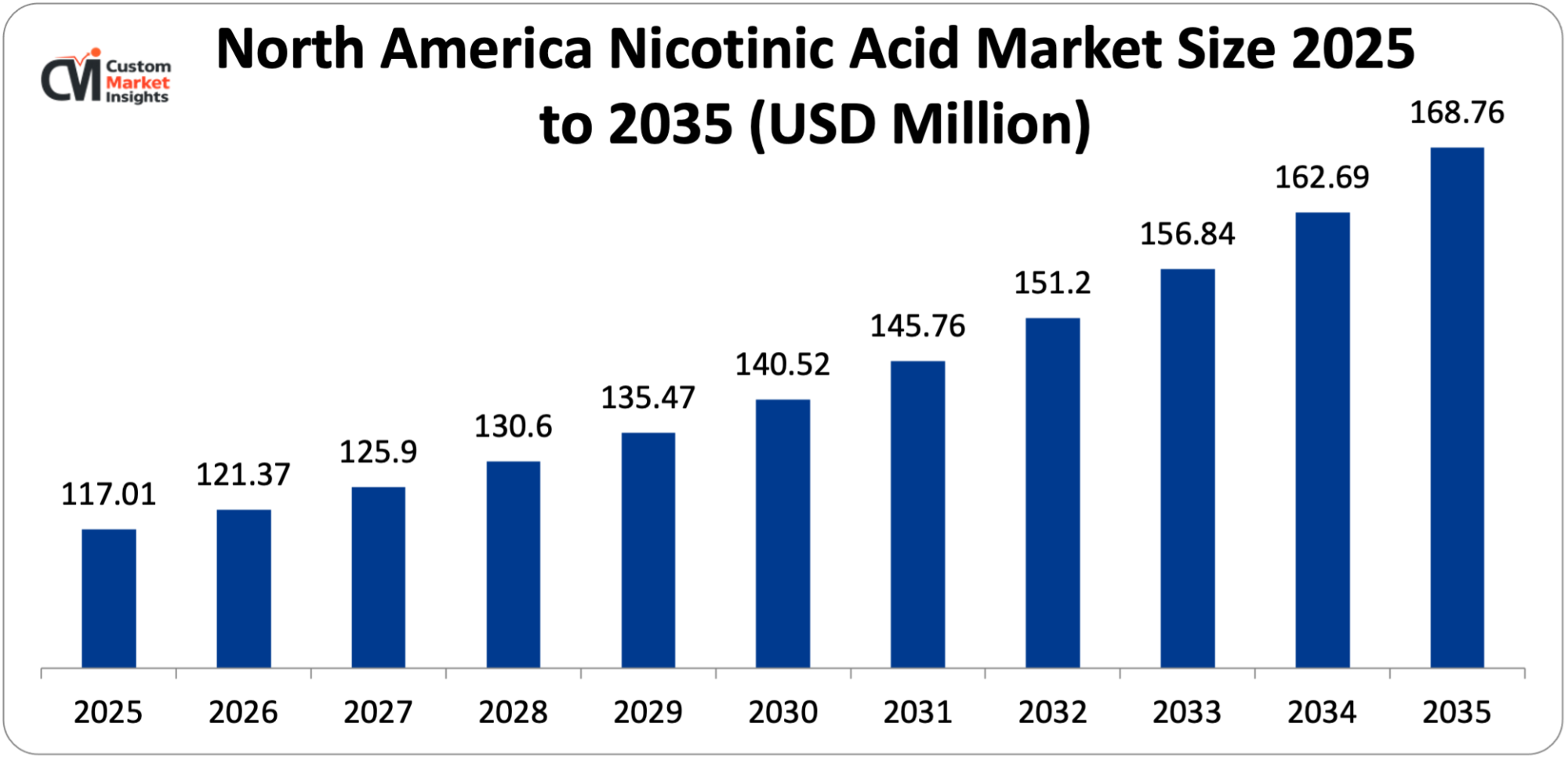
North America’s nicotinic acid market was worth USD 117.01 Million in 2025 and is expected to reach USD 168.76 Million by 2035 at a CAGR of 3.73% between 2025 and 2035.
Why did North America Dominate the Nicotinic Acid Market in 2025?
North America led the nicotinic acid market in 2025 basically owing to it being home to well-established dietary supplement, pharmaceutical, and animal feed sectors that are bound to generate consistent and robust demand for vitamin B3. The region is also witnessing an increased prevalence of various lifestyle-oriented conditions like cardiovascular diseases and hyperlipidemia, wherein the medical personnel recommend the use of nicotinic acid in supplements meant for the management of cholesterol and therapeutic formulations. Plus, strict quality standards as well as regulations that have been enforced by the U.S. FDA encourage usage of highly pure ingredients in nutraceuticals and pharmaceuticals. Rising consumer awareness is another factor pushing the market.
What is the Size of the U.S. Nicotinic Acid Market?
The market size of U.S. nicotinic acid was USD 97.39 Million in 2025 and is expected to reach USD 146.87 Million in 2035, witnessing a CAGR of 4.26% between 2026 and 2035.
U.S. Nicotinic Acid Market Trends
The U.S. leads North America’s nicotinic acid market due to rising demand for dietary supplements that are vitamin-based, coupled with exponential applications in fortified foods and pharmaceuticals. Plus, increased adoption of clean-label supplements, functional foods, and nutrition products focused on wellness is driving the manufacturers to insert nicotinic acid during formulations of fortified food products and multivitamins. Vitamin B3 is also used for manufacturing skin care products. For instance – Dove VitaminCare+ deodorant is fortified with vitamin B3 for improving natural odor defenses of the skin.
Why is the Asia Pacific Experiencing the Fastest Growth in the Global Nicotinic Acid Market?
The Asia Pacific is expected to witness the fastest CAGR in the nicotinic acid market during the forecast period. This is credited to increased healthcare awareness followed by rising demand for vitamin B3 from nutraceuticals, pharmaceuticals, animal feed, and fortified food sectors. The region is also looked upon as one of the major production hubs for nicotinic acid due to cost-effective manufacturing facilities being made available. Also, visible expansion of food fortification programs, livestock farming, and rising adoption of cosmetic formulations and dietary supplements containing vitamin B3 are bound to keep the cash registers running for the Asia Pacific.
China’s Nicotinic Acid Market Trends
China’s nicotinic acid market is expected to witness steadiness during the forecast period. This is due to the economy’s robust manufacturing base, expanding nutraceutical and pharmaceutical industries, and rising applications in animal nutrition and cosmetics. China is amongst the biggest manufacturers as well as consumers of vitamin B3, which is backed by strong export activities and chemical production at a large scale. This, in turn, does allow the domestic manufacturers to supply both – international and local markets. Also, China’s expanding personal care and skincare sector, wherein vitamin B3 is used in anti-aging and brightening formulations, does continue to create a notable demand for cosmetic-grade nicotinic acid, thereby catalyzing the growth of the market in the forecast period.
Where does the Europe stand with respect to Nicotinic Acid Market?
Europe does represent one of the significant regional nicotinic acid markets. It is characterized by stronger usage of nicotinic acid across the dietary supplement, pharmaceutical, food fortification, and cosmetic industries. Economies like France, Germany, and the UK lead the market owing to their advanced nutraceutical sectors, well-established pharmaceutical manufacturing, and rising demand for vitamin B3 in dermo-cosmetic and skincare products. Plus, stringent European regulatory standards for supplement labeling, food fortification, and quality of ingredients do encourage the use of highly pure nicotinic acid in nutrition products and healthcare, thereby rendering Europe one of the mature markets herein.
Germany Nicotinic Acid Market Trends
Germany’s nicotinic acid market is driven by the economy’s robust pharmaceutical sector, expansion of the nutraceutical industry, and rising demand for dermocosmetic products and functional foods. Germany continues to be one of the leading markets for the nicotinic acid market all across Europe, extensively supported by higher awareness amongst consumers regarding preventive healthcare. Also, with nicotinic acid increasingly being used in B-complex supplements, cholesterol-management therapies, and clinical nutrition products, Germany’s nicotinic acid market is poised to grow on a sizable note during the forecast period.
Where is the MEA regarding Adoption of Nicotinic Acid?
The Middle East and Africa (MEA) region is amongst the emerging markets for nicotinic acid. Expanding food fortification programs, animal feed sectors, and rising demand for nutritional supplements could be attributed to this emergence. Economies like South Africa, the UAE, and Egypt are dominating consumption at the regional level, supported by enhancements in livestock production and healthcare infrastructure. However, the uptake, on the whole, stays moderate as manufacturing capacity is limited to the local level.
Brazil Nicotinic Acid Market Trends
Brazil is bound to witness steadiness in the global nicotinic acid market driven by rising demand for vitamin B3 from dietary supplements, pharmaceuticals, animal feed, and fortified food products. Brazil is home to robust swine, poultry, and aquaculture sectors, which broadly use nicotinic acid in feed premixes for supporting the metabolism of animals. Overall, Brazil is reflecting stability and is expected to tread the same path during the forecast period.
Top Players in the Nicotinic Acid Market and Their Offerings
- Jubilant Life Sciences Ltd.
- DSM
- Glanbia plc
- NutraScience Labs
- BASF SE
- Graham Chemical
- Western Drugs Ltd.
- Fengchen Group Co. Ltd.
- Spectrum Chemical Mfg. Corp
- Vertellus Specialties Inc.
- Others
Key Developments
Nicotinic acid market has experienced considerable changes in the last few years as the market players are trying to diversify their technological aspects and develop product portfolios using strategic approaches.
- In March 2024, The Vitamin Shoppe and Imaraïs Beauty announced that they had launched a group of vitamin gummies formulated for supporting the wellness and health goals of beauty consumers. Apart from Super Supplements and The Vitamin Shoppe stores, they are available online at vitaminshoppe.com
- February 2024 witnessed the launch of Nature Made Advanced Multi Gummies, claiming to serve 60% of the overall nutrients per serving in everyday multivitamin gummies. The gummies are a good source of calcium and magnesium with an exceptional source of eight combined B vitamins.
These strategic measures have enabled the companies to reinforce their competitive positions, increase the product line, boost their technological competencies, and also seize growth opportunities in the fast growing nicotinic acid market.
The Nicotinic Acid Market is segmented as follows:
By Source
- Natural
- Synthetic
By Form
- Dry
- Liquid
By Application
- Animal Feed
- Food & Beverages
- Pharmaceutical
- Cosmetics
Regional Coverage:
North America
- U.S.
- Canada
- Mexico
- Rest of North America
Europe
- Germany
- France
- U.K.
- Russia
- Italy
- Spain
- Netherlands
- Rest of Europe
Asia Pacific
- China
- Japan
- India
- New Zealand
- Australia
- South Korea
- Taiwan
- Rest of Asia Pacific
The Middle East & Africa
- Saudi Arabia
- UAE
- Egypt
- Kuwait
- South Africa
- Rest of the Middle East & Africa
Latin America
- Brazil
- Argentina
- Rest of Latin America
Table of Contents
- Chapter 1. Report Introduction
- 1.1. Report Description
- 1.1.1. Purpose of the Report
- 1.1.2. USP & Key Offerings
- 1.2. Key Benefits For Stakeholders
- 1.3. Target Audience
- 1.4. Report Scope
- 1.1. Report Description
- Chapter 2. Market Overview
- 2.1. Report Scope (Segments And Key Players)
- 2.1.1. Nicotinic Acid by Segments
- 2.1.2. Nicotinic Acid by Region
- 2.2. Executive Summary
- 2.2.1. Market Size & Forecast
- 2.2.2. Nicotinic Acid Market Attractiveness Analysis, By Source
- 2.2.3. Nicotinic Acid Market Attractiveness Analysis, By Form
- 2.2.4. Nicotinic Acid Market Attractiveness Analysis, By Application
- 2.1. Report Scope (Segments And Key Players)
- Chapter 3. Market Dynamics (DRO)
- 3.1. Market Drivers
- 3.1.1. Rising Demand for Fortified Foods and Nutritional Supplements
- 3.1.2. Extensive Applications in Animal Feed
- 3.2. Market Restraints
- 3.3. Market Opportunities
- 3.5. Pestle Analysis
- 3.6. Porter’s Forces Analysis
- 3.7. Technology Roadmap
- 3.8. Value Chain Analysis
- 3.9. Government Policy Impact Analysis
- 3.10. Pricing Analysis
- 3.1. Market Drivers
- Chapter 4. Nicotinic Acid Market – By Source
- 4.1. Source Market Overview, By Source Segment
- 4.1.1. Nicotinic Acid Market Revenue Share, By Source , 2025 & 2035
- 4.1.2. Natural
- 4.1.3. Nicotinic Acid Share Forecast, By Region (USD Million)
- 4.1.4. Comparative Revenue Analysis, By Country, 2025 & 2035
- 4.1.5. Key Market Trends, Growth Factors, & Opportunities
- 4.1.6. Synthetic
- 4.1.7. Nicotinic Acid Share Forecast, By Region (USD Million)
- 4.1.8. Comparative Revenue Analysis, By Country, 2025 & 2035
- 4.1.9. Key Market Trends, Growth Factors, & Opportunities
- 4.1. Source Market Overview, By Source Segment
- Chapter 5. Nicotinic Acid Market – By Form
- 5.1. Form Market Overview, By Form Segment
- 5.1.1. Nicotinic Acid Market Revenue Share, By Form , 2025 & 2035
- 5.1.2. Dry
- 5.1.3. Nicotinic Acid Share Forecast, By Region (USD Million)
- 5.1.4. Comparative Revenue Analysis, By Country, 2025 & 2035
- 5.1.5. Key Market Trends, Growth Factors, & Opportunities
- 5.1.6. Liquid
- 5.1.7. Nicotinic Acid Share Forecast, By Region (USD Million)
- 5.1.8. Comparative Revenue Analysis, By Country, 2025 & 2035
- 5.1.9. Key Market Trends, Growth Factors, & Opportunities
- 5.1. Form Market Overview, By Form Segment
- Chapter 6. Nicotinic Acid Market – By Application
- 6.1. Application Market Overview, By Application Segment
- 6.1.1. Nicotinic Acid Market Revenue Share, By Application , 2025 & 2035
- 6.1.2. Animal Feed
- 6.1.3. Nicotinic Acid Share Forecast, By Region (USD Million)
- 6.1.4. Comparative Revenue Analysis, By Country, 2025 & 2035
- 6.1.5. Key Market Trends, Growth Factors, & Opportunities
- 6.1.6. Food & Beverages
- 6.1.7. Nicotinic Acid Share Forecast, By Region (USD Million)
- 6.1.8. Comparative Revenue Analysis, By Country, 2025 & 2035
- 6.1.9. Key Market Trends, Growth Factors, & Opportunities
- 6.1.10. Pharmaceutical
- 6.1.11. Nicotinic Acid Share Forecast, By Region (USD Million)
- 6.1.12. Comparative Revenue Analysis, By Country, 2025 & 2035
- 6.1.13. Key Market Trends, Growth Factors, & Opportunities
- 6.1.14. Cosmetics
- 6.1.15. Nicotinic Acid Share Forecast, By Region (USD Million)
- 6.1.16. Comparative Revenue Analysis, By Country, 2025 & 2035
- 6.1.17. Key Market Trends, Growth Factors, & Opportunities
- 6.1. Application Market Overview, By Application Segment
- Chapter 7. Nicotinic Acid Market – Regional Analysis
- 7.1. Nicotinic Acid Market Overview, By Region Segment
- 7.1.1. Global Nicotinic Acid Market Revenue Share, By Region, 2025 & 2035
- 7.1.2. Global Nicotinic Acid Market Revenue, By Region, 2026 – 2035 (USD Million)
- 7.1.3. Global Nicotinic Acid Market Revenue, By Source , 2026 – 2035
- 7.1.4. Global Nicotinic Acid Market Revenue, By Form , 2026 – 2035
- 7.1.5. Global Nicotinic Acid Market Revenue, By Application , 2026 – 2035
- 7.2. North America
- 7.2.1. North America Nicotinic Acid Market Revenue, By Country, 2026 – 2035 (USD Million)
- 7.2.2. North America Nicotinic Acid Market Revenue, By Source , 2026 – 2035
- 7.2.3. North America Nicotinic Acid Market Revenue, By Form , 2026 – 2035
- 7.2.4. North America Nicotinic Acid Market Revenue, By Application , 2026 – 2035
- 7.2.5. U.S. Nicotinic Acid Market Revenue, 2026 – 2035 (USD Million)
- 7.2.6. Canada Nicotinic Acid Market Revenue, 2026 – 2035 (USD Million)
- 7.2.7. Mexico Nicotinic Acid Market Revenue, 2026 – 2035 (USD Million)
- 7.2.8. Rest of North America Nicotinic Acid Market Revenue, 2026 – 2035 (USD Million)
- 7.3. Europe
- 7.3.1. Europe Nicotinic Acid Market Revenue, By Country, 2026 – 2035 (USD Million)
- 7.3.2. Europe Nicotinic Acid Market Revenue, By Source , 2026 – 2035
- 7.3.3. Europe Nicotinic Acid Market Revenue, By Form , 2026 – 2035
- 7.3.4. Europe Nicotinic Acid Market Revenue, By Application , 2026 – 2035
- 7.3.5. Germany Nicotinic Acid Market Revenue, 2026 – 2035 (USD Million)
- 7.3.6. France Nicotinic Acid Market Revenue, 2026 – 2035 (USD Million)
- 7.3.7. U.K. Nicotinic Acid Market Revenue, 2026 – 2035 (USD Million)
- 7.3.8. Russia Nicotinic Acid Market Revenue, 2026 – 2035 (USD Million)
- 7.3.9. Italy Nicotinic Acid Market Revenue, 2026 – 2035 (USD Million)
- 7.3.10. Spain Nicotinic Acid Market Revenue, 2026 – 2035 (USD Million)
- 7.3.11. Netherlands Nicotinic Acid Market Revenue, 2026 – 2035 (USD Million)
- 7.3.12. Rest of Europe Nicotinic Acid Market Revenue, 2026 – 2035 (USD Million)
- 7.4. Asia Pacific
- 7.4.1. Asia Pacific Nicotinic Acid Market Revenue, By Country, 2026 – 2035 (USD Million)
- 7.4.2. Asia Pacific Nicotinic Acid Market Revenue, By Source , 2026 – 2035
- 7.4.3. Asia Pacific Nicotinic Acid Market Revenue, By Form , 2026 – 2035
- 7.4.4. Asia Pacific Nicotinic Acid Market Revenue, By Application , 2026 – 2035
- 7.4.5. China Nicotinic Acid Market Revenue, 2026 – 2035 (USD Million)
- 7.4.6. Japan Nicotinic Acid Market Revenue, 2026 – 2035 (USD Million)
- 7.4.7. India Nicotinic Acid Market Revenue, 2026 – 2035 (USD Million)
- 7.4.8. New Zealand Nicotinic Acid Market Revenue, 2026 – 2035 (USD Million)
- 7.4.9. Australia Nicotinic Acid Market Revenue, 2026 – 2035 (USD Million)
- 7.4.10. South Korea Nicotinic Acid Market Revenue, 2026 – 2035 (USD Million)
- 7.4.11. Taiwan Nicotinic Acid Market Revenue, 2026 – 2035 (USD Million)
- 7.4.12. Rest of Asia Pacific Nicotinic Acid Market Revenue, 2026 – 2035 (USD Million)
- 7.5. The Middle-East and Africa
- 7.5.1. The Middle-East and Africa Nicotinic Acid Market Revenue, By Country, 2026 – 2035 (USD Million)
- 7.5.2. The Middle-East and Africa Nicotinic Acid Market Revenue, By Source , 2026 – 2035
- 7.5.3. The Middle-East and Africa Nicotinic Acid Market Revenue, By Form , 2026 – 2035
- 7.5.4. The Middle-East and Africa Nicotinic Acid Market Revenue, By Application , 2026 – 2035
- 7.5.5. Saudi Arabia Nicotinic Acid Market Revenue, 2026 – 2035 (USD Million)
- 7.5.6. UAE Nicotinic Acid Market Revenue, 2026 – 2035 (USD Million)
- 7.5.7. Egypt Nicotinic Acid Market Revenue, 2026 – 2035 (USD Million)
- 7.5.8. Kuwait Nicotinic Acid Market Revenue, 2026 – 2035 (USD Million)
- 7.5.9. South Africa Nicotinic Acid Market Revenue, 2026 – 2035 (USD Million)
- 7.5.10. Rest of the Middle East & Africa Nicotinic Acid Market Revenue, 2026 – 2035 (USD Million)
- 7.6. Latin America
- 7.6.1. Latin America Nicotinic Acid Market Revenue, By Country, 2026 – 2035 (USD Million)
- 7.6.2. Latin America Nicotinic Acid Market Revenue, By Source , 2026 – 2035
- 7.6.3. Latin America Nicotinic Acid Market Revenue, By Form , 2026 – 2035
- 7.6.4. Latin America Nicotinic Acid Market Revenue, By Application , 2026 – 2035
- 7.6.5. Brazil Nicotinic Acid Market Revenue, 2026 – 2035 (USD Million)
- 7.6.6. Argentina Nicotinic Acid Market Revenue, 2026 – 2035 (USD Million)
- 7.6.7. Rest of Latin America Nicotinic Acid Market Revenue, 2026 – 2035 (USD Million)
- 7.1. Nicotinic Acid Market Overview, By Region Segment
- Chapter 8. Competitive Landscape
- 8.1. Company Market Share Analysis – 2025
- 8.1.1. Global Nicotinic Acid Market: Company Market Share, 2025
- 8.2. Global Nicotinic Acid Market Company Market Share, 2024
- 8.1. Company Market Share Analysis – 2025
- Chapter 9. Company Profiles
- 9.1. Jubilant Life Sciences Ltd.
- 9.1.1. Company Overview
- 9.1.2. Key Executives
- 9.1.3. Product Portfolio
- 9.1.4. Financial Overview
- 9.1.5. Operating Business Segments
- 9.1.6. Business Performance
- 9.1.7. Recent Developments
- 9.2. DSM
- 9.3. Glanbia plc
- 9.4. NutraScience Labs
- 9.5. BASF SE
- 9.6. Graham Chemical
- 9.7. Western Drugs Ltd.
- 9.8. Fengchen Group Co. Ltd.
- 9.9. Spectrum Chemical Mfg. Corp
- 9.10. Vertellus Specialties Inc.
- 9.11. Others.
- 9.1. Jubilant Life Sciences Ltd.
- Chapter 10. Research Methodology
- 10.1. Research Methodology
- 10.2. Secondary Research
- 10.3. Primary Research
- 10.3.1. Analyst Tools and Models
- 10.4. Research Limitations
- 10.5. Assumptions
- 10.6. Insights From Primary Respondents
- 10.7. Why Custom Market Insights
- Chapter 11. Standard Report Commercials & Add-Ons
- 11.1. Customization Options
- 11.2. Subscription Module For Market Research Reports
- 11.3. Client Testimonials
List Of Figures
Figures No 1 to 24
List Of Tables
Tables No 1 to 46
Prominent Player
- Jubilant Life Sciences Ltd.
- DSM
- Glanbia plc
- NutraScience Labs
- BASF SE
- Graham Chemical
- Western Drugs Ltd.
- Fengchen Group Co. Ltd.
- Spectrum Chemical Mfg. Corp
- Vertellus Specialties Inc.
- Others
FAQs
The key players in the market are Jubilant Life Sciences Ltd., DSM, Glanbia plc, NutraScience Labs, BASF SE, Graham Chemical, Western Drugs Ltd., Fengchen Group Co. Ltd., Spectrum Chemical Mfg. Corp., Vertellus Specialties Inc., Others.
Regulatory authorities do lay down the guidelines on quality requirements, permissible levels of dosage, and health claims for ensuring product effectiveness and consumer safety. The regulations also impact manufacturing practices, product entry, and worldwide trade by requiring companies to adhere to stringent quality certifications and approval processes. Plus, government-led food fortification programs are encouraging usage of necessary vitamins such as nicotinic acid and are likely to stimulate the demand further.
Price point does play a crucial role in adoption as well as growth of the nicotinic acid market, as it does affect its large-scale use and affordability across dietary supplements, food fortification, pharmaceuticals, and animal feed sectors. When prices stay stable, the likelihood of incorporating nicotinic acid into the feed premixes and nutraceutical formulations increases, thereby extending support to broader market penetration. However, volatility in the costs of raw materials and supply chain disruptions could increase prices, which may also reduce demand where market players opt for cost-efficient alternatives.
The market for nicotinic acid is expected to witness significant growth of about USD 536 Million with a CAGR of 3.23% between the years 2026 and 2035 due to rising demand from pharmaceutical, animal feed, and dietary supplement industries, apart from increased consumer awareness regarding preventive healthcare and nutrition.
It is projected that North America will hold the largest share of the nicotinic acid market during the forecast period due to it housing a mature animal nutrition, nutraceutical, and pharmaceutical sector. Also, higher consumer awareness regarding cholesterol management and preventive healthcare has raised the usage of vitamin B3 in therapeutic formulations and dietary supplements, especially in the U.S. The region also benefits from advanced feed additive technologies, robust livestock production, and stringent regulations that encourage fortification of food with essential vitamins.
The Asia Pacific is expected to witness the fastest CAGR in the nicotinic acid market during the forecast period owing to a sizable expansion of nutraceutical, pharmaceutical, and animal feed industries in economies such as Japan, India, and China. Robust growth in aquaculture and livestock production does raise the demand for vitamin B3, which does enhance animal productivity as well as metabolism. Also, increased middle-class population, rising health awareness, and growing consumption of fortified foods and dietary supplements are catalyzing the nicotinic acid market. Another factor is lower production costs, large-scale chemical production capacity, and supportive initiatives by the governments are making the Asia Pacific one of the major hubs of production.
Nicotinic acid market is bound to grow on a decent note due to growing demand for vitamin B3 from the animal feed sector, as it improves livestock productivity, growth, and metabolism. Rising consumer awareness regarding preventive healthcare and nutrition is also driving the utility of nicotinic acid in fortified foods, dietary supplements, and pharmaceuticals, especially for the management of cholesterol. Plus, with vitamin-rich premixes highly adopted worldwide, market demand is witnessing acceleration. Also, there is a marked increase in demand for vitamin B3 derivatives in personal care and cosmetics formulations to safeguard/improve skin health.