
Surgical Case Carts Market Size, Trends and Insights By Type (Open Case Cart, Closed Case Cart), By End-user (Hospitals and Clinics, Ambulatory Surgical Centers, Others), and By Region - Global Industry Overview, Statistical Data, Competitive Analysis, Share, Outlook, and Forecast 2026 – 2035
Report Snapshot
CAGR: 4.04%%
| Study Period: | 2026-2035 |
| Fastest Growing Market: | Asia Pacific |
| Largest Market: | North America |
Major Players
- Getinge
- Stryker
- Medline Industries
- Cardinal Health
- Others
Reports Description
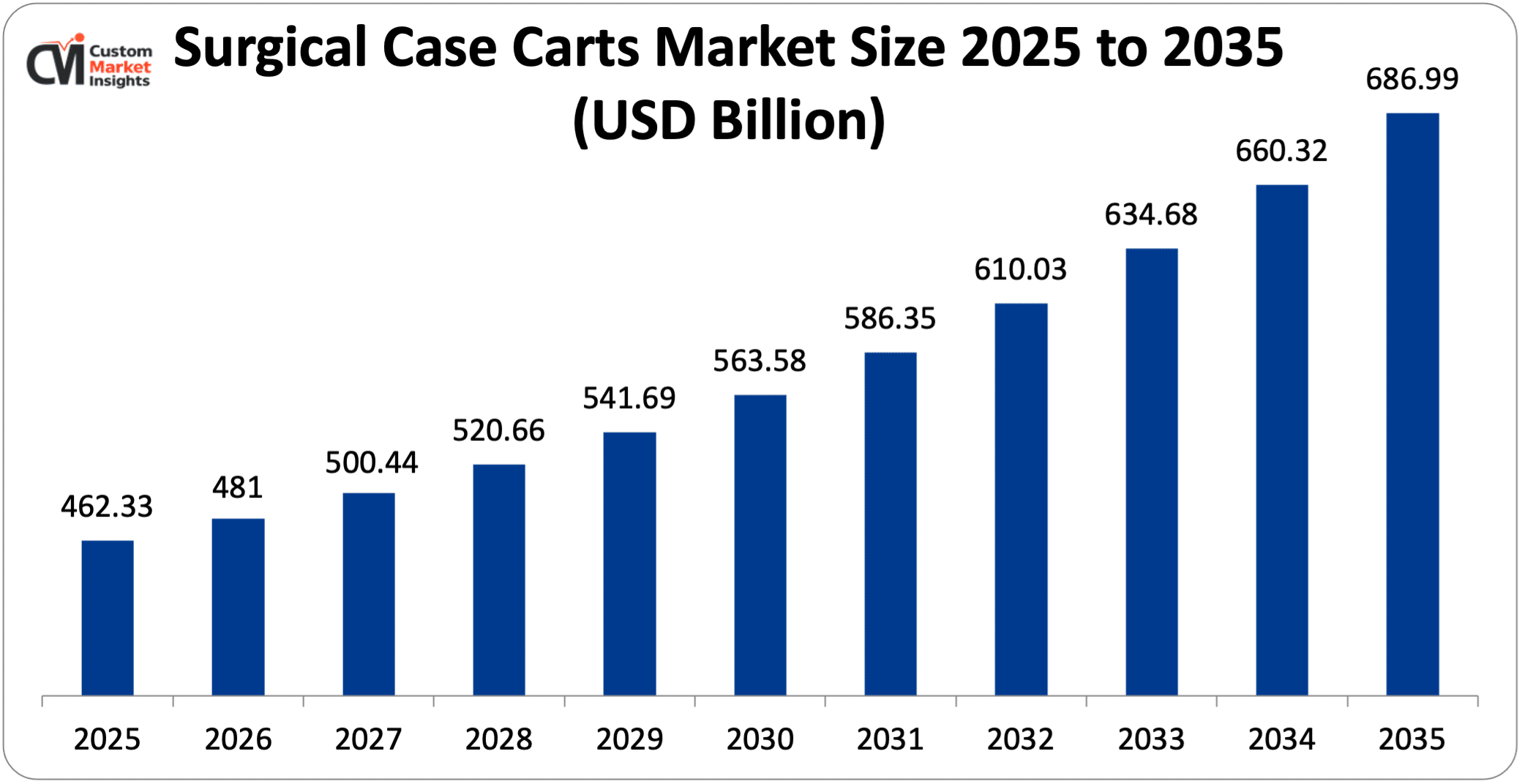
As per the surgical case carts market analysis conducted by the CMI team, the surgical case carts market is expected to record a CAGR of 4.04% from 2026 to 2035. In 2026, the market size was USD 481 Million. By 2035, the valuation is anticipated to reach USD 686.99 Million. The market is growing due to the fact that the ambulatory surgical center (ASC) segment is growing fast, with a sizable CAGR through 2035.
Hospitals still bring in the most revenue, making up more than 50% of the market. However, what’s actually pushing the total value up is a worldwide shift toward high-margin closed case cart systems. These systems now make up over 55% of all market revenue, as more facilities upgrade to meet stricter standards for sterility and infection control.
Market Highlights
- North America dominated the surgical case cart market in 2025 with 43.94% of the overall share.
- The Asia Pacific is expected to witness the fastest CAGR of 5.5% in the surgical case cart market during the forecast period.
- By type, open case carts held around 59.37% of the market share by 2025.
- By type, the closed case cart segment is expected to witness the fastest CAGR of 4.34% between 2026 and 2035.
- Through end-users, hospitals and clinics segment dominated in 2025 with 53.23% of the overall market share.
- By end-user, the ambulatory surgical centers segment is expected to witness the fastest CAGR of 4.97% between 2026 and 2035
Significant Growth Factors
- Upsurge in Volumes of Surgical Procedures
The main force behind market growth from 2026 to 2035 would be the rising number of surgeries worldwide, especially in orthopedics, cardiology, and oncology. As a greater number of people age in both developed and emerging countries, the demand for medical procedures just keeps climbing. Ambulatory surgical centers (ASCs) are multiplying, but they need specialized systems to turn over operating rooms faster. Manufacturers are designing compact carts that support efficient, lean workflows. These carts help high-volume centers keep up with growing patient numbers.
- Integration of Advanced Sterilization Technologies and Traceability
The market is changing fast as new rules now call for hospitals to use advanced traceability and sterilization technologies. Regulations such as the EU MDR and FDA UDI are pushing hospitals to shift toward RFID-enabled smart carts. These carts track the instruments and log their sterilization history in real time. With automation spreading to decontamination cycles across the industry, surgical case carts are now amongst the key data hubs inside the hospital. By automating inventory and sterility records, such systems help hospitals deal with staff shortages and make infection control better.
What are the Major Advancements Changing the Surgical Case Carts Market Today?
- Transformation to IoT Connectivity and Integrated Digital Tracking
The biggest alteration in hardware of late is how carts are getting smarter. This is credited to the advent of digital tracking and IoT tech. These days, they are much beyond metal containers. The hospitals are fitting them with RFID sensors that talk directly to their his (hospital information systems). This translates into the fact that staff can instantly see where every instrument is, count supplies automatically for avoiding leaving anything behind after surgery, and make sure each cart is properly sterilized. Going digital not only saves on time but also makes it easier to get the right sterile tools to the operating room on time, thereby cutting down on delays and keeping things safer for patients.
- Switch to Automation-ready Builds and Ergonomic Modularity
Manufacturers are making the surgical case carts modular and “automation-ready.” As such, they easily fit into automated workflows. Adjustable shelving, lightweight but tough polymers, and casters are designed to make life easier for staff with less pushing and less strain. These carts can handle the heat and harsh chemicals in automated cart washers. That’s a must in modern sterile processing departments, since washer systems are everywhere. As these carts hold up under tough cleaning and can be sanitized quickly, staff can keep things moving and infection control stays tight.
- Impact of AI on Surgical Case Carts Market
With AI, RFID, and computer vision teamed up, hospitals get inventory management tracking instruments in real time and match them with each surgeon’s needs. That means fewer mistakes and less wasted gear. Ai makes sure carts are always where they need to be. Machine learning predicts the busiest surgical hours and keeps carts moving smoothly between the sterile processing department and the operating room, thereby helping out when staff are stretched thin. As these features get more sophisticated, carts are bound to handle sterility documentation on their own, thereby building an automatic, AI-verified audit trail.
Category Wise insights
By Type
-
Why are open case carts dominating the surgical case cart market?
Open case carts are dominating as they are cost-effective and easy to move. They are feasible for hospitals that have a clean area in the middle or separate paths for clean and dirty things so things do not get contaminated from the outside. The open case carts do not have doors, so staff can see what they need and get it away. For places tight on budget, open case carts are a good choice, as they are cost-effective and easy to use.
By End-user
- How are Hospitals and Clinics leading the Surgical Case Carts Market?
Hospitals and clinics are the major users of surgical case carts. They use these carts as they perform numerous surgeries and have a department called the “sterile processing department.” This department is in charge of keeping everything sterile. Hospitals are the users of special closed case cart systems. These systems are very important as they help in keeping the instruments clean when they are being moved from one room to another. Hospitals are also trying to make their surgical process more efficient. They are using tags and computers to keep track of their equipment and supplies. There are also surgical centers growing quickly.
Report Scope
| Feature of the Report | Details |
| Market Size in 2026 | USD 481 Million |
| Projected Market Size in 2035 | USD 686.99 Million |
| Market Size in 2025 | USD 462.33 Million |
| CAGR Growth Rate | 4.04% CAGR |
| Base Year | 2025 |
| Forecast Period | 2026-2035 |
| Key Segment | By Type, End-user and Region |
| Report Coverage | Revenue Estimation and Forecast, Company Profile, Competitive Landscape, Growth Factors and Recent Trends |
| Regional Scope | North America, Europe, Asia Pacific, Middle East & Africa, and South & Central America |
| Buying Options | Request tailored purchasing options to fulfil your requirements for research. |
Regional Analysis
How big is North America’s Surgical Case Carts Market size?
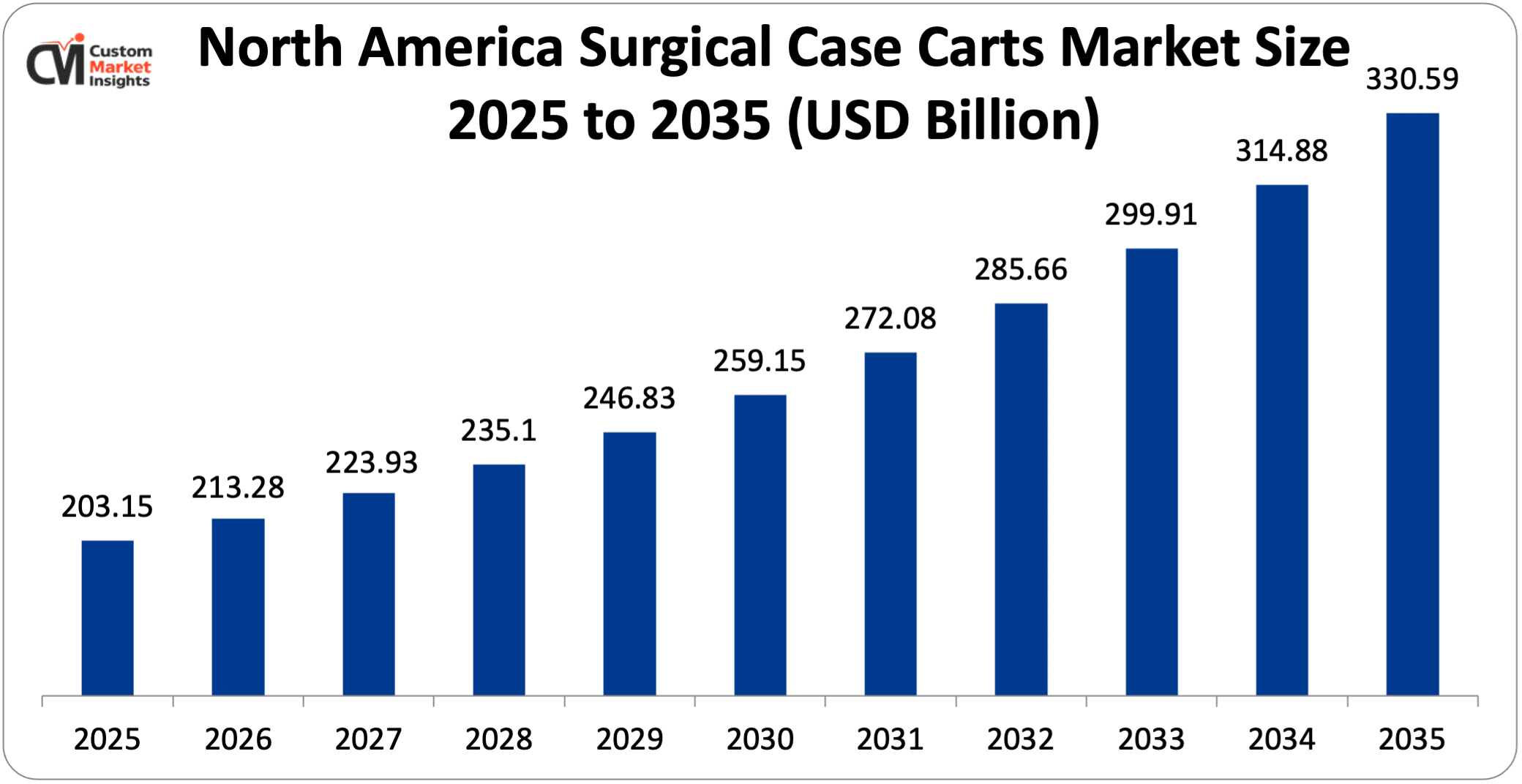
North America’s surgical case carts market was worth USD 203.15 Million in 2025 and is expected to reach USD 330.59 Million by 2035 at a CAGR of 4.99% between 2025 and 2035.
Why did North America Dominate the Surgical Case Carts Market in 2025?
North America led the market in 2025 due to its strong healthcare system and the quick uptake of operating room automation. The U.S. plays a huge role here, making up almost 80% of the region’s revenue. This edge has come from performing loads of complex surgeries using RFID-enabled smart carts for better inventory control and smoother workflows. On top of that, stringent rules around infection control and sterility have pushed hospitals to ditch outdated systems and invest in closed-case, high-end carts.
What is the Size of the U.S. Surgical Case Carts Market?
The market size of the U.S. surgical case carts was USD 155.33 Million in 2025 and is expected to reach USD 248.6 Million in 2035, witnessing a CAGR of 4.83% between 2026 and 2035.
The U.S. Surgical Case Carts Market Trends
The U.S. surgical case cart market is heading toward sturdy growth. Hospitals are under continuous pressure from ongoing labor shortages. As such, they are shifting toward smart carts packed with IoT sensors and RFID. These carts take care of tracking instruments automatically. Ambulatory surgical centers are booming, and they’re pushing this shift even faster. Hospitals and ASCs now lean heavily on closed-loop sterility due to strict oversight from the joint commission and FDA. Carts need to be durable, washable in automated systems, and fully closed off.
Why is the Asia Pacific experiencing the fastest growth in the surgical case cart market?
The Asia Pacific is witnessing the fastest CAGR in the surgical case cart market, driven by healthcare getting a major upgrade. Economies like india and china are racing to build new hospitals and specialized surgical centers for keeping up with their aging population. As such, the number of surgeries, especially in orthopedics and cardiology, is skyrocketing. At the same time, better infection control is being encouraged. That means older equipment is being phased out for modern case carts. The region is also turning into a serious hotspot for medical tourism, and local manufacturers are stepping up with high-quality, affordable tools.
China Surgical Case Carts Market Trends
China’s surgical case cart market is slated to grow on a good note during the forecast period. This is credited to the “Healthy China 2030” initiative and the economy’s strong push to rely more on its own medical devices. Hospitals in the major cities are switching to fully automated sterile processing, thereby phasing out old manual carts for smarter ones that use AI to manage supplies. These newer, high-margin carts are taking over as they are built for the heavier surgical workload. Chinese manufacturers, using government support, are building specialized carts that are both affordable and customized for things like minimally invasive and robotic surgeries. On top of that, there are new community surgery centers coming up in smaller cities. These facilities need standard, reliable carts in large numbers, which opens up a secondary market.
Where does Europe stand with respect to the surgical case cart market?
Europe is a mature market wherein hospitals are moving fast toward centralized sterile processing. France, Germany, and the UK are the major revenue generators (holding more than 50% of the market share). The industry is shifting toward tougher stainless steel carts that last longer, thanks to stringent EU medical device rules and a real emphasis on making healthcare greener. Hospitals are also using RFID and IoT tracking, which are a savior with staff shortages and keep things moving smoothly across various hospital networks. Eastern europe is also updating its healthcare systems and ambulatory surgeries, thereby driving up demand for specialty carts.
Germany Surgical Case Carts Market Trends
Germany’s surgical case cart market is set to dominate in Europe from 2026 to 2035, driven by hospitals pushing to optimize their centralized sterile supply departments (CSSDs) and having to follow the EU’s tougher Medical Device Regulation. Hospitals are now looking for more sustainable solutions — switching to strong, reusable stainless steel carts that can handle intense, frequent automated washing. On top of that, big university hospitals now see IoT-enabled fleet management as a must while buying new carts. These smart carts send real-time updates about their location and sterility, which helps hospitals tackle staff shortages and keep everything running smoothly.
Where is the Middle East & Africa regarding the surgical case cart market?
The Middle East & Africa (MEA) surgical case cart market is characterized by high-tech adoption in the gulf cooperation council (GCC) and foundational infrastructure development in Sub-Saharan Africa. Growth is heavily concentrated in the major hubs such as Dubai, Riyadh, and Johannesburg, where massive government investments like Saudi Arabia’s USD 65 Billion vision 2030 healthcare mandate are fueling transition to closed case cart systems to meet international sterility standards. While the UAE is emerging as the fastest-growing market for RFID-enabled tracking due to its focus on digital “smart hospitals,” the wider African market remains price-sensitive, wherein it prioritizes durable, cost-effective manual carts for supporting rising trauma and orthopedic surgical volumes.
Brazil Surgical Case Carts Market Trends
Brazil’s surgical case cart market is bound to grow on a robust note from 2026 to 2035. This is credited to the push from the government toward modernization of infrastructure. Huge investments are being made regarding hospital upgrades and new builds. The government programs include the new growth acceleration program (PAC). Hospitals are phasing out old open carts for high-margin closed case cart systems for keeping up with Anvisa’s strict sterility rules. Manufacturers are also working toward localization of their supply chains. The digital tech is also creating ripples. Hospitals are now fitting carts with RFID and AI-powered inventory systems to ensure real-time sterilization and smoother surgical workflows.
Top players in the Surgical Case Carts Market and their Offerings
- Getinge
- Stryker
- Medline Industries
- Cardinal Health
- Zimmer Biomet
- Mölnlycke Health Care
- 3M Healthcare
- Hillrom
- Sterisafe
- Braun Melsungen
- Trumpf Medical
- SMC Medical
- KCI
- Halyard Health
- Amsco
- Sterilmed
- STERIS Corporation
- Midmark
- Others
Key Developments
Surgical case carts market has experienced considerable changes in the last few years as the market players are trying to diversify their technological aspects and develop product portfolios using strategic approaches.
- In July 2025, Stryker Corp. announced that it had broadened its emphasis on ASCs (ambulatory surgical centers) by introducing dedicated solutions as well as service offerings customized as per the ASCs. This lends support to a wider range of products, inclusive of surgical case cart workflow improvements.
These strategic measures have enabled the companies to reinforce their competitive positions, increase the product line, boost their technological competencies, and also seize growth opportunities in the fast-growing surgical case carts market.
The Surgical Case Carts Market is segmented as follows:
By Type
- Open Case Cart
- Closed Case Cart
By End-user
- Hospitals and Clinics
- Ambulatory Surgical Centers
- Others
Regional Coverage:
North America
- U.S.
- Canada
- Mexico
- Rest of North America
Europe
- Germany
- France
- U.K.
- Russia
- Italy
- Spain
- Netherlands
- Rest of Europe
Asia Pacific
- China
- Japan
- India
- New Zealand
- Australia
- South Korea
- Taiwan
- Rest of Asia Pacific
The Middle East & Africa
- Saudi Arabia
- UAE
- Egypt
- Kuwait
- South Africa
- Rest of the Middle East & Africa
Latin America
- Brazil
- Argentina
- Rest of Latin America
Table of Contents
- Chapter 1. Report Introduction
- 1.1. Report Description
- 1.1.1. Purpose of the Report
- 1.1.2. USP & Key Offerings
- 1.2. Key Benefits For Stakeholders
- 1.3. Target Audience
- 1.4. Report Scope
- 1.1. Report Description
- Chapter 2. Market Overview
- 2.1. Report Scope (Segments And Key Players)
- 2.1.1. Surgical Case Carts by Segments
- 2.1.2. Surgical Case Carts by Region
- 2.2. Executive Summary
- 2.2.1. Market Size & Forecast
- 2.2.2. Surgical Case Carts Market Attractiveness Analysis, By Type
- 2.2.3. Surgical Case Carts Market Attractiveness Analysis, By End-user
- 2.1. Report Scope (Segments And Key Players)
- Chapter 3. Market Dynamics (DRO)
- 3.1. Market Drivers
- 3.1.1. Upsurge in Volumes of Surgical Procedures
- 3.1.2. Integration of Advanced Sterilization Technologies and Traceability
- 3.2. Market Restraints
- 3.3. Market Opportunities
- 3.5. Pestle Analysis
- 3.6. Porter Forces Analysis
- 3.7. Technology Roadmap
- 3.8. Value Chain Analysis
- 3.9. Government Policy Impact Analysis
- 3.10. Pricing Analysis
- 3.1. Market Drivers
- Chapter 4. Surgical Case Carts Market – By Type
- 4.1. Type Market Overview, By Type Segment
- 4.1.1. Surgical Case Carts Market Revenue Share, By Type, 2025 & 2035
- 4.1.2. Open Case Cart
- 4.1.3. Surgical Case Carts Share Forecast, By Region (USD Million)
- 4.1.4. Comparative Revenue Analysis, By Country, 2025 & 2035
- 4.1.5. Key Market Trends, Growth Factors, & Opportunities
- 4.1.6. Closed Case Cart
- 4.1.7. Surgical Case Carts Share Forecast, By Region (USD Million)
- 4.1.8. Comparative Revenue Analysis, By Country, 2025 & 2035
- 4.1.9. Key Market Trends, Growth Factors, & Opportunities
- 4.1. Type Market Overview, By Type Segment
- Chapter 5. Surgical Case Carts Market – By End-user
- 5.1. End-user Market Overview, By End-user Segment
- 5.1.1. Surgical Case Carts Market Revenue Share, By End-user , 2025 & 2035
- 5.1.2. Hospitals and Clinics
- 5.1.3. Surgical Case Carts Share Forecast, By Region (USD Million)
- 5.1.4. Comparative Revenue Analysis, By Country, 2025 & 2035
- 5.1.5. Key Market Trends, Growth Factors, & Opportunities
- 5.1.6. Ambulatory Surgical Centers
- 5.1.7. Surgical Case Carts Share Forecast, By Region (USD Million)
- 5.1.8. Comparative Revenue Analysis, By Country, 2025 & 2035
- 5.1.9. Key Market Trends, Growth Factors, & Opportunities
- 5.1.10. Others
- 5.1.11. Surgical Case Carts Share Forecast, By Region (USD Million)
- 5.1.12. Comparative Revenue Analysis, By Country, 2025 & 2035
- 5.1.13. Key Market Trends, Growth Factors, & Opportunities
- 5.1. End-user Market Overview, By End-user Segment
- Chapter 6. Surgical Case Carts Market – Regional Analysis
- 6.1. Surgical Case Carts Market Overview, By Region Segment
- 6.1.1. Global Surgical Case Carts Market Revenue Share, By Region, 2025 & 2035
- 6.1.2. Global Surgical Case Carts Market Revenue, By Region, 2026 – 2035 (USD Million)
- 6.1.3. Global Surgical Case Carts Market Revenue, By Type, 2026 – 2035
- 6.1.4. Global Surgical Case Carts Market Revenue, By End-user , 2026 – 2035
- 6.2. North America
- 6.2.1. North America Surgical Case Carts Market Revenue, By Country, 2026 – 2035 (USD Million)
- 6.2.2. North America Surgical Case Carts Market Revenue, By Type, 2026 – 2035
- 6.2.3. North America Surgical Case Carts Market Revenue, By End-user , 2026 – 2035
- 6.2.4. U.S. Surgical Case Carts Market Revenue, 2026 – 2035 (USD Million)
- 6.2.5. Canada Surgical Case Carts Market Revenue, 2026 – 2035 (USD Million)
- 6.2.6. Mexico Surgical Case Carts Market Revenue, 2026 – 2035 (USD Million)
- 6.2.7. Rest of North America Surgical Case Carts Market Revenue, 2026 – 2035 (USD Million)
- 6.3. Europe
- 6.3.1. Europe Surgical Case Carts Market Revenue, By Country, 2026 – 2035 (USD Million)
- 6.3.2. Europe Surgical Case Carts Market Revenue, By Type, 2026 – 2035
- 6.3.3. Europe Surgical Case Carts Market Revenue, By End-user , 2026 – 2035
- 6.3.4. Germany Surgical Case Carts Market Revenue, 2026 – 2035 (USD Million)
- 6.3.5. France Surgical Case Carts Market Revenue, 2026 – 2035 (USD Million)
- 6.3.6. U.K. Surgical Case Carts Market Revenue, 2026 – 2035 (USD Million)
- 6.3.7. Russia Surgical Case Carts Market Revenue, 2026 – 2035 (USD Million)
- 6.3.8. Italy Surgical Case Carts Market Revenue, 2026 – 2035 (USD Million)
- 6.3.9. Spain Surgical Case Carts Market Revenue, 2026 – 2035 (USD Million)
- 6.3.10. Netherlands Surgical Case Carts Market Revenue, 2026 – 2035 (USD Million)
- 6.3.11. Rest of Europe Surgical Case Carts Market Revenue, 2026 – 2035 (USD Million)
- 6.4. Asia Pacific
- 6.4.1. Asia Pacific Surgical Case Carts Market Revenue, By Country, 2026 – 2035 (USD Million)
- 6.4.2. Asia Pacific Surgical Case Carts Market Revenue, By Type, 2026 – 2035
- 6.4.3. Asia Pacific Surgical Case Carts Market Revenue, By End-user , 2026 – 2035
- 6.4.4. China Surgical Case Carts Market Revenue, 2026 – 2035 (USD Million)
- 6.4.5. Japan Surgical Case Carts Market Revenue, 2026 – 2035 (USD Million)
- 6.4.6. India Surgical Case Carts Market Revenue, 2026 – 2035 (USD Million)
- 6.4.7. New Zealand Surgical Case Carts Market Revenue, 2026 – 2035 (USD Million)
- 6.4.8. Australia Surgical Case Carts Market Revenue, 2026 – 2035 (USD Million)
- 6.4.9. South Korea Surgical Case Carts Market Revenue, 2026 – 2035 (USD Million)
- 6.4.10. Taiwan Surgical Case Carts Market Revenue, 2026 – 2035 (USD Million)
- 6.4.11. Rest of Asia Pacific Surgical Case Carts Market Revenue, 2026 – 2035 (USD Million)
- 6.5. The Middle-East and Africa
- 6.5.1. The Middle-East and Africa Surgical Case Carts Market Revenue, By Country, 2026 – 2035 (USD Million)
- 6.5.2. The Middle-East and Africa Surgical Case Carts Market Revenue, By Type, 2026 – 2035
- 6.5.3. The Middle-East and Africa Surgical Case Carts Market Revenue, By End-user , 2026 – 2035
- 6.5.4. Saudi Arabia Surgical Case Carts Market Revenue, 2026 – 2035 (USD Million)
- 6.5.5. UAE Surgical Case Carts Market Revenue, 2026 – 2035 (USD Million)
- 6.5.6. Egypt Surgical Case Carts Market Revenue, 2026 – 2035 (USD Million)
- 6.5.7. Kuwait Surgical Case Carts Market Revenue, 2026 – 2035 (USD Million)
- 6.5.8. South Africa Surgical Case Carts Market Revenue, 2026 – 2035 (USD Million)
- 6.5.9. Rest of the Middle East & Africa Surgical Case Carts Market Revenue, 2026 – 2035 (USD Million)
- 6.6. Latin America
- 6.6.1. Latin America Surgical Case Carts Market Revenue, By Country, 2026 – 2035 (USD Million)
- 6.6.2. Latin America Surgical Case Carts Market Revenue, By Type, 2026 – 2035
- 6.6.3. Latin America Surgical Case Carts Market Revenue, By End-user , 2026 – 2035
- 6.6.4. Brazil Surgical Case Carts Market Revenue, 2026 – 2035 (USD Million)
- 6.6.5. Argentina Surgical Case Carts Market Revenue, 2026 – 2035 (USD Million)
- 6.6.6. Rest of Latin America Surgical Case Carts Market Revenue, 2026 – 2035 (USD Million)
- 6.1. Surgical Case Carts Market Overview, By Region Segment
- Chapter 7. Competitive Landscape
- 7.1. Company Market Share Analysis – 2025
- 7.1.1. Global Surgical Case Carts Market: Company Market Share, 2025
- 7.2. Global Surgical Case Carts Market Company Market Share, 2024
- 7.1. Company Market Share Analysis – 2025
- Chapter 8. Company Profiles
- 8.1. Getinge
- 8.1.1. Company Overview
- 8.1.2. Key Executives
- 8.1.3. Product Portfolio
- 8.1.4. Financial Overview
- 8.1.5. Operating Business Segments
- 8.1.6. Business Performance
- 8.1.7. Recent Developments
- 8.2. Stryker
- 8.3. Medline Industries
- 8.4. Cardinal Health
- 8.5. Zimmer Biomet
- 8.6. Mölnlycke Health Care
- 8.7. 3M Healthcare
- 8.8. Hillrom
- 8.9. Sterisafe
- 8.10. B. Braun Melsungen
- 8.11. Trumpf Medical
- 8.12. SMC Medical
- 8.13. KCI
- 8.14. Halyard Health
- 8.15. Amsco
- 8.16. Sterilmed
- 8.17. STERIS Corporation
- 8.18. Midmark
- 8.19. Others.
- 8.1. Getinge
- Chapter 9. Research Methodology
- 9.1. Research Methodology
- 9.2. Secondary Research
- 9.3. Primary Research
- 9.3.1. Analyst Tools and Models
- 9.4. Research Limitations
- 9.5. Assumptions
- 9.6. Insights From Primary Respondents
- 9.7. Why Healthcare Foresights
- Chapter 10. Standard Report Commercials & Add-Ons
- 10.1. Customization Options
- 10.2. Subscription Module For Market Research Reports
- 10.3. Client Testimonials
- Chapter 11. List Of Figures
- 11.1. Figures No 1 to 19
- Chapter 12. List Of Tables
- 12.1. Tables No 1 to 41
Prominent Player
- Getinge
- Stryker
- Medline Industries
- Cardinal Health
- Zimmer Biomet
- Mölnlycke Health Care
- 3M Healthcare
- Hillrom
- Sterisafe
- Braun Melsungen
- Trumpf Medical
- SMC Medical
- KCI
- Halyard Health
- Amsco
- Sterilmed
- STERIS Corporation
- Midmark
- Others
FAQs
The key players in the market are Getinge, Stryker, Medline Industries, Cardinal Health, Zimmer Biomet, Mölnlycke Health Care, 3M Healthcare, Hillrom, Sterisafe, B. Braun Melsungen, Trumpf Medical, SMC Medical, KCI, Halyard Health, Amsco, Sterilmed, STERIS Corporation, Midmark, Others.
Government regulations are setting the direction for the surgical case cart market. They insist on strict sterility and infection control. As such, the major players have to design products that keep instruments clean. As such, more hospitals are choosing closed carts over open ones. They keep the products safe from contamination. Agencies like the U.S. FDA and European regulators under the MDR monitor the things, thereby ascertaining that quality management systems like ISO 13485 are in place and labeling is crystal clear. They look after voltage warnings and biohazard symbols. On top of that, when governments invest in new hospitals or set up big policies such as India’s National Medical Devices Policy, they drive up demand for carts and storage solutions that align with these high standards. More surgeries translate to more need for compliant carts, especially in Mexico and Canada, where construction of hospitals is booming.
Price is paramount when it comes to getting surgical case carts into hospitals. High-tech, expensive automated carts usually take longer to cope with, especially in smaller hospitals or developing economies where budgets are tight. On the other hand, ambulatory surgical centers (ASCs) are picking up, thereby driving big growth. With raw material costs and tariffs fluctuating, manufacturers are focusing on modular and personalized carts that are cheaper to maintain, thanks to local servicing and the option for phased upgrades. In North America and Europe, hospitals pay more for advanced features like RFID tracking and digital integration. However, in the asia pacific, buyers are concerned only with solid, efficient manual carts that sit well with the budgets of hospitals.
The surgical case carts market is expected to reach 686.99 million USD by 2035 at a CAGR of 4.04% between 2026 and 2035 due to voluminous surgical procedures at the global level coupled with a rising focus on sterility and infection control that asks for standardized, efficient logistics.
North America is expected to dominate the surgical case cart market between 2026 and 2035. This is credited to the region’s strong healthcare system and switch to operating room automation. Hospitals here handle huge numbers of complex orthopedic and cardiovascular surgeries. As such, they need systems that keep everything running smoothly. Players like Stryker and Medline rule the roost with AI inventory management and FID tracking. These tools keep operations and make it easy to find the things needed during surgery. Stringent FDA rules around infection control and sterilization do play a big role. These regulations encourage hospitals to upgrade by phasing out old open carts for new, closed case cart systems, which bring in higher revenue. On top of that, ambulatory surgical centers are increasingly coming up, and each one needs compact, specialized equipment—driving even more demand in North America.
The Asia Pacific region is projected to register the fastest CAGR in the surgical case carts market between 2026 and 2035, propelled by massive private and public healthcare infrastructure expansion. Governments in the emerging economies like India and China are establishing new multi-specialty hospitals and regional medical hubs. A rapidly aging population in Japan and South Korea, combined with increased incidences of chronic cardiovascular and musculoskeletal conditions, is driving a surge in procedural demand. Economies such as Malaysia, Thailand, and India are emerging as global medical value travel destinations, whereby they are necessitating the adoption of workflow-oriented, advanced case carts for managing high patient throughput and international quality standards. The presence of domestic manufacturers combined with favorable “Make in India” or China’s modernization plan policies is raising the availability of cost-effective surgical solutions, thereby enabling broader market penetration in underserved rural and remote areas.
The global surgical case cart market is growing as hospitals vie for more efficient operating rooms and stringent infection control. More facilities are doing away with old open carts for closed systems for keeping surgical tools sterile on their way to the operating room. The boom in surgeries, especially in cardiology and orthopedics, adds to this growth. Ambulatory surgical centers are coming up everywhere, and they need reliable, faster ways for handling and tracking their equipment. On top of that, automated inventory and RFID tracking are turning these carts into high-tech helpers.