
US Hazardous Waste Management Market Size, Trends and Insights By Type (Solid, Liquid, Sludge), By Treatment (Physical, Chemical, Thermal, Biological), By Disposal Method (Deep Well Injection, Detonation, Engineered Storage, Land Burial, Ocean Dumping, Incineration), By Source (Industrial, Commercial, Municipal, Healthcare, Agricultural), and By Region - Industry Overview, Statistical Data, Competitive Analysis, Share, Outlook, and Forecast 2026 – 2035
Report Snapshot
| Study Period: | 2026-2035 |
| Fastest Growing Market: | USA |
| Largest Market: | USA |
Major Players
- Waste Management Inc.
- Republic Services Inc.
- Clean Harbors Inc.
- Stericycle Inc.
- Others
Reports Description
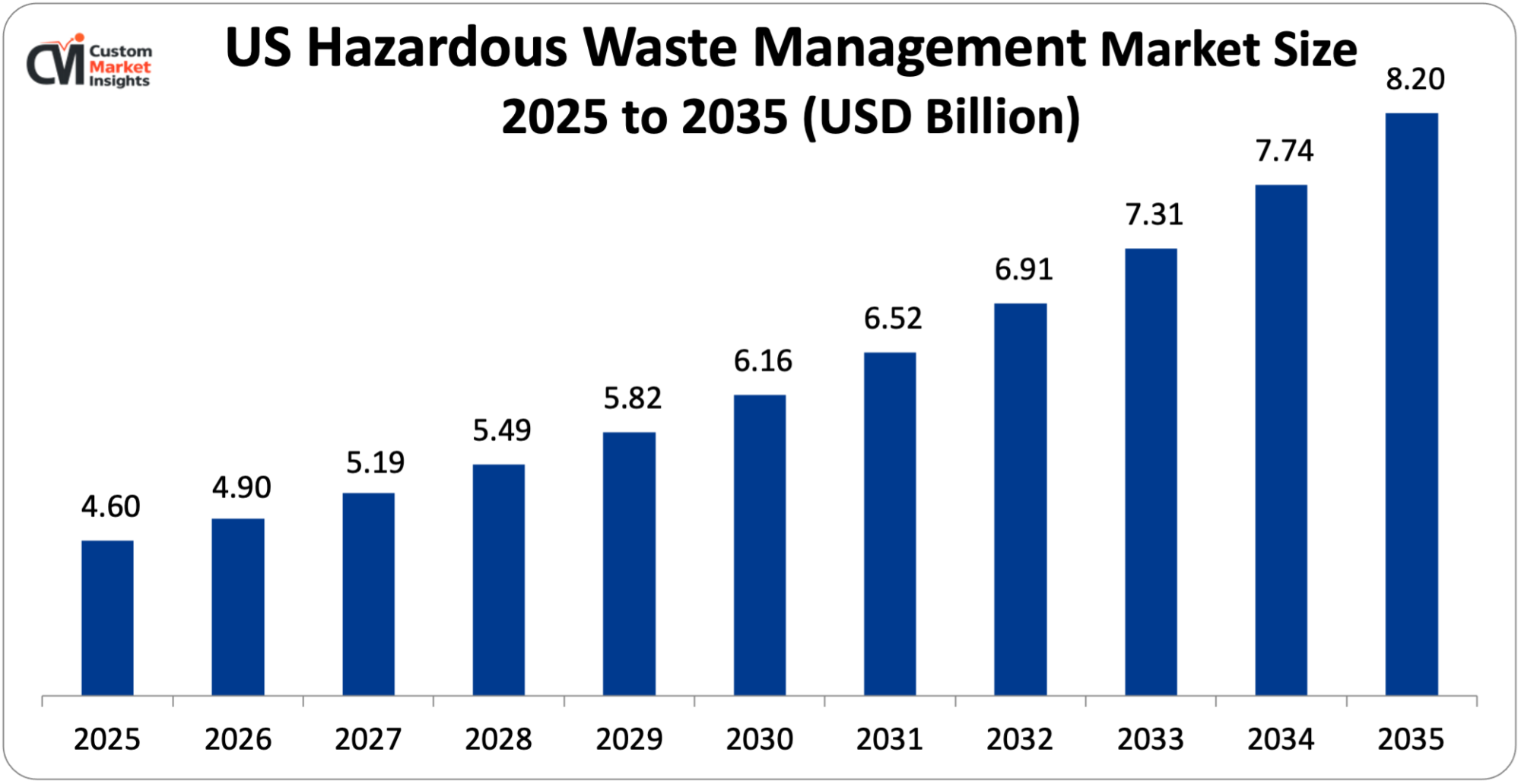
The US Hazardous Waste Management market is projected to be USD 4.9 billion in the year 2026, USD 8.2 billion in the year 2035 and at a projected CAGR of 6.1% between the years 2026 and 2035. The growth of the market is mainly fuelled by the growing production of hazardous waste through industrial production and processing, oil and gas production, and medical institutions, as well as tight federal and state level regulations on the production and disposal of waste.
The laws being implemented by agencies like the Environmental Protection Agency (EPA) are forcing industries to consider waste treatment, recycling, and disposal solutions that are in line with the laws.
Market Highlight
- By type, solid hazardous waste accounted for nearly 60.1% of market revenue in 2025, driven by high industrial generation and strict RCRA compliance.
- By treatment, chemical treatment represented around 41.2% of total demand in 2025, due to its effectiveness in neutralizing toxic and reactive wastes.
- By disposal method, incineration held nearly 38.2% market share in 2025, owing to its ability to destroy complex hazardous materials safely.
- By source, industrial waste generators accounted for approximately 40.5% of market share in 2025, driven by manufacturing, chemicals, and energy industries.
Significant Growth Factors
- Tight Environmental Rules: Tight federal and state policies in the United States have greatly influenced the hazardous waste management environment. The Resource Conservation and Recovery Act (RCRA) and the Comprehensive Environmental Response, Compensation, and Liability Act (Superfund) are laws that have stringent requirements on waste classification and handling, transportation, treatment and disposal. The structures force the industries to implement waste management systems that are compliant and invest in safer practices that would reduce environmental and population health effects. With escalating regulatory controls in the present times, such as the recent labeling of PFAS chemicals as a hazardous substance under the Superfund legislation, organizations are turning to the focus of integrating advanced waste management technologies and services to comply with the regulations and to reduce the long-term liability burdens. This regulatory impetus is still the basis of market demand for professional hazardous waste management providers. In America, over 1.07 million movements of hazardous wastes of approximately 6,081,070 tons were registered and this portrays active regulatory monitoring and enforcement of the e-Manifest system of the EPA.
- Increasing Industrial and Manufacturing Process: The extent and variety of industrial activities in the United States, from the manufacturing of chemicals and petrochemicals to the manufacturing of automobiles and electronics yield huge amounts of hazardous wastes which need to be handled appropriately. With the increase in the manufacturing production comes the increase in the total amount of waste that has to be treated, stabilized, recycled or safely disposed of. The waste streams that are generated in these industries in most cases are complex with toxic substances, solvents, heavy metals and chemical remains that require specific solutions for handling and treatment. The growing complexity of industrial operations also increases the necessity of the professional provision of waste by the employees possessing the skills in the compliance with the rules and regulations, logistics of transportation, and the high-tech disposal methods. In turn these industrial waste management continues to be a key force of the hazardous waste management market. The U.S. has approximately 882 regulated facilities for hazardous waste management indicating the extensive industrial waste production and waste management systems.
- Growth in Healthcare and Pharmaceutical Industry: Healthcare and pharmaceutical industries also emit a significant share of hazardous waste in the form of medical chemicals, laboratory waste, and contaminated materials. As the healthcare services, clinics, hospitals, research laboratories, and biotech plants continue to expand, the amount of controlled hazardous waste generated by these facilities is increasing. This has contributed to a higher payment of contracts of waste collection, treatment, and disposal to the special hazardous waste management contractors. When handled properly, these services can keep patients, employees, and communities safe against contact with infectious or toxic substances and make them follow EPA and OSHA regulations. With the healthcare industry on a steady growth due to the demographic changes and technological innovations, the demand for thorough hazardous waste management is also increasing. Healthcare-related activities in the U.S. generate hazardous waste amounting to approximately 15 percent of waste.
- Expansion of Environmental Remediation Projects: Environmental remediation projects e.g. Superfund cleanup, brownfield redevelopment, and soil decontamination projects, are significant sources of hazardous waste management services. The state agencies, as well as the EPA, spend a lot of money to combat decades-old contamination around industrial facilities, landfills, and other contaminated locations, particularly within underserved communities. These projects entail the safe elimination, transportation, and treatment of hazardous substances, which are normally in collaboration with the partners in the private sector. The more remediation is being invested in publicly and privately, the higher the demand on the specialized waste management companies that can implement the complex cleanup operations in accordance with the strict environmental rules. This is a trend that allows long-term market operation outside the normal industrial waste streams. The USD 1 billion in remediation through the Superfund program shows that EPA was taking strong measures to clean up 25 hazardous waste sites.
What are the single Biggest Developments Reshaping the US Hazardous Waste Management market Today?
- Large Operational and Compliance Costs: Hazardous waste in the United States is expensive to manage, as it involves a lot of investment in specialized equipment, trained personnel, safety measures, and compliance measures. The facilities are required to comply with the strict EPA and state regulations, such as permitting, record-keeping requirements, monitoring, and reporting. These compliance requirements raise the cost of operation between the treatment, storage, and disposal facilities and prices to the end users are usually higher. The cost of capital of treatment technologies, engineered landfills and incinerators is also high, limiting operators even further. Smaller companies or customers with tight budgets may be restricted to these higher fees and not be able to access the formal hazardous waste management market and sluggish service growth. Hundreds of controlled hazardous waste sites exist in the U.S. that is an indication of the magnitude of compliance infrastructure required to manage complex waste streams.
- Complex and Lengthy Regulatory Approval Proceses: Hazardous waste facilities in the U.S. are frequently time consuming and complex in terms of their permitting and regulatory approval. The creation of new treatment, storage, or disposal facilities will necessitate extensive environmental impact assessment, consultation with the community and multi agency review. The processes may push the start of operations and risk to investment. A few times legal difficulties or administrative complexities prolong times to a great extent hindering any infrastructure expansion or capacity building. Such complexity can discourage new entrants, lower the intensity of competition, and limit the rate of the waste management service expansion to satisfy the increasing demand. The management of hazardous waste requires compliance with restrictions on the federal and state levels, which might necessitate a substantial amount of permitting and compliance regulation.
- Public resistance to Waste Treatment Installed: Communities often oppose the installation of hazardous waste landfills, incinerators, or treatment plants on the basis of environmental health. The legal challenges, delays in the project, or constraints imposed by the policy can be the result of the public opposition based on the fear of air, soil, and water pollution. This not-in-my-backyard (NIMBY) feeling is more pronounced in underpopulated areas and in the community whose needs are already unmet. Consequently, waste management firms suffer social license problems, which can restrict geographical growth and make operations in the facilities difficult. Such community responses highlight the need to have open interactions and strong environmental protection. The environmental advocates and neighborhood groups tend to raise health issues concerning the hazardous waste plants because of the risks of toxic emissions and contamination.
Category Wise Insights
By Type
Why Solid Hazardous Waste are the Market Leaders?
The solid hazardous waste constitutes the greatest portion of the US hazardous waste management market, as the manufacturing, construction, mining, and chemical industries generate a considerable amount of solid hazardous waste. Examples of such materials include contaminated soil, metal scraps, ash, and industrial waste products. Tight EPA laws based on the Resource Conservation and Recovery Act (RCRA) demand proper handling, storage, and disposal of solid hazardous material resulting in the incessant need of treatment and landfill services. This segment enjoys even greater dominance within the industrial states because of its ease of collection and transport and its ability to be combined with various ways of treatment including incineration and land burial.
Why Liquid Hazardous Waste is the Fastest-Growing Segment?
The production of liquid hazardous waste is rising at a blistering rate because of the growing production of liquid hazardous waste by refining oil and gas, pharmaceuticals, chemical processing, and wastewater treatment plants. This form of waste contains solvents, acids, oils and decontaminated water which need special containment and treatment. Demand is being fuelled by stricter discharge standards in the Clean Water Act and increased investment in industrial wastewater treatment plants. Disposal methods such as deep well injection and chemical treatment are widely used, especially in energy producing states like Texas and Louisiana, and have been in strong growth in this segment.
By Treatment
Why Chemical Treatment are the Largest Segment?
The U.S. hazardous waste market is dominated by chemical treatment which is popular in neutralizing, detoxifying, or stabilizing the hazardous materials prior to their disposal. Chemical processes have become important in industries to meet the EPA toxicity and reactivity regulations. It is a good approach, especially for inorganic waste, acids, alkalis and heavy metals. The flexibility in various types of waste and the ability to be combined with other treatment methods, which makes chemical treatment one of the key elements of the hazardous waste management infrastructure, is what ensures its dominant role on the market.
Why is the Thermal Treatment Segment Growing Rapidly?
The segment of thermal treatment is the fastest growing one, as it is highly efficient in annihilating organic, infectious, and high-toxicity wastes. Pharmaceutical, chemical, and defense industries are beginning to utilize incineration and thermal desorption where complete destruction is necessary. Compulsory measures to curb persistent organic pollutants and dangerous medical waste have given rise to adoption. Thermal treatment is also being made viable through continuous developments of emission control and energy recovery systems that are also creating a strong growth momentum.
By Disposal Method
What is the Incineration being the Largest Segment?
Hazardous waste disposal in the U.S. is mainly by incineration because of its capability to cut down the waste content and also by incineration of waste materials that cause toxic effects. It is popularly used in the treatment of pharmaceutical, chemical, and medical wastes, which cannot be disposed of safely in landfills. Its role has been enhanced by high regulatory acceptance as well as flue gas treatment and energy recovery. Incineration is still the favored mode of disposal of complex and high-risk hazardous materials within the country, even at increased costs.
Why are Deep Well Injection the Fastest-Growing method?
Deep well injection is the most rapidly growing disposal technique, especially of liquid hazardous waste generated by chemical manufacturing and oil and gas activities. The process provides a permanent seclusion of waste materials through injecting them into underground geologically stable cores. Increased demand has been created by regulatory approvals and the growth of the shale activity. It is economical in large volumes of liquids and has a small footprint, making its adoption fly in the right areas in the United States accelerated.
By Source
What is the Industrial being the Largest Segment?
In the U.S., Industrial sources are the major contributors to the production of hazardous waste, which is influenced by manufacturing, energy production, chemicals, metals, and refining. The industries produce various types of waste, which need special treatment and disposal. The stringent government laws at both federal and state levels force the operators in the industry to contract waste management services, which guarantees a steady demand. Continued industrial operation, development of infrastructure, and environmental compliance demand continue to make industrial waste the biggest source segment of revenue generation.
Why are Healthcare is the Fastest-Growing segment?
The healthcare segment of the source is the most rapidly increasing source because of the increased number of medical procedures, pharmaceutical manufacturing, and lab testing processes. The volume of hazardous wastes has increased as a result of increased consumption of disposable medical supplies, diagnostics, and biohazard materials. Tightening up of measures that govern the handling of infectious and chemical medical wastes is causing healthcare facilities to outsource waste management to professional services. The growth of hospitals, research and laboratories, as well as life sciences manufacturing, is still growing at an accelerating rate in this segment.
Report Scope
| Feature of the Report | Details |
| Market Size in 2026 | USD 4.9 billion |
| Projected Market Size in 2035 | USD 8.2 billion |
| Market Size in 2025 | USD 4.6 billion |
| CAGR Growth Rate | 6.1% CAGR |
| Base Year | 2025 |
| Forecast Period | 2026-2035 |
| Key Segment | By Type, Treatment, Disposal Method, Source and Region |
| Report Coverage | Revenue Estimation and Forecast, Company Profile, Competitive Landscape, Growth Factors and Recent Trends |
| Buying Options | Request tailored purchasing options to fulfil your requirements for research. |
Top Players in the Market and Their Offerings
- Waste Management Inc.
- Republic Services Inc.
- Clean Harbors Inc.
- Stericycle Inc.
- US Ecology Inc.
- Veolia North America
- Clean Earth
- AECOM
- WSP Global Inc.
- Jacobs Solutions Inc.
- Bechtel
- Kiewit Corp.
- Harsco Environmental
- Arcadis NV
- GFL Environmental Inc.
- Covanta Holding Corp.
- Heritage-Crystal Clean LLC
- Triumvirate Environmental
- Casella Waste Systems Inc.
- Suez
- Others
Key Developments
Hyper Plays: The market of Hazardous Waste Management in the US is experiencing a radical change in the form of capacity building, portfolio diversification, and sustainability-conscious investments by dominant participants in the industry. Across the industrial and healthcare sectors, companies are putting more emphasis on new and highly developed treatment technologies, recycling automation, the integration of renewable energy, and strategic acquisitions to ensure environmental regulations, hazardous waste increase, and the need to comply with end-to-end waste solutions.
- In April 2025, WM declared the launch of four large facilities, including two grown recycling facilities in Central Texas and close to Baltimore, and two renewable natural gas plants close to Chicago and Philadelphia. The growth reinforces the USD 3 billion sustainability initiative of WM, which focuses on AI-based recycling and increased renewable energy supply.
- In November 2024, WM bought the regulated medical waste and secure information destruction company Stericycle for USD 7.2 billion and entered the market. The transaction enhances the hazardous waste portfolio of WM and its sustainability goal and is anticipated to create more than USD 125 million in synergy costs.
Such strategic endeavors are helping the market leaders to increase service capacity, enhance regulatory compliance, and work efficiency. Further investment in highly developed treatment facilities, automation, and specialized waste services is likely to increase competition and contribute to the growth of the market in the long term in the US hazardous waste management sector.
The US Hazardous Waste Management Market is segmented as follows:
By Type
- Solid
- Liquid
- Sludge
By Treatment
- Physical
- Chemical
- Thermal
- Biological
By Disposal Method
- Deep Well Injection
- Detonation
- Engineered Storage
- Land Burial
- Ocean Dumping
- Incineration
By Source
- Industrial
- Commercial
- Municipal
- Healthcare
- Agricultural
Table of Contents
- Chapter 1. Report Introduction
- 1.1. Report Description
- 1.1.1. Purpose of the Report
- 1.1.2. USP & Key Offerings
- 1.2. Key Benefits For Stakeholders
- 1.3. Target Audience
- 1.4. Report Scope
- 1.1. Report Description
- Chapter 2. Market Overview
- 2.1. Report Scope (Segments And Key Players)
- 2.1.1. US Hazardous Waste Management by Segments
- 2.1.2. US Hazardous Waste Management by Region
- 2.2. Executive Summary
- 2.2.1. Market Size & Forecast
- 2.2.2. US Hazardous Waste Management Market Attractiveness Analysis, By Type
- 2.2.3. US Hazardous Waste Management Market Attractiveness Analysis, By Treatment
- 2.2.4. US Hazardous Waste Management Market Attractiveness Analysis, By Disposal Method
- 2.2.5. US Hazardous Waste Management Market Attractiveness Analysis, By Source
- 2.1. Report Scope (Segments And Key Players)
- Chapter 3. Market Dynamics (DRO)
- 3.1. Market Drivers
- 3.1.1. Tight Environmental Rules
- 3.1.2. Increasing Industrial and Manufacturing Processes
- 3.1.3. Growth in Healthcare and Pharmaceutical Industry
- 3.1.4. Expansion of Environmental Remediation Projects
- 3.2. Market Restraints
- 3.3. Market Opportunities
- 3.5. Pestle Analysis
- 3.6. Porter Forces Analysis
- 3.7. Technology Roadmap
- 3.8. Value Chain Analysis
- 3.9. Government Policy Impact Analysis
- 3.10. Pricing Analysis
- 3.1. Market Drivers
- Chapter 4. US Hazardous Waste Management Market – By Type
- 4.1. Type Market Overview, By Type Segment
- 4.1.1. US Hazardous Waste Management Market Revenue Share, By Type, 2025 & 2035
- 4.1.2. Solid
- 4.1.3. US Hazardous Waste Management Share Forecast, By Region (USD Billion)
- 4.1.4. Comparative Revenue Analysis, By Country, 2025 & 2035
- 4.1.5. Key Market Trends, Growth Factors, & Opportunities
- 4.1.6. Liquid
- 4.1.7. US Hazardous Waste Management Share Forecast, By Region (USD Billion)
- 4.1.8. Comparative Revenue Analysis, By Country, 2025 & 2035
- 4.1.9. Key Market Trends, Growth Factors, & Opportunities
- 4.1.10. Sludge
- 4.1.11. US Hazardous Waste Management Share Forecast, By Region (USD Billion)
- 4.1.12. Comparative Revenue Analysis, By Country, 2025 & 2035
- 4.1.13. Key Market Trends, Growth Factors, & Opportunities
- 4.1. Type Market Overview, By Type Segment
- Chapter 5. US Hazardous Waste Management Market – By Treatment
- 5.1. Treatment Market Overview, By Treatment Segment
- 5.1.1. US Hazardous Waste Management Market Revenue Share, By Treatment, 2025 & 2035
- 5.1.2. Physical
- 5.1.3. US Hazardous Waste Management Share Forecast, By Region (USD Billion)
- 5.1.4. Comparative Revenue Analysis, By Country, 2025 & 2035
- 5.1.5. Key Market Trends, Growth Factors, & Opportunities
- 5.1.6. Chemical
- 5.1.7. US Hazardous Waste Management Share Forecast, By Region (USD Billion)
- 5.1.8. Comparative Revenue Analysis, By Country, 2025 & 2035
- 5.1.9. Key Market Trends, Growth Factors, & Opportunities
- 5.1.10. Thermal
- 5.1.11. US Hazardous Waste Management Share Forecast, By Region (USD Billion)
- 5.1.12. Comparative Revenue Analysis, By Country, 2025 & 2035
- 5.1.13. Key Market Trends, Growth Factors, & Opportunities
- 5.1.14. Biological
- 5.1.15. US Hazardous Waste Management Share Forecast, By Region (USD Billion)
- 5.1.16. Comparative Revenue Analysis, By Country, 2025 & 2035
- 5.1.17. Key Market Trends, Growth Factors, & Opportunities
- 5.1. Treatment Market Overview, By Treatment Segment
- Chapter 6. US Hazardous Waste Management Market – By Disposal Method
- 6.1. Disposal Method Market Overview, By Disposal Method Segment
- 6.1.1. US Hazardous Waste Management Market Revenue Share, By Disposal Method, 2025 & 2035
- 6.1.2. Deep Well Injection
- 6.1.3. US Hazardous Waste Management Share Forecast, By Region (USD Billion)
- 6.1.4. Comparative Revenue Analysis, By Country, 2025 & 2035
- 6.1.5. Key Market Trends, Growth Factors, & Opportunities
- 6.1.6. Detonation
- 6.1.7. US Hazardous Waste Management Share Forecast, By Region (USD Billion)
- 6.1.8. Comparative Revenue Analysis, By Country, 2025 & 2035
- 6.1.9. Key Market Trends, Growth Factors, & Opportunities
- 6.1.10. Engineered Storage
- 6.1.11. US Hazardous Waste Management Share Forecast, By Region (USD Billion)
- 6.1.12. Comparative Revenue Analysis, By Country, 2025 & 2035
- 6.1.13. Key Market Trends, Growth Factors, & Opportunities
- 6.1.14. Land Burial
- 6.1.15. US Hazardous Waste Management Share Forecast, By Region (USD Billion)
- 6.1.16. Comparative Revenue Analysis, By Country, 2025 & 2035
- 6.1.17. Key Market Trends, Growth Factors, & Opportunities
- 6.1.18. Ocean Dumping
- 6.1.19. US Hazardous Waste Management Share Forecast, By Region (USD Billion)
- 6.1.20. Comparative Revenue Analysis, By Country, 2025 & 2035
- 6.1.21. Key Market Trends, Growth Factors, & Opportunities
- 6.1.22. Incineration
- 6.1.23. US Hazardous Waste Management Share Forecast, By Region (USD Billion)
- 6.1.24. Comparative Revenue Analysis, By Country, 2025 & 2035
- 6.1.25. Key Market Trends, Growth Factors, & Opportunities
- 6.1. Disposal Method Market Overview, By Disposal Method Segment
- Chapter 7. US Hazardous Waste Management Market – By Source
- 7.1. Source Market Overview, By Source Segment
- 7.1.1. US Hazardous Waste Management Market Revenue Share, By Source, 2025 & 2035
- 7.1.2. Industrial
- 7.1.3. US Hazardous Waste Management Share Forecast, By Region (USD Billion)
- 7.1.4. Comparative Revenue Analysis, By Country, 2025 & 2035
- 7.1.5. Key Market Trends, Growth Factors, & Opportunities
- 7.1.6. Commercial
- 7.1.7. US Hazardous Waste Management Share Forecast, By Region (USD Billion)
- 7.1.8. Comparative Revenue Analysis, By Country, 2025 & 2035
- 7.1.9. Key Market Trends, Growth Factors, & Opportunities
- 7.1.10. Municipal
- 7.1.11. US Hazardous Waste Management Share Forecast, By Region (USD Billion)
- 7.1.12. Comparative Revenue Analysis, By Country, 2025 & 2035
- 7.1.13. Key Market Trends, Growth Factors, & Opportunities
- 7.1.14. Healthcare
- 7.1.15. US Hazardous Waste Management Share Forecast, By Region (USD Billion)
- 7.1.16. Comparative Revenue Analysis, By Country, 2025 & 2035
- 7.1.17. Key Market Trends, Growth Factors, & Opportunities
- 7.1.18. Agricultural
- 7.1.19. US Hazardous Waste Management Share Forecast, By Region (USD Billion)
- 7.1.20. Comparative Revenue Analysis, By Country, 2025 & 2035
- 7.1.21. Key Market Trends, Growth Factors, & Opportunities
- 7.1. Source Market Overview, By Source Segment
- Chapter 8. US Hazardous Waste Management Market – Regional Analysis
- 8.1. US Hazardous Waste Management Market Overview, By Region Segment
- 8.1.1. US Hazardous Waste Management Market Revenue Share, By Region, 2025 & 2035
- 8.1.2. US Hazardous Waste Management Market Revenue, By Region, 2026 – 2035 (USD Billion)
- 8.1.3. US Hazardous Waste Management Market Revenue, By Type, 2026 – 2035
- 8.1.4. US Hazardous Waste Management Market Revenue, By Treatment, 2026 – 2035
- 8.1.5. US Hazardous Waste Management Market Revenue, By Disposal Method, 2026 – 2035
- 8.1.6. US Hazardous Waste Management Market Revenue, By Source, 2026 – 2035
- 8.1. US Hazardous Waste Management Market Overview, By Region Segment
- Chapter 9. Competitive Landscape
- 9.1. Company Market Share Analysis – 2025
- 9.1.1. US Hazardous Waste Management Market: Company Market Share, 2025
- 9.2. US Hazardous Waste Management Market Company Market Share, 2024
- 9.1. Company Market Share Analysis – 2025
- Chapter 10. Company Profiles
- 10.1. Waste Management Inc.
- 10.1.1. Company Overview
- 10.1.2. Key Executives
- 10.1.3. Product Portfolio
- 10.1.4. Financial Overview
- 10.1.5. Operating Business Segments
- 10.1.6. Business Performance
- 10.1.7. Recent Developments
- 10.2. Republic Services Inc.
- 10.3. Clean Harbors Inc.
- 10.4. Stericycle Inc.
- 10.5. US Ecology Inc.
- 10.6. Veolia North America
- 10.7. Clean Earth
- 10.8. AECOM
- 10.9. WSP Inc.
- 10.10. Jacobs Solutions Inc.
- 10.11. Bechtel
- 10.12. Kiewit Corp.
- 10.13. Harsco Environmental
- 10.14. Arcadis NV
- 10.15. GFL Environmental Inc.
- 10.16. Covanta Holding Corp.
- 10.17. Heritage-Crystal Clean LLC
- 10.18. Triumvirate Environmental
- 10.19. Casella Waste Systems Inc.
- 10.20. Suez
- 10.21. Others.
- 10.1. Waste Management Inc.
- Chapter 11. Research Methodology
- 11.1. Research Methodology
- 11.2. Secondary Research
- 11.3. Primary Research
- 11.3.1. Analyst Tools and Models
- 11.4. Research Limitations
- 11.5. Assumptions
- 11.6. Insights From Primary Respondents
- 11.7. Why Custom Market Insights
- Chapter 12. Standard Report Commercials & Add-Ons
- 12.1. Customization Options
- 12.2. Subscription Module For Market Research Reports
- 12.3. Client Testimonials
List Of Figures
Figures No 1 to 31
List Of Tables
Tables No 1 to 2
Prominent Player
- Waste Management Inc.
- Republic Services Inc.
- Clean Harbors Inc.
- Stericycle Inc.
- US Ecology Inc.
- Veolia North America
- Clean Earth
- AECOM
- WSP Global Inc.
- Jacobs Solutions Inc.
- Bechtel
- Kiewit Corp.
- Harsco Environmental
- Arcadis NV
- GFL Environmental Inc.
- Covanta Holding Corp.
- Heritage-Crystal Clean LLC
- Triumvirate Environmental
- Casella Waste Systems Inc.
- Suez
- Others
FAQs
The key players in the market are Waste Management Inc., Republic Services Inc., Clean Harbors Inc., Stericycle Inc., US Ecology Inc., Veolia North America, Clean Earth, AECOM, WSP Global Inc., Jacobs Solutions Inc., Bechtel, Kiewit Corp., Harsco Environmental, Arcadis NV, GFL Environmental Inc., Covanta Holding Corp., Heritage-Crystal Clean LLC, Triumvirate Environmental, Casella Waste Systems Inc., Suez, Others.
The U.S. government plays a large role in the hazardous waste management market in the United States. Government regulations such as the Federal Resource Conservation and Recovery Act and other Federal Environmental Protection Agency regulations and State Environmental Laws outline the standards with which hazardous waste must be managed (stored, treated, and disposed). Increased inspections and increased penalties and reporting requirements have placed more compliance-driven demand on the market. In addition, federal funding is available to clean up sites and provide additional infrastructure (remedial action), thereby supporting the hazardous waste market. Continued regulatory alignment and enforcement will continue to provide long-term demand for professional hazardous waste management.
Purchasing decisions on price greatly impact how much of a service is used, especially among small to mid-size waste generators. Large industrial customers usually look to use a premium, full service hazardous waste service so that they can ensure continued legal compliance and ensure all risks are minimized. There are a number of businesses and healthcare organizations Using a combination of flexible contracts and bundled services will enable small to mid-sized waste generators as they manage their costs. The increasing costs associated with operating a business (especially out of pocket expenses such as rising operational expenses and rising transportation costs) will add upward pressure to the price of hazardous waste services provided to small to mid-sized waste generators. Moderate pricing pressure can be alleviated by economies of scale, long-term contracts, and technological efficiencies.
According to the market, by 2035, the market will have attained USD 8.2 billion, owing to the adoption of clouds, digital health, and AI-based healthcare facilities.
The northeast and midwest regions comprising states such as New York, Pennsylvania, Ohio, and Illinois, will comprise the majority of the market. This area has a high density of manufacturing facilities and hospitals along with legacy industrial sites, all producing a high and consistent volume of hazardous waste. The waste industry has well-established infrastructure to manage multiple waste streams through a number of different means (landfill, recycling, disposal, etc.). The industry is subject to both local and federal regulatory oversight; therefore, demand will continue for waste industry services. Lastly, because of the high density of the waste industry, there is the potential to recycle, incinerate, or treat waste in close proximity to where it’s generated, creating even more demand for waste services.
The southern and southwestern regions, such as Texas, Arizona, and Louisiana, are predicted to have the fastest growth overall. They have a strong industrial base, oil and gas production sources, and quite a number of chemical manufacturing plants, as well as favorable geological conditions that allow deep well injection. Rapid infrastructure development, expansion of industrial sectors, and increasing investment in facilities for treatment of hazardous waste have all helped foster this growth. The growth of healthcare and pharmaceutical industries in these areas also adds to the increasing need for regulated waste management services.
The main factors that cause the rise of the market are the growth of stricter environmental regulations, a greater growth of industrial and healthcare wastes, and greater application of EPA and RCRA compliance requirements. The growth of chemical, pharmaceutical, oil and gas, and high-tech production has increased the level of hazardous waste. The increased attention to sustainability, circular economy, and safe treatment of toxic substances is enhancing adoption of high-tech treatment systems. Furthermore, corporate ESG obligations and increased liabilities in regard to inappropriate disposal are forcing industries to outsource hazardous waste management to the service providers of specialized services.