
Private 5G Network Market Size, Trends and Insights By Type (Hardware, Software, Services), By Frequency (Sub-6 GHz, mmWave), By Spectrum (Licensed, Unlicensed/Shared), By Application (Manufacturing, Energy & Utilities, Transportation & Logistics, Defense, Enterprises & Campus, Mining, Healthcare/Hospitals, Oil & Gas, Retail, Agriculture, Smart Cities, Entertainment/Program Making & Special Events (PMSE), Others), and By Region - Global Industry Overview, Statistical Data, Competitive Analysis, Share, Outlook, and Forecast 2026 – 2035
Report Snapshot
CAGR: 52.8%
| Study Period: | 2026-2035 |
| Fastest Growing Market: | Asia Pacific |
| Largest Market: | North America |
Major Players
- Fujitsu Limited
- ZTE Corporation
- Cisco Systems Inc.
- Juniper Networks Inc.
- Others
Reports Description
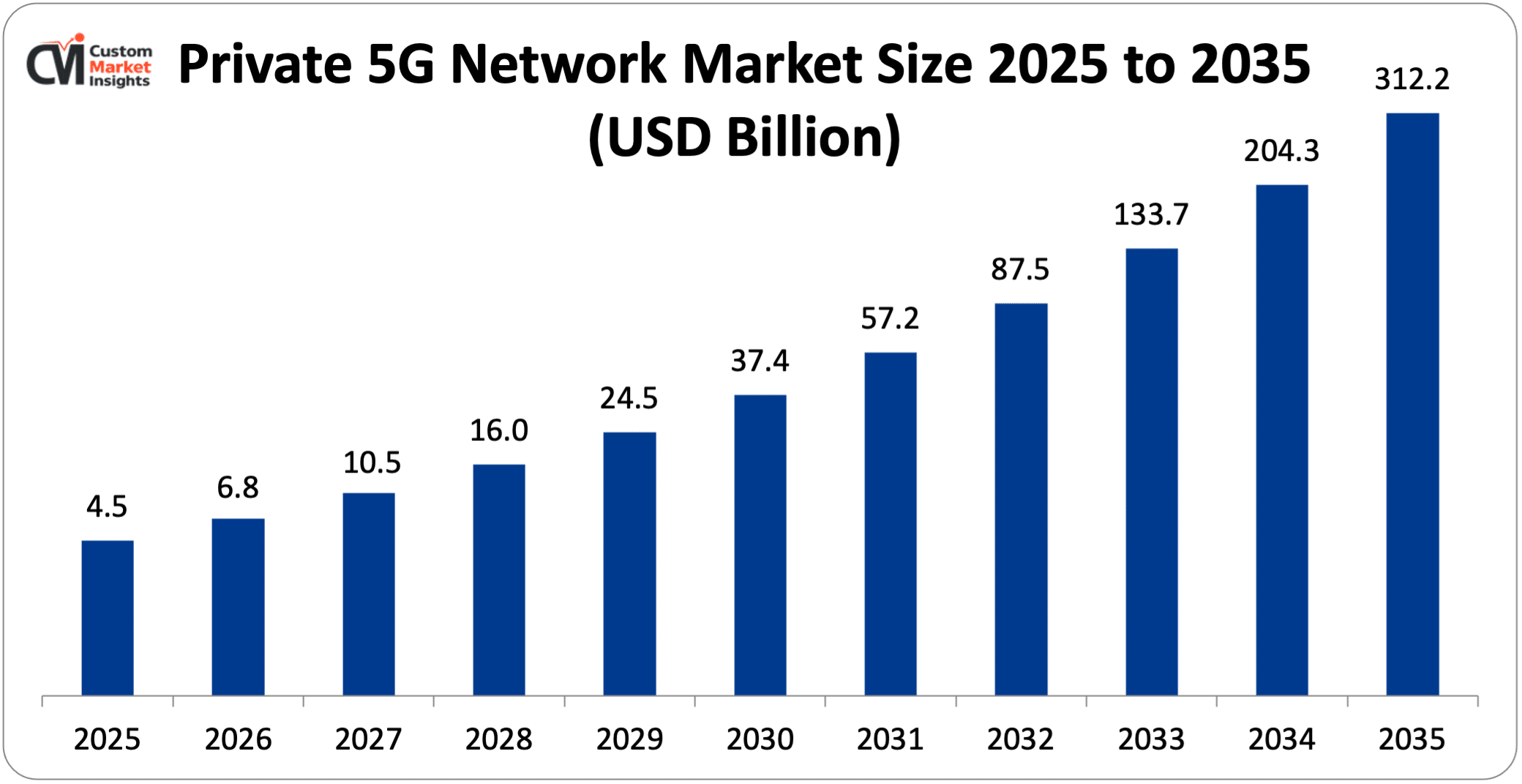
The market size of global private 5G network will be estimated at USD 4.5 billion in 2025 and is expected to grow to between USD 6.8 billion in 2026 and about USD 312.2 billion by 2035, with a current CAGR (compound annual growth rate) of 52.8% during the period of 2026 to 2035. A Private 5G Network is a dedicated cellular network based on 5G technology and operating exclusively and solely for a particular organization, company, or premises rather than as part of the mobile network used by the general public as traditional mobile networks do.
It is based on licensed, shared, or unlicensed spectrum and offers a highly dedicated, secure, reliable, and low-latency wireless connection enabling the operation of various processes and tasks. Such private 5G networks are common in environments such as manufacturing, ports, airports, hospitals, or smart campuses where permanent connectivity and real-time data analysis, data processing, big data, artificial intelligence, machine learning, automation, or Internet of Things are the fundamental parts of daily operations of the organization.
Market Highlight
- In 2025, North America will dominate the global market with an estimated market share of 32%. The rising number of projects in the area drives the market growth.
- The Asia Pacific is growing at the highest rate over the analysis period. The increasing government initiative drives the regional growth.
- By type, the hardware segment dominated the industry in 2025 of more than 50%.
- By frequency, the Sub-6 GHz segment would have the highest share of the market in 2025.
- By spectrum, the unlicensed/shared segment would have the highest share of the market in 2025.
- By application, the manufacturing segment would have the highest share of the market in 2025.
Significant Growth Factors
The private 5G network market trends present significant growth opportunities due to several factors:
- Increasing Demand for Private Networks In Sensitive Environments: Markets benefit from the raised demands of private networks in sensitive environments. The requirements for isolated secure communications are high for the sensitive information they handle in the healthcare, financial, government, and defense markets and beyond. These require a private network to secure sensitive data from a cyber-attack and also secure the emerging new technology for hospitals and remote patient monitoring, telemedicine, private interaction, live diagnostics, personal private health records (PHRs), and insurance. Financial institutions have to handle sensitive transactions. Government and defense have to operate secure networks for mission-critical operations. For organizations in these sectors, full control over their own private network allows tailored solutions that meet specific compliance demands and keeps the operations running without distraction, which is crucial for maintaining data integrity and protecting sensitive information from potential breaches. The growing demand for private networks in these environments echoes the need for data security with reliable, resilient, and isolated communications platforms.
- Emergence of Flexible Deployment Models: Flexible deployment models are among the factors that are propelling the growth of the private 5G networking market by making the technology more affordable and opening a larger enterprise adoption market. Deploying a private 5G network typically used to depend on large capital investments and specialized infrastructure and expertise and hence was accessible only to large enterprises. But now, multiple new deployment models such as 5G-as-a-service (5GaaS), managed private networks, and “network-in-a-box” deployments are enabling enterprises to deploy and scale private 5G networks with much more cost efficiency and ease while significantly reducing the time-to-market. Enterprise-specific network design from “on-premises” to hybrid, co-located, rented, public cloud, or combinations of them is also now enabled by flexible deployment options. Enterprises can truly customize private 5G networks based on specific use cases, industry verticals, and scale of operations, leading to wider adoption by a variety of industry verticals like manufacturing, logistics, healthcare, etc., and is encouraging commercial enterprises to shift operational responsibilities to vendors and telecom providers.
What are the Major Advances Changing the Private 5G Network Market Today?
- Integration of AI, IoT, and Edge Computing: The convergence of AI, IoT, and edge computing is increasingly fueling growth in the private 5G network market, as it allows for real-time, intelligent, and efficient enterprise operation. IoT devices capture an enormous volume of real-time data from sensors, connected machinery, and systems, while AI is used to analyze such data and derive actionable insights that help in predictive maintenance, automation, and manipulation of operations. Edge computing supports this use case by local processing of data to minimize latency and cloud ecosystem reliance. Private 5G networks drive this use case as a platform for reliable high-speed, low-latency and high-capacity, security sensitive connectvity. For instance. Cisco recently announced the launch of its ‘Unified Edge’ platform on private 5G that can be integrated with IoT environments and run AI workloads locally at enterprise sites, thus enabling faster decision-making, efficiency, and real-time analytics. Such product launches exemplify the unprecedented application of AI, IoT, and edge computing with private 5G networks that will transform it into the bedrock of digitally driven initiatives.
- Evolution Toward Cloud-native & Software-defined Networks: The move towards cloud-native networks and software-defined networks is therefore an important milestone in the development of the Private 5G Network market, as it is bringing about fundamental shifts in the way networks are implemented, deployed, and operated. In the past, traditional telecom networks were implemented with hardware-centric infrastructure, which was not only inflexible but also involved high deployment costs. With the move towards cloud-native networks, networks are now implemented as virtual networks with the implementation of network functions as software on the cloud infrastructure. This is bringing greater flexibility, scalability, and efficiency to the way networks are implemented. Furthermore, with the implementation of software-defined networks, the central management of network resources is possible, which is also bringing greater flexibility to the way networks are operated. This is an important milestone in the development of the private 5G market, as the implementation, deployment, operation, and management of networks are now not only bringing greater flexibility but also greater efficiency. With the implementation of cloud-native networks and software-defined networks, the implementation of the private 5G network is not only bringing greater flexibility but also greater efficiency, as the implementation of the private 5G network is now not only possible but also bringing greater efficiency.
Category Wise Insights
By Type
Why Hardware Hold a Prominent Position in the Market?
The hardware segment dominated the industry in 2025 of more than 50%. This segment’s dominance is attributed to all major telecom companies globally increasing their orders for core network, backhaul, and transport equipment. Leading network vendors Nokia Corporation and Qualcomm Technologies, Inc. have been deploying feasible equipment in order to support backend operations in providing high bandwidth, resulting in segment growth.
The services segment is growing at a highest CAGR during the forecast period. As the emphasis on installing private 5G core networks and having dedicated users control their private data increases, installation and integration services are likely to see major growth.
By Frequency
Why Sub-6 GHz Capture the Highest Market Share in the Private 5G Network Market?
The Sub-6 GHz segment would have the highest share of the market in 2025. It provides a narrower spectrum of around 1 GHz to 6 GHz and also is limited in terms of speed. However, because a sub-6 GHz range provides larger coverage, it is easier to deploy in a practical environment, particularly for private 5G networks where enterprises will be seeking coverage at a large scale. Additionally, because the spectrum has previously been used for 2G, 3G, and 4G networks, it is therefore an easier and more economic option to acquire for 5G and promotes the segment ‘s growth.
The mmWave segment is growing at a rapid rate over the projected period. Only a few federal governments of leading countries have released mmWave frequency bands to support private 5G services. For instance, the Federal Communications Commission (FCC), which is the leading factor responsible for roaming of the mmWave spectrum in the US, has released several mmWave frequencies such as 24.25-24.45 GHz, 47.2-48.2 GHz, 24.75-25.25 GHz, 38.6-40 GHz, and 27.5-29.5 GHz for providing high data rate services. Similarly, a few other countries such as Japan, South Korea, and Italy also released mmWave frequencies for high-speed data services. Therefore, excessive focus by key federal governments on releasing mmWave frequencies is expected to boost mmWave segment growth over the coming years.
By Spectrum
What Factor Causes Unlicensed/Shared to Have a Dominant Position in the Market?
The unlicensed/shared segment would have the highest share of the market in 2025. The unlicensed spectrum is attractive because the license for the whole spectrum does not need to be purchased by enterprises; it is cost-efficient and less time-consuming. The bandwidth of unlicensed spectrum is readily available and is the most favored option in the case of massive machine-to-machine (mMTC) communication connectivity of IoT devices (smart cities, stadiums, and machine-to-machine). Increasing need for high-speed and cost/time-efficient private 5G is driving demand in the unlicensed/shared spectrum segment.
The licensed segment is growing at a rapid rate over the projected period. A licensed spectrum is more costly than an unlicensed/shared spectrum, as a firm needs to purchase a full license for a particular spectrum bandwidth to get improved and secure internet connectivity from the CSPs. The licensed spectrum can also be obtained from CSPs. Although more costly, nations including the U.S. and Germany are deploying licensed spectrum for industrial and mission-critical applications. Therefore, the increasing requirement for highly secure connectivity for mission-critical applications, including AGVs, is expected to propel the licensed spectrum segment over the forecast period.
By Application
Why Does the Manufacturing Dominates the Private 5G Network Market?
The manufacturing segment would have the highest share of the market in 2025. There is a strong push for growth as a result of Industry 4.0 adoption and the demand for lower cost and more reliable, higher bandwidth connectivity in the industrial environment. Using a private 5G network, manufacturers can enable a smart factory environment where machinery, equipment, sensors, and other production systems are seamlessly connected through an Internet of Things (IIoT). Not only will this provide monitoring, predictive maintenance, and automation, but it will also provide industry-leading levels of reliability and low latency for applications such as autonomous robots and production-line Automated Guided Vehicles (AGVs).
The transportation & logistics segment is growing at a rapid rate over the projected period. The demand for quick communication, improvement of process efficiency as well as automation of complex supply chain networks is encouraging the development of segments. Logistics service providers, airports, ports, and railways are deploying private 5G networks in order to communicate in real time with vehicles, control systems, and infrastructure, as well as support functionality such as asset tracking, managing fleets, autonomous vehicles, and smart traffic management, which enhances visibility and avoids delays. Private 5G ‘s ultra-reliable and ultra-low latency is key in time-critical applications such as automation of navigation in automated guided vehicles (AGVs) in warehouses and movement of containers at smart ports.
Report Scope
| Feature of the Report | Details |
| Market Size in 2026 | USD 6.8 billion |
| Projected Market Size in 2035 | USD 312.2 billion |
| Market Size in 2025 | USD 4.5 billion |
| CAGR Growth Rate | 52.8% CAGR |
| Base Year | 2025 |
| Forecast Period | 2026-2035 |
| Key Segment | By Type, Frequency, Spectrum, Application and Region |
| Report Coverage | Revenue Estimation and Forecast, Company Profile, Competitive Landscape, Growth Factors and Recent Trends |
| Regional Scope | North America, Europe, Asia Pacific, Middle East & Africa, and South & Central America |
| Buying Options | Request tailored purchasing options to fulfil your requirements for research. |
Regional Analysis
How Big is North America Private 5G Network Market Size?
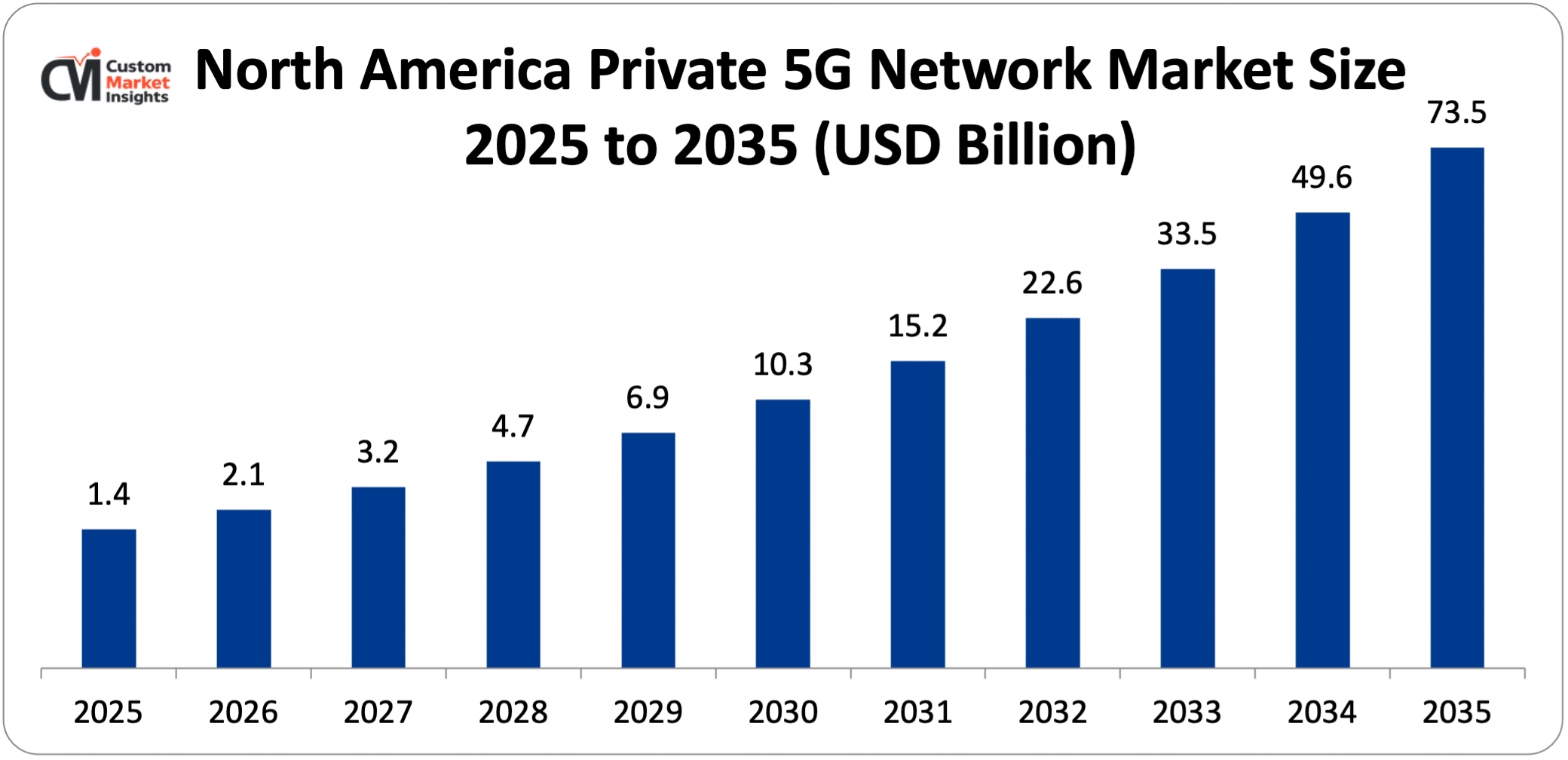
Its market size, in terms of North America private 5G network, is projected to be USD 1.4 billion in 2025 with a growth of about USD 73.5 billion in 2035 with a CAGR of 48.2% between 2026 and 2035.
Why did North America Dominate the Private 5G Network Market in 2025?
In 2025, North America will dominate the global market with an estimated market share of 32%. One of the key factors favoring the regional market is the growing number of private 5G solution providers in North America. Some of the key players operating in the field of private 5G in the North American market are AMC Networks Corporation, AT&T Inc., TVA Group Inc., and Verizon Communications, Inc., to name a few. These players are heavily investing in private 5G network infrastructure deployment, boosting the market growth.
US Private 5G Network Market Trends
In North America region, US leads the industry expansion over the projected period. The project commissioned in the area which act as major driving factor for the industry expansion. In January 2023, Verizon Business commissioned its wireless private 5G network at The Smart Factory of Deloitte @ Wichita in the U.S., a new Industry 4.0 immersive experience center.
Why is Europe Experiencing a Significant Growth in the Private 5G Network Market?
Europe holds a significant market share in 2025. The regional market has been growing fast in the past and is driven by the need for security and high-speed applications (connected things, smart cities, industrial applications, mobility, and IoT).
UK Private 5G Network Market Trends
UK held the dominant position in the market in 2025. The increasing government support drives the industry expansion.
Why is the Asia Pacific Growing at a Highest CAGR in the Private 5G Network Market?
The Asia Pacific is expected to grow at a highest CAGR over the projected period. The rapid digitalization along with the increasing government initiatives particularly in India drives the market growth.
China Private 5G Network Market Trends
China holds the prominent market share in the industry. The rapid growth of 5G connection drives the market growth.
Why is the Middle East & Africa Region is growing rapidly in the Private 5G Network?
The MEA region is growing at a steady rate over the projected period. The growing investment in 5G networks in the Middle Eastern region is creating significant growth opportunities for the regional landscape.
UAE Private 5G Network Market Trends
UAE is growing at the highest CAGR during the forecast period. The growth is supported by the nation’s aggressive digital transformation programs, rapid adoption of Industry 4.0 technologies, and rising demand for secure, high-performance connectivity in core industrial sectors.
Top Players in the Private 5G Network Market and Their Offerings
- Qualcomm Technologies Inc.
- Fujitsu Limited
- Huawei Technologies Co. Ltd.
- Samsung Electronics Co. Ltd.
- ZTE Corporation
- Cisco Systems Inc.
- Juniper Networks Inc.
- Telefonaktiebolaget LM Ericsson
- NEC Corporation
- NTT Ltd./NTT DOCOMO
- Verizon Communications Inc.
- ATandT Inc.
- Deutsche Telekom AG
- Mavenir Systems Inc.
- Altiostar (Rakuten)
- Rakuten Symphony
- Nokia Corporation
- Siemens AG
- Bosch Rexroth AG
- Amazon Web Services Inc.
- Others
Key Developments
Private 5G network market has experienced considerable changes in the last two years as the market players are trying to diversify their technological aspects and develop product portfolio using strategic approaches.
- In March 2026, Ericsson will become Virgin Media O2’s primary radio access network (RAN) partner in a five-year partnership extension that will see Ericsson power the majority of the UK service provider’s nationwide UK radio network. Through securing the majority of the radio network-focused element of Virgin Media O2’s latest Mobile Transformation Plan, the partnership extension will earn Ericsson several hundred million Euros across the five years. (https://www.ericsson.com/en/press-releases/2026/3/ericsson-to-power-majority-of-virgin-media-o2s-uk-ran-network-through-major-partnership-extension)
- In November 2025, Boldyn Networks (Boldyn) proudly announced that it has been named as a Leader by Forrester in The Forrester Wave™: Private 5G Services, Q4 2025 report. The report evaluated the most significant private 5G service providers across 21 criteria including vision and innovation grouped into three high level categories of Current Offering, Strategy, and Customer Feedback. (https://www.prnewswire.com/news-releases/boldyn-networks-named-a-leader-in-private-5g-services-q4-2025-evaluation-by-independent-research-firm-302602939.html)
These strategic measures have enabled the companies to reinforce their competitive positions, increase the product line, boost their technological competencies and also seize growth opportunities in the fast-growing private 5G network market.
The Private 5G Network Market is segmented as follows:
By Type
- Hardware
- Software
- Services
By Frequency
- Sub-6 GHz
- mmWave
By Spectrum
- Licensed
- Unlicensed/Shared
By Application
- Manufacturing
- Energy & Utilities
- Transportation & Logistics
- Defense
- Enterprises & Campus
- Mining
- Healthcare/Hospitals
- Oil & Gas
- Retail
- Agriculture
- Smart Cities
- Entertainment/Program Making & Special Events (PMSE)
- Others
Regional Coverage:
North America
- U.S.
- Canada
- Mexico
- Rest of North America
Europe
- Germany
- France
- U.K.
- Russia
- Italy
- Spain
- Netherlands
- Rest of Europe
Asia Pacific
- China
- Japan
- India
- New Zealand
- Australia
- South Korea
- Taiwan
- Rest of Asia Pacific
The Middle East & Africa
- Saudi Arabia
- UAE
- Egypt
- Kuwait
- South Africa
- Rest of the Middle East & Africa
Latin America
- Brazil
- Argentina
- Rest of Latin America
Table of Contents
- Chapter 1. Report Introduction
- 1.1. Report Description
- 1.1.1. Purpose of the Report
- 1.1.2. USP & Key Offerings
- 1.2. Key Benefits For Stakeholders
- 1.3. Target Audience
- 1.4. Report Scope
- 1.1. Report Description
- Chapter 2. Market Overview
- 2.1. Report Scope (Segments And Key Players)
- 2.1.1. Private 5G Network by Segments
- 2.1.2. Private 5G Network by Region
- 2.2. Executive Summary
- 2.2.1. Market Size & Forecast
- 2.2.2. Private 5G Network Market Attractiveness Analysis, By Type
- 2.2.3. Private 5G Network Market Attractiveness Analysis, By Frequency
- 2.2.4. Private 5G Network Market Attractiveness Analysis, By Spectrum
- 2.2.5. Private 5G Network Market Attractiveness Analysis, By Application
- 2.1. Report Scope (Segments And Key Players)
- Chapter 3. Market Dynamics (DRO)
- 3.1. Market Drivers
- 3.1.1. Increasing Demand for Private Networks In Sensitive Environments
- 3.1.2. Emergence of Flexible Deployment Models
- 3.2. Market Restraints
- 3.3. Market Opportunities
- 3.5. Pestle Analysis
- 3.6. Porter Forces Analysis
- 3.7. Technology Roadmap
- 3.8. Value Chain Analysis
- 3.9. Government Policy Impact Analysis
- 3.10. Pricing Analysis
- 3.1. Market Drivers
- Chapter 4. Private 5G Network Market – By Type
- 4.1. Type Market Overview, By Type Segment
- 4.1.1. Private 5G Network Market Revenue Share, By Type, 2025 & 2035
- 4.1.2. Hardware
- 4.1.3. Private 5G Network Share Forecast, By Region (USD Billion)
- 4.1.4. Comparative Revenue Analysis, By Country, 2025 & 2035
- 4.1.5. Key Market Trends, Growth Factors, & Opportunities
- 4.1.6. Software
- 4.1.7. Private 5G Network Share Forecast, By Region (USD Billion)
- 4.1.8. Comparative Revenue Analysis, By Country, 2025 & 2035
- 4.1.9. Key Market Trends, Growth Factors, & Opportunities
- 4.1.10. Services
- 4.1.11. Private 5G Network Share Forecast, By Region (USD Billion)
- 4.1.12. Comparative Revenue Analysis, By Country, 2025 & 2035
- 4.1.13. Key Market Trends, Growth Factors, & Opportunities
- 4.1. Type Market Overview, By Type Segment
- Chapter 5. Private 5G Network Market – By Frequency
- 5.1. Frequency Market Overview, By Frequency Segment
- 5.1.1. Private 5G Network Market Revenue Share, By Frequency, 2025 & 2035
- 5.1.2. Sub-6 GHz
- 5.1.3. Private 5G Network Share Forecast, By Region (USD Billion)
- 5.1.4. Comparative Revenue Analysis, By Country, 2025 & 2035
- 5.1.5. Key Market Trends, Growth Factors, & Opportunities
- 5.1.6. mmWave
- 5.1.7. Private 5G Network Share Forecast, By Region (USD Billion)
- 5.1.8. Comparative Revenue Analysis, By Country, 2025 & 2035
- 5.1.9. Key Market Trends, Growth Factors, & Opportunities
- 5.1. Frequency Market Overview, By Frequency Segment
- Chapter 6. Private 5G Network Market – By Spectrum
- 6.1. Spectrum Market Overview, By Spectrum Segment
- 6.1.1. Private 5G Network Market Revenue Share, By Spectrum, 2025 & 2035
- 6.1.2. Licensed
- 6.1.3. Private 5G Network Share Forecast, By Region (USD Billion)
- 6.1.4. Comparative Revenue Analysis, By Country, 2025 & 2035
- 6.1.5. Key Market Trends, Growth Factors, & Opportunities
- 6.1.6. Unlicensed/Shared
- 6.1.7. Private 5G Network Share Forecast, By Region (USD Billion)
- 6.1.8. Comparative Revenue Analysis, By Country, 2025 & 2035
- 6.1.9. Key Market Trends, Growth Factors, & Opportunities
- 6.1. Spectrum Market Overview, By Spectrum Segment
- Chapter 7. Private 5G Network Market – By Application
- 7.1. Application Market Overview, By Application Segment
- 7.1.1. Private 5G Network Market Revenue Share, By Application, 2025 & 2035
- 7.1.2. Manufacturing
- 7.1.3. Private 5G Network Share Forecast, By Region (USD Billion)
- 7.1.4. Comparative Revenue Analysis, By Country, 2025 & 2035
- 7.1.5. Key Market Trends, Growth Factors, & Opportunities
- 7.1.6. Energy & Utilities
- 7.1.7. Private 5G Network Share Forecast, By Region (USD Billion)
- 7.1.8. Comparative Revenue Analysis, By Country, 2025 & 2035
- 7.1.9. Key Market Trends, Growth Factors, & Opportunities
- 7.1.10. Transportation & Logistics
- 7.1.11. Private 5G Network Share Forecast, By Region (USD Billion)
- 7.1.12. Comparative Revenue Analysis, By Country, 2025 & 2035
- 7.1.13. Key Market Trends, Growth Factors, & Opportunities
- 7.1.14. Defense
- 7.1.15. Private 5G Network Share Forecast, By Region (USD Billion)
- 7.1.16. Comparative Revenue Analysis, By Country, 2025 & 2035
- 7.1.17. Key Market Trends, Growth Factors, & Opportunities
- 7.1.18. Enterprises & Campus
- 7.1.19. Private 5G Network Share Forecast, By Region (USD Billion)
- 7.1.20. Comparative Revenue Analysis, By Country, 2025 & 2035
- 7.1.21. Key Market Trends, Growth Factors, & Opportunities
- 7.1.22. Mining
- 7.1.23. Private 5G Network Share Forecast, By Region (USD Billion)
- 7.1.24. Comparative Revenue Analysis, By Country, 2025 & 2035
- 7.1.25. Key Market Trends, Growth Factors, & Opportunities
- 7.1.26. Healthcare/Hospitals
- 7.1.27. Private 5G Network Share Forecast, By Region (USD Billion)
- 7.1.28. Comparative Revenue Analysis, By Country, 2025 & 2035
- 7.1.29. Key Market Trends, Growth Factors, & Opportunities
- 7.1.30. Oil & Gas
- 7.1.31. Private 5G Network Share Forecast, By Region (USD Billion)
- 7.1.32. Comparative Revenue Analysis, By Country, 2025 & 2035
- 7.1.33. Key Market Trends, Growth Factors, & Opportunities
- 7.1.34. Retail
- 7.1.35. Private 5G Network Share Forecast, By Region (USD Billion)
- 7.1.36. Comparative Revenue Analysis, By Country, 2025 & 2035
- 7.1.37. Key Market Trends, Growth Factors, & Opportunities
- 7.1.38. Agriculture
- 7.1.39. Private 5G Network Share Forecast, By Region (USD Billion)
- 7.1.40. Comparative Revenue Analysis, By Country, 2025 & 2035
- 7.1.41. Key Market Trends, Growth Factors, & Opportunities
- 7.1.42. Smart Cities
- 7.1.43. Private 5G Network Share Forecast, By Region (USD Billion)
- 7.1.44. Comparative Revenue Analysis, By Country, 2025 & 2035
- 7.1.45. Key Market Trends, Growth Factors, & Opportunities
- 7.1.46. Entertainment/Program Making & Special Events (PMSE)
- 7.1.47. Private 5G Network Share Forecast, By Region (USD Billion)
- 7.1.48. Comparative Revenue Analysis, By Country, 2025 & 2035
- 7.1.49. Key Market Trends, Growth Factors, & Opportunities
- 7.1.50. Others
- 7.1.51. Private 5G Network Share Forecast, By Region (USD Billion)
- 7.1.52. Comparative Revenue Analysis, By Country, 2025 & 2035
- 7.1.53. Key Market Trends, Growth Factors, & Opportunities
- 7.1. Application Market Overview, By Application Segment
- Chapter 8. Private 5G Network Market – Regional Analysis
- 8.1. Private 5G Network Market Overview, By Region Segment
- 8.1.1. Global Private 5G Network Market Revenue Share, By Region, 2025 & 2035
- 8.1.2. Global Private 5G Network Market Revenue, By Region, 2026 – 2035 (USD Billion)
- 8.1.3. Global Private 5G Network Market Revenue, By Type, 2026 – 2035
- 8.1.4. Global Private 5G Network Market Revenue, By Frequency, 2026 – 2035
- 8.1.5. Global Private 5G Network Market Revenue, By Spectrum, 2026 – 2035
- 8.1.6. Global Private 5G Network Market Revenue, By Application, 2026 – 2035
- 8.2. North America
- 8.2.1. North America Private 5G Network Market Revenue, By Country, 2026 – 2035 (USD Billion)
- 8.2.2. North America Private 5G Network Market Revenue, By Type, 2026 – 2035
- 8.2.3. North America Private 5G Network Market Revenue, By Frequency, 2026 – 2035
- 8.2.4. North America Private 5G Network Market Revenue, By Spectrum, 2026 – 2035
- 8.2.5. North America Private 5G Network Market Revenue, By Application, 2026 – 2035
- 8.2.6. U.S. Private 5G Network Market Revenue, 2026 – 2035 (USD Billion)
- 8.2.7. Canada Private 5G Network Market Revenue, 2026 – 2035 (USD Billion)
- 8.2.8. Mexico Private 5G Network Market Revenue, 2026 – 2035 (USD Billion)
- 8.2.9. Rest of North America Private 5G Network Market Revenue, 2026 – 2035 (USD Billion)
- 8.3. Europe
- 8.3.1. Europe Private 5G Network Market Revenue, By Country, 2026 – 2035 (USD Billion)
- 8.3.2. Europe Private 5G Network Market Revenue, By Type, 2026 – 2035
- 8.3.3. Europe Private 5G Network Market Revenue, By Frequency, 2026 – 2035
- 8.3.4. Europe Private 5G Network Market Revenue, By Spectrum, 2026 – 2035
- 8.3.5. Europe Private 5G Network Market Revenue, By Application, 2026 – 2035
- 8.3.6. Germany Private 5G Network Market Revenue, 2026 – 2035 (USD Billion)
- 8.3.7. France Private 5G Network Market Revenue, 2026 – 2035 (USD Billion)
- 8.3.8. U.K. Private 5G Network Market Revenue, 2026 – 2035 (USD Billion)
- 8.3.9. Russia Private 5G Network Market Revenue, 2026 – 2035 (USD Billion)
- 8.3.10. Italy Private 5G Network Market Revenue, 2026 – 2035 (USD Billion)
- 8.3.11. Spain Private 5G Network Market Revenue, 2026 – 2035 (USD Billion)
- 8.3.12. Netherlands Private 5G Network Market Revenue, 2026 – 2035 (USD Billion)
- 8.3.13. Rest of Europe Private 5G Network Market Revenue, 2026 – 2035 (USD Billion)
- 8.4. Asia Pacific
- 8.4.1. Asia Pacific Private 5G Network Market Revenue, By Country, 2026 – 2035 (USD Billion)
- 8.4.2. Asia Pacific Private 5G Network Market Revenue, By Type, 2026 – 2035
- 8.4.3. Asia Pacific Private 5G Network Market Revenue, By Frequency, 2026 – 2035
- 8.4.4. Asia Pacific Private 5G Network Market Revenue, By Spectrum, 2026 – 2035
- 8.4.5. Asia Pacific Private 5G Network Market Revenue, By Application, 2026 – 2035
- 8.4.6. China Private 5G Network Market Revenue, 2026 – 2035 (USD Billion)
- 8.4.7. Japan Private 5G Network Market Revenue, 2026 – 2035 (USD Billion)
- 8.4.8. India Private 5G Network Market Revenue, 2026 – 2035 (USD Billion)
- 8.4.9. New Zealand Private 5G Network Market Revenue, 2026 – 2035 (USD Billion)
- 8.4.10. Australia Private 5G Network Market Revenue, 2026 – 2035 (USD Billion)
- 8.4.11. South Korea Private 5G Network Market Revenue, 2026 – 2035 (USD Billion)
- 8.4.12. Taiwan Private 5G Network Market Revenue, 2026 – 2035 (USD Billion)
- 8.4.13. Rest of Asia Pacific Private 5G Network Market Revenue, 2026 – 2035 (USD Billion)
- 8.5. The Middle-East and Africa
- 8.5.1. The Middle-East and Africa Private 5G Network Market Revenue, By Country, 2026 – 2035 (USD Billion)
- 8.5.2. The Middle-East and Africa Private 5G Network Market Revenue, By Type, 2026 – 2035
- 8.5.3. The Middle-East and Africa Private 5G Network Market Revenue, By Frequency, 2026 – 2035
- 8.5.4. The Middle-East and Africa Private 5G Network Market Revenue, By Spectrum, 2026 – 2035
- 8.5.5. The Middle-East and Africa Private 5G Network Market Revenue, By Application, 2026 – 2035
- 8.5.6. Saudi Arabia Private 5G Network Market Revenue, 2026 – 2035 (USD Billion)
- 8.5.7. UAE Private 5G Network Market Revenue, 2026 – 2035 (USD Billion)
- 8.5.8. Egypt Private 5G Network Market Revenue, 2026 – 2035 (USD Billion)
- 8.5.9. Kuwait Private 5G Network Market Revenue, 2026 – 2035 (USD Billion)
- 8.5.10. South Africa Private 5G Network Market Revenue, 2026 – 2035 (USD Billion)
- 8.5.11. Rest of the Middle East & Africa Private 5G Network Market Revenue, 2026 – 2035 (USD Billion)
- 8.6. Latin America
- 8.6.1. Latin America Private 5G Network Market Revenue, By Country, 2026 – 2035 (USD Billion)
- 8.6.2. Latin America Private 5G Network Market Revenue, By Type, 2026 – 2035
- 8.6.3. Latin America Private 5G Network Market Revenue, By Frequency, 2026 – 2035
- 8.6.4. Latin America Private 5G Network Market Revenue, By Spectrum, 2026 – 2035
- 8.6.5. Latin America Private 5G Network Market Revenue, By Application, 2026 – 2035
- 8.6.6. Brazil Private 5G Network Market Revenue, 2026 – 2035 (USD Billion)
- 8.6.7. Argentina Private 5G Network Market Revenue, 2026 – 2035 (USD Billion)
- 8.6.8. Rest of Latin America Private 5G Network Market Revenue, 2026 – 2035 (USD Billion)
- 8.1. Private 5G Network Market Overview, By Region Segment
- Chapter 9. Competitive Landscape
- 9.1. Company Market Share Analysis – 2025
- 9.1.1. Global Private 5G Network Market: Company Market Share, 2025
- 9.2. Global Private 5G Network Market Company Market Share, 2024
- 9.1. Company Market Share Analysis – 2025
- Chapter 10. Company Profiles
- 10.1. Qualcomm Technologies Inc.
- 10.1.1. Company Overview
- 10.1.2. Key Executives
- 10.1.3. Product Portfolio
- 10.1.4. Financial Overview
- 10.1.5. Operating Business Segments
- 10.1.6. Business Performance
- 10.1.7. Recent Developments
- 10.2. Fujitsu Limited
- 10.3. Huawei Technologies Co. Ltd.
- 10.4. Samsung Electronics Co. Ltd.
- 10.5. ZTE Corporation
- 10.6. Cisco Systems Inc.
- 10.7. Juniper Networks Inc.
- 10.8. Telefonaktiebolaget LM Ericsson
- 10.9. NEC Corporation
- 10.10. NTT Ltd./NTT DOCOMO
- 10.11. Verizon Communications Inc.
- 10.12. ATandT Inc.
- 10.13. Deutsche Telekom AG
- 10.14. Mavenir Systems Inc.
- 10.15. Altiostar (Rakuten)
- 10.16. Rakuten Symphony
- 10.17. Nokia Corporation
- 10.18. Siemens AG
- 10.19. Bosch Rexroth AG
- 10.20. Amazon Web Services Inc.
- 10.21. Others.
- 10.1. Qualcomm Technologies Inc.
- Chapter 11. Research Methodology
- 11.1. Research Methodology
- 11.2. Secondary Research
- 11.3. Primary Research
- 11.3.1. Analyst Tools and Models
- 11.4. Research Limitations
- 11.5. Assumptions
- 11.6. Insights From Primary Respondents
- 11.7. Why Custom Market Insights
- Chapter 12. Standard Report Commercials & Add-Ons
- 12.1. Customization Options
- 12.2. Subscription Module For Market Research Reports
- 12.3. Client Testimonials
List Of Figures
Figures No 1 to 38
List Of Tables
Tables No 1 to 51
Prominent Player
- Qualcomm Technologies Inc.
- Fujitsu Limited
- Huawei Technologies Co. Ltd.
- Samsung Electronics Co. Ltd.
- ZTE Corporation
- Cisco Systems Inc.
- Juniper Networks Inc.
- Telefonaktiebolaget LM Ericsson
- NEC Corporation
- NTT Ltd./NTT DOCOMO
- Verizon Communications Inc.
- ATandT Inc.
- Deutsche Telekom AG
- Mavenir Systems Inc.
- Altiostar (Rakuten)
- Rakuten Symphony
- Nokia Corporation
- Siemens AG
- Bosch Rexroth AG
- Amazon Web Services Inc.
- Others
FAQs
The key players in the market are Qualcomm Technologies Inc., Fujitsu Limited, Huawei Technologies Co. Ltd., Samsung Electronics Co. Ltd., ZTE Corporation, Cisco Systems Inc., Juniper Networks Inc., Telefonaktiebolaget LM Ericsson, NEC Corporation, NTT Ltd./NTT DOCOMO, Verizon Communications Inc., ATandT Inc., Deutsche Telekom AG, Mavenir Systems Inc., Altiostar (Rakuten), Rakuten Symphony, Nokia Corporation, Siemens AG, Bosch Rexroth AG, Amazon Web Services Inc., Others.
Government regulations play a crucial role in shaping the Private 5G Network market by enabling spectrum allocation, ensuring data security and compliance, and promoting infrastructure development, thereby accelerating adoption and guiding market growth.
Higher price points can slow adoption by increasing upfront investment barriers, while competitive and flexible pricing models accelerate market growth by making private 5G more accessible to a wider range of enterprises.
According to the present analysis and forecast modeling, the market of private 5G network will witness a significant growth of about USD 73.5 billion in the year 2035 with the growing innovative product launch, increasing collaboration, rising digitalization with a CAGR of 48.2% between the years 2026 and 2035.
It is projected that North America will hold the largest market share in the private 5G network market in the forecast period, with a share of about 32% of the global market share, which is attributed to the presence of major players and increasing investment in advanced technology.
The Asia Pacific is expected to grow at a highest rate during the forecast period. The growth in the region is owing to the increasing government initiatives.
Key driving factors include rising demand for secure, low-latency connectivity in industries like manufacturing and healthcare. Industry 4.0, IoT, and automation are pushing enterprises to adopt customizable private networks. Government spectrum support and growing edge computing needs also fuel market growth.