
Netherlands Long-term Care Market Size, Trends and Insights By Service (Home Healthcare, Hospice, Nursing Care, Assisted Living Facilities), By Payer (Public, Private, Out-of-Pocket), and By Region - Industry Overview, Statistical Data, Competitive Analysis, Share, Outlook, and Forecast 2026 – 2035
Report Snapshot
CAGR: 5.37%
| Study Period: | 2026-2035 |
| Fastest Growing Market: | Netherlands |
| Largest Market: | Netherlands |
Major Players
- Buurtzorg Nederland
- Omring
- Tzorg
- Clariane
- Others
Reports Description
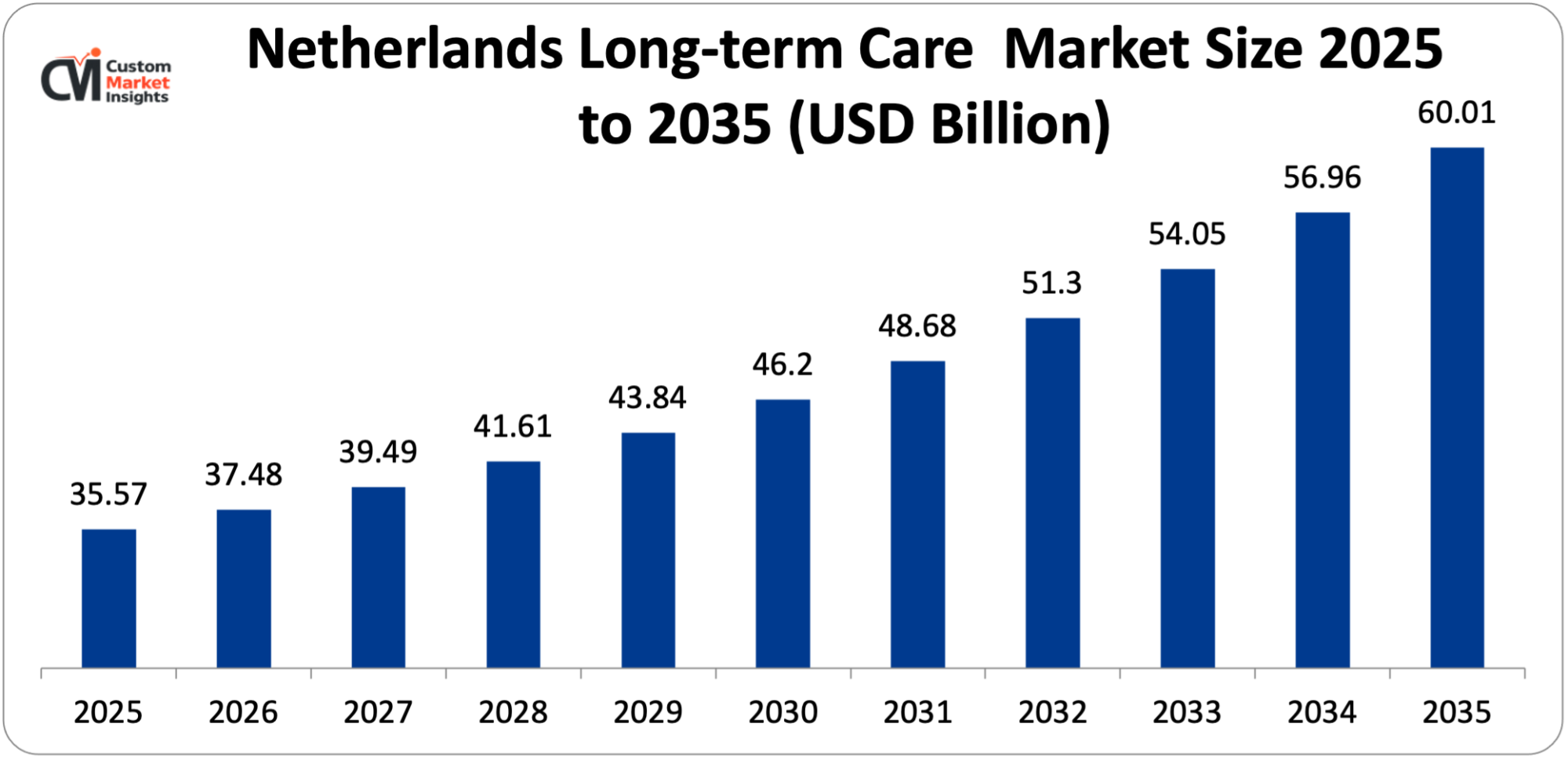
The Netherlands long-term care market is expected to record a CAGR of 5.37% from 2026 to 2035. In 2026, the market size was USD 37.48 Billion. By 2035, the valuation is anticipated to reach USD 60.01 Billion.
The market is growing due to the Netherlands being home to a plethora of residential care facilities, nursing homes, rehabilitation, home-based care services, and various other support services for the ones suffering from functional limitations or chronic conditions. Furthermore, with continual government support, the Dutch long-term care market is poised to grow on a decent note during the forecast period.
Market Highlights
- By service, nursing care held around 33% of the market share in 2025.
- By service, the hospice segment is expected to witness the fastest CAGR of 7.12% between 2026 and 2035.
- By payer, the public segment dominated in 2025 with 57% of the overall market share.
- By payer, the private segment is expected to witness the fastest CAGR of 8.65% during the forecast period.
Significant Growth Factors
The Netherlands long-term market presents significant growth opportunities due to several factors:
- Increased Geriatric Population
One of the major growth drivers of the Netherlands long-term care market is the rising aging population. As per Statistics Netherlands, the number of people aged 65 and above is on a visibly increasing spree, which translates to a higher occurrence of age-related ailments like mobility limitations, dementia, and chronic diseases. This shift is substantially raising the demand for assisted living facilities, nursing homes, and home-based care services. With increasing life expectancy, more individuals need medical supervision in the long run, thereby prompting expansion of the care workforce and infrastructure across the Netherlands healthcare system.
- Structured Funding through Government Support
The Netherlands does operate a comprehensible national scheme under the Long-term Care Act, which ascertains wider access to home-based and institutional care services for all the eligible residents. Also, investments by the public in healthcare infrastructure coupled with policies are driving community care and aging-in-place models. This, in turn, has catalyzed the development of digital health solutions and home healthcare services. On top of that, rising adoption of assistive technologies, remote monitoring, and integrated care programs is enhancing service efficiency.
What are the Major Advancements Changing the Netherlands Long-term Care Market Today?
- Transformation to Community-centered and Home-based Care Models
The government’s strategy pertaining to long-term care focuses on “care at home if possible,” thereby catalyzing independent living along with minimal dependency on institutional facilities. The Health Insurance Act, the Long-term Care Act, and the Social Support Act are supporting this shift through various integrated monetary frameworks, which do distribute responsibilities for home nursing, institutional care, and community support across various platforms. Also, extramural care packages and novel housing-care concepts let older adults live on an independent account while receiving customized services in parallel. Such reforms do aid in exercising control over long-term care expenses, improving the quality of lives of senior citizens, and adapting to the greater number of people who will need long-term support going forward.
- Care Delivery’s Digital Transformation
Healthcare insurers and providers are visibly adopting the telehealth platforms, interoperable electronic health records, and remote patient monitoring systems for improving care efficiency and coordination. Such technologies help in addressing the shortages of workforce and reducing administrative burdens while facilitating patient-centric care models. As such, the long-term care providers are handsomely investing in technological advancements for extending support to remote monitoring, improving communication between families and caregivers, and enhancing chronic disease management.
- Impact of AI on the Netherlands Long-term Care Market
The Dutch healthcare system is facing increased pressure from the geriatric population with a projected dearth of healthcare professionals, which is, in turn, compelling the providers to opt for AI-based solutions. The AI tools do automate administrative tasks like scheduling, documentation, and patient record management, thereby letting caregivers spend time on patient care on a direct basis. Studies show that around 40% of the Dutch healthcare professionals have been reported to spend more time on administration as compared to patient interaction. Herein, AI paves the way for reducing burden and improving productivity. As an outcome, healthcare organizations and hospitals are into the deployment of AI for transcription, logistics management, and workflow optimization, thereby helping in streamlining operations and improving long-term care facilities’ efficiency. Also, AI-driven remote monitoring, smart sensors, and predictive analytics are used for tracking patient health. AI-enabled systems in elderly care, like vision-based monitoring solutions, are capable of automatically detecting falls, unusual behaviour patterns, or sleep disturbances.
Category Wise Insights
Why Does Nursing Care Segment Dominate the Netherlands Long-term Care Market?
The Netherlands has a higher proportion of citizens aged 65 and above, which translates to the need for continual medical supervision, assistance with daily living activities, and rehabilitation services. The nursing care facilities herein have specifically been equipped for managing complex health conditions like Parkinson’s disease, Alzheimer’s disease, Type 2 Diabetes, which are seen amongst the geriatric population. Such facilities imply skilled nursing services, specialized dementia care, and medication management that may not be possible to be delivered through standardized home care services, thereby rendering them necessary in the long-term care system.
By Payer
How does Public Segment Dominate The Netherlands Long-term Care Market?
The Netherlands operates one of the most publicly funded and comprehensible long-term care systems across the globe. A huge share of long-term care (LTC) services, especially 24-hour supervision and intensive nursing home care, is financed through the Long-Term Care Act (WLZ), which is funded by mandatory social insurance contributions. It is thus ascertained that the individuals battling severe cognitive or physical impairments receive home-based or institutional long-term care with the majority of costs covered by the Dutch government. In other words, public financing plays a crucial role in supporting residential care facilities, nursing homes, and specialized dementia care services in Holland.
Report Scope
| Feature of the Report | Details |
| Market Size in 2026 | USD 37.48 Billion |
| Projected Market Size in 2035 | USD 60.01 Billion |
| Market Size in 2025 | USD 35.57 Billion |
| CAGR Growth Rate | 5.37% CAGR |
| Base Year | 2025 |
| Forecast Period | 2026-2035 |
| Key Segment | By Service, Payer and Region |
| Report Coverage | Revenue Estimation and Forecast, Company Profile, Competitive Landscape, Growth Factors and Recent Trends |
| Buying Options | Request tailored purchasing options to fulfil your requirements for research. |
Top Players in The Netherlands Long-term Care Market and Their Offerings
- Buurtzorg Nederland
- Omring
- Tzorg
- Clariane
- Domus Valuas
- Mediq
- Luscii
- Others
Key Developments
The Netherlands long-term care market has experienced considerable changes in the last two years as the market players are trying to diversify their technological aspects and develop product portfolios using strategic approaches.
- Of late, Buurtzorg has strengthened the digital ecosystem through its internal digital platform called “BuurtzorgWeb,” which does help nurses for coordinating patient data and collaborating within the self-managed teams. The platform does support nurses using the mobile devices for managing documentation and communication in real time.
- In 2024, Omring renewed its Topcare certification for specialized geriatric rehabilitation services (GRZPLUS). Omring continues collaborating with the other regional care organizations on rehabilitation programs for improving patient outcomes.
The Netherlands Long-term Care Market is segmented as follows:
By Service
- Home Healthcare
- Hospice
- Nursing Care
- Assisted Living Facilities
By Payer
- Public
- Private
- Out-of-Pocket
Table of Contents
- Chapter 1. Report Introduction
- 1.1. Report Description
- 1.1.1. Purpose of the Report
- 1.1.2. USP & Key Offerings
- 1.2. Key Benefits For Stakeholders
- 1.3. Target Audience
- 1.4. Report Scope
- 1.1. Report Description
- Chapter 2. Market Overview
- 2.1. Report Scope (Segments And Key Players)
- 2.1.1. Netherlands Long-term Care by Segments
- 2.1.2. Netherlands Long-term Care by Region
- 2.2. Executive Summary
- 2.2.1. Market Size & Forecast
- 2.2.2. Netherlands Long-term Care Market Attractiveness Analysis, By Service
- 2.2.3. Netherlands Long-term Care Market Attractiveness Analysis, By Payer
- 2.1. Report Scope (Segments And Key Players)
- Chapter 3. Market Dynamics (DRO)
- 3.1. Market Drivers
- 3.1.1. Increased Geriatric Population
- 3.1.2. Structured Funding through Government Support
- 3.2. Market Restraints
- 3.3. Market Opportunities
- 3.5. Pestle Analysis
- 3.6. Porter’s Forces Analysis
- 3.7. Technology Roadmap
- 3.8. Value Chain Analysis
- 3.9. Government Policy Impact Analysis
- 3.10. Pricing Analysis
- 3.1. Market Drivers
- Chapter 4. Netherlands Long-term Care Market – By Service
- 4.1. Service Market Overview, By Service Segment
- 4.1.1. Netherlands Long-term Care Market Revenue Share, By Service , 2025 & 2035
- 4.1.2. Home Healthcare
- 4.1.3. Netherlands Long-term Care Share Forecast, By Region (USD Billion)
- 4.1.4. Comparative Revenue Analysis, By Country, 2025 & 2035
- 4.1.5. Key Market Trends, Growth Factors, & Opportunities
- 4.1.6. Hospice
- 4.1.7. Netherlands Long-term Care Share Forecast, By Region (USD Billion)
- 4.1.8. Comparative Revenue Analysis, By Country, 2025 & 2035
- 4.1.9. Key Market Trends, Growth Factors, & Opportunities
- 4.1.10. Nursing Care
- 4.1.11. Netherlands Long-term Care Share Forecast, By Region (USD Billion)
- 4.1.12. Comparative Revenue Analysis, By Country, 2025 & 2035
- 4.1.13. Key Market Trends, Growth Factors, & Opportunities
- 4.1.14. Assisted Living Facilities
- 4.1.15. Netherlands Long-term Care Share Forecast, By Region (USD Billion)
- 4.1.16. Comparative Revenue Analysis, By Country, 2025 & 2035
- 4.1.17. Key Market Trends, Growth Factors, & Opportunities
- 4.1. Service Market Overview, By Service Segment
- Chapter 5. Netherlands Long-term Care Market – By Payer
- 5.1. Payer Market Overview, By Payer Segment
- 5.1.1. Netherlands Long-term Care Market Revenue Share, By Payer, 2025 & 2035
- 5.1.2. Public
- 5.1.3. Netherlands Long-term Care Share Forecast, By Region (USD Billion)
- 5.1.4. Comparative Revenue Analysis, By Country, 2025 & 2035
- 5.1.5. Key Market Trends, Growth Factors, & Opportunities
- 5.1.6. Private
- 5.1.7. Netherlands Long-term Care Share Forecast, By Region (USD Billion)
- 5.1.8. Comparative Revenue Analysis, By Country, 2025 & 2035
- 5.1.9. Key Market Trends, Growth Factors, & Opportunities
- 5.1.10. Out-of-Pocket
- 5.1.11. Netherlands Long-term Care Share Forecast, By Region (USD Billion)
- 5.1.12. Comparative Revenue Analysis, By Country, 2025 & 2035
- 5.1.13. Key Market Trends, Growth Factors, & Opportunities
- 5.1. Payer Market Overview, By Payer Segment
- Chapter 6. Netherlands Long-term Care Market – Regional Analysis
- 6.1. Netherlands Long-term Care Market Overview, By Region Segment
- 6.1.1. Netherlands Long-term Care Market Revenue Share, By Region, 2025 & 2035
- 6.1.2. Netherlands Long-term Care Market Revenue, By Region, 2026 – 2035 (USD Billion)
- 6.1.3. Netherlands Long-term Care Market Revenue, By Service, 2026 – 2035
- 6.1.4. Netherlands Long-term Care Market Revenue, By Payer, 2026 – 2035
- 6.1. Netherlands Long-term Care Market Overview, By Region Segment
- Chapter 7. Competitive Landscape
- 7.1. Company Market Share Analysis – 2025
- 7.1.1. Netherlands Long-term Care Market: Company Market Share, 2025
- 7.2. Netherlands Long-term Care Market Company Market Share, 2024
- 7.1. Company Market Share Analysis – 2025
- Chapter 8. Company Profiles
- 8.1. Buurtzorg Nederland
- 8.1.1. Company Overview
- 8.1.2. Key Executives
- 8.1.3. Product Portfolio
- 8.1.4. Financial Overview
- 8.1.5. Operating Business Segments
- 8.1.6. Business Performance
- 8.1.7. Recent Developments
- 8.2. Omring
- 8.3. Tzorg
- 8.4. Clariane
- 8.5. Domus Valuas
- 8.6. Mediq
- 8.7. Luscii
- 8.8. Others.
- 8.1. Buurtzorg Nederland
- Chapter 9. Research Methodology
- 9.1. Research Methodology
- 9.2. Secondary Research
- 9.3. Primary Research
- 9.3.1. Analyst Tools and Models
- 9.4. Research Limitations
- 9.5. Assumptions
- 9.6. Insights From Primary Respondents
- 9.7. Why Custom Market Insights
- Chapter 10. Standard Report Commercials & Add-Ons
- 10.1. Customization Options
- 10.2. Subscription Module For Market Research Reports
- 10.3. Client Testimonials
List Of Figures
Figures No 1 to 16
List Of Tables
Tables No 1 to 2
Prominent Player
- Buurtzorg Nederland
- Omring
- Tzorg
- Clariane
- Domus Valuas
- Mediq
- Luscii
- Others
FAQs
The key players in the market are Buurtzorg Nederland, Omring, Tzorg, Clariane, Domus Valuas, Mediq, Luscii, Others.
Key legislations like the Social Support Act (Wmo), the Health Insurance Act (Zvw), and the Long-Term Care Act (WLZ) set out the services publicly financed, the way responsibilities are divided amongst insurers, municipalities, and care providers, and who qualifies for the care. Plus, regulatory frameworks are incentivizing innovations like small-scale residential care and adoption of digital health by providing operational guidelines and funding pathways, thereby rendering government policy one of the key drivers for market expansion.
The cost of services dictates sustainability for providers and accessibility for patients. The publicly funded programs such as the Long-Term Care Act (WLZ) and support from municipalities such as the Social Support Act (Wmo) aid in mitigating the out-of-pocket expenses pertaining to intensive care, thereby facilitating wider adoption of home-care and nursing home services. The providers are also leveraging the digital health solutions, integrated community care models, and telecare for reducing per-patient costs while sustaining quality.
The Netherlands’ long-term care market is expected to reach USD 60.01 Billion by 2035, growing at a CAGR of 5.37% from 2026 to 2035. The market is growing due to an increased aging population with a rise in the need for chronic care and a shift toward community-centered, home-based, and technology-enabled care models. Addition of public funding drives the market further.
Increased geriatric population with a rising occurrence of degenerative and chronic conditions like Parkinson’s disease and Alzheimer’s disease is driving sustained demand for rehabilitation, nursing, and home-care services. This demand is further reinforced by the Health Insurance Act (Zvw), the Social Support Act (Wmo), and the Long-term Care Act (WLZ), which ascertain proper financing for home care and institutional care. Also, a shift toward community-centered care and aging-in-place models, coupled with the adoption of digital health technologies like telecare, is facilitating more of the personalized care. All these factors are driving the Netherlands’ long-term care market.