
Compression Garments and Stockings Market Size, Trends and Insights By Product Type (Compression Stockings, Compression Garments), By Compression Level (Moderate Compression, Mild Compression, Firm Compression, Extra-Firm Compression), By Application (Medical Use, Non-Medical Use), By Gender (Women, Unisex, Men), By Distribution Channel (Offline, Online), and By Region - Global Industry Overview, Statistical Data, Competitive Analysis, Share, Outlook, and Forecast 2026 – 2035
Report Snapshot
CAGR: 4.8%
| Study Period: | 2026-2035 |
| Fastest Growing Market: | Asia Pacific |
| Largest Market: | Asia Pacific |
Major Players
- Bauerfeind
- 3M
- Cardinal Health
- Thuasne
- Others
Reports Description
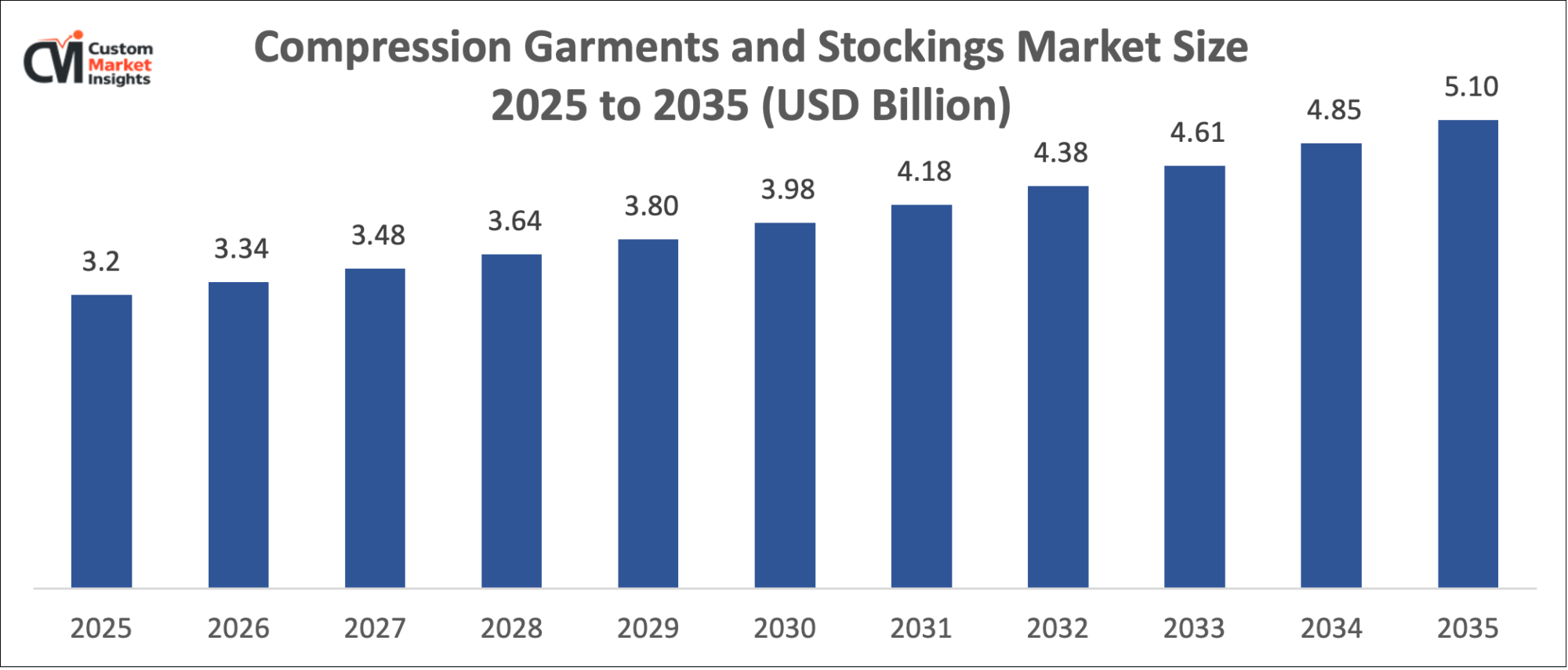
It is estimated that the market size of global compression garments and stockings will be USD 3.2 billion in the year 2025, and its market size will be USD 3.34 billion in the year 2026, and close to USD 5.10 billion in the year 2035, with a CAGR of 4.8% between the years of 2026 and 2035. The market is expanding due to the increasing knowledge on vascular health, rising incidence of chronic diseases like varicose veins and lymphedema and the rising number of aged people. There is also growing demand based on the growing application of compression wear in sport and post-operative recovery.
Market Highlight
- Asia Pacific: The compression garments and stockings had a market share of 20.25% with a 30% market share.
- In 2025, the compression stockings category represented the biggest market share by product type and had a market share of about 42% due to the high clinical application of it in venous disorders and post-surgery management.
- By product type, the compression garments segment (sleeves, wraps, and body garments) will experience the highest growth rate within the forecast period due to the growing use of the products in the management of lymphedema and sports recovery.
- Application-wise, the largest market share of approximately 39% in 2025 was in the medical use segment, and non-medical (sports and wellness) has the fastest growing market share because of growing awareness of sporting/fitness and preventive care.
- By compression level, the moderate compression segment will take up the market with an estimated 46.5% in 2025, as it is extensively prescribed to mild to moderate cases, whereas the firm and extra-firm segments will continue to take root in niche treatments.
- By distribution channel, the offline channel had contributed almost 60% of the market share in 2025 as a result of the necessity to fit professionally and seek medical advice, whereas the online channel is proving to be the most rapidly growing channel because of the convenience and repeat purchase.
Significant Growth Factors
The Market Trends of the Compression garments and stockings offer serious growth potential owing to a number of factors:
- Increasing Incidence of Chronic Venous Diseases and Aging of the Population: The growing prevalence of chronic venous diseases including varicose veins, deep vein thrombosis (DVT), and lymphedema is a key driver to the compression garments and stockings market. It is further estimated that close to 25-30 percent of the entire adult population in the world experiences venous insufficiency in some form, which provides a large base of demand. Moreover, the number of elderly people over the age of 60 years worldwide is estimated to go beyond 1.4 billion by 2030, which means that the threat of developing circulatory disorders, which need continuous treatment, is high. Compression therapy is well known as a non-invasive treatment method that is cost-effective and, therefore, it is a choice treatment option in all healthcare systems. More so, the treatment takes are also improving with awareness creation, early diagnosis and transition towards home-based care. Preventive care is also being given a focus by governments and healthcare providers and is further boosting the steady demand for compression garments in developed economies and across the emerging economies.
- Growing Adoption in Sports, Wellness, and Post-Surgical Recovery: Compression garments are being utilized in non-medical segments of the market, specifically sports, wellness and post-surgery, indicating a vastly growing market segment. The sportswear market worldwide, worth more than USD 400 billion in 2025, is an indicator of a high consumer market preference to performance-based clothing, such as compression wear. These garments are gaining popularity among athletes and those who are interested in fitness to enhance blood circulation in the body, the fatigue levels in muscles and also the recovery process. Furthermore, over 300 million surgical operations are done annually all over the world and most of these surgeries demand that post-operative compression be done to reduce swelling and aid healing. New technology like breathable fabrics, lightweight fabrics, and moisture wicking fabrics is enhancing comfort and usability, prompting its use in a wider application. Besides, the fast growth of e-commerce, which is projected to contribute more than 25 percent of the global clothing sales by 2030 is increasing the accessibility of products, and it has helped manufacturers to connect more with the consumer market in various parts of the world.
What are the Significant Developments that are Powering up the Compression garments and stockings Market today?
- Smart Compression Wear and Digital Health Integration: The combination of digital health technologies and smart textiles is one of the most revolutionary changes in the compression garments and stockings market. The incorporation of compression garments with modern sensors that monitor the rates of pressure, movement of the limbs, and blood flow in real-time is becoming more integrated in providing increasingly individualized therapy. This is especially necessary since it has been demonstrated that a compliance rate of only 30 to 35 percent of the patients would be fully adherent to compression therapy and that non-compliance would greatly diminish the effects of the treatment. The Smart systems can be used to eliminate this gap by providing real-time feedback, reminders and tracking of usage. There is also clinical evidence that with the aid of consistent use of compression therapy the healing of ulcers can be raised by more than 90% in the case of venous leg ulcers, and this indicates the significance of adherence. With these innovations, healthcare providers are able to remotely track patients, manage treatment regimens, and achieve better outcomes, so compression garments are currently an active component of digital and preventive healthcare systems.
- Advanced Fabric Technologies and Material Innovation: The comfort, durability, and effectiveness of compression garments are getting much better with the advancement in fabric technology and are overcoming one of the major obstacles to adoption patient discomfort. The studies show that almost forty percent of patients abandon compression therapy because of tightness, heat retention and skin irritation. In a bid to break this, manufacturers are coming up with breathable, moisture-wicking, and antimicrobial fabrics which can improve the wearability over time. The gradient compression technology is used to make sure that the pressure is the greatest at the ankle and then the pressure decreases gradually up to the ankle height, which clinically enhances the venous return and lessens swelling. Moreover, continuous knitting and better elastomeric fibers will be used to ensure a nice fit and decrease skin damage due to friction. Research also indicates that properly fitted compression stockings have the potential of reducing the leg swelling of up to 60 percent in patients with chronic venous inadequacies. Such innovations play a vital part in enhancing patient compliance and therefore compression therapy can be used more easily in both medical and non-medical lives.
- Growth of Customization and 3D Knitting Technologies: 3D knitting and customization technologies are changing the way compression garments are created and produced and allow more specific and accurate answers for the patients. The classic standard sizes do not usually provide the best pressure distribution particularly in patients who have such conditions as lymphedema where there is a big variation in the shape of limbs. Tailor-made clothing offers a good fit to the body to achieve better compression which enhances the therapeutic results and comfort. There have been clinical observations that, when fitted compression garments are used, the effectiveness of the treatment can improve by 20 30 percent as compared to standard sizes. The latest knitting technologies support 3D knitting which enables manufacturers to fabricate clothes with adjustable compression areas in one piece which has reduced seams and increased comfort. Moreover, digital body scanning allows making precise measurements, which minimize fitting errors and returns. These technologies reduce the wastage of materials also by 20 percent, hence making production more efficient. In turn, the customization is becoming increasingly important in enhancing patient compliance and increasing the application of compression therapy.
- Sustainable and Eco-Friendly Product Development: Environmental concerns and changing preferences by consumers are influencing the compression garments and stockings market to make sustainability a major concern in the industry. To have less impact on the environment, manufacturers are adopting recycled fibers, biodegradable materials and low-impact dyes. The significance of this change is that the textile sector contributes up to 10 percent of carbon emissions in the world, which is compelling companies to use greener options. Moreover, adopting production processes that save water is being undertaken and some of the techniques of producing the textile are able to save over 50 percent of the water used by traditional methods. Other areas to incorporate circular models include eliminating waste through recycling worn clothes into new fibers by the brands. This is further supported by healthcare providers who are starting to focus more on procurement that is environmentally friendly. These sustainable innovations do not only decrease ecological impact but also increase brand value and address the increased demand of responsible healthcare products.
Category Wise Insights
By Product Type
Why Compression Stockings are Leaders of the Market?
Compression stockings are the largest market in the compression garments and stockings market, mainly because they have wide application in the treatment of venous diseases, including varicose veins, deep vein thrombosis (DVT), and leg swelling. Clinical literature shows that 20-30% of adults are affected by chronic venous insufficiency, and that is the reason as to why stockings are the most widely prescribed as the first line of treatment. Their superiority is motivated by convenience, standardized size, and solid clinical support both in the hospital and home-care environments. The compression stockings help to increase the pressure, which is greatest near the ankle and less in an upward direction, which enhances the venous return and decreases the swelling. They also prove useful in the postoperative management, and they are regularly prescribed by hospitals after an operation to prevent blood clots. Moreover, stockings are cheaper and more available than full-body garments and are becoming more popular among the aging population and patients who need long-term treatment.
Full Body, sleeves, wraps, and compression garments are also experiencing increased growth because of their use in complicated cases like lymphedema and after surgery. These are specialized items with compression on various body regions and are finding application in sports and rehabilitation. They are gaining acceptance because of their ability to offer tailored compression and improved coverage, especially to patients who need a more in-depth treatment than lower-limb patients.
By Compression Level
The Reasoning Behind Why Moderate Compression Conquers the Market?
The most common segment is moderate compression because it is usually prescribed in the most prevalent medical conditions and preventive care. Usually between 15-20mmHg or 20-30mmHg, this is the most popular recommended levels of mild to moderate venous disorders as well as swelling during pregnancy and extended standing. Research indicates that a considerable number of diagnosed cases are at early stages of the venous disease, and moderate compression is the most appropriate and popular treatment. It is effective in relieving symptoms and at the same time being comfortable, which is of paramount importance because almost 40 percent of patients quit treatment because of uneasiness.
The mild compression is mostly employed to be preventative, especially in cases where the person has a sedentary lifestyle or travels for hours. Strong and extra-firm degrees of compression are applied to more serious cases of lymphedema and chronic venous insufficiency cases, where larger pressure is needed to control the accumulation of fluid. Such greater compression levels, however, usually need medical monitoring and correct installation, and hence they are not easily adopted. This notwithstanding, they are indispensable in complex treatment cases, especially in hospital care and specialized therapy.
By Application
Why is Medical Use the dominant in the Market?
The medical use is the highest point of application because clinically compression therapy has a high dependency in the treatment of vascular and lymphatic disease. Compression stockings have been extensively employed in the treatment of varicose veins, DVT and venous leg ulcers and as research indicates, compression therapy when performed properly can lead to a healing rate of most cases of venous ulcers of more than 90 percent. These products are regularly prescribed by hospitals and healthcare givers both prophylactically and as a follow-up to treatment procedures particularly following surgery where there is a high likelihood of blood clots. Moreover, the aging population and rising cases of chronic illnesses also boost demand in the segment.
The non-medical use is growing at a high rate, especially in sports, fitness, and wellness. Compression wear is used by the athletes to improve the circulation and muscle fatigue as well as the recovery time. This is being facilitated by increased awareness of preventive health and active lifestyles. Although medical use continues to prevail based on need and prescription demand, the non-medical use is on the increase as consumers are now using compression products as a way of performance and comfort in day to day activities.
By Gender
Why Women Segment Dominates the Market?
The market share of compression garments and stockings is the highest among the women’s segment since women have more venous disorders. Research indicates that women have the highest probability of developing varicose veins by 2-3 times as much as men, mainly as a result of hormonal imbalance, pregnancy, and lifestyle. Leg swelling and venous insufficiency are more likely during pregnancy alone and will result in increased use of compression stockings. Moreover, women are more aggressive in seeking healthcare and acquiring wellness products, which enhances demand further.
The male segment is also increasing steadily, especially with the aging populations and people whose work involves sedentary jobs. Unisex products are becoming more popular because they are versatile and have a wider array of applications in various situations such as sports and travelling. Nonetheless, the greater clinical need and awareness level among women still makes this segment the leading factor in the total market demand.
By Distribution Channel
So why are there many Offline Channels that have dominated the market?
The compression garments and stocking market relies on the offline distribution channels that include hospitals, pharmacies, and specialty medical stores because of the necessity of correct fitting and medical advice. The compression therapy is usually a process that demands proper measurements to maintain the right amount of pressure, and the wrong fit may diminish its efficiency or result in discomfort. Due to this fact, there is a high percentage of first-time users who buy their products using offline stores where specialists help them with the size and the type of product they want to buy. Also, healthcare providers prescribe numerous products, which further increases the position of sales in hospitals and pharmacies.
The online channels are increasing at a high rate as a result of convenience, expansion of products offered and rising consumer awareness. The buying of standardized goods such as compression stockings is also becoming more and more moved online, with the buying of the products being a repeat purchase. The e-commerce sites are also able to offer specifics of each product and also customer feedback that enable the user to decide correctly. Online channels are emerging as a strategic driver to growth, especially among younger and technologically intelligent consumers, as offline channels are still dominated by clinical dependency.
Report Scope
| Feature of the Report | Details |
| Market Size in 2026 | USD 3.34 billion |
| Projected Market Size in 2035 | USD 5.10 billion |
| Market Size in 2025 | USD 3.2 billion |
| CAGR Growth Rate | 4.8% CAGR |
| Base Year | 2025 |
| Forecast Period | 2026-2035 |
| Key Segment | By Product Type, Compression Level, Application, Gender, Distribution Channel and Region |
| Report Coverage | Revenue Estimation and Forecast, Company Profile, Competitive Landscape, Growth Factors and Recent Trends |
| Regional Scope | North America, Europe, Asia Pacific, Middle East & Africa, and South & Central America |
| Buying Options | Request tailored purchasing options to fulfil your requirements for research. |
Regional Analysis
Why will Asia Pacific Dominate the Market in 2025?
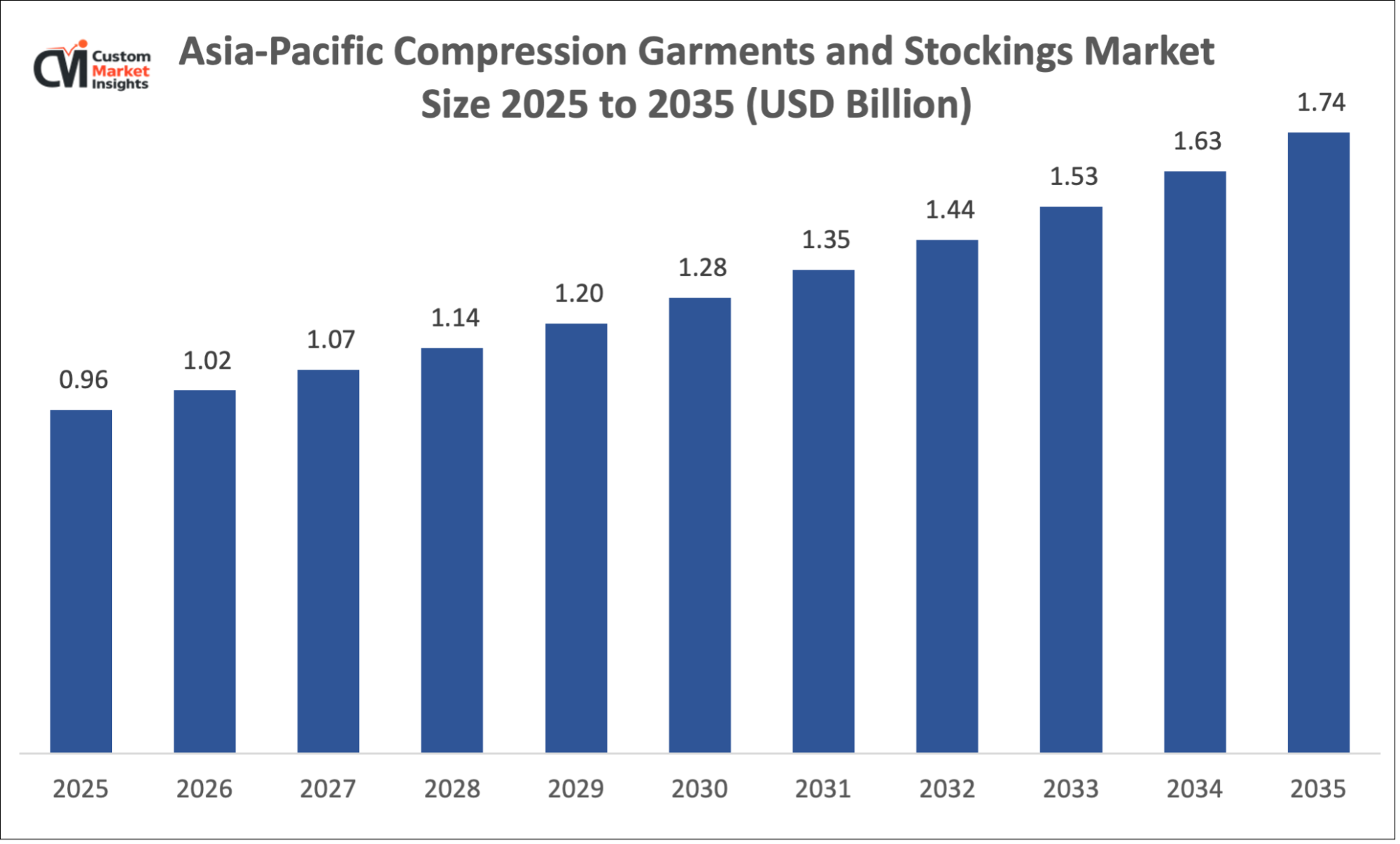
The Asian Pacific has a dominant role in the compression garments and stockings industry due to the significant number of patients, increased awareness of healthcare, and the availability of more medical products. Vascular diseases burden is very high in the region, with the research providing evidence that more than 20 percent of adults in urban populations of Asians demonstrate signs of venous disorders.
The other significant cause is the rapid aging of the population since nations such as Japan, China, and South Korea have observed a significant increment in the elderly population that requires long-term compression therapy. Also, rising instances of diabetes, more than 140 million adults in China and India alone, are also making them susceptible to complications associated with circulation, further enhancing demand. The increasing healthcare infrastructure, the development of medical tourism, and the increasing disposable income make the availability of compression products easier as well. With the growing awareness in preventive healthcare, Asia Pacific will continue to dominate as a result of both the clinical demand and the growing adoption by consumers.
China Market Trends
China can be considered one of the biggest markets since it has a huge population of patients and an expanding healthcare system. The population of 65 and more years are more than 140 million people in the country, and most of them are vulnerable to venous insufficiency and mobility-related disorders. Moreover, of the adult population, the rate of diabetes is more than 12 percent, which exacerbates the risks of developing circulation problems, which need compression treatment. Chinese hospitals are also prescribing the use of compression stockings in the recovery process after surgeries and to prevent thrombosis. The high growth of local production and supply of affordable goods also encourage mass use.
What is the Reason behind the steady Growth in North America?
The North American region is steadily growing because of the good awareness, good clinical adoption, and well established healthcare system. It is estimated that more than 25 million venous disorder sufferers are in the United States alone, hence a steady demand for compression therapy. Moreover, the number of deep vein thrombosis (DVT) cases is approximately 900,000 cases a year, with many necessitating post-treatment or preventive use of compression. There is also good incorporation of advanced medical products as well as high physician recommendations. The growing interest in preventative services and at-home care is also helping to sustain a consistent demand.
What is the Market Size of the U.S.?
The compression garments and stocking market is also backed by a huge patient population and high clinical utilization in the U.S. Immigrant population having more than 6.5 million individuals with chronic venous insufficiency and a lot of surgical operations that are being carried out annually, the need for compression therapy is also stable. The market is relatively growing with an increased number of patients using long-term management solutions for vascular conditions.
U.S. Market Trends
The U.S. market is characterized by the fact that there is a high level of healthcare awareness, growth in obesity, and sedentary lifestyles. It has been reported that close to 42 percent of the adults are obese, thereby making them susceptible to circulatory disorders and swelling of legs. Compression garments have been popular in hospitals to provide post-operative care most prominently to prevent the incidence of blood clots. Moreover, there is a high uptake in sports and fitness, in addition to ready access in the pharmacies and online stores, which are encouraging the growth of the market. Patient compliance is also being enhanced by technological improvements and improved design of products.
What is the Reason behind Europe Implementing Sustainability and Efficiency?
Europe is also a major market because of the aging population and high concentration on regulation of healthcare quality. Over 20 percent of the Europeans are above the age of 65, and this has raised the market pressure of compression therapy to a high level. The area also focuses on high-quality and green products in the medical field and has a high-quality standard in the materials and production. Compression stockings receive extensive prescribing in publicly funded healthcare, especially in the treatment of chronic venous pathology. The market trends are shifting towards increased attention to environmentally friendly clothes and durable products.
Germany Market Trends
Germany has one of the most significant contributions in Europe because it has advanced healthcare and high compliance with compression therapy. Research claims that approximately 15-20 percent of adults in Germany have venous disorders which means they have high demand. The medical compression products are also highly reimbursed in the country, which promotes their use. The main product qualities sought by German consumers are quality and durability, which lead to the need to sell high-quality and technologically advanced compression garments.
What is the Reason why the Middle East & Africa Region is Growing?
The Middle East and Africa region is experiencing expansion because of the development of better healthcare facilities and increased awareness about chronic diseases. Higher levels of diabetes- almost 1 in every 6 adults in certain gulf countries- are leading to complications of circulation that demand compression therapy. Also, the fact that people are becoming more urbanized and sedentary is increasing cases of obesity and sedentary behavior. The governments are also investing in the growth of healthcare and enhancing the access to medical products. Though the market is in its infancy, the consistent adoption of compression garments and stockings is anticipated due to the increasing awareness and increasing prevalence of illness.
Top Players in the Market and Their Offerings
- Bauerfeind
- 3M
- Cardinal Health
- Thuasne
- Lohmann and Rauscher GmbH and Co. KG
- Sockwell
- Tynor Orthotics Pvt. Ltd.
- Gibaud
- Scholl’s Wellness Co.
- SIGVARIS Group
- JUZO
- SWISSLASTIC AG ST. GALLEN
- Surgiwear Limited
- Medi GmbH and Co. KG
- ThermoTek
- Ames Walker
- Vissco Next
- Calzificio Zeta S.r.l.
- VIM and VIGR
- CEP
- Sanyleg S.r.l.
- Maxwell
- Heinz Schiebler GmbH and Co. KG
- Gloria Med S.p.A.
- NovaMed Europe Ltd
- Rejuva Health
- Zensah
- Compressana GmbH
- Others
Key Developments
The market has experienced vast evolution with the players in the industry trying to maximize their operations and improve product lines.
- In January 2024, Cardinal Health revealed that it was building a new 340,000-square-foot distribution center in Fort Worth, Texas, to serve its at-Home Solutions business. The facility will be constructed to include elaborate robotics and AI -based warehouse systems that enhance the efficiency, accuracy, and safety at the workplace to fulfill the orders. It will span two warehouses that currently exist and increase the inventory capacity greatly and will process about 10,000 packages in a day. The facility will be fully operational in summer 2025 and it will enhance the ability of the company in supplying home healthcare.
- Cardinal Health announced in August 2024 that it would build a 249,000-square-foot center to distribute medical products in Walton Hills, Ohio, as part of its overall expansion of U.S. warehouse capacity and the modernization of its logistics processes. The new plant will substitute the smaller one in Solon and will be combined with the latest technologies of automation to simplify the distribution operations and increase the safety of employees. It is planned to go online in the spring of 2025, to help enhance the level of efficiency and scalability in its network of medical supplies.
Such strategic endeavors have enabled the companies to consolidate market positions, increase product offerings, and improve technology as well as seize growth opportunities in the growing market.
The Compression Garments and Stockings Market is segmented as follows:
By Product Type
- Compression Stockings
- Compression Garments
By Compression Level
- Moderate Compression
- Mild Compression
- Firm Compression
- Extra-Firm Compression
By Application
- Medical Use
- Non-Medical Use
By Gender
- Women
- Unisex
- Men
By Distribution Channel
- Offline
- Online
Regional Coverage:
North America
- U.S.
- Canada
- Mexico
- Rest of North America
Europe
- Germany
- France
- U.K.
- Russia
- Italy
- Spain
- Netherlands
- Rest of Europe
Asia Pacific
- China
- Japan
- India
- New Zealand
- Australia
- South Korea
- Taiwan
- Rest of Asia Pacific
The Middle East & Africa
- Saudi Arabia
- UAE
- Egypt
- Kuwait
- South Africa
- Rest of the Middle East & Africa
Latin America
- Brazil
- Argentina
- Rest of Latin America
Table of Contents
- Chapter 1. Report Introduction
- 1.1. Report Description
- 1.1.1. Purpose of the Report
- 1.1.2. USP & Key Offerings
- 1.2. Key Benefits For Stakeholders
- 1.3. Target Audience
- 1.4. Report Scope
- 1.1. Report Description
- Chapter 2. Market Overview
- 2.1. Report Scope (Segments And Key Players)
- 2.1.1. Compression Garments and Stockings by Segments
- 2.1.2. Compression Garments and Stockings by Region
- 2.2. Executive Summary
- 2.2.1. Market Size & Forecast
- 2.2.2. Compression Garments and Stockings Market Attractiveness Analysis, By Product Type
- 2.2.3. Compression Garments and Stockings Market Attractiveness Analysis, By Compression Level
- 2.2.4. Compression Garments and Stockings Market Attractiveness Analysis, By Application
- 2.2.5. Compression Garments and Stockings Market Attractiveness Analysis, By Gender
- 2.2.6. Compression Garments and Stockings Market Attractiveness Analysis, By Distribution Channel
- 2.1. Report Scope (Segments And Key Players)
- Chapter 3. Market Dynamics (DRO)
- 3.1. Market Drivers
- 3.1.1. Increasing Incidence of Chronic Venous Diseases and Aging of the Population
- 3.1.2. Growing Adoption in Sports
- 3.1.3. Wellness
- 3.1.4. and Post-Surgical Recovery
- 3.2. Market Restraints
- 3.3. Market Opportunities
- 3.5. Pestle Analysis
- 3.6. Porter Forces Analysis
- 3.7. Technology Roadmap
- 3.8. Value Chain Analysis
- 3.9. Government Policy Impact Analysis
- 3.10. Pricing Analysis
- 3.1. Market Drivers
- Chapter 4. Compression Garments and Stockings Market – By Product Type
- 4.1. Product Type Market Overview, By Product Type Segment
- 4.1.1. Compression Garments and Stockings Market Revenue Share, By Product Type, 2025 & 2035
- 4.1.2. Compression Stockings
- 4.1.3. Compression Garments and Stockings Share Forecast, By Region (USD Billion)
- 4.1.4. Comparative Revenue Analysis, By Country, 2025 & 2035
- 4.1.5. Key Market Trends, Growth Factors, & Opportunities
- 4.1.6. Compression Garments
- 4.1.7. Compression Garments and Stockings Share Forecast, By Region (USD Billion)
- 4.1.8. Comparative Revenue Analysis, By Country, 2025 & 2035
- 4.1.9. Key Market Trends, Growth Factors, & Opportunities
- 4.1. Product Type Market Overview, By Product Type Segment
- Chapter 5. Compression Garments and Stockings Market – By Compression Level
- 5.1. Compression Level Market Overview, By Compression Level Segment
- 5.1.1. Compression Garments and Stockings Market Revenue Share, By Compression Level, 2025 & 2035
- 5.1.2. Moderate Compression
- 5.1.3. Compression Garments and Stockings Share Forecast, By Region (USD Billion)
- 5.1.4. Comparative Revenue Analysis, By Country, 2025 & 2035
- 5.1.5. Key Market Trends, Growth Factors, & Opportunities
- 5.1.6. Mild Compression
- 5.1.7. Compression Garments and Stockings Share Forecast, By Region (USD Billion)
- 5.1.8. Comparative Revenue Analysis, By Country, 2025 & 2035
- 5.1.9. Key Market Trends, Growth Factors, & Opportunities
- 5.1.10. Firm Compression
- 5.1.11. Compression Garments and Stockings Share Forecast, By Region (USD Billion)
- 5.1.12. Comparative Revenue Analysis, By Country, 2025 & 2035
- 5.1.13. Key Market Trends, Growth Factors, & Opportunities
- 5.1.14. Extra-Firm Compression
- 5.1.15. Compression Garments and Stockings Share Forecast, By Region (USD Billion)
- 5.1.16. Comparative Revenue Analysis, By Country, 2025 & 2035
- 5.1.17. Key Market Trends, Growth Factors, & Opportunities
- 5.1. Compression Level Market Overview, By Compression Level Segment
- Chapter 6. Compression Garments and Stockings Market – By Application
- 6.1. Application Market Overview, By Application Segment
- 6.1.1. Compression Garments and Stockings Market Revenue Share, By Application, 2025 & 2035
- 6.1.2. Medical Use
- 6.1.3. Compression Garments and Stockings Share Forecast, By Region (USD Billion)
- 6.1.4. Comparative Revenue Analysis, By Country, 2025 & 2035
- 6.1.5. Key Market Trends, Growth Factors, & Opportunities
- 6.1.6. Non-Medical Use
- 6.1.7. Compression Garments and Stockings Share Forecast, By Region (USD Billion)
- 6.1.8. Comparative Revenue Analysis, By Country, 2025 & 2035
- 6.1.9. Key Market Trends, Growth Factors, & Opportunities
- 6.1. Application Market Overview, By Application Segment
- Chapter 7. Compression Garments and Stockings Market – By Gender
- 7.1. Gender Market Overview, By Gender Segment
- 7.1.1. Compression Garments and Stockings Market Revenue Share, By Gender, 2025 & 2035
- 7.1.2. Women
- 7.1.3. Compression Garments and Stockings Share Forecast, By Region (USD Billion)
- 7.1.4. Comparative Revenue Analysis, By Country, 2025 & 2035
- 7.1.5. Key Market Trends, Growth Factors, & Opportunities
- 7.1.6. Unisex
- 7.1.7. Compression Garments and Stockings Share Forecast, By Region (USD Billion)
- 7.1.8. Comparative Revenue Analysis, By Country, 2025 & 2035
- 7.1.9. Key Market Trends, Growth Factors, & Opportunities
- 7.1.10. Men
- 7.1.11. Compression Garments and Stockings Share Forecast, By Region (USD Billion)
- 7.1.12. Comparative Revenue Analysis, By Country, 2025 & 2035
- 7.1.13. Key Market Trends, Growth Factors, & Opportunities
- 7.1. Gender Market Overview, By Gender Segment
- Chapter 8. Compression Garments and Stockings Market – By Distribution Channel
- 8.1. Distribution Channel Market Overview, By Distribution Channel Segment
- 8.1.1. Compression Garments and Stockings Market Revenue Share, By Distribution Channel, 2025 & 2035
- 8.1.2. Offline
- 8.1.3. Compression Garments and Stockings Share Forecast, By Region (USD Billion)
- 8.1.4. Comparative Revenue Analysis, By Country, 2025 & 2035
- 8.1.5. Key Market Trends, Growth Factors, & Opportunities
- 8.1.6. Online
- 8.1.7. Compression Garments and Stockings Share Forecast, By Region (USD Billion)
- 8.1.8. Comparative Revenue Analysis, By Country, 2025 & 2035
- 8.1.9. Key Market Trends, Growth Factors, & Opportunities
- 8.1. Distribution Channel Market Overview, By Distribution Channel Segment
- Chapter 9. Compression Garments and Stockings Market – Regional Analysis
- 9.1. Compression Garments and Stockings Market Overview, By Region Segment
- 9.1.1. Global Compression Garments and Stockings Market Revenue Share, By Region, 2025 & 2035
- 9.1.2. Global Compression Garments and Stockings Market Revenue, By Region, 2026 – 2035 (USD Billion)
- 9.1.3. Global Compression Garments and Stockings Market Revenue, By Product Type, 2026 – 2035
- 9.1.4. Global Compression Garments and Stockings Market Revenue, By Compression Level, 2026 – 2035
- 9.1.5. Global Compression Garments and Stockings Market Revenue, By Application, 2026 – 2035
- 9.1.6. Global Compression Garments and Stockings Market Revenue, By Gender, 2026 – 2035
- 9.1.7. Global Compression Garments and Stockings Market Revenue, By Distribution Channel, 2026 – 2035
- 9.2. North America
- 9.2.1. North America Compression Garments and Stockings Market Revenue, By Country, 2026 – 2035 (USD Billion)
- 9.2.2. North America Compression Garments and Stockings Market Revenue, By Product Type, 2026 – 2035
- 9.2.3. North America Compression Garments and Stockings Market Revenue, By Compression Level, 2026 – 2035
- 9.2.4. North America Compression Garments and Stockings Market Revenue, By Application, 2026 – 2035
- 9.2.5. North America Compression Garments and Stockings Market Revenue, By Gender, 2026 – 2035
- 9.2.6. North America Compression Garments and Stockings Market Revenue, By Distribution Channel, 2026 – 2035
- 9.2.7. U.S. Compression Garments and Stockings Market Revenue, 2026 – 2035 (USD Billion)
- 9.2.8. Canada Compression Garments and Stockings Market Revenue, 2026 – 2035 (USD Billion)
- 9.2.9. Mexico Compression Garments and Stockings Market Revenue, 2026 – 2035 (USD Billion)
- 9.2.10. Rest of North America Compression Garments and Stockings Market Revenue, 2026 – 2035 (USD Billion)
- 9.3. Europe
- 9.3.1. Europe Compression Garments and Stockings Market Revenue, By Country, 2026 – 2035 (USD Billion)
- 9.3.2. Europe Compression Garments and Stockings Market Revenue, By Product Type, 2026 – 2035
- 9.3.3. Europe Compression Garments and Stockings Market Revenue, By Compression Level, 2026 – 2035
- 9.3.4. Europe Compression Garments and Stockings Market Revenue, By Application, 2026 – 2035
- 9.3.5. Europe Compression Garments and Stockings Market Revenue, By Gender, 2026 – 2035
- 9.3.6. Europe Compression Garments and Stockings Market Revenue, By Distribution Channel, 2026 – 2035
- 9.3.7. Germany Compression Garments and Stockings Market Revenue, 2026 – 2035 (USD Billion)
- 9.3.8. France Compression Garments and Stockings Market Revenue, 2026 – 2035 (USD Billion)
- 9.3.9. U.K. Compression Garments and Stockings Market Revenue, 2026 – 2035 (USD Billion)
- 9.3.10. Russia Compression Garments and Stockings Market Revenue, 2026 – 2035 (USD Billion)
- 9.3.11. Italy Compression Garments and Stockings Market Revenue, 2026 – 2035 (USD Billion)
- 9.3.12. Spain Compression Garments and Stockings Market Revenue, 2026 – 2035 (USD Billion)
- 9.3.13. Netherlands Compression Garments and Stockings Market Revenue, 2026 – 2035 (USD Billion)
- 9.3.14. Rest of Europe Compression Garments and Stockings Market Revenue, 2026 – 2035 (USD Billion)
- 9.4. Asia Pacific
- 9.4.1. Asia Pacific Compression Garments and Stockings Market Revenue, By Country, 2026 – 2035 (USD Billion)
- 9.4.2. Asia Pacific Compression Garments and Stockings Market Revenue, By Product Type, 2026 – 2035
- 9.4.3. Asia Pacific Compression Garments and Stockings Market Revenue, By Compression Level, 2026 – 2035
- 9.4.4. Asia Pacific Compression Garments and Stockings Market Revenue, By Application, 2026 – 2035
- 9.4.5. Asia Pacific Compression Garments and Stockings Market Revenue, By Gender, 2026 – 2035
- 9.4.6. Asia Pacific Compression Garments and Stockings Market Revenue, By Distribution Channel, 2026 – 2035
- 9.4.7. China Compression Garments and Stockings Market Revenue, 2026 – 2035 (USD Billion)
- 9.4.8. Japan Compression Garments and Stockings Market Revenue, 2026 – 2035 (USD Billion)
- 9.4.9. India Compression Garments and Stockings Market Revenue, 2026 – 2035 (USD Billion)
- 9.4.10. New Zealand Compression Garments and Stockings Market Revenue, 2026 – 2035 (USD Billion)
- 9.4.11. Australia Compression Garments and Stockings Market Revenue, 2026 – 2035 (USD Billion)
- 9.4.12. South Korea Compression Garments and Stockings Market Revenue, 2026 – 2035 (USD Billion)
- 9.4.13. Taiwan Compression Garments and Stockings Market Revenue, 2026 – 2035 (USD Billion)
- 9.4.14. Rest of Asia Pacific Compression Garments and Stockings Market Revenue, 2026 – 2035 (USD Billion)
- 9.5. The Middle-East and Africa
- 9.5.1. The Middle-East and Africa Compression Garments and Stockings Market Revenue, By Country, 2026 – 2035 (USD Billion)
- 9.5.2. The Middle-East and Africa Compression Garments and Stockings Market Revenue, By Product Type, 2026 – 2035
- 9.5.3. The Middle-East and Africa Compression Garments and Stockings Market Revenue, By Compression Level, 2026 – 2035
- 9.5.4. The Middle-East and Africa Compression Garments and Stockings Market Revenue, By Application, 2026 – 2035
- 9.5.5. The Middle-East and Africa Compression Garments and Stockings Market Revenue, By Gender, 2026 – 2035
- 9.5.6. The Middle-East and Africa Compression Garments and Stockings Market Revenue, By Distribution Channel, 2026 – 2035
- 9.5.7. Saudi Arabia Compression Garments and Stockings Market Revenue, 2026 – 2035 (USD Billion)
- 9.5.8. UAE Compression Garments and Stockings Market Revenue, 2026 – 2035 (USD Billion)
- 9.5.9. Egypt Compression Garments and Stockings Market Revenue, 2026 – 2035 (USD Billion)
- 9.5.10. Kuwait Compression Garments and Stockings Market Revenue, 2026 – 2035 (USD Billion)
- 9.5.11. South Africa Compression Garments and Stockings Market Revenue, 2026 – 2035 (USD Billion)
- 9.5.12. Rest of the Middle East & Africa Compression Garments and Stockings Market Revenue, 2026 – 2035 (USD Billion)
- 9.6. Latin America
- 9.6.1. Latin America Compression Garments and Stockings Market Revenue, By Country, 2026 – 2035 (USD Billion)
- 9.6.2. Latin America Compression Garments and Stockings Market Revenue, By Product Type, 2026 – 2035
- 9.6.3. Latin America Compression Garments and Stockings Market Revenue, By Compression Level, 2026 – 2035
- 9.6.4. Latin America Compression Garments and Stockings Market Revenue, By Application, 2026 – 2035
- 9.6.5. Latin America Compression Garments and Stockings Market Revenue, By Gender, 2026 – 2035
- 9.6.6. Latin America Compression Garments and Stockings Market Revenue, By Distribution Channel, 2026 – 2035
- 9.6.7. Brazil Compression Garments and Stockings Market Revenue, 2026 – 2035 (USD Billion)
- 9.6.8. Argentina Compression Garments and Stockings Market Revenue, 2026 – 2035 (USD Billion)
- 9.6.9. Rest of Latin America Compression Garments and Stockings Market Revenue, 2026 – 2035 (USD Billion)
- 9.1. Compression Garments and Stockings Market Overview, By Region Segment
- Chapter 10. Competitive Landscape
- 10.1. Company Market Share Analysis – 2025
- 10.1.1. Global Compression Garments and Stockings Market: Company Market Share, 2025
- 10.2. Global Compression Garments and Stockings Market Company Market Share, 2024
- 10.1. Company Market Share Analysis – 2025
- Chapter 11. Company Profiles
- 11.1. Bauerfeind
- 11.1.1. Company Overview
- 11.1.2. Key Executives
- 11.1.3. Product Portfolio
- 11.1.4. Financial Overview
- 11.1.5. Operating Business Segments
- 11.1.6. Business Performance
- 11.1.7. Recent Developments
- 11.2. 3M
- 11.3. Cardinal Health
- 11.4. Thuasne
- 11.5. Lohmann and Rauscher GmbH and Co. KG
- 11.6. Sockwell
- 11.7. Tynor Orthotics Pvt. Ltd.
- 11.8. Gibaud
- 11.9. Scholl’s Wellness Co.
- 11.10. SIGVARIS Group
- 11.11. JUZO
- 11.12. SWISSLASTIC AG ST. GALLEN
- 11.13. G. Surgiwear Limited
- 11.14. Medi GmbH and Co. KG
- 11.15. ThermoTek
- 11.16. Ames Walker
- 11.17. Vissco Next
- 11.18. Calzificio Zeta S.r.l.
- 11.19. VIM and VIGR
- 11.20. CEP
- 11.21. Sanyleg S.r.l.
- 11.22. Maxwell
- 11.23. Heinz Schiebler GmbH and Co. KG
- 11.24. Gloria Med S.p.A.
- 11.25. NovaMed Europe Ltd
- 11.26. Rejuva Health
- 11.27. Zensah
- 11.28. Compressana GmbH
- 11.29. Others
- 11.1. Bauerfeind
- Chapter 12. Research Methodology
- 12.1. Research Methodology
- 12.2. Secondary Research
- 12.3. Primary Research
- 12.3.1. Analyst Tools and Models
- 12.4. Research Limitations
- 12.5. Assumptions
- 12.6. Insights From Primary Respondents
- 12.7. Why Custom Market Insights
- Chapter 13. Standard Report Commercials & Add-Ons
- 13.1. Customization Options
- 13.2. Subscription Module For Market Research Reports
- 13.3. Client Testimonials
List Of Figures
Figures No 1 to 33
List Of Tables
Tables No 1 to 56
Prominent Player
- Bauerfeind
- 3M
- Cardinal Health
- Thuasne
- Lohmann and Rauscher GmbH and Co. KG
- Sockwell
- Tynor Orthotics Pvt. Ltd.
- Gibaud
- Scholl’s Wellness Co.
- SIGVARIS Group
- JUZO
- SWISSLASTIC AG ST. GALLEN
- Surgiwear Limited
- Medi GmbH and Co. KG
- ThermoTek
- Ames Walker
- Vissco Next
- Calzificio Zeta S.r.l.
- VIM and VIGR
- CEP
- Sanyleg S.r.l.
- Maxwell
- Heinz Schiebler GmbH and Co. KG
- Gloria Med S.p.A.
- NovaMed Europe Ltd
- Rejuva Health
- Zensah
- Compressana GmbH
- Others
FAQs
The key players in the market are Bauerfeind, 3M, Cardinal Health, Thuasne, Lohmann and Rauscher GmbH and Co. KG, Sockwell, Tynor Orthotics Pvt. Ltd., Gibaud, Scholl’s Wellness Co., SIGVARIS Group, JUZO, SWISSLASTIC AG ST. GALLEN, G. Surgiwear Limited, Medi GmbH and Co. KG, ThermoTek, Ames Walker, Vissco Next, Calzificio Zeta S.r.l., VIM and VIGR, CEP, Sanyleg S.r.l., Maxwell, Heinz Schiebler GmbH and Co. KG, Gloria Med S.p.A., NovaMed Europe Ltd., Rejuva Health, Zensah, Compressana GmbH, and Others.
The government regulations are very essential in defining the market of compression garments and stockings as they are used to determine the quality, safety, and clinical effectiveness of the products. In most nations compression clothes are regarded as medical equipment, which must meet high standards of pressure and safety of materials. The use of these is also encouraged by regulatory bodies in preventive health care, specifically in post-surgical treatment and thrombosis prevention. In some areas such as Europe, healthcare institutions tend to reimburse compression products prescribed by doctors, which enhance access to these devices by patients. There are also guidelines that prescribe compression therapy in case of such conditions as venous ulcers, where healing may reach more than 90 percent when correctly employed. The laws are also favourable to innovation in terms of materials and manufacturing and are also crucial to the patient safety and reliability of treatment.
Compression garments and stockings are not very expensive as compared to other medical interventions, yet prices determine their adoption especially in developing countries. Simple compression stockings cost USD 10-50 per pair, and professional or medical-grade stockings are USD 50-150+ depending on the level of the compression and personalization. Replacement may be necessary several times every year, further escalating cost to the patient in the long run. They, however, prevent complications effectively, such as swelling up to 60 percent in some patients, and are cost-effective in comparison with surgical interventions. Coverage and reimbursement of insurance in the developed markets also contributes to its adoption, whereas access in price-sensitive areas is enhanced by the availability of cheaper alternatives and online selling issues.
Based on the current analysis, in the current market, it is estimated that the market will grow to approximately USD 5.10 billion in 2035 with the market growing at a very good rate of 4.8 between 2026 and 2035, this is attributed to increased clinical demand and wider use in both medical and non-medical uses. The demand will be driven by the rising rates of chronic venous diseases, which impact millions of people across the world today, and the rising number of surgical procedures that are carried out (more than 300 million operations every year).
Asia Pacific is expected to control the compression shoe and stocking market because it has a huge population base and the occurrence of vascular and lifestyle diseases. Research shows that more than 20 percent of the urban Asian populations that are aged adults exhibit symptoms of venous disorders. Another advantage of pressure ulcers to the region is the ameliorating health infrastructure and the increasing health care awareness as regards compression therapy. China is the leading contributor because it boasts more than 140 million people who are at the age of 65 and above, whilst India is a significant contributor, as there are increasing diabetes cases and sedentary lifestyles. Also, the product is gaining strength in the market due to affordable production and growing accessibility via pharmacies and online platforms. All these factors guarantee the continuity of the demand and domination of the Asia Pacific region in the long run.
Asia-Pacific is projected to have the most growth as it has a huge and growing patient base, increased access to healthcare, and growing awareness. Chronic conditions are rampant in the region, and nations such as China and India alone have more than 140 million diabetic patients, which puts them at risk of developing vascular diseases. Also, the fast aging in other nations like Japan, where almost 30 percent of the population is above 65 years of age, is hastening the need for compression therapy. Growth is also being supported by increasing infrastructure in the healthcare sector, increased disposable incomes, and increased penetration of medical products. The transition to preventative treatment and the growing accessibility of low-cost compression devices are also major drivers to the booming growth in the region.
The World compression garments and stockings market is mainly motivated by the increasing occurrence of vascular diseases, including varicose veins and deep vein thrombosis (DVT), that occur in almost a quarter or third of all adults in the world. The rising population of the aged group, projected to contain over 1.4 billion individuals aged more than 60 years by 2030, is a major factor that is pushing the demand of compression therapy. Also, rising incidences of diabetes-afflicting more than half a billion individuals across the world are causing complications to circulation. Surgical operations are also increasing, with an estimated amount exceeding 300 million operations yearly which contributes to pressure on stock demand. Moreover, the rise of preventative medicine and home-based care, used more frequently in sports and wellness are also some of the reasons that can justify steady market growth.