
Global Compression Garments and Stockings Market Size Likely to Grow at a CAGR of 4.8% By 2035
Key highlights
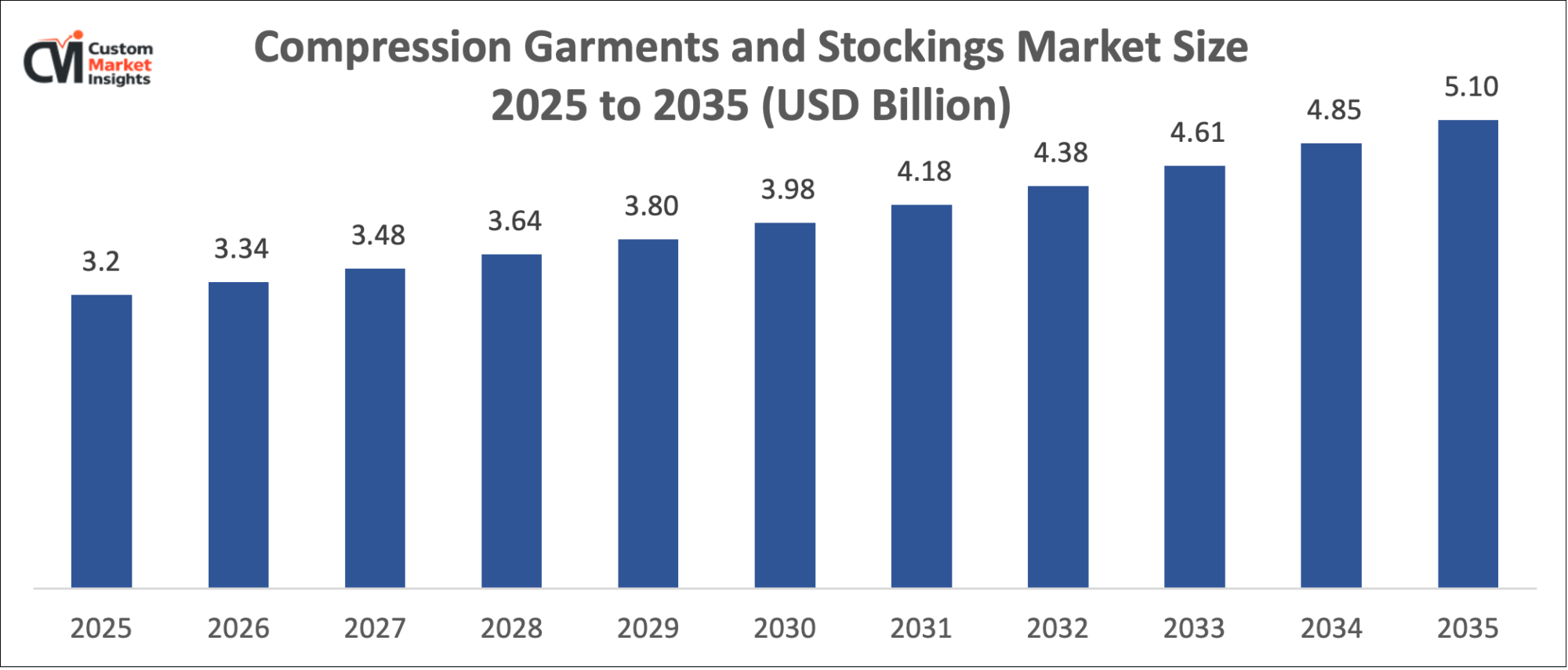
- Market valued at USD 3.34 Bn in 2026, projected to reach USD 5.1 Bn by 2035.
- Expected to grow at a CAGR of 4.8% over 2026-2035.
- Asia Pacific is the largest regional market.
Market Size and Growth
It is estimated that the market size of global compression garments and stockings will be USD 3.2 billion in the year 2025, and its market size will be USD 3.34 billion in the year 2026, and close to USD 5.10 billion in the year 2035, with a CAGR of 4.8% between the years of 2026 and 2035.
To learn more about this report - request a sample report PDF
Compression garments and stockings Market Revenue and Trends
The compression garments and stockings market is growing well owing to the increased rate of chronic diseases like venous disorders, lymphedema, and varicose veins and the growing awareness among people of the importance of preventive healthcare. They are also used in the medical and wellness sector and are common in blood circulation, swelling, and post-surgical recovery. Patient comfort and compliance are being boosted by technological innovation in fabric materials such as breathable fabrics, elastic fabrics, and antimicrobial fabrics. Also, the increasing population of the aged population that is more vulnerable to circulatory disorders is also playing a significant role in demand.
What are the Factors that are Sufficiently Impactful on the development of Compression garments and stockings Market?
The development of the compression garments and the stockings market is highly dependent on the increase of the prevalence of vascular conditions and lifestyle diseases like obesity and immobility. The use of compression therapy by medical professionals has become a first-line and non-invasive alternative to treatment of such conditions as deep vein thrombosis (DVT), varicose veins, and edema. The consumer base is further increasing with the increasing use of compression wear in sports and fitness in the recovery and performance improvement of muscles.
The other major aspect that contributes to growth in the market is the constant innovation in clothing technology and product design. Manufacturers are also coming up with better compression garments that are highly elastic, durable, and attractive to the user, and this has made them more comfortable to use in the long run. Moreover, the growing spending on healthcare, the growth of channels of distribution such as online customer platforms, and the increase in awareness in the emerging markets are driving the adoption. All these are likely to ensure the compression garments and stockings market continues growing within the forecast period.
Segment Insight
By Product Type
Compression stockings have a large percentage of the compression garment and stocking market because of their wide clinical application in treating venous conditions like varicose veins, deep vein thrombosis (DVT), and leg swelling. The uniform design and ease of administration, along with the high recommendation of the medical fraternity, make them the frontrunners in treatment both in hospitals and in home care. The effects that are offered by these products include graduated pressure, which enhances blood flow and swelling. Also, they are affordable and accessible to ensure mass usage, especially by the aging population. Compression garments like sleeves, wraps, and full-body items are on the rise in popularity because of their capability to provide localized compression for situations like lymphedema and post-surgical recovery as well as an increasing use in sports and rehabilitation procedures.
By Compression Level
A significant percentage of the compression garments and stockings market is composed of moderate compression because it is delivered as a standard medical prescription for preventive services and care. It offers the best compromise between therapy and comfort and is applicable to situations with mild to moderate venous disorders, swelling during pregnancy, and prolonged standing. It is also dominant due to its greater compliance with patients than a higher level of compression. Mild compression is applied very much as a preventive agent, whereas the high levels of compression, such as firm and extra-firm, are needed in serious cases such as chronic venous insufficiency and lymphedema. Nevertheless, these advanced levels frequently need medical attention and accurate adjustment, which restricts their widespread acceptance despite their significance in more advanced treatment cases.
By Application
The compression garments and stockings business is dominated by medical use in the market since the clinical use of compression therapy is heavily relied upon in the treatment of vascular and lymphatic diseases. These products have wide applications in the management of conditions like varicose veins, DVT, and venous ulcers and in post-operative management to avert complications. The increasing number of senators and the increasing cases of such chronic illnesses also contribute to the demand in this segment. The non-medical segment of use, such as sports, fitness, and wellness, is also growing in its momentum as consumers are choosing compression wear more often to help them play better and to bring down muscle fatigue and speed up recovery. This change of preventive and lifestyle-based use is adding to the growth of the segment.
By Gender
The compression garments and stockings market consists of a large proportion of women because of the intensity of venous disorders among the female communities. Hormonal fluctuations, pregnancy, and lifestyle habits are some of the factors that increase the pressure to use compression products among women. Moreover, the women are more receptive to preventive health and wellness products, which also contributes to the growth of the segment. The men's market is also growing, especially in the case of the people who are old and lack exercise in their lifestyles. The consumer base is being expanded by increased awareness and the existence of unisex products yet overall demand remains largely dominated by women.
By Distribution Channel
The distribution channels include offline stores such as hospitals, pharmacies, and specialty medical stores that occupy a significant portion of the compression garments and stockings market because of the requirement to be properly fitted and professionally advised. These channels are used to put the correct amount of pressure, and the product that will be used in therapy is also selected accurately. Sales that are prescript-based also fortify the role of offline channels. In the meantime, online platforms are rapidly growing with the convenience aspect, expansion of products, and growing consumer consciousness. The e-commerce channels are especially popular for repetitive buying and standardized products, which is why they are a relevant source of growth together with the conventional line of distribution channels.
Outlook
Based on the future projections, the compression garments and stockings sector is projected to expand continuously within the 2026-2035-time frame due to the escalating number of vascular conditions, aging of the population, and the rising popularity of preventive medicine. The market is also growing as a result of the demand for non-invasive treatment solutions for the conditions, including varicose veins, deep vein thrombosis (DVT), lymphedema, and edema. Patient comfort and compliance are also being enhanced through technological enhancements in the fabric materials used such as breathable, lightweight and antimicrobial fabrics.
Regional Insights
The Asian Pacific market is likely to record the highest rate of growth of compression garments and stockings because of increased healthcare awareness and the prevalence of chronic venous disorders and the growth of healthcare facilities. Rapid urbanization and aging populations are being witnessed in countries like China, India, and Japan, which are some major sources of demand. Also, the expanding disposable income, rising rates of preventive medical care, and the rising size of retail and electronic commerce are enhancing access to products. Market growth in the region is also being accelerated by the existence of a huge pool of patients and rising investments in healthcare services.
The market of compression garments and stockings is expected to grow steadily in Europe because it pays much attention to the standards of clinical treatment and preventive healthcare. The percentage of the elderly population is high in the region and it predisposes more people to circulatory disorders. Favorable adoption is being facilitated by government-sponsored healthcare systems, reimbursement rules, and being educated about compression therapy. Also, it is an emerging market that is expanding because there are already established manufacturers of medical devices, and the demand is rising towards high quality and clinical products.
Another market with a mature and continuously developing opportunity is North America, which is characterized by developed healthcare systems, excellent knowledge of vascular issues and adoption of compression therapy. The area has a good distribution system, which includes hospitals, retail pharmacies, and e-commerce systems. Further rising demand is also being fuelled by increasing prevalence of lifestyle-related diseases including obesity and sedentary behavior. There is also the rising demand for compression wear in sports and wellness and the continuous innovation of products which helps sustain market growth in the United States and Canada.
Report Scope
| Feature of the Report | Details |
| Market Size in 2026 | USD 3.34 billion |
| Projected Market Size in 2035 | USD 5.10 billion |
| Market Size in 2025 | USD 3.2 billion |
| CAGR Growth Rate | 4.8% CAGR |
| Base Year | 2025 |
| Forecast Period | 2026-2035 |
| Key Segment | By Product Type, Compression Level, Application, Gender, Distribution Channel and Region |
| Report Coverage | Revenue Estimation and Forecast, Company Profile, Competitive Landscape, Growth Factors and Recent Trends |
| Regional Scope | North America, Europe, Asia Pacific, Middle East & Africa, and South & Central America |
| Buying Options | Request tailored purchasing options to fulfil your requirements for research. |
Recent Developments
- Cardinal Health said in January 2024 that it had developed a new 340,000-square-foot distribution center in Fort Worth, Texas, to serve its at-Home Solutions business. The design aim of the facility is to integrate the best robotics and AI-mediated warehouse systems to enhance the efficiency of fulfilling orders, accuracy, and safety of the workplace. It will consolidate, replace two current warehouses, and increase inventory capacity as well as processing about 10,000 packages daily. It is projected that the center will be fully operational in summer 2025, which will enhance the home healthcare supply chain capabilities of the company.
List of the prominent players in the Compression Garments and Stockings Market:
- Bauerfeind
- 3M
- Cardinal Health
- Thuasne
- Lohmann and Rauscher GmbH and Co. KG
- Sockwell
- Tynor Orthotics Pvt. Ltd.
- Gibaud
- Scholl’s Wellness Co.
- SIGVARIS Group
- JUZO
- SWISSLASTIC AG ST. GALLEN
- Surgiwear Limited
- Medi GmbH and Co. KG
- ThermoTek
- Ames Walker
- Vissco Next
- Calzificio Zeta S.r.l.
- VIM and VIGR
- CEP
- Sanyleg S.r.l.
- Maxwell
- Heinz Schiebler GmbH and Co. KG
- Gloria Med S.p.A.
- NovaMed Europe Ltd
- Rejuva Health
- Zensah
- Compressana GmbH
- Others
The Compression Garments and Stockings Market is segmented as follows:
By Product Type
- Compression Stockings
- Compression Garments
By Compression Level
- Moderate Compression
- Mild Compression
- Firm Compression
- Extra-Firm Compression
By Application
- Medical Use
- Non-Medical Use
By Gender
- Women
- Unisex
- Men
By Distribution Channel
- Offline
- Online
Regional Coverage:
North America
- U.S.
- Canada
- Mexico
- Rest of North America
Europe
- Germany
- France
- U.K.
- Russia
- Italy
- Spain
- Netherlands
- Rest of Europe
Asia Pacific
- China
- Japan
- India
- New Zealand
- Australia
- South Korea
- Taiwan
- Rest of Asia Pacific
The Middle East & Africa
- Saudi Arabia
- UAE
- Egypt
- Kuwait
- South Africa
- Rest of the Middle East & Africa
Latin America
- Brazil
- Argentina
- Rest of Latin America

Rushikesh Dorge
Head - Client RelationsRushikesh Dorge is a seasoned Market Research and Business Consulting Professional with over six years of experience in market intelligence, competitive analysis, forecasting, and business strategy. At Custom Market Insights, he helps organizations identify growth opportunities a
View profile and reportsAbout Custom Market Insights
Custom Market Insights is a market research and advisory company. It publishes syndicated reports across 18+ industries and delivers custom research, feasibility studies and market entry strategy for companies, investors and consultancies.
###