
Ethylene Acrylic Acid Market Size, Trends and Insights By Type (Injection Grade EAA Copolymer, Extrusion Grade EAA Copolymer), By Product Type (5 wt % Comonomer, 9 wt % Comonomer, 20 wt % Comonomer), By Application (Packaging, Powder Coating, Water-Based Solvent, Hot Melt Adhesive), and By Region - Global Industry Overview, Statistical Data, Competitive Analysis, Share, Outlook, and Forecast 2026 – 2035
Report Snapshot
CAGR: 9.85%
| Study Period: | 2026-2035 |
| Fastest Growing Market: | North America |
| Largest Market: | Asia Pacific |
Major Players
- Dow Inc.
- Exxonmobil Chemical
- Honeywell International Inc.
- Celanese Corporation
- Others
Reports Description
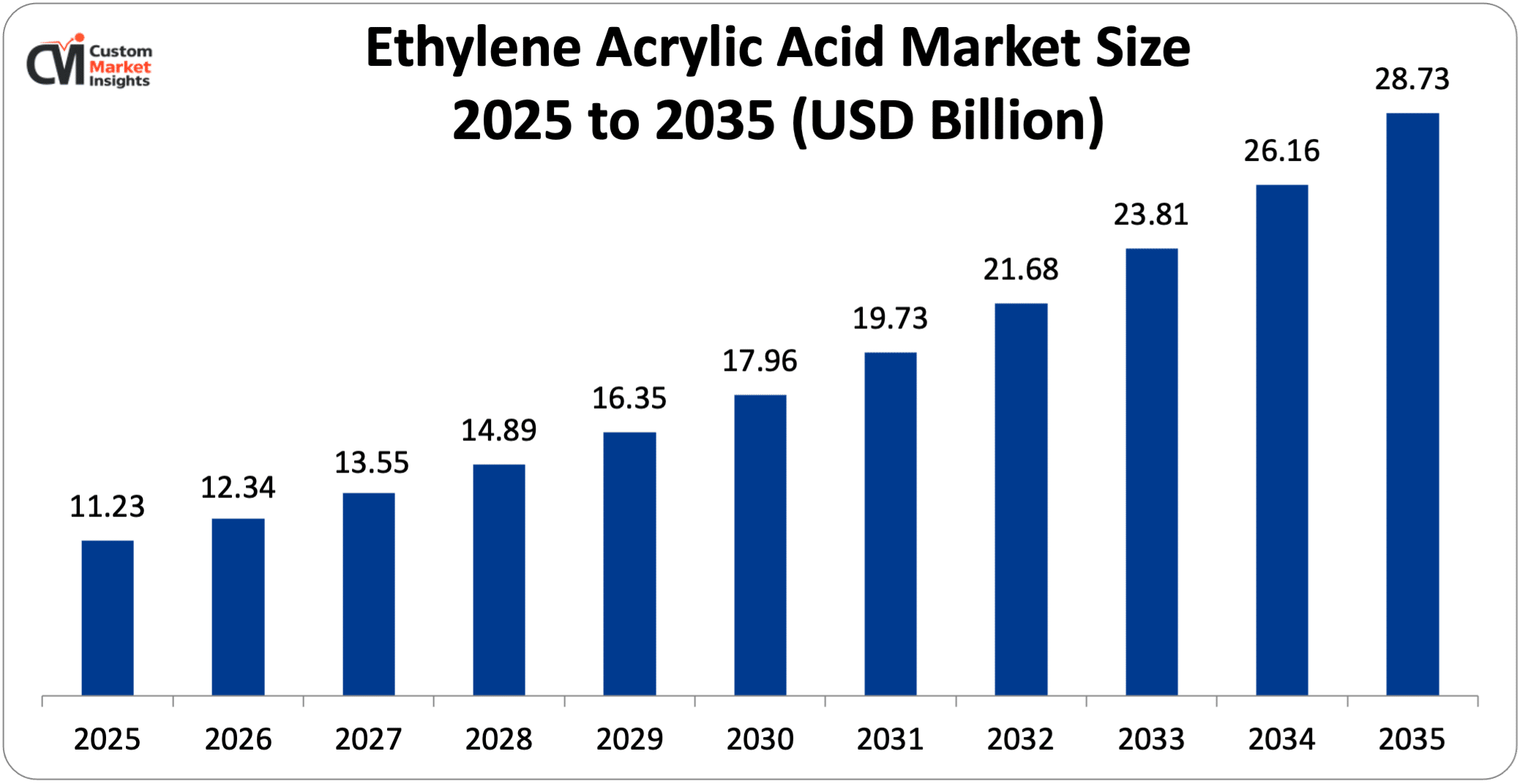
As per the ethylene acrylic acid market analysis conducted by the CMI team, the ethylene acrylic acid (EAA) market is expected to record a CAGR of 9.85% from 2026 to 2035. In 2026, the market size was USD 12.34 billion. By 2035, the valuation is anticipated to reach USD 36.61 billion. The market is expanding due to growing demand for EAA in construction, automotive, and packaging applications.
EAA’s flexibility, adhesion, and heat-sealing properties could be attributed to this demand. This growth is also supported by its increased use in recyclable and sustainable packaging solutions, especially in the emerging economies all across the Asia Pacific. Also, product innovations and technological advancements on the part of chemical manufacturers are expected to improve market penetration further.
Market Highlights
- The Asia Pacific dominated the ethylene acrylic acid market in 2025 with 57.34% of the overall share.
- North America is expected to witness the fastest CAGR of 10.5% in the ethylene acrylic acid market during the forecast period.
- By type, extrusion grade EAA copolymer held around 67.37% of the market share by 2025.
- By type, injection grade EAA copolymer is expected to witness the fastest CAGR of 11.34% between 2026 and 2035.
- Through product type, the 20 wt% comonomer segment dominated in 2025 with 48.23% of the overall market share.
- By product type, the 9 wt% comonomer segment is expected to witness the fastest CAGR of 9.97% between 2026 and 2035.
- By application, the packaging segment dominated in 2025 with 55.64% of the overall market share.
- By application, the hot melt adhesive segment is expected to witness the fastest CAGR of 10.34% between 2026 and 2035.
Significant Growth Factors
- Demand for High-Performance and Sustainable Materials: EAA has superlative adhesion to plastics, metals, and foils, along with exceptional flexibility and dependable heat-sealing capacities. As such, it becomes one of the preferred choices for recyclable and multilayer packaging films. The rising focus on reduction of plastic waste and enhancing food safety standards is expediting adoption of EAA in the pharmaceutical, food & beverages, and consumer goods verticals. The Asia Pacific, LATAM, and certain parts of Europe are witnessing exponential consumption owing to increased industrialization and sterner government regulations that promote environmentally friendly packaging solutions, plus, innovations regarding EAA formulations that can improve barrier properties, compatibility with the other polymers, and mechanical strength are facilitating production of lightweight, more efficient, and sustainable packaging.
- Applications in Adhesive, Construction, and Automotive Sectors: the manufacturers pertaining to the automotive sector are using EAA’s properties for producing lightweight, fuel-efficient, durable components and protective coatings that improve longevity and performance. In the construction vertical, EAA is used in coatings, sealants, protective films, and waterproofing membranes owing to its elasticity, chemical resistance, and bonding capacities. EAA is also being adopted by the hot-melt and adhesives vertical to obtain better thermal stability and tackiness. Development of polymer blends and EAA grades customized for specified applications is widening the usability of ethylene acrylic acid across multiple industries apart from the ones mentioned above.
What are the Major Advancements Changing the Ethylene Acrylic Acid Market Today?
- Development of High-Performance EAA Copolymers: conventional EAA grades do offer basic flexibility and adhesion. However, recent innovations are focusing on increasing the compatibility with the other polymers, enhancing chemical resistance, and improving the heat-sealing efficiency. Such advanced formulations let EAA be leveraged in applications that are more demanding – such as multilayer packaging films that need exceptional oxygen, moisture, and aroma barrier properties. Furthermore, the emergence of partially renewable and bio-based EAA grades does align with the increasing focus on sustainability, thereby facilitating manufacturers to lessen their carbon footprint while safeguarding the polymer’s functional advantages. Such advancements are raising EAA’s adoption in the high-value sectors such as pharmaceuticals, food & beverages, and specialty industrial films.
- Integrating EAA with Innovative Applications: EAA is being integrated into applications way beyond conventional packaging – such as construction, automotive, and adhesives. In the automotive industry, the uses of EAA comprise fuel system components, lightweight composite materials, and protective coatings that improve durability, lessen the weight of the vehicles, and enhance fuel efficiency. In construction, the cutting-edge EAA-based sealants, membranes, and coatings are paving the way for superlative chemical resistance, adhesion, and flexibility. Plus, development of personalized, EAA-based hot-melt formulations and adhesives with optimized bonding strength and thermal stability is driving the adoption across the entire industrial manufacturing vertical.
- Impact of AI on Ethylene Acrylic Acid Market: AI is increasingly replenishing the ethylene acrylic acid market by improving production efficiency, demand forecasting, and quality control across the value chain. The AI-driven process optimization and predictive maintenance in petrochemical plants help manufacturers in reducing downtime, improving yield, and minimizing energy consumption during EAA copolymers’ production. Plus, ml models aid in analyzing large datasets pertaining to supply chain dynamics, pricing of raw materials, and customer demand, thereby allowing for more strategic decision-making and precise forecasting. Plus, intelligent automation related to inventory management and logistics is helping in streamlining the distribution networks, thereby reducing the operational costs and ascertaining timely delivery.
Category Wise insights
By Type
- Why is extrusion grade EAA copolymer dominating the ethylene acrylic acid market?
Extrusion-grade ethylene acrylic acid (EAA) copolymer leads the market owing to its cost-efficiency, versatility, and compatibility with the high-volume production processes. The grade is broadly used in numerous extrusion applications like coatings, films, packaging materials, and laminates, wherein it does offer exceptional adhesion to the substrates such as polyethylene, paper, and aluminum. Its superlative flexibility, heat sealability, and chemical resistance do render it valuable in industrial wrapping and food packaging, thereby driving consistency. Plus, these processes facilitate continual production with higher throughput and lower operational costs in comparison with their counterparts.
By Product Type
- How is 20 wt % comonomer leading the ethylene acrylic acid market?
The 20 wt % comonomer segment leads the ethylene acrylic acid (EAA) market, as it does offer an optimal balance between material processibility and adhesion performance. With this concentration, acrylic acid content substantially improves polarity, thereby facilitating robust adhesion to the challenging substrates like glass, metals, and polar polymers, which are critical in coating, packaging, and lamination applications. Also, it does retain sufficient characteristics for ensuring toughness, flexibility, and ease of extrusion/molding, thereby averting processing difficulties or brittleness seen at the comonomer levels. These characteristics make 20 wt % EAA highly versatile.
By Application
- Why does packaging dominate the ethylene acrylic acid market?
Packaging leads the global ethylene acrylic acid market owing to EAA’s exclusive combination of flexibility, strong adhesion, and exceptional barrier performance, which are necessary for modern day packaging solutions. The application areas include laminates, multilayer films, and coatings where they effectively tie layers, thereby bonding various dissimilar materials like aluminum, polyethylene, and paper without the requirement of extra adhesives. Their superlative resistance to grease, moisture, and chemicals does make them valuable in pharmaceutical and food packaging verticals. Plus, speedy growth of sustainable and flexible packaging apart from rising demand for high-performance materials does reinforce the compound’s dominance.
Report Scope
| Feature of the Report | Details |
| Market Size in 2026 | USD 12.34 billion |
| Projected Market Size in 2035 | USD 36.61 billion |
| Market Size in 2025 | USD 11.23 billion |
| CAGR Growth Rate | 9.85% CAGR |
| Base Year | 2025 |
| Forecast Period | 2026-2035 |
| Key Segment | By Type, Product Type, Application and Region |
| Report Coverage | Revenue Estimation and Forecast, Company Profile, Competitive Landscape, Growth Factors and Recent Trends |
| Regional Scope | North America, Europe, Asia Pacific, Middle East & Africa, and South & Central America |
| Buying Options | Request tailored purchasing options to fulfil your requirements for research. |
Regional Analysis
How big is the Asia Pacific’s ethylene acrylic acid market size?
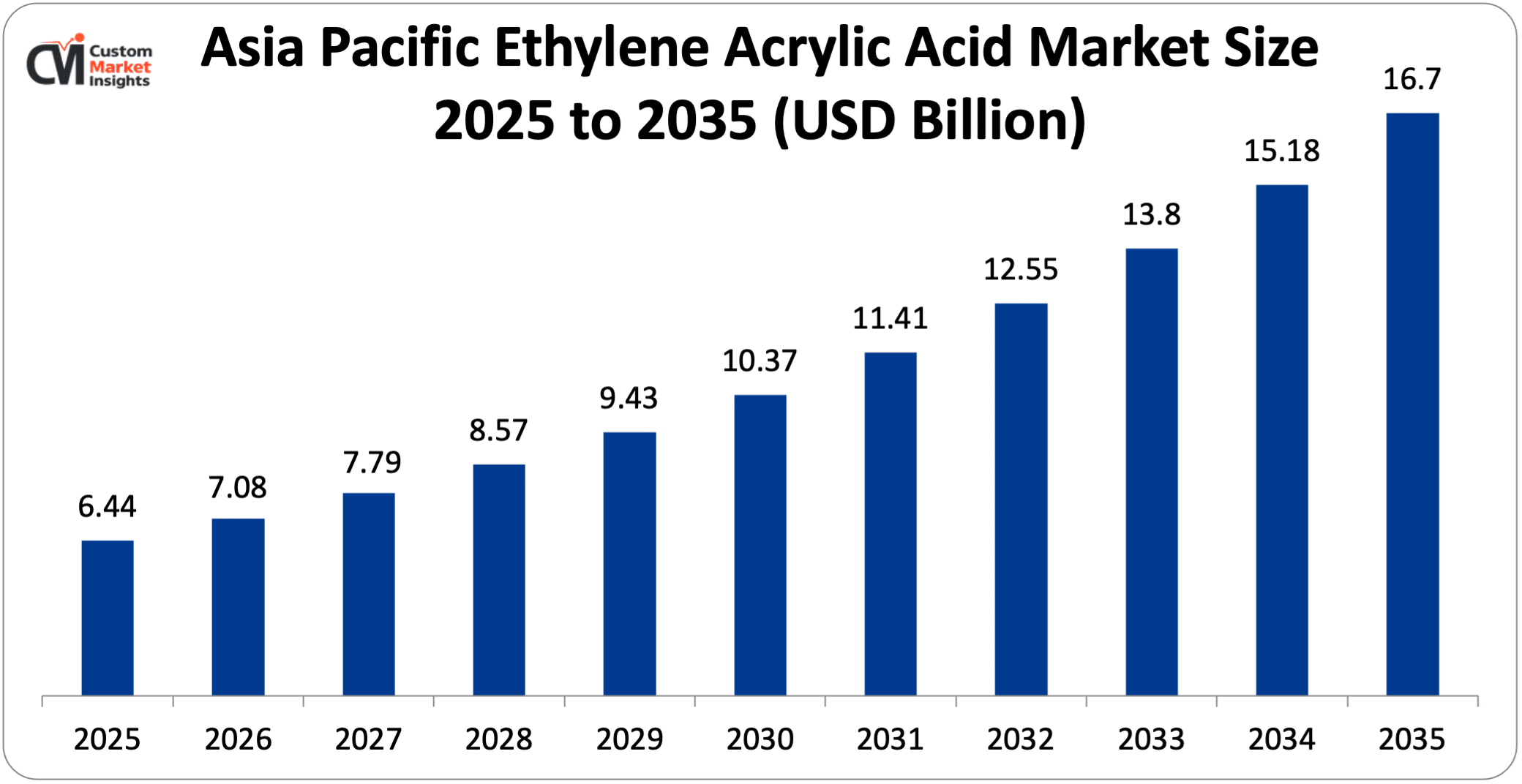
Asia Pacific’s ethylene acrylic acid market was worth USD 6.44 Billion in 2025 and is expected to reach USD 16.7 Billion by 2035 at a CAGR of 9.99% between 2025 and 2035.
Why did the Asia Pacific Dominate the Ethylene Acrylic Acid Market in 2025?
The Asia Pacific dominated the ethylene acrylic acid (EAA) market in 2025 owing to its robust manufacturing base. As such, there is an increased demand from construction, automotive, and packaging verticals. Economies like Japan, India, and China are serving as the major manufacturing as well as consumption hubs supported by the exponentially increasing middle class population. The flexible packaging sector is also driven by urbanization and e-commerce, which, in turn, does increase EAA’s demand in laminates and films. Plus, cost-efficiency offered with respect to labor, large-scale production capacities, and raw materials coupled with government policies promoting domestic manufacturing are further strengthening the position of the Asia Pacific in the ethylene acrylic acid market.
What is the Size of China Ethylene Acrylic Acid Market?
The market size of China’s ethylene acrylic acid was USD 4.14 billion in 2025 and is expected to reach USD 10.66 billion in 2035, witnessing a CAGR of 9.87% between 2026 and 2035.
China Ethylene Acrylic Acid Market Trends
China’s ethylene acrylic acid (EAA) market is likely to witness robust growth during the forecast period due to rising demand for packaging, rapid industrialization, and proper regulatory frameworks. Rising urbanization coupled with an expanding middle-class population is expediting the demand for longer shelf-life packaging, whereas the government initiatives that promote low-carbon, recyclable, and food-safe materials are bolstering the adoption of EAA-based adhesives and coatings. Plus, continual investments regarding petrochemical capacity expansion, advancements pertaining to sustainable polymer technologies, and cost optimization using alternative feedstock. As such, China acts as a key hub regarding both – innovation and consumption of EAA.
Why is North America experiencing the fastest growth in the ethylene acrylic acid market?
North America is expected to witness the quickest growth in the ethylene acrylic acid market owing to advancements in petrochemical infrastructure, a growing focus on sustainable materials, and robust end-use industries. The region benefits from a cost-efficient and stable supply of prime raw materials, thereby facilitating large-scale innovation in EAA formulations. Higher demand from the well-established automotive, packaging, and adhesives sectors, especially for food-safe and flexible packaging, is also supported by expanding e-commerce and consumption of consumer goods. Plus, notable investments in recyclable polymers, green chemistry, and advanced extrusion technologies are expediting adoption.
U.S. Ethylene Acrylic Acid Market Trends
The U.S. ethylene acrylic acid (EAA) market is likely to show innovation-oriented growth during the forecast period due to robust demand from automotive, advanced packaging, and specialty adhesive verticals. Increased consumer preference for lightweight, durable, and high-barrier packaging materials is visibly boosting the consumption of EAA, especially in lamination and extrusion coating applications. Plus, rising regulatory pressure for recyclable and sustainable materials translates to manufacturers developing eco-friendly EAA formulations with enhanced compatibility in the multi-layer recycling systems.
Where does Europe stand with respect to ethylene acrylic acid market?
Europe holds a significant ethylene acrylic acid market share due to robust regulatory influence, especially from the sustainability initiatives like circular economy policies. As such, development of bio-based and recyclable EAA materials is on the rise. The end-use verticals include automotive, advanced packaging, and coatings. Economies such as France, Germany, and the U.K. are the prime demand centers, which are, in turn, supported by high class performance standards
Germany Ethylene Acrylic Acid Market Trends
Germany continues to be one of the key contributors to Europe’s ethylene acrylic acid market due to higher demand from automotive coatings, advanced packaging, and specialty adhesives verticals. Herein, superlative bonding as well as barrier properties of EAA are paramount. The economy’s stern recycling and environmental policies are expediting a shift toward low-VOC, eco-friendly, and recyclable polymer solutions, thereby encouraging the manufacturers to come up with sustainable formulations.
Where is the Middle East & Africa regarding the ethylene acrylic acid market?
The Middle East & Africa (MEA) region is bound to make a mark in the ethylene acrylic acid market during the forecast period. This is credited to expanding construction, packaging, and automotive sectors, apart from increased demand for high class coatings and adhesives. The middle east does benefit from an abundance of petrochemical feedstock coupled with ongoing investments in the downstream polymer industries, particularly in economies like the UAE and Saudi Arabia, which, in turn, are strengthening the local manufacturing capabilities. On the other hand, Africa’s growth on this count is supported by improvement in industrial infrastructure, rising urbanization, and rising consumption of packaged goods.
Brazil Ethylene Acrylic Acid Market Trends
Brazil’s ethylene acrylic acid market is expected to witness steadiness during the forecast period. This is due to the visible expansion of packaging, automotive, and construction verticals. The key driver is rising demand for sustainable and flexible packaging solutions. EAA copolymers are known for offering better durability, strong adhesion, and recyclability. This renders them ideal for industrial laminates and food packaging. The extended applications include manufacturing and industrial sectors. Plus, a switch to bio-based and eco-friendly materials is observed. However, volatility of raw materials is bound to restrain the market.
Top players in the Ethylene Acrylic Acid Market and their Offerings
- Dow Inc.
- Exxonmobil Chemical
- Honeywell International Inc.
- Celanese Corporation
- Arkema Group
- LyondellBasell Industries
- SABIC
- INEOS
- Eastman Chemical Company
- Mitsubishi Chemical Corporation
- Sumitomo Chemical Co. Ltd.
- DuPont
- BASF SE
- Lcy Chemical Corp.
- Formosa Plastics Corporation
- Wanhua Chemical Group
- Shandong Dongyue Chemical Co. Ltd.
- Shandong Xingfu Chemical Co. Ltd.
- Suzhou Tianlong Chemical Co. Ltd.
- ChemChina
- Reliance Industries Limited
- Others
Key Developments
Ethylene acrylic acid market has experienced considerable changes in the last few years as the market players are trying to diversify their technological aspects and develop product portfolios using strategic approaches.
- In April 2024, Dow Inc. Introduced a strategic initiative for expanding its portfolio of EAA polymers comprising adhesives, coatings, and packaging in South Africa. This initiative does highlight Dow’s commitment to delivery of sustainable, high-performance polymer solutions catering to local consumer and industrial needs.
- In March 2024, Honeywell international Inc. Launched a high-adhesion EAA grade designed for industrial laminates and multilayer food packaging.
These strategic measures have enabled the companies to reinforce their competitive positions, increase the product line, boost their technological competencies, and also seize growth opportunities in the fast-growing ethylene acrylic acid market.
The Ethylene Acrylic Acid Market is segmented as follows:
By Type
- Injection Grade EAA Copolymer
- Extrusion Grade EAA Copolymer
By Product Type
- 5 wt % Comonomer
- 9 wt % Comonomer
- 20 wt % Comonomer
By Application
- Packaging
- Powder Coating
- Water-Based Solvent
- Hot Melt Adhesive
Regional Coverage:
North America
- U.S.
- Canada
- Mexico
- Rest of North America
Europe
- Germany
- France
- U.K.
- Russia
- Italy
- Spain
- Netherlands
- Rest of Europe
Asia Pacific
- China
- Japan
- India
- New Zealand
- Australia
- South Korea
- Taiwan
- Rest of Asia Pacific
The Middle East & Africa
- Saudi Arabia
- UAE
- Egypt
- Kuwait
- South Africa
- Rest of the Middle East & Africa
Latin America
- Brazil
- Argentina
- Rest of Latin America
Table of Contents
- Chapter 1. Report Introduction
- 1.1. Report Description
- 1.1.1. Purpose of the Report
- 1.1.2. USP & Key Offerings
- 1.2. Key Benefits For Stakeholders
- 1.3. Target Audience
- 1.4. Report Scope
- 1.1. Report Description
- Chapter 2. Market Overview
- 2.1. Report Scope (Segments And Key Players)
- 2.1.1. Ethylene Acrylic Acid by Segments
- 2.1.2. Ethylene Acrylic Acid by Region
- 2.2. Executive Summary
- 2.2.1. Market Size & Forecast
- 2.2.2. Ethylene Acrylic Acid Market Attractiveness Analysis, By Type
- 2.2.3. Ethylene Acrylic Acid Market Attractiveness Analysis, By Product Type
- 2.2.4. Ethylene Acrylic Acid Market Attractiveness Analysis, By Application
- 2.1. Report Scope (Segments And Key Players)
- Chapter 3. Market Dynamics (DRO)
- 3.1. Market Drivers
- 3.1.1. Demand for High-Performance and Sustainable Materials
- 3.1.2. Applications in Adhesive Construction and Automotive Sectors
- 3.2. Market Restraints
- 3.3. Market Opportunities
- 3.5. Pestle Analysis
- 3.6. Porter Forces Analysis
- 3.7. Technology Roadmap
- 3.8. Value Chain Analysis
- 3.9. Government Policy Impact Analysis
- 3.10. Pricing Analysis
- 3.1. Market Drivers
- Chapter 4. Ethylene Acrylic Acid Market – By Type
- 4.1. Type Market Overview, By Type Segment
- 4.1.1. Ethylene Acrylic Acid Market Revenue Share, By Type , 2025 & 2035
- 4.1.2. Injection Grade EAA Copolymer
- 4.1.3. Ethylene Acrylic Acid Share Forecast, By Region (USD Billion)
- 4.1.4. Comparative Revenue Analysis, By Country, 2025 & 2035
- 4.1.5. Key Market Trends, Growth Factors, & Opportunities
- 4.1.6. Extrusion Grade EAA Copolymer
- 4.1.7. Ethylene Acrylic Acid Share Forecast, By Region (USD Billion)
- 4.1.8. Comparative Revenue Analysis, By Country, 2025 & 2035
- 4.1.9. Key Market Trends, Growth Factors, & Opportunities
- 4.1. Type Market Overview, By Type Segment
- Chapter 5. Ethylene Acrylic Acid Market – By Product Type
- 5.1. Product Type Market Overview, By Product Type Segment
- 5.1.1. Ethylene Acrylic Acid Market Revenue Share, By Product Type , 2025 & 2035
- 5.1.2. 5 wt% Comonomer
- 5.1.3. Ethylene Acrylic Acid Share Forecast, By Region (USD Billion)
- 5.1.4. Comparative Revenue Analysis, By Country, 2025 & 2035
- 5.1.5. Key Market Trends, Growth Factors, & Opportunities
- 5.1.6. 9 wt% Comonomer
- 5.1.7. Ethylene Acrylic Acid Share Forecast, By Region (USD Billion)
- 5.1.8. Comparative Revenue Analysis, By Country, 2025 & 2035
- 5.1.9. Key Market Trends, Growth Factors, & Opportunities
- 5.1.10. 20 wt % Comonomer
- 5.1.11. Ethylene Acrylic Acid Share Forecast, By Region (USD Billion)
- 5.1.12. Comparative Revenue Analysis, By Country, 2025 & 2035
- 5.1.13. Key Market Trends, Growth Factors, & Opportunities
- 5.1. Product Type Market Overview, By Product Type Segment
- Chapter 6. Ethylene Acrylic Acid Market – By Application
- 6.1. Application Market Overview, By Application Segment
- 6.1.1. Ethylene Acrylic Acid Market Revenue Share, By Application , 2025 & 2035
- 6.1.2. Packaging
- 6.1.3. Ethylene Acrylic Acid Share Forecast, By Region (USD Billion)
- 6.1.4. Comparative Revenue Analysis, By Country, 2025 & 2035
- 6.1.5. Key Market Trends, Growth Factors, & Opportunities
- 6.1.6. Powder Coating
- 6.1.7. Ethylene Acrylic Acid Share Forecast, By Region (USD Billion)
- 6.1.8. Comparative Revenue Analysis, By Country, 2025 & 2035
- 6.1.9. Key Market Trends, Growth Factors, & Opportunities
- 6.1.10. Water-Based Solvent
- 6.1.11. Ethylene Acrylic Acid Share Forecast, By Region (USD Billion)
- 6.1.12. Comparative Revenue Analysis, By Country, 2025 & 2035
- 6.1.13. Key Market Trends, Growth Factors, & Opportunities
- 6.1.14. Hot Melt Adhesive
- 6.1.15. Ethylene Acrylic Acid Share Forecast, By Region (USD Billion)
- 6.1.16. Comparative Revenue Analysis, By Country, 2025 & 2035
- 6.1.17. Key Market Trends, Growth Factors, & Opportunities
- 6.1. Application Market Overview, By Application Segment
- Chapter 7. Ethylene Acrylic Acid Market – Regional Analysis
- 7.1. Ethylene Acrylic Acid Market Overview, By Region Segment
- 7.1.1. Global Ethylene Acrylic Acid Market Revenue Share, By Region, 2025 & 2035
- 7.1.2. Global Ethylene Acrylic Acid Market Revenue, By Region, 2026 – 2035 (USD Billion)
- 7.1.3. Global Ethylene Acrylic Acid Market Revenue, By Type , 2026 – 2035
- 7.1.4. Global Ethylene Acrylic Acid Market Revenue, By Product Type , 2026 – 2035
- 7.1.5. Global Ethylene Acrylic Acid Market Revenue, By Application , 2026 – 2035
- 7.2. North America
- 7.2.1. North America Ethylene Acrylic Acid Market Revenue, By Country, 2026 – 2035 (USD Billion)
- 7.2.2. North America Ethylene Acrylic Acid Market Revenue, By Type , 2026 – 2035
- 7.2.3. North America Ethylene Acrylic Acid Market Revenue, By Product Type , 2026 – 2035
- 7.2.4. North America Ethylene Acrylic Acid Market Revenue, By Application , 2026 – 2035
- 7.2.5. U.S. Ethylene Acrylic Acid Market Revenue, 2026 – 2035 (USD Billion)
- 7.2.6. Canada Ethylene Acrylic Acid Market Revenue, 2026 – 2035 (USD Billion)
- 7.2.7. Mexico Ethylene Acrylic Acid Market Revenue, 2026 – 2035 (USD Billion)
- 7.2.8. Rest of North America Ethylene Acrylic Acid Market Revenue, 2026 – 2035 (USD Billion)
- 7.3. Europe
- 7.3.1. Europe Ethylene Acrylic Acid Market Revenue, By Country, 2026 – 2035 (USD Billion)
- 7.3.2. Europe Ethylene Acrylic Acid Market Revenue, By Type , 2026 – 2035
- 7.3.3. Europe Ethylene Acrylic Acid Market Revenue, By Product Type , 2026 – 2035
- 7.3.4. Europe Ethylene Acrylic Acid Market Revenue, By Application , 2026 – 2035
- 7.3.5. Germany Ethylene Acrylic Acid Market Revenue, 2026 – 2035 (USD Billion)
- 7.3.6. France Ethylene Acrylic Acid Market Revenue, 2026 – 2035 (USD Billion)
- 7.3.7. U.K. Ethylene Acrylic Acid Market Revenue, 2026 – 2035 (USD Billion)
- 7.3.8. Russia Ethylene Acrylic Acid Market Revenue, 2026 – 2035 (USD Billion)
- 7.3.9. Italy Ethylene Acrylic Acid Market Revenue, 2026 – 2035 (USD Billion)
- 7.3.10. Spain Ethylene Acrylic Acid Market Revenue, 2026 – 2035 (USD Billion)
- 7.3.11. Netherlands Ethylene Acrylic Acid Market Revenue, 2026 – 2035 (USD Billion)
- 7.3.12. Rest of Europe Ethylene Acrylic Acid Market Revenue, 2026 – 2035 (USD Billion)
- 7.4. Asia Pacific
- 7.4.1. Asia Pacific Ethylene Acrylic Acid Market Revenue, By Country, 2026 – 2035 (USD Billion)
- 7.4.2. Asia Pacific Ethylene Acrylic Acid Market Revenue, By Type , 2026 – 2035
- 7.4.3. Asia Pacific Ethylene Acrylic Acid Market Revenue, By Product Type , 2026 – 2035
- 7.4.4. Asia Pacific Ethylene Acrylic Acid Market Revenue, By Application , 2026 – 2035
- 7.4.5. China Ethylene Acrylic Acid Market Revenue, 2026 – 2035 (USD Billion)
- 7.4.6. Japan Ethylene Acrylic Acid Market Revenue, 2026 – 2035 (USD Billion)
- 7.4.7. India Ethylene Acrylic Acid Market Revenue, 2026 – 2035 (USD Billion)
- 7.4.8. New Zealand Ethylene Acrylic Acid Market Revenue, 2026 – 2035 (USD Billion)
- 7.4.9. Australia Ethylene Acrylic Acid Market Revenue, 2026 – 2035 (USD Billion)
- 7.4.10. South Korea Ethylene Acrylic Acid Market Revenue, 2026 – 2035 (USD Billion)
- 7.4.11. Taiwan Ethylene Acrylic Acid Market Revenue, 2026 – 2035 (USD Billion)
- 7.4.12. Rest of Asia Pacific Ethylene Acrylic Acid Market Revenue, 2026 – 2035 (USD Billion)
- 7.5. The Middle-East and Africa
- 7.5.1. The Middle-East and Africa Ethylene Acrylic Acid Market Revenue, By Country, 2026 – 2035 (USD Billion)
- 7.5.2. The Middle-East and Africa Ethylene Acrylic Acid Market Revenue, By Type , 2026 – 2035
- 7.5.3. The Middle-East and Africa Ethylene Acrylic Acid Market Revenue, By Product Type , 2026 – 2035
- 7.5.4. The Middle-East and Africa Ethylene Acrylic Acid Market Revenue, By Application , 2026 – 2035
- 7.5.5. Saudi Arabia Ethylene Acrylic Acid Market Revenue, 2026 – 2035 (USD Billion)
- 7.5.6. UAE Ethylene Acrylic Acid Market Revenue, 2026 – 2035 (USD Billion)
- 7.5.7. Egypt Ethylene Acrylic Acid Market Revenue, 2026 – 2035 (USD Billion)
- 7.5.8. Kuwait Ethylene Acrylic Acid Market Revenue, 2026 – 2035 (USD Billion)
- 7.5.9. South Africa Ethylene Acrylic Acid Market Revenue, 2026 – 2035 (USD Billion)
- 7.5.10. Rest of the Middle East & Africa Ethylene Acrylic Acid Market Revenue, 2026 – 2035 (USD Billion)
- 7.6. Latin America
- 7.6.1. Latin America Ethylene Acrylic Acid Market Revenue, By Country, 2026 – 2035 (USD Billion)
- 7.6.2. Latin America Ethylene Acrylic Acid Market Revenue, By Type , 2026 – 2035
- 7.6.3. Latin America Ethylene Acrylic Acid Market Revenue, By Product Type , 2026 – 2035
- 7.6.4. Latin America Ethylene Acrylic Acid Market Revenue, By Application , 2026 – 2035
- 7.6.5. Brazil Ethylene Acrylic Acid Market Revenue, 2026 – 2035 (USD Billion)
- 7.6.6. Argentina Ethylene Acrylic Acid Market Revenue, 2026 – 2035 (USD Billion)
- 7.6.7. Rest of Latin America Ethylene Acrylic Acid Market Revenue, 2026 – 2035 (USD Billion)
- 7.1. Ethylene Acrylic Acid Market Overview, By Region Segment
- Chapter 8. Competitive Landscape
- 8.1. Company Market Share Analysis – 2025
- 8.1.1. Global Ethylene Acrylic Acid Market: Company Market Share, 2025
- 8.2. Global Ethylene Acrylic Acid Market Company Market Share, 2024
- 8.1. Company Market Share Analysis – 2025
- Chapter 9. Company Profiles
- 9.1. Dow Inc.
- 9.1.1. Company Overview
- 9.1.2. Key Executives
- 9.1.3. Product Portfolio
- 9.1.4. Financial Overview
- 9.1.5. Operating Business Segments
- 9.1.6. Business Performance
- 9.1.7. Recent Developments
- 9.2. Exxonmobil Chemical
- 9.3. Honeywell International Inc.
- 9.4. Celanese Corporation
- 9.5. Arkema Group
- 9.6. LyondellBasell Industries
- 9.7. SABIC
- 9.8. INEOS
- 9.9. Eastman Chemical Company
- 9.10. Mitsubishi Chemical Corporation
- 9.11. Sumitomo Chemical Co. Ltd.
- 9.12. DuPont
- 9.13. BASF SE
- 9.14. Lcy Chemical Corp.
- 9.15. Formosa Plastics Corporation
- 9.16. Wanhua Chemical Group
- 9.17. Shandong Dongyue Chemical Co. Ltd.
- 9.18. Shandong Xingfu Chemical Co. Ltd.
- 9.19. Suzhou Tianlong Chemical Co. Ltd.
- 9.20. ChemChina
- 9.21. Reliance Industries Limited
- 9.22. Others.
- 9.1. Dow Inc.
- Chapter 10. Research Methodology
- 10.1. Research Methodology
- 10.2. Secondary Research
- 10.3. Primary Research
- 10.3.1. Analyst Tools and Models
- 10.4. Research Limitations
- 10.5. Assumptions
- 10.6. Insights From Primary Respondents
- 10.7. Why Healthcare Foresights
- Chapter 11. Standard Report Commercials & Add-Ons
- 11.1. Customization Options
- 11.2. Subscription Module For Market Research Reports
- 11.3. Client Testimonials
- Chapter 12. List Of Figures
- 12.1. Figures No 1 to 25
- Chapter 13. List Of Tables
- 13.1. Tables No 1 to 46
Prominent Player
- Dow Inc.
- Exxonmobil Chemical
- Honeywell International Inc.
- Celanese Corporation
- Arkema Group
- LyondellBasell Industries
- SABIC
- INEOS
- Eastman Chemical Company
- Mitsubishi Chemical Corporation
- Sumitomo Chemical Co. Ltd.
- DuPont
- BASF SE
- Lcy Chemical Corp.
- Formosa Plastics Corporation
- Wanhua Chemical Group
- Shandong Dongyue Chemical Co. Ltd.
- Shandong Xingfu Chemical Co. Ltd.
- Suzhou Tianlong Chemical Co. Ltd.
- ChemChina
- Reliance Industries Limited
- Others
FAQs
The key players in the market are Dow Inc., Exxonmobil Chemical, Honeywell International Inc., Celanese Corporation, Arkema Group, LyondellBasell Industries, SABIC, INEOS, Eastman Chemical Company, Mitsubishi Chemical Corporation, Sumitomo Chemical Co. Ltd., DuPont, BASF SE, Lcy Chemical Corp., Formosa Plastics Corporation, Wanhua Chemical Group, Shandong Dongyue Chemical Co. Ltd., Shandong Xingfu Chemical Co. Ltd., Suzhou Tianlong Chemical Co. Ltd., ChemChina, Reliance Industries Limited, Others.
Strict environmental policies pertaining to plastic waste management, chemical safety, and emissions are compelling the manufacturers into the development of low-VOC, recyclable, and eco-friendly EAA formulations. Regulations around material standards and food safety are encouraging usage of non-toxic, high-performance materials in food-contact packaging. Also, policies that promote circular economy practices are expediting R&D investments.
The price point does directly influence buying decisions across various end-use industries. EAA is reported to be more expensive than its counterparts like polyethylene, which is bound to limit its adoption in applications that are cost-sensitive, particularly in the developing economies. However, superior performance on the part of EAA such as flexibility, strong adhesion, and barrier properties, justifies the premium cost in applications such as specialty adhesives, automotive coatings, flexibility, and adhesion.
The market for ethylene acrylic acid is expected to witness a significant growth of about USD 28.73 Billion in the year 2035 with a CAGR of 9.85% between the years 2026 and 2035 due to an ever-increasing demand for flexible produce with minimal losses.
It is projected that the Asia Pacific will hold the largest market share in the ethylene acrylic acid market during the forecast period due to the expansion of manufacturing and packaging sectors and rapid industrialization. The region’s exploding population is driving the higher demand for food-safe and flexible packaging, especially with increased e-Commerce and urbanization.
North America is expected to witness the fastest growth rate of about 10.5% in the forecast period due to a technologically advanced and strong petrochemical industry, supported by cost-effective and abundant shale-based feedstock. The region is witnessing a higher demand for EAA in automotive, flexible packaging, and specialty adhesive applications, driven by expanding consumer goods consumption.
The ethylene acrylic acid (EAA) market is basically driven by growing demand for high-performance flexible packaging, whereby EAA’s exceptional sealability, adhesion, and barrier properties make it conducive to pharmaceutical, food, and e-commerce applications. Rising consumer preference for durable, lightweight, and longer shelf-life packaging solutions is notably boosting the adoption. Plus, speedy expansion in electronics, construction, and automotive verticals is driving the requirement of advanced laminates, coatings, and adhesives. Also, there is a robust push for recyclable and sustainable materials, which translates to the creation of eco-friendly EAA formulations.