
Global Ethylene Acrylic Acid Market Size Likely to Grow at a CAGR of 9.85% By 2035
Key highlights
- The ethylene acrylic acid market is projected to grow on a decent note with increased demand for high-performance polymers across automotive, packaging, and construction industries.
- By Type Extrusion grade segment leads the ethylene acrylic acid (EAA) market due to the widespread use of extrusion grade ethylene acrylic acid in extrusion coating, flexible packaging, and laminating applications.
- North America is expected to witness the fastest CAGR in the ethylene acrylic acid market.
- In February 2024, Arkema Group announced that it had entered into a strategic partnership with a European packaging consortium for developing eco-friendly EAA-based films for medical and food applications.
Market Size and Growth
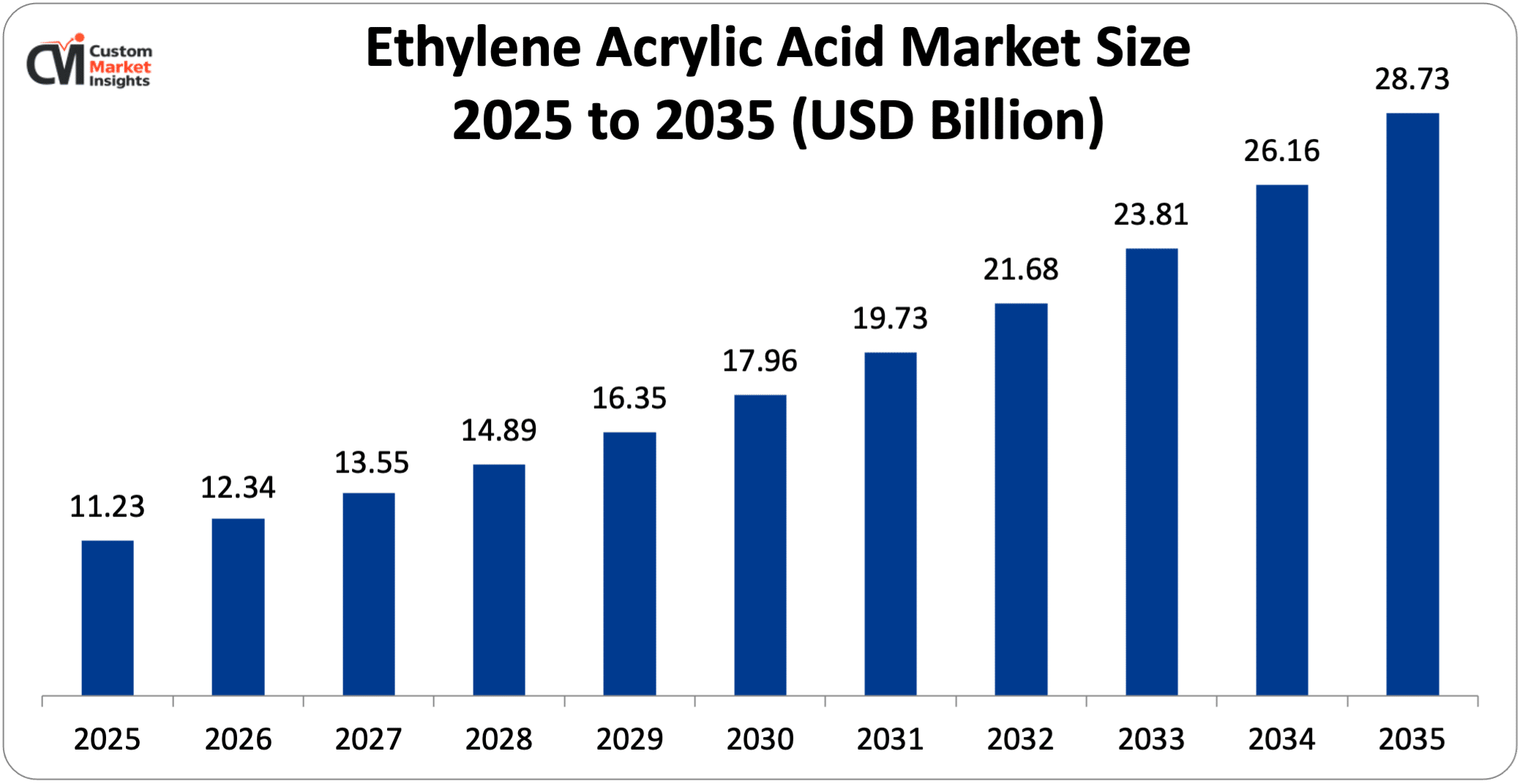
As per the ethylene acrylic acid market size analysis conducted by the CMI team, the ethylene acrylic acid (EAA) market is expected to record a CAGR of 9.85% from 2026 to 2035. In 2026, the market size was USD 12.34 billion. By 2035, the valuation is anticipated to reach USD 36.61 billion.
To learn more about this report - request a sample report PDF
Ethylene Acrylic Acid Market Revenue and Trends
The ethylene acrylic acid market is projected to grow on a decent note with increased demand for high-performance polymers across automotive, packaging, and construction industries. The end-use applications include e-Commerce, pharmaceuticals, and food. The key dynamics include a robust shift toward eco-friendly and recyclable materials and advancements in lamination technologies and extrusion coating, along with EAA’s rising integration in specialty adhesives and electric vehicle components.
Source: Custom Market Insights analysis.
What are the Factors That Have a Significant Contribution to the Growth of the Ethylene Acrylic Acid Market?
One of the major factors contributing to the growth of the ethylene acrylic acid market includes increased demand for high class flexible packaging across beverage, food, pharmaceutical, and e-Commerce verticals. EAA’s exceptional sealability, adhesion, and barrier properties render it suitable for various multilayer packaging structures, enhancing products’ safety and shelf life. Fast-paced urbanization, altering lifestyles, and growing consumption of convenience and packaged food are accelerating the demand further, especially in the developing economies. EAA is also used in laminates, adhesives, and coatings due to the above-mentioned properties.
The other factor is increased emphasis on regulatory compliance and sustainability, which is driving development as well as adoption of eco-friendly and recyclable polymer solutions. The environmental agencies and governments are asking for lower emissions and decreased plastic waste, thereby prompting the manufacturers to look for advanced EAA formulations compatible with the circular economy goals.
Segment Insights
By Type
Extrusion grade segment leads the ethylene acrylic acid (EAA) market due to the widespread use of extrusion grade ethylene acrylic acid in extrusion coating, flexible packaging, and laminating applications. The industries are opting for extrusion grade EAA for its exceptional heat-seal capability, excellent adhesion, and compatibility with the multilayer structures. It thus becomes inevitable in medical packaging, food packaging, and industrial films. The injection grade segment is expected to witness the quickest CAGR during the forecast period. This is supported by the rising adoption of injection-grade ethylene acrylic acid in molded components that are used in electronics, automotive parts, and consumer goods verticals.
By Application
The packaging segment does account for the largest revenue due to the inevitability of EAA in sealing layers, laminates, and barrier coatings owing to flexible packaging rendered therein. It also caters to the rising demand for e-Commerce packaging, ready-to-eat foods, and sustainability-emphasized materials. The hot melt adhesive segment is poised to witness the fastest CAGR going forward due to growing demand for this adhesive in labeling, hygiene products, bookbinding, and industrial applications. EAA improves flexibility, adhesive strength, and low-temperature performance. This, in turn, does make it a vital component in the next-generation high-performance hot melt adhesive systems.
Regional Insights
The Asia Pacific dominates the ethylene acrylic acid market due to economies like Japan, India, and China witnessing an increased demand for pharmaceutical packaging, processed food, and government initiatives extending support to EAA’s adoption.
North America is expected to witness the fastest CAGR in the ethylene acrylic acid market. This is credited to the U.S. being focused on innovation regarding new, bio-based chemical compounds. Higher demand from adhesives, packaging, and automotive sectors is keeping the cash registers ringing for the ethylene acrylic acid market.
Report Scope
| Feature of the Report | Details |
| Market Size in 2026 | USD 12.34 billion |
| Projected Market Size in 2035 | USD 36.61 billion |
| Market Size in 2025 | USD 11.23 billion |
| CAGR Growth Rate | 9.85% CAGR |
| Base Year | 2025 |
| Forecast Period | 2026-2035 |
| Key Segment | By Type, Product Type, Application and Region |
| Report Coverage | Revenue Estimation and Forecast, Company Profile, Competitive Landscape, Growth Factors and Recent Trends |
| Regional Scope | North America, Europe, Asia Pacific, Middle East & Africa, and South & Central America |
| Buying Options | Request tailored purchasing options to fulfil your requirements for research. |
Recent Developments
- In February 2024, Arkema Group announced that it had entered into a strategic partnership with a European packaging consortium for developing eco-friendly EAA-based films for medical and food applications.
List of the prominent players in the Ethylene Acrylic Acid Market:
- Dow Inc.
- Exxonmobil Chemical
- Honeywell International Inc.
- Celanese Corporation
- Arkema Group
- LyondellBasell Industries
- SABIC
- INEOS
- Eastman Chemical Company
- Mitsubishi Chemical Corporation
- Sumitomo Chemical Co. Ltd.
- DuPont
- BASF SE
- Lcy Chemical Corp.
- Formosa Plastics Corporation
- Wanhua Chemical Group
- Shandong Dongyue Chemical Co. Ltd.
- Shandong Xingfu Chemical Co. Ltd.
- Suzhou Tianlong Chemical Co. Ltd.
- ChemChina
- Reliance Industries Limited
- Others
The Ethylene Acrylic Acid Market is segmented as follows:
By Type
- Injection Grade EAA Copolymer
- Extrusion Grade EAA Copolymer
By Product Type
- 5 wt % Comonomer
- 9 wt % Comonomer
- 20 wt % Comonomer
By Application
- Packaging
- Powder Coating
- Water-Based Solvent
- Hot Melt Adhesive
Regional Coverage:
North America
- U.S.
- Canada
- Mexico
- Rest of North America
Europe
- Germany
- France
- U.K.
- Russia
- Italy
- Spain
- Netherlands
- Rest of Europe
Asia Pacific
- China
- Japan
- India
- New Zealand
- Australia
- South Korea
- Taiwan
- Rest of Asia Pacific
The Middle East & Africa
- Saudi Arabia
- UAE
- Egypt
- Kuwait
- South Africa
- Rest of the Middle East & Africa
Latin America
- Brazil
- Argentina
- Rest of Latin America
Rushikesh Dorge
View profile and reportsAbout Custom Market Insights
Custom Market Insights is a market research and advisory company. It publishes syndicated reports across 18+ industries and delivers custom research, feasibility studies and market entry strategy for companies, investors and consultancies.
###