
Topical Antifungals Market Size, Trends and Insights By Product Type (Azoles, Allylamines, Polyenes & Echinocandins), By Formulation Type (Creams, Ointments, Lotions, Sprays, Powders), By Indication (Dermatophyte Infections/Tinea, Onychomycosis, Candidiasis), By Type/Access (OTC (Over-the-Counter), Prescription), By Distribution Channel (Retail Pharmacies & Drug Stores, Online Pharmacies, Hospital Pharmacies), and By Region - Global Industry Overview, Statistical Data, Competitive Analysis, Share, Outlook, and Forecast 2026 – 2035
Report Snapshot
CAGR: 4.67%
| Study Period: | 2026-2035 |
| Fastest Growing Market: | Asia Pacific |
| Largest Market: | North America |
Major Players
- Bayer AG
- Pfizer Inc.
- Novartis AG
- GlaxoSmithKline (GSK)
- Others
Reports Description
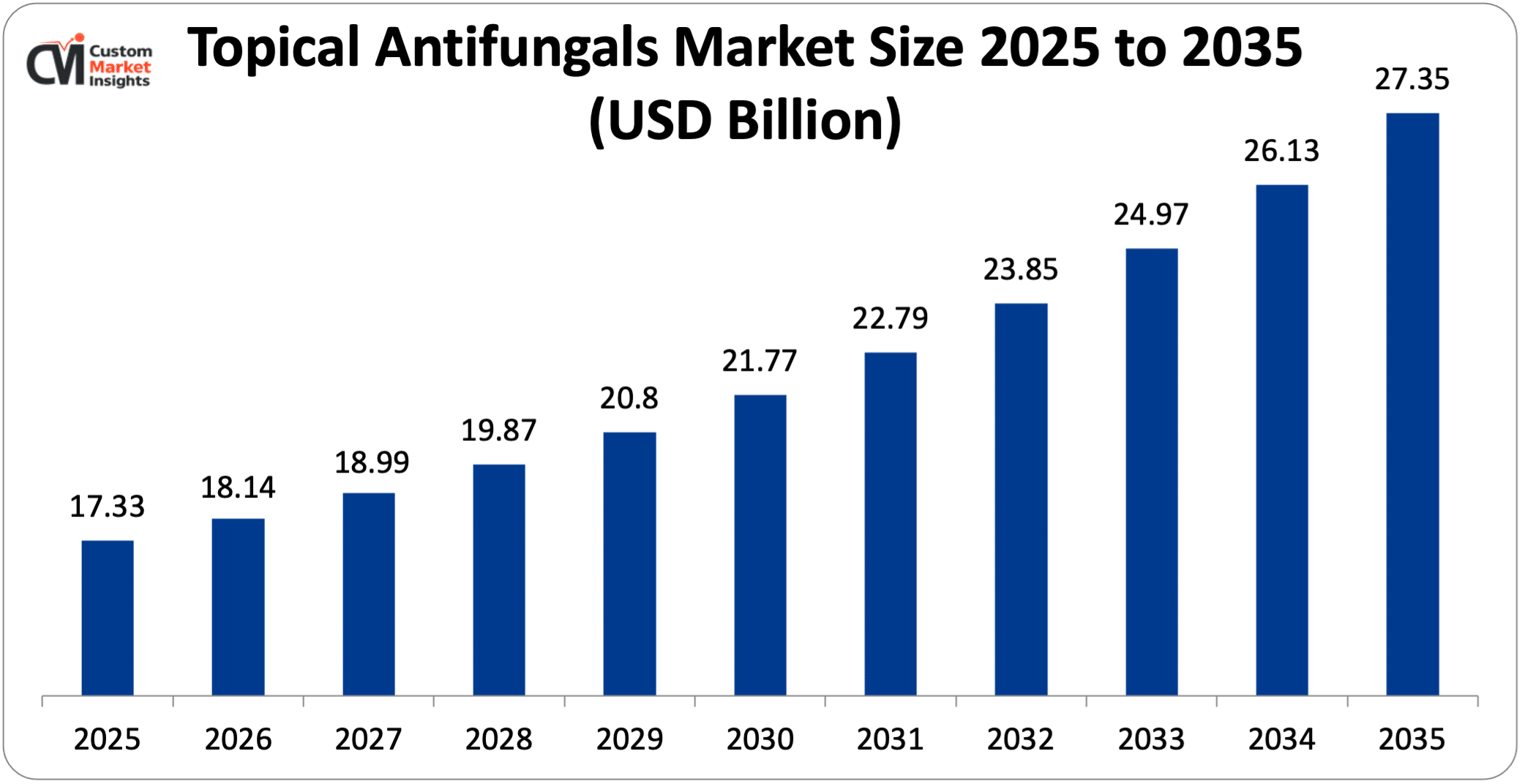
As per the topical antifungals market analysis conducted by the CMI team, the topical antifungals market is expected to record a CAGR of 4.67% from 2026 to 2035. In 2026, the market size was USD 18.14 Billion. By 2035, the valuation is anticipated to reach USD 27.35 Billion.
The market is expanding due to rising incidences of superficial infections followed by rising availability of OTC (over-the-counter) formulations. The generation of revenue basically revolves around allylamine and azole segments.
Market Highlights
- North America dominated the topical antifungals market in 2025 with 43.34% of the overall share.
- The Asia Pacific is expected to witness the fastest CAGR of 5.5% in the topical antifungals market during the forecast period.
- By product type, azoles held around 47.37% of the market share by 2025.
- By product type, allylamines are expected to witness the fastest CAGR of 4.44% between 2026 and 2035.
- Through formulation type, creams dominated in 2025 with 48.23% of the overall market share.
- By formulation type, lotions are expected to witness the fastest CAGR of 3.97% between 2026 and 2035.
- By indication, dermatophyte infections/tinea dominated in 2025 with 34.64% of the overall market share.
- By indication, onychomycosis is expected to witness the fastest CAGR of 3.34% between 2026 and 2035.
- By type/access, the OTC (Over-the-Counter) segment led in 2025 with 57.34% of the overall market share.
- By type/access, Prescription segment is expected to witness the fastest CAGR of 3.93% between 2026 and 2035.
- By distribution channel, retail pharmacies & drug stores led with 38.65% of the market share.
- By distribution channel, online pharmacies are expected to witness the fastest CAGR of 3.82% during the forecast period.
Significant Growth Factors
- Growing Prevalence of Chronic Lifestyle Ailments
The topical antifungals market is bound to grow well by 2035. This is mainly because more people have health problems like diabetes and obesity. These conditions make people more likely to get infections such as candidiasis and onychomycosis. As there is a sizable geriatric population worldwide, they want treatments that are easy to use and do not have many side effects. The dermatology market is changing as people care more about looking good and being healthy. Media and wellness trends make people aware of the importance of personal hygiene. As a result, they want to treat problems and use good over-the-counter antifungal products. The topical antifungals market growth is driven by these factors. People are looking for treatments that work well and are easy to use.
- Technological Advancements in Topical Delivery Systems
The other growth factor in the topical antifungals market is the leap in delivery systems. For example, nanoparticle-based carriers, film-forming sprays, and penetrating nail lacquers are now widely available. These advancements do away with the skin barrier issue. They make sure active ingredients reach the infection site better and stay at levels longer. The use of AI-driven tools and e-pharmacy platforms is also helping. They let patients diagnose quickly using their smartphones and get targeted treatments delivered to their homes away. This digital change along with antifungal treatments, like allylamines and triazoles, will keep the market growing.
What are the Major Advancements Changing the Topical Antifungals Market Today?
- Incorporation of Advanced Drug Delivery Systems
The topical antifungals market is growing due to new ways to get the medicine into the skin and nails. Topical antifungals are getting better with technologies like nano-emulsions and special nanoparticles that help the medicine get deeper into the skin. The topical antifungals have ingredients like terbinafine or clotrimazole that work well when they get deep into the skin and nails. For example, there are medicated nail polishes that people can use for treating fungal infections of the nails. These medicated nail polishes help the medicine stay on the nail for a long time. This means that people do not have to apply the medicine often.
- Adoption of Digital Health
The field of healthcare is changing with the use of tools and artificial intelligence to diagnose problems. Now there are phone apps that can gauge if it’s eczema, fungus, or anything else by looking at pictures of skin issues like rashes or bumps. The people who make these products are also using intelligence to learn more about the bad bugs that cause skin problems like candida and trichophyton. This helps them make better products that can fight these bugs that are hard to kill.
- Impact of AI on Topical Antifungals Market
Artificial intelligence is changing the way medicines for fungus infections on the skin are devised. It helps to find better ways for treating these infections by using computer programs that look for information. Artificial intelligence is also used in apps that people can use on their phones to look at their skin and figure out what is wrong with it. For example, if someone has an infection on their nails or skin, the app can tell them what to do and what medicine to use to make it better. Artificial intelligence is also good at guessing which fungus infections will not be affected by some medicines. This helps the people who make these medicines come up with better ones that will work.
Category Wise insights
By Product Type
-
Why are azoles dominating the topical antifungals market?
Azoles dominate the topical antifungals market. They make up close to 45% of the money made from selling these kinds of medicines around the world. This is because azoles are really good at fighting a range of common fungi, including dermatophytes and yeast. Azoles work by curbing the growth of the enzyme that helps in devising the membrane of fungi. This makes them a reliable choice for doctors to prescribe. They do not have many side effects. Azoles like clotrimazole, miconazole, and ketoconazole have been sold without a prescription for a long time. This means people can easily buy them at pharmacies, and they are not too expensive.
By Formulation Type
- How are creams leading the topical antifungals market?
Creams are leading in the market. They have over 40% of the global revenue share. This is because creams have a formula that helps deliver medicine and soothe skin at the same time. Creams are popular among doctors and patients. They cover large areas well. This makes them better than powders or sprays. Some known cream brands like Canesten and Lamisil are widely available and affordable. One can easily buy them over-the-counter. This has made creams the go-to choice for treating infections like ringworm and athletes foot.
By Indication
- How are dermatophyte infections/tinea leading the topical antifungals market?
Dermatophyte infections or tinea are dominating the topical antifungals market. This is because dermatophyte infections are the common kind of fungus that affects the skin worldwide. 20 to 25 percent of people around the world get these infections. There are kinds of dermatophyte infections like tinea pedis, which is also known as athlete’s foot; tinea corporis, which is also known as ringworm and tinea cruris, which is also known as jock itch. These infections are contagious. This means people are always looking for creams, sprays and powders that they can buy without a prescription to treat dermatophyte infections. Another reason dermatophyte infections are dominating the market is that a greater number of people are playing sports and working out together. When people do these things they are likely to get fungal infections in moist places. As a result, people need creams and sprays that work fast to treat dermatophyte infections like terbinafine and clotrimazole.
By Type/Access
- How is the OTC (Over-the-Counter) type leading the topical antifungals market?
The over-the-counter segment dominates the topical antifungals market. This is due to the fact that people can easily gauge if they have infections like athlete’s foot and ringworm. They do not need to go to the doctor to find out what is wrong. People prefer taking care of these problems by themselves. They can buy medicine without a prescription. Some strong medicines like terbinafine and clotrimazole are now available without a prescription. This means people can get treatment without spending much. The over-the-counter segment is also strong because people can easily buy them at pharmacies and supermarkets. There are different brands, and they are priced competitively. This means they sell more than prescription medicines.
By Distribution Channel
- Why do retail pharmacies & drug stores dominate the topical antifungals market?
Retail pharmacies and drugstores are anticipated to dominate the antifungals market during the forecast period. These are the primary access points for consumers looking for over-the-counter (OTC) antifungal medications. Consumer demand for topical antifungal medications for self-treatment of common skin infections such as athlete’s foot and ringworm is met through convenient access to retail pharmacies. Retail pharmacy chains are also strategically located in high-traffic areas and are regarded as “one-stop shops” for various personal care items. Retail pharmacy and drug shop sales account for the majority of antifungal sales. They also offer well-stocked shelves for consumer access to a broad variety of antifungal agents.
Report Scope
| Feature of the Report | Details |
| Market Size in 2026 | USD 18.14 Billion |
| Projected Market Size in 2035 | USD 27.35 Billion |
| Market Size in 2025 | USD 17.33 Billion |
| CAGR Growth Rate | 4.67% CAGR |
| Base Year | 2025 |
| Forecast Period | 2026-2035 |
| Key Segment | By Product Type, Formulation Type, Indication, Type/Access, Distribution Channel and Region |
| Report Coverage | Revenue Estimation and Forecast, Company Profile, Competitive Landscape, Growth Factors and Recent Trends |
| Regional Scope | North America, Europe, Asia Pacific, Middle East & Africa, and South & Central America |
| Buying Options | Request tailored purchasing options to fulfil your requirements for research. |
Regional Analysis
How big is North America’s topical antifungals market size?
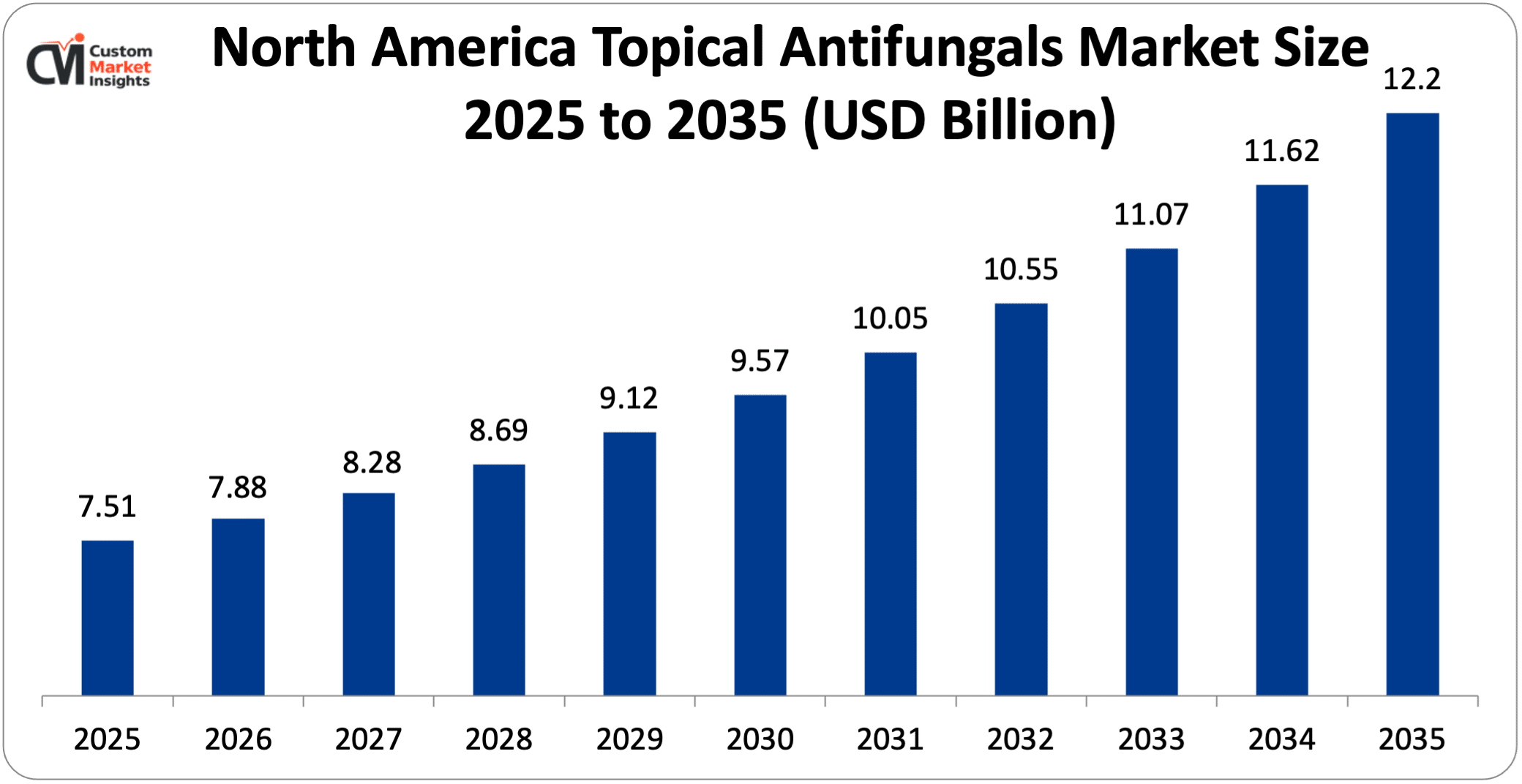
North America’s topical antifungals market was worth USD 7.51 Billion in 2025 and is expected to reach USD 1.89 Billion by 2035 at a CAGR of 4.97% between 2025 and 2035.
Why did North America Dominate the Topical Antifungals Market in 2025?
North America led the topical antifungals market in 2025. This is because it has good healthcare systems and houses big companies like Johnson & Johnson, Pfizer, and Bausch Health. These companies make sure that people can get the products they need and that new products are always being doled out. North America houses a sizable number of individuals getting fungal infections, especially the geriatric population. There are also stores available, where people can buy medicine without a prescription, which makes it easy for people to treat themselves. The market for antifungals in North America also did well in 2025 because people herein are showing willingness toward spending on healthcare.
What is the Size of the U.S. Topical Antifungals Market?
The market size of the U.S. topical antifungals was USD 5.74 Billion in 2025 and is expected to reach USD 8.53 Billion in 2035, witnessing a CAGR of 4.07% between 2026 and 2035.
U.S. Topical Antifungals Market Trends
The U.S. topical antifungals market is projected to gain significant traction with changing lifestyle patterns that are highly associated with chronic onychomycosis and tinea pedis. These chronic fungal infections are expected to increase with rising lifestyle-related fungal infections and a growing geriatric demographic presenting a wide patient pool of fungal infections. As new and effective medications become available to treat fungal infections, there is expected to be a switch from prescription to OTC (over-the-counter) topical antifungal treatments. Hence, the rising retail accessibility through pharmacies such as CVS and Walgreens (selling topical antifungal solutions to treat routine fungal infections) is expected to complement the industry expansion. In addition, products available for purchase online from multiple retail sources and direct manufacturers are expected to yield lucrative returns throughout the growth period. Advanced digital health integration paired with the introduction of AI-driven dermatological apps for chronic disease management is further characterized as one of the principal growth opportunities across the U.S. topical antifungals market.
Why is the Asia Pacific experiencing the fastest growth in the topical antifungals market?
The Asia Pacific is expected to witness the fastest CAGR in the topical antifungals market during the forecast period owing to high heat and humidity, along with a rapidly urbanizing population. Also, increasing number of retail pharmacy chains, along with the growth of e-Commerce platforms in economies such as India and China is further leading to the growth of the Asia topical antifungal market. Non-prescription antifungal medicines, such as OTC azoles and allylamines for ringworm infection, are expected to grow significantly in the upcoming period. Also, the growth of this market is further expected to be catalyzed by the growth of over-the-counter (OTC) antifungal medicines used to treat superficial fungal infections. In addition, investments by local generic manufacturers in affordable high-quality formulations that require product and analytical development and clinical trials are adding to the market revenue.
China Topical Antifungals Market Trends
China’s topical antifungals market is bound to grow on a sizable note between 2026 and 2035. This growth is due to the fact that there are several people who need treatment herein. Moreover, as people move to cities, they become more aware of taking care of their skin and keeping themselves clean. People are now choosing quality treatments over cheap ones. They prefer types of treatments like special gels and sprays that work better and feel more comfortable. Big companies in china are spending loads of money on research to create new types of treatments. The government is also helping by making sure people in these areas can get skin care.
Where does Europe stand with respect to topical antifungals market?
Bayer ag and Novartis are the key players in the topical antifungals market in Europe. The higher preference for high class dermatological formulations coupled with the introduction of innovative delivery systems is driving the market growth in the European region. Growing aging population, especially in economies such as Germany and France, coupled with the increased prevalence of onychomycosis, is the factor positively influencing the market growth. At the same time, strict regulations regarding product approval under the EMA may impact the market growth. The ongoing shift toward sustainable packaging is expected to offer lucrative opportunities for the industry players during the forecast period.
Germany Topical Antifungals Market Trends
Germany has witnessed a strong switch to self-medication as they increasingly prefer to purchase topical antifungals such as Canesten (Bayer) and Lamisil (Novartis/GSK) over-the-counter rather than through prescriptions. There has been a gradual shift from prescription to OTC, which has made Germany an attractive proposition for key players looking to grow in this market. As the economy has a stringent regulatory environment for healthcare marketing, it reduces the number of migraine headaches for key stakeholders. Ongoing research and development in the topical antifungals space to come up with innovative delivery forms (medicated nail lacquers, sprays, etc.) Are bound to drive the market until 2035.
Where is the Middle East & Africa regarding topical antifungals market?
The Middle East & Africa topical antifungals market is anticipated to grow on a considerable note during the forecast period. The high temperature of the region promotes the growth of skin and nail infections, which are bound to result in higher demand for topical antifungals in the near future. The regions such as Saudi Arabia, UAE, and South Africa are the biggest markets for topical antifungals in the Middle East & Africa region. The growing healthcare expenditure and the expansion of organized retail pharmacies are poised to drive the market for topical antifungals in the region.
Over-the-counter sales of azoles and allylamines are expected to increase at a healthy rate during the forecast period. The rising healthcare expenditure is expected to propel the growth of the pharmaceutical industry in the region, which will boost the demand for topical antifungals. The rising number of private health insurance policies in the region is expected to propel the growth of the topical antifungals market. However, the limited healthcare infrastructure in rural Africa is the major restraint for the topical antifungals market. The countries in the African continent depend on imported drugs, which in turn results in high operating costs. As an outcome, the companies operating in the market find it convenient to opt for strategic investments, as this will allow them to increase the footprint in the region and also reduce the overall expenditure.
Brazil Topical Antifungals Market Trends
Brazil’s topical antifungals market is expected to grow at a significant rate during the forecast period. Brazil’s tropical climate with high humidity drives the environment for a wide range of fungal infections. Dermatophytosis and candidiasis are increasingly prevalent in the region, and due to the large range of topical formulations available over the counter in stores like raiadrogasil they are easily treated. Another key driver of Brazil’s topical antifungals market is the increased accessibility of topical antifungals in the market coupled with the rising spending power of the middle-class population in the country. Middle-class demand for innovative delivery systems like long-acting nail lacquers that take the place of oral treatments is driving the topical antifungal market as the demand is catered for in the form of highly desirable dermatological products. Brazil’s topical antifungal market is also experiencing traction in the form of highly affordable generic azoles. Anvisa has also imposed a rigorous enforcement of quality controls within the country that are centered around safety, efficacy, and bioavailability, which is asking manufacturers to pay closer attention to these requirements. This is making it easier for customers to get a hold of high-quality formulas.
Top Players in the Topical Antifungals Market and their Offerings
- Bayer AG
- Pfizer Inc.
- Novartis AG
- GlaxoSmithKline (GSK)
- Others
Key Developments
Topical antifungals market has experienced considerable changes in the last few years as the market players are trying to diversify their technological aspects and develop product portfolios using strategic approaches.
- In September 2024, the European Medicines Agency reaffirmed that it had authorized VFEND (voriconazole) with the objective to treat serious fungal infections and invasive aspergillosis all over Europe, whereby it would be supporting continuous clinical usage of systemic antifungal therapy devised by Pfizer.
These strategic measures have enabled the companies to reinforce their competitive positions, increase the product line, boost their technological competencies, and also seize growth opportunities in the fast-growing topical antifungals market.
The Topical Antifungals Market is segmented as follows:
By Product Type
- Azoles
- Allylamines
- Polyenes & Echinocandins
By Formulation Type
- Creams
- Ointments
- Lotions
- Sprays
- Powders
By Indication
- Dermatophyte Infections/Tinea
- Onychomycosis
- Candidiasis
By Type/Access
- OTC (Over-the-Counter)
- Prescription
By Distribution Channel
- Retail Pharmacies & Drug Stores
- Online Pharmacies
- Hospital Pharmacies
Regional Coverage:
North America
- U.S.
- Canada
- Mexico
- Rest of North America
Europe
- Germany
- France
- U.K.
- Russia
- Italy
- Spain
- Netherlands
- Rest of Europe
Asia Pacific
- China
- Japan
- India
- New Zealand
- Australia
- South Korea
- Taiwan
- Rest of Asia Pacific
The Middle East & Africa
- Saudi Arabia
- UAE
- Egypt
- Kuwait
- South Africa
- Rest of the Middle East & Africa
Latin America
- Brazil
- Argentina
- Rest of Latin America
Table of Contents
- Chapter 1. Report Introduction
- 1.1. Report Description
- 1.1.1. Purpose of the Report
- 1.1.2. USP & Key Offerings
- 1.2. Key Benefits For Stakeholders
- 1.3. Target Audience
- 1.4. Report Scope
- 1.1. Report Description
- Chapter 2. Market Overview
- 2.1. Report Scope (Segments And Key Players)
- 2.1.1. Topical Antifungals by Segments
- 2.1.2. Topical Antifungals by Region
- 2.2. Executive Summary
- 2.2.1. Market Size & Forecast
- 2.2.2. Topical Antifungals Market Attractiveness Analysis, By Product Type
- 2.2.3. Topical Antifungals Market Attractiveness Analysis, By Formulation Type
- 2.2.4. Topical Antifungals Market Attractiveness Analysis, By Indication
- 2.2.5. Topical Antifungals Market Attractiveness Analysis, By Type/Access
- 2.2.6. Topical Antifungals Market Attractiveness Analysis, By Distribution Channel
- 2.1. Report Scope (Segments And Key Players)
- Chapter 3. Market Dynamics (DRO)
- 3.1. Market Drivers
- 3.1.1. Growing Prevalence of Chronic Lifestyle Ailments
- 3.1.2. Technological Advancements in Topical Delivery Systems
- 3.2. Market Restraints
- 3.3. Market Opportunities
- 3.5. Pestle Analysis
- 3.6. Porter Forces Analysis
- 3.7. Technology Roadmap
- 3.8. Value Chain Analysis
- 3.9. Government Policy Impact Analysis
- 3.10. Pricing Analysis
- 3.1. Market Drivers
- Chapter 4. Topical Antifungals Market – By Product Type
- 4.1. Product Type Market Overview, By Product Type Segment
- 4.1.1. Topical Antifungals Market Revenue Share, By Product Type , 2025 & 2035
- 4.1.2. Azoles
- 4.1.3. Topical Antifungals Share Forecast, By Region (USD Billion)
- 4.1.4. Comparative Revenue Analysis, By Country, 2025 & 2035
- 4.1.5. Key Market Trends, Growth Factors, & Opportunities
- 4.1.6. Allylamines
- 4.1.7. Topical Antifungals Share Forecast, By Region (USD Billion)
- 4.1.8. Comparative Revenue Analysis, By Country, 2025 & 2035
- 4.1.9. Key Market Trends, Growth Factors, & Opportunities
- 4.1.10. Polyenes & Echinocandins
- 4.1.11. Topical Antifungals Share Forecast, By Region (USD Billion)
- 4.1.12. Comparative Revenue Analysis, By Country, 2025 & 2035
- 4.1.13. Key Market Trends, Growth Factors, & Opportunities
- 4.1. Product Type Market Overview, By Product Type Segment
- Chapter 5. Topical Antifungals Market – By Formulation Type
- 5.1. Formulation Type Market Overview, By Formulation Type Segment
- 5.1.1. Topical Antifungals Market Revenue Share, By Formulation Type , 2025 & 2035
- 5.1.2. Creams
- 5.1.3. Topical Antifungals Share Forecast, By Region (USD Billion)
- 5.1.4. Comparative Revenue Analysis, By Country, 2025 & 2035
- 5.1.5. Key Market Trends, Growth Factors, & Opportunities
- 5.1.6. Ointments
- 5.1.7. Topical Antifungals Share Forecast, By Region (USD Billion)
- 5.1.8. Comparative Revenue Analysis, By Country, 2025 & 2035
- 5.1.9. Key Market Trends, Growth Factors, & Opportunities
- 5.1.10. Lotions
- 5.1.11. Topical Antifungals Share Forecast, By Region (USD Billion)
- 5.1.12. Comparative Revenue Analysis, By Country, 2025 & 2035
- 5.1.13. Key Market Trends, Growth Factors, & Opportunities
- 5.1.14. Sprays
- 5.1.15. Topical Antifungals Share Forecast, By Region (USD Billion)
- 5.1.16. Comparative Revenue Analysis, By Country, 2025 & 2035
- 5.1.17. Key Market Trends, Growth Factors, & Opportunities
- 5.1.18. Powders
- 5.1.19. Topical Antifungals Share Forecast, By Region (USD Billion)
- 5.1.20. Comparative Revenue Analysis, By Country, 2025 & 2035
- 5.1.21. Key Market Trends, Growth Factors, & Opportunities
- 5.1. Formulation Type Market Overview, By Formulation Type Segment
- Chapter 6. Topical Antifungals Market – By Indication
- 6.1. Indication Market Overview, By Indication Segment
- 6.1.1. Topical Antifungals Market Revenue Share, By Indication, 2025 & 2035
- 6.1.2. Dermatophyte Infections/Tinea
- 6.1.3. Topical Antifungals Share Forecast, By Region (USD Billion)
- 6.1.4. Comparative Revenue Analysis, By Country, 2025 & 2035
- 6.1.5. Key Market Trends, Growth Factors, & Opportunities
- 6.1.6. Onychomycosis
- 6.1.7. Topical Antifungals Share Forecast, By Region (USD Billion)
- 6.1.8. Comparative Revenue Analysis, By Country, 2025 & 2035
- 6.1.9. Key Market Trends, Growth Factors, & Opportunities
- 6.1.10. Candidiasis
- 6.1.11. Topical Antifungals Share Forecast, By Region (USD Billion)
- 6.1.12. Comparative Revenue Analysis, By Country, 2025 & 2035
- 6.1.13. Key Market Trends, Growth Factors, & Opportunities
- 6.1. Indication Market Overview, By Indication Segment
- Chapter 7. Topical Antifungals Market – By Type/Access
- 7.1. Type/Access Market Overview, By Type/Access Segment
- 7.1.1. Topical Antifungals Market Revenue Share, By Type/Access , 2025 & 2035
- 7.1.2. OTC (Over-the-Counter)
- 7.1.3. Topical Antifungals Share Forecast, By Region (USD Billion)
- 7.1.4. Comparative Revenue Analysis, By Country, 2025 & 2035
- 7.1.5. Key Market Trends, Growth Factors, & Opportunities
- 7.1.6. Prescription
- 7.1.7. Topical Antifungals Share Forecast, By Region (USD Billion)
- 7.1.8. Comparative Revenue Analysis, By Country, 2025 & 2035
- 7.1.9. Key Market Trends, Growth Factors, & Opportunities
- 7.1. Type/Access Market Overview, By Type/Access Segment
- Chapter 8. Topical Antifungals Market – By Distribution Channel
- 8.1. Distribution Channel Market Overview, By Distribution Channel Segment
- 8.1.1. Topical Antifungals Market Revenue Share, By Distribution Channel, 2025 & 2035
- 8.1.2. Retail Pharmacies & Drug Stores
- 8.1.3. Topical Antifungals Share Forecast, By Region (USD Billion)
- 8.1.4. Comparative Revenue Analysis, By Country, 2025 & 2035
- 8.1.5. Key Market Trends, Growth Factors, & Opportunities
- 8.1.6. Online Pharmacies
- 8.1.7. Topical Antifungals Share Forecast, By Region (USD Billion)
- 8.1.8. Comparative Revenue Analysis, By Country, 2025 & 2035
- 8.1.9. Key Market Trends, Growth Factors, & Opportunities
- 8.1.10. Hospital Pharmacies
- 8.1.11. Topical Antifungals Share Forecast, By Region (USD Billion)
- 8.1.12. Comparative Revenue Analysis, By Country, 2025 & 2035
- 8.1.13. Key Market Trends, Growth Factors, & Opportunities
- 8.1. Distribution Channel Market Overview, By Distribution Channel Segment
- Chapter 9. Topical Antifungals Market – Regional Analysis
- 9.1. Topical Antifungals Market Overview, By Region Segment
- 9.1.1. Global Topical Antifungals Market Revenue Share, By Region, 2025 & 2035
- 9.1.2. Global Topical Antifungals Market Revenue, By Region, 2026 – 2035 (USD Billion)
- 9.1.3. Global Topical Antifungals Market Revenue, By Product Type , 2026 – 2035
- 9.1.4. Global Topical Antifungals Market Revenue, By Formulation Type , 2026 – 2035
- 9.1.5. Global Topical Antifungals Market Revenue, By Indication, 2026 – 2035
- 9.1.6. Global Topical Antifungals Market Revenue, By Type/Access , 2026 – 2035
- 9.1.7. Global Topical Antifungals Market Revenue, By Distribution Channel, 2026 – 2035
- 9.2. North America
- 9.2.1. North America Topical Antifungals Market Revenue, By Country, 2026 – 2035 (USD Billion)
- 9.2.2. North America Topical Antifungals Market Revenue, By Product Type , 2026 – 2035
- 9.2.3. North America Topical Antifungals Market Revenue, By Formulation Type , 2026 – 2035
- 9.2.4. North America Topical Antifungals Market Revenue, By Indication, 2026 – 2035
- 9.2.5. North America Topical Antifungals Market Revenue, By Type/Access , 2026 – 2035
- 9.2.6. North America Topical Antifungals Market Revenue, By Distribution Channel, 2026 – 2035
- 9.2.7. U.S. Topical Antifungals Market Revenue, 2026 – 2035 (USD Billion)
- 9.2.8. Canada Topical Antifungals Market Revenue, 2026 – 2035 (USD Billion)
- 9.2.9. Mexico Topical Antifungals Market Revenue, 2026 – 2035 (USD Billion)
- 9.2.10. Rest of North America Topical Antifungals Market Revenue, 2026 – 2035 (USD Billion)
- 9.3. Europe
- 9.3.1. Europe Topical Antifungals Market Revenue, By Country, 2026 – 2035 (USD Billion)
- 9.3.2. Europe Topical Antifungals Market Revenue, By Product Type , 2026 – 2035
- 9.3.3. Europe Topical Antifungals Market Revenue, By Formulation Type , 2026 – 2035
- 9.3.4. Europe Topical Antifungals Market Revenue, By Indication, 2026 – 2035
- 9.3.5. Europe Topical Antifungals Market Revenue, By Type/Access , 2026 – 2035
- 9.3.6. Europe Topical Antifungals Market Revenue, By Distribution Channel, 2026 – 2035
- 9.3.7. Germany Topical Antifungals Market Revenue, 2026 – 2035 (USD Billion)
- 9.3.8. France Topical Antifungals Market Revenue, 2026 – 2035 (USD Billion)
- 9.3.9. U.K. Topical Antifungals Market Revenue, 2026 – 2035 (USD Billion)
- 9.3.10. Russia Topical Antifungals Market Revenue, 2026 – 2035 (USD Billion)
- 9.3.11. Italy Topical Antifungals Market Revenue, 2026 – 2035 (USD Billion)
- 9.3.12. Spain Topical Antifungals Market Revenue, 2026 – 2035 (USD Billion)
- 9.3.13. Netherlands Topical Antifungals Market Revenue, 2026 – 2035 (USD Billion)
- 9.3.14. Rest of Europe Topical Antifungals Market Revenue, 2026 – 2035 (USD Billion)
- 9.4. Asia Pacific
- 9.4.1. Asia Pacific Topical Antifungals Market Revenue, By Country, 2026 – 2035 (USD Billion)
- 9.4.2. Asia Pacific Topical Antifungals Market Revenue, By Product Type , 2026 – 2035
- 9.4.3. Asia Pacific Topical Antifungals Market Revenue, By Formulation Type , 2026 – 2035
- 9.4.4. Asia Pacific Topical Antifungals Market Revenue, By Indication, 2026 – 2035
- 9.4.5. Asia Pacific Topical Antifungals Market Revenue, By Type/Access , 2026 – 2035
- 9.4.6. Asia Pacific Topical Antifungals Market Revenue, By Distribution Channel, 2026 – 2035
- 9.4.7. China Topical Antifungals Market Revenue, 2026 – 2035 (USD Billion)
- 9.4.8. Japan Topical Antifungals Market Revenue, 2026 – 2035 (USD Billion)
- 9.4.9. India Topical Antifungals Market Revenue, 2026 – 2035 (USD Billion)
- 9.4.10. New Zealand Topical Antifungals Market Revenue, 2026 – 2035 (USD Billion)
- 9.4.11. Australia Topical Antifungals Market Revenue, 2026 – 2035 (USD Billion)
- 9.4.12. South Korea Topical Antifungals Market Revenue, 2026 – 2035 (USD Billion)
- 9.4.13. Taiwan Topical Antifungals Market Revenue, 2026 – 2035 (USD Billion)
- 9.4.14. Rest of Asia Pacific Topical Antifungals Market Revenue, 2026 – 2035 (USD Billion)
- 9.5. The Middle-East and Africa
- 9.5.1. The Middle-East and Africa Topical Antifungals Market Revenue, By Country, 2026 – 2035 (USD Billion)
- 9.5.2. The Middle-East and Africa Topical Antifungals Market Revenue, By Product Type , 2026 – 2035
- 9.5.3. The Middle-East and Africa Topical Antifungals Market Revenue, By Formulation Type , 2026 – 2035
- 9.5.4. The Middle-East and Africa Topical Antifungals Market Revenue, By Indication, 2026 – 2035
- 9.5.5. The Middle-East and Africa Topical Antifungals Market Revenue, By Type/Access , 2026 – 2035
- 9.5.6. The Middle-East and Africa Topical Antifungals Market Revenue, By Distribution Channel, 2026 – 2035
- 9.5.7. Saudi Arabia Topical Antifungals Market Revenue, 2026 – 2035 (USD Billion)
- 9.5.8. UAE Topical Antifungals Market Revenue, 2026 – 2035 (USD Billion)
- 9.5.9. Egypt Topical Antifungals Market Revenue, 2026 – 2035 (USD Billion)
- 9.5.10. Kuwait Topical Antifungals Market Revenue, 2026 – 2035 (USD Billion)
- 9.5.11. South Africa Topical Antifungals Market Revenue, 2026 – 2035 (USD Billion)
- 9.5.12. Rest of the Middle East & Africa Topical Antifungals Market Revenue, 2026 – 2035 (USD Billion)
- 9.6. Latin America
- 9.6.1. Latin America Topical Antifungals Market Revenue, By Country, 2026 – 2035 (USD Billion)
- 9.6.2. Latin America Topical Antifungals Market Revenue, By Product Type , 2026 – 2035
- 9.6.3. Latin America Topical Antifungals Market Revenue, By Formulation Type , 2026 – 2035
- 9.6.4. Latin America Topical Antifungals Market Revenue, By Indication, 2026 – 2035
- 9.6.5. Latin America Topical Antifungals Market Revenue, By Type/Access , 2026 – 2035
- 9.6.6. Latin America Topical Antifungals Market Revenue, By Distribution Channel, 2026 – 2035
- 9.6.7. Brazil Topical Antifungals Market Revenue, 2026 – 2035 (USD Billion)
- 9.6.8. Argentina Topical Antifungals Market Revenue, 2026 – 2035 (USD Billion)
- 9.6.9. Rest of Latin America Topical Antifungals Market Revenue, 2026 – 2035 (USD Billion)
- 9.1. Topical Antifungals Market Overview, By Region Segment
- Chapter 10. Competitive Landscape
- 10.1. Company Market Share Analysis – 2025
- 10.1.1. Global Topical Antifungals Market: Company Market Share, 2025
- 10.2. Global Topical Antifungals Market Company Market Share, 2024
- 10.1. Company Market Share Analysis – 2025
- Chapter 11. Company Profiles
- 11.1. Bayer AG
- 11.1.1. Company Overview
- 11.1.2. Key Executives
- 11.1.3. Product Portfolio
- 11.1.4. Financial Overview
- 11.1.5. Operating Business Segments
- 11.1.6. Business Performance
- 11.1.7. Recent Developments
- 11.2. Pfizer Inc.
- 11.3. Novartis AG
- 11.4. GlaxoSmithKline (GSK)
- 11.5. Others.
- 11.1. Bayer AG
- Chapter 12. Research Methodology
- 12.1. Research Methodology
- 12.2. Secondary Research
- 12.3. Primary Research
- 12.3.1. Analyst Tools and Models
- 12.4. Research Limitations
- 12.5. Assumptions
- 12.6. Insights From Primary Respondents
- 12.7. Why Healthcare Foresights
- Chapter 13. Standard Report Commercials & Add-Ons
- 13.1. Customization Options
- 13.2. Subscription Module For Market Research Reports
- 13.3. Client Testimonials
- Chapter 14. List Of Figures
- 14.1. Figures No 1 to 36
- Chapter 15. List Of Tables
- 15.1. Tables No 1 to 56
Prominent Player
- Bayer AG
- Pfizer Inc.
- Novartis AG
- GlaxoSmithKline (GSK)
- Others
FAQs
The key players in the market are Bayer AG, Pfizer Inc., Novartis AG, GlaxoSmithKline (GSK), Others.
Government regulations are a vital part of the overall development of the antifungal medications market. The quality of topical antifungal drugs is assessed through competing efficacy standards and enforced safety. Such guidelines are established for ensuring the performance, safety, and effectiveness of these drugs. The significant governing bodies that are leading the restrictive and competitive regulations regarding topical antifungals include the U.S. FDA and the European medicines agency. These regulations also impact the approval and receipt of the essential market authorizations and good manufacturing practices. The clinical usefulness and vitality of the topical antifungals rely on the ability for transitioning from prescription to over-the-counter for patient access.
A significant impact of price point is that it dictates the potential growth of the market. There are higher incidences of fungal infections in low-to-middle-income regions of the world wherein the consumers are price-sensitive. As such, many doctors prefer prescribing generic drugs (especially topical medications). Patients are also opting to purchase the low-cost generic alternative to original branded drugs. This is resulting in a shift toward affordable generics. However, for meeting the market share in these regions manufactures have to price these generic drugs in such a way that it is 30-80% lower than its branded counterpart that provides less scope of profit to a manufacturer.
In the developed markets the premium brands maintain higher margins. For instance, leading antifungal brands such as Tinea, Luliconazole (Lulz), and Ciclopirox are responsible for maintaining higher margins in the anti-fungal treatment market. Price sensitive region cannot afford these market prices. These regions do not consider fungal skin lesions as a serious medical condition and generally prefer over-the-counter products. Another price-sensitive markets are India and Europe where the companies face intense price competition. With increasing price competition the manufacturers are only able to maintain their profit margins by offering a large portfolio of products to the consumer.
The market for topical antifungals is expected to witness a significant growth of about USD 27.35 Billion in the year 2035 with a CAGR of 4.67% between the years 2026 and 2035 due to rising incidences of superficial fungal infections like candidiasis and athlete’s foot, along with rising preference for self-medication through easy OTC (over-the-counter) topical formulations.
North America is anticipated to dominate the topical antifungals market during the forecast period due to factors such as advanced healthcare infrastructure and higher per capita healthcare spending. Furthermore, a strong regulatory environment and presence of the major pharmaceutical companies including Johnson & Johnson, Pfizer, and Bausch Health are expected to drive the regional market. Higher incidences of skin infections such as nail fungus and athlete’s foot, and increased popularity of topical antifungal products due to shift toward OTC availability are further expected to drive revenue in the topical antifungals market. Established retail pharmacy networks in the region are expected to drive the topical antifungals market. Sustained revenue growth in the North America topical antifungals market is attributed to the rise in number of drug approvals by regional regulatory organizations such as the U.S. FDA.
The topical antifungals market in Asia Pacific is anticipated to experience the fastest CAGR owing to numerous unmet medical needs, dense population, and surge in awareness regarding healthcare. Rise in healthcare expenditure and enhancement in healthcare infrastructure are likely to drive the topical antifungals market in the Asia Pacific. Growing population in china and India is expected to boost the demand for topical antifungals in the Asia Pacific. According to a report released by the world health organization, India and China are two of the most populous countries in the world. Thus, high prevalence of skin infections in the region is expected to fuel the market.
The growth of the topical antifungals market is attributed to the rising incidences of superficial fungal infections that are basically caused by yeast and dermatophytes, especially in the humid regions. Plus, the tendency of individuals to develop fungal infections is also contributing to the growth of the market. The market is also growing due to the expanding geriatric and immunocompromised population. Furthermore, the increasing availability of over-the-counter (OTC) formulations is driving the growth of the topical antifungals market. In addition, the increasing retail and e-Commerce access to topical antifungals is helping with the growth of the topical antifungals market.