
Birdwatching Tourism Market Size, Trends and Insights By Traveler Type (Hard Core Birders, Enthusiastic Birders, Casual Birders), By Age Group (18-34 Years, 35-54 Years, 55-64 Years, 65+ Years), By Group (Solo, Couples, Family, Groups), and By Region - Global Industry Overview, Statistical Data, Competitive Analysis, Share, Outlook, and Forecast 2026 – 2035
Report Snapshot
| Study Period: | 2026-2035 |
| Fastest Growing Market: | Europe |
| Largest Market: | North America |
Major Players
- Hurtigruten Group
- Eagle-Eye Tours
- Birding Ecotours
- Tropical Birding
- Others
Reports Description
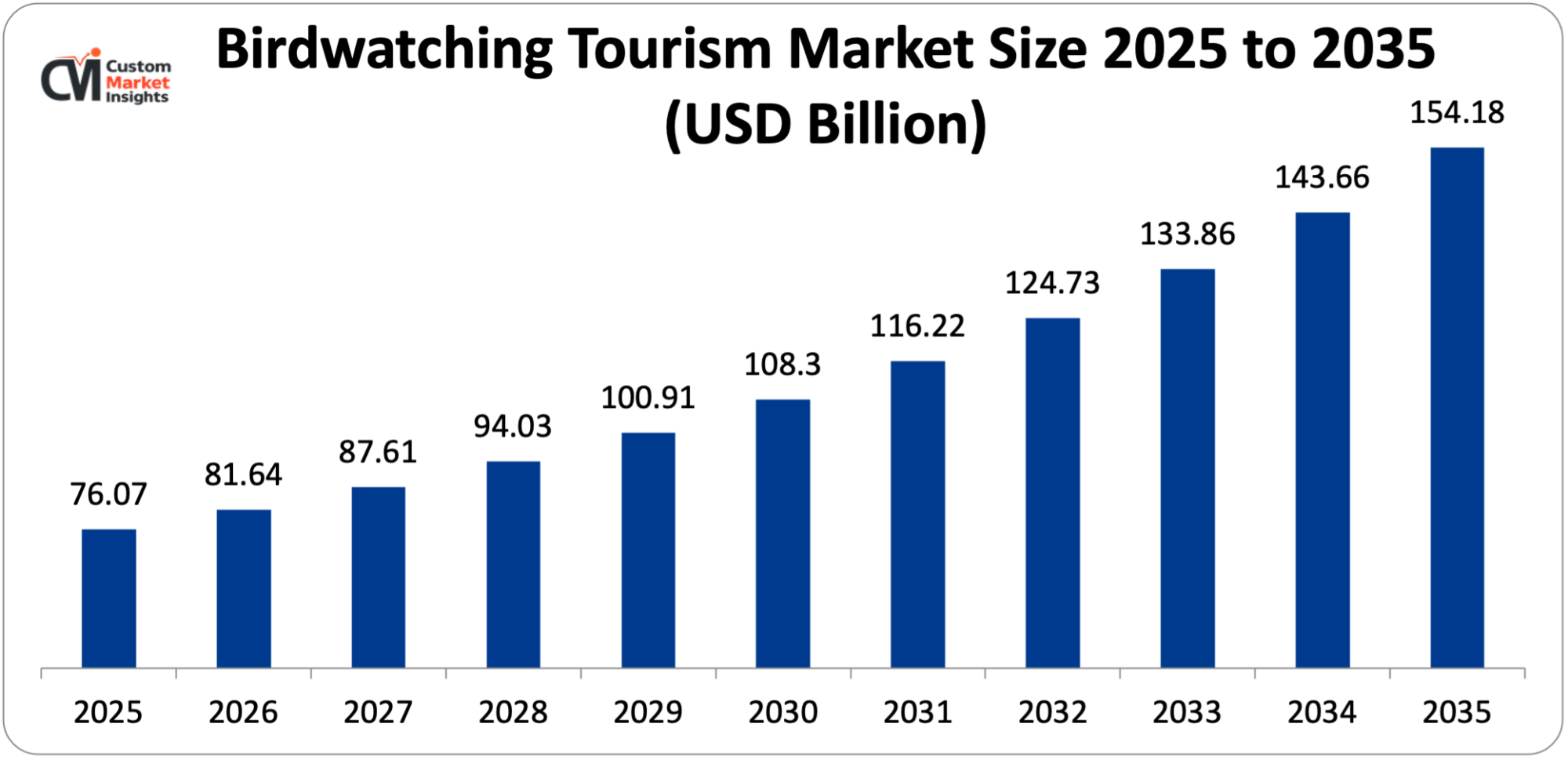
As per the birdwatching tourism market analysis conducted by the CMI team, the birdwatching tourism market is expected to record a CAGR of 7.32% from 2026 to 2035. In 2026, the market size was USD 81.64 Billion. By 2035, the valuation is anticipated to reach USD 154.18 Billion.
The market is expanding due to increased demand for ecotourism and a rising inclination toward nature-oriented travel experiences. Also, propagated wildlife photography tours, guided birding tours, and digital bird identification tools are driving the market further.
Market Highlights
- Central & South America dominated the birdwatching tourism market in 2025 with 51.37% of the overall share.
- Europe is expected to witness the fastest CAGR of 9.5% in the birdwatching tourism market during the forecast period.
- By traveler type, the enthusiastic birders segment held around 57.67% of the market share in 2025.
- By traveler type, the casual birders segment is expected to witness the fastest CAGR of 7.34% between 2026 and 2035.
- By age group, the travelers aged between 35 and 54 held around 42.34% of the market share in 2025.
- By age group, travelers aged 65 and above are expected to witness the fastest CAGR of 7.54% during the forecast period.
- By group, couples dominated in 2025 with 38.54% of the market share.
- By group, the solo segment is expected to witness the fastest CAGR of 7.12% during the forecast period.
Significant Growth Factors
The Birdwatching Tourism Market Trends signify the following:
- Growing Inclination toward Sustainable Travel and Eco-tourism: Travelers worldwide are increasingly opting for nature-based experiences promoting awareness about biodiversity and environmental conservation. Birdwatching does pave the way for low-impact travel activities that let tourists explore various natural habitats while extending support to local communities and conservation initiatives. Plus, rising awareness about birds’ ecological importance and wildlife protection is encouraging a greater number of travelers to be a part of birdwatching tours, thereby contributing handsomely to this segment of tourism that could be categorized as “niche.”
- Improvement in Tourism Infrastructure: GPS tracking tools, mobile apps for identification of birds, social media platforms, and digital field guides let enthusiasts document sightings, locate species, and share their experience with the communities at the global level. Also, the development of observation towers, birding trails, eco-lodges, and specific guided tours has improved visitor experience and also raised participation. Such innovations, in amalgamation with enhanced accessibility to destinations rich in biodiversity, are driving the linear progression with respect to the global birdwatching tourism market.
What are the Major Advancements Changing the Birdwatching Tourism Market Today?
- Integration of Digital Technologies using Artificial Intelligence: Modern day digital platforms and mobile apps let birdwatchers identify species at the next instance using sound recordings or photographs, thereby rendering the activity more accessible to the beginners and improving the experience for those who already have a hang of birdwatching. Real-time databases and AI-powered tools let travelers access updated information regarding migration patterns, bird sightings, and the finest observation locations during trips. Besides, citizen-science apps like Birda let users share observations by recording sightings. Such technological innovations improve birdwatching tourism’s interactive and educational aspects and also aid the tour operators in designing better itineraries by opting for analysis of bird distribution data.
- Launch of Immersive Technologies: Modern day birdwatching is now incorporating drones, smart binoculars, augmented reality (AR), and virtual reality (VR) for diving deep into the habitats and behavior of birds. Along these lines, AI-enabled smart optics like Swarovski AX Visio AI-Supported Binoculars are able to identify hordes of bird species and capture the images that are capable of being shared with various connected devices. Remote sensing technologies and drones are also helping tourists and researchers to observe the birds at a distance without disturbing them and the natural ecosystems. At the same time, VR and AR experiences let users explore migration routes and bird habitats in the immersive environment, with observation towers and birding trails to add.
Category Wise Insights
By Traveler Type
Why are enthusiastic birders dominating the global birdwatching tourism market?
Enthusiastic birders, unlike casual tourists who look upon birdwatching as a casual activity, do plan specific trips for spotting endemic or rare species. They are known for travelling long distances to various biodiversity hotspots, taking part in organized birding adventures, and investing in professional equipment, guides, and extended stays in national parks or nature reserves. This group also pays visits repeatedly to these destinations during various seasons for observing migratory species, which does raise revenue from tourism along with demand for travel agencies focused on birdwatching. The other reason is them getting deeply involved in citizen science, conservation, and birding communities.
By Age Group
Why does the Age Group of 35 to 54 dominate the global birdwatching tourism market?
The age group between 35 and 54 leads the global birdwatching tourism market, as individuals herein are blessed with monetary stability, robust interest in the nature-based experience, and travel flexibility. In other words, individuals falling in this age bracket are having established careers, which permit them to shell out money on ecotourism trips and guided travel to well-known birding destinations like Ecuador, Costa Rica, South Africa, and the like. Also, they have the tendency of seeking exclusive leisure activities promoting relaxation, environmental engagement, and learning, which are provided by birdwatching.
By Group
Why do couples account for the largest revenue share of the global birdwatching tourism market?
Couples lead the global birdwatching tourism market, as birdwatching trips are generally looked upon as nature-focused, peaceful experiences that are best suited for bonding and travel. Several couples opt for ecotourism activities combining scenic landscapes, wildlife observation, and relaxation, thereby resulting in booking guided birding tours, booking longer vacations, and booking ecolodges in hotspots such as South Africa, Peru, and Costa Rica. Couples, in comparison with solo travelers, spend more on private guides, accommodation upgrades, bundled nature experiences, and photography excursions.
Report Scope
| Feature of the Report | Details |
| Market Size in 2026 | USD 81.64 Billion |
| Projected Market Size in 2035 | USD 154.18 Billion |
| Market Size in 2025 | USD 76.07 Billion |
| CAGR Growth Rate | 7.32% CAGR |
| Base Year | 2025 |
| Forecast Period | 2026-2035 |
| Key Segment | By Traveler Type, Age Group, Group and Region |
| Report Coverage | Revenue Estimation and Forecast, Company Profile, Competitive Landscape, Growth Factors and Recent Trends |
| Regional Scope | North America, Europe, Asia Pacific, Middle East & Africa, and South & Central America |
| Buying Options | Request tailored purchasing options to fulfil your requirements for research. |
Regional Analysis
How Big is Central & South America’s Birdwatching Tourism Market Size?
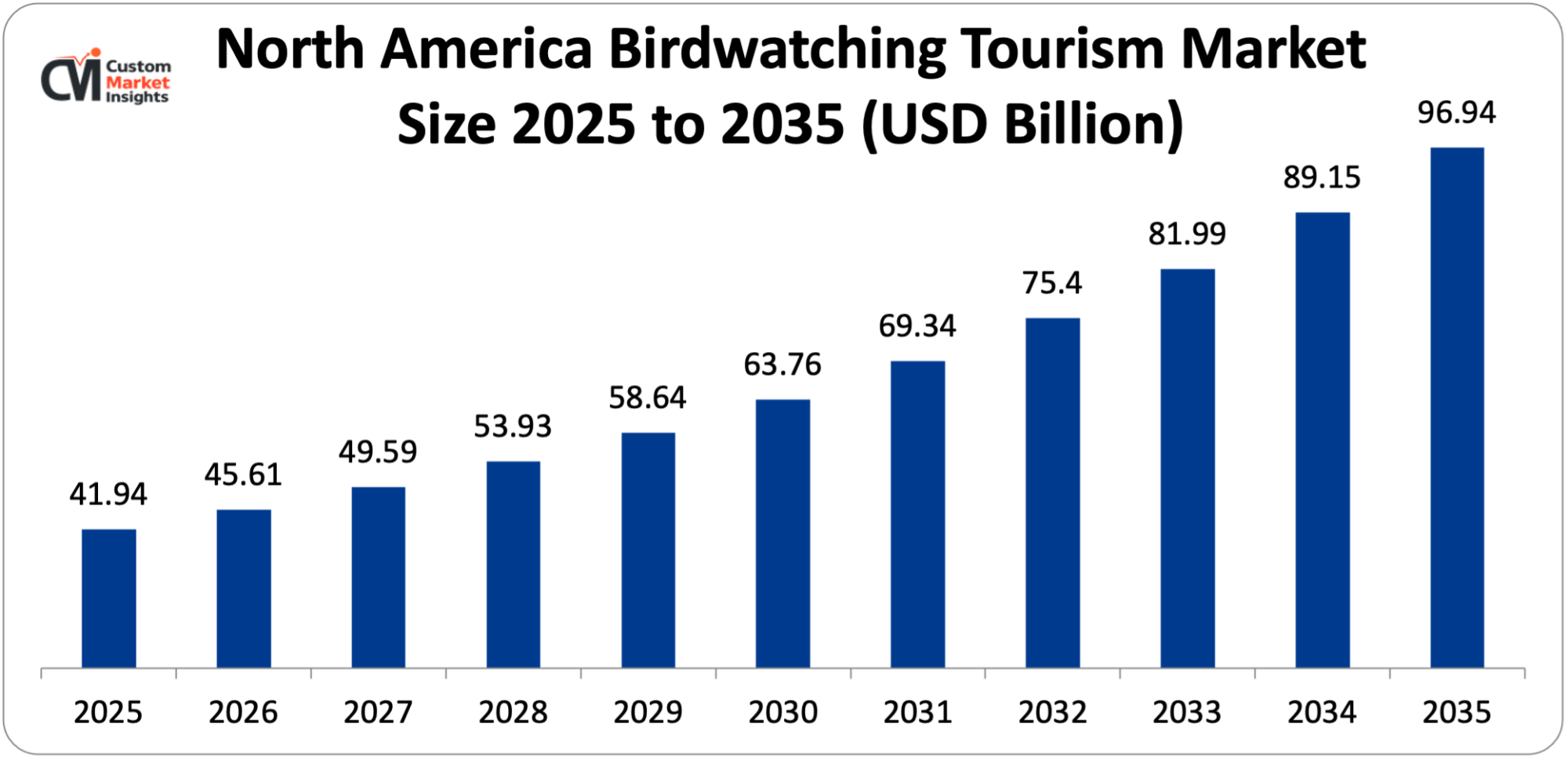
Central & South America’s birdwatching tourism market was worth USD 41.94 Billion in 2025 and is expected to reach USD 96.94 Billion by 2035 at a CAGR of 8.74% between 2025 and 2035.
Why did Central & South America Dominate the Birdwatching Tourism Market in 2025?
Central & South America dominated the birdwatching tourism market in 2025 due to their explicit biodiversity along with birding destinations recognized worldwide. The major birdwatching hotspots include Colombia, Brazil, Ecuador, Costa Rica, and Peru, which are known for hosting some of the highest diversity of bird species across the globe. Brazil alone generated a sizable revenue in 2025 and the status quo is expected to remain the same during the forecast period.
What is the Size of Costa Rica Birdwatching Tourism Market?
The market size of Costa Rica birdwatching tourism was USD 40.11 Billion in 2025 and is expected to reach USD 81.93 Billion in 2035, witnessing a CAGR of 8.26% between 2026 and 2035.
Costa Rica Birdwatching Tourism Market Trends
Costa Rica holds the distinction of housing more than 900 bird species, thereby rendering it one of the most appealing destinations for birdwatchers asking for rare and diverse species within a comparatively smaller area. The government is also extending support to strengthen the infrastructure for sustainable tourism. Also, wildlife photography and eco-friendly travel are witnessing a rising demand from European and North American travelers.
Why is the Europe Experiencing the Fastest Growth in the Global Birdwatching Tourism Market?
Europe encompasses a huge base of those who are enthusiasts, with close to 20% of the European wildlife tourists showing interest in birdwatching. This, in turn, contributes to revenue from economies such as Spain, Germany, and the United Kingdom. Those staying in these regions prefer sustainable travel, increased participation in the ecotourism activities, and enhanced cross-border travel connectivity across various European destinations.
UK’s Birdwatching Tourism Market Trends
The UK practices increased participation in outdoor leisure activities, thereby resulting in rising demand for sustainable tourism. A greater number of travelers are seeking eco-friendly holidays and trips focused on trips. Plus, many local wildlife initiatives imply combined participation of international and domestic tourists in birdwatching experiences in the United Kingdom. Also, adoption of technological advancements translates to accessibility to birding through digital tools.
Where does North America stand with respect to Birdwatching Tourism Market?
North America holds a significant market share due to the U.S. and Canada collectively contributing to vast avian biodiversity and migratory bird corridors like the Mississippi, Atlantic, and Pacific flyways. Robust birdwatching culture, wildlife refuges, expansive network of national parks, and birding trails – all are all keeping the cash registers ringing. As such, North America accounts for almost 33% of the market share, and the scenario is expected to persist during the forecast period.
U.S. Birdwatching Tourism Market Trends
The U.S. birdwatching tourism market experiences steadiness, which is driven by the increased interest in nature-oriented travel, growing environmental awareness, and raised participation in the birding activities. Research states that close to 37% of individuals aged 16 and above participate in birding. It further states that over 43 million amongst them prefer birdwatching trips away from home. Additionally, casual birders are found increasingly participating in birdwatching tourism, thereby adding to the revenue.
Where is the Asia Pacific regarding Adoption of Birdwatching Tourism?
The Asia Pacific region is amongst the quickest adopters of birdwatching tourism, which is catalysed by the expansion of ecotourism initiatives, explicit biodiversity, and an increased middle-class population who are showing interest in nature-based tourism. Economies like China, India, Indonesia, Australia, and Japan are visibly investing in birding infrastructure. With tourism boards and governments promoting biodiversity hotspots like Himalayan habitats and tropical forests, the Asia Pacific is emerging as one of the major destinations as well as future growth hubs related to birdwatching tourism.
China Birdwatching Tourism Market Trends
China’s birdwatching tourism market is being driven by strong support by the government for ecological conservation backed by rising participation by the populace in nature-based recreation. One of the ongoing trends is the propagation of birdwatching by social media communities. Plus, the promulgation of photography camps, guided tours, ecotourism activities, and birdwatching festivals around the East Asian-Australasian Flyway is bolstering conservation.
How is MEA faring regarding Birdwatching Tourism Market?
MEA’s development is backed by a rich repository of migratory bird corridors, biodiversity, and expanding initiatives pertaining to ecotourism, especially in economies like Saudi Arabia, South Africa, Oman, and the UAE. Out of these, South Africa leads owing to its well-established bird diversity and wildlife tourism infrastructure. The Middle Eastern economies are looking forward to further diversifying their portfolios by promoting desert and wetland birding experiences.
Top Players in the Birdwatching Tourism Market and Their Offerings
- Hurtigruten Group
- Eagle-Eye Tours
- Birding Ecotours
- Tropical Birding
- Rockjumper Birding Tours
- Sabrewing Nature Tours
- High Lonesome Bird Tours
- Field Guides Incorporated
- Wildlife Worldwide Holidays
- Wings Birding Tours
- Others
Key Developments
Birdwatching tourism market has experienced considerable changes in the last few years as the market players are trying to diversify their technological aspects and develop product portfolios using strategic approaches.
- In September 2025, the South Rupununi Conservation Society introduced a Bird Guide Accreditation Program in collaboration with the Guyana Tourism Authority, thereby marking its very first structured initiative of certifying and standardizing the bird-guiding expertise.
- In July 2025, the Andaman and Nicobar Islands administration introduced a dedicated birdwatching tourism initiative for drawing eco-travel enthusiasts and nature lovers by portraying the region’s enriching avian biodiversity (including many rare and endemic bird species) and promoting sustainable, responsible travel experiences in the archipelago’s wetlands, forests, and mangrove ecosystems. The program is inclusive of birding trails, awareness campaigns, and support for eco-friendly tourism.
These strategic measures have enabled the companies to reinforce their competitive positions, increase the product line, boost their technological competencies, and also seize growth opportunities in the fast growing birdwatching tourism market.
The Birdwatching Tourism Market is segmented as follows:
By Traveler Type
- Hard Core Birders
- Enthusiastic Birders
- Casual Birders
By Age Group
- 18-34 Years
- 35-54 Years
- 55-64 Years
- 65+ Years
By Group
- Solo
- Couples
- Family
- Groups
Regional Coverage:
North America
- U.S.
- Canada
- Mexico
- Rest of North America
Europe
- Germany
- France
- U.K.
- Russia
- Italy
- Spain
- Netherlands
- Rest of Europe
Asia Pacific
- China
- Japan
- India
- New Zealand
- Australia
- South Korea
- Taiwan
- Rest of Asia Pacific
The Middle East & Africa
- Saudi Arabia
- UAE
- Egypt
- Kuwait
- South Africa
- Rest of the Middle East & Africa
Latin America
- Brazil
- Argentina
- Rest of Latin America
Table of Contents
- Chapter 1. Report Introduction
- 1.1. Report Description
- 1.1.1. Purpose of the Report
- 1.1.2. USP & Key Offerings
- 1.2. Key Benefits For Stakeholders
- 1.3. Target Audience
- 1.4. Report Scope
- 1.1. Report Description
- Chapter 2. Market Overview
- 2.1. Report Scope (Segments And Key Players)
- 2.1.1. Birdwatching Tourism by Segments
- 2.1.2. Birdwatching Tourism by Region
- 2.2. Executive Summary
- 2.2.1. Market Size & Forecast
- 2.2.2. Birdwatching Tourism Market Attractiveness Analysis, By Traveler Type
- 2.2.3. Birdwatching Tourism Market Attractiveness Analysis, By Age Group
- 2.2.4. Birdwatching Tourism Market Attractiveness Analysis, By Group
- 2.1. Report Scope (Segments And Key Players)
- Chapter 3. Market Dynamics (DRO)
- 3.1. Market Drivers
- 3.1.1. Growing Inclination toward Sustainable Travel and Eco-tourism
- 3.1.2. Improvement in Tourism Infrastructure
- 3.2. Market Restraints
- 3.3. Market Opportunities
- 3.5. Pestle Analysis
- 3.6. Porter’s Forces Analysis
- 3.7. Technology Roadmap
- 3.8. Value Chain Analysis
- 3.9. Government Policy Impact Analysis
- 3.10. Pricing Analysis
- 3.1. Market Drivers
- Chapter 4. Birdwatching Tourism Market – By Traveler Type
- 4.1. Traveler Type Market Overview, By Traveler Type Segment
- 4.1.1. Birdwatching Tourism Market Revenue Share, By Traveler Type , 2025 & 2035
- 4.1.2. Hard Core Birders
- 4.1.3. Birdwatching Tourism Share Forecast, By Region (USD Billion)
- 4.1.4. Comparative Revenue Analysis, By Country, 2025 & 2035
- 4.1.5. Key Market Trends, Growth Factors, & Opportunities
- 4.1.6. Enthusiastic Birders
- 4.1.7. Birdwatching Tourism Share Forecast, By Region (USD Billion)
- 4.1.8. Comparative Revenue Analysis, By Country, 2025 & 2035
- 4.1.9. Key Market Trends, Growth Factors, & Opportunities
- 4.1.10. Casual Birders
- 4.1.11. Birdwatching Tourism Share Forecast, By Region (USD Billion)
- 4.1.12. Comparative Revenue Analysis, By Country, 2025 & 2035
- 4.1.13. Key Market Trends, Growth Factors, & Opportunities
- 4.1. Traveler Type Market Overview, By Traveler Type Segment
- Chapter 5. Birdwatching Tourism Market – By Age Group
- 5.1. Age Group Market Overview, By Age Group Segment
- 5.1.1. Birdwatching Tourism Market Revenue Share, By Age Group , 2025 & 2035
- 5.1.2. 18-34 Years
- 5.1.3. Birdwatching Tourism Share Forecast, By Region (USD Billion)
- 5.1.4. Comparative Revenue Analysis, By Country, 2025 & 2035
- 5.1.5. Key Market Trends, Growth Factors, & Opportunities
- 5.1.6. 35-54 Years
- 5.1.7. Birdwatching Tourism Share Forecast, By Region (USD Billion)
- 5.1.8. Comparative Revenue Analysis, By Country, 2025 & 2035
- 5.1.9. Key Market Trends, Growth Factors, & Opportunities
- 5.1.10. 55-64 Years
- 5.1.11. Birdwatching Tourism Share Forecast, By Region (USD Billion)
- 5.1.12. Comparative Revenue Analysis, By Country, 2025 & 2035
- 5.1.13. Key Market Trends, Growth Factors, & Opportunities
- 5.1.14. 65+ Years
- 5.1.15. Birdwatching Tourism Share Forecast, By Region (USD Billion)
- 5.1.16. Comparative Revenue Analysis, By Country, 2025 & 2035
- 5.1.17. Key Market Trends, Growth Factors, & Opportunities
- 5.1. Age Group Market Overview, By Age Group Segment
- Chapter 6. Birdwatching Tourism Market – By Group
- 6.1. Group Market Overview, By Group Segment
- 6.1.1. Birdwatching Tourism Market Revenue Share, By Group, 2025 & 2035
- 6.1.2. Solo
- 6.1.3. Birdwatching Tourism Share Forecast, By Region (USD Billion)
- 6.1.4. Comparative Revenue Analysis, By Country, 2025 & 2035
- 6.1.5. Key Market Trends, Growth Factors, & Opportunities
- 6.1.6. Couples
- 6.1.7. Birdwatching Tourism Share Forecast, By Region (USD Billion)
- 6.1.8. Comparative Revenue Analysis, By Country, 2025 & 2035
- 6.1.9. Key Market Trends, Growth Factors, & Opportunities
- 6.1.10. Family
- 6.1.11. Birdwatching Tourism Share Forecast, By Region (USD Billion)
- 6.1.12. Comparative Revenue Analysis, By Country, 2025 & 2035
- 6.1.13. Key Market Trends, Growth Factors, & Opportunities
- 6.1.14. Groups
- 6.1.15. Birdwatching Tourism Share Forecast, By Region (USD Billion)
- 6.1.16. Comparative Revenue Analysis, By Country, 2025 & 2035
- 6.1.17. Key Market Trends, Growth Factors, & Opportunities
- 6.1. Group Market Overview, By Group Segment
- Chapter 7. Birdwatching Tourism Market – Regional Analysis
- 7.1. Birdwatching Tourism Market Overview, By Region Segment
- 7.1.1. Global Birdwatching Tourism Market Revenue Share, By Region, 2025 & 2035
- 7.1.2. Global Birdwatching Tourism Market Revenue, By Region, 2026 – 2035 (USD Billion)
- 7.1.3. Global Birdwatching Tourism Market Revenue, By Traveler Type , 2026 – 2035
- 7.1.4. Global Birdwatching Tourism Market Revenue, By Age Group , 2026 – 2035
- 7.1.5. Global Birdwatching Tourism Market Revenue, By Group, 2026 – 2035
- 7.2. North America
- 7.2.1. North America Birdwatching Tourism Market Revenue, By Country, 2026 – 2035 (USD Billion)
- 7.2.2. North America Birdwatching Tourism Market Revenue, By Traveler Type , 2026 – 2035
- 7.2.3. North America Birdwatching Tourism Market Revenue, By Age Group , 2026 – 2035
- 7.2.4. North America Birdwatching Tourism Market Revenue, By Group, 2026 – 2035
- 7.2.5. U.S. Birdwatching Tourism Market Revenue, 2026 – 2035 (USD Billion)
- 7.2.6. Canada Birdwatching Tourism Market Revenue, 2026 – 2035 (USD Billion)
- 7.2.7. Mexico Birdwatching Tourism Market Revenue, 2026 – 2035 (USD Billion)
- 7.2.8. Rest of North America Birdwatching Tourism Market Revenue, 2026 – 2035 (USD Billion)
- 7.3. Europe
- 7.3.1. Europe Birdwatching Tourism Market Revenue, By Country, 2026 – 2035 (USD Billion)
- 7.3.2. Europe Birdwatching Tourism Market Revenue, By Traveler Type , 2026 – 2035
- 7.3.3. Europe Birdwatching Tourism Market Revenue, By Age Group , 2026 – 2035
- 7.3.4. Europe Birdwatching Tourism Market Revenue, By Group, 2026 – 2035
- 7.3.5. Germany Birdwatching Tourism Market Revenue, 2026 – 2035 (USD Billion)
- 7.3.6. France Birdwatching Tourism Market Revenue, 2026 – 2035 (USD Billion)
- 7.3.7. U.K. Birdwatching Tourism Market Revenue, 2026 – 2035 (USD Billion)
- 7.3.8. Russia Birdwatching Tourism Market Revenue, 2026 – 2035 (USD Billion)
- 7.3.9. Italy Birdwatching Tourism Market Revenue, 2026 – 2035 (USD Billion)
- 7.3.10. Spain Birdwatching Tourism Market Revenue, 2026 – 2035 (USD Billion)
- 7.3.11. Netherlands Birdwatching Tourism Market Revenue, 2026 – 2035 (USD Billion)
- 7.3.12. Rest of Europe Birdwatching Tourism Market Revenue, 2026 – 2035 (USD Billion)
- 7.4. Asia Pacific
- 7.4.1. Asia Pacific Birdwatching Tourism Market Revenue, By Country, 2026 – 2035 (USD Billion)
- 7.4.2. Asia Pacific Birdwatching Tourism Market Revenue, By Traveler Type , 2026 – 2035
- 7.4.3. Asia Pacific Birdwatching Tourism Market Revenue, By Age Group , 2026 – 2035
- 7.4.4. Asia Pacific Birdwatching Tourism Market Revenue, By Group, 2026 – 2035
- 7.4.5. China Birdwatching Tourism Market Revenue, 2026 – 2035 (USD Billion)
- 7.4.6. Japan Birdwatching Tourism Market Revenue, 2026 – 2035 (USD Billion)
- 7.4.7. India Birdwatching Tourism Market Revenue, 2026 – 2035 (USD Billion)
- 7.4.8. New Zealand Birdwatching Tourism Market Revenue, 2026 – 2035 (USD Billion)
- 7.4.9. Australia Birdwatching Tourism Market Revenue, 2026 – 2035 (USD Billion)
- 7.4.10. South Korea Birdwatching Tourism Market Revenue, 2026 – 2035 (USD Billion)
- 7.4.11. Taiwan Birdwatching Tourism Market Revenue, 2026 – 2035 (USD Billion)
- 7.4.12. Rest of Asia Pacific Birdwatching Tourism Market Revenue, 2026 – 2035 (USD Billion)
- 7.5. The Middle-East and Africa
- 7.5.1. The Middle-East and Africa Birdwatching Tourism Market Revenue, By Country, 2026 – 2035 (USD Billion)
- 7.5.2. The Middle-East and Africa Birdwatching Tourism Market Revenue, By Traveler Type , 2026 – 2035
- 7.5.3. The Middle-East and Africa Birdwatching Tourism Market Revenue, By Age Group , 2026 – 2035
- 7.5.4. The Middle-East and Africa Birdwatching Tourism Market Revenue, By Group, 2026 – 2035
- 7.5.5. Saudi Arabia Birdwatching Tourism Market Revenue, 2026 – 2035 (USD Billion)
- 7.5.6. UAE Birdwatching Tourism Market Revenue, 2026 – 2035 (USD Billion)
- 7.5.7. Egypt Birdwatching Tourism Market Revenue, 2026 – 2035 (USD Billion)
- 7.5.8. Kuwait Birdwatching Tourism Market Revenue, 2026 – 2035 (USD Billion)
- 7.5.9. South Africa Birdwatching Tourism Market Revenue, 2026 – 2035 (USD Billion)
- 7.5.10. Rest of the Middle East & Africa Birdwatching Tourism Market Revenue, 2026 – 2035 (USD Billion)
- 7.6. Latin America
- 7.6.1. Latin America Birdwatching Tourism Market Revenue, By Country, 2026 – 2035 (USD Billion)
- 7.6.2. Latin America Birdwatching Tourism Market Revenue, By Traveler Type , 2026 – 2035
- 7.6.3. Latin America Birdwatching Tourism Market Revenue, By Age Group , 2026 – 2035
- 7.6.4. Latin America Birdwatching Tourism Market Revenue, By Group, 2026 – 2035
- 7.6.5. Brazil Birdwatching Tourism Market Revenue, 2026 – 2035 (USD Billion)
- 7.6.6. Argentina Birdwatching Tourism Market Revenue, 2026 – 2035 (USD Billion)
- 7.6.7. Rest of Latin America Birdwatching Tourism Market Revenue, 2026 – 2035 (USD Billion)
- 7.1. Birdwatching Tourism Market Overview, By Region Segment
- Chapter 8. Competitive Landscape
- 8.1. Company Market Share Analysis – 2025
- 8.1.1. Global Birdwatching Tourism Market: Company Market Share, 2025
- 8.2. Global Birdwatching Tourism Market Company Market Share, 2024
- 8.1. Company Market Share Analysis – 2025
- Chapter 9. Company Profiles
- 9.1. Hurtigruten Group
- 9.1.1. Company Overview
- 9.1.2. Key Executives
- 9.1.3. Product Portfolio
- 9.1.4. Financial Overview
- 9.1.5. Operating Business Segments
- 9.1.6. Business Performance
- 9.1.7. Recent Developments
- 9.2. Eagle-Eye Tours
- 9.3. Birding Ecotours
- 9.4. Tropical Birding
- 9.5. Rockjumper Birding Tours
- 9.6. Sabrewing Nature Tours
- 9.7. High Lonesome Bird Tours
- 9.8. Field Guides Incorporated
- 9.9. Wildlife Worldwide Holidays
- 9.10. Wings Birding Tours
- 9.11. Others.
- 9.1. Hurtigruten Group
- Chapter 10. Research Methodology
- 10.1. Research Methodology
- 10.2. Secondary Research
- 10.3. Primary Research
- 10.3.1. Analyst Tools and Models
- 10.4. Research Limitations
- 10.5. Assumptions
- 10.6. Insights From Primary Respondents
- 10.7. Why Custom Market Insights
- Chapter 11. Standard Report Commercials & Add-Ons
- 11.1. Customization Options
- 11.2. Subscription Module For Market Research Reports
- 11.3. Client Testimonials
List Of Figures
Figures No 1 to 27
List Of Tables
Tables No 1 to 46
Prominent Player
- Hurtigruten Group
- Eagle-Eye Tours
- Birding Ecotours
- Tropical Birding
- Rockjumper Birding Tours
- Sabrewing Nature Tours
- High Lonesome Bird Tours
- Field Guides Incorporated
- Wildlife Worldwide Holidays
- Wings Birding Tours
- Others
FAQs
The key players in the market are Hurtigruten Group, Eagle-Eye Tours, Birding Ecotours, Tropical Birding, Rockjumper Birding Tours, Sabrewing Nature Tours, High Lonesome Bird Tours, Field Guides Incorporated, Wildlife Worldwide Holidays, Wings Birding Tours, Others.
Government policies pertaining to protected areas, wildlife protection, and habitat conservation aid in preserving bird populations as well as ecosystems, which, in turn, prove to be core attractions regarding birdwatching tourism. The governments also regulate visitors’ access to wetlands, national parks, and wildlife sanctuaries through guidelines, permits, and capacity limits for minimizing environmental impact. Plus, several authorities do promote ecotourism via conservation programs, partnerships with the local communities, and development of infrastructure, which helps in creating organized birdwatching trails, educational initiatives, and expansion of tourism.
Affordable experiences of birdwatching – like local tours, self-guided trips, and visits to nature reserves in the vicinity – do encourage broader participation amongst hobbyists and casual travelers, thereby widening the market base. On the other hand, premium pricing for the specified birdwatching packages that include expeditions led by experts, photography-focused tours, and remote biodiversity spots draws niche segments like high-spending ecotourists and professional birders.
The market for birdwatching tourism is expected to witness a significant growth of about USD 154.18 Billion in the interest of leisure interests (like birdwatching tourism) worldwide with a CAGR of 7.32% between the years 2026 and 2035.
It is projected that Central & South America will hold the largest share of the birdwatching tourism market during the forecast period due to economies such as Costa Rica, Colombia, Brazil, Ecuador, and Peru hosting hordes of bird species that encompass various rare and endemic species. Costa Rica is home to over 900 and Colombia to more than 1900 recorded species. The other advantages include the presence of the Andes mountains, whereby the governments encourage investments in the improvement of conservation programs and sustainable tourism infrastructure.
Europe is expected to witness the fastest growth rate of about 9.5% in the forecast period due to an ongoing trend of robust international participation. The international birders, better known as high-spending travellers, are known for typically planning longer stays for maximizing sightings of species, especially during the migration seasons. This does raise demand for accommodation, local spending in hamlets, and guided tour bookings. The cross-border movement mentioned above strengthens the tourism revenue at the regional level and also lends support to conservation funding throughout Europe.
Nature-based travel and ecotourism are gaining popularity, as a greater number of travellers are seeking wildlife-focused and sustainable experiences. Rising environmental awareness coupled with inclination toward biodiversity conservation is encouraging individuals to partake in various birdwatching activities, whereas expansion of national parks, protected areas, and wildlife reserves is resulting in development of birding destinations that are more accessible. Technological advancements like digital photography, mobile apps for bird identification, and online birding communities are also drawing new participants. Increased demand for guided birding tours, specified travel experiences, and birdwatching festivals is also extending support to the birdwatching tourism market’s expansion.