
Costa Rica Birdwatching Tourism Market Size, Trends and Insights By Traveler Type (Hard Core Birders, Enthusiastic Birders, Casual Birders), By Age Group (18-34 Years, 35-54 Years, 55-64 Years, 65+ Years), By Group (Solo, Couples, Family, Groups), and By Region - Industry Overview, Statistical Data, Competitive Analysis, Share, Outlook, and Forecast 2026 – 2035
Report Snapshot
| Study Period: | 2026-2035 |
| Fastest Growing Market: | Costa Rica |
| Largest Market: | Costa Rica |
Major Players
- Costa Rica Focus
- Birding Costa Rica
- Green Trogon Expeditions
- Ataringa Tours
- Others
Reports Description
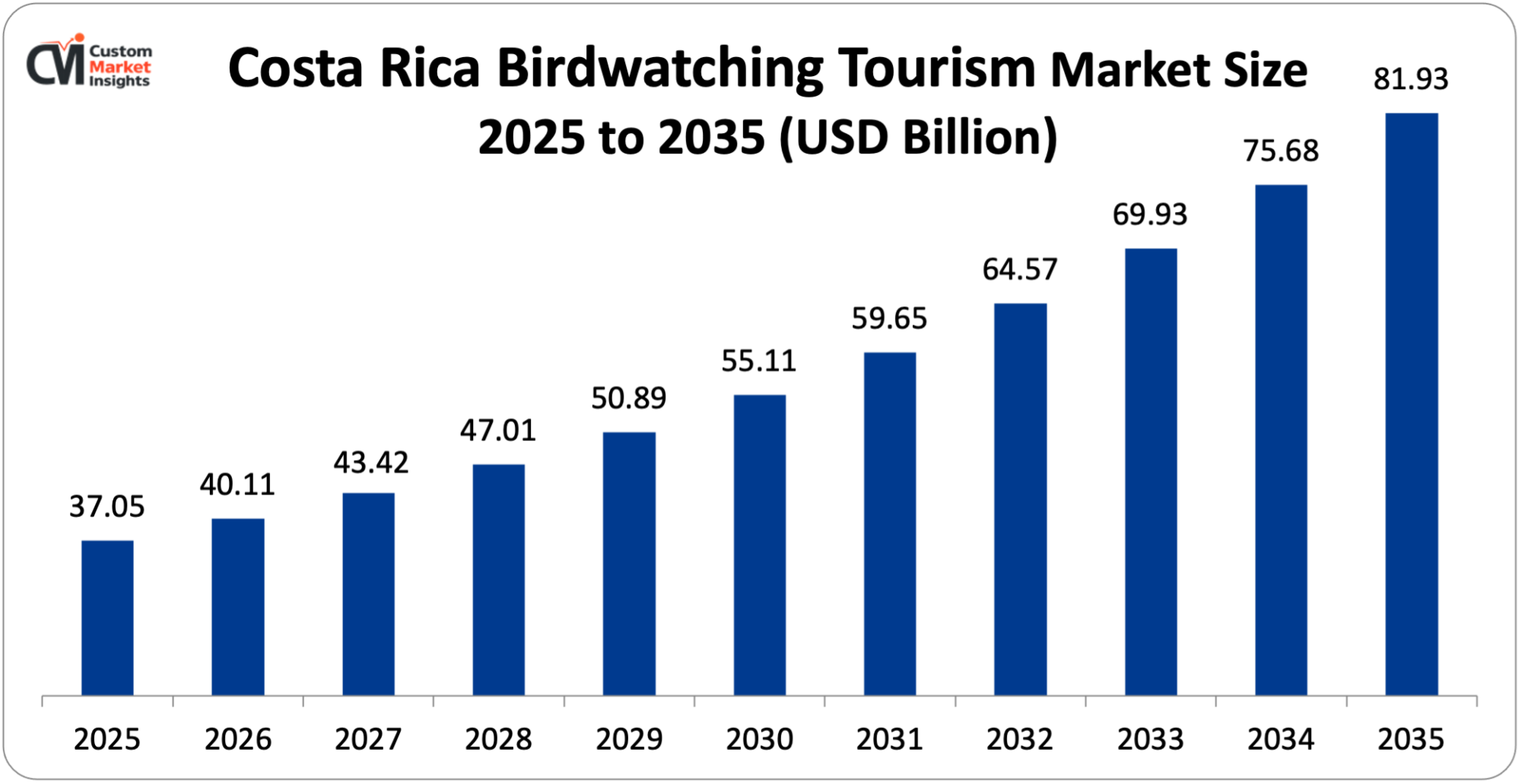
The Costa Rica birdwatching tourism market is expected to record a CAGR of 8.26% from 2026 to 2035. In 2026, the market size was USD 40.11 Billion. By 2035, the valuation is anticipated to reach USD 81.93 Billion.
The market is growing due to the fact that the region hosts around 5% of the global species, inclusive of the vibrant ones such as Resplendent Quetzal and Scarlet Macaw. Also, it houses diverse ecosystems such as tropical rainforests, cloud forests, and mangroves. Furthermore, the National Birdwatching Tourism Board does work with the Costa Rican Tourism Institute (ICT) for enhancing guide safety, expertise, and infrastructure, thereby ascertaining a high-class experience. The well-known areas constitute Monteverde Cloud Forest, Osa Peninsula, and special spots to the north of Bijagua.
Market Highlights
- By traveler type, enthusiastic birders held around 57% of the market share in 2025.
- By traveler type, casual birders are expected to witness the fastest CAGR of 7.85% between 2026 and 2035.
- By age group, individuals aged 35-54 dominated in 2025 with 42.34% of the overall market share.
- By age group, individuals aged 65 and above are expected to witness the fastest CAGR of 7.64% during the forecast period.
- By group, the highest market share of 38.95% was attributed to couples in 2025.
- By group, the solo segment is expected to witness the fastest CAGR of 7.43% between 2026 and 2035.
Significant Growth Factors
The Costa Rica birdwatching tourism market presents significant growth opportunities due to several factors:
- Recognition as a Premier Birdwatching Destination
Costa Rica is home to over 900 bird species, out of which many are rare or endemic. This does render it one of the prime locations for experienced birdwatchers as well as novices. The region also has national reserves and parks extensively placed, which do offer visible opportunities for bird sightings in primeval environments. Plus, the commitment of the region to sustainable tourism practices and conservation has positioned it as a fascinating and responsible destination for those who are eco-conscious. This, in turn, restores its reputation in the birdwatching community worldwide.
- Rising Interest in Nature-based Tourism and Wellness
The post-pandemic era has ushered in interest in nature-based tourism as well as wellness. In other words, the travelers are visibly seeking extensive experience connecting them to the natural habitat and promoting mental wellness. Birdwatching does offer an enriching and tranquil escape from a monotonous rut. The ongoing trend in the direction of sustainable travel, which is supported by the region’s community-based tourism initiatives and eco-certification programs, is drawing a greater number of tourists to its place. Plus, partnerships between tour operators and local communities supported by the government are helping in the promotion of birdwatching as one of the key elements in the tourism offerings of Costa Rica.
What are the Major Advancements Changing Costa Rica Birdwatching Market Today?
- Integration of Technology into Conservation and Tourism Efforts
Digital platforms like eBird are transforming the way sightings are shared, recorded, and promoted, thereby aiding in scientifically documenting the region’s exceptional avian diversity and elevating the profile as one of the happening birdwatching destinations. Such tools let visiting birders contribute to building worldly life lists and real-time datasets. They also aid researchers and local guides in identifying trends and hotspots, thereby strengthening planning for visitors and conservation planning alike. Also, deploying novel infrastructure such as birdwatching observation towers with professionally developed trails has improved on-ground experience on the whole.
- Concentration on Community-centric Development
Costa Rica’s academic institutions and tourism organizations are collaborating to formalize birdwatching tourism as one of the core niches for ecotourism. They include training programs for community participatory monitoring projects and guides that do link scientific research and local knowledge, and also promotional efforts that target global birders. As such, apart from Costa Rica’s ecological reputation of avian biodiversity, a wider interest is cultivated in birdwatching tourism. Also, employment opportunities get boosted in the rural regions. Conservation ethics and sustainability could also be embedded with the help of the local populace supporting local engagement and habitat protection.
- Impact of AI on Costa Rica Birdwatching Tourism Market
AI-powered eco-acoustic monitoring projects are getting deployed for safeguarding species such as Green Macaw by analyzing voluminous bird sound data, thereby aiding conservationists and researchers in understanding breeding cycles and threats in a more effective manner as compared to conventional methods. Also, AI is shaping the way tourists navigate as well as engage with Costa Rica’s birdwatching opportunities. Wider trends in Costa Rica’s tourism industry point toward AI being used for streamlining traveler information, customizing recommendations, and improving operational efficiency across customer service, reservations, and logistics. As such, birdwatchers benefit while arranging specialized accommodations and specialized tours. Integrated smart guide apps that are powered by AI are capable of providing personalized birdwatching itineraries, real-time updates, and species checklists on the basis of user interests.
Category Wise Insights
By Traveler Type
Why Do Enthusiastic Birders Dominate Costa Rica Birdwatching Tourism Market?
With over 900 recorded bird species, Costa Rica does offer iconic and rare sightings like the scarlet macaw and resplendent quetzal. The serious birders are pretty motivated and knowledgeable to plan trips around endemic species. As such, they are likely to invest more in guided tours, multi-day excursions, and specialized lodges. Also, the region’s long-standing commitment toward sustainable tourism and conservation is aligning with values that the enthusiastic birders are abiding by. As enthusiastic birders travel in groups and pay visits during the shoulder seasons for maximizing sightings, the tourism operators customize services, promotional efforts, and pricing with regard to this segment, thereby resulting in dominance on their part in the Costa Rican birdwatching tourism market.
By Age Group
-
How do Individuals aged 35-54 Years Dominate Costa Rica Birdwatching Tourism Market?
Individuals aged between 35 and 54 years of age are majorly dominating Costa Rica birdwatching tourism market, as they amalgamate monetary stability with preferences for active lifestyles. It has been observed that the ones falling in this age group are usually at their peak as far as earning is concerned. This lets them afford specialized eco-tours and even stays at birding lodges adjacent to reserves. Plus, they are known for maintaining physical stamina required for rainforest trails, early-morning hikes, and multi-day excursions where biodiverse regions exist. Many in this age group also look upon birdwatching as a hobby/stress-relieving escape from their busy careers. Therefore, there is an exponential demand for safe, structured, and well-planned tours in protected areas like Tortuguero and Monteverde.
By Group
-
Where do Couples stand with respect to Costa Rica Birdwatching Tourism Market?
Couples are representing one of the most commercially valued and strongest visitor segments. In other words, birdwatching is generally looked upon as one of the mutual hobbies, whereby it is made an appealing activity for the partners looking for nature-focused, meaningful travel experiences. Also, couples have the tendency of spending more per booking in comparison with solo travelers, thereby going for private guides, customized excursions, and upgraded rooms in the reputed birding destinations like La Selva Biological Station. As such, owners of eco-lodges often design packages blending birdwatching with leisure-oriented or romantic elements like fine dining, scenic viewpoints, and spa services.
Report Scope
| Feature of the Report | Details |
| Market Size in 2026 | USD 40.11 Billion |
| Projected Market Size in 2035 | USD 81.93 Billion |
| Market Size in 2025 | USD 37.05 Billion |
| CAGR Growth Rate | 8.26% CAGR |
| Base Year | 2025 |
| Forecast Period | 2026-2035 |
| Key Segment | By Traveler Type, Age Group, Group and Region |
| Report Coverage | Revenue Estimation and Forecast, Company Profile, Competitive Landscape, Growth Factors and Recent Trends |
| Buying Options | Request tailored purchasing options to fulfil your requirements for research. |
Top Players in Costa Rica Birdwatching Tourism Market and Their Offerings
- Costa Rica Focus
- Birding Costa Rica
- Green Trogon Expeditions
- Ataringa Tours
- Cotinga Tours
- The Ara Project
- Osa Conservation
- Others
Key Developments
The Costa Rica birdwatching tourism market has experienced considerable changes in the last two years as the market players are trying to diversify their technological aspects and develop product portfolios using strategic approaches.
- In July 2025, Pursuit completed the acquisition of Tabacón Thermal Resort and Spa, which indicated the expansion of its portfolio in the luxury wellness tourism segment of Costa Rica.
The Costa Rica Birdwatching Tourism Market is segmented as follows:
By Traveler Type
- Hard Core Birders
- Enthusiastic Birders
- Casual Birders
By Age Group
- 18-34 Years
- 35-54 Years
- 55-64 Years
- 65+ Years
By Group
- Solo
- Couples
- Family
- Groups
Table of Contents
- Chapter 1. Report Introduction
- 1.1. Report Description
- 1.1.1. Purpose of the Report
- 1.1.2. USP & Key Offerings
- 1.2. Key Benefits For Stakeholders
- 1.3. Target Audience
- 1.4. Report Scope
- 1.1. Report Description
- Chapter 2. Market Overview
- 2.1. Report Scope (Segments And Key Players)
- 2.1.1. Costa Rica Birdwatching Tourism by Segments
- 2.1.2. Costa Rica Birdwatching Tourism by Region
- 2.2. Executive Summary
- 2.2.1. Market Size & Forecast
- 2.2.2. Costa Rica Birdwatching Tourism Market Attractiveness Analysis, By Traveler Type
- 2.2.3. Costa Rica Birdwatching Tourism Market Attractiveness Analysis, By Age Group
- 2.2.4. Costa Rica Birdwatching Tourism Market Attractiveness Analysis, By Group
- 2.1. Report Scope (Segments And Key Players)
- Chapter 3. Market Dynamics (DRO)
- 3.1. Market Drivers
- 3.1.1. Recognition as a Premier Birdwatching Destination
- 3.1.2. Rising Interest in Nature-based Tourism and Wellness
- 3.2. Market Restraints
- 3.3. Market Opportunities
- 3.5. Pestle Analysis
- 3.6. Porter’s Forces Analysis
- 3.7. Technology Roadmap
- 3.8. Value Chain Analysis
- 3.9. Government Policy Impact Analysis
- 3.10. Pricing Analysis
- 3.1. Market Drivers
- Chapter 4. Costa Rica Birdwatching Tourism Market – By Traveler Type
- 4.1. Traveler Type Market Overview, By Traveler Type Segment
- 4.1.1. Costa Rica Birdwatching Tourism Market Revenue Share, By Traveler Type , 2025 & 2035
- 4.1.2. Hard Core Birders
- 4.1.3. Costa Rica Birdwatching Tourism Share Forecast, By Region (USD Billion)
- 4.1.4. Comparative Revenue Analysis, By Country, 2025 & 2035
- 4.1.5. Key Market Trends, Growth Factors, & Opportunities
- 4.1.6. Enthusiastic Birders
- 4.1.7. Costa Rica Birdwatching Tourism Share Forecast, By Region (USD Billion)
- 4.1.8. Comparative Revenue Analysis, By Country, 2025 & 2035
- 4.1.9. Key Market Trends, Growth Factors, & Opportunities
- 4.1.10. Casual Birders
- 4.1.11. Costa Rica Birdwatching Tourism Share Forecast, By Region (USD Billion)
- 4.1.12. Comparative Revenue Analysis, By Country, 2025 & 2035
- 4.1.13. Key Market Trends, Growth Factors, & Opportunities
- 4.1. Traveler Type Market Overview, By Traveler Type Segment
- Chapter 5. Costa Rica Birdwatching Tourism Market – By Age Group
- 5.1. Age Group Market Overview, By Age Group Segment
- 5.1.1. Costa Rica Birdwatching Tourism Market Revenue Share, By Age Group , 2025 & 2035
- 5.1.2. 18-34 Years
- 5.1.3. Costa Rica Birdwatching Tourism Share Forecast, By Region (USD Billion)
- 5.1.4. Comparative Revenue Analysis, By Country, 2025 & 2035
- 5.1.5. Key Market Trends, Growth Factors, & Opportunities
- 5.1.6. 35-54 Years
- 5.1.7. Costa Rica Birdwatching Tourism Share Forecast, By Region (USD Billion)
- 5.1.8. Comparative Revenue Analysis, By Country, 2025 & 2035
- 5.1.9. Key Market Trends, Growth Factors, & Opportunities
- 5.1.10. 55-64 Years
- 5.1.11. Costa Rica Birdwatching Tourism Share Forecast, By Region (USD Billion)
- 5.1.12. Comparative Revenue Analysis, By Country, 2025 & 2035
- 5.1.13. Key Market Trends, Growth Factors, & Opportunities
- 5.1.14. 65+ Years
- 5.1.15. Costa Rica Birdwatching Tourism Share Forecast, By Region (USD Billion)
- 5.1.16. Comparative Revenue Analysis, By Country, 2025 & 2035
- 5.1.17. Key Market Trends, Growth Factors, & Opportunities
- 5.1. Age Group Market Overview, By Age Group Segment
- Chapter 6. Costa Rica Birdwatching Tourism Market – By Group
- 6.1. Group Market Overview, By Group Segment
- 6.1.1. Costa Rica Birdwatching Tourism Market Revenue Share, By Group , 2025 & 2035
- 6.1.2. Solo
- 6.1.3. Costa Rica Birdwatching Tourism Share Forecast, By Region (USD Billion)
- 6.1.4. Comparative Revenue Analysis, By Country, 2025 & 2035
- 6.1.5. Key Market Trends, Growth Factors, & Opportunities
- 6.1.6. Couples
- 6.1.7. Costa Rica Birdwatching Tourism Share Forecast, By Region (USD Billion)
- 6.1.8. Comparative Revenue Analysis, By Country, 2025 & 2035
- 6.1.9. Key Market Trends, Growth Factors, & Opportunities
- 6.1.10. Family
- 6.1.11. Costa Rica Birdwatching Tourism Share Forecast, By Region (USD Billion)
- 6.1.12. Comparative Revenue Analysis, By Country, 2025 & 2035
- 6.1.13. Key Market Trends, Growth Factors, & Opportunities
- 6.1.14. Groups
- 6.1.15. Costa Rica Birdwatching Tourism Share Forecast, By Region (USD Billion)
- 6.1.16. Comparative Revenue Analysis, By Country, 2025 & 2035
- 6.1.17. Key Market Trends, Growth Factors, & Opportunities
- 6.1. Group Market Overview, By Group Segment
- Chapter 7. Costa Rica Birdwatching Tourism Market – Regional Analysis
- 7.1. Costa Rica Birdwatching Tourism Market Overview, By Region Segment
- 7.1.1. Costa Rica Birdwatching Tourism Market Revenue Share, By Region, 2025 & 2035
- 7.1.2. Costa Rica Birdwatching Tourism Market Revenue, By Region, 2026 – 2035 (USD Billion)
- 7.1.3. Costa Rica Birdwatching Tourism Market Revenue, By Traveler Type , 2026 – 2035
- 7.1.4. Costa Rica Birdwatching Tourism Market Revenue, By Age Group , 2026 – 2035
- 7.1.5. Costa Rica Birdwatching Tourism Market Revenue, By Group , 2026 – 2035
- 7.1. Costa Rica Birdwatching Tourism Market Overview, By Region Segment
- Chapter 8. Competitive Landscape
- 8.1. Company Market Share Analysis – 2025
- 8.1.1. Costa Rica Birdwatching Tourism Market: Company Market Share, 2025
- 8.2. Costa Rica Birdwatching Tourism Market Company Market Share, 2024
- 8.1. Company Market Share Analysis – 2025
- Chapter 9. Company Profiles
- 9.1. Costa Rica Focus
- 9.1.1. Company Overview
- 9.1.2. Key Executives
- 9.1.3. Product Portfolio
- 9.1.4. Financial Overview
- 9.1.5. Operating Business Segments
- 9.1.6. Business Performance
- 9.1.7. Recent Developments
- 9.2. Birding Costa Rica
- 9.3. Green Trogon Expeditions
- 9.4. Ataringa Tours
- 9.5. Cotinga Tours
- 9.6. The Ara Project
- 9.7. Osa Conservation
- 9.8. Others
- 9.1. Costa Rica Focus
- Chapter 10. Research Methodology
- 10.1. Research Methodology
- 10.2. Secondary Research
- 10.3. Primary Research
- 10.3.1. Analyst Tools and Models
- 10.4. Research Limitations
- 10.5. Assumptions
- 10.6. Insights From Primary Respondents
- 10.7. Why Custom Market Insights
- Chapter 11. Standard Report Commercials & Add-Ons
- 11.1. Customization Options
- 11.2. Subscription Module For Market Research Reports
- 11.3. Client Testimonials
List Of Figures
Figures No 1 to 22
List Of Tables
Tables No 1 to 2
Prominent Player
- Costa Rica Focus
- Birding Costa Rica
- Green Trogon Expeditions
- Ataringa Tours
- Cotinga Tours
- The Ara Project
- Osa Conservation
- Others
FAQs
The key players in the market are Costa Rica Focus, Birding Costa Rica, Green Trogon Expeditions, Ataringa Tours, Cotinga Tours, The Ara Project, Osa Conservation, Others.
Costa Rica, through robust environmental legislation coupled with expansion of the protected areas looked through by SINAC (National System of Conservation Areas), has preserved almost 25% of its territory as biological reserves, national parks, and wildlife refuges. Also, stern rules regarding deforestation, land use, sustainable development, and wildlife protection ascertain that the critical bird habitats stay intact, thereby extending support to long-term biodiversity.
As Costa Rica is positioned as one of the premium ecotourism destinations, it witnesses higher guide, park access, and accommodation costs in comparison with several neighboring economies. Though this may restrain participation from the budget-conscious travelers, it does strengthen appeal amongst the serious birders and monetarily stable demographics who do prioritize expert guidance, comfort, biodiversity, and safety over lower cost.
The Costa Rica birdwatching tourism market is expected to reach USD 81.93 Billion by 2035, growing at a CAGR of 8.26% from 2026 to 2035. The market is growing due to increased global connectivity that has rendered greater accessibility to remote birding hotspots, along with promulgation of information via digital platforms, thereby facilitating travelers to discover as well as plan the birdwatching trips in a more efficient way.
Costa Rica is known for its explicit avian biodiversity (more than 900 recorded species), robust conservation policies rendering protection to around 25% of the national territory, and well-established ecotourism infrastructure making remote habitats safe and accessible for visitors. Plus, specialized birding lodges, professional guiding services, targeted marketing toward the higher-spending demographics, and enhanced transportation networks are collectively accelerating market expansion.