
Foldable Electric Scooter Market Size, Trends and Insights By Type (Two Wheelers, Three Wheelers, Unicycle), By Battery Type (Sealed Lead, Acid Battery, Lithium-ion Battery, Others), By Voltage (24V, 36V, 48V, Above 48V), By Sales Channel (E-commerce, OEM), and By Region - Global Industry Overview, Statistical Data, Competitive Analysis, Share, Outlook, and Forecast 2026 – 2035
Report Snapshot
CAGR: 5.2%
| Study Period: | 2026-2035 |
| Fastest Growing Market: | North America |
| Largest Market: | Asia Pacific |
Major Players
- Xiaomi Corporation
- Segway Megawheel
- GOTRAX
- Turboant
- Others
Reports Description
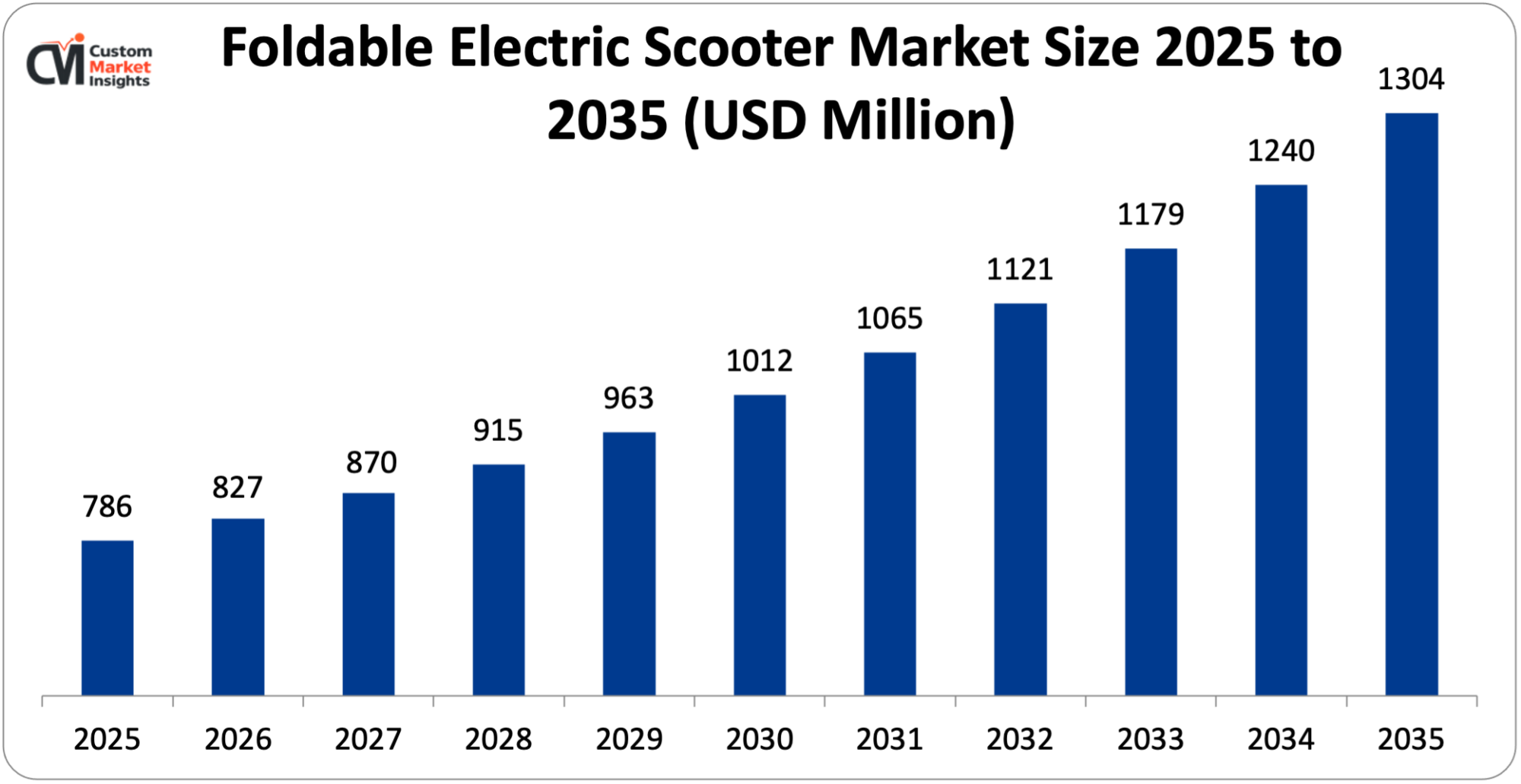
The market size of global foldable electric scooters will be estimated at USD 786 million in 2025 and is expected to grow to between USD 827 million in 2026 and about USD 1304 million by 2035, with a current CAGR (compound annual growth rate) of 5.2% during the period of 2026 to 2035. A foldable electric scooter is a type of battery-powered personal transporter that has been designed with a folding frame structure for a more streamlined, more easily portable vehicle that can be carried or stored.
A typical foldable electric scooter would have an electric motor, a rechargeable battery pack, a set of handlebars, a stepping board or deck to stand on, and small-diameter wheels for portability over short ranges; the foldability of this subclass of electric scooter enables the control and steering device to be folded into a smaller, more lightweight configuration for carry-on purposes. This type of electric scooter is ideal for use in urban environments and is commonly used for its convenience, reduced costs, and environmentally friendly nature, since it does not produce any exhaust gases and requires little maintenance.
Market Highlight
- In 2025, the Asia Pacific will dominate the global market with an estimated market share of 48%. High production of EVs drives the market growth.
- North America is growing at the highest rate over the analysis period. The increasing focus towards green technology drives the regional growth.
- By type, the two-wheeler segment dominated the industry in 2025.
- By battery type, the lithium-ion battery segment captures the largest market share in 2025.
- By voltage, the 24V segment captures the largest market share in 2025.
- By sales channel, the OEM segment captures the largest market share in 2025.
Significant Growth Factors
The foldable electric scooter market trends present significant growth opportunities due to several factors:
- Rising Urbanization and Traffic Congestion: Urbanization is one of the key factors driving demand for a foldable electric scooter market since it leads to overutilization of urban transportation systems and congestion on roads. Going by the economic survey of the Indian government and data on urbanization in India, as of the Census 2011, India already had around 31.1% of its population (around 377 million) in its cities, which is expected to grow up to approximately 600 million (40%) by 2036. Any increase in the urban population necessarily leads to increased pressure on urban infrastructure, especially roads and public conveyance. Indian urbanization studies have shown that with every rise in urban population, there is a rise in vehicles plying the urban roads, which leads to congestion. A study to address government concerns points out that the rise in vehicles in urban cities such as Delhi and Bengaluru directly leads to traffic congestion. Data from a survey on ‘Mega cities of the world’ confirms this and shows that Bengaluru is one of the largest contributors of congestion in the world, where commuters spent 168 hours stuck in traffic, and during peak hours, the speed of vehicles reduced to a couple of meters per second. Similar data shows that vehicle registration in Mysuru increased by over 170,000 in 2 years, thereby leading to increased congestion. Policy reports on such urban cities point out that urbanization has led to an ‘over-stressed infrastructure’ where existing city roads and conveyance systems are not able to cater to the rising share of urban population. This creates logistics and daily travel stress such as longer commutes, lack of reliable day-to-day conveyance, and rising transportation costs. Hence, consumers are turning towards time-saving, compact mobility options such as electric scooters.
- Environmental Concerns & Sustainability Push: Key factors in the growth of the foldable electric scooter market include the evolution of environmental concerns and the worldwide trend toward green transportation systems. Various countries and environmental agencies have expressed grave concerns over the impact of transportation vehicles on air pollution and climate change. According to the Central Pollution Control Board (CPCB) of India, vehicle exhaust gases are amongst the major sources of urban air pollution in India, with metropolitan cities such as Delhi, Mumbai, and Kolkata suffering major urban pollution concerns. Further, according to the Ministry of Environment, Forest, and Climate Change, India ranks among the highest CO₂ emitters in the world, with the growth of the vehicular population being a major cause; the transport sector is responsible for a quarter of the global greenhouse gas emissions. Consequently, various initiatives have been undertaken to promote electric vehicles, such as the FAME India Scheme, which rewards with incentives; government policies; public purchase schemes, etc. Legislatures and policies, including FAME and others, aim at replacing conventional vehicles with electric vehicles, including the innovative foldable electric scooters, with the goal that the central government targets net-zero emissions by 2070. Besides reducing tailpipe emissions to naught, Electric two wheelers also consume a third less energy and a significantly lesser quantity of material and fuel; studies have shown that electric vehicles also curtail traffic congestions and idle time, which helps to mitigate the indirect consumption of fuel. The scope for more sustainable electric two-wheelers as a part of the population becomes more environmentally conscious, and with the strict emission norms and the increasing number of environmentally friendly policies and schemes that aid green transportation, the foldable electric scooter market is likely to witness aggressive growth in the long term.
What are the Major Advances Changing the Foldable Electric Scooter Market Today?
- Advanced Battery Technology: Emerging advanced battery technology has been one of the key technological innovations leading to the growth in the foldable electric scooter industry, with manufacturers bringing forth new models and innovations to significantly increase the range, safety, and affordability of electric scooters much faster than traditional scooters, which are limited in range. This is turning ubiquitous short-range, cheap scooters into practical all-day transportation devices. Examples include Xiaomi, which has increased the battery size in its electric scooter lineup continuously: 280 Wh lithium-ion batteries with a 30 km range with regenerative brakes at launch, as part of the initial Mi Electric Scooter; 446 Wh lithium-ion batteries with a 55 km range and improved BMS and safety features in 2026; and the latest flagship announced at MWC 2026 with a 585 Wh battery and a 75 km range. Add to this innovation in the Indian battery business models: Hero MotoCorp’s BaaS (Battery as a Service) model, introduced along with the VIDA electric scooter with affordable subscription plans (a highly popular feature across markets), has seen a rapid adoption across markets, and standalone technological leaps like Ola Electric‘s solid-state batteries will be sure to drive industry innovation in the coming years.
- Lightweight & Foldable Design Innovations: One of the major innovations in the modern foldable electric scooter market is the development of lightweight and foldable designs. Innovations that improve the portability, usability, and convenience of scooters are some of the main drivers of demand in the urban electric scooter market. To cater to this demand, scooter manufacturers have been deploying new materials, such as custom aerospace-grade aluminum alloys and carbon fiber composites, allowing companies to manufacture more lightweight electric scooters. Modern foldable E-scooters can weigh as little as 10-15 kg, allowing a rider to simply carry the weight of the E-scooter upstairs and into an office or cafe. Innovations in foldable frame design have also greatly gained popularity. Older foldable electric scooter models came equipped with cumbersome multi-step designs, which in some cases could take a rider several minutes and dozens of words to change from the transport mode to the “ready to ride” mode. Now, the best models come with one-click or rapid-release systems that can fold a scooter in a matter of seconds, such as the 3-second folding mechanism in the Xiaomi line or the reinforced hinge design of Segway-Ninebot. These innovations have greatly improved the portability of electric scooters. Additionally, innovation and improvements in compact frame design have allowed the scooters to be stored with greater ease in tight spaces, such as the tight corners of desks, car trunks, and small apartments, which, as noted earlier, have seen increased demand in crowded city centers. Some of the top-end models, such as Bluenow or Xiaomi, also come with collapsible stems and handlebars.
Category Wise Insights
By Type
Why Two Wheelers Hold a Prominent Position in the Market?
The two wheelers segment dominated the industry in 2025. This growth has been on the back of rising need for more personalized, compact, yet dependable, and environmentally friendly urban modes of transport. With increased densification and land constraints in urban areas, populations are shifting to newer, leaner, and more portable modes of transportation (two-wheelers) from traditional ICE powered two-wheelers (motorcycles and scooters), which are relatively bulky since they are suitable for longer rides. While the current consumer preference shift is boosting revenues in the electric two-wheeler (sit-in) segment (electric scooters and bikes), battery improvements offer increased mileage and fuel efficiency, thus driving revenue boosts. Price rise and an increased awareness about the environment are also compelling more consumers to adopt electric two-wheelers instead of traditional ICE two-wheelers.
The three wheelers segment is growing at the highest CAGR during the forecast period. The reason for this growth is changing trends in urban mobility and evolving use cases. Three-wheelers (electric rickshaws and cargo/passenger vehicles) have been a dominant form in urban India and other developing countries for short distances and last-mile deliveries. However, foldable electric scooters are emerging as a suitable alternative or companion to these, especially in these developing markets, for cubature carriers or individual commuters. The revenue in this product category is increasing as consumers and operators look for new flexible means of mobility that don’t require the operational costs, parking, government regulations, and other costs associated with three-wheelers. Additionally, the huge growth of e-commerce and hyperlocal delivery is creating a market for nimble and portable vehicles; foldable scooters are being adopted in some cases for fast turnaround, short-distance deliveries where scooters may be nimbler and more practical than three-wheelers. Advances in battery efficiency, weight, connectivity, and other areas are helping make them more convenient versus space-hogging three-wheelers.
By Battery Type
Why Lithium-ion Battery Capture the Highest Market Share in the Foldable Electric Scooter Market?
The lithium-ion battery segment captures the largest market share in 2025. The growth is being fueled by continuous technology advances, increasing energy efficiency, and real-world customer product innovations. Due to the necessity of foldability for portability and performance (heavier and faster motors required) Lithium-ion batteries currently dominate this market segment, providing the highest energy density, largest lifecycle, fastest charges, and lightest weight (important features for scooters). With this increasing interest and market uptake, we are seeing manufacturers continue to include higher-capacity lithium-ion & lithium iron phosphate (LFP) batteries to provide increased range and reliability, thus directly increasing revenue in the overall market. According to industry experts, recent developments focus on extending battery life and efficiency, thus providing consumers with a more practical solution for daily commuting and further encouraging adoption worldwide. A good example of recent 2025 launches is Suzuki’s proposed e-Access (2025) electric scooter equipped with a 3.07 kWh lithium-ion battery, providing a theoretical range in excess of 95 km, thus providing one of the highest practical urban commuting distances possible. Similarly, Bounce Infinity announced they would be launching a Lithium-based battery (2 kWh and 4 kWh variants in 2025) providing a theoretical range of 160 km with ultra-fast charging times of only 15 minutes.
The acid battery segment is growing at a rapid rate over the projected period. The growth is owing to their low self-discharge rate and ability to hold a charge for longer periods even when not in use.
By Voltage
Why 24V Capture the Highest Market Share in the Foldable Electric Scooter Market?
The 24V segment captures the largest market share in 2025. The high demand for this vehicle in the entry category, particularly for short-distance urban distances, primarily fuels the rapid growth. A 24 V scooter motor will also be used for a low-speed, energy-saving, and cheaper product in the entry/small category, which is suitable for beginners, students, and light commuters. Lower voltage assembly has a lower manufacturing cost; they will be able to sell at much lower costs and to much larger consumers in the market, like the Indian and Southeast Asian markets.
The 48V segment is growing at a rapid rate over the projected period. This increase is primarily due to the value’s efficiency in achieving an optimal balance between greater power, a longer operational range, and overall improved performance, which are the key factors that every cyclist seeks while riding daily in urban areas. When compared to lower-voltage scooters (24 V and 48 V), the same scooter will have better acceleration and a faster top speed and will be able to carry higher payloads and thus make it more attractive to a bigger customer base (working people, daily frequent commuters, etc.). This market is particularly exploiting technology improvements in lithium-Ion batteries in order to extend the travel ranges at the 48 V level, preserving the relatively low weight of such systems.
By Sales Channel
Why OEM Capture the Highest Market Share in the Foldable Electric Scooter Market?
The OEM segment captures the largest market share in 2025. The growing demand for high-quality, reliable, innovative, and advanced city-scooter group bikes from both consumers and business customers stimulates growth. OEMs will contribute to designing, manufacturing, and supplying complete scooters or spare parts to various brands and dealers, having spread the product line and being ready for growth, this trend has grown with the efficient urban mobility requirements; consumers prefer to buy the bike with proven brands rather than purchase from unauthentic brands (which may sell low-quality products with fully integrated underlying structures such as advanced battery systems, smart connectivity, safety & security mechanisms, etc.).
The e-commerce segment is growing at a rapid rate over the projected period. This growth is supported by growing digital retailing and changing buying processes of consumers. With online retailers like Flipkart and Amazon, consumers can compare the features, prices, and reviews of various brands and then choose to purchase the product, making it an easy purchase process. This rule becomes important with foldable electric scooters, as consumers take into account battery size, weight, and portability.
Report Scope
| Feature of the Report | Details |
| Market Size in 2026 | USD 827 million |
| Projected Market Size in 2035 | USD 1304 million |
| Market Size in 2025 | USD 786 million |
| CAGR Growth Rate | 5.2% CAGR |
| Base Year | 2025 |
| Forecast Period | 2026-2035 |
| Key Segment | By Type, Battery Type, Voltage, Sales Channel and Region |
| Report Coverage | Revenue Estimation and Forecast, Company Profile, Competitive Landscape, Growth Factors and Recent Trends |
| Regional Scope | North America, Europe, Asia Pacific, Middle East & Africa, and South & Central America |
| Buying Options | Request tailored purchasing options to fulfil your requirements for research. |
Regional Analysis
How Big is the Asia Pacific Foldable Electric Scooter Market Size?
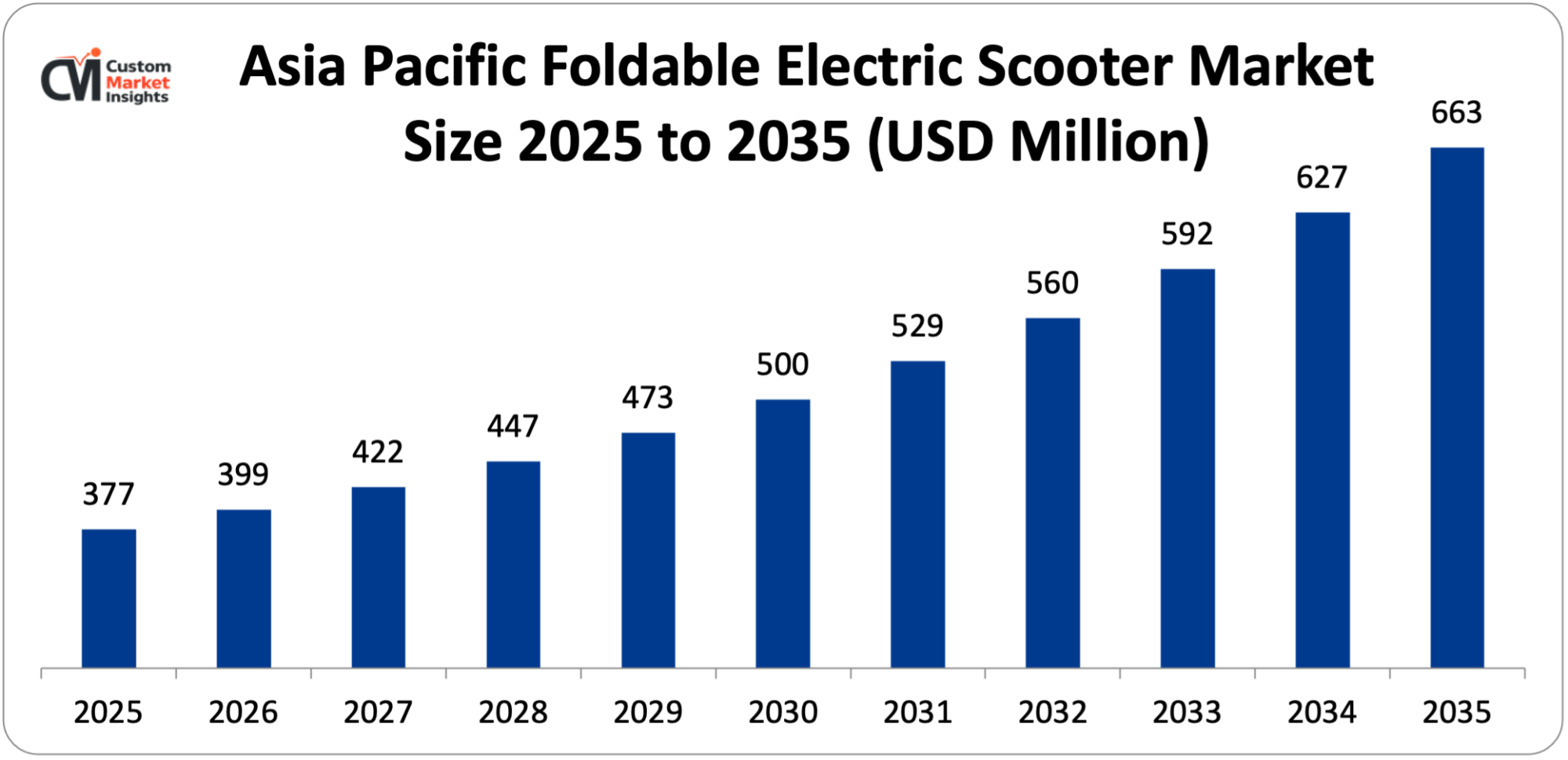
Its market size, in terms of the Asia Pacific foldable electric scooter, is projected to be USD 377 million in 2025 with a growth of about USD 663 million in 2035 with a CAGR of 5.8% between 2026 and 2035.
Why did Asia Pacific Dominate the Foldable Electric Scooter Market in 2025?
In 2025, the Asia Pacific will dominate the global market with an estimated market share of 48%. Fast urbanization, increasing environmental awareness, and environment-friendly policies—especially in China, the cornerstone of the boom—drive the growth. Based on official data from China‘s CNBS, the urbanization rate stood at 66.16% by 2023, meaning that a huge number of people had had to relocate into the cities and the urban infrastructure had to expand significantly. This situation is leading to more and more demand for short-distance urban transport and tiny, efficient, and last-mile mobility solutions, which all directly lead to more market penetration of foldable electric scooters in the major Chinese cities. At the same time, the environmental issues are also supporting the shift to electric mobility. Authority-backed research revealed that in China, cities are responsible for 84.73% of the country‘s CO emissions, and urban-dwelling residents produce substantially higher amounts of carbon emissions than rural villagers. Over the same period, China also experienced a significant increase in its overall emissions and became one of the biggest carbon emitters in the world. As a result, the Chinese government has always pushed towards the prevalence of electric vehicles, micro-mobility, and low-emission transportation systems.
India Foldable Electric Scooter Market Trends
In the Asia Pacific region, India leads the industry expansion over the projected period. The major reasons for these upward trends include rising fuel prices, which have reduced transportation expenditures on electric scooters; increasing urbanization; and growing traffic congestion, which has created a demand for portable, easily storable, and lightweight electric scooters, such as fold-up models.
Why is Europe Experiencing a Significant Growth in the Foldable Electric Scooter Market?
Europe holds a significant market share in 2025. Government interventions, stricter regulations, and a transformation of urban mobility policies are major growth factors in the entire region. One main contributor to this growth has been the proactive approach of the European Union toward the transition to decarbonization and sustainable transport. Strict emission standards (e.g., Euro 5+), subsidies, and tax benefits have been established in a number of European countries in order to encourage the use of zero-emission vehicles; consequently, it is now easier and cheaper for end users to purchase and use electric scooters, and in particular, foldable versions. Within the European Union there have been several initiatives and programs funded by the government aiming at rapid diffusion of the electric mobility sector.
The Green eMotion project was one major initiative aiming at establishing an integrated and scalable electric mobility infrastructure across Europe, in addition to many other similar government-funded projects. Also, most cities throughout Europe are actively changing urban mobility through restrictive policies (e.g., the implementation of LEZs and banning of ICE vehicles) against ICE vehicles, which directly leads to increased use of electric micromobility options, like electric scooters. Investment in infrastructure has also grown in most of the regions, including bike lanes and micromobility corridors, and the necessary infrastructure, such as charging points, is being established, providing practical benefits for those that use the foldable electric scooter.
Germany Foldable Electric Scooter Market Trends
Germany held the dominant position in the market in 2025. A key reason for this growth was the German government’s proactive process of legalizing and regulating e-scooters. The government of Germany legalized the use of e-scooters in 2019 making it legal on public roads, enabling a rapid rise in individual access to shared mobility services across cities. Having laws in place enables platform providers to grow and scale up rapidly and hence leads to high adoption rates across cities. For instance, there are 80 cities in Germany that have 150,000+ shared e-scooters.
Why is North America Growing at a Highest rate in the Foldable Electric Scooter Market?
North America is expected to grow at a steady rate over the projected period. There are a few simple underlying factors to this growth: Firstly, many consumers are demanding more clean and cheaper modes of transportation. Electric scooters have neither a no-cost-to-direct-emissions impact nor lower operating costs than gasoline-powered cars. Secondly, urban congestion grows in highly congested areas such as New York, Los Angeles, and San Francisco, prompting travelers to turn to more convenient, rugged, lightweight, and foldable forms of transportation, such as scooters, for planning shorter journeys. Thirdly, the growth of shared mobility (ride sharing, e-scooters) and last-mile delivery plays a large part in increasing the demand.
US Foldable Electric Scooter Market Trends
The US holds the prominent market share in the industry. The increasing government subsidies and shift towards green technology drive the country’s growth.
Why is the Middle East & Africa Region is growing rapidly in the Foldable Electric Scooter?
The MEA region is growing at a steady rate over the projected period. Governments and urban planners in several MEA countries are also pushing clean energy and smart mobility programs, which are making the policy environment conducive for the uptake of electric mobility. Growth in tourism and commercial activity in many of the MEA key cities is driving demand as well, with foldable scooters being used more often for leisure and short distances.
UAE Foldable Electric Scooter Market Trends
The UAE is growing at the highest CAGR during the forecast period. The increasing investment in advanced technology and innovative product launches drives the market growth.
Top Players in the Foldable Electric Scooter Market and Their Offerings
- Xiaomi Corporation
- Segway Megawheel
- Pride Mobility Products Corp
- GOTRAX
- Shenzhen Iezway Technology
- Turboant
- INOKIM
- Spacepac Industries Pty Ltd
- Mercane Wheels
- E-Twow
- Hiboy
- Glion
- EcoReco
- Razor
- XOOTR
- Others
Key Developments
Foldable electric scooter market has experienced considerable changes in the last two years as the market players are trying to diversify their technological aspects and develop product portfolios using strategic approaches.
- In March 2026, ENGWE, a leading global e-bike brand, previewed the upcoming launch of its new folding electric bike, the ENGWE ZIP, ahead of its official release on April 15. As the inaugural model in a newly established product line for high-frequency urban commuting, ZIP represents a strategic extension beyond ENGWE’s core performance and leisure categories. Purpose-built for compact, space-constrained environments, it underscores the brand’s growing commitment to practical, commuter-oriented mobility solutions. (https://www.prnewswire.co.uk/news-releases/engwe-expands-urban-footprint-with-zip-folding-e-bike-for-city-commuters-302722992.html)
- In November 2025, Yamaha Motor Co., Ltd. announced in India the launch of two new electric scooter models for the country: the AEROX E electric sport scooter developed in-house by Yamaha and the EC-06 electric scooter created in collaboration with River Mobility Private Limited. The AEROX E electric sport scooter is one of Yamaha’s high value-added models developed in line with its premium segment strategy for the ASEAN region and other emerging markets, as outlined in its Medium-Term Management Plan. The gasoline-powered AEROX 155 has already been well received in the Indian market, and the AEROX E delivers that same signature Yamaha sporty ride and stylish exterior design with an electric version. By launching this model, the Company aims to establish a premium brand image in India’s EV market. The AEROX E will be produced by India Yamaha Motor Pvt. Ltd. (https://global.yamaha-motor.com/news/2025/1112/ev.html)
These strategic measures have enabled the companies to reinforce their competitive positions, increase the product line, boost their technological competencies, and also seize growth opportunities in the fast-growing foldable electric scooter market.
The Foldable Electric Scooter Market is segmented as follows:
By Type
- Two Wheelers
- Three Wheelers
- Unicycle
By Battery Type
- Sealed Lead
- Acid Battery
- Lithium-ion Battery
- Others
By Voltage
- 24V
- 36V
- 48V
- Above 48V
By Sales Channel
- E-commerce
- OEM
Regional Coverage:
North America
- U.S.
- Canada
- Mexico
- Rest of North America
Europe
- Germany
- France
- U.K.
- Russia
- Italy
- Spain
- Netherlands
- Rest of Europe
Asia Pacific
- China
- Japan
- India
- New Zealand
- Australia
- South Korea
- Taiwan
- Rest of Asia Pacific
The Middle East & Africa
- Saudi Arabia
- UAE
- Egypt
- Kuwait
- South Africa
- Rest of the Middle East & Africa
Latin America
- Brazil
- Argentina
- Rest of Latin America
Table of Contents
- Chapter 1. Report Introduction
- 1.1. Report Description
- 1.1.1. Purpose of the Report
- 1.1.2. USP & Key Offerings
- 1.2. Key Benefits For Stakeholders
- 1.3. Target Audience
- 1.4. Report Scope
- 1.1. Report Description
- Chapter 2. Market Overview
- 2.1. Report Scope (Segments And Key Players)
- 2.1.1. Foldable Electric Scooter by Segments
- 2.1.2. Foldable Electric Scooter by Region
- 2.2. Executive Summary
- 2.2.1. Market Size & Forecast
- 2.2.2. Foldable Electric Scooter Market Attractiveness Analysis, By Type
- 2.2.3. Foldable Electric Scooter Market Attractiveness Analysis, By Battery Type
- 2.2.4. Foldable Electric Scooter Market Attractiveness Analysis, By Voltage
- 2.2.5. Foldable Electric Scooter Market Attractiveness Analysis, By Sales Channel
- 2.1. Report Scope (Segments And Key Players)
- Chapter 3. Market Dynamics (DRO)
- 3.1. Market Drivers
- 3.1.1. Rising Urbanization and Traffic Congestion
- 3.1.2. Environmental Concerns & Sustainability Push
- 3.2. Market Restraints
- 3.3. Market Opportunities
- 3.5. Pestle Analysis
- 3.6. Porter Forces Analysis
- 3.7. Technology Roadmap
- 3.8. Value Chain Analysis
- 3.9. Government Policy Impact Analysis
- 3.10. Pricing Analysis
- 3.1. Market Drivers
- Chapter 4. Foldable Electric Scooter Market – By Type
- 4.1. Type Market Overview, By Type Segment
- 4.1.1. Foldable Electric Scooter Market Revenue Share, By Type, 2025 & 2035
- 4.1.2. Two Wheelers
- 4.1.3. Foldable Electric Scooter Share Forecast, By Region (USD Million)
- 4.1.4. Comparative Revenue Analysis, By Country, 2025 & 2035
- 4.1.5. Key Market Trends, Growth Factors, & Opportunities
- 4.1.6. Three Wheelers
- 4.1.7. Foldable Electric Scooter Share Forecast, By Region (USD Million)
- 4.1.8. Comparative Revenue Analysis, By Country, 2025 & 2035
- 4.1.9. Key Market Trends, Growth Factors, & Opportunities
- 4.1.10. Unicycle
- 4.1.11. Foldable Electric Scooter Share Forecast, By Region (USD Million)
- 4.1.12. Comparative Revenue Analysis, By Country, 2025 & 2035
- 4.1.13. Key Market Trends, Growth Factors, & Opportunities
- 4.1. Type Market Overview, By Type Segment
- Chapter 5. Foldable Electric Scooter Market – By Battery Type
- 5.1. Battery Type Market Overview, By Battery Type Segment
- 5.1.1. Foldable Electric Scooter Market Revenue Share, By Battery Type, 2025 & 2035
- 5.1.2. Sealed Lead
- 5.1.3. Foldable Electric Scooter Share Forecast, By Region (USD Million)
- 5.1.4. Comparative Revenue Analysis, By Country, 2025 & 2035
- 5.1.5. Key Market Trends, Growth Factors, & Opportunities
- 5.1.6. Acid Battery
- 5.1.7. Foldable Electric Scooter Share Forecast, By Region (USD Million)
- 5.1.8. Comparative Revenue Analysis, By Country, 2025 & 2035
- 5.1.9. Key Market Trends, Growth Factors, & Opportunities
- 5.1.10. Lithium-ion Battery
- 5.1.11. Foldable Electric Scooter Share Forecast, By Region (USD Million)
- 5.1.12. Comparative Revenue Analysis, By Country, 2025 & 2035
- 5.1.13. Key Market Trends, Growth Factors, & Opportunities
- 5.1.14. Others
- 5.1.15. Foldable Electric Scooter Share Forecast, By Region (USD Million)
- 5.1.16. Comparative Revenue Analysis, By Country, 2025 & 2035
- 5.1.17. Key Market Trends, Growth Factors, & Opportunities
- 5.1. Battery Type Market Overview, By Battery Type Segment
- Chapter 6. Foldable Electric Scooter Market – By Voltage
- 6.1. Voltage Market Overview, By Voltage Segment
- 6.1.1. Foldable Electric Scooter Market Revenue Share, By Voltage, 2025 & 2035
- 6.1.2. 24V
- 6.1.3. Foldable Electric Scooter Share Forecast, By Region (USD Million)
- 6.1.4. Comparative Revenue Analysis, By Country, 2025 & 2035
- 6.1.5. Key Market Trends, Growth Factors, & Opportunities
- 6.1.6. 36V
- 6.1.7. Foldable Electric Scooter Share Forecast, By Region (USD Million)
- 6.1.8. Comparative Revenue Analysis, By Country, 2025 & 2035
- 6.1.9. Key Market Trends, Growth Factors, & Opportunities
- 6.1.10. 48V
- 6.1.11. Foldable Electric Scooter Share Forecast, By Region (USD Million)
- 6.1.12. Comparative Revenue Analysis, By Country, 2025 & 2035
- 6.1.13. Key Market Trends, Growth Factors, & Opportunities
- 6.1.14. Above 48V
- 6.1.15. Foldable Electric Scooter Share Forecast, By Region (USD Million)
- 6.1.16. Comparative Revenue Analysis, By Country, 2025 & 2035
- 6.1.17. Key Market Trends, Growth Factors, & Opportunities
- 6.1. Voltage Market Overview, By Voltage Segment
- Chapter 7. Foldable Electric Scooter Market – By Sales Channel
- 7.1. Sales Channel Market Overview, By Sales Channel Segment
- 7.1.1. Foldable Electric Scooter Market Revenue Share, By Sales Channel, 2025 & 2035
- 7.1.2. E-commerce
- 7.1.3. Foldable Electric Scooter Share Forecast, By Region (USD Million)
- 7.1.4. Comparative Revenue Analysis, By Country, 2025 & 2035
- 7.1.5. Key Market Trends, Growth Factors, & Opportunities
- 7.1.6. OEM
- 7.1.7. Foldable Electric Scooter Share Forecast, By Region (USD Million)
- 7.1.8. Comparative Revenue Analysis, By Country, 2025 & 2035
- 7.1.9. Key Market Trends, Growth Factors, & Opportunities
- 7.1. Sales Channel Market Overview, By Sales Channel Segment
- Chapter 8. Foldable Electric Scooter Market – Regional Analysis
- 8.1. Foldable Electric Scooter Market Overview, By Region Segment
- 8.1.1. Global Foldable Electric Scooter Market Revenue Share, By Region, 2025 & 2035
- 8.1.2. Global Foldable Electric Scooter Market Revenue, By Region, 2026 – 2035 (USD Million)
- 8.1.3. Global Foldable Electric Scooter Market Revenue, By Type, 2026 – 2035
- 8.1.4. Global Foldable Electric Scooter Market Revenue, By Battery Type, 2026 – 2035
- 8.1.5. Global Foldable Electric Scooter Market Revenue, By Voltage, 2026 – 2035
- 8.1.6. Global Foldable Electric Scooter Market Revenue, By Sales Channel, 2026 – 2035
- 8.2. North America
- 8.2.1. North America Foldable Electric Scooter Market Revenue, By Country, 2026 – 2035 (USD Million)
- 8.2.2. North America Foldable Electric Scooter Market Revenue, By Type, 2026 – 2035
- 8.2.3. North America Foldable Electric Scooter Market Revenue, By Battery Type, 2026 – 2035
- 8.2.4. North America Foldable Electric Scooter Market Revenue, By Voltage, 2026 – 2035
- 8.2.5. North America Foldable Electric Scooter Market Revenue, By Sales Channel, 2026 – 2035
- 8.2.6. U.S. Foldable Electric Scooter Market Revenue, 2026 – 2035 (USD Million)
- 8.2.7. Canada Foldable Electric Scooter Market Revenue, 2026 – 2035 (USD Million)
- 8.2.8. Mexico Foldable Electric Scooter Market Revenue, 2026 – 2035 (USD Million)
- 8.2.9. Rest of North America Foldable Electric Scooter Market Revenue, 2026 – 2035 (USD Million)
- 8.3. Europe
- 8.3.1. Europe Foldable Electric Scooter Market Revenue, By Country, 2026 – 2035 (USD Million)
- 8.3.2. Europe Foldable Electric Scooter Market Revenue, By Type, 2026 – 2035
- 8.3.3. Europe Foldable Electric Scooter Market Revenue, By Battery Type, 2026 – 2035
- 8.3.4. Europe Foldable Electric Scooter Market Revenue, By Voltage, 2026 – 2035
- 8.3.5. Europe Foldable Electric Scooter Market Revenue, By Sales Channel, 2026 – 2035
- 8.3.6. Germany Foldable Electric Scooter Market Revenue, 2026 – 2035 (USD Million)
- 8.3.7. France Foldable Electric Scooter Market Revenue, 2026 – 2035 (USD Million)
- 8.3.8. U.K. Foldable Electric Scooter Market Revenue, 2026 – 2035 (USD Million)
- 8.3.9. Russia Foldable Electric Scooter Market Revenue, 2026 – 2035 (USD Million)
- 8.3.10. Italy Foldable Electric Scooter Market Revenue, 2026 – 2035 (USD Million)
- 8.3.11. Spain Foldable Electric Scooter Market Revenue, 2026 – 2035 (USD Million)
- 8.3.12. Netherlands Foldable Electric Scooter Market Revenue, 2026 – 2035 (USD Million)
- 8.3.13. Rest of Europe Foldable Electric Scooter Market Revenue, 2026 – 2035 (USD Million)
- 8.4. Asia Pacific
- 8.4.1. Asia Pacific Foldable Electric Scooter Market Revenue, By Country, 2026 – 2035 (USD Million)
- 8.4.2. Asia Pacific Foldable Electric Scooter Market Revenue, By Type, 2026 – 2035
- 8.4.3. Asia Pacific Foldable Electric Scooter Market Revenue, By Battery Type, 2026 – 2035
- 8.4.4. Asia Pacific Foldable Electric Scooter Market Revenue, By Voltage, 2026 – 2035
- 8.4.5. Asia Pacific Foldable Electric Scooter Market Revenue, By Sales Channel, 2026 – 2035
- 8.4.6. China Foldable Electric Scooter Market Revenue, 2026 – 2035 (USD Million)
- 8.4.7. Japan Foldable Electric Scooter Market Revenue, 2026 – 2035 (USD Million)
- 8.4.8. India Foldable Electric Scooter Market Revenue, 2026 – 2035 (USD Million)
- 8.4.9. New Zealand Foldable Electric Scooter Market Revenue, 2026 – 2035 (USD Million)
- 8.4.10. Australia Foldable Electric Scooter Market Revenue, 2026 – 2035 (USD Million)
- 8.4.11. South Korea Foldable Electric Scooter Market Revenue, 2026 – 2035 (USD Million)
- 8.4.12. Taiwan Foldable Electric Scooter Market Revenue, 2026 – 2035 (USD Million)
- 8.4.13. Rest of Asia Pacific Foldable Electric Scooter Market Revenue, 2026 – 2035 (USD Million)
- 8.5. The Middle-East and Africa
- 8.5.1. The Middle-East and Africa Foldable Electric Scooter Market Revenue, By Country, 2026 – 2035 (USD Million)
- 8.5.2. The Middle-East and Africa Foldable Electric Scooter Market Revenue, By Type, 2026 – 2035
- 8.5.3. The Middle-East and Africa Foldable Electric Scooter Market Revenue, By Battery Type, 2026 – 2035
- 8.5.4. The Middle-East and Africa Foldable Electric Scooter Market Revenue, By Voltage, 2026 – 2035
- 8.5.5. The Middle-East and Africa Foldable Electric Scooter Market Revenue, By Sales Channel, 2026 – 2035
- 8.5.6. Saudi Arabia Foldable Electric Scooter Market Revenue, 2026 – 2035 (USD Million)
- 8.5.7. UAE Foldable Electric Scooter Market Revenue, 2026 – 2035 (USD Million)
- 8.5.8. Egypt Foldable Electric Scooter Market Revenue, 2026 – 2035 (USD Million)
- 8.5.9. Kuwait Foldable Electric Scooter Market Revenue, 2026 – 2035 (USD Million)
- 8.5.10. South Africa Foldable Electric Scooter Market Revenue, 2026 – 2035 (USD Million)
- 8.5.11. Rest of the Middle East & Africa Foldable Electric Scooter Market Revenue, 2026 – 2035 (USD Million)
- 8.6. Latin America
- 8.6.1. Latin America Foldable Electric Scooter Market Revenue, By Country, 2026 – 2035 (USD Million)
- 8.6.2. Latin America Foldable Electric Scooter Market Revenue, By Type, 2026 – 2035
- 8.6.3. Latin America Foldable Electric Scooter Market Revenue, By Battery Type, 2026 – 2035
- 8.6.4. Latin America Foldable Electric Scooter Market Revenue, By Voltage, 2026 – 2035
- 8.6.5. Latin America Foldable Electric Scooter Market Revenue, By Sales Channel, 2026 – 2035
- 8.6.6. Brazil Foldable Electric Scooter Market Revenue, 2026 – 2035 (USD Million)
- 8.6.7. Argentina Foldable Electric Scooter Market Revenue, 2026 – 2035 (USD Million)
- 8.6.8. Rest of Latin America Foldable Electric Scooter Market Revenue, 2026 – 2035 (USD Million)
- 8.1. Foldable Electric Scooter Market Overview, By Region Segment
- Chapter 9. Competitive Landscape
- 9.1. Company Market Share Analysis – 2025
- 9.1.1. Global Foldable Electric Scooter Market: Company Market Share, 2025
- 9.2. Global Foldable Electric Scooter Market Company Market Share, 2024
- 9.1. Company Market Share Analysis – 2025
- Chapter 10. Company Profiles
- 10.1. Segway Megawheel
- 10.1.1. Company Overview
- 10.1.2. Key Executives
- 10.1.3. Product Portfolio
- 10.1.4. Financial Overview
- 10.1.5. Operating Business Segments
- 10.1.6. Business Performance
- 10.1.7. Recent Developments
- 10.2. Pride Mobility Products Corp
- 10.3. GOTRAX
- 10.4. Shenzhen Iezway Technology
- 10.5. Turboant
- 10.6. INOKIM
- 10.7. Spacepac Industries Pty Ltd
- 10.8. Mercane Wheels
- 10.9. E-Twow
- 10.10. Hiboy
- 10.11. Glion
- 10.12. EcoReco
- 10.13. Razor
- 10.14. XOOTR
- 10.15. Others.
- 10.1. Segway Megawheel
- Chapter 11. Research Methodology
- 11.1. Research Methodology
- 11.2. Secondary Research
- 11.3. Primary Research
- 11.3.1. Analyst Tools and Models
- 11.4. Research Limitations
- 11.5. Assumptions
- 11.6. Insights From Primary Respondents
- 11.7. Why Custom Market Insights
- Chapter 12. Standard Report Commercials & Add-Ons
- 12.1. Customization Options
- 12.2. Subscription Module For Market Research Reports
- 12.3. Client Testimonials
List Of Figures
Figures No 1 to 31
List Of Tables
Tables No 1 to 51
Prominent Players
- Xiaomi Corporation
- Segway Megawheel
- Pride Mobility Products Corp
- GOTRAX
- Shenzhen Iezway Technology
- Turboant
- INOKIM
- Spacepac Industries Pty Ltd
- Mercane Wheels
- E-Twow
- Hiboy
- Glion
- EcoReco
- Razor
- XOOTR
- Others
FAQs
Government regulations play a crucial role in shaping the development and growth of the foldable electric scooter market by influencing adoption, safety standards, and overall market structure. Supportive policies such as subsidies, tax incentives, and EV promotion schemes encourage consumers to shift toward electric mobility by reducing upfront costs and improving affordability. At the same time, regulations that legalize e-scooter usage on public roads, define speed limits, and set safety requirements (such as helmets, lights, and braking systems) create a structured and trustworthy environment for both users and manufacturers. Governments also impact the market through environmental policies and emission norms, which push consumers away from internal combustion engine vehicles toward cleaner alternatives like electric scooters.
The price point plays a critical role in shaping the growth and adoption of the foldable electric scooter market, as it directly influences consumer accessibility and purchasing decisions. Lower-priced models, typically with basic features and lower battery capacity, attract price-sensitive consumers, including students and first-time users, thereby expanding market penetration, especially in developing regions. On the other hand, mid-range and premium-priced scooters, equipped with advanced features such as longer battery range, smart connectivity, and enhanced durability, appeal to urban professionals and frequent commuters, driving higher-value sales and revenue growth.
According to the present analysis and forecast modeling, the market of foldable electric scooters will witness a significant growth of about USD 1304 million in the year 2035 with the growing innovative product launch, increasing collaboration, growing EV adoption, and increasing government subsidies with a CAGR of 5.2% between the years 2026 and 2035.
It is projected that the Asia Pacific will hold the largest market share in the foldable electric scooter market in the forecast period, with a share of about 48% of the global market share, which is attributed to the growing government initiatives and presence of major players.
North America is expected to grow at the highest rate during the forecast period. The growth in the region is owing to the growing traffic congestion in the area.
The key players in the market are Segway Megawheel, Pride Mobility Products Corp., GOTRAX, Shenzhen Iezway Technology, Turboant, INOKIM, Spacepac Industries Pty Ltd., Mercane Wheels, E-Twow, Hiboy, Glion, EcoReco, Razor, XOOTR, Others.
7 . What are the key driving factors influencing the growth of the Foldable Electric Scooter market?
The growth of the foldable electric scooter market is primarily driven by rapid urbanization, increasing traffic congestion, rising demand for last-mile connectivity, growing environmental awareness, advancements in battery and lightweight design technologies, supportive government policies, and the expanding adoption of e-commerce and shared mobility solutions, all of which collectively enhance the convenience, affordability, and sustainability of urban transportation.