
Mexico Culinary Tourism Market Size, Trends and Insights By Activity (Culinary Trails, Cooking Classes, Restaurants, Food Festivals), By Booking Mode (Online Travel Agencies (OTA), Tour Operators, Direct Travel), By Tourist Type (Recreational, Diversionary, Existential, Experimental), and By Region - Industry Overview, Statistical Data, Competitive Analysis, Share, Outlook, and Forecast 2026 – 2035
Report Snapshot
| Study Period: | 2026-2035 |
| Fastest Growing Market: | Mexico |
| Largest Market: | Mexico |
Major Players
- Eat Mexico
- Mexico Foodie Tours
- Sabores Mexico Food Tours
- Unforgettable Culinary Traditions
- Others
Reports Description
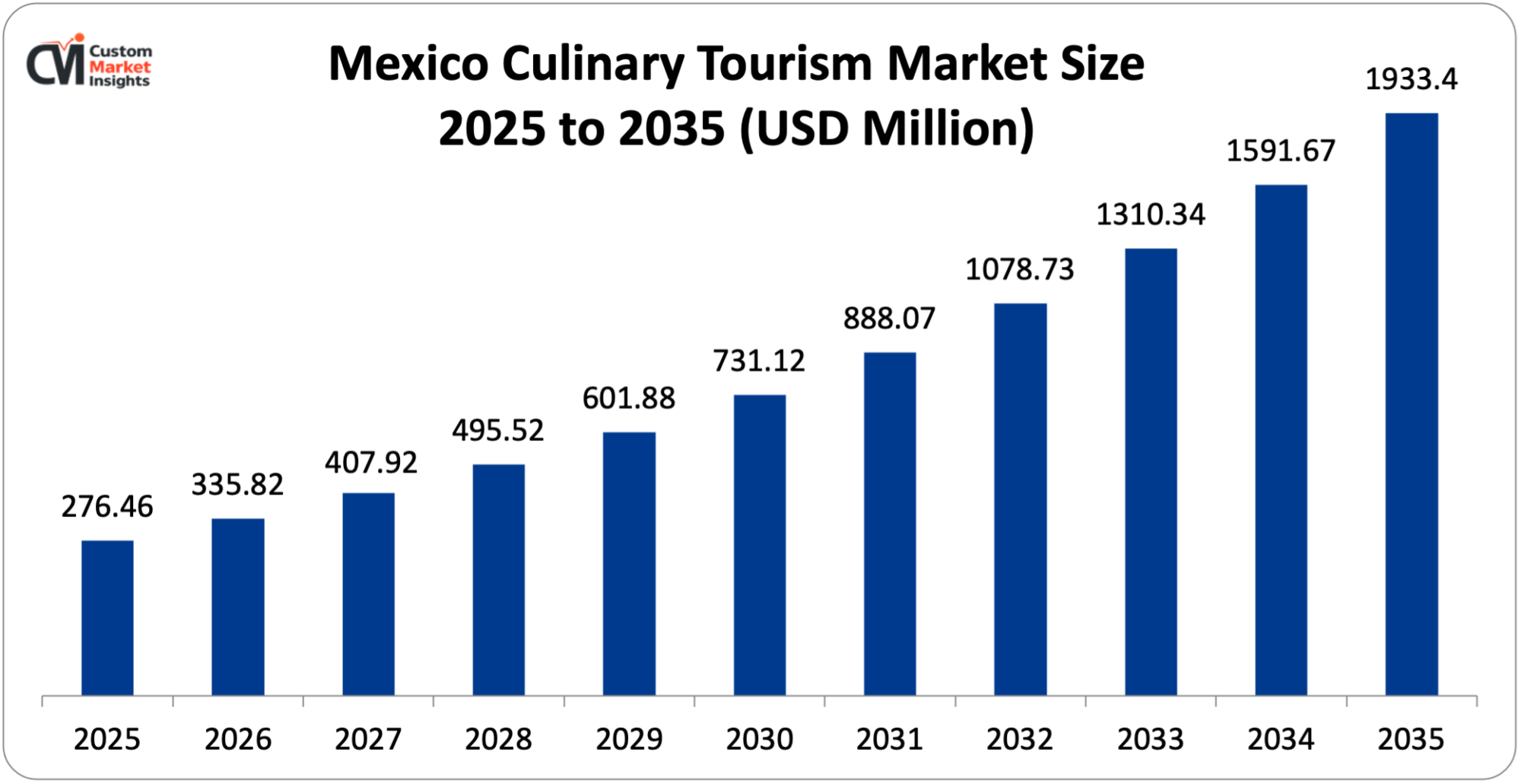
Mexico’s culinary tourism market is expected to record a CAGR of 21.47% from 2026 to 2035. In 2026, the market size was USD 335.82 Million. By 2035, the valuation is anticipated to reach USD 1933.4 Million.
The market is growing due to bodies like the UNESCO recognizing Mexican cuisine for its richness and its inclusion in well-known guides such as Michelin. Also, the fact that around 30% of the visitors’ spending goes into gastronomy can’t be ignored. Mexico houses varied culinary experiences in the form of food festivals, street food tours, cooking classes, and fine dining that pave the way for diverse options that draw travelers who are food-centric. Furthermore, promotion by influencers and exposure to social media are amplifying regional dishes’ visibility.
Market Highlights
- By activity, food festivals held around 32.23% of the market share in 2025.
- By activity, culinary trails are expected to witness the fastest CAGR of 24.37% between 2026 and 2035.
- By booking mode, direct travel segment dominated in 2025 with 65.34% of the overall market share.
- By booking mode, online travel agencies (OTAs) are expected to witness the fastest CAGR of 24.83% during the forecast period.
- By tourist type, the highest market share of 43.35% was attributed to the existential segment in 2025.
- By tourist type, the diversionary segment is expected to witness the fastest CAGR of 21.48% between 2026 and 2035.
Significant Growth Factors
Mexico culinary tourism market presents significant growth opportunities due to several factors:
- Diverse Regional Heritage & Regional Cuisine
Oaxacan mole is amongst the widely recognized Mexican cuisines. Mezcal trails are another selling point. The key dynamics are inclusive of growing demand for sustainable, local food, raised affordability, and social media influence. In other words, the travelers are increasingly looking out for hands-on, genuine culinary experiences like visits to local, conventional producers, market tours, and cooking classes. Food festivals are amongst the biggest revenue generators, whereas exclusive culinary trails are amongst the fastest-growing segments. In all, Mexico does offer a cost-effective, high-value destination for global travelers who are seeking authentic, luxury, street food, and budget-friendly experiences. Moreover, traditional Mexican cuisine, since 2010, is a part of the Representative List of the Intangible Cultural Heritage of Humanity.
- Millennials’ and Gen Z’s Inclination toward Culinary Tourism
Research states that millennials and Gen Z account for the biggest constellation of culinary tourists, thereby accounting for over 40% of the market for culinary tourism worldwide. This is credited to the fact that they prefer immersive, authentic, and shareable food experiences. Moreover, they heavily depend on digital platforms for discovering novel places.
Gen X is showing interest in the form of frequent visits to food festivals, wine regions, and reputed culinary destinations. Gen Alpha is also influencing family travel choices through interest in educational and interactive food activities. Marriott International, in 2025, shared the observation that luxury culinary tourism is one of the key travel drivers, with around 88% of affluent travelers stating that discovery of novel foods is necessary while choosing a destination.
What are the Major Advancements Changing Mexico Culinary Tourism Market Today?
- Online Travel Agents (OTA) Spreading Wings
An online travel agent (OTA) implies an application or a web-based platform letting users book as well as reserve online accommodations and services related to travel. They are ruling the roost as they pave the way for convenience through various curated selections of the culinary tours constituting different regions and addressing varied interests, budgets, and dietary requirements. The process gets streamlined further through seamless booking, comparison, and access to information through mobile apps and user-friendly platforms. Also, OTAs bank on AI-powered recommendations and robust online marketing strategies for cultivating reach at the global level and targeting foodies and food enthusiasts at the global level. They portray the Mexican culinary market on multilingual platforms, partner with the local tour operators, and integrate the local payment methods, thereby transcending the language barriers and making transactions easy. Plus, virtual reality tours improve value proposition and draw tech-savvy tourists.
- Affordable Infrastructure
Mexico has been witnessing an elevated domestic tourism, thereby making exploration of its vibrant culinary tapestry accessible and appealing. The tour operators are addressing this by proffering the hyper-local experience, such as visits to indigenous communities, family-run farms, and street food vendors, thereby displaying exclusive regional traditions and specialties defining Mexican cuisine. Plus, affordability in comparison with global travel does play a vital role with respect to dominance. At the same time, the international scenario is showing immense potential. Mexican cuisine is being noticed worldwide, which is basically driven by media as well as celebrity chefs spotlighting specialized dishes such as moles and tacos. The latest improvements in the Mayan Riviera are catering to global visitors who are asking for luxury culinary experiences.
- Impact of AI on Mexico Culinary Tourism Market
Increased adoption of AI is transforming Mexico’s culinary tourism market by improving industry operations as well as travelers’ experiences. The market players are visibly adopting AI tools, right from virtual concierges and itinerary planners to Chatbots handling customer service in multiple languages. This does make exploration of local cuisine more efficient, tailored, and appealing to the food travelers. Also, predictive analytics aid restaurants, tour operators, and hotels in forecasting demand and optimizing pricing, whereas the digital campaigns that tech firms are powering do integrate AI into content creation and travel planning for showcasing the region’s gastronomy to the international audience in a more effective manner.
Category Wise Insights
By Product
Why Do Food Festivals Dominate Mexico Culinary Tourism Market?
Food festivals hold close to one-third of the overall market share. This is attributed to the fact that food festivals, events, and culinary tours draw travelers to novel destinations by floating immersive and diverse food experiences. For example – Mexico City, Oaxaca, and Guadalajara are known for hosting certain well-known festivals, wherein they drive both – food travelers and lovers. Moreover, these festivals are organized such that they do coincide with noteworthy cultural events or holidays. As such, they raise their appeal to the tourists who are planning trips around exclusive experiences. Furthermore, these festivals stand out by highlighting indigenous foods such as cacao, chili, and corn.
By Booking Mode
-
How Does Direct Travel Dominate Mexico Culinary Tourism Market?
Direct travel, better known as direct booking, significantly influences Mexico culinary tourism market, particularly as travelers develop greater interest in authentic, immersive food experiences. Direct travel lets them bypass mass-market, generic offerings and get in direct touch with local farmers, chefs, and food artisans. They also provide access to farm-to-table experiences, food tours, private cooking classes, and gourmet tasting menus that third-party providers do not provide. Also, booking a culinary experience or tour provides tourists with the ability to personalize their food-centric trips to meet their preferences, such as emphasizing specific regions (Jalisco for tequila or Oaxaca for mole) or exploring niche traditions (such as conventional Yucatán cooking).
By Tourist Type.
-
Where do Existential Tourists stand with respect to Mexico Culinary Tourism Market?
Existential tourists are the ones seeking deep connection with local food in place of merely luxury gastronomy or casual dining. They prefer dining where locals dine (such as humble eateries and street food) instead of typical restaurants meant for tourists. They also take part in immersive activities like food workshops, cooking classes, market tours, and other experiences connecting them to a place’s culinary roots. Such tourists account for 40-45% of the overall market share. Mercado 20 de Noviembre in Mérida, coupled with street food culture, is a big attraction.
Report Scope
| Feature of the Report | Details |
| Market Size in 2026 | USD 335.82 Million |
| Projected Market Size in 2035 | USD 1933.4 Million |
| Market Size in 2025 | USD 276.46 million |
| CAGR Growth Rate | 21.47% CAGR |
| Base Year | 2025 |
| Forecast Period | 2026-2035 |
| Key Segment | By Activity, Booking Mode, Tourist Type and Region |
| Report Coverage | Revenue Estimation and Forecast, Company Profile, Competitive Landscape, Growth Factors and Recent Trends |
| Buying Options | Request tailored purchasing options to fulfil your requirements for research. |
Top Players in Mexico Culinary Tourism Market and Their Offerings
- Eat Mexico
- Mexico Foodie Tours
- Sabores Mexico Food Tours
- Unforgettable Culinary Traditions
- Eat Like a Local/Club Tengo Hambre
- Homlunch
- Traveling Spoon
- Velas Resorts
- Others
Key Developments
Mexico’s culinary tourism market has experienced considerable changes in the last two years as the market players are trying to diversify their technological aspects and develop product portfolios using strategic approaches.
- Oaxaca City is known for Oaxaca Street Food Essentials by Club Tengo Hambre, which is known for memela with chorizo.
The Mexico Culinary Tourism Market is segmented as follows:
By Activity
- Culinary Trails
- Cooking Classes
- Restaurants
- Food Festivals
By Booking Mode
- Online Travel Agencies (OTA)
- Tour Operators
- Direct Travel
By Tourist Type
- Recreational
- Diversionary
- Existential
- Experimental
Table of Contents
- Chapter 1. Report Introduction
- 1.1. Report Description
- 1.1.1. Purpose of the Report
- 1.1.2. USP & Key Offerings
- 1.2. Key Benefits For Stakeholders
- 1.3. Target Audience
- 1.4. Report Scope
- 1.1. Report Description
- Chapter 2. Market Overview
- 2.1. Report Scope (Segments And Key Players)
- 2.1.1. Mexico Culinary Tourism by Segments
- 2.1.2. Mexico Culinary Tourism by Region
- 2.2. Executive Summary
- 2.2.1. Market Size & Forecast
- 2.2.2. Mexico Culinary Tourism Market Attractiveness Analysis, By Activity
- 2.2.3. Mexico Culinary Tourism Market Attractiveness Analysis, By Booking Mode
- 2.2.4. Mexico Culinary Tourism Market Attractiveness Analysis, By Tourist Type
- 2.1. Report Scope (Segments And Key Players)
- Chapter 3. Market Dynamics (DRO)
- 3.1. Market Drivers
- 3.1.1. Diverse Regional Heritage & Regional Cuisine
- 3.1.2. Millennials’ and Gen Z’s Inclination toward Culinary Tourism
- 3.2. Market Restraints
- 3.3. Market Opportunities
- 3.5. Pestle Analysis
- 3.6. Porter’s Forces Analysis
- 3.7. Technology Roadmap
- 3.8. Value Chain Analysis
- 3.9. Government Policy Impact Analysis
- 3.10. Pricing Analysis
- 3.1. Market Drivers
- Chapter 4. Mexico Culinary Tourism Market – By Activity
- 4.1. Activity Market Overview, By Activity Segment
- 4.1.1. Mexico Culinary Tourism Market Revenue Share, By Activity , 2025 & 2035
- 4.1.2. Culinary Trails
- 4.1.3. Mexico Culinary Tourism Share Forecast, By Region (USD Million)
- 4.1.4. Comparative Revenue Analysis, By Country, 2025 & 2035
- 4.1.5. Key Market Trends, Growth Factors, & Opportunities
- 4.1.6. Cooking Classes
- 4.1.7. Mexico Culinary Tourism Share Forecast, By Region (USD Million)
- 4.1.8. Comparative Revenue Analysis, By Country, 2025 & 2035
- 4.1.9. Key Market Trends, Growth Factors, & Opportunities
- 4.1.10. Restaurants
- 4.1.11. Mexico Culinary Tourism Share Forecast, By Region (USD Million)
- 4.1.12. Comparative Revenue Analysis, By Country, 2025 & 2035
- 4.1.13. Key Market Trends, Growth Factors, & Opportunities
- 4.1.14. Food Festivals
- 4.1.15. Mexico Culinary Tourism Share Forecast, By Region (USD Million)
- 4.1.16. Comparative Revenue Analysis, By Country, 2025 & 2035
- 4.1.17. Key Market Trends, Growth Factors, & Opportunities
- 4.1. Activity Market Overview, By Activity Segment
- Chapter 5. Mexico Culinary Tourism Market – By Booking Mode
- 5.1. Booking Mode Market Overview, By Booking Mode Segment
- 5.1.1. Mexico Culinary Tourism Market Revenue Share, By Booking Mode , 2025 & 2035
- 5.1.2. Online Travel Agencies (OTA)
- 5.1.3. Mexico Culinary Tourism Share Forecast, By Region (USD Million)
- 5.1.4. Comparative Revenue Analysis, By Country, 2025 & 2035
- 5.1.5. Key Market Trends, Growth Factors, & Opportunities
- 5.1.6. Tour Operators
- 5.1.7. Mexico Culinary Tourism Share Forecast, By Region (USD Million)
- 5.1.8. Comparative Revenue Analysis, By Country, 2025 & 2035
- 5.1.9. Key Market Trends, Growth Factors, & Opportunities
- 5.1.10. Direct Travel
- 5.1.11. Mexico Culinary Tourism Share Forecast, By Region (USD Million)
- 5.1.12. Comparative Revenue Analysis, By Country, 2025 & 2035
- 5.1.13. Key Market Trends, Growth Factors, & Opportunities
- 5.1. Booking Mode Market Overview, By Booking Mode Segment
- Chapter 6. Mexico Culinary Tourism Market – By Tourist Type
- 6.1. Tourist Type Market Overview, By Tourist Type Segment
- 6.1.1. Mexico Culinary Tourism Market Revenue Share, By Tourist Type , 2025 & 2035
- 6.1.2. Recreational
- 6.1.3. Mexico Culinary Tourism Share Forecast, By Region (USD Million)
- 6.1.4. Comparative Revenue Analysis, By Country, 2025 & 2035
- 6.1.5. Key Market Trends, Growth Factors, & Opportunities
- 6.1.6. Diversionary
- 6.1.7. Mexico Culinary Tourism Share Forecast, By Region (USD Million)
- 6.1.8. Comparative Revenue Analysis, By Country, 2025 & 2035
- 6.1.9. Key Market Trends, Growth Factors, & Opportunities
- 6.1.10. Existential
- 6.1.11. Mexico Culinary Tourism Share Forecast, By Region (USD Million)
- 6.1.12. Comparative Revenue Analysis, By Country, 2025 & 2035
- 6.1.13. Key Market Trends, Growth Factors, & Opportunities
- 6.1.14. Experimental
- 6.1.15. Mexico Culinary Tourism Share Forecast, By Region (USD Million)
- 6.1.16. Comparative Revenue Analysis, By Country, 2025 & 2035
- 6.1.17. Key Market Trends, Growth Factors, & Opportunities
- 6.1. Tourist Type Market Overview, By Tourist Type Segment
- Chapter 7. Mexico Culinary Tourism Market – Regional Analysis
- 7.1. Mexico Culinary Tourism Market Overview, By Region Segment
- 7.1.1. Mexico Culinary Tourism Market Revenue Share, By Region, 2025 & 2035
- 7.1.2. Mexico Culinary Tourism Market Revenue, By Region, 2026 – 2035 (USD Million)
- 7.1.3. Mexico Culinary Tourism Market Revenue, By Activity , 2026 – 2035
- 7.1.4. Mexico Culinary Tourism Market Revenue, By Booking Mode , 2026 – 2035
- 7.1.5. Mexico Culinary Tourism Market Revenue, By Tourist Type , 2026 – 2035
- 7.1. Mexico Culinary Tourism Market Overview, By Region Segment
- Chapter 8. Competitive Landscape
- 8.1. Company Market Share Analysis – 2025
- 8.1.1. Mexico Culinary Tourism Market: Company Market Share, 2025
- 8.2. Mexico Culinary Tourism Market Company Market Share, 2024
- 8.1. Company Market Share Analysis – 2025
- Chapter 9. Company Profiles
- 9.1. Eat Mexico
- 9.1.1. Company Overview
- 9.1.2. Key Executives
- 9.1.3. Product Portfolio
- 9.1.4. Financial Overview
- 9.1.5. Operating Business Segments
- 9.1.6. Business Performance
- 9.1.7. Recent Developments
- 9.2. Mexico Foodie Tours
- 9.3. Sabores Mexico Food Tours
- 9.4. Unforgettable Culinary Traditions
- 9.5. Eat Like a Local/Club Tengo Hambre
- 9.6. Homlunch
- 9.7. Traveling Spoon
- 9.8. Velas Resorts
- 9.9. Others.
- 9.1. Eat Mexico
- Chapter 10. Research Methodology
- 10.1. Research Methodology
- 10.2. Secondary Research
- 10.3. Primary Research
- 10.3.1. Analyst Tools and Models
- 10.4. Research Limitations
- 10.5. Assumptions
- 10.6. Insights From Primary Respondents
- 10.7. Why Custom Market Insights
- Chapter 11. Standard Report Commercials & Add-Ons
- 11.1. Customization Options
- 11.2. Subscription Module For Market Research Reports
- 11.3. Client Testimonials
List Of Figures
Figures No 1 to 22
List Of Tables
Tables No 1 to 2
Prominent Player
- Eat Mexico
- Mexico Foodie Tours
- Sabores Mexico Food Tours
- Unforgettable Culinary Traditions
- Eat Like a Local/Club Tengo Hambre
- Homlunch
- Traveling Spoon
- Velas Resorts
- Others
FAQs
The key players in the market are Eat Mexico, Mexico Foodie Tours, Sabores Mexico Food Tours, Unforgettable Culinary Traditions, Eat Like a Local/Club Tengo Hambre, Homlunch, Traveling Spoon, Velas Resorts, Others.
The government of Mexico, especially through SECTUR (Secretaría de Turismo), is into the integration of gastronomy as one of the pillars of national tourism policy. Various coordinated initiatives involve the industrial bodies such as CANIRAC. Such policies are elevating Mexico’s profile related to culinary tourism. It also encourages investment in culinary infrastructure and food culture through its and private entities.
Premium, high-end culinary experiences in the form of special workshops, chef-led tastings, or luxury food tours often come at a higher price than their counterparts. This can, in turn, cut the corners for travelers who are price-sensitive, particularly from middle- and lower-income segments. These high costs are looked upon as one of the barriers to participation, with various premium packages adversely affecting the tourists who are moving on a shoestring budget.
Mexico’s culinary tourism market is expected to reach USD 1.93 Billion by 2035, growing at a CAGR of 21.47% from 2026 to 2035. With travelers willing to participate (not merely observe) in hands-on cooking classes, farm-to-table experiences, market tours with local guides, and agave distillery workshops. Also, social media do act as discovery tools regarding destinations. Exclusive dishes are turning out to be ongoing trends (such as the mescal experience and specific tacos).
The modern day travelers are inclined toward proper engagement with the local cultures, with food being one of the immersive ways of connecting to traditions, heritage, and community life. Mexico is known for offering culinary tourism, which paves the way for deeper insights way beyond conventional sightseeing. As such, street and regional foods play the role of cultural ambassadors. Also, storytelling revolving around dishes such as tamales or moles improves cultural context. This, in turn, does drive wider interest, resulting in longer stays in Mexico City, Puebla, and Oaxaca.