
- Home
- Automotive and Transportation
- Global Open Process Automation Systems Market
Global Open Process Automation Systems Market 2026 – 2035
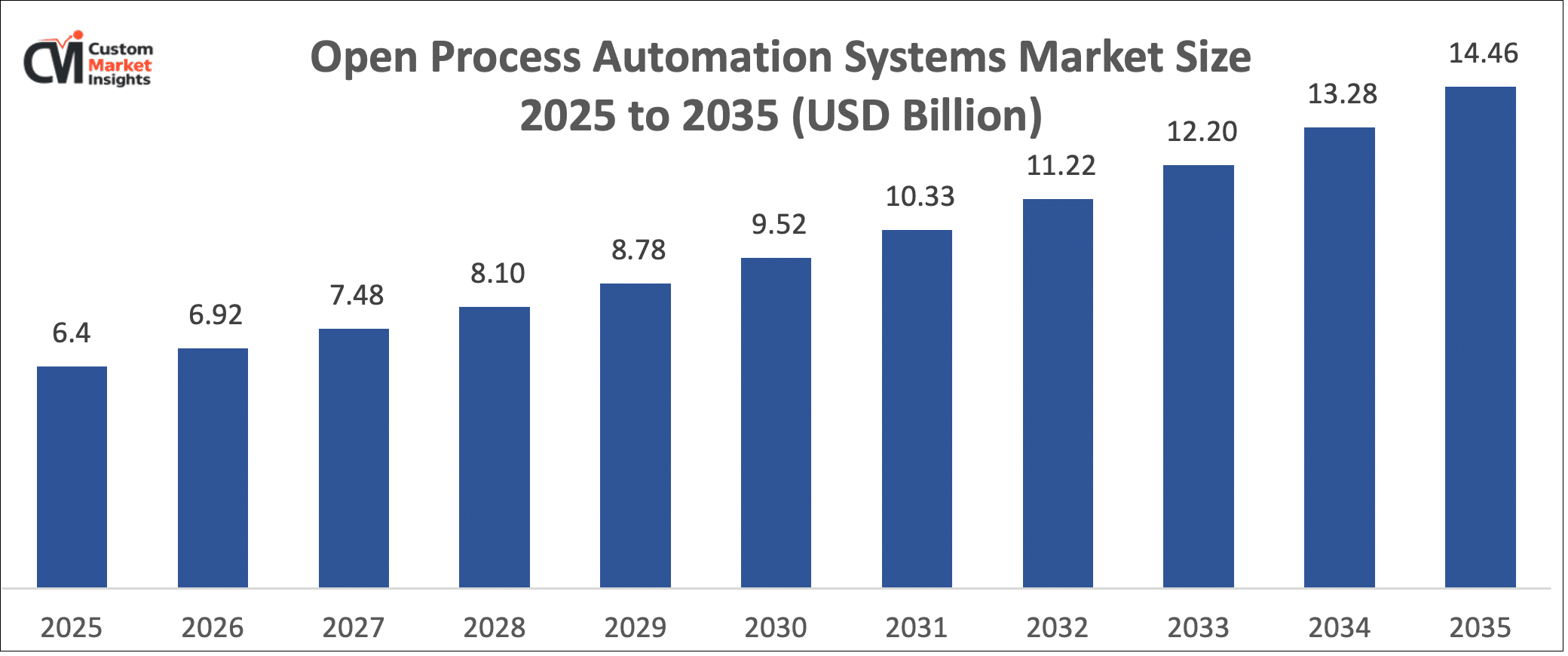
Valued at USD 6.92 Bn in 2026, the market is projected to reach USD 14.46 Bn by 2035, growing at a 8.5% CAGR. Asia Pacific holds the largest share, while North America grows fastest. The report profiles 12 companies.
- 320+ Pages
- 12+ Companies
- Base year 2025
- Forecast 2026-2035
- Global coverage
The global open process automation systems market was valued at USD 6.92 Bn in 2026 and is projected to reach USD 14.46 Bn by 2035, growing at a CAGR of 8.5%. Asia Pacific is the largest regional market and North America is growing fastest.
Source: Custom Market Insights analysis.
To learn more about this report - request a sample report PDF
Reports Description
The market size of the Open Process Automation Systems is estimated to grow to USD 6.92 billion by 2026 and is intended to grow to USD 14.46 billion in the year 2035 at a CAGR of 8.5% in the 2026-2035 forecast period. The market is growing with the increasing use of open, interoperable, and vendor-neutral automation systems within industries to enhance adaptability and efficiency as well as the scalability of industrial activity. The increasing pressure to modernize control systems of the past, minimize vendor lock-in, and enhance cybersecurity in industries like oil and gas, power generation, chemicals, and manufacturing is stimulating the growth of the market. Moreover, the further development of industrial IoT (IIoT), cloud computing-based automation systems, and Industry 4.0 technologies and the investments in digital transformation and smart manufacturing will also contribute to the increased growth of the market.
To learn more about this report - request a sample report PDF
Market Highlight
- In 2025, North America occupied a substantial part of the Open Process Automation Systems Market because of the early adoption of the open automation standards and the powerful investments in industrial digitalization.
- The CAGR of Asia Pacific is projected to be the highest in the period between 2026 and 2035 due to the high rates of industrialization and the growing interest in the use of Industry 4.0 technologies.
- On a Component basis, the hardware market segment prevailed in 2025 as its usage of controllers, networking equipment, and field devices is high, whereas the software market segment is projected to increase steadily with the demand for analytics and automation platforms.
- On-premises systems had the highest percentage in 2025 by Deployment Type when compared to cloud-based deployment, but the latter is expected to increase because of the need to place more value on remote monitoring and digital integration.
- Through Architecture, open distributed control systems (DCS) had a significant portion in 2025 due to the flexibility of the automation and the interoperability.
- In Industry Vertical, oil and gas conquered the market in 2025 because of strong dependence on the higher automation systems.
- Application and process control recorded the highest share in 2025 with asset management and plant optimization projected to increase in the period of forecast.
Significant Growth Factors
The emerging trend of the Open Process Automation Systems Market is tightly connected with the increasing popularity of open, interoperable automation systems, the escalating trend of the modernization of old industrial automation systems, and the rise in attention to digitalization, cybersecurity, and efficiency of operations among process industries.
- Updating Work Systems With Previous Industrial Automation: A large number of industrial systems are moving towards open, vendor-neutral automation architectures to enhance flexibility, interoperability, and lifecycle management. With open process automation, the organization is able to have multi-vendor solutions and upgrade without replacing the entire infrastructure. As an example, in March 2024, Honeywell detailed improvements in its Experion open automation platform, which is intended to assist industrial operators to modernize old control systems besides enhancing scalability and interoperability between process plants.
- Increase in the Use Of Industry 4.0 and Digital Manufacturing Technologies: fast development of industrial IoT (IIoT), cloud computing and advanced analytics is increasing the adoption pace of the open process automation systems in industries including oil and gas, chemicals, and power generation. The technologies make it possible to analyze data in real-time, predictive maintenance, and visibility in operations. By way of example, in September 2023, Siemens unveiled the improvements of its industrial automation and digitalization solutions in the interest of the manufacturing and process industries to assist in creating an open and interoperable process automation environment.
The Major Innovations That Are Transforming the Open Process Automation Systems Market Of the Modern World
- Application of Open and Interoperable Automation Platforms: Companies are also inventing open automation platforms that allow easy integration of inter-vendor equipment, software and control systems to industrial plants. These environments help to increase flexibility, scalability, and lifecycle and reduce vendor lock-in. Schneider Electric, as an example, announced in June 2023 that it had introduced enhancements to its EcoStruxure Automation Expert, an open and software-defined automation platform that supports industrial control applications and automation systems and makes it interoperable by engaging interoperable hardware.
- Process Automation using AI and Intense Analytics: AI, machine learning, and data analytics are transforming the sphere of industrial automation as they will enable predictive maintenance, process optimization, and real-time awareness of the processes. The technologies assist industries to identify something going wrong very early, minimize downtime, and increase productivity in complex manufacturing and processing settings. In October 2024, ABB declared new artificial intelligence-based features in its industrial automation systems, allowing the industry to monitor, perform predictive maintenance, and make decisions about the processes using data.
- Digital and Software-Defined Automation Architectures: The transition to digital manufacturing and Industry 4.0 is prompting business enterprises to create software-defined automation systems that decouple hardware with control software and enable more flexible and modular automation systems. Emerson launched the updates to its DeltaV distributed control system in March 2024, which is implemented to operate in the environment of modern and open automation and enhance the connectivity between industrial devices, analytics platforms, and control applications.
Category Wise Insights
By Component
Why Hardware is becoming the Market Leader?
The hardware portion will be the leading market structure of the Open Process Automation Systems Market in 2025. The primary causes of this growth are the growing use of industrial controllers, edge devices, networking devices, sensors, and field instruments, which comprise the physical base of open automation systems. The industries are replacing the legacy control infrastructure with new hardware that meets open standards and interoperability to ensure smooth communication between devices of different vendors. In the meantime, the software segment should increase at a high rate over the forecast period as industries will use the innovative analytics platform, AI-assisted automation tools, and digital control software. Services segment such as system integration, maintenance and consulting is also gaining ground since organizations need specialized services to add and operate open automation environments.
By Deployment Type
The reason why On-Premises Systems are dominating the market?
It is estimated that in 2025, on-premises deployment will take over the market since most industrial facilities choose localized control systems as a way of maintaining operation security, reliability, and adherence to stringent industrial regulations. These systems enable firms to retain complete control over essential automation systems and reduce the cybersecurity threat. Nevertheless, cloud-based implementation will experience high growth in the forecast period because of the growing need in remote monitoring solutions, platform solutions, which operate on a large scale with scalability; and real-time access to data. With the digitization transformation strategies being embraced by the industries, the cloud-based automation solutions are emerging as a promising solution in enhancing the visibility and efficiency of operations.
By Architecture
What is the significance of Open Distributed Control Systems?
It is anticipated that Open Distributed Control Systems (DCS) will be a significant portion of the market in 2025 as they offer flexible, scalable, and interoperable automation models enabling the devices and software of several vendors to interoperate. The architecture assists industries to upgrade old automation systems without necessarily overhauling the infrastructure in place. The interest towards modular control systems is also increasing due to the fact that modular control systems allow the organization to improve automation features progressively, which saves money and enhances the flexibility of the system. Moreover, interoperable automation systems are gaining more and more significance with the companies being concerned with open standards, integration of systems, and vendor-neutral automation environments.
By Industry Vertical
Why is the Oil and Gas Sector becoming the market leader?
It is projected that the oil and gas business will rule the market in 2025 because of the high dependence of advanced automation systems to operate the sophisticated exploration, refining, and production processes. Open automation systems enable an operator to be more efficient, safe, and have less downtime. Other significant adopters are the chemicals and power generation industries that need scalable and dependable automation processes to manage the large scale industrial processes. Meanwhile, the pharmaceutical and manufacturing industries are becoming more actively deployed to open automation technologies to promote smart manufacturing, regulatory compliance, and enhanced the efficiency of the processes.
By Application
Why is Process Control Ruling the Market?
The process control division is forecasted to have the highest portion in 2025 as automation systems are actually being employed to oversee and control industrial operations in real-time to maintain a steady output and efficiency. Industries use open automation systems to combine different control systems and streamline production processes. Applications in asset management and plant optimization will also have tremendous growth as companies will employ the use of data analytics, predictive maintenance, and digital monitoring tools to enhance performance and decrease downtime of their equipment. Also, the industrial monitoring applications are growing because companies are concentrating on improving the visibility of operations in large and complicated industrial sites.
Report Scope
| Feature of the Report | Details |
| Market Size in 2026 | USD 6.92 billion |
| Projected Market Size in 2035 | USD 14.46 billion |
| Market Size in 2025 | USD 6.4 billion |
| CAGR Growth Rate | 8.5% CAGR |
| Base Year | 2025 |
| Forecast Period | 2026-2035 |
| Key Segment | By Component, Deployment Type, Architecture, Industry Vertical, Application and Region |
| Report Coverage | Revenue Estimation and Forecast, Company Profile, Competitive Landscape, Growth Factors and Recent Trends |
| Regional Scope | North America, Europe, Asia Pacific, Middle East & Africa, and South & Central America |
| Buying Options | Request tailored purchasing options to fulfil your requirements for research. |
Regional Analysis
What Is the Size of the Asia Pacific Market?
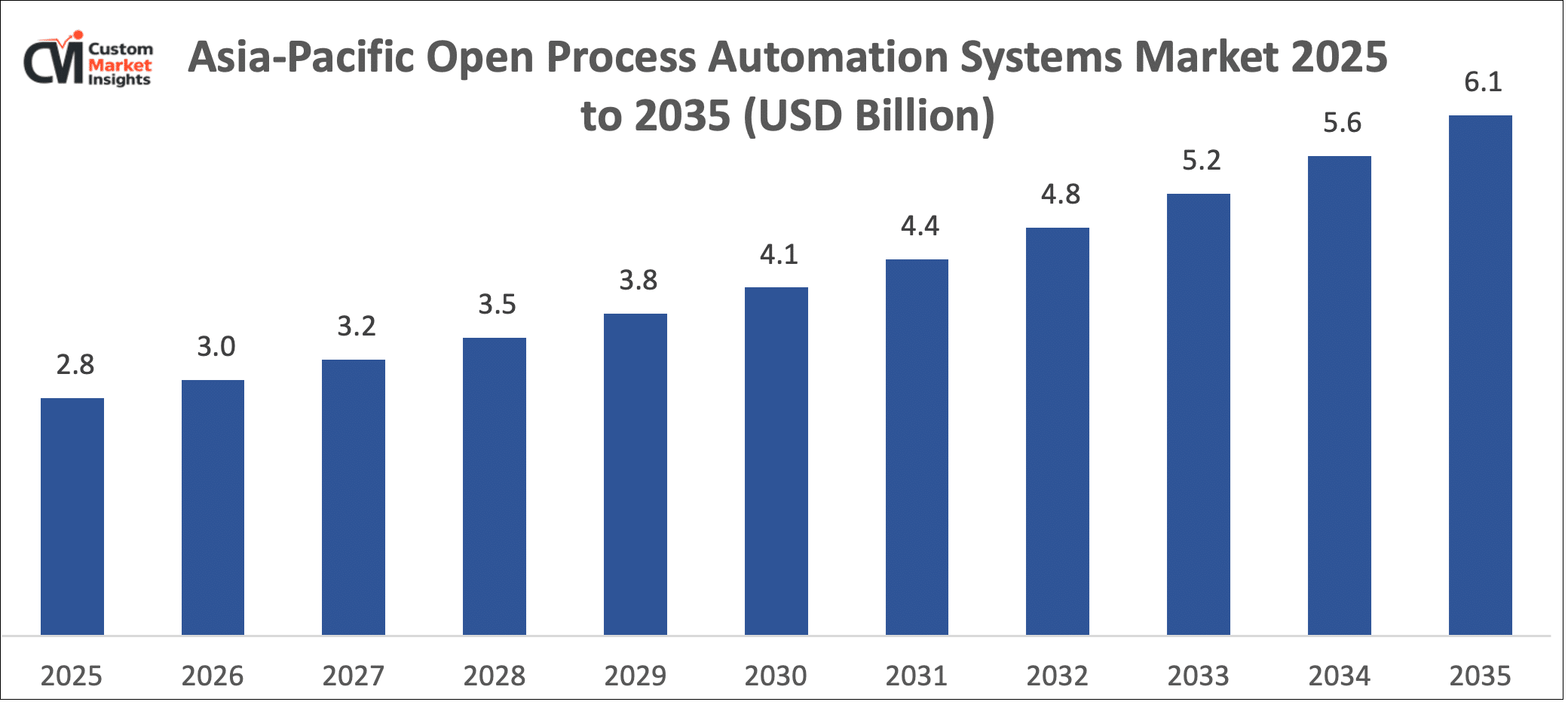
The region is one of the fastest-growing markets due to industrial automation, the creation of the manufacturing sector, and an increase in investment in the Industry 4.0 technologies. The area is also migrating towards modernization of the traditional automation systems besides the introduction of the open and interoperable automation systems to improve productivity and efficiency in operations.
To learn more about this report - request a sample report PDF
Why Does Asia Pacific Control the Market 2025?
In 2025, nearly 40-45 percent of the global market share was attained in the Asia Pacific, which was made possible by strong industrialization, increasing application of smart manufacturing, and increasing demand for sophisticated automation in the oil and gas, chemicals, and power production sectors. Other emerging markets such as China, Japan, South Korea, and India are also emerging as big investors in the modern automation systems and digital manufacturing systems. In April 2024, an example is the announcement by Siemens of the expansion of its industrial automation and digital manufacturing in the Asia Pacific to play a role in the introduction of open and interoperable technologies of automation to local manufacturing processes.
China Market Trends
China conquers the Asian Pacific market because it possesses significant manufacturing experience and colossal investments into the digitalization and automation technologies of the industry. Modernizing the old factories with the open automation solutions, industrial IoT, and other high-performance process control solutions is also underway to enhance efficiency and competitiveness in the country. In October 2023, Schneider Electric also accelerated the installation of EcoStruxure automation solutions to assist manufacturers in China in integrating open and software-defined automation platforms into smart factory environments.
The Growth of North American Market: What Is It Behaved By?
The market size of the North America Open Process Automation Systems will be on an increasing trend even though it is projected that the average growth in the market will be about 6.0% CAGR in the years between 2026 and 2035 and this is because the region is showing a high interest in digital transformation of industries, cybersecurity, and modernization of the next generation control systems. There is also the presence of large automation companies and high open automation rates in most industries, such as oil and gas, power generation, and pharmaceuticals, which are the key drivers of growth. In May 2024, Honeywell declared fresh features to its Experion automation framework to help open interoperable automation landscapes to the industrial operators in North America.
U.S. Market Trends
The high demand for AI-driven automation systems, predictive maintenance, and industrial internet of things systems that enable open automation structures has been experienced in the U.S. market. The industries are adopting digital technologies to make sure that they deliver productivity and reduce the level of downtime in their operation. Rockwell Automation's example declared the innovations to its industrial automation and digital transformation solutions in September 2023, and these solutions help manufacturers deploy the open and connected automation environments.
Top Players in the Market and Their Offerings
- ABB Ltd.
- Siemens AG
- Honeywell International Inc.
- Schneider Electric SE
- Emerson Electric Co.
- Rockwell Automation Inc.
- Yokogawa Electric Corporation
- Mitsubishi Electric Corporation
- General Electric Company
- Hitachi Ltd.
- Bosch Rexroth AG
- FANUC Corporation
- Others
Key Developments
Open Process Automation Systems Market has grown tremendously, with large industrial automation vendors, software makers, and technology corporations investing in open and interoperable automation frameworks, digital control systems, and Industry 4.0 innovation to enhance industrial performance, adaptability, and system combination in the process industries.
- Schneider Electric has recently introduced new functions to its EcoStruxure Automation Expert, a software-defined automation platform that can support open and interoperable automation architectures of industries, allowing manufacturers to mix multi-vendor systems and enhance operational flexibility (June 2023).
- ABB In October 2024, ABB unveiled the additional capabilities of its portfolio of industrial automation and digital solutions, which focuses on AI-based monitoring, predictive maintenance, and open system integration to serve the current process automation environment.
All these reveal the growing interest of businesses in open automation systems, higher levels of digital technologies, and interoperable industrial systems in order to maximize operational efficiency, minimize the complexity of the system, and expedite the implementation of next-generation process automation systems.
Regional Coverage:
North America
- U.S.
- Canada
- Mexico
- Rest of North America
Europe
- Germany
- France
- U.K.
- Russia
- Italy
- Spain
- Netherlands
- Rest of Europe
Asia Pacific
- China
- Japan
- India
- New Zealand
- Australia
- South Korea
- Taiwan
- Rest of Asia Pacific
The Middle East & Africa
- Saudi Arabia
- UAE
- Egypt
- Kuwait
- South Africa
- Rest of the Middle East & Africa
Latin America
- Brazil
- Argentina
- Rest of Latin America
Global Open Process Automation Systems Market 2026 – 2035
Updated: May 2026 · Formats: PDF, Excel, PPT
Frequently asked questions
Who are the key players in the Open Process Automation Systems market?
The key players in the market are ABB Ltd., Siemens AG, Honeywell International Inc., Schneider Electric SE, Emerson Electric Co., Rockwell Automation Inc., Yokogawa Electric Corporation, Mitsubishi Electric Corporation, General Electric Company, Hitachi Ltd., Bosch Rexroth AG, FANUC Corporation, Others.
What are the effects of government regulations on market development?
The open automation technologies are being promoted by government programs, which encourage the implementation of Industry 4.0, smart manufacturing, and industrial cybersecurity. In March 2024, Emerson unveiled modifications to its DeltaV distributed control system that can be used to facilitate contemporary open automation architectures and industrial digitalization endeavors.
What is the effect of pricing on market growth?
Open automation systems have high initial investments in terms of advanced hardware and software as well as integration services. Nevertheless, they have long-term advantages of less downtime, efficiency, and lower maintenance costs. Rockwell Automation in September 2023 introduced new upgraded automation solutions aimed to assist it in flexible and open automation industrial environments.
How big will be the market at the forecast period?
It is estimated that the Open Process Automation Systems Market will increase to approximately USD 14.46 billion by 2035 and will grow at the rate of approximately 8.5% between the years 2026 and 2035. The increased use of AI-driven automation and digital process control technologies helps the market grow. In October 2024, ABB launched the new AI advanced capabilities in the industrial automation solutions.
Where do we expect to find the market leader?
The large market share is likely to be witnessed in North America owing to the high prevalence of industrial automation firms and the use of digital transformation technologies. In May 2024, Honeywell announced that it was adding some new features to its Experion automation platform to allow the integration of open and interoperable process automation systems.
Which area will record the best CAGR?
It is projected that Asia Pacific will register the highest CAGR in 2026-2035 because of the fast industrialization and rising use of Industry 4.0 and smart technologies in manufacturing. China, Japan, and India are among countries that are putting a lot of money into digital manufacturing. Siemens has also developed its industrial automation systems in the Asian Pacific to facilitate the development of sophisticated digital manufacturing systems in April 2024.
What are the key causes of aggressive market growth?
The market of open process automation systems in the world is expanding with the rising demand to automate legacy industrial control systems and reduce vendor lock-in as well as to make automation platforms interoperable. The convergence of the industrial IoT, artificial intelligence, and the development of sophisticated analytics is only enhancing the uptake in the oil and gas, chemicals, and power generation sectors. As an example, in June 2023, Schneider Electric extended the EcoStruxure Automation Expert platform to accommodate open and software-defined automation systems in industries.
More Automotive and Transportation reports
- Global Ultraviolet (UV) Disinfection Equipment Market 2026-2035
- Global Value Stream Management Market 2025 – 2034
- Global Cloud Financial Planning and Analysis Solution Market 2025 – 2034
- Global Hydrogen Technology Testing, Inspection and Certification TIC Market 2026 – 2035
- Global AI Orchestration Platform Market 2026 – 2035
- Global Accounts Receivable Automation Market 2026 – 2035
- Global Subsea Cable Monitoring System Market 2026 – 2035
- Global Smart Grid Cybersecurity Market 2026 – 2035
Table of contents
Buy individual chapters for $490 each: 11 chapters available, from Report Introduction to Company Profiles.
1Report IntroductionBuy · $490
- 1.1Report Description
- 1.1.1Purpose of the Report
- 1.1.2USP & Key Offerings
- 1.2Key Benefits For Stakeholders
- 1.3Target Audience
- 1.4Report Scope
- 1.1
2Market OverviewBuy · $490
- 2.1Report Scope (Segments And Key Players)
- 2.1.1Open Process Automation Systems by Segments
- 2.1.2Open Process Automation Systems by Region
- 2.2Executive Summary
- 2.2.1Market Size & Forecast
- 2.2.2Open Process Automation Systems Market Attractiveness Analysis, By Component
- 2.2.3Open Process Automation Systems Market Attractiveness Analysis, By Deployment Type
- 2.2.4Open Process Automation Systems Market Attractiveness Analysis, By Architecture
- 2.2.5Open Process Automation Systems Market Attractiveness Analysis, By Industry Vertical
- 2.2.6Open Process Automation Systems Market Attractiveness Analysis, By Application
- 2.1
3Market Dynamics (DRO)Buy · $490
- 3.1Market Drivers
- 3.1.1Updating Work Systems With Previous Industrial Automation
- 3.1.2Increase in the Use Of Industry 4.0 and Digital Manufacturing Technologies
- 3.2Market Restraints
- 3.3Market Opportunities
- 3.5Pestle Analysis
- 3.6Porter Forces Analysis
- 3.7Technology Roadmap
- 3.8Value Chain Analysis
- 3.9Government Policy Impact Analysis
- 3.10Pricing Analysis
- 3.1
4Open Process Automation Systems Market - By ComponentBuy · $490
- 4.1Component Market Overview, By Component Segment
- 4.1.1Open Process Automation Systems Market Revenue Share, By Component, 2025 & 2035
- 4.1.2Hardware
- 4.1.3Open Process Automation Systems Share Forecast, By Region (USD Billion)
- 4.1.4Comparative Revenue Analysis, By Country, 2025 & 2035
- 4.1.5Key Market Trends, Growth Factors, & Opportunities
- 4.1.6Software
- 4.1.7Open Process Automation Systems Share Forecast, By Region (USD Billion)
- 4.1.8Comparative Revenue Analysis, By Country, 2025 & 2035
- 4.1.9Key Market Trends, Growth Factors, & Opportunities
- 4.1.10Services
- 4.1.11Open Process Automation Systems Share Forecast, By Region (USD Billion)
- 4.1.12Comparative Revenue Analysis, By Country, 2025 & 2035
- 4.1.13Key Market Trends, Growth Factors, & Opportunities
- 4.1
5Open Process Automation Systems Market - By Deployment TypeBuy · $490
- 5.1Deployment Type Market Overview, By Deployment Type Segment
- 5.1.1Open Process Automation Systems Market Revenue Share, By Deployment Type, 2025 & 2035
- 5.1.2On-Premises
- 5.1.3Open Process Automation Systems Share Forecast, By Region (USD Billion)
- 5.1.4Comparative Revenue Analysis, By Country, 2025 & 2035
- 5.1.5Key Market Trends, Growth Factors, & Opportunities
- 5.1.6Cloud-Based
- 5.1.7Open Process Automation Systems Share Forecast, By Region (USD Billion)
- 5.1.8Comparative Revenue Analysis, By Country, 2025 & 2035
- 5.1.9Key Market Trends, Growth Factors, & Opportunities
- 5.1
6Open Process Automation Systems Market - By ArchitectureBuy · $490
- 6.1Architecture Market Overview, By Architecture Segment
- 6.1.1Open Process Automation Systems Market Revenue Share, By Architecture, 2025 & 2035
- 6.1.2Open Distributed Control Systems (DCS)
- 6.1.3Open Process Automation Systems Share Forecast, By Region (USD Billion)
- 6.1.4Comparative Revenue Analysis, By Country, 2025 & 2035
- 6.1.5Key Market Trends, Growth Factors, & Opportunities
- 6.1.6Modular Control Systems
- 6.1.7Open Process Automation Systems Share Forecast, By Region (USD Billion)
- 6.1.8Comparative Revenue Analysis, By Country, 2025 & 2035
- 6.1.9Key Market Trends, Growth Factors, & Opportunities
- 6.1.10Interoperable Automation Platforms
- 6.1.11Open Process Automation Systems Share Forecast, By Region (USD Billion)
- 6.1.12Comparative Revenue Analysis, By Country, 2025 & 2035
- 6.1.13Key Market Trends, Growth Factors, & Opportunities
- 6.1
7Open Process Automation Systems Market - By Industry VerticalBuy · $490
- 7.1Industry Vertical Market Overview, By Industry Vertical Segment
- 7.1.1Open Process Automation Systems Market Revenue Share, By Industry Vertical, 2025 & 2035
- 7.1.2Oil & Gas
- 7.1.3Open Process Automation Systems Share Forecast, By Region (USD Billion)
- 7.1.4Comparative Revenue Analysis, By Country, 2025 & 2035
- 7.1.5Key Market Trends, Growth Factors, & Opportunities
- 7.1.6Chemicals
- 7.1.7Open Process Automation Systems Share Forecast, By Region (USD Billion)
- 7.1.8Comparative Revenue Analysis, By Country, 2025 & 2035
- 7.1.9Key Market Trends, Growth Factors, & Opportunities
- 7.1.10Power Generation
- 7.1.11Open Process Automation Systems Share Forecast, By Region (USD Billion)
- 7.1.12Comparative Revenue Analysis, By Country, 2025 & 2035
- 7.1.13Key Market Trends, Growth Factors, & Opportunities
- 7.1.14Pharmaceuticals
- 7.1.15Open Process Automation Systems Share Forecast, By Region (USD Billion)
- 7.1.16Comparative Revenue Analysis, By Country, 2025 & 2035
- 7.1.17Key Market Trends, Growth Factors, & Opportunities
- 7.1.18Manufacturing
- 7.1.19Open Process Automation Systems Share Forecast, By Region (USD Billion)
- 7.1.20Comparative Revenue Analysis, By Country, 2025 & 2035
- 7.1.21Key Market Trends, Growth Factors, & Opportunities
- 7.1
8Open Process Automation Systems Market - By ApplicationBuy · $490
- 8.1Application Market Overview, By Application Segment
- 8.1.1Open Process Automation Systems Market Revenue Share, By Application, 2025 & 2035
- 8.1.2Process Control
- 8.1.3Open Process Automation Systems Share Forecast, By Region (USD Billion)
- 8.1.4Comparative Revenue Analysis, By Country, 2025 & 2035
- 8.1.5Key Market Trends, Growth Factors, & Opportunities
- 8.1.6Asset Management
- 8.1.7Open Process Automation Systems Share Forecast, By Region (USD Billion)
- 8.1.8Comparative Revenue Analysis, By Country, 2025 & 2035
- 8.1.9Key Market Trends, Growth Factors, & Opportunities
- 8.1.10Plant Optimization
- 8.1.11Open Process Automation Systems Share Forecast, By Region (USD Billion)
- 8.1.12Comparative Revenue Analysis, By Country, 2025 & 2035
- 8.1.13Key Market Trends, Growth Factors, & Opportunities
- 8.1.14Industrial Monitoring
- 8.1.15Open Process Automation Systems Share Forecast, By Region (USD Billion)
- 8.1.16Comparative Revenue Analysis, By Country, 2025 & 2035
- 8.1.17Key Market Trends, Growth Factors, & Opportunities
- 8.1
9Open Process Automation Systems Market - Regional AnalysisBuy · $490
- 9.1Open Process Automation Systems Market Overview, By Region Segment
- 9.1.1Global Open Process Automation Systems Market Revenue Share, By Region, 2025 & 2035
- 9.1.2Global Open Process Automation Systems Market Revenue, By Region, 2026 - 2035 (USD Billion)
- 9.1.3Global Open Process Automation Systems Market Revenue, By Component, 2026 - 2035
- 9.1.4Global Open Process Automation Systems Market Revenue, By Deployment Type, 2026 - 2035
- 9.1.5Global Open Process Automation Systems Market Revenue, By Architecture, 2026 - 2035
- 9.1.6Global Open Process Automation Systems Market Revenue, By Industry Vertical, 2026 - 2035
- 9.1.7Global Open Process Automation Systems Market Revenue, By Application, 2026 - 2035
- 9.2North America
- 9.2.1North America Open Process Automation Systems Market Revenue, By Country, 2026 - 2035 (USD Billion)
- 9.2.2North America Open Process Automation Systems Market Revenue, By Component, 2026 - 2035
- 9.2.3North America Open Process Automation Systems Market Revenue, By Deployment Type, 2026 - 2035
- 9.2.4North America Open Process Automation Systems Market Revenue, By Architecture, 2026 - 2035
- 9.2.5North America Open Process Automation Systems Market Revenue, By Industry Vertical, 2026 - 2035
- 9.2.6North America Open Process Automation Systems Market Revenue, By Application, 2026 - 2035
- 9.2.7U.S. Open Process Automation Systems Market Revenue, 2026 - 2035 (USD Billion)
- 9.2.8Canada Open Process Automation Systems Market Revenue, 2026 - 2035 (USD Billion)
- 9.2.9Mexico Open Process Automation Systems Market Revenue, 2026 - 2035 (USD Billion)
- 9.2.10Rest of North America Open Process Automation Systems Market Revenue, 2026 - 2035 (USD Billion)
- 9.3Europe
- 9.3.1Europe Open Process Automation Systems Market Revenue, By Country, 2026 - 2035 (USD Billion)
- 9.3.2Europe Open Process Automation Systems Market Revenue, By Component, 2026 - 2035
- 9.3.3Europe Open Process Automation Systems Market Revenue, By Deployment Type, 2026 - 2035
- 9.3.4Europe Open Process Automation Systems Market Revenue, By Architecture, 2026 - 2035
- 9.3.5Europe Open Process Automation Systems Market Revenue, By Industry Vertical, 2026 - 2035
- 9.3.6Europe Open Process Automation Systems Market Revenue, By Application, 2026 - 2035
- 9.3.7Germany Open Process Automation Systems Market Revenue, 2026 - 2035 (USD Billion)
- 9.3.8France Open Process Automation Systems Market Revenue, 2026 - 2035 (USD Billion)
- 9.3.9U.K. Open Process Automation Systems Market Revenue, 2026 - 2035 (USD Billion)
- 9.3.10Russia Open Process Automation Systems Market Revenue, 2026 - 2035 (USD Billion)
- 9.3.11Italy Open Process Automation Systems Market Revenue, 2026 - 2035 (USD Billion)
- 9.3.12Spain Open Process Automation Systems Market Revenue, 2026 - 2035 (USD Billion)
- 9.3.13Netherlands Open Process Automation Systems Market Revenue, 2026 - 2035 (USD Billion)
- 9.3.14Rest of Europe Open Process Automation Systems Market Revenue, 2026 - 2035 (USD Billion)
- 9.4Asia Pacific
- 9.4.1Asia Pacific Open Process Automation Systems Market Revenue, By Country, 2026 - 2035 (USD Billion)
- 9.4.2Asia Pacific Open Process Automation Systems Market Revenue, By Component, 2026 - 2035
- 9.4.3Asia Pacific Open Process Automation Systems Market Revenue, By Deployment Type, 2026 - 2035
- 9.4.4Asia Pacific Open Process Automation Systems Market Revenue, By Architecture, 2026 - 2035
- 9.4.5Asia Pacific Open Process Automation Systems Market Revenue, By Industry Vertical, 2026 - 2035
- 9.4.6Asia Pacific Open Process Automation Systems Market Revenue, By Application, 2026 - 2035
- 9.4.7China Open Process Automation Systems Market Revenue, 2026 - 2035 (USD Billion)
- 9.4.8Japan Open Process Automation Systems Market Revenue, 2026 - 2035 (USD Billion)
- 9.4.9India Open Process Automation Systems Market Revenue, 2026 - 2035 (USD Billion)
- 9.4.10New Zealand Open Process Automation Systems Market Revenue, 2026 - 2035 (USD Billion)
- 9.4.11Australia Open Process Automation Systems Market Revenue, 2026 - 2035 (USD Billion)
- 9.4.12South Korea Open Process Automation Systems Market Revenue, 2026 - 2035 (USD Billion)
- 9.4.13Taiwan Open Process Automation Systems Market Revenue, 2026 - 2035 (USD Billion)
- 9.4.14Rest of Asia Pacific Open Process Automation Systems Market Revenue, 2026 - 2035 (USD Billion)
- 9.5The Middle-East and Africa
- 9.5.1The Middle-East and Africa Open Process Automation Systems Market Revenue, By Country, 2026 - 2035 (USD Billion)
- 9.5.2The Middle-East and Africa Open Process Automation Systems Market Revenue, By Component, 2026 - 2035
- 9.5.3The Middle-East and Africa Open Process Automation Systems Market Revenue, By Deployment Type, 2026 - 2035
- 9.5.4The Middle-East and Africa Open Process Automation Systems Market Revenue, By Architecture, 2026 - 2035
- 9.5.5The Middle-East and Africa Open Process Automation Systems Market Revenue, By Industry Vertical, 2026 - 2035
- 9.5.6The Middle-East and Africa Open Process Automation Systems Market Revenue, By Application, 2026 - 2035
- 9.5.7Saudi Arabia Open Process Automation Systems Market Revenue, 2026 - 2035 (USD Billion)
- 9.5.8UAE Open Process Automation Systems Market Revenue, 2026 - 2035 (USD Billion)
- 9.5.9Egypt Open Process Automation Systems Market Revenue, 2026 - 2035 (USD Billion)
- 9.5.10Kuwait Open Process Automation Systems Market Revenue, 2026 - 2035 (USD Billion)
- 9.5.11South Africa Open Process Automation Systems Market Revenue, 2026 - 2035 (USD Billion)
- 9.5.12Rest of the Middle East & Africa Open Process Automation Systems Market Revenue, 2026 - 2035 (USD Billion)
- 9.6Latin America
- 9.6.1Latin America Open Process Automation Systems Market Revenue, By Country, 2026 - 2035 (USD Billion)
- 9.6.2Latin America Open Process Automation Systems Market Revenue, By Component, 2026 - 2035
- 9.6.3Latin America Open Process Automation Systems Market Revenue, By Deployment Type, 2026 - 2035
- 9.6.4Latin America Open Process Automation Systems Market Revenue, By Architecture, 2026 - 2035
- 9.6.5Latin America Open Process Automation Systems Market Revenue, By Industry Vertical, 2026 - 2035
- 9.6.6Latin America Open Process Automation Systems Market Revenue, By Application, 2026 - 2035
- 9.6.7Brazil Open Process Automation Systems Market Revenue, 2026 - 2035 (USD Billion)
- 9.6.8Argentina Open Process Automation Systems Market Revenue, 2026 - 2035 (USD Billion)
- 9.6.9Rest of Latin America Open Process Automation Systems Market Revenue, 2026 - 2035 (USD Billion)
- 9.1
10Competitive LandscapeBuy · $490
- 10.1Company Market Share Analysis - 2025
- 10.1.1Global Open Process Automation Systems Market: Company Market Share, 2025
- 10.2Global Open Process Automation Systems Market Company Market Share, 2024
- 10.1
11Company ProfilesBuy · $490
- 11.1ABB Ltd.Company OverviewKey ExecutivesProduct PortfolioFinancial OverviewOperating Business SegmentsBusiness PerformanceRecent Developments
- 11.2Siemens AG
- 11.3Honeywell International Inc.
- 11.4Schneider Electric SE
- 11.5Emerson Electric Co.
- 11.6Rockwell Automation Inc.
- 11.7Yokogawa Electric Corporation
- 11.8Mitsubishi Electric Corporation
- 11.9General Electric Company
- 11.10Hitachi Ltd.
- 11.11Bosch Rexroth AG
- 11.12FANUC Corporation
- 11.1
12Research Methodology
- 12.1Research Methodology
- 12.2Secondary Research
- 12.3Primary Research
- 12.3.1Analyst Tools and Models
- 12.4Research Limitations
- 12.5Assumptions
- 12.6Insights From Primary Respondents
- 12.7Why Custom Market Insights
- 12.1
13Standard Report Commercials & Add-Ons
- 13.1Customization Options
- 13.2Subscription Module For Market Research Reports
- 13.3Client Testimonials
- List Of Figures
- Figures No 1 to 37
- List Of Tables
- Tables No 1 to 56
- 13.1
Get the full report structure, sample pages and data tables in the free sample.
Download free sampleMarket segments
The Open Process Automation Systems Market is segmented as follows:
By Component
- Hardware
- Software
- Services
By Deployment Type
- On-Premises
- Cloud-Based
By Architecture
- Open Distributed Control Systems (DCS)
- Modular Control Systems
- Interoperable Automation Platforms
By Industry Vertical
- Oil & Gas
- Chemicals
- Power Generation
- Pharmaceuticals
- Manufacturing
By Application
- Process Control
- Asset Management
- Plant Optimization
- Industrial Monitoring
Get the full report structure, sample pages and data tables in the free sample.
Download free sampleCompany listing
- ABB Ltd.114 reports
- Siemens AG164 reports
- Honeywell International Inc.139 reports
- Schneider Electric SE96 reports
- Emerson Electric Co.55 reports
- Rockwell Automation Inc.30 reports
- Yokogawa Electric Corporation19 reports
- Mitsubishi Electric Corporation78 reports
- General Electric Company89 reports
- Hitachi Ltd.41 reports
- Bosch Rexroth AG15 reports
- FANUC Corporation11 reports
- And many more
Get the full report structure, sample pages and data tables in the free sample.
Download free sample