
Vending Machine Market Size, Trends and Insights By Type (Tobacco Vending Machine, Food Vending Machine, Beverages Vending Machine, Others), By Application (Hotels & Restaurants, Public Places, Corporate Offices, Others), By Technology (Smart Machine, Automatic Machine, Semi-Automatic Machine), and By Region - Global Industry Overview, Statistical Data, Competitive Analysis, Share, Outlook, and Forecast 2026 – 2035
Report Snapshot
CAGR: 5.6%
| Study Period: | 2026-2035 |
| Fastest Growing Market: | Asia Pacific |
| Largest Market: | North America |
Major Players
- Evoca Group
- Royal Vendors Inc.
- N&W Global Vending S.p.A.
- Fuji Electric Co. Ltd.
- Others
Reports Description
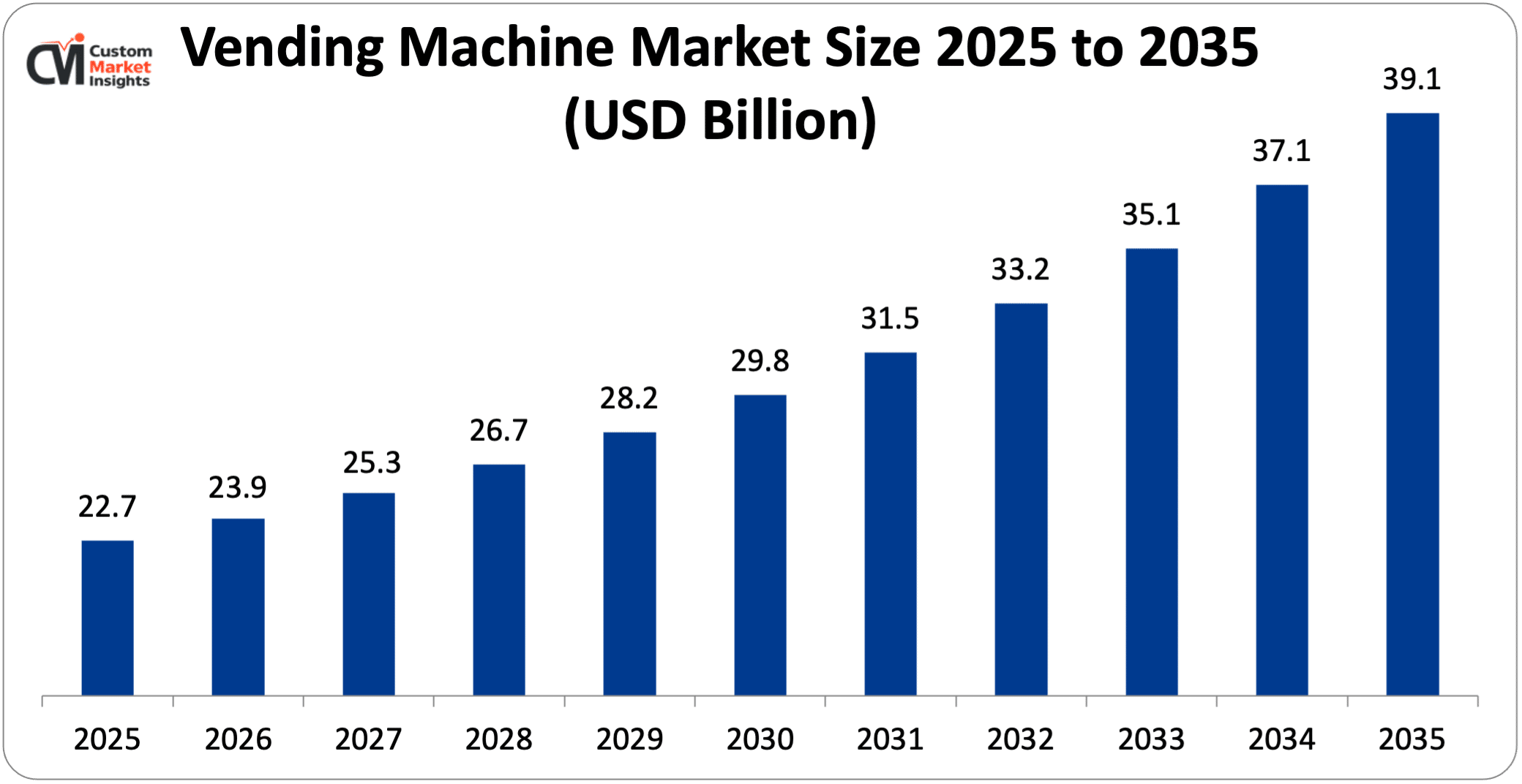
The market size of global vending machines will be estimated at USD 22.7 billion in 2025 and is expected to grow to between USD 23.9 billion in 2026 and about USD 39.1 billion by 2035, with a current CAGR (compound annual growth rate) of 5.6% during the period of 2026 to 2035. A vending machine operates as a self-operated retail machine that dispenses products to customers who make payments to the machine. The machines function independently of human operators, and they get placed in locations that receive high foot traffic, including offices, schools, hospitals, transportation hubs, and public spaces.
Modern vending machines use advanced technologies that include digital payment systems that support UPI, card, and mobile wallet payments; touchscreens; and IoT-based inventory management systems that enable real-time monitoring and improved user experience. The vending machines serve as vital components of the modern automated retail system because they provide customers with nonstop access to their services and enable rapid payment processing.
Market Highlight
- In 2025, North America will dominate the global market with an estimated market share of 45%. This growth is driven by the region’s strong demand for convenience-oriented consumption, supported by fast-paced lifestyles and a large working population that prefers quick, on-the-go food and beverage options.
- The Asia Pacific is growing at the highest CAGR over the analysis period. The increasing product launches and growing urbanization drive the industry growth.
- By type, the beverages vending machine segment accounted for the highest revenue share in 2025 of over 40%.
- By application, the hotels & restaurants segment would have the highest share of the market in 2025 of 39%.
- By technology, the automatic machine segment dominated the market with a revenue share of 55%.
Significant Growth Factors
The vending machine market trends present significant growth opportunities due to several factors:
- Rising Demand For Convenience & On-The-Go Consumption: The vending machine market expands because modern consumers now prefer fast and easy access to products which they can obtain without delay. People who live busy lives and work long hours need to find fast ways to get food and drinks and essential items that they can buy without going to traditional stores. Vending machines fulfill this requirement because they provide customers with immediate product availability at major locations which include offices, metro stations, airports and educational institutions. The system enables customers to make fast contactless payments that decrease their waiting time and result in higher customer satisfaction while creating repeated use patterns that drive market expansion.
- Urbanization & Changing Lifestyles: Urbanization together with changing lifestyles leads to increased development of the vending machine industry because urban areas undergo rapid population growth while modern infrastructure development creates higher demand for immediate retail services. The increasing number of people who work in fast-paced environments together with their time-restricted schedules has resulted in a greater demand for self-service solutions that help them maintain their daily activities. Vending machines which office spaces, commercial buildings, transport terminals and public areas have established their locations in, provide customers with immediate access to food and drinks and essential products. The growing middle class in urban areas together with their changing shopping behaviors results in increased acceptance of automated retail systems which leads to continuous market development.
What are the Major Advances Changing the Vending Machine Market Today?
- Smart Vending Machines (IoT Integration): The Internet of Things (IoT) has created smart vending machines which bring major technological progress to the vending machine industry by turning standard vending machines into intelligent retail systems that operate through internet connections. The machines use sensors together with cloud-based software to provide operators the ability to track inventory levels and monitor sales performance while receiving instant notifications about restocking requirements and machinery maintenance needs. The system operates at maximum efficiency because it establishes a direct connection between the different components which helps to decrease operational problems while maintaining product stocks for maximum service. Businesses use IoT integration to collect data about consumer purchasing behavior which helps them choose products and decide their display locations according to actual customer demand. Smart vending machines improve business operations together with customer service which leads to their ability to drive market expansion.
- Touchless & Biometric Interfaces: The vending machine industry has undergone a significant transformation because touchless and biometric systems now allow customers to engage with automated retail machines in completely new ways. Through their contactless payment system users can complete transactions using gesture control, voice commands, QR code scanning and facial or fingerprint authentication. The system provides both fast service and user-friendly operation which helps people maintain hygiene standards during busy times at public areas. Biometric authentication enables businesses to construct secure systems that allow customers to receive personalized product recommendations and make safe payment transactions. The market for touchless and biometric vending machines has expanded because customers now demand contactless shopping experiences which drive businesses to create new products.
Category Wise Insights
By Type
Why Beverages Vending Machine Hold a Prominent Position in the Market?
The beverage vending machine segment accounted for the highest revenue share in 2025 of over 40%. Consumers maintain a steady requirement for instant drink accessibility, which includes soft drinks, coffee, tea, energy drinks, and bottled water. The demand for immediate refreshment services has increased because of urban population growth, consumer work patterns, and the development of new educational and transportation facilities.
The food vending machine segment is growing at the highest CAGR during the forecast period. The growth is driven by the increasing demand for quick, accessible, and ready-to-eat meal options among busy urban consumers. Vending machines have become popular among consumers who need convenient food options because they face increased work demands that force them to eat differently while lacking time for conventional dining. The various technological advancements, which include temperature-controlled compartments, smart dispensing systems, and cashless payment integration, have achieved three main benefits by enhancing food quality, safety, and user experience, which resulted in higher adoption rates of their products.
By Application
Why Hotels & Restaurants Capture the Highest Market Share in the Vending Machine Market?
The hotels & restaurants segment would have the highest share of the market in 2025 of 39%. Automated systems, which boost guest satisfaction and operational performance, become more popular every day, which leads to business growth. Hospitality providers use vending machines to provide round-the-clock access to snacks and beverages and essential products, which decreases their need for staff to perform normal tasks while they spend less on employee expenses. Vending machines in hotel lobbies and corridors and recreational spaces enable guests to make fast and contactless purchases, which improve their hotel experience. Restaurants use vending machines to provide customers with self-service ordering and takeaway options, which extend their operating hours beyond regular dining times. The growing focus on contactless service, especially post-pandemic, together with smart vending technologies and cashless payments, which are becoming more advanced, leads to increased adoption because these factors drive businesses to achieve steady revenue growth.
The public places segment is growing at a rapid rate over the projected period. The growing use of digital payment systems combined with intelligent vending machine systems results in faster transactions, which improve customer experience and lead to more frequent use of these systems. The expansion of urban development together with rising public transportation needs will result in more vending machines being installed at public locations, which will create ongoing revenue growth for this business sector.
By Technology
Why Automatic Machine dominates in the Vending Machine Market?
The automatic machine segment dominated the market with a revenue share of 55%. An automatic vending machine is a self-operated device that delivers products when payment is received. The vending machine industry currently demonstrates a trend toward modern technologies, which include Internet of Things (IoT) integration, touchless controls, and digital payment systems. The system upgrades enable users to access better convenience while operators receive instant inventory data, which helps them manage stock more effectively. Automatic machines are embracing these technological enhancements to meet the changing demands of today’s consumers.
The smart machine segment is growing at a rapid rate over the projected period. The smart machines that vending machines use operate with advanced technology that improves their efficiency while creating better experiences for their users. These machines incorporate features like IoT connectivity, touchless interfaces, and data analytics. The vending machine industry currently develops through several trends that implement predictive maintenance using machine learning, real-time system monitoring through IoT, contactless payment systems for better hygiene, and customized product recommendations. Smart vending machines are developing into a retail solution that provides customers with an effortless shopping experience through their use of data and displays that fit their current needs.
Report Scope
| Feature of the Report | Details |
| Market Size in 2026 | USD 23.9 billion |
| Projected Market Size in 2035 | USD 39.1 billion |
| Market Size in 2025 | USD 22.7 billion |
| CAGR Growth Rate | 5.6% CAGR |
| Base Year | 2025 |
| Forecast Period | 2026-2035 |
| Key Segment | By Type, Application, Technology and Region |
| Report Coverage | Revenue Estimation and Forecast, Company Profile, Competitive Landscape, Growth Factors and Recent Trends |
| Regional Scope | North America, Europe, Asia Pacific, Middle East & Africa, and South & Central America |
| Buying Options | Request tailored purchasing options to fulfil your requirements for research. |
Regional Analysis
How Big is the North American Vending Machine Market Size?
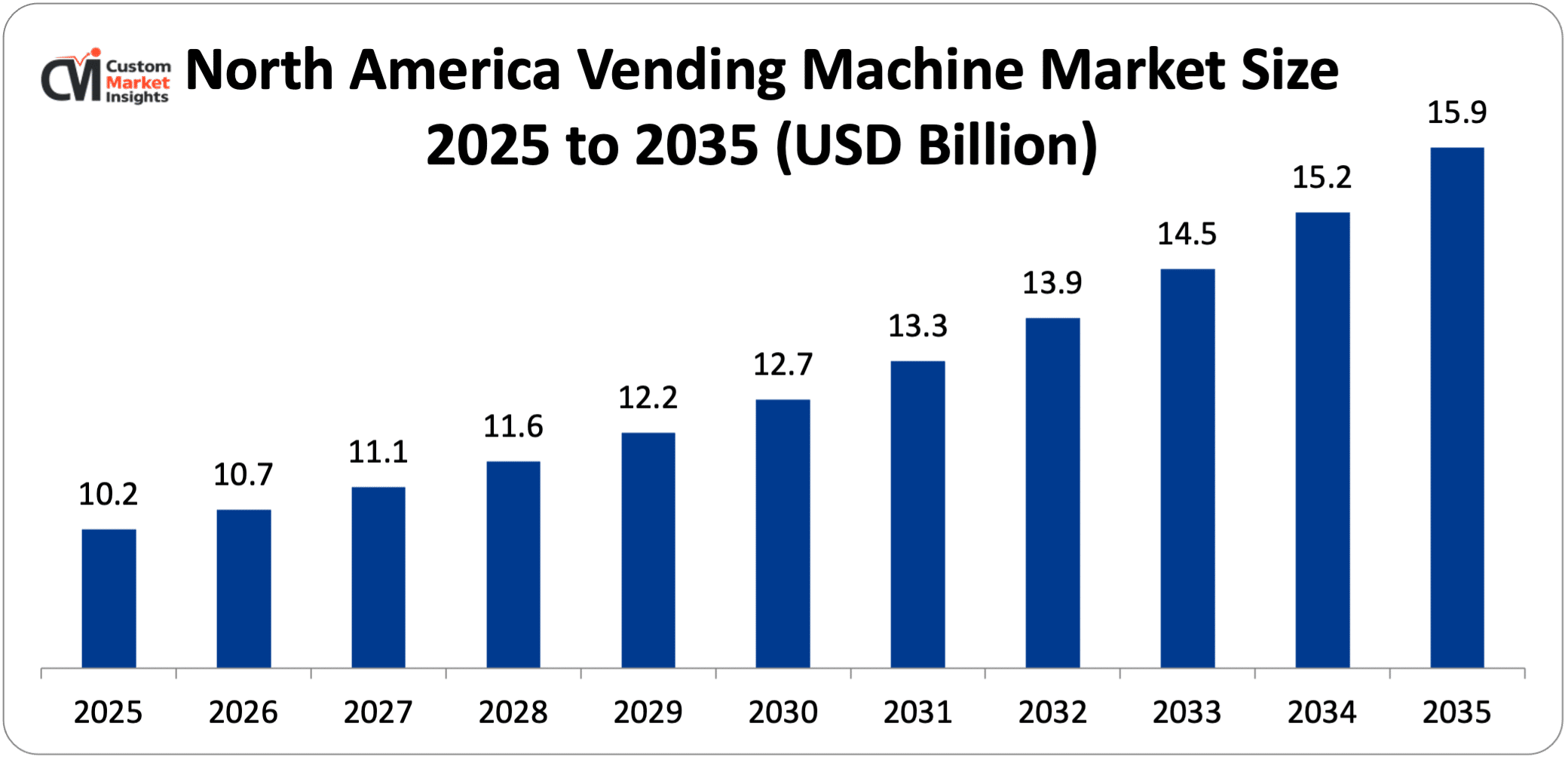
Its market size, in terms of North America Vending Machine, is projected to be USD 10.2 billion in 2025 with a growth of about USD 15.9 billion in 2035 with a CAGR of 4.5% between 2026 and 2035.
Why did North America Dominate the Vending Machine Market in 2025?
In 2025, North America will dominate the global market with an estimated market share of 45%. The region benefits from three factors, which include its strong infrastructure system, its high consumer demand for convenience, and its history of adopting new vending technologies. North America has developed a mature vending industry that operates through various payment methods and touchless systems and provides different types of products to customers. The market expands because people snack while they work and there exists a big workforce in the area. North America occupies a significant position in the vending machine market because its technological progress and customer-focused business model enable it to maintain a substantial market share.
US Vending Machine Market Trends
In the North American region, the US is expected to dominate the market over the projected period. The high import of vending machines in the area drives the industry growth. According to the Observatory of Economic Complexity (OEC) report, the main import for vending machines has been the U.S., importing $257 million in 2023 and $259 million in 2024.
Why is Europe Experiencing Significant Growth in the Vending Machine Market?
Europe holds a significant market share in 2025. Europe operates as a mature vending market that receives its cultural influence from European work environments and urban coffee drinking traditions. The demand for products centers on beverages and nutritious snacks, which offer both quality and convenient consumption. Digital wallets are becoming popular among young people, just as hybrid payment models continue to exist. The operators focus on intelligent connected machines, which enhance both service reliability and user experience.
Germany Vending Machine Market Trends
Germany held the dominant position in the market in 2025. Germany has developed workplace vending machines to support both industrial productivity needs and employee convenience requirements. The machines provide vending services that offer fresh meals and high-quality coffee together with healthy snack options. People continue to use hybrid payment systems, which allow them to pay with both cash and digital methods. The large cities generate additional revenue through their sale of electronic products and pharmaceutical items and locally produced goods.
Why is the Asia Pacific Growing at a Highest CAGR in the Vending Machine Market?
The Asia Pacific is expected to grow at the highest CAGR over the projected period. The vending machine market in this area experiences high growth because of multiple reasons. The urban areas of this region have expanded through rapid urbanization which created dense population centers that require easy-to-reach retail services. The widespread use of cashless payment systems together with new technological developments has increased the operational efficiency and market attractiveness of vending machines.
India Vending Machine Market Trends
India holds the prominent market share in the industry. The growth is driven by three factors, which include rapid urbanization and people who demand convenience and the increasing use of advanced technologies. India is the top producer and exporter of vending machines because government programs such as “Make in India” support the industry. India exports more vending machines than any other country, with 34,262 shipments, while China follows with 21,813 shipments in 2024.
Why is the Middle East & Africa Region is growing rapidly in the Vending Machine?
The MEA region is growing at a steady rate over the projected period. Urbanization together with infrastructure development activities, which take place in countries such as the UAE and Saudi Arabia and South Africa. The growing urban population together with their active lifestyles. This creates a need for food and beverage options that people can consume while they travel. The airport and hotel and entertainment hub sectors have expanded their operations. This growth has led to more vending machines being installed. International travelers use these machines to find products that they can obtain quickly and easily.
UAE Vending Machine Market Trends
The UAE is growing at the highest CAGR during the forecast period. The growing innovative product launch drives the industry growth.
Top Players in the Vending Machine Market and Their Offerings
- Evoca Group
- Royal Vendors Inc.
- N&W Global Vending S.p.A.
- Fuji Electric Co. Ltd.
- Selecta Group AG
- Azkoyen S.A.
- FAS International S.p.A.
- Bianchi Industry SpA
- Glory Limited
- Sielaff GmbH & Co. KG
- Groupe SEB
- Vendekin Technologies
- Vendiman
- Vendstop
- Godrej Enterprises
- The Vending Company
- Others
Key Developments
Vending machine market has experienced considerable changes in the last two years as the market players are trying to diversify their technological aspects and develop product portfolios using strategic approaches.
- In April 2025, Coca-Cola Bottlers Japan Inc. and its partner, Fuji Electric, launched the world’s first hydrogen-powered vending machine at EXPO 2025 in Osaka, Japan. This technology allows the vending machine to function in any location or weather condition without emitting CO2.
- In March 2025, Wendor, one of India’s leading smart vending solutions providers, launched its innovative state-of-the-art vending machines and smart lockers to revolutionize the food and beverage industry at AAHAR 2025.
These strategic measures have enabled the companies to reinforce their competitive positions, increase the product line, boost their technological competencies, and also seize growth opportunities in the fast-growing vending machine market.
The Vending Machine Market is segmented as follows:
By Type
- Tobacco Vending Machine
- Food Vending Machine
- Beverages Vending Machine
- Others
By Application
- Hotels & Restaurants
- Public Places
- Corporate Offices
- Others
By Technology
- Smart Machine
- Automatic Machine
- Semi-Automatic Machine
Regional Coverage:
North America
- U.S.
- Canada
- Mexico
- Rest of North America
Europe
- Germany
- France
- U.K.
- Russia
- Italy
- Spain
- Netherlands
- Rest of Europe
Asia Pacific
- China
- Japan
- India
- New Zealand
- Australia
- South Korea
- Taiwan
- Rest of Asia Pacific
The Middle East & Africa
- Saudi Arabia
- UAE
- Egypt
- Kuwait
- South Africa
- Rest of the Middle East & Africa
Latin America
- Brazil
- Argentina
- Rest of Latin America
Table of Contents
- Chapter 1. Report Introduction
- 1.1. Report Description
- 1.1.1. Purpose of the Report
- 1.1.2. USP & Key Offerings
- 1.2. Key Benefits For Stakeholders
- 1.3. Target Audience
- 1.4. Report Scope
- 1.1. Report Description
- Chapter 2. Market Overview
- 2.1. Report Scope (Segments And Key Players)
- 2.1.1. Vending Machine by Segments
- 2.1.2. Vending Machine by Region
- 2.2. Executive Summary
- 2.2.1. Market Size & Forecast
- 2.2.2. Vending Machine Market Attractiveness Analysis, By Type
- 2.2.3. Vending Machine Market Attractiveness Analysis, By Application
- 2.2.4. Vending Machine Market Attractiveness Analysis, By Technology
- 2.1. Report Scope (Segments And Key Players)
- Chapter 3. Market Dynamics (DRO)
- 3.1. Market Drivers
- 3.1.1. Rising Demand For Convenience & On-The-Go Consumption
- 3.1.2. Urbanization & Changing Lifestyles
- 3.2. Market Restraints
- 3.3. Market Opportunities
- 3.5. Pestle Analysis
- 3.6. Porter Forces Analysis
- 3.7. Technology Roadmap
- 3.8. Value Chain Analysis
- 3.9. Government Policy Impact Analysis
- 3.10. Pricing Analysis
- 3.1. Market Drivers
- Chapter 4. Vending Machine Market – By Type
- 4.1. Type Market Overview, By Type Segment
- 4.1.1. Vending Machine Market Revenue Share, By Type, 2025 & 2035
- 4.1.2. Tobacco Vending Machine
- 4.1.3. Vending Machine Share Forecast, By Region (USD Billion)
- 4.1.4. Comparative Revenue Analysis, By Country, 2025 & 2035
- 4.1.5. Key Market Trends, Growth Factors, & Opportunities
- 4.1.6. Food Vending Machine
- 4.1.7. Vending Machine Share Forecast, By Region (USD Billion)
- 4.1.8. Comparative Revenue Analysis, By Country, 2025 & 2035
- 4.1.9. Key Market Trends, Growth Factors, & Opportunities
- 4.1.10. Beverages Vending Machine
- 4.1.11. Vending Machine Share Forecast, By Region (USD Billion)
- 4.1.12. Comparative Revenue Analysis, By Country, 2025 & 2035
- 4.1.13. Key Market Trends, Growth Factors, & Opportunities
- 4.1.14. Others
- 4.1.15. Vending Machine Share Forecast, By Region (USD Billion)
- 4.1.16. Comparative Revenue Analysis, By Country, 2025 & 2035
- 4.1.17. Key Market Trends, Growth Factors, & Opportunities
- 4.1. Type Market Overview, By Type Segment
- Chapter 5. Vending Machine Market – By Application
- 5.1. Application Market Overview, By Application Segment
- 5.1.1. Vending Machine Market Revenue Share, By Application, 2025 & 2035
- 5.1.2. Hotels & Restaurants
- 5.1.3. Vending Machine Share Forecast, By Region (USD Billion)
- 5.1.4. Comparative Revenue Analysis, By Country, 2025 & 2035
- 5.1.5. Key Market Trends, Growth Factors, & Opportunities
- 5.1.6. Public Places
- 5.1.7. Vending Machine Share Forecast, By Region (USD Billion)
- 5.1.8. Comparative Revenue Analysis, By Country, 2025 & 2035
- 5.1.9. Key Market Trends, Growth Factors, & Opportunities
- 5.1.10. Corporate Offices
- 5.1.11. Vending Machine Share Forecast, By Region (USD Billion)
- 5.1.12. Comparative Revenue Analysis, By Country, 2025 & 2035
- 5.1.13. Key Market Trends, Growth Factors, & Opportunities
- 5.1.14. Others
- 5.1.15. Vending Machine Share Forecast, By Region (USD Billion)
- 5.1.16. Comparative Revenue Analysis, By Country, 2025 & 2035
- 5.1.17. Key Market Trends, Growth Factors, & Opportunities
- 5.1. Application Market Overview, By Application Segment
- Chapter 6. Vending Machine Market – By Technology
- 6.1. Technology Market Overview, By Technology Segment
- 6.1.1. Vending Machine Market Revenue Share, By Technology, 2025 & 2035
- 6.1.2. Smart Machine
- 6.1.3. Vending Machine Share Forecast, By Region (USD Billion)
- 6.1.4. Comparative Revenue Analysis, By Country, 2025 & 2035
- 6.1.5. Key Market Trends, Growth Factors, & Opportunities
- 6.1.6. Automatic Machine
- 6.1.7. Vending Machine Share Forecast, By Region (USD Billion)
- 6.1.8. Comparative Revenue Analysis, By Country, 2025 & 2035
- 6.1.9. Key Market Trends, Growth Factors, & Opportunities
- 6.1.10. Semi-Automatic Machine
- 6.1.11. Vending Machine Share Forecast, By Region (USD Billion)
- 6.1.12. Comparative Revenue Analysis, By Country, 2025 & 2035
- 6.1.13. Key Market Trends, Growth Factors, & Opportunities
- 6.1. Technology Market Overview, By Technology Segment
- Chapter 7. Vending Machine Market – Regional Analysis
- 7.1. Vending Machine Market Overview, By Region Segment
- 7.1.1. Global Vending Machine Market Revenue Share, By Region, 2025 & 2035
- 7.1.2. Global Vending Machine Market Revenue, By Region, 2026 – 2035 (USD Billion)
- 7.1.3. Global Vending Machine Market Revenue, By Type, 2026 – 2035
- 7.1.4. Global Vending Machine Market Revenue, By Application, 2026 – 2035
- 7.1.5. Global Vending Machine Market Revenue, By Technology, 2026 – 2035
- 7.2. North America
- 7.2.1. North America Vending Machine Market Revenue, By Country, 2026 – 2035 (USD Billion)
- 7.2.2. North America Vending Machine Market Revenue, By Type, 2026 – 2035
- 7.2.3. North America Vending Machine Market Revenue, By Application, 2026 – 2035
- 7.2.4. North America Vending Machine Market Revenue, By Technology, 2026 – 2035
- 7.2.5. U.S. Vending Machine Market Revenue, 2026 – 2035 (USD Billion)
- 7.2.6. Canada Vending Machine Market Revenue, 2026 – 2035 (USD Billion)
- 7.2.7. Mexico Vending Machine Market Revenue, 2026 – 2035 (USD Billion)
- 7.2.8. Rest of North America Vending Machine Market Revenue, 2026 – 2035 (USD Billion)
- 7.3. Europe
- 7.3.1. Europe Vending Machine Market Revenue, By Country, 2026 – 2035 (USD Billion)
- 7.3.2. Europe Vending Machine Market Revenue, By Type, 2026 – 2035
- 7.3.3. Europe Vending Machine Market Revenue, By Application, 2026 – 2035
- 7.3.4. Europe Vending Machine Market Revenue, By Technology, 2026 – 2035
- 7.3.5. Germany Vending Machine Market Revenue, 2026 – 2035 (USD Billion)
- 7.3.6. France Vending Machine Market Revenue, 2026 – 2035 (USD Billion)
- 7.3.7. U.K. Vending Machine Market Revenue, 2026 – 2035 (USD Billion)
- 7.3.8. Russia Vending Machine Market Revenue, 2026 – 2035 (USD Billion)
- 7.3.9. Italy Vending Machine Market Revenue, 2026 – 2035 (USD Billion)
- 7.3.10. Spain Vending Machine Market Revenue, 2026 – 2035 (USD Billion)
- 7.3.11. Netherlands Vending Machine Market Revenue, 2026 – 2035 (USD Billion)
- 7.3.12. Rest of Europe Vending Machine Market Revenue, 2026 – 2035 (USD Billion)
- 7.4. Asia Pacific
- 7.4.1. Asia Pacific Vending Machine Market Revenue, By Country, 2026 – 2035 (USD Billion)
- 7.4.2. Asia Pacific Vending Machine Market Revenue, By Type, 2026 – 2035
- 7.4.3. Asia Pacific Vending Machine Market Revenue, By Application, 2026 – 2035
- 7.4.4. Asia Pacific Vending Machine Market Revenue, By Technology, 2026 – 2035
- 7.4.5. China Vending Machine Market Revenue, 2026 – 2035 (USD Billion)
- 7.4.6. Japan Vending Machine Market Revenue, 2026 – 2035 (USD Billion)
- 7.4.7. India Vending Machine Market Revenue, 2026 – 2035 (USD Billion)
- 7.4.8. New Zealand Vending Machine Market Revenue, 2026 – 2035 (USD Billion)
- 7.4.9. Australia Vending Machine Market Revenue, 2026 – 2035 (USD Billion)
- 7.4.10. South Korea Vending Machine Market Revenue, 2026 – 2035 (USD Billion)
- 7.4.11. Taiwan Vending Machine Market Revenue, 2026 – 2035 (USD Billion)
- 7.4.12. Rest of Asia Pacific Vending Machine Market Revenue, 2026 – 2035 (USD Billion)
- 7.5. The Middle-East and Africa
- 7.5.1. The Middle-East and Africa Vending Machine Market Revenue, By Country, 2026 – 2035 (USD Billion)
- 7.5.2. The Middle-East and Africa Vending Machine Market Revenue, By Type, 2026 – 2035
- 7.5.3. The Middle-East and Africa Vending Machine Market Revenue, By Application, 2026 – 2035
- 7.5.4. The Middle-East and Africa Vending Machine Market Revenue, By Technology, 2026 – 2035
- 7.5.5. Saudi Arabia Vending Machine Market Revenue, 2026 – 2035 (USD Billion)
- 7.5.6. UAE Vending Machine Market Revenue, 2026 – 2035 (USD Billion)
- 7.5.7. Egypt Vending Machine Market Revenue, 2026 – 2035 (USD Billion)
- 7.5.8. Kuwait Vending Machine Market Revenue, 2026 – 2035 (USD Billion)
- 7.5.9. South Africa Vending Machine Market Revenue, 2026 – 2035 (USD Billion)
- 7.5.10. Rest of the Middle East & Africa Vending Machine Market Revenue, 2026 – 2035 (USD Billion)
- 7.6. Latin America
- 7.6.1. Latin America Vending Machine Market Revenue, By Country, 2026 – 2035 (USD Billion)
- 7.6.2. Latin America Vending Machine Market Revenue, By Type, 2026 – 2035
- 7.6.3. Latin America Vending Machine Market Revenue, By Application, 2026 – 2035
- 7.6.4. Latin America Vending Machine Market Revenue, By Technology, 2026 – 2035
- 7.6.5. Brazil Vending Machine Market Revenue, 2026 – 2035 (USD Billion)
- 7.6.6. Argentina Vending Machine Market Revenue, 2026 – 2035 (USD Billion)
- 7.6.7. Rest of Latin America Vending Machine Market Revenue, 2026 – 2035 (USD Billion)
- 7.1. Vending Machine Market Overview, By Region Segment
- Chapter 8. Competitive Landscape
- 8.1. Company Market Share Analysis – 2025
- 8.1.1. Global Vending Machine Market: Company Market Share, 2025
- 8.2. Global Vending Machine Market Company Market Share, 2024
- 8.1. Company Market Share Analysis – 2025
- Chapter 9. Company Profiles
- 9.1. Evoca Group
- 9.1.1. Company Overview
- 9.1.2. Key Executives
- 9.1.3. Product Portfolio
- 9.1.4. Financial Overview
- 9.1.5. Operating Business Segments
- 9.1.6. Business Performance
- 9.1.7. Recent Developments
- 9.2. Royal Vendors Inc.
- 9.3. N&W Global Vending S.p.A.
- 9.4. Fuji Electric Co. Ltd.
- 9.5. Selecta Group AG
- 9.6. Azkoyen S.A.
- 9.7. FAS International S.p.A.
- 9.8. Bianchi Industry SpA
- 9.9. Glory Limited
- 9.10. Sielaff GmbH & Co. KG
- 9.11. Groupe SEB
- 9.12. Vendekin Technologies
- 9.13. Vendiman
- 9.14. Vendstop
- 9.15. Godrej Enterprises
- 9.16. The Vending Company
- 9.17. Others.
- 9.1. Evoca Group
- Chapter 10. Research Methodology
- 10.1. Research Methodology
- 10.2. Secondary Research
- 10.3. Primary Research
- 10.3.1. Analyst Tools and Models
- 10.4. Research Limitations
- 10.5. Assumptions
- 10.6. Insights From Primary Respondents
- 10.7. Why Custom Market Insights
- Chapter 11. Standard Report Commercials & Add-Ons
- 11.1. Customization Options
- 11.2. Subscription Module For Market Research Reports
- 11.3. Client Testimonials
List Of Figures
Figures No 1 to 27
List Of Tables
Tables No 1 to 46
Prominent Players
FAQs
The key players in the market are Evoca Group, Royal Vendors Inc., N&W Global Vending S.p.A., Fuji Electric Co. Ltd., Selecta Group AG, Azkoyen S.A., FAS International S.p.A., Bianchi Industry SpA, Glory Limited, Sielaff GmbH & Co. KG, Groupe SEB, Vendekin Technologies, Vendiman, Vendstop, Godrej Enterprises, The Vending Company, Others.
Government regulations play a crucial role by setting standards for food safety, hygiene, taxation, and cashless payment compliance, which can both encourage market growth through increased consumer trust and slow adoption by raising operational and compliance costs for vending machine operators.
Higher price points can slow adoption by limiting affordability, while competitively priced vending machines and products accelerate market growth by attracting a larger consumer base and increasing usage frequency.
According to the present analysis and forecast modeling, the market of vending machines will witness a significant growth of about USD 39.1 billion in the year 2035 with the growing innovative product launch, increasing collaboration, and increasing integration of advanced technology with a CAGR of 5.6% between the years 2026 and 2035.
It is projected that North America will hold the largest market share in the vending machine market in the forecast period, with a share of about 45% of the global market share, which is owing to the presence of major players and increasing integration of advanced technology in a product.
The Asia Pacific is expected to grow at the highest rate during the forecast period. The increasing urban population and innovative product launches drive the market growth.
The key factors driving the market are increased use of self-service technology across many industries and increasing demand for Internet of Things and cloud computing-enabled industrial vending machines.