
Jewelry Market Size, Trends and Insights By Product (Necklace, Ring, Earring, Bracelet, Others), By Material (Platinum, Gold, Diamond, Others), By Sales Channel (Offline Retail Stores, Online Retail Stores), By End User (Men, Women, Children), and By Region - Global Industry Overview, Statistical Data, Competitive Analysis, Share, Outlook, and Forecast 2026 – 2035
Report Snapshot
CAGR: 5.6%
| Study Period: | 2026-2035 |
| Fastest Growing Market: | Europe |
| Largest Market: | Asia Pacific |
Major Players
- Harry Winston
- Dora International
- Malabar Gold & Diamonds
- Pandora
- Others
Reports Description
The market size of global jewelry will be estimated at USD 382 billion in 2025 and is expected to grow to between USD 403 billion in 2026 and about USD 659 billion by 2035, with a current CAGR (compound annual growth rate) of 5.6% during the period of 2026 to 2035. Jewelry refers to decorative items that people wear to enhance their personal appearance. The term encompasses all types of jewelry that jewelers create using precious metals, gemstones and other materials.
The collection consists of necklaces, bracelets, earrings, rings and brooches which artisans create by using metalworking, stone setting, enameling and filigree techniques. The product base material consists of precious metals which include gold, silver, platinum, diamonds, rubies, emeralds and sapphires, which serve as gemstones that provide color and brilliance. People use the item to express themselves because it shows their social status and wealth and it serves as a personal sentimental keepsake.
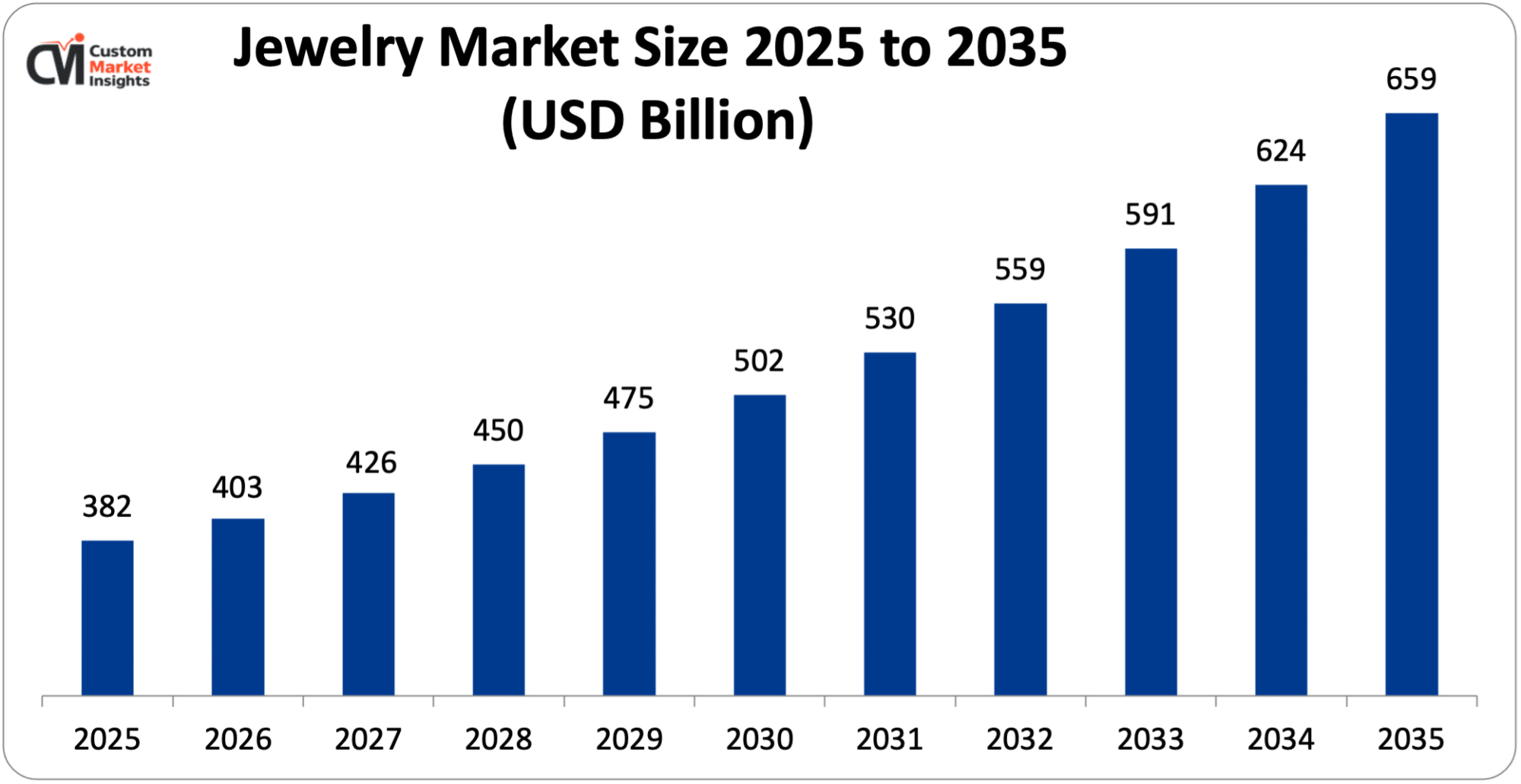
Market Highlight
- In 2025, the Asia Pacific will dominate the global market with an estimated market share of 60%. Increasing disposable income of the population drives the regional market.
- Europe is growing at the highest CAGR over the analysis period. The increasing product launch drives the industry growth.
- By product, the ring segment accounted for the highest revenue share in 2025 of 34%.
- By material, the gold segment would have the highest share of the market in 2025 of 55%.
- By sales channel, the offline retail stores segment dominated the market with a revenue share of 84%.
- By end user, the women segment dominated the market with a revenue share of over 70%.
Significant Growth Factors
The jewelry market trends present significant growth opportunities due to several factors:
- Growing Demand For Luxury & Branded Jewelry: The global jewelry market has experienced its main growth boost from increased consumer demand for high-end branded jewelry which delivers both quality and authentic status value to customers. Consumers today prefer well-known brands like Cartier and Tiffany & Co. and Bulgari because these brands provide better quality and authentic materials and products that maintain their value over time. The market trend occurs because middle- and high-income consumers in emerging markets increasingly become aware of different brands. Consumers today choose branded products because they provide clear pricing information and certified quality standards and branded products have become more common in the market after shoppers started leaving unorganized jewelry stores which handle their products more. The shift creates more trust among consumers which helps businesses charge higher prices that lead to increased market earnings. The urban and younger consumer groups now view luxury jewelry as a status symbol and a lifestyle expression. Social media platforms and celebrity endorsements together with global fashion trends have increased the appeal of branded jewelry which people now see as an aspirational product. Consumers show a higher tendency to select branded jewelry when they need to purchase items for special events like weddings and engagements and for gift giving because they need products that offer them both trust and prestige. Established brands are growing their business operations through exclusive showrooms, online platforms and personalized services which help improve customer experience and product availability. The demand for premium collections has increased because of the combined capabilities of e-commerce and virtual try-on technology and customization features.
- Rising Popularity of Lab-Grown & Sustainable Jewelry: The popularity of labs and sustainable jewelry, meanwhile, is proving to be another way that the global jewelry market can grow and make consumers more comfortable with spending on more expensive items, as buyer values have shifted toward affordability as well as ethics and the environment. Designed to mimic real diamonds, the lab-grown versions are identical in appearance and composition but are way cheaper. This means jewelry makers can make jewelry that looks comparable to natural diamond jewelry more affordable and accessible for their customers. Cheaper needs improved technology and graphics. Lab-grown diamond adoption is increasing across all segments of jewelry, from the fashionable to the fine, for not only daily wear but high-end jewelry as well. The main reason is consumer demand for more awareness of how people get quality jewelry. Consumers are being more demanding about mining-related environmental damage and labor work. As a result, consumers prefer to buy sustainable and environmentally friendly alternatives like lab-grown diamonds, recycled metal, and ethically sourced gemstones, which fit the agenda of green consumerism. And they are particularly popular among millennials and Gen Z consumers. Others are working hard to make more environmentally and socially conscious choices, helping build and strengthen their brand advantages, for example: By building transparent supply chains and using eco-friendly processes and certifications. Some jewelry brands are also adopting recycled gold and carbon-neutral production to attract customers and stand out from competitors.
What are the Major Advances Changing the Jewelry Market Today?
- Personalization & Custom Jewelry Design: The incoming personalized and custom jewelry design trend provides the jewelry industry with its most significant advancement because it transforms the way customers purchase and use jewelry. Through customized jewelry design people can create their own jewelry designs which display their personal style and their inner feelings and their major life milestones. The trend toward personal expression through unique styles has reached its highest point with millennial and Gen Z shoppers who choose to express themselves through unique products instead of wearing common fashion items. The advanced technologies which include Computer-Aided Design (CAD) and 3D printing enable jewelers to develop precise digital models and actual prototypes that fulfill customer design requirements. The technologies enable manufacturers to produce items at faster rates while achieving superior design accuracy and delivering budget-friendly customization solutions to an expanded customer base. Customers can create their own designs by selecting gemstones and metals and engravings and other styles which results in a product that shows their unique identity. Personalized jewelry conveys deep emotional significance, which makes it a popular choice for weddings, engagements, anniversary gifts, and special occasions. Customers who engrave names and birthstones and symbolic motifs on jewelry create better emotional connections with products, which leads to increased customer satisfaction and their willingness to pay higher prices. Customers develop emotional bonds with products, which drives their brand loyalty and repeat purchasing behavior.
- Smart Jewelry & Wearable Technology: The jewelry market has reached a major milestone through the introduction of smart jewelry which integrates wearable technology to create products that combine visual appeal with practical use to meet the demands of contemporary customers. The smart jewelry system which differs from conventional jewelry uses its built-in sensors and connectivity systems to deliver health monitoring and fitness tracking and real-time notifications while maintaining an elegant and unobtrusive design. The market for smart rings and bracelets and pendants grows because these devices provide users with functional wearable technology that matches their fashion preferences. The primary factor driving this trend forward results from people wanting better systems to track their health and wellness progress. The smart jewelry system lets users track their heart rate and sleep patterns and physical activity and stress levels which attracts users who prioritize their health. The Oura Ring demonstrates this market shift because it provides users with comprehensive tracking features through a compact device that resembles jewelry. Smart jewelry products attract customers who prefer simple designs that combine multiple functions into a single device. These devices provide users with a lightweight solution that enables them to maintain a low profile throughout their daily activities which include formal and professional occasions. Users prefer these products because they enable complete integration of technology into their regular activities. The growth of smart jewelry usage has been driven by technological developments that have improved the size reduction of devices and their power consumption and their ability to connect wirelessly through Bluetooth technology. Fashion companies now work with designers to develop products that merge high-end design elements with advanced technological features because brands invest in design development.
Category Wise Insights
By Product
Why Ring Hold a Prominent Position in the Market?
The ring segment accounted for the highest revenue share in 2025 of 34%. The global jewelry market, especially for rings, is influenced by multiple key drivers which include the rising purchasing power of consumers, the increasing demand for expensive and personalized jewelry, and the strong cultural significance of rings in engagement, wedding, and milestone celebrations. The way people shop today is being transformed by the increasing demand for products that use environmentally friendly materials that have been ethically sourced. The combination of global fashion trends and celebrity endorsements together with the expanding online retail industry enables customers to see products more easily which leads to increased sales and market growth across the world.
The necklace segment is growing at the highest CAGR during the forecast period. The necklace segment in the global jewelry market operates through two main fashion trends which include the rise of statement jewelry and personalized items and through the increase of spending power in both emerging markets and developed markets. The global market for these products exists because people maintain their cultural traditions which drive their gift giving habits during holidays and weddings and other important events. A YouGov survey from June 2025 showed that 33% of British men bought necklaces and chains for their personal use. The growth of online shopping and influencer marketing has made designer and custom necklace products more visible to consumers because people now know about sustainable practices which pressure companies to use responsible and visible sourcing methods.
By Material
Why Gold Capture the Highest Market Share in the Jewelry Market?
The gold segment would have the highest share of the market in 2025 of 55%. Gold jewelry sales depend on three factors which people value gold for its cultural importance, its ability to create beautiful things and its function as a financial asset. The demand for yellow, white and rose gold products comes from both traditional and modern design elements which are especially popular in markets such as India and China and Italy. The data published in October 2025 shows that Indians consider gold to be a precious material which they buy during their sacred Dhanteras and Diwali celebrations. The cultural aspect includes religious beliefs, traditions & festivals. The current fashion trends drive more people to prefer gold jewelry which offers lightweight designs and flexible wearing options.
The diamond segment is growing at a rapid rate over the projected period. The global diamond jewelry market maintains its expansion because it depends on three main elements which are luxuriousness, romanticism, and everlasting worth. The demand for diamond jewelry remains strong because people use it to celebrate their cultural engagement, wedding traditions and their important life events. The diamond certification and grading process now uses advanced technology which helps customers trust the system because lab-grown diamonds have become popular among younger customers who care about the environment. A 2025 survey by The Plumb Club which studied 2,000 U.S. consumers aged 25 to 60 found that 84% of participants knew about lab-grown diamonds.
By Sales Channel
Why Offline Retail Stores dominates in the Jewelry Market?
The offline retail stores segment dominated the market with a revenue share of 84%. People prefer to examine physical products because this builds their trust and they want to receive customized help when buying expensive items. People consider jewelry to be an emotional and financial investment which drives them to shop for jewelry in stores so they can check its authenticity and evaluate its craftsmanship and they need to see certification through hallmarking. The tradition of buying gold and diamond jewelry during weddings and festivals remains part of Indian culture which makes this practice especially evident in India.
The online retail stores segment is growing at a rapid rate over the projected period. The introduction of advanced technologies which include augmented reality (AR) and virtual try-on tools will enable customers to see how jewelry will appear on them thus decreasing their purchase doubts while they shop online. The online platforms gain trust through their detailed product descriptions together with high-resolution images, certification transparency and customer reviews.
By End User
Why Women dominates in the Jewelry Market?
The women segment dominated the market with a revenue share of over 70%. The traditional jewelry customs of Indian women drive their jewelry practices which use gold and diamond jewelry to show social status, financial wealth and spiritual value during wedding and festival events. The rising fashion awareness together with access to international trends has created a higher demand for modern lightweight daily wear designs that offer multiple styling options. The combination of branded product lines and celebrity endorsements together with social media trends establishes a standard for customers to aspire to which they use to make their buying decisions. The combination of accessible financing options and the ability to buy products through physical stores and online platforms has created an environment where women can purchase jewelry for both decorative purposes and personal identity expression.
The men segment is growing at a rapid rate over the projected period. Fashion standards now develop because people want to show their individuality according to their new ways of living. Men’s jewelry has evolved beyond its traditional wedding band and watch limits to include chains, bracelets, rings, cufflinks, and earrings because fashion now offers gender-neutral options. Men now wear jewelry because social media platforms and celebrities and athletes have made it a common fashion choice.
Report Scope
| Feature of the Report | Details |
| Market Size in 2026 | USD 403 billion |
| Projected Market Size in 2035 | USD 659 billion |
| Market Size in 2025 | USD 382 billion |
| CAGR Growth Rate | 5.6% CAGR |
| Base Year | 2025 |
| Forecast Period | 2026-2035 |
| Key Segment | By Product, Material, Sales Channel, End User and Region |
| Report Coverage | Revenue Estimation and Forecast, Company Profile, Competitive Landscape, Growth Factors and Recent Trends |
| Regional Scope | North America, Europe, Asia Pacific, Middle East & Africa, and South & Central America |
| Buying Options | Request tailored purchasing options to fulfil your requirements for research. |
Regional Analysis
How Big is the Asia Pacific Jewelry Market Size?
Its market size, in terms of Asia pacific Jewelry, is projected to be USD 229 billion in 2025 with a growth of about USD 472 billion in 2035 with a CAGR of 7.5% between 2026 and 2035.
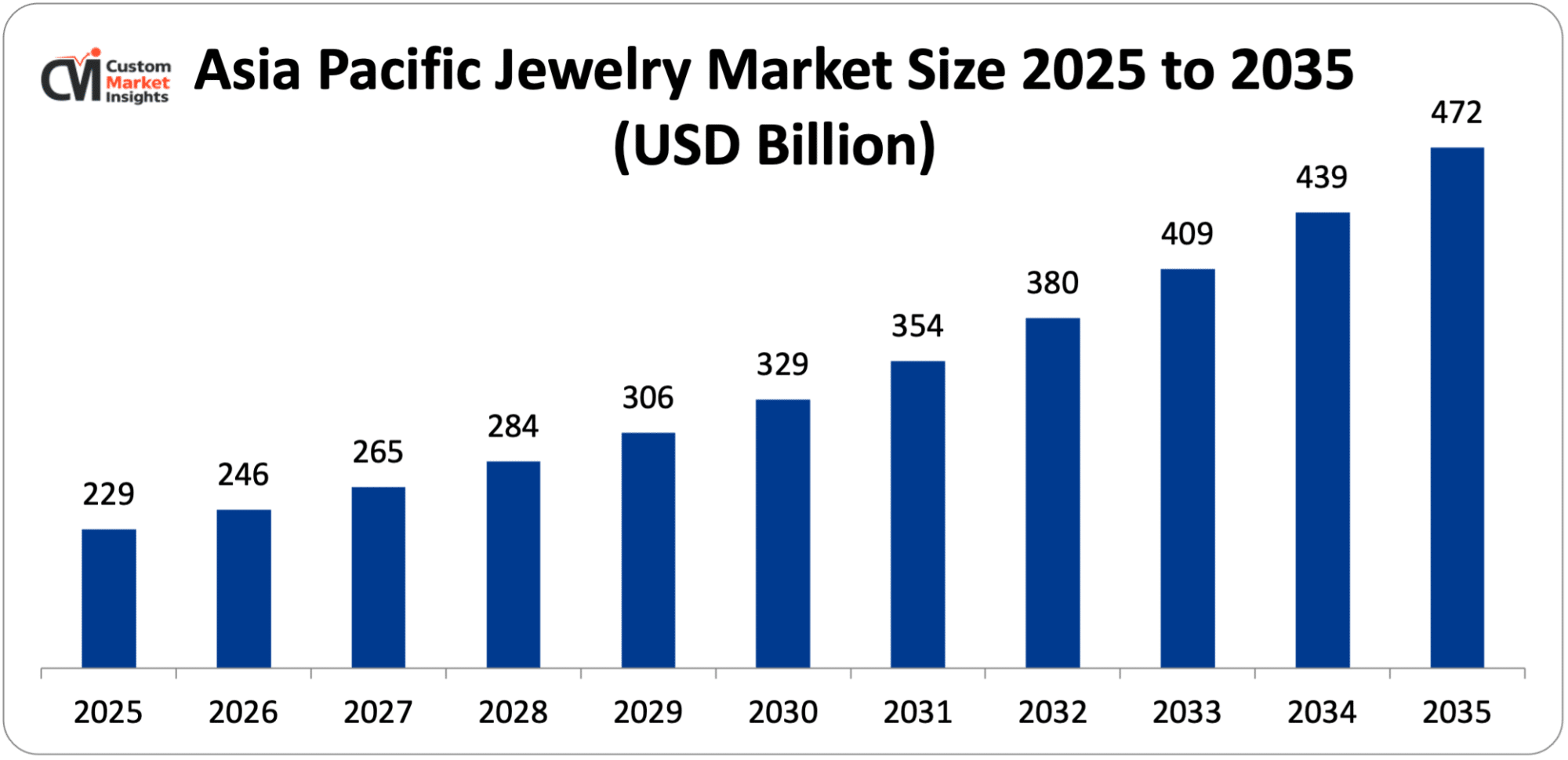
Why did the Asia Pacific Dominate the Jewelry Market in 2025?
In 2025, the Asia Pacific will dominate the global market with an estimated market share of 60%. The Asia Pacific jewelry market experiences growth because people spend more money after their incomes increase and middle-class markets expand their demand for luxury goods. The demand for products increases during cultural events which include weddings and religious festivals. Urban areas are expanding while people gain access to international fashion trends which affects their buying habits.
India Jewelry Market Trends
In the Asia Pacific region, India is expected to dominate the market over the projected period. The market functions as one of the largest markets worldwide because it receives continuous support from cultural demand which connects to weddings, festivals and gifting. Gold remains the dominant category, while diamond and lightweight daily-wear jewelry are gaining traction among younger, urban consumers. The market develops through three main factors which include organized retail, hallmarking adoption and modern design.
Why is North America Experiencing a Significant Growth in the Jewelry Market?
North America holds a significant market share in 2025. The North American jewelry market grows because people want modern fashion jewelry that makes a bold statement. People now prefer to buy products from brands that use sustainable materials and ethically sourced materials. The jewelry market now reaches new customers because men wear jewelry as part of their regular fashion and people adopt less formal styles. The market experiences growth because young people and tech enthusiasts show interest in smart jewelry and technology-based accessories.
US Jewelry Market Trends
The US held the dominant position in the market in 2025. The U.S. jewelry market experiences growth because consumers in the country spend more money and choose to buy expensive customized jewelry. The two generations who demand sustainable products for their purchases are millennials and Gen Z. E-commerce development together with digital marketing activities enables businesses to reach customers while providing them with more shopping options. Customer purchasing patterns continue to be shaped by the current trends, which include customization and branded partnerships and gemstone popularity. The data that ItaliaChains published in August 2025 showed that they studied 5000 verified customers to find out that Americans spend an average of USD 477 per year on jewelry.
Why is Europe Growing at a Highest CAGR in the Jewelry Market?
Europe is expected to grow at the highest CAGR over the projected period. The European jewelry market operates through traditional practices and contemporary fashion trends and customer preference for customized products that use sustainable materials. Shoppers prioritize craftsmanship and design, showing strong interest in both luxury and affordable fashion jewelry. People maintain constant buying patterns through their participation in festive events which include weddings and anniversaries and holiday celebrations. The regional jewelry industry experiences market expansion through digital platforms and influencer marketing which drive contemporary jewelry trends to new audiences.
UK Jewelry Market Trends
The UK holds the prominent market share in the industry. The demand for jewelry in the UK results from three main factors which include traditional practices, modern fashion trends, and increasing interest in sustainable luxury. Both established heritage brands and new designers who create unique products with compelling stories attract customers to their work. People decide what to buy based on three main factors which include current fashion trends, cultural festivals, and social events like weddings. The rising popularity of customizable and gender-neutral designs is changing how people of all ages choose their products. The YouGov survey results from June 2025 show that approximately 17% of UK men purchased jewelry which includes chains bracelets and earrings for personal use.
Why is the Middle East & Africa Region is growing rapidly in the Jewelry?
The MEA region is growing at a steady rate over the projected period. Dubai functions as a global retail hub because its extensive gold markets and tax benefits attract both local customers and international tourists who increase jewelry sales. The combination of competitive prices and extensive product selection and excellent product quality attracts tourists who help increase retail sales. The African market experiences increased demand for traditional and contemporary jewelry designs because its urban population grows and its middle-class population expands.
UAE Jewelry Market Trends
The UAE is growing at the highest CAGR during the forecast period. The increasing product launches and retail hub expansion drive the industry growth.
Top Players in the Jewelry Market and Their Offerings
- Harry Winston
- Dora International
- Malabar Gold & Diamonds
- Pandora
- Louis Vuitton SE
- Chow Tai Fook
- GRAFF
- Richemont
- Signet Jewelers Ltd.
- Stern
- Swarovski AG
- Damiani
- Blue Nile
- Buccellati
- De Beers
- Jacob & Co.
- Tiffany & Co.
- Fame Diamonds
- Gemco Designs
- Mauboussin
- Others
Key Developments
Jewelry market has experienced considerable changes in the last two years as the market players are trying to diversify their technological aspects and develop product portfolios using strategic approaches.
- In June 2025, De Beers introduced Ombré Desert Diamonds, its first flagship “beacon” jewelry concept in over a decade, showcasing multi-stone pieces inspired by desert hues to reignite interest in naturally colored diamonds. The company also introduced Origin, a De Beers Group polished diamond program offering full provenance via blockchain-backed traceability, enriching consumer connection through origin, rarity, and social-impact storytelling.
- In May 2025, Shanghai inaugurated the International Jewelry Fashion Functional Zone in Huangpu District, aiming to establish the city as a global jewelry and fashion hub. The initiative includes a comprehensive three-year development plan featuring 24 strategic tasks across six key categories, such as brand incubation, designer talent cultivation, and immersive retail experiences.
These strategic measures have enabled the companies to reinforce their competitive positions, increase the product line, boost their technological competencies, and also seize growth opportunities in the fast-growing jewelry market.
The Jewelry Market is segmented as follows:
By Product
- Necklace
- Ring
- Earring
- Bracelet
- Others
By Material
- Platinum
- Gold
- Diamond
- Others
By Sales Channel
- Offline Retail Stores
- Online Retail Stores
By End User
- Men
- Women
- Children
Regional Coverage:
North America
- U.S.
- Canada
- Mexico
- Rest of North America
Europe
- Germany
- France
- U.K.
- Russia
- Italy
- Spain
- Netherlands
- Rest of Europe
Asia Pacific
- China
- Japan
- India
- New Zealand
- Australia
- South Korea
- Taiwan
- Rest of Asia Pacific
The Middle East & Africa
- Saudi Arabia
- UAE
- Egypt
- Kuwait
- South Africa
- Rest of the Middle East & Africa
Latin America
- Brazil
- Argentina
- Rest of Latin America
Table of Contents
- Chapter 1. Report Introduction
- 1.1. Report Description
- 1.1.1. Purpose of the Report
- 1.1.2. USP & Key Offerings
- 1.2. Key Benefits For Stakeholders
- 1.3. Target Audience
- 1.4. Report Scope
- 1.1. Report Description
- Chapter 2. Market Overview
- 2.1. Report Scope (Segments And Key Players)
- 2.1.1. Jewelry by Segments
- 2.1.2. Jewelry by Region
- 2.2. Executive Summary
- 2.2.1. Market Size & Forecast
- 2.2.2. Jewelry Market Attractiveness Analysis, By Product
- 2.2.3. Jewelry Market Attractiveness Analysis, By Material
- 2.2.4. Jewelry Market Attractiveness Analysis, By Sales Channel
- 2.2.5. Jewelry Market Attractiveness Analysis, By End User
- 2.1. Report Scope (Segments And Key Players)
- Chapter 3. Market Dynamics (DRO)
- 3.1. Market Drivers
- 3.1.1. Growing Demand For Luxury & Branded Jewelry
- 3.1.2. Rising Popularity of Lab-Grown & Sustainable Jewelry
- 3.2. Market Restraints
- 3.3. Market Opportunities
- 3.5. Pestle Analysis
- 3.6. Porter Forces Analysis
- 3.7. Technology Roadmap
- 3.8. Value Chain Analysis
- 3.9. Government Policy Impact Analysis
- 3.10. Pricing Analysis
- 3.1. Market Drivers
- Chapter 4. Jewelry Market – By Product
- 4.1. Product Market Overview, By Product Segment
- 4.1.1. Jewelry Market Revenue Share, By Product, 2025 & 2035
- 4.1.2. Necklace
- 4.1.3. Jewelry Share Forecast, By Region (USD Billion)
- 4.1.4. Comparative Revenue Analysis, By Country, 2025 & 2035
- 4.1.5. Key Market Trends, Growth Factors, & Opportunities
- 4.1.6. Ring
- 4.1.7. Jewelry Share Forecast, By Region (USD Billion)
- 4.1.8. Comparative Revenue Analysis, By Country, 2025 & 2035
- 4.1.9. Key Market Trends, Growth Factors, & Opportunities
- 4.1.10. Earring
- 4.1.11. Jewelry Share Forecast, By Region (USD Billion)
- 4.1.12. Comparative Revenue Analysis, By Country, 2025 & 2035
- 4.1.13. Key Market Trends, Growth Factors, & Opportunities
- 4.1.14. Bracelet
- 4.1.15. Jewelry Share Forecast, By Region (USD Billion)
- 4.1.16. Comparative Revenue Analysis, By Country, 2025 & 2035
- 4.1.17. Key Market Trends, Growth Factors, & Opportunities
- 4.1.18. Others
- 4.1.19. Jewelry Share Forecast, By Region (USD Billion)
- 4.1.20. Comparative Revenue Analysis, By Country, 2025 & 2035
- 4.1.21. Key Market Trends, Growth Factors, & Opportunities
- 4.1. Product Market Overview, By Product Segment
- Chapter 5. Jewelry Market – By Material
- 5.1. Material Market Overview, By Material Segment
- 5.1.1. Jewelry Market Revenue Share, By Material, 2025 & 2035
- 5.1.2. Platinum
- 5.1.3. Jewelry Share Forecast, By Region (USD Billion)
- 5.1.4. Comparative Revenue Analysis, By Country, 2025 & 2035
- 5.1.5. Key Market Trends, Growth Factors, & Opportunities
- 5.1.6. Gold
- 5.1.7. Jewelry Share Forecast, By Region (USD Billion)
- 5.1.8. Comparative Revenue Analysis, By Country, 2025 & 2035
- 5.1.9. Key Market Trends, Growth Factors, & Opportunities
- 5.1.10. Diamond
- 5.1.11. Jewelry Share Forecast, By Region (USD Billion)
- 5.1.12. Comparative Revenue Analysis, By Country, 2025 & 2035
- 5.1.13. Key Market Trends, Growth Factors, & Opportunities
- 5.1.14. Others
- 5.1.15. Jewelry Share Forecast, By Region (USD Billion)
- 5.1.16. Comparative Revenue Analysis, By Country, 2025 & 2035
- 5.1.17. Key Market Trends, Growth Factors, & Opportunities
- 5.1. Material Market Overview, By Material Segment
- Chapter 6. Jewelry Market – By Sales Channel
- 6.1. Sales Channel Market Overview, By Sales Channel Segment
- 6.1.1. Jewelry Market Revenue Share, By Sales Channel, 2025 & 2035
- 6.1.2. Offline Retail Stores
- 6.1.3. Jewelry Share Forecast, By Region (USD Billion)
- 6.1.4. Comparative Revenue Analysis, By Country, 2025 & 2035
- 6.1.5. Key Market Trends, Growth Factors, & Opportunities
- 6.1.6. Online Retail Stores
- 6.1.7. Jewelry Share Forecast, By Region (USD Billion)
- 6.1.8. Comparative Revenue Analysis, By Country, 2025 & 2035
- 6.1.9. Key Market Trends, Growth Factors, & Opportunities
- 6.1. Sales Channel Market Overview, By Sales Channel Segment
- Chapter 7. Jewelry Market – By End User
- 7.1. End User Market Overview, By End User Segment
- 7.1.1. Jewelry Market Revenue Share, By End User, 2025 & 2035
- 7.1.2. Men
- 7.1.3. Jewelry Share Forecast, By Region (USD Billion)
- 7.1.4. Comparative Revenue Analysis, By Country, 2025 & 2035
- 7.1.5. Key Market Trends, Growth Factors, & Opportunities
- 7.1.6. Women
- 7.1.7. Jewelry Share Forecast, By Region (USD Billion)
- 7.1.8. Comparative Revenue Analysis, By Country, 2025 & 2035
- 7.1.9. Key Market Trends, Growth Factors, & Opportunities
- 7.1.10. Children
- 7.1.11. Jewelry Share Forecast, By Region (USD Billion)
- 7.1.12. Comparative Revenue Analysis, By Country, 2025 & 2035
- 7.1.13. Key Market Trends, Growth Factors, & Opportunities
- 7.1. End User Market Overview, By End User Segment
- Chapter 8. Jewelry Market – Regional Analysis
- 8.1. Jewelry Market Overview, By Region Segment
- 8.1.1. Global Jewelry Market Revenue Share, By Region, 2025 & 2035
- 8.1.2. Global Jewelry Market Revenue, By Region, 2026 – 2035 (USD Billion)
- 8.1.3. Global Jewelry Market Revenue, By Product, 2026 – 2035
- 8.1.4. Global Jewelry Market Revenue, By Material, 2026 – 2035
- 8.1.5. Global Jewelry Market Revenue, By Sales Channel, 2026 – 2035
- 8.1.6. Global Jewelry Market Revenue, By End User, 2026 – 2035
- 8.2. North America
- 8.2.1. North America Jewelry Market Revenue, By Country, 2026 – 2035 (USD Billion)
- 8.2.2. North America Jewelry Market Revenue, By Product, 2026 – 2035
- 8.2.3. North America Jewelry Market Revenue, By Material, 2026 – 2035
- 8.2.4. North America Jewelry Market Revenue, By Sales Channel, 2026 – 2035
- 8.2.5. North America Jewelry Market Revenue, By End User, 2026 – 2035
- 8.2.6. U.S. Jewelry Market Revenue, 2026 – 2035 (USD Billion)
- 8.2.7. Canada Jewelry Market Revenue, 2026 – 2035 (USD Billion)
- 8.2.8. Mexico Jewelry Market Revenue, 2026 – 2035 (USD Billion)
- 8.2.9. Rest of North America Jewelry Market Revenue, 2026 – 2035 (USD Billion)
- 8.3. Europe
- 8.3.1. Europe Jewelry Market Revenue, By Country, 2026 – 2035 (USD Billion)
- 8.3.2. Europe Jewelry Market Revenue, By Product, 2026 – 2035
- 8.3.3. Europe Jewelry Market Revenue, By Material, 2026 – 2035
- 8.3.4. Europe Jewelry Market Revenue, By Sales Channel, 2026 – 2035
- 8.3.5. Europe Jewelry Market Revenue, By End User, 2026 – 2035
- 8.3.6. Germany Jewelry Market Revenue, 2026 – 2035 (USD Billion)
- 8.3.7. France Jewelry Market Revenue, 2026 – 2035 (USD Billion)
- 8.3.8. U.K. Jewelry Market Revenue, 2026 – 2035 (USD Billion)
- 8.3.9. Russia Jewelry Market Revenue, 2026 – 2035 (USD Billion)
- 8.3.10. Italy Jewelry Market Revenue, 2026 – 2035 (USD Billion)
- 8.3.11. Spain Jewelry Market Revenue, 2026 – 2035 (USD Billion)
- 8.3.12. Netherlands Jewelry Market Revenue, 2026 – 2035 (USD Billion)
- 8.3.13. Rest of Europe Jewelry Market Revenue, 2026 – 2035 (USD Billion)
- 8.4. Asia Pacific
- 8.4.1. Asia Pacific Jewelry Market Revenue, By Country, 2026 – 2035 (USD Billion)
- 8.4.2. Asia Pacific Jewelry Market Revenue, By Product, 2026 – 2035
- 8.4.3. Asia Pacific Jewelry Market Revenue, By Material, 2026 – 2035
- 8.4.4. Asia Pacific Jewelry Market Revenue, By Sales Channel, 2026 – 2035
- 8.4.5. Asia Pacific Jewelry Market Revenue, By End User, 2026 – 2035
- 8.4.6. China Jewelry Market Revenue, 2026 – 2035 (USD Billion)
- 8.4.7. Japan Jewelry Market Revenue, 2026 – 2035 (USD Billion)
- 8.4.8. India Jewelry Market Revenue, 2026 – 2035 (USD Billion)
- 8.4.9. New Zealand Jewelry Market Revenue, 2026 – 2035 (USD Billion)
- 8.4.10. Australia Jewelry Market Revenue, 2026 – 2035 (USD Billion)
- 8.4.11. South Korea Jewelry Market Revenue, 2026 – 2035 (USD Billion)
- 8.4.12. Taiwan Jewelry Market Revenue, 2026 – 2035 (USD Billion)
- 8.4.13. Rest of Asia Pacific Jewelry Market Revenue, 2026 – 2035 (USD Billion)
- 8.5. The Middle-East and Africa
- 8.5.1. The Middle-East and Africa Jewelry Market Revenue, By Country, 2026 – 2035 (USD Billion)
- 8.5.2. The Middle-East and Africa Jewelry Market Revenue, By Product, 2026 – 2035
- 8.5.3. The Middle-East and Africa Jewelry Market Revenue, By Material, 2026 – 2035
- 8.5.4. The Middle-East and Africa Jewelry Market Revenue, By Sales Channel, 2026 – 2035
- 8.5.5. The Middle-East and Africa Jewelry Market Revenue, By End User, 2026 – 2035
- 8.5.6. Saudi Arabia Jewelry Market Revenue, 2026 – 2035 (USD Billion)
- 8.5.7. UAE Jewelry Market Revenue, 2026 – 2035 (USD Billion)
- 8.5.8. Egypt Jewelry Market Revenue, 2026 – 2035 (USD Billion)
- 8.5.9. Kuwait Jewelry Market Revenue, 2026 – 2035 (USD Billion)
- 8.5.10. South Africa Jewelry Market Revenue, 2026 – 2035 (USD Billion)
- 8.5.11. Rest of the Middle East & Africa Jewelry Market Revenue, 2026 – 2035 (USD Billion)
- 8.6. Latin America
- 8.6.1. Latin America Jewelry Market Revenue, By Country, 2026 – 2035 (USD Billion)
- 8.6.2. Latin America Jewelry Market Revenue, By Product, 2026 – 2035
- 8.6.3. Latin America Jewelry Market Revenue, By Material, 2026 – 2035
- 8.6.4. Latin America Jewelry Market Revenue, By Sales Channel, 2026 – 2035
- 8.6.5. Latin America Jewelry Market Revenue, By End User, 2026 – 2035
- 8.6.6. Brazil Jewelry Market Revenue, 2026 – 2035 (USD Billion)
- 8.6.7. Argentina Jewelry Market Revenue, 2026 – 2035 (USD Billion)
- 8.6.8. Rest of Latin America Jewelry Market Revenue, 2026 – 2035 (USD Billion)
- 8.1. Jewelry Market Overview, By Region Segment
- Chapter 9. Competitive Landscape
- 9.1. Company Market Share Analysis – 2025
- 9.1.1. Global Jewelry Market: Company Market Share, 2025
- 9.2. Global Jewelry Market Company Market Share, 2024
- 9.1. Company Market Share Analysis – 2025
- Chapter 10. Company Profiles
- 10.1. Harry Winston
- 10.1.1. Company Overview
- 10.1.2. Key Executives
- 10.1.3. Product Portfolio
- 10.1.4. Financial Overview
- 10.1.5. Operating Business Segments
- 10.1.6. Business Performance
- 10.1.7. Recent Developments
- 10.2. Dora International
- 10.3. Malabar Gold & Diamonds
- 10.4. Pandora
- 10.5. Louis Vuitton SE
- 10.6. Chow Tai Fook
- 10.7. GRAFF
- 10.8. Richemont
- 10.9. Signet Jewelers Ltd.
- 10.10. H. Stern
- 10.11. Swarovski AG
- 10.12. Damiani
- 10.13. Blue Nile
- 10.14. Buccellati
- 10.15. De Beers
- 10.16. Jacob & Co.
- 10.17. Tiffany & Co.
- 10.18. Fame Diamonds
- 10.19. Gemco Designs
- 10.20. Mauboussin
- 10.21. Others.
- 10.1. Harry Winston
- Chapter 11. Research Methodology
- 11.1. Research Methodology
- 11.2. Secondary Research
- 11.3. Primary Research
- 11.3.1. Analyst Tools and Models
- 11.4. Research Limitations
- 11.5. Assumptions
- 11.6. Insights From Primary Respondents
- 11.7. Why Custom Market Insights
- Chapter 12. Standard Report Commercials & Add-Ons
- 12.1. Customization Options
- 12.2. Subscription Module For Market Research Reports
- 12.3. Client Testimonials
List Of Figures
Figures No 1 to 32
List Of Tables
Tables No 1 to 51
FAQs
The key players in the market are Harry Winston, Dora International, Malabar Gold & Diamonds, Pandora, Louis Vuitton SE, Chow Tai Fook, GRAFF, Richemont, Signet Jewelers Ltd., H. Stern, Swarovski AG, Damiani, Blue Nile, Buccellati, De Beers, Jacob & Co., Tiffany & Co., Fame Diamonds, Gemco Designs, Mauboussin, Others
Government regulations play a crucial role in shaping the jewelry market’s development by ensuring quality standards, consumer protection, and ethical sourcing, while also influencing pricing, trade flows, and market transparency through policies such as hallmarking mandates, import/export duties, taxation, and anti-money laundering norms.
Price points directly influence market growth and adoption by determining affordability and accessibility—lower prices expand the customer base and volume sales, while higher prices drive premium segment value and brand positioning.
According to the present analysis and forecast modeling, the market of jewelry will witness a significant growth of about USD 659 billion in the year 2035 with the growing innovative product launch, increasing collaboration, increasing disposable income with a CAGR of 5.6% between the years 2026 and 2035.
It is projected that the Asia Pacific will hold the largest market share in the jewelry market in the forecast period, with a share of about 60% of the global market share, which is owing to the presence of major players and increasing trends of gifting.
Europe is expected to grow at a highest rate during the forecast period. The evolving fashion trends drive the market growth.
The key factors driving the Market are Increasing disposable income of the population, shifting fashion trends.