
Germany Eubiotics Market Size, Trends and Insights By Product (Probiotics, Lactobacilli, Bifidobacterium, Streptococcus, Prebiotics, FOS, Inulin, GOS, MOS, Organic Acids, Phytogenics), By Form (Liquid Form, Solid Form), By Application (Gut Health, Immunity, Yield), By End-use (Cattle Feed, Dairy, Meat, Poultry, Swine, Aquatic), and By Region - Industry Overview, Statistical Data, Competitive Analysis, Share, Outlook, and Forecast 2026 – 2035
Report Snapshot
CAGR: 6.37%
| Study Period: | 2026-2035 |
| Fastest Growing Market: | Germany |
| Largest Market: | Germany |
Major Players
- BASF SE
- Koninklijke DSM N.V.
- Novozymes A/S
- Kemin Industries Inc.
- Others
Reports Description
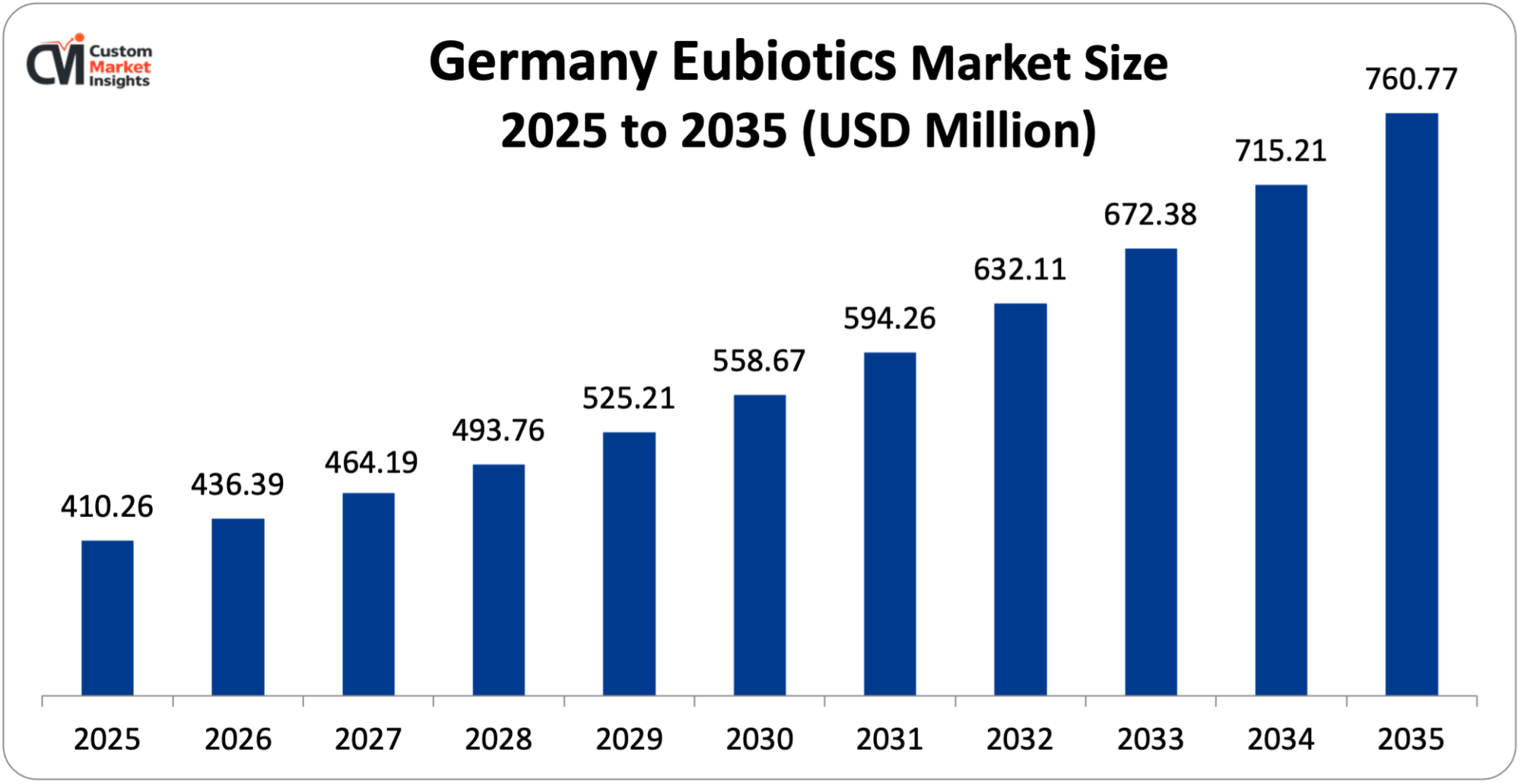
The German eubiotics market is expected to record a CAGR of 6.37% from 2026 to 2035. In 2026, the market size was USD 436.39 Million. By 2035, the valuation is anticipated to reach USD 760.77 Million. The market is growing due to stringent EU regulatory standards being in place, along with robust demand for residue-free and sustainable meat products.
The commercial producers are preferring eubiotics that are scientifically validated, especially for poultry and swine, with the objective of meeting compliance and performance targets, whereas feed companies are handsomely investing in standardized, documented products. The suppliers who are capable of offering strong efficacy, sustainability credentials, and supply chains that are traceable are witnessing higher demand as compared to their counterparts. As such, Germany has turned out to be a high class Launchpad regarding eubiotics with higher specifications in the wider market of Europe.
Market Highlights
- By product, probiotics held around 42% of the market share in 2025.
- By product, organic acids are expected to witness the fastest CAGR of 7.12% between 2026 and 2035.
- By form, solid form dominated in 2025 with 61% of the overall market share.
- By form, liquid form is expected to witness the fastest CAGR of 7.65% during the forecast period.
- By application, the highest market share of 36.95% was attributed to gut health in 2025.
- By application, gut health is expected to witness the fastest CAGR of 7.44% between 2026 and 2035.
- By end-user, the poultry segment held 38.6% of the overall market share in 2025.
- By end-use cattle feed is expected to witness the fastest CAGR of 8.12% between 2026 and 2035.
Significant Growth Factors
Germany eubiotics market presents significant growth opportunities due to several factors:
- Stringent Regulations Limiting Use of Antibiotics
Germany, as a part of the wider European Union’s food safety and animal health strategies, has executed stringent measures for reducing or eliminating promoters of antibiotics in animal feed. This pressure has, in turn, forced those dealing with livestock to opt for sustainable, safer alternatives like organic acids, prebiotics, probiotics, and essential oils for maintaining gut productivity and health. Moreover, with raised scrutiny over AMR (antimicrobial resistance) and increased consumer awareness with regard to antibiotic residues in dairy and meat products, the farmers are into proactive incorporation of eubiotics into the feed formulations. Such products not only lend support to prevention of disease but also adhere to the robust regulatory compliance culture of Germany along with higher standards pertaining to the production of food.
- Technologically Advanced Animal Feed and Livestock Industry
Germany holds the distinction of housing a technologically advanced, huge animal feed and livestock industry, which does create a visible demand for feed additives that enhance performance. The region is one of the leading manufacturers of poultry, dairy, and pork products. It is also known for maintaining a highly research-driven and organized farming sector, robust infrastructure related to veterinary research, and continual innovation in animal nutrition. On top of that, the rising focus on reduction of environmental hazards is translating into integrating natural feed additives, thereby positioning eubiotics as one of the essential components of modern day livestock management all across Germany.
What are the Major Advancements Changing Germany Eubiotics Market Today?
- Advanced Probiotics’ Formulations and Delivery Systems
The market players are coming up with technologically advanced eubiotic formulations as well as delivery systems, particularly in the probiotics segment. They are launching targeted encapsulation technologies and spore-forming probiotics that noticeably enhance the effectiveness and stability of eubiotics under real-time livestock digestive conditions. Encapsulation techniques are reported to render protection to sensitive ingredients during production and digestion of feed, thereby facilitating more consistent and precise release. Spore-forming strains are capable of withstanding pelleting pressures and high temperatures, thereby ascertaining that beneficial microbes stay feasible to the animal gut. Such innovations are improving feed conversion ratios. The above-mentioned eubiotic products are thus witnessing a sizable demand in Germany.
- Microbiome-Driven Custom Solutions
Advancements in microbiome-related research are letting feed formulators and scientists better comprehend animals’ complex gut ecosystems and the way specified microbial communities impact immunity, health, and productivity. The players are thus doling out species-specific eubiotic blends with personalized gut health programs to optimize performance and nutrition for ruminants, swine, and poultry exclusively instead of using generic additives. As such, synergistic combinations comprising organic acids, prebiotics, and phytogenics are being designed for supporting targeted outcomes such as better immunity, enhanced nutrient absorption, or reduced emissions of methane.
- Impact of AI on Germany Eubiotics Market
Advanced AI algorithms are getting integrated into the farm management systems and feed formulation software’s for analyzing huge datasets pertaining to animal health, feed conversion ratios, gut microbiome profiles, and environmental hazards. This, in turn, lets the producers design targeted eubiotic blends like prebiotics, probiotics, phytogenics, and organic acids’ optimized combinations tailored to specified production goals and livestock species. AI also extends support to early performance forecasting and disease detection, thereby reducing dependency on antibiotics while enhancing sustainability and productivity. Plus, research powered by AI propels selection of strain by identification of effective microbial combinations in a more efficient manner, thereby improving competitiveness and effectiveness of the eubiotic solutions all across Germany.
Category Wise Insights
By Product
Why Do Probiotics Dominate Germany Eubiotics Market?
Probiotics help in improving intestinal microbial balance, feed conversion efficiency, and nutrient absorption in swine, poultry, and dairy cattle. They also offer multi-functional advantages such as enhanced digestion, prevention of disease, and reduction in mortality rates in comparison with their counterparts such as phytogenics or organic acids. Excessive scientific trials conducted all across the European farms have raised farmers’ confidence, thereby accelerating commercial use at a wider scale. Also, following stringent antimicrobial-resistance policies, the producers of livestock in Germany are increasingly relying on probiotics as one of the natural alternatives for maintaining the gut microbiota balance.
By Form
-
How does Solid Form Dominate Germany Eubiotics Market?
Eubiotics in the solid form are superior in terms of stability, cost-efficiency, ease of handling, and compatibility with feed manufacturing systems at the industrial level. This dominance is especially visible in prebiotics, probiotics, phytogenic additives, and organic acids used in dairy feed, swine, and poultry. Also, solid forms do offer better stability and longer shelf life under varying humidity and temperature. Moreover, solid variants are less prone to oxidation and microbial degradation, thereby making them simpler to store without refrigeration.
By Application
-
Where does Gut Health stand with respect to Germany Eubiotics Market?
Majority of formulations in Germany are being marketed for gut microbiome modulation. The market is witnessing research collaborations between biotechnology companies and feed manufacturers, inclusive of players such as BASF SE, thereby raising emphasis on optimization of strains, mapping of microbiomes, and digestive efficiency. This type of scientific backing does reinforce gut health as an epicenter of value proposition regarding Germany eubiotics market.
By End-use
Why is Poultry Segment dominating Germany Eubiotics Market?
Germany is driven by robust domestic consumption of eggs and chicken meat. As per the EU’s regulatory framework, poultry producers are witnessing stern controls regarding the usage of antibiotics. As production cycles of poultry are highly intensive and short, disruptions in gut health are likely to impact mortality rates and feed efficiency. This does make eubiotics, especially organic acids and probiotics, necessary for the maintenance of stable intestinal performance and microflora. Broiler chickens have a shorter rearing cycle (around 5-7 weeks), which means that advantages of eubiotics like improvement in weight gain, feed conversion ratio (FCR), and resistance against diseases are realized faster.
Report Scope
| Feature of the Report | Details |
| Market Size in 2026 | USD 436.39 Million |
| Projected Market Size in 2035 | USD 760.77 Million |
| Market Size in 2025 | USD 410.26 Million |
| CAGR Growth Rate | 6.37% CAGR |
| Base Year | 2025 |
| Forecast Period | 2026-2035 |
| Key Segment | By Product, Form, Application, End-use and Region |
| Report Coverage | Revenue Estimation and Forecast, Company Profile, Competitive Landscape, Growth Factors and Recent Trends |
| Buying Options | Request tailored purchasing options to fulfil your requirements for research. |
Top Players in Germany Eubiotics Market and Their Offerings
- BASF SE
- Koninklijke DSM N.V.
- Novozymes A/S
- Kemin Industries Inc.
- Lallemand Inc.
- Lesaffre Group
- Cargill Inc.
- Addcon Group GmbH
- Behn Meyer Holding AG
- Beneo GmbH
- Hansen Holding A/S
- Novus International Inc.
- DuPont de Nemours Inc.
- Others
Key Developments
The German eubiotics market has experienced considerable changes in the last two years as the market players are trying to diversify their technological aspects and develop product portfolios using strategic approaches.
- In September 2025, Royal DSM/DSM-Firmenich introduced a novel lactobacillus probiotic strain particularly tailored for poultry for improving feed efficiency and gut health. This strain forms a part of the company’s improved probiotic portfolio designed especially for the production of antibiotic-free poultry.
The Germany Eubiotics Market is segmented as follows:
By Product
- Probiotics
- Lactobacilli
- Bifidobacterium
- Streptococcus
- Prebiotics
- FOS
- Inulin
- GOS
- MOS
- Organic Acids
- Phytogenics
By Form
- Liquid Form
- Solid Form
By Application
- Gut Health
- Immunity
- Yield
By End-use
- Cattle Feed
- Dairy
- Meat
- Poultry
- Swine
- Aquatic
Table of Contents
- Chapter 1. Report Introduction
- 1.1. Report Description
- 1.1.1. Purpose of the Report
- 1.1.2. USP & Key Offerings
- 1.2. Key Benefits For Stakeholders
- 1.3. Target Audience
- 1.4. Report Scope
- 1.1. Report Description
- Chapter 2. Market Overview
- 2.1. Report Scope (Segments And Key Players)
- 2.1.1. Germany Eubiotics by Segments
- 2.1.2. Germany Eubiotics by Region
- 2.2. Executive Summary
- 2.2.1. Market Size & Forecast
- 2.2.2. Germany Eubiotics Market Attractiveness Analysis, By Product
- 2.2.3. Germany Eubiotics Market Attractiveness Analysis, By Form
- 2.2.4. Germany Eubiotics Market Attractiveness Analysis, By Application
- 2.2.5. Germany Eubiotics Market Attractiveness Analysis, By End-use
- 2.1. Report Scope (Segments And Key Players)
- Chapter 3. Market Dynamics (DRO)
- 3.1. Market Drivers
- 3.1.1. Stringent Regulations Limiting Use of Antibiotics
- 3.1.2. Technologically Advanced Animal Feed and Livestock Industry
- 3.2. Market Restraints
- 3.3. Market Opportunities
- 3.5. Pestle Analysis
- 3.6. Porter’s Forces Analysis
- 3.7. Technology Roadmap
- 3.8. Value Chain Analysis
- 3.9. Government Policy Impact Analysis
- 3.10. Pricing Analysis
- 3.1. Market Drivers
- Chapter 4. Germany Eubiotics Market – By Product
- 4.1. Product Market Overview, By Product Segment
- 4.1.1. Germany Eubiotics Market Revenue Share, By Product, 2025 & 2035
- 4.1.2. Probiotics
- 4.1.3. Germany Eubiotics Share Forecast, By Region (USD Million)
- 4.1.4. Comparative Revenue Analysis, By Country, 2025 & 2035
- 4.1.5. Key Market Trends, Growth Factors, & Opportunities
- 4.1.6. Lactobacilli
- 4.1.7. Germany Eubiotics Share Forecast, By Region (USD Million)
- 4.1.8. Comparative Revenue Analysis, By Country, 2025 & 2035
- 4.1.9. Key Market Trends, Growth Factors, & Opportunities
- 4.1.10. Bifidobacterium
- 4.1.11. Germany Eubiotics Share Forecast, By Region (USD Million)
- 4.1.12. Comparative Revenue Analysis, By Country, 2025 & 2035
- 4.1.13. Key Market Trends, Growth Factors, & Opportunities
- 4.1.14. Streptococcus
- 4.1.15. Germany Eubiotics Share Forecast, By Region (USD Million)
- 4.1.16. Comparative Revenue Analysis, By Country, 2025 & 2035
- 4.1.17. Key Market Trends, Growth Factors, & Opportunities
- 4.1.18. Prebiotics
- 4.1.19. Germany Eubiotics Share Forecast, By Region (USD Million)
- 4.1.20. Comparative Revenue Analysis, By Country, 2025 & 2035
- 4.1.21. Key Market Trends, Growth Factors, & Opportunities
- 4.1.22. Inulin
- 4.1.23. Germany Eubiotics Share Forecast, By Region (USD Million)
- 4.1.24. Comparative Revenue Analysis, By Country, 2025 & 2035
- 4.1.25. Key Market Trends, Growth Factors, & Opportunities
- 4.1.26. GOS
- 4.1.27. Germany Eubiotics Share Forecast, By Region (USD Million)
- 4.1.28. Comparative Revenue Analysis, By Country, 2025 & 2035
- 4.1.29. Key Market Trends, Growth Factors, & Opportunities
- 4.1.30. MOS
- 4.1.31. Germany Eubiotics Share Forecast, By Region (USD Million)
- 4.1.32. Comparative Revenue Analysis, By Country, 2025 & 2035
- 4.1.33. Key Market Trends, Growth Factors, & Opportunities
- 4.1.34. Organic Acids
- 4.1.35. Germany Eubiotics Share Forecast, By Region (USD Million)
- 4.1.36. Comparative Revenue Analysis, By Country, 2025 & 2035
- 4.1.37. Key Market Trends, Growth Factors, & Opportunities
- 4.1.38. Phytogenics
- 4.1.39. Germany Eubiotics Share Forecast, By Region (USD Million)
- 4.1.40. Comparative Revenue Analysis, By Country, 2025 & 2035
- 4.1.41. Key Market Trends, Growth Factors, & Opportunities
- 4.1. Product Market Overview, By Product Segment
- Chapter 5. Germany Eubiotics Market – By Form
- 5.1. Form Market Overview, By Form Segment
- 5.1.1. Germany Eubiotics Market Revenue Share, By Form, 2025 & 2035
- 5.1.2. Liquid Form
- 5.1.3. Germany Eubiotics Share Forecast, By Region (USD Million)
- 5.1.4. Comparative Revenue Analysis, By Country, 2025 & 2035
- 5.1.5. Key Market Trends, Growth Factors, & Opportunities
- 5.1.6. Solid Form
- 5.1.7. Germany Eubiotics Share Forecast, By Region (USD Million)
- 5.1.8. Comparative Revenue Analysis, By Country, 2025 & 2035
- 5.1.9. Key Market Trends, Growth Factors, & Opportunities
- 5.1. Form Market Overview, By Form Segment
- Chapter 6. Germany Eubiotics Market – By Application
- 6.1. Application Market Overview, By Application Segment
- 6.1.1. Germany Eubiotics Market Revenue Share, By Application, 2025 & 2035
- 6.1.2. Gut Health
- 6.1.3. Germany Eubiotics Share Forecast, By Region (USD Million)
- 6.1.4. Comparative Revenue Analysis, By Country, 2025 & 2035
- 6.1.5. Key Market Trends, Growth Factors, & Opportunities
- 6.1.6. Immunity
- 6.1.7. Germany Eubiotics Share Forecast, By Region (USD Million)
- 6.1.8. Comparative Revenue Analysis, By Country, 2025 & 2035
- 6.1.9. Key Market Trends, Growth Factors, & Opportunities
- 6.1.10. Yield
- 6.1.11. Germany Eubiotics Share Forecast, By Region (USD Million)
- 6.1.12. Comparative Revenue Analysis, By Country, 2025 & 2035
- 6.1.13. Key Market Trends, Growth Factors, & Opportunities
- 6.1. Application Market Overview, By Application Segment
- Chapter 7. Germany Eubiotics Market – By End-use
- 7.1. End-use Market Overview, By End-use Segment
- 7.1.1. Germany Eubiotics Market Revenue Share, By End-use , 2025 & 2035
- 7.1.2. Cattle Feed
- 7.1.3. Germany Eubiotics Share Forecast, By Region (USD Million)
- 7.1.4. Comparative Revenue Analysis, By Country, 2025 & 2035
- 7.1.5. Key Market Trends, Growth Factors, & Opportunities
- 7.1.6. Dairy
- 7.1.7. Germany Eubiotics Share Forecast, By Region (USD Million)
- 7.1.8. Comparative Revenue Analysis, By Country, 2025 & 2035
- 7.1.9. Key Market Trends, Growth Factors, & Opportunities
- 7.1.10. Meat
- 7.1.11. Germany Eubiotics Share Forecast, By Region (USD Million)
- 7.1.12. Comparative Revenue Analysis, By Country, 2025 & 2035
- 7.1.13. Key Market Trends, Growth Factors, & Opportunities
- 7.1.14. Poultry
- 7.1.15. Germany Eubiotics Share Forecast, By Region (USD Million)
- 7.1.16. Comparative Revenue Analysis, By Country, 2025 & 2035
- 7.1.17. Key Market Trends, Growth Factors, & Opportunities
- 7.1.18. Swine
- 7.1.19. Germany Eubiotics Share Forecast, By Region (USD Million)
- 7.1.20. Comparative Revenue Analysis, By Country, 2025 & 2035
- 7.1.21. Key Market Trends, Growth Factors, & Opportunities
- 7.1.22. Aquatic
- 7.1.23. Germany Eubiotics Share Forecast, By Region (USD Million)
- 7.1.24. Comparative Revenue Analysis, By Country, 2025 & 2035
- 7.1.25. Key Market Trends, Growth Factors, & Opportunities
- 7.1. End-use Market Overview, By End-use Segment
- Chapter 8. Germany Eubiotics Market – Regional Analysis
- 8.1. Germany Eubiotics Market Overview, By Region Segment
- 8.1.1. Germany Eubiotics Market Revenue Share, By Region, 2025 & 2035
- 8.1.2. Germany Eubiotics Market Revenue, By Region, 2026 – 2035 (USD Million)
- 8.1.3. Germany Eubiotics Market Revenue, By Product , 2026 – 2035
- 8.1.4. Germany Eubiotics Market Revenue, By Form , 2026 – 2035
- 8.1.5. Germany Eubiotics Market Revenue, By Application , 2026 – 2035
- 8.1.6. Germany Eubiotics Market Revenue, By End-use , 2026 – 2035
- 8.1. Germany Eubiotics Market Overview, By Region Segment
- Chapter 9. Competitive Landscape
- 9.1. Company Market Share Analysis – 2025
- 9.1.1. Germany Eubiotics Market: Company Market Share, 2025
- 9.2. Germany Eubiotics Market Company Market Share, 2024
- 9.1. Company Market Share Analysis – 2025
- Chapter 10. Company Profiles
- 10.1. ASF SE
- 10.1.1. Company Overview
- 10.1.2. Key Executives
- 10.1.3. Product Portfolio
- 10.1.4. Financial Overview
- 10.1.5. Operating Business Segments
- 10.1.6. Business Performance
- 10.1.7. Recent Developments
- 10.2. Koninklijke DSM N.V.
- 10.3. Novozymes A/S
- 10.4. Kemin Industries Inc.
- 10.5. Lallemand Inc.
- 10.6. Lesaffre Group
- 10.7. Cargill Inc.
- 10.8. Addcon Group GmbH
- 10.9. Behn Meyer Holding AG
- 10.10. Beneo GmbH
- 10.11. Chr. Hansen Holding A/S
- 10.12. Novus International Inc.
- 10.13. DuPont de Nemours Inc.
- 10.14. Others.
- 10.1. ASF SE
- Chapter 11. Research Methodology
- 11.1. Research Methodology
- 11.2. Secondary Research
- 11.3. Primary Research
- 11.3.1. Analyst Tools and Models
- 11.4. Research Limitations
- 11.5. Assumptions
- 11.6. Insights From Primary Respondents
- 11.7. Why Custom Market Insights
- Chapter 12. Standard Report Commercials & Add-Ons
- 12.1. Customization Options
- 12.2. Subscription Module For Market Research Reports
- 12.3. Client Testimonials
List Of Figures
Figures No 1 to 34
List Of Tables
Tables No 1 to 2
FAQs
The key players in the market are BASF SE, Koninklijke DSM N.V., Novozymes A/S, Kemin Industries Inc., Lallemand Inc., Lesaffre Group, Cargill Inc., Addcon Group GmbH, Behn Meyer Holding AG, Beneo GmbH, Chr. Hansen Holding A/S, Novus International Inc., DuPont de Nemours Inc., Others.
German antimicrobial reduction and the EU mandates notably mandate adoption of eubiotics. For instance, the EU is known for its Farm to Fork Strategy, which aims to curtail the use of antimicrobials in livestock by 50% by the year 2030, thereby driving the producers toward seeking alternatives such as prebiotics, probiotics, phytogenics, and organic acids for maintaining the health of animals without antibiotics. As such, the regulatory backdrop mentioned above does position eubiotics not only as optional supplements but also as essential tools for complying with the antibiotic stewardship goals.
The price of eubiotics does have a notable material impact on the adoption and growth of Germany’s eubiotics market. The fact that eubiotics—particularly advanced formulations such as targeted prebiotics, probiotics, and complex organic acid blends—cost visibly more than conventional feed additives can’t be ignored. This price premium could be discouraging for smaller firms riding on tighter margins. As such, they are likely to delay adoption or use eubiotics in a selective manner.
The Germany eubiotics market is expected to reach USD 760.77 Million by 2035, growing at a CAGR of 6.37% from 2026 to 2035. The market is growing due to the fact that antibiotic growth promoters are being banned or restricted, which is pushing livestock producers to go for eubiotics as compliant alternatives. Also, there is an increased focus on animal welfare and sustainable farming practices in Germany. The eubiotics adhere to these goals.
Germany, as a member of the EU, does enforce stern policies regarding the reduction of or ban on AGPs (antibiotic growth promoters) in livestock, thereby adhering to the EU’s antimicrobial-resistance goals. This, in turn, does encourage the livestock producers to go for the adoption of natural alternatives such as prebiotics, probiotics, and various other eubiotics in animal feed. German feed producers and farmers increasingly opt for eubiotics for improving immunity, gut health, and livestock productivity on the whole.