
Electric Vehicle Charging Station Market Size, Trends and Insights By Vehicle Type (Passenger Cars, Commercial Vehicles, Buses and Coaches), By Charger Type (AC Charging Station, DC Charging Station), By Connector Type (CCS, CHAdeMO, GB/T, Tesla NACS, Wireless), By Ownership Model (Public, Private – Residential, Private – Fleet/Workplace), and By Region - Global Industry Overview, Statistical Data, Competitive Analysis, Share, Outlook, and Forecast 2026 – 2035
Report Snapshot
| Study Period: | 2026-2035 |
| Fastest Growing Market: | North America |
| Largest Market: | Asia-Pacific |
Major Players
- ABB Ltd.
- ChargePoint Inc.
- Tesla Inc.
- Siemens AG
- Others
Reports Description
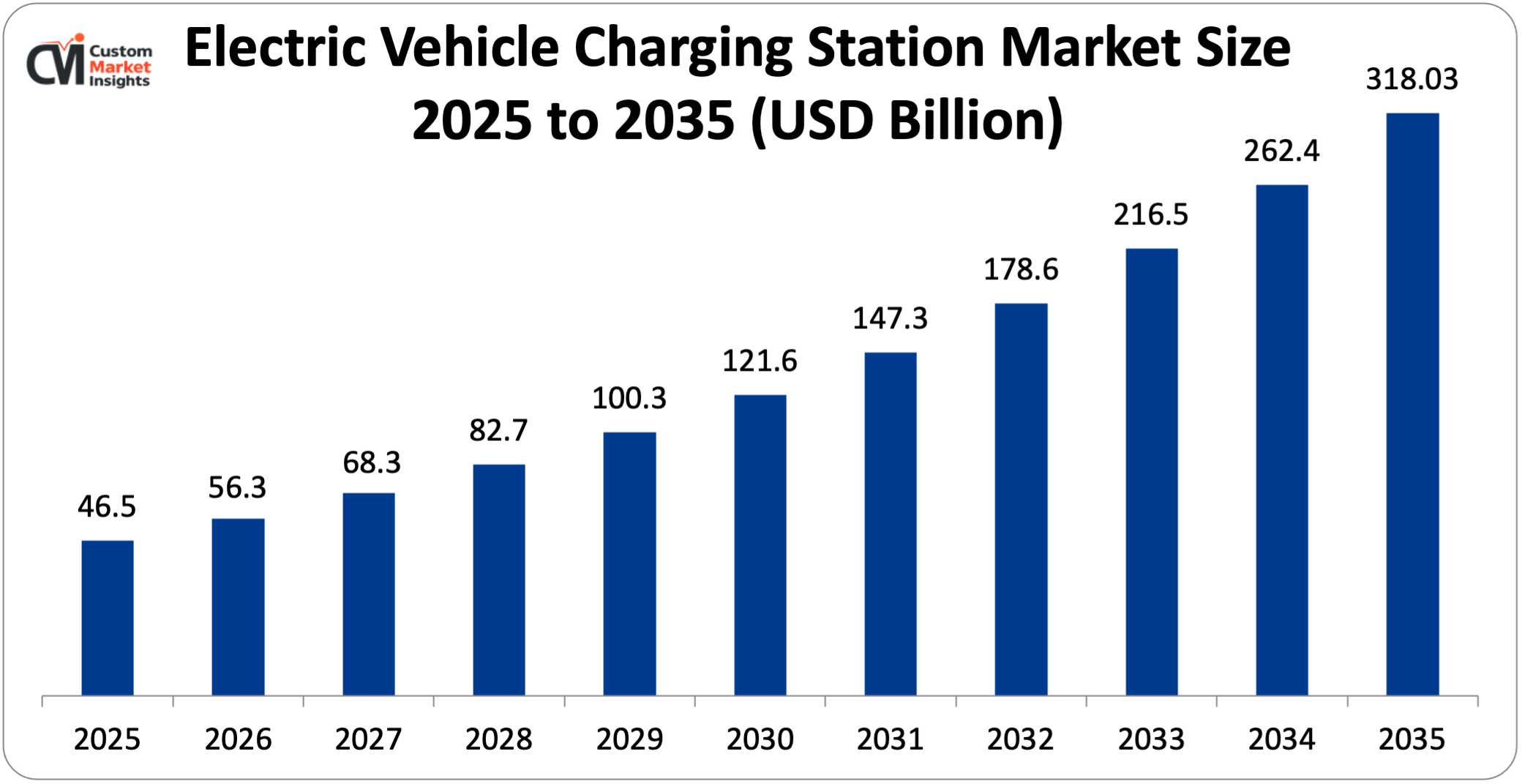
The market size of global electric vehicle charging stations will be estimated at USD 46.5 billion in 2025 and is expected to grow to between USD 56.3 billion in 2026 and about USD 318.03 billion by 2035, with a current CAGR (compound annual growth rate) of 21.2% during the period of 2026 to 2035. An electric vehicle (EV) charging station refers to a deployment setup of electric infrastructure providing electric energy service to replenish electric vehicles (EVs), including battery electric vehicles (BEVs) and plug-in hybrid electric vehicles (PHEVs). Specific components of the EV charging station include charging hardware, connectors, power conversion systems, and communication infrastructure and/or payment systems.
Electric vehicle charging stations can be located at a user’s home or at commercial or public locations and are generally grouped by level according to their power and charging speed, for example, slow AC chargers for home and slow chargers as well as fast chargers for highways and busy hubs.
Market Highlight
- In 2025, the Asia Pacific will dominate the global market with an estimated market share of 60%. The high production of EVs in China drives the market growth.
- North America is growing at the highest CAGR over the analysis period. The increasing government regulation regarding green technology propels the regional market.
- By vehicle type, the passenger cars segment dominated the industry in 2025 of over 80%.
- By charger type, the DC Charging Station segment captures the largest market share in 2025 of over 75%.
- By connector type, the CCS segment captures a highest revenue share in 2025 of 35%.
- By ownership model, the public segment captures the highest revenue share in 2025 of 65%.
Significant Growth Factors
The electric vehicle charging station market trends present significant growth opportunities due to several factors:
- Rising Adoption of EVs: Governments encourage people to purchase EVs by providing automakers with subsidies, tax exemptions, rebates, and fixed quotas. These factors are anticipated to fuel the market expansion for electric vehicle charging stations. However, as the demand for EVs grows, power infrastructures and charging stations need to keep the cars running correctly. Furthermore, strict government pollution rules have forced people to purchase EVs. The worldwide demand for electric vehicles (EVs) has recently been growing enormously. However, China and the United States hold the most significant market shares for the same. Since there is a growing demand for EVs, the market for electronic charging is also expanding. The installation of the charging stations is being financed in part by governments around the world. For instance, the national policies of China’s government have permitted the construction of fast-charging stations. Like China, the US government provides all its resources to build EV charging stations. The government’s active assistance will likely stimulate the market for level 3 charging stations during the projected period.
- The Popularity of Mobility as a Service (MaaS): The concept of Mobility as a Service (MaaS) has gained visibility, which is expected to promote the development of this industry further. However, the focus on subscription-based charging types has been one of the catalysts for the growth of EV charging stations, as it provides users with flexible payment options and encourages more frequent use of electric vehicles. According to the model, numerous utilities have partnered with OEMs to offer their consumers subscription-based services, including Vattenfall AB, Duke Energy Corporation, and the New York Power Authority. For instance, Duke Energy Corp. and ChargePoint Inc. struck a collaboration agreement to provide subscription-based services to its EV drivers in North Carolina, a U.S. state. However, several expenses related to the EV charging infrastructure, such as maintenance, installation, and operational costs, are detrimental to the market’s expansion.
What are the Major Advances Changing the Electric Vehicle Charging Station Market Today?
- Ultra-fast & Megawatt Charging Technology: Ultra-fast and megawatt charging is a major market-changing technology upon which the EV charging station industry is relying to change the entire paradigm of the EV charging station ecosystem, thereby essentially making EVs drastically more affordable in terms of how quickly they can be refueled. Ultra-fast charging is typically in the 150 kW to 350 kW range, and megawatt charging is greater than 1,000 kW (i.e., 1 MW) and would be made possible by high-voltage architectures (800 V–1000 V+), high-voltage battery chemistries, and innovative liquid cooling systems. It can provide hundreds of kilometers of range to an EV vehicle in a matter of minutes. This advancement in high-powered/ultra-fast charging addresses one of the biggest pain points impacting EV adoption so much so that electric vehicles can be refueled within a few minutes and within the same time it takes for a traditional combustion engine-powered vehicle to refuel. For instance, BYD‘s newly announced Super e-Platform was launched in 2022, offering megawatt-level charging capabilities (up to 1,000 kW), which could theoretically deliver a range of 400 km+ in five minutes. This is complementarily paired with innovative Blade batteries and silicon carbide power electronics to provide high-voltage batteries and ultra-fast charging modules. Vehicles such as the Han L and the Tang L are designed to capitalize on the megawatt charging platform. Additionally, this year, BYD has launched the company‘s next-generation “flash charging” technology, capable of ultra-fast charging power levels of 1 MW–1.5 MW (the anticipated next step is to reach 2 MW). One such example is with newer electric vehicles such as the Denza Z9 GT, which charges from a ~10% state of charge to a 70% charge in nearly five minutes. Such product launches illustrate how ultra-fast and megawatt charging are changing the EV ecosystem by reducing turnaround time, fostering development in commercial fleet electrification, and furthering the expansion of high-power charging infrastructure.
- AI-driven Smart Charging Systems: AI-enabled smart charging stations are another advancement not only for the EV charging station industry but also for the sustainable transportation industry as a whole. These are the charging stations that utilize AI, machine learning, and data insights to intelligently and efficiently adapt the charging infrastructure of electric vehicles. For example, these intelligent stations analyze sensors’ data on energy consumption, power transfer capacity of the power grids, user charging patterns, and tariffs to dynamically control, defer, and shift loading rates between connections or even between charging stations as well as share load between chargers in order to optimize energy costs, to avoid overloads on the electric utility system, and to manage noise. One can cite the case of ABB‘s charging stations that use the ABB Ability™ digital platform to deploy intelligent power charging stations. The interconnected system gathers data and uses that data to rapidly optimize power draw throughout their network of chargers. Moreover, Siemens has stated that the new building-integrated charging stations integrate intelligent energy management systems that predict demand and coordinate recharging with the availability of renewable energy sources. These technologies show how advances in artificial intelligence can evolve EV charging stations from simple electric sockets into integral parts of the future’s intelligent energy infrastructure. However, one problem is that the Tesla Superchargers have introduced intelligent charging to some extent, which partially solves this phenomenon.
Category Wise Insights
By Vehicle Type
Why Do Passenger Cars Hold a Prominent Position in the Market?
The passenger cars segment dominated the industry in 2025 of over 80%. This growth is primarily driven by the proliferation of home and workplace charging solutions for passenger cars and dense public charging network deployments in cities, apartments, and business parks. Governments from leading economies across the world are providing incentives, subsidies, and tax benefits to boost the sales of Electric Vehicles and the proliferation of charging infrastructure. Further, developments in battery technology and the proliferation of ultra-fast chargers have made Electric Vehicles more suitable for their daily use and long-distance travel.
The commercial vehicles segment is growing at the highest CAGR over the analysis period. The predictable utilization trends of commercial vehicles enable energy suppliers to time their electricity provision and set competitive rates so as to guarantee steady demand and income. The boom of e-commerce and last-mile logistics has more than doubled the demand for reliable charging facilities as businesses aim at high efficiency and low emissions.
By Charger Type
Why DC Charging Station Capture the Highest Market Share in the Electric Vehicle Charging Station Market?
The DC Charging Station segment captures the largest market share in 2025 of over 75%. The increase in the adoption of long-range electric vehicles and the requirement of high-power fast-charging stations for intercity travel are some of the biggest factors that have driven the growth of the DC fast charger market. The addition of electric buses, logistics, and ride-hailing fleets also has led to the necessity of high-power fast-charging stations for such vehicles that are highly dependent on rapid charging to function properly. Both the government and private customers are focusing on high-power DC charger grid expansion by relying on national EV infrastructure programs, which are fueling the growth of this market.
The AC Charging Station segment is growing at the highest rate over the projected period. Recent innovations in smart charging technologies have broadened the functionality (convenience, auto-scheduling, load management, etc.) and appeal (cost savings, reduced strain on the grid, lower electricity consumption, etc.) of AC charging stations. These smart features reduce costs and provide extended functionality to the end user, which is a major selling point as the electric vehicle market grows, and with more widespread charging stations, load becomes increasingly distributed over residential and commercial settings. Because of this, the AC charging station is well positioned to realize strong and continued revenue growth.
By Connector Type
Why CCS Holds a Prominent Share in the Electric Vehicle Charging Station Market?
The CCS segment captures the highest revenue share in 2025 of 35%. A key driver of this growth has been the fast scaling up of the DC fast-charging network, where the CCS connector is the leading technology. The proposed Spearhead fast-charging specification, which is designed for charging of up to 350 kW and more, is particularly suitable for highway corridors, urban fast-charging clusters, and commercial vehicle applications and commands a premium price relative to slower chargers due to higher throughput and increased utilization. Growing regulatory pressure in the US, China, and Europe combined with government-supported programs to promote infrastructure development has also helped to drive the deployment of CCS fast-charge stations.
The CHAdeMO segment is growing at a rapid rate over the projected period. The primary factors behind this continued revenue stream are the fact that there are still a significant number of current EVs using CHAdeMO connectors, which require these charging points, and that many of the other public charging stations, especially within the mature markets, utilize multi-standard chargers. These chargers incorporate the CHAdeMO connector within other connector types to allow the station to cater to the majority of its customers. The fact that this standard facilitates bi-directional charging also increases this standard‘s future relevance.
By Ownership Model
Why Public Holds a Prominent Share in the Electric Vehicle Charging Station Market?
The public segment captures the highest revenue share in 2025 of 65%. One of the main drivers for this growth is explained by the split of fast and ultra-fast DC networks for charging. Those networks have been mainly set up in publicly available sites, allowing long-range driving/fast charging. State investment and private initiative, supported by subsidies, public-private collaborations, and national EV penetration targets, have been concentrated on deploying public charging infrastructures. Moreover, the extension of ride-hailing operations, electric taxis, and integrated mobility platforms drove the share of public charging up thanks to more fast charging during driving.
The Private – Residential segment is growing at a rapid rate over the projected period. In smart homes, energy management systems enhance residential charging stations, enabling smart features like scheduling charging, remote system health checking, and synchronization to renewable energy (by rooftop solar panels). This smart innovation reduces off-energy waste and offers EV owners control of the process while eliminating bulky devices from the grid and helping accrue premium revenues for the private residential segment. Earnings from private residential segments steadily increase because they are scalable, completely user-friendly, and fully meet the needs of EV owners.
Report Scope
| Feature of the Report | Details |
| Market Size in 2026 | USD 56.3 billion |
| Projected Market Size in 2035 | USD 318.03 billion |
| Market Size in 2025 | USD 46.5 billion |
| CAGR Growth Rate | 21.2% CAGR |
| Base Year | 2025 |
| Forecast Period | 2026-2035 |
| Key Segment | By Vehicle Type, Charger Type, Connector Type, Ownership Model and Region |
| Report Coverage | Revenue Estimation and Forecast, Company Profile, Competitive Landscape, Growth Factors and Recent Trends |
| Regional Scope | North America, Europe, Asia Pacific, Middle East & Africa, and South & Central America |
| Buying Options | Request tailored purchasing options to fulfil your requirements for research. |
Regional Analysis
How Big is the Asia Pacific Electric Vehicle Charging Station Market Size?
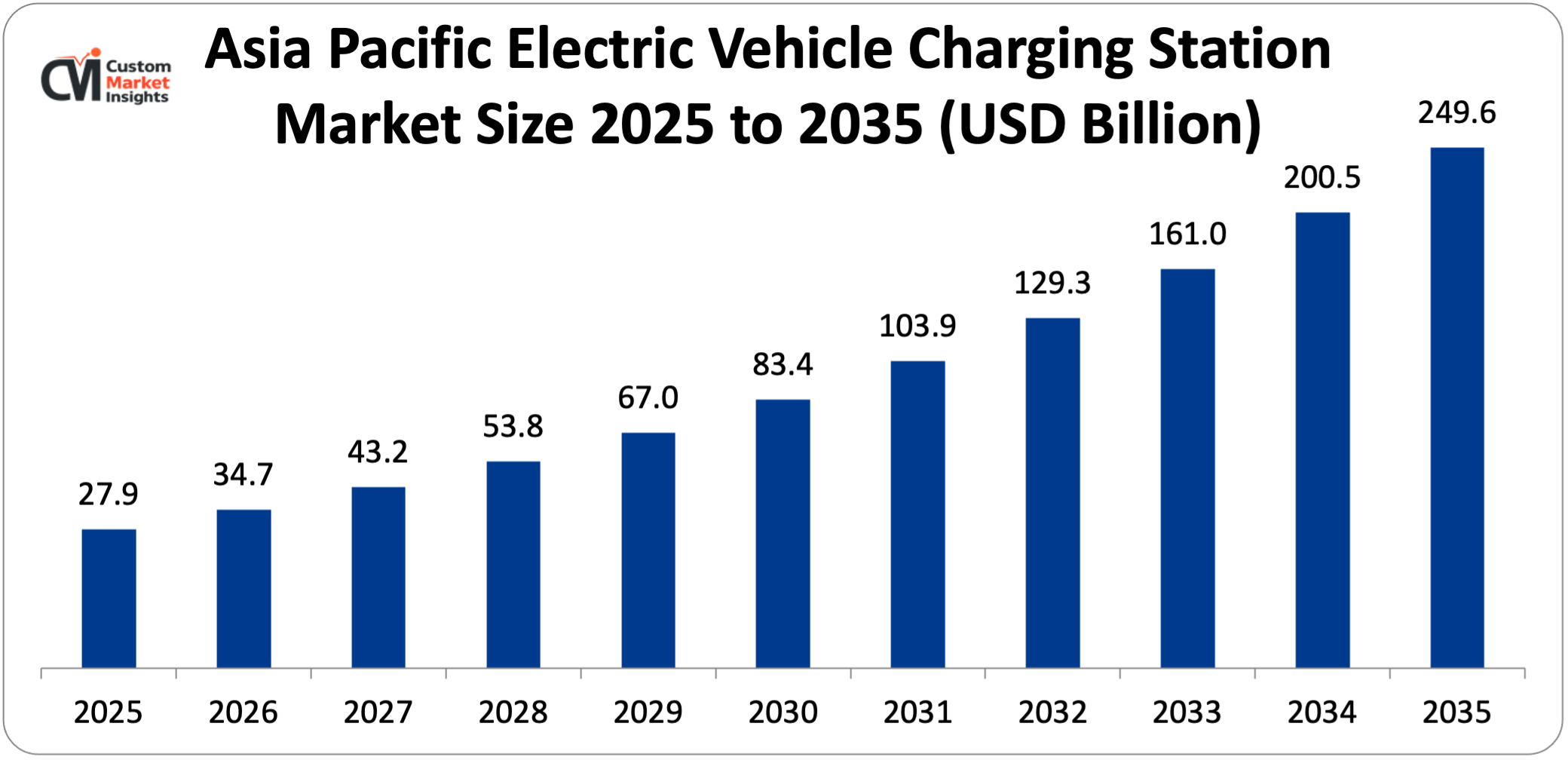
Its market size, in terms of the Asia Pacific Electric Vehicle Charging Station, is projected to be USD 27.9 billion in 2025 with a growth of about USD 249.6 billion in 2035 with a CAGR of 24.5% between 2026 and 2035.
Why did the North America Dominate the Electric Vehicle Charging Station Market in 2025?
In 2025, the Asia Pacific will dominate the global market with an estimated market share of 60%. One of the leading drivers for this expansion is the existing support system of policies like subsidies, incentives, and country-wide electrification targets to cut carbon emissions and seek a reduced reliance on fossil fuels. China has made significant investments in EV charging infrastructure along with the development of highways, while India has launched programs like FAME (Faster Adoption of Manufacturing of Electric Vehicles), which contributes to the boost in the growth of charging stations in cities and highways. Moreover, urbanization along with the increasing number of smart-city projects in the region, instigates the growth of the EV infrastructure in residential, commercial, and public domains.
China Electric Vehicle Charging Station Market Trends
In the Asia Pacific region, China leads the industry expansion over the projected period. The growth is owing to the increasing number of partnerships in the area. In March 2026, a Chinese energy infrastructure firm whose investors include Nio will partner with BYD to roll out a network of Flash Charging stations in China from an initial concentration of battery-swap infrastructure, reports Zhong‘an Energy. It underscores the increasing convergence of China‘s ultra-fast chargers and Nio‘s battery-swap network.
Why is Europe Experiencing a Significant Growth in the Electric Vehicle Charging Station Market?
Europe holds a significant market share in 2025. Europe‘s aggressive targeting of renewable energy, coupled with robust smart grid development, has greatly amplified the penetration of intelligent charging solutions, such as smart charging and vehicle-to-grid (V2G). Europe‘s automotive biggies and technology vendors playing in the same space have also compounded the innovation lead and the standardization levels (final embodiment—CCS connector) in the region. Consequently, continuing policy leadership, infrastructure build-up, and its mature EV ecosystem have translated into a steady growth in market revenue for EV charging stations in Europe.
UK Electric Vehicle Charging Station Market Trends
UK held the dominant position in the market in 2025. The UK government has ambitious targets to remove all new petrol and diesel vehicles from sale and support zero-emission mobility. This initiative has pushed the rapid growth of electric vehicles in the UK, which directly led to a significant increase in the requirement of charging points (both private and public) and thus a high increase in revenue for the operators of charging networks and infrastructure.
Why is North America Growing at a Highest CAGR in the Electric Vehicle Charging Station Market?
North America is expected to grow at the highest CAGR over the projected period. The private sector is highly engaged in the market, with a large number of such companies as energy firms, equipment suppliers, and car makers undertaking investments to expand production capacity and develop new products like ultra-fast chargers, smart chargers, and subscription services. The CAGR of electric commercial vehicle usage (e.g. Last-mile delivery vans and ride-hailing vehicles) may increase the demands for the high-capacity charging infrastructure investment. Therefore, the North America EV charging stations market is experiencing continued robust revenue expansion.
US Electric Vehicle Charging Station Market Trends
US holds the prominent market share in the industry. One of the main drivers of this trend has been both the policy incentives and funding programs to speed up the rollout of EV infrastructure. For instance, in the US a range of significant federal investment and incentive programs has been set up to develop a comprehensive mass-market charging network—fast-charging corridors across highways and dense urban charging hubs.
Why is the Middle East & Africa Region is growing rapidly in the Electric Vehicle Charging Station?
The MEA region is growing at a steady rate over the projected period. The huge push for sustainability and reduction in fossil fuel reliance drives this demand. Abundant Middle eastern oil nations are pumping billions into a sustainable future, such as Aramco investments, Saudi Arabia vision 2030, and Dubai and Abu Dhabi’s pockets of clean energy projects. This, together with the rise of smart cities and entertainment & luxury-led investments into urban cities, is boosting the proliferation of integrated EV charging infrastructure at residential, commercial, and public locations.
UAE Electric Vehicle Charging Station Market Trends
The UAE is growing at the highest CAGR during the forecast period. This growth is mainly driven by the rising investment in the green technology space and rising product launches by the key market players.
Top Players in the Electric Vehicle Charging Station Market and Their Offerings
- ABB Ltd.
- ChargePoint Inc.
- Tesla Inc.
- Siemens AG
- Schneider Electric Corporation
- Shell Plc.
- ENGIE SA (EVBox)
- BYD Motors Inc.
- Tritium Charging Inc.
- Blink Charging o.
- Delta Electronics Inc.
- Kempower Oyj
- Electrify America LLC
- IONITY GmbH
- Leviton Manufacturing Co. Inc.
- Others
Key Developments
Electric vehicle charging station market has experienced considerable changes in the last two years as the market players are trying to diversify their technological aspects and develop product portfolios using strategic approaches.
- In March 2026, Beam Global and HEVO Inc., a New York-based developer of wireless charging technology, announced the launch of an integrated autonomous wireless charging system powered by Beam’s EV ARC off-grid, solar-powered EV charging infrastructure. The system is designed for autonomous vehicle (AV) operations and can also support commercial electric vehicle (EV) fleet applications where automated charging is beneficial. The solution is commercially available and has generated interest from AV operators, government agencies, and commercial fleet customers in the United States, the United Arab Emirates, and other international markets. (https://www.government-fleet.com/news/beam-global-and-hevo-inc-launch-market-ready-autonomous-charging-platform-for-autonomous-vehicles)
- In August 2025, Intelligent power management company Eaton, together with ChargePoint, a leading provider of electric vehicle (EV) charging solutions, announced an ultrafast charging architecture with end-to-end power infrastructure for public charging and fleets. ChargePoint Express Grid, powered by Eaton, is a vehicle-to-everything (V2X) capable solution that delivers up to 600kW of power for passenger EVs and can provide megawatt charging for heavy-duty commercial applications. (https://www.eaton.com/us/en-us/company/news-insights/news-releases/2025/eaton-and-chargepoint-launch-breakthrough-ultrafast.html)
These strategic measures have enabled the companies to reinforce their competitive positions, increase the product line, boost their technological competencies, and also seize growth opportunities in the fast-growing electric vehicle charging station market.
The Electric Vehicle Charging Station Market is segmented as follows:
By Vehicle Type
- Passenger Cars
- Commercial Vehicles
- Buses and Coaches
By Charger Type
- AC Charging Station
- DC Charging Station
By Connector Type
- CCS
- CHAdeMO
- GB/T
- Tesla NACS
- Wireless
By Ownership Model
- Public
- Private – Residential
- Private – Fleet/Workplace
Regional Coverage:
North America
- U.S.
- Canada
- Mexico
- Rest of North America
Europe
- Germany
- France
- U.K.
- Russia
- Italy
- Spain
- Netherlands
- Rest of Europe
Asia Pacific
- China
- Japan
- India
- New Zealand
- Australia
- South Korea
- Taiwan
- Rest of Asia Pacific
The Middle East & Africa
- Saudi Arabia
- UAE
- Egypt
- Kuwait
- South Africa
- Rest of the Middle East & Africa
Latin America
- Brazil
- Argentina
- Rest of Latin America
Table of Contents
- Chapter 1. Report Introduction
- 1.1. Report Description
- 1.1.1. Purpose of the Report
- 1.1.2. USP & Key Offerings
- 1.2. Key Benefits For Stakeholders
- 1.3. Target Audience
- 1.4. Report Scope
- 1.1. Report Description
- Chapter 2. Market Overview
- 2.1. Report Scope (Segments And Key Players)
- 2.1.1. Electric Vehicle Charging Station by Segments
- 2.1.2. Electric Vehicle Charging Station by Region
- 2.2. Executive Summary
- 2.2.1. Market Size & Forecast
- 2.2.2. Electric Vehicle Charging Station Market Attractiveness Analysis, By Vehicle Type
- 2.2.3. Electric Vehicle Charging Station Market Attractiveness Analysis, By Charger Type
- 2.2.4. Electric Vehicle Charging Station Market Attractiveness Analysis, By Connector Type
- 2.2.5. Electric Vehicle Charging Station Market Attractiveness Analysis, By Ownership Model
- 2.1. Report Scope (Segments And Key Players)
- Chapter 3. Market Dynamics (DRO)
- 3.1. Market Drivers
- 3.1.1. Rising Adoption of EVs
- 3.1.2. The Popularity of Mobility as a Service (MaaS)
- 3.2. Market Restraints
- 3.3. Market Opportunities
- 3.5. Pestle Analysis
- 3.6. Porter Forces Analysis
- 3.7. Technology Roadmap
- 3.8. Value Chain Analysis
- 3.9. Government Policy Impact Analysis
- 3.10. Pricing Analysis
- 3.1. Market Drivers
- Chapter 4. Electric Vehicle Charging Station Market – By Vehicle Type
- 4.1. Vehicle Type Market Overview, By Vehicle Type Segment
- 4.1.1. Electric Vehicle Charging Station Market Revenue Share, By Vehicle Type, 2024 & 2035
- 4.1.2. Passenger Cars
- 4.1.3. Electric Vehicle Charging Station Share Forecast, By Region (USD Billion)
- 4.1.4. Comparative Revenue Analysis, By Country, 2024 & 2035
- 4.1.5. Key Market Trends, Growth Factors, & Opportunities
- 4.1.6. Commercial Vehicles
- 4.1.7. Electric Vehicle Charging Station Share Forecast, By Region (USD Billion)
- 4.1.8. Comparative Revenue Analysis, By Country, 2024 & 2035
- 4.1.9. Key Market Trends, Growth Factors, & Opportunities
- 4.1.10. Buses and Coaches
- 4.1.11. Electric Vehicle Charging Station Share Forecast, By Region (USD Billion)
- 4.1.12. Comparative Revenue Analysis, By Country, 2024 & 2035
- 4.1.13. Key Market Trends, Growth Factors, & Opportunities
- 4.1. Vehicle Type Market Overview, By Vehicle Type Segment
- Chapter 5. Electric Vehicle Charging Station Market – By Charger Type
- 5.1. Charger Type Market Overview, By Charger Type Segment
- 5.1.1. Electric Vehicle Charging Station Market Revenue Share, By Charger Type, 2024 & 2035
- 5.1.2. AC Charging Station
- 5.1.3. Electric Vehicle Charging Station Share Forecast, By Region (USD Billion)
- 5.1.4. Comparative Revenue Analysis, By Country, 2024 & 2035
- 5.1.5. Key Market Trends, Growth Factors, & Opportunities
- 5.1.6. DC Charging Station
- 5.1.7. Electric Vehicle Charging Station Share Forecast, By Region (USD Billion)
- 5.1.8. Comparative Revenue Analysis, By Country, 2024 & 2035
- 5.1.9. Key Market Trends, Growth Factors, & Opportunities
- 5.1. Charger Type Market Overview, By Charger Type Segment
- Chapter 6. Electric Vehicle Charging Station Market – By Connector Type
- 6.1. Connector Type Market Overview, By Connector Type Segment
- 6.1.1. Electric Vehicle Charging Station Market Revenue Share, By Connector Type, 2024 & 2035
- 6.1.2. CCS
- 6.1.3. Electric Vehicle Charging Station Share Forecast, By Region (USD Billion)
- 6.1.4. Comparative Revenue Analysis, By Country, 2024 & 2035
- 6.1.5. Key Market Trends, Growth Factors, & Opportunities
- 6.1.6. CHAdeMO
- 6.1.7. Electric Vehicle Charging Station Share Forecast, By Region (USD Billion)
- 6.1.8. Comparative Revenue Analysis, By Country, 2024 & 2035
- 6.1.9. Key Market Trends, Growth Factors, & Opportunities
- 6.1.10. GB/T
- 6.1.11. Electric Vehicle Charging Station Share Forecast, By Region (USD Billion)
- 6.1.12. Comparative Revenue Analysis, By Country, 2024 & 2035
- 6.1.13. Key Market Trends, Growth Factors, & Opportunities
- 6.1.14. Tesla NACS
- 6.1.15. Electric Vehicle Charging Station Share Forecast, By Region (USD Billion)
- 6.1.16. Comparative Revenue Analysis, By Country, 2024 & 2035
- 6.1.17. Key Market Trends, Growth Factors, & Opportunities
- 6.1.18. Wireless
- 6.1.19. Electric Vehicle Charging Station Share Forecast, By Region (USD Billion)
- 6.1.20. Comparative Revenue Analysis, By Country, 2024 & 2035
- 6.1.21. Key Market Trends, Growth Factors, & Opportunities
- 6.1. Connector Type Market Overview, By Connector Type Segment
- Chapter 7. Electric Vehicle Charging Station Market – By Ownership Model
- 7.1. Ownership Model Market Overview, By Ownership Model Segment
- 7.1.1. Electric Vehicle Charging Station Market Revenue Share, By Ownership Model, 2024 & 2035
- 7.1.2. Public
- 7.1.3. Electric Vehicle Charging Station Share Forecast, By Region (USD Billion)
- 7.1.4. Comparative Revenue Analysis, By Country, 2024 & 2035
- 7.1.5. Key Market Trends, Growth Factors, & Opportunities
- 7.1.6. Private – Residential
- 7.1.7. Electric Vehicle Charging Station Share Forecast, By Region (USD Billion)
- 7.1.8. Comparative Revenue Analysis, By Country, 2024 & 2035
- 7.1.9. Key Market Trends, Growth Factors, & Opportunities
- 7.1.10. Private – Fleet/Workplace
- 7.1.11. Electric Vehicle Charging Station Share Forecast, By Region (USD Billion)
- 7.1.12. Comparative Revenue Analysis, By Country, 2024 & 2035
- 7.1.13. Key Market Trends, Growth Factors, & Opportunities
- 7.1. Ownership Model Market Overview, By Ownership Model Segment
- Chapter 8. Electric Vehicle Charging Station Market – Regional Analysis
- 8.1. Electric Vehicle Charging Station Market Overview, By Region Segment
- 8.1.1. Global Electric Vehicle Charging Station Market Revenue Share, By Region, 2024 & 2035
- 8.1.2. Global Electric Vehicle Charging Station Market Revenue, By Region, 2026 – 2035 (USD Billion)
- 8.1.3. Global Electric Vehicle Charging Station Market Revenue, By Vehicle Type, 2026 – 2035
- 8.1.4. Global Electric Vehicle Charging Station Market Revenue, By Charger Type, 2026 – 2035
- 8.1.5. Global Electric Vehicle Charging Station Market Revenue, By Connector Type, 2026 – 2035
- 8.1.6. Global Electric Vehicle Charging Station Market Revenue, By Ownership Model, 2026 – 2035
- 8.2. North America
- 8.2.1. North America Electric Vehicle Charging Station Market Revenue, By Country, 2026 – 2035 (USD Billion)
- 8.2.2. North America Electric Vehicle Charging Station Market Revenue, By Vehicle Type, 2026 – 2035
- 8.2.3. North America Electric Vehicle Charging Station Market Revenue, By Charger Type, 2026 – 2035
- 8.2.4. North America Electric Vehicle Charging Station Market Revenue, By Connector Type, 2026 – 2035
- 8.2.5. North America Electric Vehicle Charging Station Market Revenue, By Ownership Model, 2026 – 2035
- 8.2.6. U.S. Electric Vehicle Charging Station Market Revenue, 2026 – 2035 (USD Billion)
- 8.2.7. Canada Electric Vehicle Charging Station Market Revenue, 2026 – 2035 (USD Billion)
- 8.2.8. Mexico Electric Vehicle Charging Station Market Revenue, 2026 – 2035 (USD Billion)
- 8.2.9. Rest of North America Electric Vehicle Charging Station Market Revenue, 2026 – 2035 (USD Billion)
- 8.3. Europe
- 8.3.1. Europe Electric Vehicle Charging Station Market Revenue, By Country, 2026 – 2035 (USD Billion)
- 8.3.2. Europe Electric Vehicle Charging Station Market Revenue, By Vehicle Type, 2026 – 2035
- 8.3.3. Europe Electric Vehicle Charging Station Market Revenue, By Charger Type, 2026 – 2035
- 8.3.4. Europe Electric Vehicle Charging Station Market Revenue, By Connector Type, 2026 – 2035
- 8.3.5. Europe Electric Vehicle Charging Station Market Revenue, By Ownership Model, 2026 – 2035
- 8.3.6. Germany Electric Vehicle Charging Station Market Revenue, 2026 – 2035 (USD Billion)
- 8.3.7. France Electric Vehicle Charging Station Market Revenue, 2026 – 2035 (USD Billion)
- 8.3.8. U.K. Electric Vehicle Charging Station Market Revenue, 2026 – 2035 (USD Billion)
- 8.3.9. Russia Electric Vehicle Charging Station Market Revenue, 2026 – 2035 (USD Billion)
- 8.3.10. Italy Electric Vehicle Charging Station Market Revenue, 2026 – 2035 (USD Billion)
- 8.3.11. Spain Electric Vehicle Charging Station Market Revenue, 2026 – 2035 (USD Billion)
- 8.3.12. Netherlands Electric Vehicle Charging Station Market Revenue, 2026 – 2035 (USD Billion)
- 8.3.13. Rest of Europe Electric Vehicle Charging Station Market Revenue, 2026 – 2035 (USD Billion)
- 8.4. Asia Pacific
- 8.4.1. Asia Pacific Electric Vehicle Charging Station Market Revenue, By Country, 2026 – 2035 (USD Billion)
- 8.4.2. Asia Pacific Electric Vehicle Charging Station Market Revenue, By Vehicle Type, 2026 – 2035
- 8.4.3. Asia Pacific Electric Vehicle Charging Station Market Revenue, By Charger Type, 2026 – 2035
- 8.4.4. Asia Pacific Electric Vehicle Charging Station Market Revenue, By Connector Type, 2026 – 2035
- 8.4.5. Asia Pacific Electric Vehicle Charging Station Market Revenue, By Ownership Model, 2026 – 2035
- 8.4.6. China Electric Vehicle Charging Station Market Revenue, 2026 – 2035 (USD Billion)
- 8.4.7. Japan Electric Vehicle Charging Station Market Revenue, 2026 – 2035 (USD Billion)
- 8.4.8. India Electric Vehicle Charging Station Market Revenue, 2026 – 2035 (USD Billion)
- 8.4.9. New Zealand Electric Vehicle Charging Station Market Revenue, 2026 – 2035 (USD Billion)
- 8.4.10. Australia Electric Vehicle Charging Station Market Revenue, 2026 – 2035 (USD Billion)
- 8.4.11. South Korea Electric Vehicle Charging Station Market Revenue, 2026 – 2035 (USD Billion)
- 8.4.12. Taiwan Electric Vehicle Charging Station Market Revenue, 2026 – 2035 (USD Billion)
- 8.4.13. Rest of Asia Pacific Electric Vehicle Charging Station Market Revenue, 2026 – 2035 (USD Billion)
- 8.5. The Middle-East and Africa
- 8.5.1. The Middle-East and Africa Electric Vehicle Charging Station Market Revenue, By Country, 2026 – 2035 (USD Billion)
- 8.5.2. The Middle-East and Africa Electric Vehicle Charging Station Market Revenue, By Vehicle Type, 2026 – 2035
- 8.5.3. The Middle-East and Africa Electric Vehicle Charging Station Market Revenue, By Charger Type, 2026 – 2035
- 8.5.4. The Middle-East and Africa Electric Vehicle Charging Station Market Revenue, By Connector Type, 2026 – 2035
- 8.5.5. The Middle-East and Africa Electric Vehicle Charging Station Market Revenue, By Ownership Model, 2026 – 2035
- 8.5.6. Saudi Arabia Electric Vehicle Charging Station Market Revenue, 2026 – 2035 (USD Billion)
- 8.5.7. UAE Electric Vehicle Charging Station Market Revenue, 2026 – 2035 (USD Billion)
- 8.5.8. Egypt Electric Vehicle Charging Station Market Revenue, 2026 – 2035 (USD Billion)
- 8.5.9. Kuwait Electric Vehicle Charging Station Market Revenue, 2026 – 2035 (USD Billion)
- 8.5.10. South Africa Electric Vehicle Charging Station Market Revenue, 2026 – 2035 (USD Billion)
- 8.5.11. Rest of the Middle East & Africa Electric Vehicle Charging Station Market Revenue, 2026 – 2035 (USD Billion)
- 8.6. Latin America
- 8.6.1. Latin America Electric Vehicle Charging Station Market Revenue, By Country, 2026 – 2035 (USD Billion)
- 8.6.2. Latin America Electric Vehicle Charging Station Market Revenue, By Vehicle Type, 2026 – 2035
- 8.6.3. Latin America Electric Vehicle Charging Station Market Revenue, By Charger Type, 2026 – 2035
- 8.6.4. Latin America Electric Vehicle Charging Station Market Revenue, By Connector Type, 2026 – 2035
- 8.6.5. Latin America Electric Vehicle Charging Station Market Revenue, By Ownership Model, 2026 – 2035
- 8.6.6. Brazil Electric Vehicle Charging Station Market Revenue, 2026 – 2035 (USD Billion)
- 8.6.7. Argentina Electric Vehicle Charging Station Market Revenue, 2026 – 2035 (USD Billion)
- 8.6.8. Rest of Latin America Electric Vehicle Charging Station Market Revenue, 2026 – 2035 (USD Billion)
- 8.1. Electric Vehicle Charging Station Market Overview, By Region Segment
- Chapter 9. Competitive Landscape
- 9.1. Company Market Share Analysis – 2024
- 9.1.1. Global Electric Vehicle Charging Station Market: Company Market Share, 2024
- 9.2. Global Electric Vehicle Charging Station Market Company Market Share, 2023
- 9.1. Company Market Share Analysis – 2024
- Chapter 10. Company Profiles
- 10.1. ABB Ltd.
- 10.1.1. Company Overview
- 10.1.2. Key Executives
- 10.1.3. Product Portfolio
- 10.1.4. Financial Overview
- 10.1.5. Operating Business Segments
- 10.1.6. Business Performance
- 10.1.7. Recent Developments
- 10.2. ChargePoint Inc.
- 10.3. Tesla Inc.
- 10.4. Siemens AG
- 10.5. Schneider Electric Corporation
- 10.6. Shell Plc.
- 10.7. ENGIE SA (EVBox)
- 10.8. BYD Motors Inc.
- 10.9. Tritium Charging Inc.
- 10.10. Blink Charging o.
- 10.11. Delta Electronics Inc.
- 10.12. Kempower Oyj
- 10.13. Electrify America LLC
- 10.14. IONITY GmbH
- 10.15. Leviton Manufacturing Co. Inc.
- 10.16. Others.
- 10.1. ABB Ltd.
- Chapter 11. Research Methodology
- 11.1. Research Methodology
- 11.2. Secondary Research
- 11.3. Primary Research
- 11.3.1. Analyst Tools and Models
- 11.4. Research Limitations
- 11.5. Assumptions
- 11.6. Insights From Primary Respondents
- 11.7. Why Healthcare Foresights
- Chapter 12. Standard Report Commercials & Add-Ons
- 12.1. Customization Options
- 12.2. Subscription Module For Market Research Reports
- 12.3. Client Testimonials
- Chapter 13. List Of Figures
- 13.1. Figures No 1 to 31
- Chapter 14. List Of Tables
- 14.1. Tables No 1 to 51
Prominent Players
- ABB Ltd.
- ChargePoint Inc.
- Tesla Inc.
- Siemens AG
- Schneider Electric Corporation
- Shell Plc.
- ENGIE SA (EVBox)
- BYD Motors Inc.
- Tritium Charging Inc.
- Blink Charging
- Delta Electronics Inc.
- Kempower Oyj
- Electrify America LLC
- IONITY GmbH
- Leviton Manufacturing Co. Inc.
- Others
FAQs
The key players in the market are ABB Ltd., ChargePoint Inc., Tesla Inc., Siemens AG, Schneider Electric Corporation, Shell Plc., ENGIE SA (EVBox), BYD Motors Inc., Tritium Charging Inc., Blink Charging Co., Delta Electronics Inc., Kempower Oyj, Electrify America LLC, IONITY GmbH, Leviton Manufacturing Co. Inc., Others.
Government rules & regulations have a substantial impact on the growth of the EV charging station market as they build a solid framework for driving the adoption of Electric Vehicles (EV) in the country and infrastructure setup. For instance, policies such as subsidies, grants, and tax benefits have a negative impact on the total cost of installing charging stations and buying an EV which motivates institutional as well as individual investors to participate in the market. Various regulations related to emission abatement and deadlines for phase-wise elimination of internal combustion engine cars are also responsible for the traction of electric vehicles, as they create urgency for consumers and manufacturers to transition to cleaner alternatives.
Cost is another factor that impacts the EV charging station market, as it directly affects the infrastructure installation and the consumption of the EV market. In general, the installation of the charging stations requires a significant amount of capital compared to the efficiency of the station. The high cost of installing chargers, in particular-dc fast chargers, has the potential to limit the number of stations that can be installed by small operators, whereas the low cost of integrating AC home chargers is enabling larger adoption of charging infrastructure that can be integrated into home settings. Charging fees relative to the price of traditional fuel types also impact consumer adoption of EVs and the use of charging infrastructure.
According to the present analysis and forecast modeling, the market of electric vehicle charging stations will witness a significant growth of about USD 318.03 billion in the year 2035 with the growing innovative product launch, increasing collaboration, and rising adoption of EVs across the globe with a CAGR of 21.2% between the years 2026 and 2035.
It is projected that the Asia Pacific will hold the largest market share in the electric vehicle charging station market in the forecast period, with a share of about 60% of the global market share, which is attributed to the region’s presence of major players and high production of EVs.
North America is expected to grow at the highest CAGR during the forecast period. The growth in the region is owing to the rising government initiatives.
The market of EV charging stations is growing rapidly due to the growing number of EVs on the road, supported by incentives & subsidies provided by various governments. Growing charging infrastructure, advances in fast & smart charging, and increased investments in charging stations are helping the market grow. Moreover, growing demand from passenger & commercial vehicles and the growth of urbanization & sustainability schemes in the automotive sector are helping to grow the market of EV charging stations.