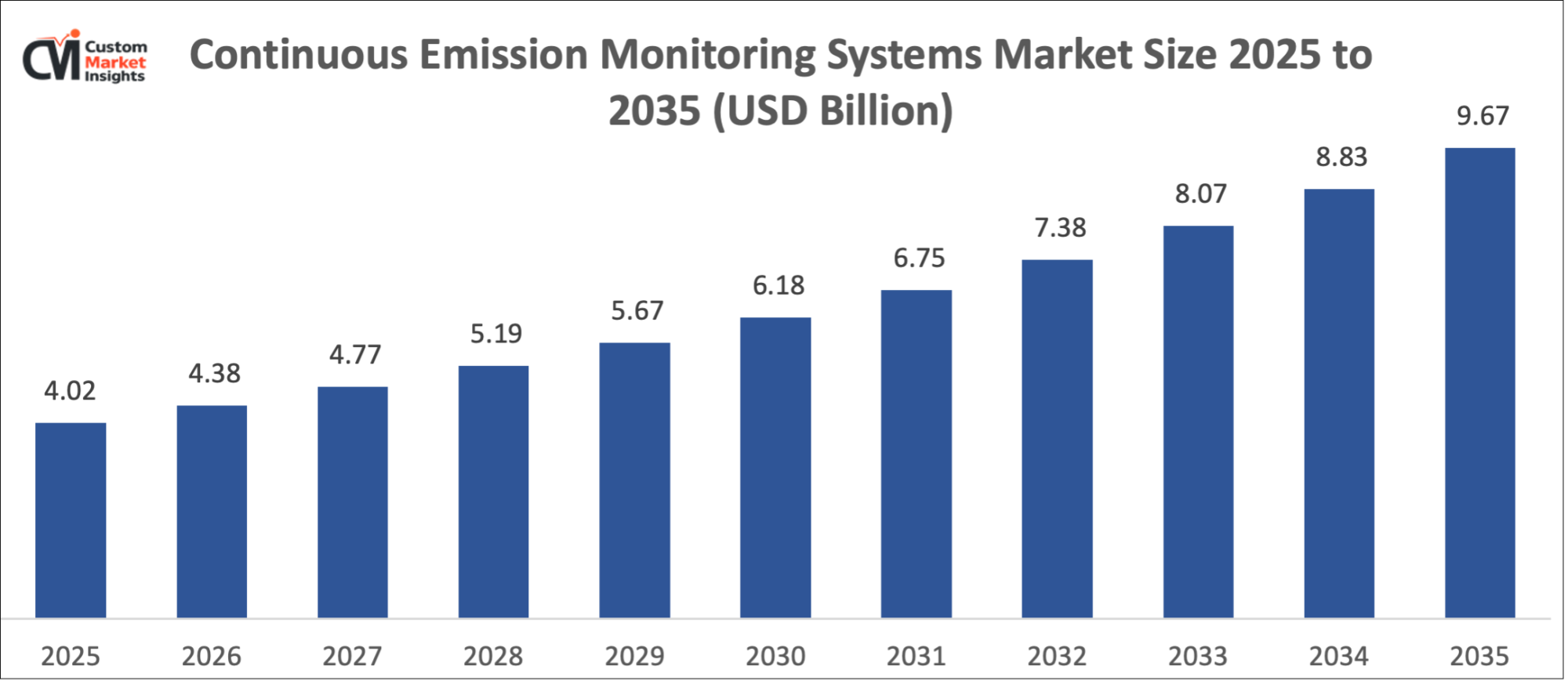
The global continuous emission monitoring systems market was valued at USD 4.38 Bn in 2026 and is projected to reach USD 9.67 Bn by 2035, growing at a CAGR of 9.2%. North America is the largest regional market and Asia Pacific is growing fastest.
Global Continuous Emission Monitoring Systems Market 2026 – 2035
Continuous emission monitoring systems market is projected to be USD 4.38 billion in the year 2026, USD 9.67 billion in the year 2035 and at a projected CAGR of 9.2% between the years 2026 and 2035. The major factor that makes this market grow is the rising level of environmental regulation and strict emission control policies introduced by governments and other regulatory bodies to check and mitigate air pollution by industries. Continuous emission monitoring systems are becoming a common practice in industries like power generation, oil and gas, chemicals, cement and metals to ensure that the industries remain within the boundaries of the regulatory standards and also to exercise transparency in emission reporting.
Asia Pacific was the market leader of the continuous emission monitoring systems with a 45% market share of 2025.
North America will grow by 9.3% in the period between 2026 and 2035.
The Direct Extractive CEMS segment had taken over 35% of the market share in 2025 by type.
By Installation Type, New Installations segment will experience the highest CAGR of 9.4% between 2026 and 2035.
Application-wise, the Power generation segment will have the largest market share of 42% in 2025, driven by strict emission regulations and monitoring requirements.
Significant Growth Factors
Trends in Continuous emission monitoring systems Market Trends present significant growth opportunities due to several factors:
Strict Environmental Guidelines and Compliance Requirements: The world's governments and environmental control agencies are implementing tighter environmental standards of air quality as a measure of regulating factory emissions in order to curb environmental pollution. CEMS is a common technology in power generation, cement, oil and gas, chemical, and metal processing industries to measure the real time pollution of sulfur dioxide (SO₂), nitrogen oxides (NOₓ), carbon monoxide (CO), and particulate matter. The existence of regulatory systems that enforce the industries to constantly monitor and report the level of emissions is compelling companies to use sophisticated monitoring systems. Such systems assist facilities to stay in line with the environmental standards besides enhancing transparency and environmental responsibility in their operations.
Increment in Global Consciousness on Air Quality and Climate Change Mitigation: Ever-growing apprehensions regarding climate change and worsening air quality are enhancing the uptake of emission monitoring technologies across the globe. Policies that are meant to mitigate the emission of greenhouse gases and industrial air pollution are being put in place by the governments, international organizations, and environmental agencies. In order to promote such programs as carbon reduction and clean air action plans, continuous emission monitoring systems allow any changes in the level of emissions to be properly traced and to be used to foster the environment. The increased consciousness of the environmental and human health effects of industrial emissions is also pushing industries to invest in sound monitoring infrastructure which can be used in supporting sustainable and responsible industrial practices.
Growth of Industrial and Power Generation Capacity: The rapid rate of industrialization particularly in the emerging economies in the Asia-Pacific, the Middle East and Latin America is putting pressure on the capacity of the market of the emission monitoring solutions. Industrial production and thermal power plants, refineries, and large scale industries produce large emissions that have to be monitored to ensure that they do not exceed the limit stipulated by the regulations. With the governments making investments in energy and industrial infrastructure, the necessity of the efficient monitoring system turns out to be more urgent. The continuous emission monitoring system assists the operators of the plants to optimize their combustion efficiency and also to identify any anomalies in emissions as well as to maintain that the industrial functions do not exceed the environmental limits imposed.
Improvement in Monitoring Technologies and Data Integration: Technological advancement in monitors, gas analysers and digital monitoring systems is enhancing the precision and efficiency of the emission monitoring systems. The current solutions of CEMS are becoming more closely integrated with cloud-based systems or data analytics tools as well as remote monitoring systems supporting real-time conveying of data and predictive maintenance. Such innovations enable industries to analyze the emission patterns more efficiently, automate the compliance reporting, and enhance decision-making operations. The implementation of innovative software, automation systems, and IoT-driven monitoring systems is changing the conventional emission monitoring systems to intelligent environmental management systems.
What are the single Biggest Developments Reshaping the Continuous emission monitoring systems market Today?
High Capital Investment and Complexity of Installation: Continuous emission monitoring systems (CEMS) demand high initial investment in hardware and installation, calibration and connection to control systems of the plant. Companies in the power generation sector, cement sector and oil and gas industry have to set aside huge funds to install and maintain these monitoring systems. Besides the cost of equipment, the facilities are also required to spend on regular maintenance schedules, qualified technicians, and compliance reporting systems. These high capital and operation costs may slow the adoption of these facilities in the small and medium-sized industrial facilities. With industries juggling between the cost of environmental compliance and the cost of operation, the monetary cost of installing and maintaining sophisticated monitoring systems is a major concern that is defining the market.
Regulatory Differences and Complexity of Compliance by Region: The monitoring of emissions in different countries and different regulatory jurisdictions varies greatly, and this presents a challenge to the multinational industrial operator. Compliance management may be a challenge due to the differences in the standards of pollutants, reporting rate, calibration, and data verification. The industries that may be engaged in various regions would normally require the deployment of the specific monitoring systems to comply with the particular regulatory structures. This is a disjointed regulatory climate that adds to the complexity of operations as well as heightens the awareness of the necessity of adaptable and versatile emission monitoring technologies that can adapt to different global environmental compliance requirements.
Technical Con restraint on the process of monitoring various industrial emissions: Despite the improvement in CEMS technologies, it is difficult to monitor some types of pollutants and ensure the accuracy of measurements in tough industrial conditions. Based on the performance and calibration accuracy of the sensor, high temperatures, corrosive gases, dust, and varying concentrations of emission can have an impact. The steel manufacturing industry, waste disposal, and petrochemical processing are a few examples of industries that produce complex streams of emissions that need special monitoring solutions. The technical challenge in this case is to ensure continuous, reliable and accurate emission measurement under such conditions and manufacturers engage in constant innovation in the design of sensors, data analytics, and system reliability.
Increasing Consistency of Demand in Digital and Automated Environmental Monitoring: The operators of the industry are turning more and more into digital monitoring platforms that would allow real-time monitoring of emissions, automated compliance reporting, and remote diagnostics. Conventional emission monitoring solutions are slowly being deposed by unified solutions that are linked to industrial automation systems and cloud-based data analytics technologies. These computer-related functions enable plants to identify anomalies and enhance operational effectiveness and respond proactively to environmental risks. With the introduction of Industry 4.0 technology and smart manufacturing methods used by industries, the digital monitoring solution integration can become a significant trend that is transforming the market of the continuous emission monitoring systems.
Why are Direct Extractive CEMS the Market Leaders?
Direct extractive CEMS are more prevalent in the market as they offer very good and reliable measurement of industrial emissions of a broad diversity of pollutants. Such systems take gas samples at the location of emission and test them with sophisticated gas analysers enabling industries to detect pollutants like sulfur dioxide, nitrogen oxides, and carbon monoxide in high precision. This technology is suitable in power plants, cement plants, and petrochemical industries because the technology is compatible with the stringent environmental compliance regulations. Also, the fact that direct extractive systems can be successful in the severe industrial environments and deliver consistent long-term monitoring outputs has enhanced their adoption in the large industrial facilities. Direct extractive CEMS still command the biggest portion of revenue in the market of continuous emission monitoring systems as the regulatory bodies continue to insist on sustained and precise reporting of emissions.
Why are In-situ CEMS the Fastest-Growing Segment?
The in-situ CEMS is becoming the fastest-growing branch of technology since it provides real-time monitoring with minimum handling of samples and requires fewer maintenance actions. These systems can quantify emissions in the stack/duct, and there is no requirement of a difficult sampling and conditioning system found in extractive technologies. This eases the architecture of the systems and lowers the operations cost incurred by industrial operators. In-situ systems are especially becoming popular in industries that require compact, energy saving monitoring systems that can be installed faster and are more efficient in their operations. The need of in-situ CEMS technologies is likely to increase at a high rate in the forecast period as most industrial facilities implement the modern environmental monitoring infrastructure and attempt to minimize the downtime and maintenance costs.
By Installation Type
Why are Retrofit Installations/Upgrades the Market Leaders?
Upgrades and retrofit installations constitute the biggest market in the CEMS market due to the fact that most of the current industrial facilities need to be upgraded on their emission monitoring systems in order to comply with the changing environmental requirements. Legacy infrastructure is a common feature of power plants, refineries, cement plants, and other heavy industrial facilities, which are required to be modernized to meet newer and tighter requirements of emission monitoring. The ability to retrofit the industries creates an opportunity to increase the monitoring capabilities without uprooting complete systems within a plant, which makes it a cost-effective strategy of compliance. In most of the regions, governments are intensifying policies that monitor the environment, which is forcing operators to modernize the current monitoring systems with the new sophisticated sensors, data acquisition systems, and automated reporting systems. Consequently, the highest proportion of installations in the continuous emission monitoring systems market is in retrofit installations.
Why are New Installations the Fastest-Growing Segment?
The new installations are increasing at a very high rate because of the growth of industrial infrastructure as well as new power generation projects in the world. Emerging economies are pouring money into energy production, manufacturing facilities and industrial processing plants all these need to have emission monitoring systems in place at the onset of operation to adhere to the environmental regulations. Emission monitoring systems are becoming a requirement in the construction and commissioning of industrial plants in accordance with environmental impact assessment and regulation frameworks. With the growing trend of enforcing environmental compliance policies by governments and encouraging sustainable industrial growth, newly installed monitoring systems in new facilities are rapidly growing and it is the fastest-growing part of the installation business.
Why is Power Generation the Largest Application Segment?
The largest market segment of the CEMS is still power generation as a large amount of emissions is generated by thermal power plants and other energy production units. The power plants that use coal and gas as fuels release emissions like sulfur dioxide, nitrogen oxides and particulate matter which have to be tracked constantly so that they do not exceed environmental standards. Continuous emission monitoring systems are important in assisting utilities to monitor the level of emissions, maximize the efficiency of combustion, and comply with regulations. Further, the government regulations aimed at eliminating the emission of gases in the energy industry have seen the large scale implementation of monitoring systems in the older and new power plants. Therefore, the greatest portion of the demand in the market of continuous emission monitoring systems takes place in the power generation sector.
Why is Waste Incineration the Fastest-Growing Application Segment?
The most rapidly growing application segment is waste incineration as the attention to sustainability of waste management practices and the development of waste-to-energy facilities across the globe are growing. Through the burning of municipal and industrial waste in the incineration plants, different gaseous pollutants and particulate emissions occur and hence constant monitoring is imperative to ensure environmental adherence. There is an increased trend among governments to impose stringent requirements on waste treatment plant which will reduce the risks posed to the environment and the health of the population. With the growth and increase in waste generation, most nations are now investing in modern waste incineration and waste-to-energy facilities and these facilities need a modern emission monitoring system. This is becoming a trend whereby the usage of CEMS is rapidly increasing in the waste management industry.
Report Scope
Feature of the Report
Details
Market Size in 2026
USD 4.38 billion
Projected Market Size in 2035
USD 9.67 billion
Market Size in 2025
USD 4.02 billion
CAGR Growth Rate
9.2% CAGR
Base Year
2025
Forecast Period
2026-2035
Key Segment
By Technology, Installation Type, Application and Region
Report Coverage
Revenue Estimation and Forecast, Company Profile, Competitive Landscape, Growth Factors and Recent Trends
Regional Scope
North America, Europe, Asia Pacific, Middle East & Africa, and South & Central America
Buying Options
Request tailored purchasing options to fulfil your requirements for research.
Regional Analysis
How Big is the Asia Pacific Market Size?
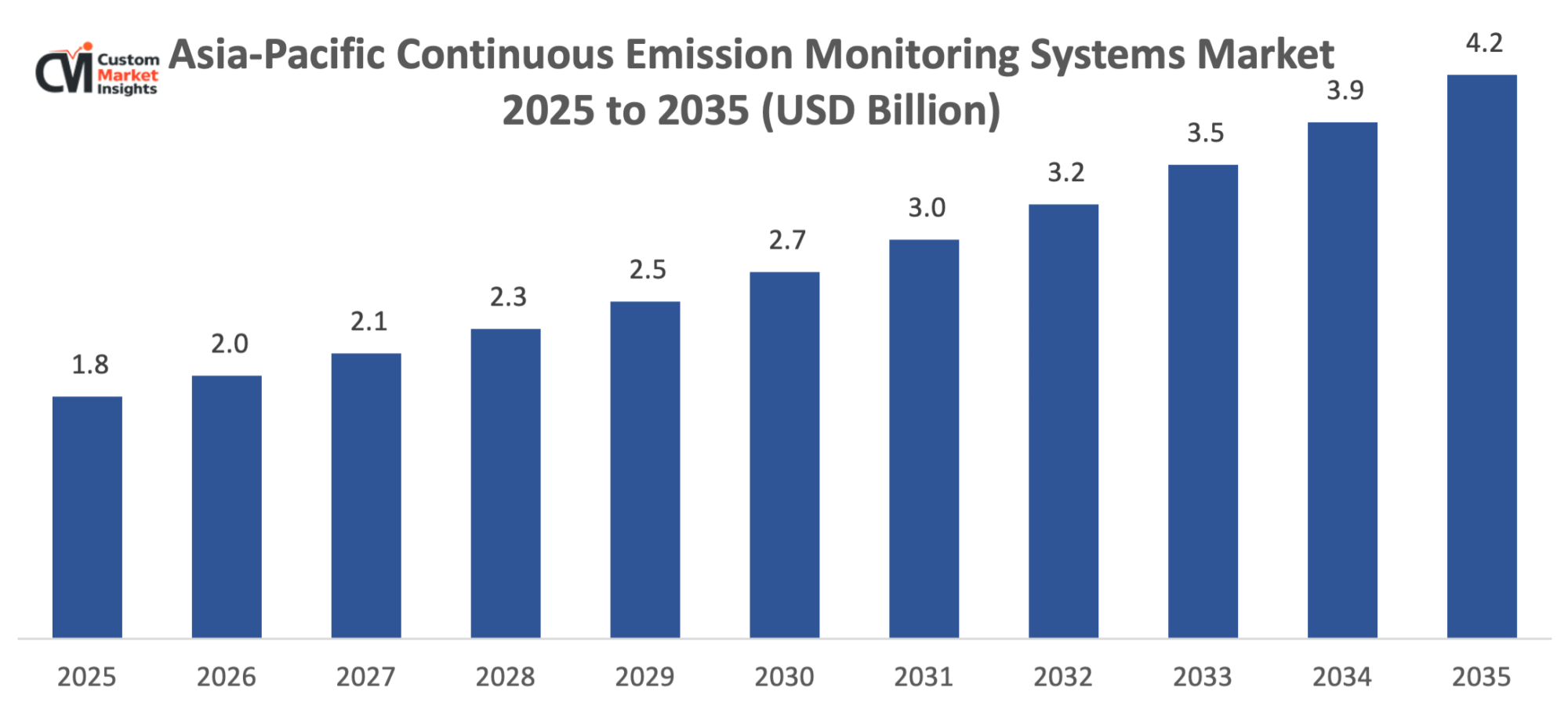
The Asia Pacific continuous emission monitoring systems market size is estimated at USD 1.8 billion in 2025 and is projected to reach approximately USD 4.2 billion by 2035, with a 8.8% CAGR from 2026 to 2035.
The Asia-Pacific region accounted for the largest share of the Continuous Emission Monitoring Systems (CEMS) market in 2025, supported by rapid industrialization, expanding power generation capacity, and increasingly strict environmental regulations across major economies. Countries such as China and India have implemented stronger air pollution control policies that require industrial facilities to continuously monitor emissions from power plants, refineries, cement plants, and chemical industries. The region’s large manufacturing base, growing energy demand, and expansion of coal-fired power plants have significantly increased the need for reliable emissions monitoring technologies. Governments are also investing in digital environmental monitoring infrastructure and smart pollution control systems, which further supports the adoption of advanced CEMS solutions. Continuous urbanization and stricter enforcement of air-quality standards are expected to keep the region dominant during the forecast period.
China Market Trends
China represents one of the largest markets for Continuous Emission Monitoring Systems due to its extensive industrial base and strong regulatory push to reduce air pollution. The government has strengthened emission monitoring requirements for sectors such as power generation, steel manufacturing, cement production, and petrochemicals. The need to have real-time emissions monitoring and reporting systems in industrial facilities has been on the rise because of national air pollution control programs and even carbon neutrality goals. There are stringent policies of pollution control that the Chinese government enforces in the country as a part of the national air quality programs, which dictates that there must be constant monitoring of pollutants like SO₂, NOx, and particulate matter. The manufacturing industry in the country also produces an estimated 27-30 percent of the world's manufacturing, and this is another factor contributing to the need of monitoring solutions in the steel, cement, and chemical plants. Moreover, the further dynamic growth of renewable energy facilities, the modernization of the older power plants, and the digitalization of the industrial monitoring systems are stimulating the implementation of the advanced technologies of the CEMS throughout the country.
Why is North America Experiencing Steady Growth?
The Continuous Emission Monitoring Systems market in North America is facing stable growth as there is an established industrial base and systems of environmental compliance. The industries in the power generation, oil and gas, chemicals, and manufacturing are mandated to have certified emission monitoring systems in order to meet the stringent environmental controls. The demand is driven by continuous upgrades of monitoring infrastructure, modernization of outdated monitoring equipment, and digital data management platform adoption. The area generates more than 900 million metric tons of CO₂ every year through power generation, and this puts a high demand on precise monitoring systems. Moreover, the carbon capture projects, energy transition programs, and industrial decarbonization programs are also becoming more common in the region, also contributing to the growing demand for precise emissions monitoring technologies.
What is the Size of the U.S. Market?
In the U.S., the market size of the continuous emission monitoring systems is estimated at USD xx million in the year 2025 and is anticipated to grow at an accelerating rate of xx% between the year 2026 and 2035.
U.S. Market Trends
The market of Continuous Emission Monitoring Systems is represented in the United States with a large portion of the world's demand because of the stringent environmental regulation laws and large industrial bases. The regulations imposed by the United States Environmental Protection Agency provide continuous monitoring and reporting of the emissions of the pollutants of the power plants, refineries, and manufacturing plants. It emits more than 4 billion metric tons of greenhouse gas a year, and a wide-ranging monitoring apparatus is needed in the energy and industrial sectors. The American power industry alone has over 7,000 power generation units, most of which are supposed to be equipped with continuous emission monitoring systems to provide compliance reporting. The use of advanced CEMS technologies is being implemented by increasing investments in clean energy projects, reform of fossil fuel-powered power plants, and introduction of digital environmental monitoring platforms. The operators of the industry are also modernizing the old monitoring systems in order to enhance the accuracy of the data, compliance reporting, and efficiency in the way the business operates.
Why is Europe Focusing on Sustainability and Efficiency?
Europe is a very good market for Continuous Emission Monitoring Systems because it is highly concerned with the environmental sustainability, carbon goals, and emission quotas of the industrial premises. About 10,000 industrial plants in Europe are monitored by the emission monitoring and reporting policies, which are power plants, refineries, cement plants and chemical plants. The region has also put in place strict environmental policies that demand industries keep track of real time emission reports. The need to invest in renewable energy, de-carbonization of industries, and energy saving measures is pushing towards the use of advanced monitoring solutions. The growth in sciences is the adoption of digital CEMS solutions in industries that operate in the power generation, chemical, cement, and waste management sectors as a way of enhancing their environmental compliance and transparency in their operations.
Germany Market Trends
The European Continuous Emission Monitoring Systems market has a serious place in Germany because of the high industrial infrastructure and environmental regulations of the country. Germany contributes approximately 25 percent of the industrial production in Europe, with the top industries being chemicals, steel, automobile production, and production of energy. The nation has additionally over 400 giant industrial emission plants, which must be monitored and reported on on a continuous basis. The manufacturing base in the country is very high in the chemical, automotive, steel, and energy producing sectors, and continuous monitoring on emissions to meet the regulatory standards is necessary. The industries in Germany are also investing more in precision monitoring technologies, automation, and digital environmental management systems to minimize the emissions and enhance efficiency.
Why is the Middle East & Africa Region Experiencing Growth?
The Middle East and Africa region is experiencing an increasing use of the Continuous Emission Monitoring Systems as the energy and industrial sector is rising and development and regulation of the sphere of environmental monitoring become more popular. The Middle East region contributes approximately 30 percent of the world oil production and in the region there are hundreds of large refining and petrochemical plants all of which need an emissions system. The power generation, petrochemical, and massive industrial industries are being greatly invested in by nations like Saudi Arabia and the United Arab Emirates and in such industries, emissions have to be constantly monitored so that the environment is not violated. Meanwhile, the number of African economies is providing stronger environmental regulations on mining, power plants, and other industrial plants. The increase in their awareness of air pollution control and the gradual rise of environmental protection regulations will push the growth of the demand on CEMS technologies in the region in the forecasting period.
Top Players in the Market and Their Offerings
ABB
Siemens
Emerson Electric Co.
Teledyne Technologies
Horiba
Thermo Fisher Scientific Inc.
AMETEK Inc
Fuji Electric Co. Ltd.
SICK AG
IMR Environmental Equipment Inc.
Kanomax USA Inc.
METTLER TOLEDO
MRU Instruments
Process Insights Inc.
Envea
Keller Group plc
Endress+Hauser Group Services AG
RKI Instruments
Acoem
Others
Key Developments
The Continuous Emission Monitoring Systems (CEMS) market has seen a high rate of technological innovations and strategic partnerships as firms are keen on enhancing real time monitoring of emissions, regulatory compliance and transparency of environmental issues. Participants in the market are also coming up with sophisticated monitoring systems that combine digital analytics, automation, and remote monitoring features to ensure that industries are in a position to measure and control the emission of greenhouse gases and pollutants. The reasons behind these developments include the increasing global regulations on emissions, increased corporate responsibilities in sustainability and the increased use of data-based environmental monitoring solutions in power generation, shipping, and the industrial sector.
In June 2025, Kongsberg Maritime launched a Continuous Emissions Monitoring System (CEMS) that enables real-time monitoring of CO₂, CH₄, SOx, NOx, and CO directly from ship exhaust gases. The system is designed to support the maritime industry in reducing its carbon footprint and complying with increasingly stringent global emission regulations.
In May 2025, Siemens entered a global partnership with German clean-tech company TURN2X to scale up the production of renewable natural gas (RNG). Under this collaboration, Siemens will provide automation, digitalization, and energy management solutions to optimize TURN2X’s operations and support the transition toward sustainable energy through the production of carbon-neutral methane.
In May 2025, The Finnish Meteorological Institute introduced two innovative satellite-based methodologies to enhance the monitoring of greenhouse gas and air pollution emissions from urban areas, power plants, and industrial facilities. These methods deliver more accurate and near real-time emissions data, supporting improved environmental monitoring, regulatory compliance, and policy development.
These technological developments are enabling companies to enhance monitoring accuracy, expand application areas, and strengthen compliance capabilities for industries facing strict environmental regulations. Continuous innovation in sensor technologies, digital integration, and remote emissions analytics is expected to intensify competition among solution providers and accelerate the adoption of advanced CEMS solutions across energy, manufacturing, and maritime sectors during the forecast period.
Who are the key players in the Continuous Emission Monitoring Systems market?
The key players in the market are ABB, Siemens, Emerson Electric Co., Teledyne Technologies, Horiba, Thermo Fisher Scientific Inc., AMETEK Inc., Fuji Electric Co. Ltd., SICK AG, IMR Environmental Equipment Inc., Kanomax USA Inc., METTLER TOLEDO, MRU Instruments, Process Insights Inc., Envea, Keller Group plc, Endress+Hauser Group Services AG, RKI Instruments, Acoem, Others.
What about the role of the government regulations?
Government regulations are also vital in the development of the market on Continuous Emission Monitoring Systems. Not only in the US but also in other global regions, most environmental agencies are introducing stringent emission monitoring and reporting standards to curb air pollution and attain climate objectives. Legal measures like the Clean Air Act and emission monitoring acts in some states like the European Union and China compel industries to install an approved emission monitoring system. These policies stimulate industries to use modern technologies in CEMS to be compliant, enhance transparency in reporting emissions, and help to make commitments at national and international climate levels.
How does price impact on market growth?
Price is a key issue in the adaptation of Continuous Emission Monitoring Systems especially among small and medium-sized facilities. Although the adoption in smaller manufacturing industries may be affected by cost, large power plants and refineries tend to invest in high-end and integrated monitoring solutions. Nevertheless, cost efficiency is being gradually enhanced by the growing accessibility of modular systems, developments in technology of sensors, and incorporation of software based analytics. In the long run, the cost of the system will decrease due to the technological advancement and the increase in its acceptance, which will promote its expansion into the broader market segment.
What will be the region that is likely to assume the market?
The Continuous Emission Monitoring Systems market in North America is projected to be leading because of its strict environmental regulation system, as well as the level of adoption of sophisticated monitoring technologies. The bureaucratic policies of agencies like the environmental protection agency of the United States have mandated industries to monitor and report emissions in real time and this has stimulated high demand for CEMS solutions in power generation, oil and gas, and manufacturing industries. The availability of the major providers of monitoring technologies and a good investment in environmental compliance infrastructure is also an advantage of the region.
Which region is the most promising in terms of CAGR?
The Asia-Pacific region will have the highest CAGR in the Continuous Emission Monitoring Systems market within the forecast period. The growing demand for constant emissions monitoring technologies is being prompted by rapid industrialization, rising energy needs, and more stringent environmental laws in countries like China and India. Also, government policies to enhance air quality and monitor the industrial pollution are stimulating the use of advanced CEMS solutions by power plants, refineries, cement plants, and chemical industries.
What are the driving forces that matter the most in the market development?
The major forces behind the Continuous Emission Monitoring Systems (CEMS) market are the growingly stricter nature of environmental regulations and the growing pressure of industries to control and decrease emissions of pollutants. Industrial facility and power plant pollutants like SO₂, NOx, CO₂, and particulate matter are continuously being monitored as governments and environmental agencies worldwide enforce it. Secondly, the accelerating corporate attention to the sustainability, carbon reporting, and ESG compliance is increasing the use of sophisticated emission monitoring technologies. Blistering industrialization, power plant development; and the implementation of digital technologies, including IoT-based sensors, remote monitoring, and cloud-based analytics are also contributing to the development of the market.
Rushikesh Dorge is a seasoned Market Research and Business Consulting Professional with over six years of experience in market intelligence, competitive analysis, forecasting, and business strategy. At Custom Market Insights, he helps organizations identify growth opportunities and make informed decisions by transforming complex market data into actionable insights.