Flying Cars Market Size, Trends and Insights By Product (Manned Flying Cars, Unmanned Flying Cars), By Capacity (2-Person Sitter, 3 and 4-Person Sitter, 5-Person Sitter), and By Region - Global Industry Overview, Statistical Data, Competitive Analysis, Share, Outlook, and Forecast 2024–2033
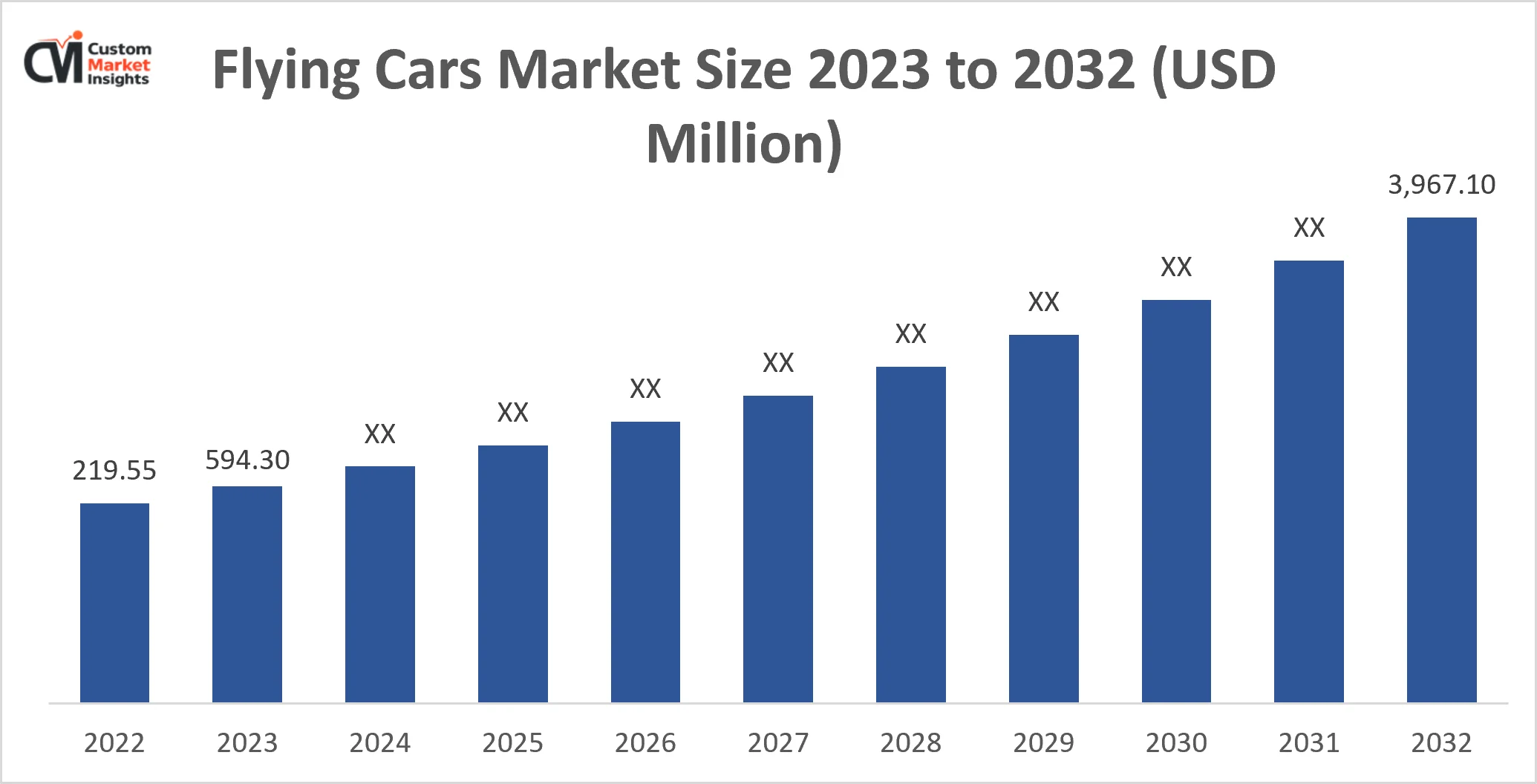
The global flying cars market was valued at USD 594 Mn in 2023 and is projected to reach USD 3.97 Bn by 2032, growing at a CAGR of 35.2%. Europe is the largest regional market and Asia-Pacific is growing fastest.
As per the current market research conducted by CMI Team, the global Flying Cars Market is expected to record a CAGR of 35.2% from 2023 to 2032. In 2022, the market size is projected to reach a valuation of USD 219.55 million. By 2032, the valuation is anticipated to reach USD 3,967.10 million.
The flying car market refers to the hypothetical market for vehicles that can both drive on roads like traditional cars and also take off and fly like aircraft. It is an emerging concept in the transportation industry that aims to combine the benefits of ground-based transportation with the freedom of flying, potentially reducing traffic congestion and opening up new possibilities for personal and commercial travel.
Several companies and startups were working on developing prototypes and concepts for flying cars. These companies included well-known names like Uber with their Uber Elevate program, and new players such as Volocopter, Terrafugia, and PAL-V. Many of these projects focused on electric or hybrid-electric vertical takeoff and landing (eVTOL) technologies.
The challenges faced by the flying car market included safety concerns, regulatory hurdles, infrastructure requirements, and high manufacturing costs. It was uncertain when these vehicles would become widely available for consumer use, and the timeline for mainstream adoption was uncertain.
Flying Cars Market - Significant Growth Factors
Urban Congestion: As cities continue to face increasing traffic congestion, flying cars could offer an alternative mode of transportation that bypasses road traffic and reduces travel times, especially for short-to-medium distances.
Advancements in Technology: The development of lightweight materials, improved battery technology, and advancements in electric propulsion systems could make flying cars more feasible and efficient, increasing their appeal to consumers.
Environmental Concerns: Electric and hybrid-electric flying cars have the potential to be more environmentally friendly than traditional gasoline-powered vehicles, which could attract environmentally conscious consumers and government incentives.
Integration with Existing Infrastructure: Successful integration of flying cars into existing transportation infrastructure, including air traffic management systems and ground-based transportation networks, would be critical for their widespread adoption.
Ride-sharing and Mobility Services: Ride-sharing and mobility-as-a-service platforms could play a significant role in the flying car market, making it more accessible and affordable to a broader range of consumers.
Regulatory Support: Clear and supportive regulations from governments and aviation authorities will be crucial for the safe and legal operation of flying cars. Supportive regulations can help reduce barriers to entry and foster innovation in the industry.
Safety Improvements: Ensuring the safety of flying cars is of utmost importance. Advancements in autonomous flying technology, collision avoidance systems, and robust safety standards would be significant growth drivers.
Consumer Demand: If flying cars can offer a practical and comfortable mode of transportation, with clear benefits over traditional cars and planes, consumer demand could drive the growth of the market.
Investment and Funding: Continued investment and funding from private investors and governments into research, development, and infrastructure for flying cars can accelerate their growth and commercialization.
Uber and Joby Aviation: In December 2020, Uber announced the sale of its Elevate division, which was focused on developing flying taxi technology, to Joby Aviation, an eVTOL aircraft manufacturer. As part of the deal, Uber also invested $75 million in Joby Aviation. This move allowed Uber to offload its flying car ambitions while maintaining an interest in the emerging market.
Hyundai and Urban Air Mobility (UAM) Partners: Hyundai Motor Company announced various partnerships and investments in the UAM sector, which included the development of urban air mobility vehicles and infrastructure. While not an acquisition, these collaborations indicated growing interest from established automotive companies in the flying car market.
Safety Concerns: Safety is a critical factor when it comes to flying cars. The technology is still in its early stages, and there is a risk of accidents and incidents during testing and initial deployment. Public perception of safety risks could hinder consumer acceptance and regulatory approval.
Regulatory Hurdles: The integration of flying cars into existing airspace and ground-based transportation systems presents complex regulatory challenges. Obtaining necessary certifications, and approvals, and defining new rules for the operation of flying cars might take significant time and resources.
Infrastructure Requirements: Establishing the necessary infrastructure for flying cars, including vertiports (airports for vertical takeoff and landing vehicles), charging stations, and air traffic management systems, requires significant investment and planning.
High Manufacturing Costs: The development and production of flying cars involve sophisticated technology and advanced materials, which can result in high manufacturing costs. This could make flying cars unaffordable for many consumers, limiting their market appeal.
Limited Range and Payload Capacity: Current battery technology may limit the range and payload capacity of flying cars, making them suitable mainly for short to medium distances. This limitation could restrict their practicality and usability for certain applications.
Noise Pollution: Electric vertical takeoff and landing (eVTOL) aircraft, which are often considered for flying cars, can generate significant noise during takeoff and landing. Addressing noise pollution concerns will be essential for gaining public acceptance and regulatory approval.
Competition from Other Transportation Technologies: Flying cars face competition from various other transportation technologies, including conventional cars, public transit, electric scooters, autonomous vehicles, and hyperloop systems. Convincing consumers to adopt flying cars over these established options can be challenging.
Environmental Impact: While electric flying cars have the potential to be more environmentally friendly than traditional aircraft, their energy and resource consumption during manufacturing and operation could still have environmental consequences if not properly managed.
Public Acceptance: Convincing the general public to accept and trust flying cars as a safe and practical mode of transportation will be a significant hurdle. Overcoming scepticism and fear of new technologies will require effective communication and transparent safety demonstrations.
Report Scope
Feature of the Report
Details
Market Size in 2023
USD 594.30 Million
Projected Market Size in 2032
USD 3,967.10 Million
Market Size in 2022
USD 219.55 Million
CAGR Growth Rate
35.2% CAGR
Base Year
2023
Forecast Period
2024-2033
Key Segment
By Product, Capacity and Region
Report Coverage
Revenue Estimation and Forecast, Company Profile, Competitive Landscape, Growth Factors and Recent Trends
Regional Scope
North America, Europe, Asia Pacific, Middle East & Africa, and South & Central America
Buying Options
Request tailored purchasing options to fulfil your requirements for research.
The flying cars market is categorized into two segments: Manned Flying Cars and Unmanned Flying Cars. One of the key drivers fueling market demand is the growing problem of increased road traffic. As urban congestion worsens, there is a rising need for innovative transportation solutions, which is expected to boost the adoption of flying cars.
By Capacity:
The flying cars market is divided based on capacity into three categories: 2-Person Sitter, 3 and 4-Person Sitter, and 5-Person Sitter. The ability to accommodate multiple passengers in a single vehicle is expected to drive the market demand significantly in the future. As the provision to carry several individuals at once becomes more prevalent, it is likely to contribute to the growing popularity and adoption of flying cars in the coming years.
Flying Cars Market - Regional Analysis
North America: North America was one of the leading regions in terms of research, development, and investment in flying cars. The United States, in particular, was a hub for many flying car startups and companies. Regions like Silicon Valley attracted significant interest from investors and innovators in the urban air mobility sector. The Federal Aviation Administration (FAA) in the U.S. was also actively involved in shaping the regulatory framework for this emerging industry.
Europe: Europe was another key region in the flying cars market, with countries like Germany, the United Kingdom, and the Netherlands showing considerable interest. Several European companies were actively involved in developing eVTOL aircraft and urban air mobility solutions. The European Union Aviation Safety Agency (EASA) was working on regulations to address the safe integration of flying cars into European airspace.
Asia Pacific: The Asia Pacific region was also witnessing growth in the flying cars market. Countries like Japan, China, and South Korea were investing in research and development efforts. Additionally, emerging economies with dense urban areas and traffic congestion, such as India, were exploring the potential of flying cars as a futuristic transportation solution.
Rest of the World: Other regions, including the Middle East and certain countries in Latin America, were also expressing interest in the flying car market. These regions recognized the potential benefits of urban air mobility for their densely populated and traffic-congested urban centers.
List of the prominent players in the Flying Cars Market:
Volocopter GmbH
A³ by Airbus
AeroMobil
Boeing
Cartivator
EHANG
TERRAFUGIA
Joby Aviation
Lilium
Uber Technologies Inc.
Others
Regional Coverage
North America
U.S.
Canada
Mexico
Rest of North America
Europe
Germany
France
U.K.
Italy
Spain
Rest of Europe
Asia Pacific
China
Japan
India
New Zealand
Australia
South Korea
Rest of Asia Pacific
The Middle East & Africa
Saudi Arabia
UAE
Egypt
Kuwait
South Africa
Rest of the Middle East & Africa
Latin America
Brazil
Argentina
Rest of Latin America
CMI.Market Research Report2023-2032
Get the full report
Updated: September 2026 · Formats: PDF, Excel, PPT
Which are the driving factors of the Flying Cars Market?
The key factors driving the Market are Urban Congestion, Advancements in Technology, Environmental Concerns, Integration with Existing Infrastructure, Ride-sharing and Mobility Services, Regulatory Support, Safety Improvements, Consumer Demand And Investment and Funding.
Which type led the Flying Cars market?
The "Product" category dominated the market in 2022.
Who are the key players in the Flying Cars market?
The key players in the market are Volocopter GmbH, A³ by Airbus, AeroMobil, Boeing, Cartivator, EHANG, TERRAFUGIA, Joby Aviation, Lilium, Uber Technologies Inc., Others.
Which region held the largest market share in the Flying Cars market?
"North America" had the largest share in the Flying Cars Market.
What is the growth rate of the Flying Cars market?
The global market is projected to grow at a CAGR of 35.2% during the forecast period, 2023-2032.
How much is the Flying Cars market?
The Flying Cars Market size was valued at USD 219.55 Million in 2022.
Ayush Kadam is a Senior Market Research Analyst at Custom Market Insights, with over seven years of experience in syndicated and custom market research. He specializes in market sizing, competitive intelligence, industry trends, forecasting, and strategic insights, helping clients turn complex data into actionable business decisions.