
Online Clothing Rental Market Size, Trends and Insights By Type (Subscription-Based Rental, One-Time / Per-Occasion Rental, Peer-to-Peer (P2P) Rental, Corporate / B2B Rental Programs); By Category (Everyday Wear (Casual and Smart-Casual), Formal & Evening Wear (Gowns, Suits, Black-Tie), Ethnic & Traditional Wear, Maternity Wear, Kids & Infant Wear, Outerwear & Seasonal Wear, Other Categories (Activewear and Workwear)); By End-User (Women, Men, Kids), By Price Point (Economy (Under USD 30 per rental), Mid-Range (USD 30 – USD 100 per rental), Premium / Luxury (Above USD 100 per rental)); and By Region – Global Industry Overview, Statistical Data, Competitive Analysis, Share, Outlook, and Forecast 2026 – 2035
Report Snapshot
| Study Period: | 2026-2035 |
| Fastest Growing Market: | Asia Pacific |
| Largest Market: | North America |
Major Players
- Rent the Runway Inc.
- Nuuly (Urban Outfitters Inc.)
- Le Tote Inc.
- Gwynnie Bee (CaaStle Inc.)
- Others
Reports Description
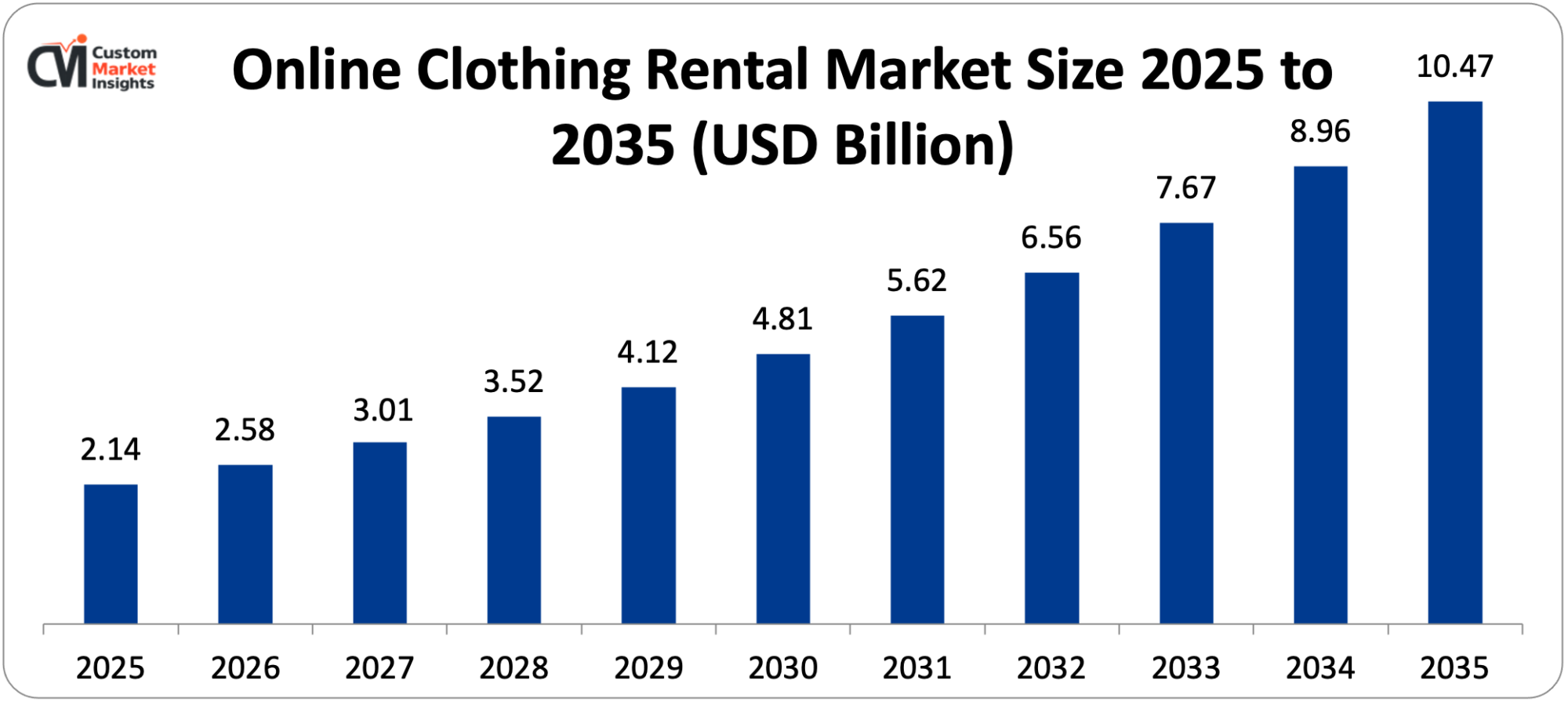
The size of the global online clothing rental market is estimated to be USD 2.14 billion in 2025 and is estimated to grow at a CAGR of 15.2% between the years 2026 and 2035, with the size of the market increasing at a rate of USD 2.58 billion in 2025 to about USD 10.47 billion in 2035.
The increasing rate of consumer uptake of circular fashion and sustainable consumption models, the increasing prices of high-quality and designer clothes that uphold rental as an economical substitute, the growth of digital platforms and mobile commerce that facilitates friction-free rental experiences, the increasing impact of social media and occasion-based dressing culture, especially among millennials and Gen Z consumers, and the growing awareness of the environmental impact of fast fashion are collectively contributing to strong growth in the market over the forecast period.
Market Highlight
- Online clothing rental market was dominated by North America, which had a 36% market share in 2025.
- Asia Pacific will grow at a rate of 19.8% in the period between 2026 and 2035 which is the highest of all CAGRs.
- Typewise, the subscription-based rental market segment won about 47% of the market share in 2025.
- By type, the peer-to-peer rental segment has the highest CAGR between 2026 and 2035 of 21.3%.
- By end-user, the women segment will provide the most market share of 68% in 2025, and the men segment will have the most rapid CAGR of 17.9% in the projections that fall in the years between 2026 and 2035.
- By segment, the formal and evening wear segment took 39% of the market in 2025.
- At the price point, the middle segment had a share of 44% in the market in 2025.
- Online clothing rental controlled a dominant 61.3% of the entire clothing rental market in 2024, which represented the radical repositioning of the rental business out of bricks and mortar shops to online platforms in all the major world markets.
Significant Growth Factors
The Online Clothing Rental Market Trends present significant growth opportunities due to several factors:
- Surging Consumer Sustainability Consciousness and Circular Fashion Adoption: The rising awareness of the world about the disastrous environmental footprint of fashion, in the form of approximately 10% of annual global carbon emissions and 93 billion cubic meters of water per year that the industry emits, according to the United Nations Environment Programme (UNEP), is fundamentally changing the perception of consumers about the ownership of clothes and triggering a rapid transition to rental, resale, and sharing models that extend the idea of garment utilization rates and lower the need to produce new items. The Ellen MacArthur Foundation estimates seven to ten wears per garment in the developed markets before it is disposed of, and fast fashion business models provide structural incentives to overproduction and shorter consumption cycles to produce a forecasted 92 million tons of textile waste in the world annually. The direct solution to this utilization inefficiency is clothing rental, whereby several consumers can get value out of one garment throughout its usable life cycle, with rental models showing an average garment usage rate of 30-50 wears to the item – a 4-7-fold move over the fast fashion ownership model. The survey conducted by McKinsey & Company in 2024 showed that 67% of consumers worldwide put sustainability in the top three on their purchasing list, compared to 49% in 2019, with the share of sustainability as a top-three priority on the list rising especially quickly among consumers aged 18-34 years who constitute the heart of the online clothing rental segment. The secondhand and rental clothing market worldwide will have increased to USD 227 billion in 2024 and USD 350 billion in 2028 as a result of the 2024 Resale Report by ThredUp, with the rental sector rising more rapidly than the secondhand one as buyers look to have access to higher-quality garments than their budget would otherwise allow them to afford as most of them would do by purchasing them outright. The corporate sustainability promises of most of the big fashion players, such as H&M, Zara parent Inditex, Kering, and LVMH, many of which have set targets of garment life changes and virgin material reduction by 2030, are also providing brand-level investment into rental platform alliances and circular business model development that is providing commercial plausibility and marketing investment to the clothing rental segment.
- Rising Occasion-Driven Dressing and Social Media Influence Creating Rental Demand: The growing social media-inspired culture of occasion dressing – where consumers feel socially compelled to wear new, non-repeated clothes on Instagram, TikTok, and other visual mediums – ironically generates strong clothing rental demand as a more cost-effective way of keeping the wardrobe diverse. A 2024 survey by LendingTree found that 35% of U.S. millennials said that they felt anxious about the same outfit being worn to a social event photographed and shared on social media, a behavioral phenomenon that creates a demand in the outfit churn market that can be satisfied at a fraction of the purchase price by the rental service. The world’s special occasions and events industry, including weddings, proms, galas, corporate events, holiday parties, and cultural festivities, is estimated at USD 1.56 trillion in 2024, which is the basis of the demand base of formal and evening wear rental, which has served to anchor the clothing rental industry in the market. The Knot states that the average wedding guest outfit in the United States costs USD 287 in 2024, and formal occasion wear is worn just once or twice a year on average, which is a utilization economics that makes rental at USD 30 – USD 150 a one-time event very appealing to cost-conscious individuals. The fashion-discovery algorithm, which shows the user an average of 52 new outfit inspirations per week based on the 2024 platform data, is both spurring outfit aspiration and pushing consumers towards rental as the available solution to experience a variety of fashion styles without making a financial commitment. Valued at USD 21.1 billion in 2024 as the global influencer marketing market, influencer platforms are trending towards a more and more fully integrated place in influencer content, making rental a normal fashion behavior, not a cost-saving strategy, with tens of millions of fashion-interested consumers of all kinds represented on digital platforms.
What are the Major Advances Changing the Online Clothing Rental Market Today?
- AI-Powered Personalization and Fit Technology Transforming the Rental Experience: The adoption of machine learning and computer vision technologies and artificial intelligence into online services in the clothing rental market is eliminating the most significant historical hurdle to the adoption of rental, the uncertainty about the garment fit, compatibility with style, and applicability to a customer, by embarking on hyper-personalized curation in matching the suggestions of the rentals to the customer’s body measurements, style preferences, and the instances of application with increasing accuracy. Rent the Runway, the largest online style rental in the world with an approximate 170,000 active subscribers as of 2024, has heavily invested in an AI-based style algorithm, which uses subscriber rental history, wishlist behavior, and feedback on returns and social media style hints to generate personalized rental suggestions with a claimed accuracy of 78% based on subscriber satisfaction ratings. Rental platforms are also adopting AI body measurement technologies (such as 3D body scanning based on photogrammetry algorithms using a smartphone camera) to capture accurate body measurements without a consumer owning any measuring technology, and companies such as True Fit, Fit:Match, and Bodygram are also offering white-label fit intelligence APIs that rental platforms can use to offer body size recommendations with up to 3045% lower return due to poor fit rates than provided by standard size guidance. The minimization of fit-related returns is economically imperative to rental platforms due to the operation cost of any one cycle of returns cleaning, quality inspection, small-time repair, re-photography, and re-cataloging which on average costs USD 8.18 to USD 18 per item based on the type of garments and the size of the platform. Generative AI is also taking the experience of customization further by offering virtual try-on, where consumer uploaded images are run through the system to display real visualization of garments on their actual body shape and proportions, lowering rental apprehension and raising the rates of accessing the content to purchase. Shopify in its 2024 The Future of Commerce report found that platforms with AI-assisted virtual try-on features had 40% lower returns and 64% higher conversion rates than platforms that used regular product photography, metrics that have direct financial interest in the economics of rental platforms.
- Subscription Model Innovation and Flexible Membership Architecture: The adoption of clothing rental subscription models that move past fixed-decision monthly box formats and into highly adaptable consumer controlled membership structures that offer flexibility in shipment frequency and mix-and-match rental time and real-time wardrobe swapping is drastically increasing subscriber retention rates and broadening the consumer base that can be addressed through this type of subscription model. Early clothing rental subscription designs such as the original Unlimited subscription (USD 159 per month) of Rent the Runway and the stylist-selected boxing model of Stitch Fix, all required plenty of initial commitment and would only be adopted by very fashion-oriented consumers with ample time to spend on platform education and curation review. Next-generation subscription models such as the USD 98 per month six-item rotation plan of Nuuly, the stretch-to-pause model of Le Tote subscriptions, and the rental credit-based model of Fashion Pass give the consumer the choice and flexibility of accessing rental products without the stress of strict monthly obligations. The subscription rental market showed high recovery and growth after the pandemic and the industry analysis showed that the global subscription rental revenue increased at an 18.3% CAGR between 2022 and 2024 as consumers reverted to face-to-face social and professional interactions creating greater demand for occasion-specific wardrobe diversity. B2B subscription — where online rental services are offered to corporate clients offering curated wardrobes to their employees to work in client-facing roles, at speaking events, and during company events, among other things — is also an emerging and highly scalable demand channel, with platforms such as CaaStle and Armarium developing enterprise subscription programs for financial services, consulting, and media firms. It is estimated that the corporate rental market will expand into the 23.4% CAGR between 2026 and 2032 due to the growing acceptance of wardrobe support programs by employers as a way to increase employee confidence, minimize individual financial liability and add to corporate standards of sustainability reporting which is now actively tracked by ESG-aware shareholders.
Category Wise Insights
By Type
Why Does Subscription-Based Rental Lead the Market?
The largest type segment in 2025 will be subscription-based rental, taking around 47% of the total market share. That is due to the better unit economics of subscription products on a rental platform, which generates predictable recurrent income, higher customer lifetime value, and reduced cost to amortize customer acquisition costs than the transactional per-occasion rental products and reflects customer willingness to pay recurrent subscription fees to access curated wardrobes that help them evade the cognitive cost of occasion-specific rental shopping. The category market leader and first mover, Rent the Runway, which made almost USD 298 million in revenue during the fiscal year 2024, with nearly 78% of its income coming through the subscription memberships, confirms the commercial power of the subscription model at scale. Nuuly, the clothing rental subsidiary of Urban Outfitters, which was launched in 2019, claimed to pass 250,000 active subscribers in 2024 and become profitable, which shows that at scale with controlled unit economics, subscription rental can become a commercially viable business. This benefit of the subscription model is especially acute in categories where everyday and workwear are sold, as the nature of requiring outfits regularly creates strong value-for-money dynamics for monthly subscribers compared to per-occasion rental offers: formal and evening wear, where the semi-infrequent nature of occasion-specific dressing better fits the consumer usage process. The subscription retention results of platform retention data subscription services show that subscribers who remain longer than six months have on average 3.4-fold higher lifetime values than subscribers with short-term tenure, and the retention of subscribers via personalization quality and customer service excellence is a financially important strategically positioning issue of platform operators.
By Category
Why Does Formal & Evening Wear Dominate the Market?
The highest category segment will be formal and evening wear, as they will have a total market share of around 39% in 2025. This form of leadership resembles the basic economics of occasion-specific wardrobe: formal clothes are worn the least, command the highest prices per item in the apparel category, are most the subject of social disapproval to be distinctive and in-fashion, and are thus the most prone to be worn in situations – galas, weddings, award ceremonies, corporate dinners – where photographs will be distributed socially and where there will be a strong incentive to avoid repetition of items. The retail price of a formal gown in the U.S. is USD 380-USD 1,200 on average, and the same clothes may be rented at USD 50-USD 200, which is a 75-85% cost savings, which makes the rental the economically superior option to consumers who attend fewer than three-four formal events annually. The American wedding business alone, worth USD 57.9 billion and performing about 2.4 million weddings every year, creates a large market in formal wear rental among wedding attendees, bridesmaids, groomsmen, and, in other cases, brides and grooms themselves, and by 2024, 18% of wedding party participants will be renting formal wear in the U.S., according to The Knot. Ethnic and traditional apparel is growing well, especially in South Asian markets such as India, where wedding industry demand for lehengas, sarees, and sherwanis is at peak levels due to lehenga rental demand being particularly intense in wedding seasons (and where the wedding industry is estimated to be USD 50 billion annually and the bridal and groomswear rental business is reported to be USD 200-USD 2000 per occasion when using high-end platforms).
By End-User
Why Do Women Dominate the Market?
Women are the overwhelmingly dominant end-user segment, at around 68% of the total market share in 2025, as a result of the combination of greater variety of fashion and increased intricacy of occasion dressing in women’s apparel as compared to men, more social media engagement in fashion content by women consumers, wider range of occasion dressing needs (professional, casual, formal, and cultural) being met simultaneously, and the more advanced and extensive marketing investment that has been made by the rental business in the case of female consumers due to their being more willing to adopt new fashion models of consumption. This is because the average American woman is estimated to possess about 103 clothing items, but only about 20% of her wardrobe is regularly used per a 2024 ClosetMaid survey, which is a utilization inefficiency that generates a high level of rational motivation to replace infrequently used occasion and statement clothing through rental. The age group of 25 to 44 responds to rental demand in particular, with the combination of busy social schedules that need occasion outfits and the financial sensitivity to consider rental an effective alternative to purchase and enough fashion interest to invest in the platform onboarding and customerization process that will ensure the greatest good of rental fulfillment.
By Price Point
Why Does Mid-Range Dominate the Market?
The mid-range price point segment, the segment with rentals at USD 30 and USD 100 per occasion or similar value of a monthly subscription, represents the most appropriate value between affordability and quality that characterizes the mainstream clothing rental value proposition to the core millennial and gen-Z consumer demographic. The mid-range rental will allow consumers to rent garments in emerging designer collections, modern luxury brands, and high-end high-street collections, and these garments have either a retail price point of USD 200-USD 600, thereby making the rental discount attractive, or are accessible to the high volume opportunity of mass-market consumers that the platform will scale to. The high-end and luxury market – rentals above USD 100 per event, offering access to designer brands such as Zimmermann, Self-portrait, Oscar de la Renta, and Valentino – is expanding at a fast pace and is projected to reach a 19.2% CAGR between 2026 and 2035 due to the increasing adoption of rental by high-net-worth customers as a trophy item acquisition means to avoid USD 2,000-USD 10,000+ and the adoption of rental as a customer acquisition and brand experience channel reaching aspirational consumers who will become purchasers as their incomes grow.
Report Scope
| Feature of the Report | Details |
| Market Size in 2026 | USD 2.58 billion |
| Projected Market Size in 2035 | USD 10.47 billion |
| Market Size in 2025 | USD 2.14 billion |
| CAGR Growth Rate | 15.2% CAGR |
| Base Year | 2025 |
| Forecast Period | 2026-2035 |
| Key Segment | By Type, Category, End-User, Price Point and Region |
| Report Coverage | Revenue Estimation and Forecast, Company Profile, Competitive Landscape, Growth Factors and Recent Trends |
| Regional Scope | North America, Europe, Asia Pacific, Middle East & Africa, and South & Central America |
| Buying Options | Request tailored purchasing options to fulfil your requirements for research. |
Regional Analysis
How Big is the North America Market Size?
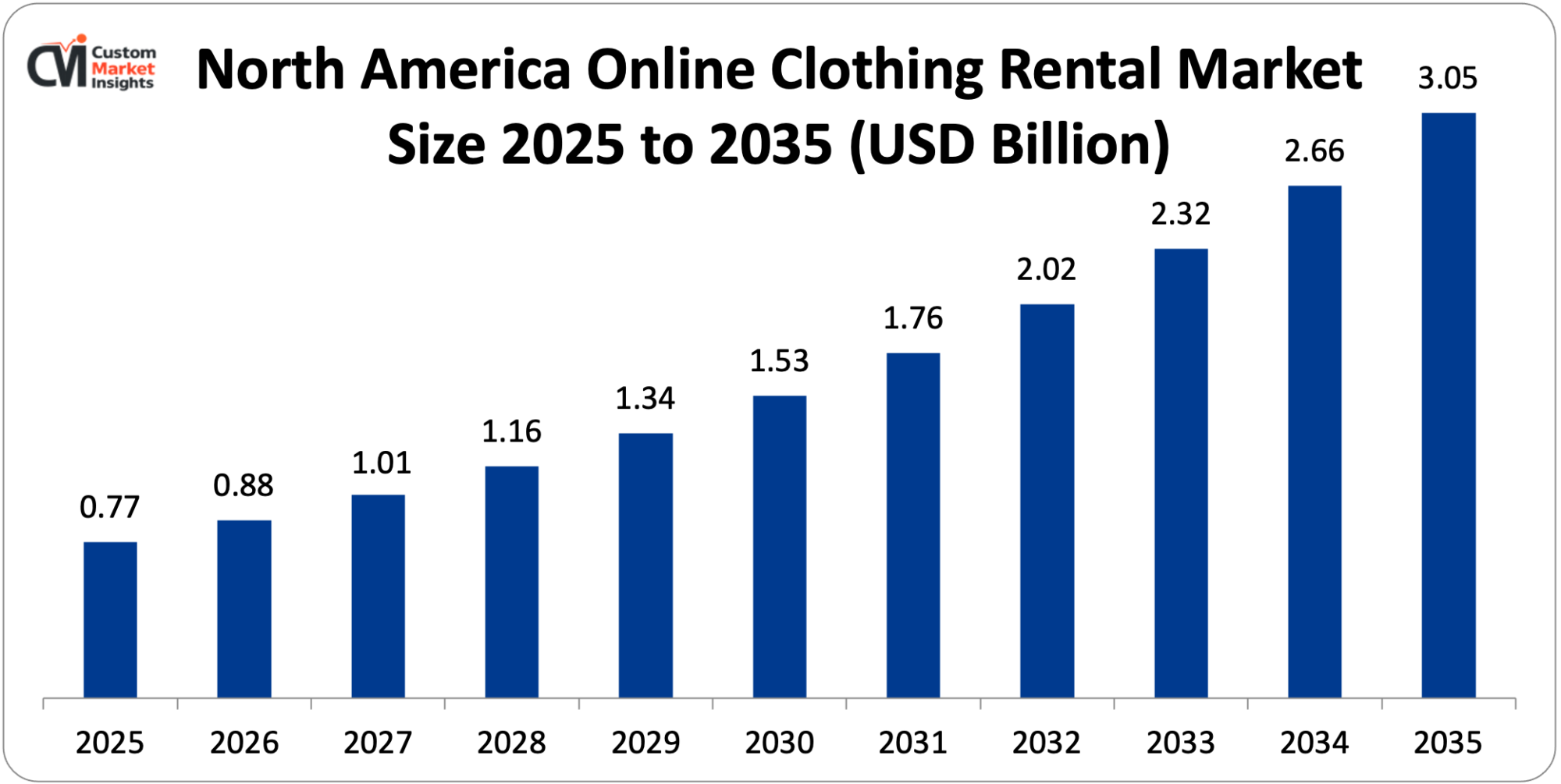
The North America online clothing rental market size is estimated at USD 770 million in 2025 and is projected to reach approximately USD 3.05 billion by 2035, with a 14.8% CAGR from 2026 to 2035.
Why Did North America Dominate the Market in 2025?
The region has a high smartphone penetration rate allowing consumers to enjoy frictionless online rental experiences, the region has a large and densely populated urban core population of fashion-engaged millennial and Gen Z consumers in metropolitan regions such as New York, Los Angeles, Chicago, and San Francisco that constitutes the highest-density markets for the adoption of online rental services worldwide, and a high market share of 36% in 2025 is indicative of the region as the birthplace and most commercially mature market of online clothing rental solutions. The consumer spending power and fashion culture on which premium wardrobe rental is founded are rooted in the fashion industry of the United States, which in the year 2024 will have a valuation of approximately USD 350 billion, and in which American consumers allocate USD 1,760 on average per year on clothing as the Bureau of Labor Statistics 2024 Consumer Expenditure Survey indicates, and which is a spending power that creates a healthy financial incentive to seek to maximize the value of their wardrobe through the use of rental. The 2024 annual report of Rent the Runway revealed that the company had around 170,000 active subscribers and a retail-valued rental inventory of over USD 300 million, which shows the potential the North American market has.
U.S. Market Trends
The U.S. market is characterized by platform competition re-intensification, the rising AI personalization investment and the post-pandemic recovery taking consumers back to face-to-face events and social gatherings that generated new renting demand due to the disruption of the COVID-19 crisis that hit occasion wear rental so hard. The platform consolidation trend of more highly capitalized players, including Rent the Runway buying the technology assets of Caastle, Urban Outfitters investing in the growth of Nuuly, and a number of smaller platforms going out of business, has been concentrating the market among better capitalized players with the inventory scale and technology investment capacity to provide continuously high-quality rental experiences that drive subscriber retention. The increasing U.S. resale and re-commerce sector is now USD 73 billion and with 11% CAGR is forming a complementary ecosystem that makes circular fashion practices such as rental possible, lowering the consumer education expenditure of the rental sites by targeting consumers who have already adopted circular fashion practices through second-hand shopping.
Why is Europe a Strategically Important Market?
The online cloth hire business is projected to have USD 524 million in 2025 and it is projected to have USD 2.04 billion in 2035 with a CAGR of 14.6. Europe is a market of outstanding strategic value that is led by the most developed regulatory systems in the world that encourage sustainable fashion, such as the Strategy of Sustainable and Circular Textiles that is forcing to render textiles in the EU market to be durable, recyclable, and produced with recycled materials by 2030, and advanced fashion cultures within the UK, France, Italy, and Germany where consumers are highly engaged with well-designed fashion and increasingly aware of sustainability.
The United Kingdom has become the most commercially advanced online clothing rental business in Europe, aided by the early development of platforms by By Rotation, Hurr Collective, MY WARDROBE HQ, and OOTD (Outfit of the Day) as well as the fact that the British consumers were highly receptive to the business model of sharing the economy and were highly active on social media platforms in terms of fashion content. A survey conducted by YouGov in 2024 has revealed that 41% of UK consumers aged 18 to 35 years had ever rented clothing at some point during the last 12 months, the highest number of customers who had ever rented a garment in any major national market in the world and the first evidence that rental is a mainstream fashion behavior in the UK. France, the home of the most prestigious luxury fashion brands in the world, featuring LVMH, Kering, Chanel, and Hermès, is a complex yet opportunity rich market with a cultural prestige of owning fashion items coexisting with an increased willingness to engage in sustainable consumption as younger consumers in Paris are becoming more interested in trying on-demand rental and ownership of fashion items as a customer experience and sustainability effort, with a number of these designer brands already experimenting with the concept of official rental as a customer experience and sustainability program.
Why is Asia Pacific the Fastest-Growing Market?
The fastest-growing regional market is Asia Pacific, which will also experience a CAGR of 19.8% between 2026 and 2035, as it reflects the combination of multiple strong and sequential growth drivers: the seismic growth of fashion-interested millennial and Gen Z consumer segments in China, India, South Korea, and Southeast Asia, who are digital natives and highly responsive to app-based rental businesses; the phenomenal cultural relevance of occasion dressing in Asian markets, and especially the Indian wedding market, which is USD 50 billion annually; and the East Asia Pacific fashion market, which is estimated to be USD 650-700 billion in 2024, and projected to grow by USD 1.1 trillion in 2030, which is presently the biggest and quickest fashion consumption opportunity in the world and endures the most significant long-term expansion prospect of online rental websites. Having its headquarters in Singapore and operating in Singapore, Indonesia, and Hong Kong, Style Theory has already become the leading subscription clothing rental platform in the Asian Pacific region with more than 100,000 subscribers and a rental collection of more than 50,000 garments of 600 plus brands, which indicates the commercial feasibility of the subscription rental business in Asian markets with localized strategies.
Why is the Middle East & Africa Region an Emerging Opportunity?
The LAMEA region is experiencing an emerging market development due to the youthful, trendy urban consumers of high-income levels and large volumes in the Gulf Cooperation Council, creating a promising luxury-rental opportunity, especially in Dubai and Riyadh where designer fashion is a cultural status symbol and rental can access ultra-premium fashion labels at affordable prices; the broad-based growth of social media fashion culture in the region because of the high rates of smartphone penetration of 95%+ in GCC countries; the high occasion wear demand caused by the wedding culture in Saudi, Emirati, The fashion retail market in the UAE is also expected to expand with an 8.3% CAGR till the year 2030, and the creation of special luxury shops to rent clothes and online platforms in Dubai, such as Caramel Style and The Borrowed Dress, and the extension of the foreign platform all indicate that the commercialization of the formal rent in the Gulf market has not yet arrived but is in the process of development.
Top Players in the Market and Their Offerings
- Rent the Runway Inc.
- Nuuly (Urban Outfitters Inc.)
- Le Tote Inc.
- Gwynnie Bee (CaaStle Inc.)
- By Rotation Ltd.
- Hurr Collective Ltd.
- MY WARDROBE HQ Ltd.
- Style Theory Pte. Ltd.
- Flyrobe Pvt. Ltd.
- The Black Tux Inc.
- Nuw Ltd.
- Others
Key Developments
Industry players have experienced massive changes in the market as they look forward to increasing geographical coverage, advancing into technology, and winning the market based on subscriptions, peer to peer and company rentals.
- In September 2025: Rent the Runway declared the introduction of its more advanced AI style concierge option, the element that offers subscribers a conversational AI interface producing personalized rental occasion outfit tips by occasion type, weather forecast, current wardrobe pieces the subscriber already possesses, and their fashion inclinations.
- In November 2025: By Rotation, the UK-based leading peer-to-peer clothing rental company, has stated that it has received a USD 12 million Series B round of funding led by Molten Ventures and with H&M Group CO:LAB investment arm as one of the participating investors, which values the company at USD 65 million.
These strategic actions have enabled businesses to consolidate market shares, venture into new geographies and consumer groups, draw strategic capital to support the commercial maturity of the clothing rental category, and benefit from technology and collaboration opportunities that enhance the platform experience and economics that support sustainable market development.
The Online Clothing Rental Market is segmented as follows:
By Type
- Subscription-Based Rental
- One-Time / Per-Occasion Rental
- Peer-to-Peer (P2P) Rental
- Corporate / B2B Rental Programs
By Category
- Everyday Wear (Casual and Smart-Casual)
- Formal & Evening Wear (Gowns, Suits, Black-Tie)
- Ethnic & Traditional Wear
- Maternity Wear
- Kids & Infant Wear
- Outerwear & Seasonal Wear
- Other Categories (Activewear, Workwear)
By End-User
- Women
- Men
- Kids
By Price Point
- Economy (Under USD 30 per rental)
- Mid-Range (USD 30 – USD 100 per rental)
- Premium / Luxury (Above USD 100 per rental)
Regional Coverage:
North America
- U.S.
- Canada
- Mexico
- Rest of North America
Europe
- Germany
- France
- U.K.
- Russia
- Italy
- Spain
- Netherlands
- Rest of Europe
Asia Pacific
- China
- Japan
- India
- New Zealand
- Australia
- South Korea
- Taiwan
- Rest of Asia Pacific
The Middle East & Africa
- Saudi Arabia
- UAE
- Egypt
- Kuwait
- South Africa
- Rest of the Middle East & Africa
Latin America
- Brazil
- Argentina
- Rest of Latin America
Table of Contents
- Chapter 1. Report Introduction
- 1.1. Report Description
- 1.1.1. Purpose of the Report
- 1.1.2. USP & Key Offerings
- 1.2. Key Benefits For Stakeholders
- 1.3. Target Audience
- 1.4. Report Scope
- 1.1. Report Description
- Chapter 2. Market Overview
- 2.1. Report Scope (Segments And Key Players)
- 2.1.1. Online Clothing Rental by Segments
- 2.1.2. Online Clothing Rental by Region
- 2.2. Executive Summary
- 2.2.1. Market Size & Forecast
- 2.2.2. Online Clothing Rental Market Attractiveness Analysis, By Type
- 2.2.3. Online Clothing Rental Market Attractiveness Analysis, By Category
- 2.2.4. Online Clothing Rental Market Attractiveness Analysis, By End-User
- 2.2.5. Online Clothing Rental Market Attractiveness Analysis, By Price Point
- 2.1. Report Scope (Segments And Key Players)
- Chapter 3. Market Dynamics (DRO)
- 3.1. Market Drivers
- 3.1.1. Surging Consumer Sustainability Consciousness and Circular Fashion Adoption
- 3.1.2. Rising Occasion-Driven Dressing and Social Media Influence Creating Rental Demand
- 3.2. Market Restraints
- 3.3. Market Opportunities
- 3.5. Pestle Analysis
- 3.6. Porter Forces Analysis
- 3.7. Technology Roadmap
- 3.8. Value Chain Analysis
- 3.9. Government Policy Impact Analysis
- 3.10. Pricing Analysis
- 3.1. Market Drivers
- Chapter 4. Online Clothing Rental Market – By Type
- 4.1. Type Market Overview, By Type Segment
- 4.1.1. Online Clothing Rental Market Revenue Share, By Type, 2025 & 2035
- 4.1.2. Subscription-Based Rental
- 4.1.3. Online Clothing Rental Share Forecast, By Region (USD Billion)
- 4.1.4. Comparative Revenue Analysis, By Country, 2025 & 2035
- 4.1.5. Key Market Trends, Growth Factors, & Opportunities
- 4.1.6. One-Time / Per-Occasion Rental
- 4.1.7. Online Clothing Rental Share Forecast, By Region (USD Billion)
- 4.1.8. Comparative Revenue Analysis, By Country, 2025 & 2035
- 4.1.9. Key Market Trends, Growth Factors, & Opportunities
- 4.1.10. Peer-to-Peer (P2P) Rental
- 4.1.11. Online Clothing Rental Share Forecast, By Region (USD Billion)
- 4.1.12. Comparative Revenue Analysis, By Country, 2025 & 2035
- 4.1.13. Key Market Trends, Growth Factors, & Opportunities
- 4.1.14. Corporate / B2B Rental Programs
- 4.1.15. Online Clothing Rental Share Forecast, By Region (USD Billion)
- 4.1.16. Comparative Revenue Analysis, By Country, 2025 & 2035
- 4.1.17. Key Market Trends, Growth Factors, & Opportunities
- 4.1. Type Market Overview, By Type Segment
- Chapter 5. Online Clothing Rental Market – By Category
- 5.1. Category Market Overview, By Category Segment
- 5.1.1. Online Clothing Rental Market Revenue Share, By Category, 2025 & 2035
- 5.1.2. Everyday Wear (Casual and Smart-Casual)
- 5.1.3. Online Clothing Rental Share Forecast, By Region (USD Billion)
- 5.1.4. Comparative Revenue Analysis, By Country, 2025 & 2035
- 5.1.5. Key Market Trends, Growth Factors, & Opportunities
- 5.1.6. Formal & Evening Wear (Gowns, Suits, Black-Tie)
- 5.1.7. Online Clothing Rental Share Forecast, By Region (USD Billion)
- 5.1.8. Comparative Revenue Analysis, By Country, 2025 & 2035
- 5.1.9. Key Market Trends, Growth Factors, & Opportunities
- 5.1.10. Ethnic & Traditional Wear
- 5.1.11. Online Clothing Rental Share Forecast, By Region (USD Billion)
- 5.1.12. Comparative Revenue Analysis, By Country, 2025 & 2035
- 5.1.13. Key Market Trends, Growth Factors, & Opportunities
- 5.1.14. Maternity Wear
- 5.1.15. Online Clothing Rental Share Forecast, By Region (USD Billion)
- 5.1.16. Comparative Revenue Analysis, By Country, 2025 & 2035
- 5.1.17. Key Market Trends, Growth Factors, & Opportunities
- 5.1.18. Kids & Infant Wear
- 5.1.19. Online Clothing Rental Share Forecast, By Region (USD Billion)
- 5.1.20. Comparative Revenue Analysis, By Country, 2025 & 2035
- 5.1.21. Key Market Trends, Growth Factors, & Opportunities
- 5.1.22. Outerwear & Seasonal Wear
- 5.1.23. Online Clothing Rental Share Forecast, By Region (USD Billion)
- 5.1.24. Comparative Revenue Analysis, By Country, 2025 & 2035
- 5.1.25. Key Market Trends, Growth Factors, & Opportunities
- 5.1.26. Other Categories (Activewear, Workwear)
- 5.1.27. Online Clothing Rental Share Forecast, By Region (USD Billion)
- 5.1.28. Comparative Revenue Analysis, By Country, 2025 & 2035
- 5.1.29. Key Market Trends, Growth Factors, & Opportunities
- 5.1. Category Market Overview, By Category Segment
- Chapter 6. Online Clothing Rental Market – By End-User
- 6.1. End-User Market Overview, By End-User Segment
- 6.1.1. Online Clothing Rental Market Revenue Share, By End-User, 2025 & 2035
- 6.1.2. Women
- 6.1.3. Online Clothing Rental Share Forecast, By Region (USD Billion)
- 6.1.4. Comparative Revenue Analysis, By Country, 2025 & 2035
- 6.1.5. Key Market Trends, Growth Factors, & Opportunities
- 6.1.6. Men
- 6.1.7. Online Clothing Rental Share Forecast, By Region (USD Billion)
- 6.1.8. Comparative Revenue Analysis, By Country, 2025 & 2035
- 6.1.9. Key Market Trends, Growth Factors, & Opportunities
- 6.1.10. Kids
- 6.1.11. Online Clothing Rental Share Forecast, By Region (USD Billion)
- 6.1.12. Comparative Revenue Analysis, By Country, 2025 & 2035
- 6.1.13. Key Market Trends, Growth Factors, & Opportunities
- 6.1. End-User Market Overview, By End-User Segment
- Chapter 7. Online Clothing Rental Market – By Price Point
- 7.1. Price Point Market Overview, By Price Point Segment
- 7.1.1. Online Clothing Rental Market Revenue Share, By Price Point, 2025 & 2035
- 7.1.2. Economy (Under USD 30 per rental)
- 7.1.3. Online Clothing Rental Share Forecast, By Region (USD Billion)
- 7.1.4. Comparative Revenue Analysis, By Country, 2025 & 2035
- 7.1.5. Key Market Trends, Growth Factors, & Opportunities
- 7.1.6. Mid-Range (USD 30 – USD 100 per rental)
- 7.1.7. Online Clothing Rental Share Forecast, By Region (USD Billion)
- 7.1.8. Comparative Revenue Analysis, By Country, 2025 & 2035
- 7.1.9. Key Market Trends, Growth Factors, & Opportunities
- 7.1.10. Premium / Luxury (Above USD 100 per rental)
- 7.1.11. Online Clothing Rental Share Forecast, By Region (USD Billion)
- 7.1.12. Comparative Revenue Analysis, By Country, 2025 & 2035
- 7.1.13. Key Market Trends, Growth Factors, & Opportunities
- 7.1. Price Point Market Overview, By Price Point Segment
- Chapter 8. Online Clothing Rental Market – Regional Analysis
- 8.1. Online Clothing Rental Market Overview, By Region Segment
- 8.1.1. Global Online Clothing Rental Market Revenue Share, By Region, 2025 & 2035
- 8.1.2. Global Online Clothing Rental Market Revenue, By Region, 2026 – 2035 (USD Billion)
- 8.1.3. Global Online Clothing Rental Market Revenue, By Type, 2026 – 2035
- 8.1.4. Global Online Clothing Rental Market Revenue, By Category, 2026 – 2035
- 8.1.5. Global Online Clothing Rental Market Revenue, By End-User, 2026 – 2035
- 8.1.6. Global Online Clothing Rental Market Revenue, By Price Point, 2026 – 2035
- 8.2. North America
- 8.2.1. North America Online Clothing Rental Market Revenue, By Country, 2026 – 2035 (USD Billion)
- 8.2.2. North America Online Clothing Rental Market Revenue, By Type, 2026 – 2035
- 8.2.3. North America Online Clothing Rental Market Revenue, By Category, 2026 – 2035
- 8.2.4. North America Online Clothing Rental Market Revenue, By End-User, 2026 – 2035
- 8.2.5. North America Online Clothing Rental Market Revenue, By Price Point, 2026 – 2035
- 8.2.6. U.S. Online Clothing Rental Market Revenue, 2026 – 2035 (USD Billion)
- 8.2.7. Canada Online Clothing Rental Market Revenue, 2026 – 2035 (USD Billion)
- 8.2.8. Mexico Online Clothing Rental Market Revenue, 2026 – 2035 (USD Billion)
- 8.2.9. Rest of North America Online Clothing Rental Market Revenue, 2026 – 2035 (USD Billion)
- 8.3. Europe
- 8.3.1. Europe Online Clothing Rental Market Revenue, By Country, 2026 – 2035 (USD Billion)
- 8.3.2. Europe Online Clothing Rental Market Revenue, By Type, 2026 – 2035
- 8.3.3. Europe Online Clothing Rental Market Revenue, By Category, 2026 – 2035
- 8.3.4. Europe Online Clothing Rental Market Revenue, By End-User, 2026 – 2035
- 8.3.5. Europe Online Clothing Rental Market Revenue, By Price Point, 2026 – 2035
- 8.3.6. Germany Online Clothing Rental Market Revenue, 2026 – 2035 (USD Billion)
- 8.3.7. France Online Clothing Rental Market Revenue, 2026 – 2035 (USD Billion)
- 8.3.8. U.K. Online Clothing Rental Market Revenue, 2026 – 2035 (USD Billion)
- 8.3.9. Russia Online Clothing Rental Market Revenue, 2026 – 2035 (USD Billion)
- 8.3.10. Italy Online Clothing Rental Market Revenue, 2026 – 2035 (USD Billion)
- 8.3.11. Spain Online Clothing Rental Market Revenue, 2026 – 2035 (USD Billion)
- 8.3.12. Netherlands Online Clothing Rental Market Revenue, 2026 – 2035 (USD Billion)
- 8.3.13. Rest of Europe Online Clothing Rental Market Revenue, 2026 – 2035 (USD Billion)
- 8.4. Asia Pacific
- 8.4.1. Asia Pacific Online Clothing Rental Market Revenue, By Country, 2026 – 2035 (USD Billion)
- 8.4.2. Asia Pacific Online Clothing Rental Market Revenue, By Type, 2026 – 2035
- 8.4.3. Asia Pacific Online Clothing Rental Market Revenue, By Category, 2026 – 2035
- 8.4.4. Asia Pacific Online Clothing Rental Market Revenue, By End-User, 2026 – 2035
- 8.4.5. Asia Pacific Online Clothing Rental Market Revenue, By Price Point, 2026 – 2035
- 8.4.6. China Online Clothing Rental Market Revenue, 2026 – 2035 (USD Billion)
- 8.4.7. Japan Online Clothing Rental Market Revenue, 2026 – 2035 (USD Billion)
- 8.4.8. India Online Clothing Rental Market Revenue, 2026 – 2035 (USD Billion)
- 8.4.9. New Zealand Online Clothing Rental Market Revenue, 2026 – 2035 (USD Billion)
- 8.4.10. Australia Online Clothing Rental Market Revenue, 2026 – 2035 (USD Billion)
- 8.4.11. South Korea Online Clothing Rental Market Revenue, 2026 – 2035 (USD Billion)
- 8.4.12. Taiwan Online Clothing Rental Market Revenue, 2026 – 2035 (USD Billion)
- 8.4.13. Rest of Asia Pacific Online Clothing Rental Market Revenue, 2026 – 2035 (USD Billion)
- 8.5. The Middle-East and Africa
- 8.5.1. The Middle-East and Africa Online Clothing Rental Market Revenue, By Country, 2026 – 2035 (USD Billion)
- 8.5.2. The Middle-East and Africa Online Clothing Rental Market Revenue, By Type, 2026 – 2035
- 8.5.3. The Middle-East and Africa Online Clothing Rental Market Revenue, By Category, 2026 – 2035
- 8.5.4. The Middle-East and Africa Online Clothing Rental Market Revenue, By End-User, 2026 – 2035
- 8.5.5. The Middle-East and Africa Online Clothing Rental Market Revenue, By Price Point, 2026 – 2035
- 8.5.6. Saudi Arabia Online Clothing Rental Market Revenue, 2026 – 2035 (USD Billion)
- 8.5.7. UAE Online Clothing Rental Market Revenue, 2026 – 2035 (USD Billion)
- 8.5.8. Egypt Online Clothing Rental Market Revenue, 2026 – 2035 (USD Billion)
- 8.5.9. Kuwait Online Clothing Rental Market Revenue, 2026 – 2035 (USD Billion)
- 8.5.10. South Africa Online Clothing Rental Market Revenue, 2026 – 2035 (USD Billion)
- 8.5.11. Rest of the Middle East & Africa Online Clothing Rental Market Revenue, 2026 – 2035 (USD Billion)
- 8.6. Latin America
- 8.6.1. Latin America Online Clothing Rental Market Revenue, By Country, 2026 – 2035 (USD Billion)
- 8.6.2. Latin America Online Clothing Rental Market Revenue, By Type, 2026 – 2035
- 8.6.3. Latin America Online Clothing Rental Market Revenue, By Category, 2026 – 2035
- 8.6.4. Latin America Online Clothing Rental Market Revenue, By End-User, 2026 – 2035
- 8.6.5. Latin America Online Clothing Rental Market Revenue, By Price Point, 2026 – 2035
- 8.6.6. Brazil Online Clothing Rental Market Revenue, 2026 – 2035 (USD Billion)
- 8.6.7. Argentina Online Clothing Rental Market Revenue, 2026 – 2035 (USD Billion)
- 8.6.8. Rest of Latin America Online Clothing Rental Market Revenue, 2026 – 2035 (USD Billion)
- 8.1. Online Clothing Rental Market Overview, By Region Segment
- Chapter 9. Competitive Landscape
- 9.1. Company Market Share Analysis – 2025
- 9.1.1. Global Online Clothing Rental Market: Company Market Share, 2025
- 9.2. Global Online Clothing Rental Market Company Market Share, 2024
- 9.1. Company Market Share Analysis – 2025
- Chapter 10. Company Profiles
- 10.1. Rent the Runway Inc.
- 10.1.1. Company Overview
- 10.1.2. Key Executives
- 10.1.3. Product Portfolio
- 10.1.4. Financial Overview
- 10.1.5. Operating Business Segments
- 10.1.6. Business Performance
- 10.1.7. Recent Developments
- 10.2. Nuuly (Urban Outfitters Inc.)
- 10.3. Le Tote Inc.
- 10.4. Gwynnie Bee (CaaStle Inc.)
- 10.5. By Rotation Ltd.
- 10.6. Hurr Collective Ltd.
- 10.7. MY WARDROBE HQ Ltd.
- 10.8. Style Theory Pte. Ltd.
- 10.9. Flyrobe Pvt. Ltd.
- 10.10. The Black Tux Inc.
- 10.11. Nuw Ltd.
- 10.12. Others.
- 10.1. Rent the Runway Inc.
- Chapter 11. Research Methodology
- 11.1. Research Methodology
- 11.2. Secondary Research
- 11.3. Primary Research
- 11.3.1. Analyst Tools and Models
- 11.4. Research Limitations
- 11.5. Assumptions
- 11.6. Insights From Primary Respondents
- 11.7. Why Custom Market Insights
- Chapter 12. Standard Report Commercials & Add-Ons
- 12.1. Customization Options
- 12.2. Subscription Module For Market Research Reports
- 12.3. Client Testimonials
List Of Figures
Figures No 1 to 35
List Of Tables
Tables No 1 to 51
Prominent Player
- Rent the Runway Inc.
- Nuuly (Urban Outfitters Inc.)
- Le Tote Inc.
- Gwynnie Bee (CaaStle Inc.)
- By Rotation Ltd.
- Hurr Collective Ltd.
- MY WARDROBE HQ Ltd.
- Style Theory Pte. Ltd.
- Flyrobe Pvt. Ltd.
- The Black Tux Inc.
- Nuw Ltd.
- Others
FAQs
The key players in the market are Rent the Runway Inc., Nuuly (Urban Outfitters Inc.), Le Tote Inc., Gwynnie Bee (CaaStle Inc.), By Rotation Ltd., Hurr Collective Ltd., MY WARDROBE HQ Ltd., Style Theory Pte. Ltd., Flyrobe Pvt. Ltd., The Black Tux Inc., Nuw Ltd., Others.
In the key markets, government policies are becoming more influential in determining the demand climate as well as the operational demands of online clothing rental businesses. The regulatory pressure on fast fashion brands caused by the EU Strategy of Sustainable and Circular Textiles, which states that all textile products sold in the EU must be durable, repairable, and recyclable by 2030 is at the same time adding consumer awareness of what is available in the market of circular fashion, like rental. The Extended Producer Responsibility (EPR) laws on textiles are currently being established in France (first introduced by REFASHION since 2007), the Netherlands, and other EU countries, which have financial responsibility for the end-of-life management of their textiles, and which is creating financial incentives to encourage clothing brands to collaborate with rental sites as a form of circular distribution that means a longer life of the garment and a lowered liability towards the EPR. The Green Claims Directive that will come into force by 2026 proposed by the EU will impose substantiated environmental claims on fashion marketing, such as sustainability claims by rental platforms, which will establish compliance requirements, favoring those platforms operating on verifiable data on their environmental impact as compared to those making unverified sustainability claims. The Climate Corporate Data Accountability Act of California, which mandates large businesses to report Scope 3 supply chain emissions beginning in 2026 is likely to result in corporate purchasing of rental services as a recorded wardrobe carbon reduction measure to employee events and travel, which is a boon to the B2B corporate rental segment. In Europe and California, data privacy laws such as GDPR and CCPA set expectations on the wide range of personal information, such as body measurements, style preferences, and behavioral data, that rental platforms gather and can process to offer AI personalization and demand investment in data architecture and consent management software compliant with their laws.
Online clothing rental pricing models can range widely between economy single-item rental prices of USD 10.13 to compete directly with fast fashion purchase options, mid-range subscription packages of USD 80.13 a month to have access to modern designer labels, and high-end per-occasion rental of USD 150.50 to rent designer gowns and high-end occasion wear. The sensitivity to price depends greatly on the type of occasion, consumer demographic, and geographic market; the highest price inelasticity is observed in the case of formal occasion wear since the costs of substitutes in purchasing alternatives to the high cost purchase alternatives are high and the presence of alternative purchase options at low costs reflects the highest price sensitivity because of the low frequency of wear. The issue of platform economics of online clothing rental is the gross margin required to pay the high cost of operations of the rental cycle, including cleaning, quality inspection, photography, packaging, and two-way shipping which at the major platforms amounts to USD 15- USD 25 on a rental item on a cycle, and the average rental transaction value of USD 50- USD 60 is required before online clothing rental can attain sustainable unit economics. This pricing model is moving the industry to subscription models with the most revenue per subscriber relationship and lower per-item marketing and transaction costs and to P2P models in which inventory and other costs borne by platforms can be kept to a minimum through transference of garment ownership and cleaning burden to individual lenders.
According to current analysis, the market is estimated to reach about USD 10.47 billion in 2035 with mainstream consumer adoption of rental as a normalized fashion behavior as a niche sustainability choice in developed and developing markets and with both developed and developing markets growing the consumer market, plus luxury brand acceptance of rental as a customer acquisition and experience channel accelerating premium segment growth and, finally, commercial maturation in the Asian marketplace adding the largest consumer populations in the global market to the active rental market at a CAGR of 15.2% between 2026 and 2035.
It is projected that North America will retain the greatest share of the revenue during the forecast period, dominating about 36% of the global market share by 2025, given that U.S. consumers have demonstrated high rental value proposition economics (high per-capita fashion spending, USD 1,760/annually); advanced digital commerce infrastructure has facilitated smoother rental transaction experiences; the highest concentration of fashion-oriented millennial and Gen Z urban consumers in the world is concentrated in the high-density metropolitan markets; and the culture of subscription commerce is highly developed and has reached an advanced level that reduces behavioral barriers to clothing rental subscription adoption relative to markets where subscription commerce is less mature.
Asia Pacific is estimated to have the fastest CAGR of 19.8% in the forecasting period on the basis of India 50-billion annual wedding market generating the phenomenal occasion wear rental demand; China’s 1.4 billion consumer market with millions of young consumers growing in middle-class fashion activity; Style Theory already commercially validating the subscription rental model in Singapore and Southeast Asia; the cultural role of occasion dressing in the East and South Asian markets generating structurally high formal wear rental demand; and the booming social media fashion culture in the region reaching out in hundreds of millions of young, fashion-engaged consumers receptive to rental as a culturally normalized fashion behavior.
The Global Online Clothing Rental Market is expected to see significant growth due to the fashion industry generating about 10% of the global emission of carbon a year, causing a consumer shift to more sustainable options; the 2nd-hand and rental clothing market (USD 350 billion by 2028); and the occasion-driven dressing culture (67% of global consumers consider sustainability as a key buying factor in 2024), driving the need to use AI personalization, reducing the number of post-use clothes thrown away by 30-45% in the developed markets, offering a globally AI-powered personalization reducing fit-related return rates by 30–45%, improving rental platform economics, and the global special occasions market valued at USD 1.56 trillion providing a massive foundational demand base for formal and occasion wear rental across all geographies.