
Anti-Aging Market Size, Trends and Insights By Product (Topical Products, Moisturizers & Serums, Anti-wrinkle Creams, Retinoids, Peptides, Antioxidants, Sunscreens & Anti-pollution Formulations, Injectables, Botulinum Toxins, Anti-Aging Dietary Supplements, Laser Resurfacing, Clinical & Therapeutic Services), By Age Group (20–39 Years, 40–59 Years, 60+ Years ~30%), By Distribution Channel (Offline/Retail, Online/E-commerce, Hospital/Clinic Direct Sales), By End User (Individual Consumers, Hospitals & Specialty Centers, Dermatology Clinics & Medspas), and By Region - Global Industry Overview, Statistical Data, Competitive Analysis, Share, Outlook, and Forecast 2026 – 2035
Report Snapshot
CAGR: 5.5%
| Study Period: | 2026-2035 |
| Fastest Growing Market: | Asia-Pacific |
| Largest Market: | North America |
Major Players
- Unilever PLC
- Beiersdorf AG
- The Procter & Gamble Company
- Shiseido Company Limited
- Others
Reports Description
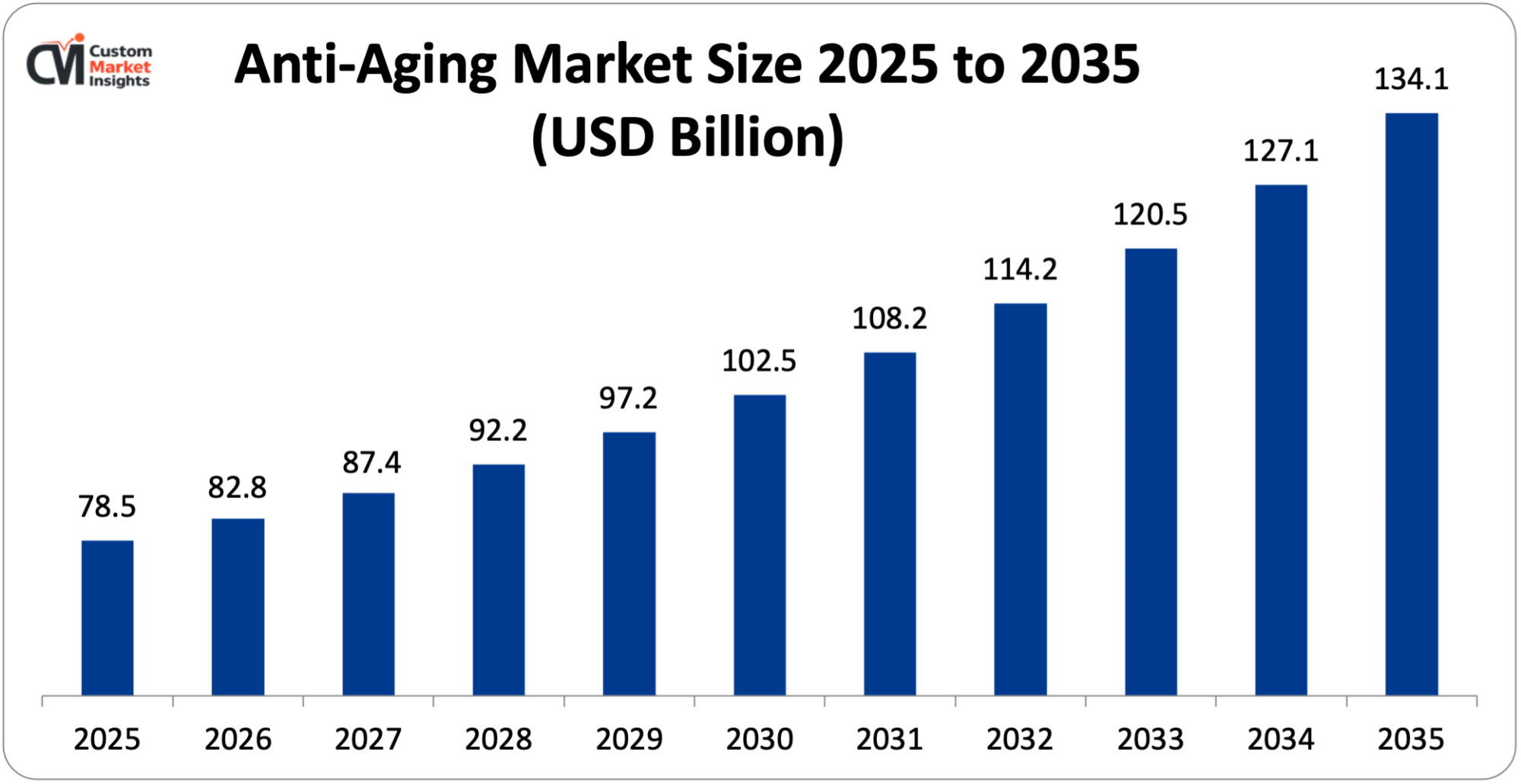
The market size of the global anti-aging industry will be estimated at USD 78.5 billion in 2025 and is expected to grow to between USD 82.8 billion in 2026 and about USD 134.1 billion by 2035 with a current CAGR of 5.5% during the period of 2026 to 2035. The anti-aging is the term used to describe all the products, treatments, technologies and services which can help to slow, prevent or diminish the visible and cellular signs of aging. Those can be topical skin care products such as creams, serums, sunscreen, antioxidants, essential oils, acid peels, and bioactives; anti-aging diets and supplementation; minimally invasive aesthetic procedures such as dermal fillers, neurotoxins, fat reduction technology, and energy-based devices such as lasers, radio frequency, ultrasound, and intense pulsed light; and longevity and regenerative therapies.
The value of the anti-aging market today is driven by the rise in life expectancy, awareness of anti-aging products for preventive skin care, demand for minimally invasive dermatological and aesthetic procedures, scientific and technological innovations in biotechnology and dermatology, and increased preference of the aging population for younger segments. Moreover, the anti-aging market comprises the retail, clinical, and digital health sectors. It is an industry that integrates all three disciplines, from aesthetics to beauty to wellness, combining them into a unified whole.
Market Highlight
- In 2025, North America will dominate the global market with an estimated market share of 35%. The rising innovative product launch and the increasing aging population.
- The Asia Pacific is growing at the highest CAGR over the analysis period. The presence of major players drives the regional market.
- By product, the topical products segment captures the largest revenue share of over 35% in 2025.
- By end user, the individual consumers segment captures the largest market share of over 65% in 2025.
Significant Growth Factors
The anti-aging market trends present significant growth opportunities due to several factors:
- Rise of minimally invasive aesthetic treatments: The anti-aging market has expanded greatly as a result of fewer people opting for invasive procedures that make them appear younger. Consumers want effective treatments that are minimally invasive, quick to recover from, and have a lower risk and pain level than surgery. This trend has led to the increasing demand for treatments such as chemical peels, microneedling, botulinum toxin and dermal filler injections, and energy devices (laser and radio-frequency skin tightening). These procedures are now more precise, safer, accessible, and more customized to the individual, with advancements in technology. Technology has made it more accessible to everyone, and the natural look and lower risk associated with these procedures have led to an increasing number of younger patients. With the expansion of the number of beauty-based places and the increasing accessibility of anti-aging treatments such as in-house diagnostic centers, aesthetic rejuvenation, and independent clinics offering dermatology and cosmetic services, healthcare providers are having to adapt to the increasingly popular demand for less invasive procedures.
- Technology and product innovation: By improving the efficacy, safety, and personalized offering of anti-aging technology, there are several growing areas of the anti-aging technology market through the development of new technology and products. Biotech, dermatology, and cosmetic science have all achieved progress that has led to the development of new compounds and formulations. Examples are peptides, growth factors, stem cell extracts, and new types of retinoids. These products are leading to the discovery of better results to have a more youthful-appearing face and skin. Meanwhile, new technologies such as laser, IPL, radio frequency, ultrasound, and light-based systems are enabling safer and much more precise, non-surgical, or minimally invasive treatments. These are proving to be much less or not painful and have a much faster recovery time. There are also higher demand, focus, and growth because they are creating individual treatments for different skin types, aging concerns, and beauty outcomes.
What are the Major Advances Changing the Anti-Aging Market Today?
- Next-generation bioactive ingredients: Next-Generation Bioactive ingredients are one of the most significant innovations that are reshaping the anti-aging category today in the most significant manner. Next-generation bioactives are developed from state-of-the-art science, including such disciplines as biotechnology, molecular biology, and dermatology, on a significantly more profound understanding of the biological processes of aging skin to aim to reverse (do away with) the root causes of aging, such as degradation of collagen, oxidative damage, inflammation, and senescent cells. Rather than merely addressing the surface problems, such as dryness, roughness, age spots, wrinkles, fine lines, etc., the next-generation category of bioactives combines the most cutting-edge science advancements for delivering visibly demonstrable, proven-to-make-a-difference improvements on the visible parameters such as tone, texture, firmness, and structure of skin in clinical studies. This category incorporates advanced peptides that provide collagen and elastin-boosting benefits, growth factors that accelerate cell regeneration and renewal, delivery vehicles of stabilized retinoid derivatives with significantly less irritation, complex antioxidants to fight the oxidative onslaught of free radicals, and ingredients that restore the balance of the microbiome of skin. Formulation breakthroughs such as encapsulation techniques and nanocarrier systems are employed to keep the bioactive stability of core ingredients that penetrate skin faster and deeper while alleviating irritation, thereby offering greater efficacy. Innovations in this category of science-driven ingredients are establishing a foundation to enhance performance and provide scientifically testable results that can be transformed into compelling marketing messages, which in turn enable brands to inspire consumer confidence, create distinct advantages in a highly saturated marketplace, generate premium pricing, and contribute to the robust growth of this category.
- Personalized and AI-driven solutions: The move toward personalization and artificial intelligence innovation is one of the major advancements in the anti-aging market. Companies are no longer relying on a simple approach of providing generic products and procedures but instead using artificial intelligence, data analysis, and digital diagnostics to individualize skin care routines and anti-aging procedures based on one’s skin type, aging indicators, life habits, and exposure to various elements. The artificial intelligence skin analysis systems now in use through skin scan camera equipment at clinics, mobile apps, and camera systems will analyze skin features like wrinkles, pigmentation, hydration, pore size, and elasticity with a great degree of acuity. In parallel, brands and dermatology practices would be able to offer more targeted ingredients, complementary formulations, customized treatment recommendations, and planning schedules. Scientific data can further enhance treatment recommendations, utilizing microbiome testing and genetic markers, for example, to tailor regimens. Some skin analysis tools, like the U. J. V. and 3Genom, also attempt to anticipate future deterioration patterns, thus enabling the delivery of reduction-oriented, preemptive procedures. Integration of subscription services and progress monitoring programs will foster customer retention and repeat purchases, faster results, and customer delight—all of which propel volume growth for anti-aging brands.
Category Wise Insights
By Product
Why topical products hold a prominent position in the market?
The topical products segment captures the largest revenue share of over 35% in 2025. The growth of Anti-aging Creams, serums, and lotions is supported by the fact that consumer demand for more affordable, easily available, non-invasive products such as creams, serums, lotions, retinoids, and sunscreen-based anti-aging products is on the rise. Growing awareness among the young population of the benefits of preventive skin care (amongst millennials and Gen Z) has resulted in a large consumer base and repeat purchases. Innovations in advanced bioactives like peptides, stabilized retinoids, antioxidants, niacinamide, and ceramide-based solutions have enhanced the efficacy and, thereby, the acceptance of the products by premium-segment consumers, driving the demand. Moreover, aggressive initiatives launched by e-commerce, the power of social media/hashtags, and influencer-based promotion have further helped in translating these products to the end consumer, and most of this consumer base resides globally. Growing concerns of pollution, UV rays, and early skin aging have also contributed to higher demand for the products, thus contributing significantly to the revenue generation.
The injectables segment is expected to grow at a significant rate over the projected period. The market is also being influenced by the increasing demand for non-invasive procedures within aesthetics, which provide fast, visible results with reduced downtime. Products such as botulinum toxin injections, fillers, and peels are becoming a preference to plastic surgery, as they ‘are safer and cheaper, with a shorter recovery time. ‘ The increased normalization of undergoing aesthetic procedures, alongside a rise in popularity via social media and increased industry standards, has increased the target market of younger patients, men and women opting to maintain a more youthful appearance. Advances in technology have maximized the longevity, safety, and naturalness of the results achieved, thus promoting customer satisfaction and encouraging repeat visits. More possibilities are now available because dermatological and medical spa practices are growing, and there are more qualified professionals in areas that need them.
By End User
Why Individual Consumers Dominates the Anti-Aging Market?
The individual consumers segment captures the largest market share of over 65% in 2025. People started to choose their own treatment plans. The market started to change as more people were interested in personal use items, including masks, serums, and supplements that are sold directly to consumers. Social media, reviews, and point-of-purchase marketing are examples of consumer-driven developments that have led to more experimentation and brand loyalty. The average consumer is now the main source of income, not professional or institutional consumers. This is because they can buy a wide choice of brands and commodities online and in stores.
The dermatology clinics & medspas segment is expected to grow at the highest rate over the projected period. Consumers are increasingly confident in professional, specific age-defying procedures that deliver faster and more consistent results. The approval of combination procedures, such as PRP plus filling, and the availability of state-of-the-art equipment in clinics and medspas also improve the results. Moreover, young and wealthy consumers, who are more concerned about their lifestyles, are very much inclined to preventive aesthetic procedures. This segment is expected to register the fastest CAGR during the forecast period.
Report Scope
| Feature of the Report | Details |
| Market Size in 2026 | USD 82.8 billion |
| Projected Market Size in 2035 | USD 134.1 billion |
| Market Size in 2025 | USD 78.5 billion |
| CAGR Growth Rate | 5.5% CAGR |
| Base Year | 2025 |
| Forecast Period | 2026-2035 |
| Key Segment | By Product, Age Group, Distribution Channel, End User and Region |
| Report Coverage | Revenue Estimation and Forecast, Company Profile, Competitive Landscape, Growth Factors and Recent Trends |
| Regional Scope | North America, Europe, Asia Pacific, Middle East & Africa, and South & Central America |
| Buying Options | Request tailored purchasing options to fulfil your requirements for research. |
Regional Analysis
How Big is North America Anti-Aging Market Size?
Its market size, in terms of North America anti-aging, is projected to be USD 27.5 billion in 2025 with growth to about USD 45.1 billion in 2035 with a CAGR of 5.1% between 2026 and 2035.

Why did North America Dominate the Anti-Aging Market in 2025?
In 2025, North America will dominate the global market with an estimated market share of 35%. The region’s growth can be attributed to the high levels of consumer awareness, excellent healthcare infrastructure, and significant purchasing power. The region also has earlier adoption of new technologies in skincare, injectables, and energy-based technologies, backed by a strong network of dedicated dermatology clinics, medical spas, and cosmetic surgery centers.
The growth in demand for minimally invasive procedures, increased interest among the younger age groups for preventive skincare, and increased acceptance among men for aesthetic procedures further aid consumers’ growth. Top cosmetics and pharmaceutical companies are growing by always coming up with new products and using digital and influencer media to advertise them.
US Anti-Aging Market Trends
In the North American region, the US leads the industry expansion over the projected period. U.S. Consumers have higher buying power for investing in high-priced skincare products and procedures and are thus more knowledgeable and willing to purchase high-quality and clinically proven to be effective anti-aging lotions, potions, and serums from luxury brands and anti-aging treatments—professional dermatologist care services. Also, the dominant and well-developed American beauty industry itself—with plenty of international and domestic epidermis care brands—enables the accessibility to reliable and affordable anti-aging products.
Why is Europe Experiencing the Fastest Growth in the Anti-Aging Market?
Europe is growing significantly, accounting for a revenue share of 30% in 2025. There has been a huge increase in consumer cosmetic purchases of anti-wrinkle products in Europe. Consumers are now willing to spend on high-end skin care products that may show visible enhancements over investing in traditional or now generic anti-wrinkle moisturizers. This increase in luxury skincare brands and medical-grade skincare treatments has caused the rise of the demand for high-end anti-aging products.
UK Anti-Aging Market Trends
The UK held the dominant position in the market. The drivers of country growth are complemented by an overall increase in consumer knowledge of skin technology, a rise in consumer appetite for higher-end aesthetic treatments, and forever-supporting growth in premium prices of beauty products. Consumers in the UK are increasingly willing to spend money on anti-aging products and treatments, such as high-tech serums, enduring the use of retinoid products, or using SPF products that also have anti-aging properties, which have aided the growth of topical and used treatments. Furthermore, the popularity of the clinical segment, which includes prescriptions for injectables (such as botulinum toxin and dermal fillers) among both male and female consumers, particularly younger adults seeking natural-looking effects, has also contributed to country growth. This growth is further supported by the proliferation of aesthetic clinics, medical spas, and private dermatology clinics in major cities, along with the influence of social media and beauty movements fueled by celebrities.
Why is the Asia Pacific is growing at a significant rate in the Anti-Aging Market?
The Asia Pacific holds the substantial market share over the projected period. Many Asian countries, for example China and India, are also accumulating more wealth that allows consumers to indulge more in personal care and beauty products, making premium and high-end brands more affordable. In addition to this, the emerging trends of K-beauty and J-beauty have greatly contributed to society’s obsession with perfect-looking, youthful skin. Shiseido, for example, launched a new reformulated version of the cult age-defying product, L77IMUNE Power Infusing Serum, in January 2015. They utilized over 30 years of research to develop Power Fermented Camellia+, an ingredient embedded in its formula that preserves and renews the skin.
China Anti-Aging Market Trends
China led the Asia Pacific market. The revenue of China’s anti-aging market keeps growing significantly due to the increasing disposable income and speed of urbanization. Chinese customers pay more and more attention to appearance and daily skin care, which attracts a lot of middle class with positive income increases to spend more on premium anti-aging products such as high-end serums, creams, and high-end dermatologist-recommended products. the Chinese young generation is adopting preventive skin care routines at an early stage, which makes it a huge addressable market for the industry and implies more repeat purchases, and the rate of e-commerce platforms and social commerce is also growing significantly, which results in much easier access to available products/brand penetration.
Why is the Middle East & Africa Region is growing rapidly in the Anti-Aging?
The MEA region is growing at a steady rate over the projected period. Regionally, this growth is driven by an improved level of disposable incomes, growing urban populations, and the development of awareness of aesthetics and skin care treatments. In the Middle East region, high consumer spending power and increasing demand for high-end beauty and minimally invasive cosmetic procedures will greatly contribute to this growth, especially in Gulf countries.
UAE Anti-Aging Market Trends
The UAE is growing at the highest CAGR during the forecast period. The growth is driven by high disposable income levels, a beauty-conscious population, and increasing demand for premium skincare and minimally invasive aesthetic procedures.
Top Players in the Anti-Aging Market and Their Offerings
- Unilever PLC
- Beiersdorf AG
- The Procter & Gamble Company
- Shiseido Company Limited
- The Estée Lauder Companies Inc.
- Revlon Inc.
- Oriflame Holding AG
- Avon Products, Inc.
- PMD Beauty (Age Sciences Inc.)
- L’Oréal S.A.
- Azafran
- IDC
- Beaucience India Pvt Ltd
- ALASTIN Skincare Inc.
- Premier Anti-Aging Co.,Ltd.
- Others
Key Developments
Anti-Aging market has experienced considerable changes in the last two years as the market players are trying to diversify their technological aspects and develop product portfolios using strategic approaches.
- In February 2025, Estée Lauder Companies (ELC) collaborated with Serpin Pharma to develop innovative skincare ingredients focused on longevity. Serpin Pharma specializes in anti-inflammatory research, particularly a group of proteins called Serine Protease Inhibitors, which help the body repair inflamed cells. (https://www.elcompanies.com/en/news-and-media/newsroom/press-releases/2025/02-26-2025-140034821)
- In February 2025, NIVEA MEN introduced the Age Defense skincare line, designed to address common signs of aging such as wrinkles, dryness, rough texture, dullness, and loss of firmness. The range features key ingredients like Thiamidol and Hyaluronic Acid to deliver effective results while maintaining a simple routine. It includes an advanced serum to reduce dark spots and fine lines, a hydrating face serum with Pro-Retinol for long-lasting moisture, an eye cream to combat puffiness and dark circles, and a daily moisturizer with SPF 30 for sun protection and hydration. (https://www.prnewswire.com/news-releases/nivea-men-debuts-revolutionary-face-care-with-new-age-defense-line-302369425.html)
These strategic measures have enabled the companies to reinforce their competitive positions, increase the product line, boost their technological competencies, and also seize growth opportunities in the fast-growing anti-aging market.
The Anti-Aging Market is segmented as follows:
By Product
- Topical Products
- Moisturizers & Serums
- Anti-wrinkle Creams
- Retinoids, Peptides, Antioxidants
- Sunscreens & Anti-pollution Formulations
- Injectables
-
- Botulinum Toxins
- Anti-Aging Dietary Supplements
- Laser Resurfacing
- Clinical & Therapeutic Services
By Age Group
- 20–39 Years
- 40–59 Years
- 60+ Years ~30%
By Distribution Channel
- Offline/Retail
- Online/E-commerce
- Hospital/Clinic Direct Sales
By End User
- Individual Consumers
- Hospitals & Specialty Centers
- Dermatology Clinics & Medspas
Regional Coverage:
North America
- U.S.
- Canada
- Mexico
- Rest of North America
Europe
- Germany
- France
- U.K.
- Russia
- Italy
- Spain
- Netherlands
- Rest of Europe
Asia Pacific
- China
- Japan
- India
- New Zealand
- Australia
- South Korea
- Taiwan
- Rest of Asia Pacific
The Middle East & Africa
- Saudi Arabia
- UAE
- Egypt
- Kuwait
- South Africa
- Rest of the Middle East & Africa
Latin America
- Brazil
- Argentina
- Rest of Latin America
Table of Contents
- Chapter 1. Report Introduction
- 1.1. Report Description
- 1.1.1. Purpose of the Report
- 1.1.2. USP & Key Offerings
- 1.2. Key Benefits For Stakeholders
- 1.3. Target Audience
- 1.4. Report Scope
- 1.1. Report Description
- Chapter 2. Market Overview
- 2.1. Report Scope (Segments And Key Players)
- 2.1.1. Anti-Aging by Segments
- 2.1.2. Anti-Aging by Region
- 2.2. Executive Summary
- 2.2.1. Market Size & Forecast
- 2.2.2. Anti-Aging Market Attractiveness Analysis, By Product
- 2.2.3. Anti-Aging Market Attractiveness Analysis, By Age Group
- 2.2.4. Anti-Aging Market Attractiveness Analysis, By Distribution Channel
- 2.2.5. Anti-Aging Market Attractiveness Analysis, By End User
- 2.1. Report Scope (Segments And Key Players)
- Chapter 3. Market Dynamics (DRO)
- 3.1. Market Drivers
- 3.1.1. Rise of minimally invasive aesthetic treatments
- 3.1.2. Technology and product innovation
- 3.2. Market Restraints
- 3.3. Market Opportunities
- 3.5. Pestle Analysis
- 3.6. Porter’s Forces Analysis
- 3.7. Technology Roadmap
- 3.8. Value Chain Analysis
- 3.9. Government Policy Impact Analysis
- 3.10. Pricing Analysis
- 3.1. Market Drivers
- Chapter 4. Anti-Aging Market – By Product
- 4.1. Product Market Overview, By Product Segment
- 4.1.1. Anti-Aging Market Revenue Share, By Product, 2025 & 2035
- 4.1.2. Topical Products
- 4.1.2.1. Moisturizers & Serums
- 4.1.2.2. Anti-wrinkle Creams
- 4.1.2.3. Retinoids, Peptides, Antioxidants
- 4.1.2.4. Sunscreens & Anti-pollution Formulations
- 4.1.3. Anti-Aging Share Forecast, By Region (USD Billion)
- 4.1.4. Comparative Revenue Analysis, By Country, 2025 & 2035
- 4.1.5. Key Market Trends, Growth Factors, & Opportunities
- 4.1.6. Injectables
- 4.1.6.1. Botulinum Toxins
- 4.1.6.2. Anti-Aging Dietary Supplements
- 4.1.6.3. Laser Resurfacing
- 4.1.6.4. Clinical & Therapeutic Services
- 4.1.7. Anti-Aging Share Forecast, By Region (USD Billion)
- 4.1.8. Comparative Revenue Analysis, By Country, 2025 & 2035
- 4.1.9. Key Market Trends, Growth Factors, & Opportunities
- 4.1. Product Market Overview, By Product Segment
- Chapter 5. Anti-Aging Market – By Age Group
- 5.1. Age Group Market Overview, By Age Group Segment
- 5.1.1. Anti-Aging Market Revenue Share, By Age Group, 2025 & 2035
- 5.1.2. 20–39 Years
- 5.1.3. Anti-Aging Share Forecast, By Region (USD Billion)
- 5.1.4. Comparative Revenue Analysis, By Country, 2025 & 2035
- 5.1.5. Key Market Trends, Growth Factors, & Opportunities
- 5.1.6. 40–59 Years
- 5.1.7. Anti-Aging Share Forecast, By Region (USD Billion)
- 5.1.8. Comparative Revenue Analysis, By Country, 2025 & 2035
- 5.1.9. Key Market Trends, Growth Factors, & Opportunities
- 5.1.10. 60+ Years ~30%
- 5.1.11. Anti-Aging Share Forecast, By Region (USD Billion)
- 5.1.12. Comparative Revenue Analysis, By Country, 2025 & 2035
- 5.1.13. Key Market Trends, Growth Factors, & Opportunities
- 5.1. Age Group Market Overview, By Age Group Segment
- Chapter 6. Anti-Aging Market – By Distribution Channel
- 6.1. Distribution Channel Market Overview, By Distribution Channel Segment
- 6.1.1. Anti-Aging Market Revenue Share, By Distribution Channel, 2025 & 2035
- 6.1.2. Offline/Retail
- 6.1.3. Anti-Aging Share Forecast, By Region (USD Billion)
- 6.1.4. Comparative Revenue Analysis, By Country, 2025 & 2035
- 6.1.5. Key Market Trends, Growth Factors, & Opportunities
- 6.1.6. Online/E-commerce
- 6.1.7. Anti-Aging Share Forecast, By Region (USD Billion)
- 6.1.8. Comparative Revenue Analysis, By Country, 2025 & 2035
- 6.1.9. Key Market Trends, Growth Factors, & Opportunities
- 6.1.10. Hospital/Clinic Direct Sales
- 6.1.11. Anti-Aging Share Forecast, By Region (USD Billion)
- 6.1.12. Comparative Revenue Analysis, By Country, 2025 & 2035
- 6.1.13. Key Market Trends, Growth Factors, & Opportunities
- 6.1. Distribution Channel Market Overview, By Distribution Channel Segment
- Chapter 7. Anti-Aging Market – By End User
- 7.1. End User Market Overview, By End User Segment
- 7.1.1. Anti-Aging Market Revenue Share, By End User, 2025 & 2035
- 7.1.2. Individual Consumers
- 7.1.3. Anti-Aging Share Forecast, By Region (USD Billion)
- 7.1.4. Comparative Revenue Analysis, By Country, 2025 & 2035
- 7.1.5. Key Market Trends, Growth Factors, & Opportunities
- 7.1.6. Hospitals & Specialty Centers
- 7.1.7. Anti-Aging Share Forecast, By Region (USD Billion)
- 7.1.8. Comparative Revenue Analysis, By Country, 2025 & 2035
- 7.1.9. Key Market Trends, Growth Factors, & Opportunities
- 7.1.10. Dermatology Clinics & Medspas
- 7.1.11. Anti-Aging Share Forecast, By Region (USD Billion)
- 7.1.12. Comparative Revenue Analysis, By Country, 2025 & 2035
- 7.1.13. Key Market Trends, Growth Factors, & Opportunities
- 7.1. End User Market Overview, By End User Segment
- Chapter 8. Anti-Aging Market – Regional Analysis
- 8.1. Anti-Aging Market Overview, By Region Segment
- 8.1.1. Global Anti-Aging Market Revenue Share, By Region, 2025 & 2035
- 8.1.2. Global Anti-Aging Market Revenue, By Region, 2026 – 2035 (USD Billion)
- 8.1.3. Global Anti-Aging Market Revenue, By Product, 2026 – 2035
- 8.1.4. Global Anti-Aging Market Revenue, By Age Group, 2026 – 2035
- 8.1.5. Global Anti-Aging Market Revenue, By Distribution Channel, 2026 – 2035
- 8.1.6. Global Anti-Aging Market Revenue, By End User, 2026 – 2035
- 8.2. North America
- 8.2.1. North America Anti-Aging Market Revenue, By Country, 2026 – 2035 (USD Billion)
- 8.2.2. North America Anti-Aging Market Revenue, By Product, 2026 – 2035
- 8.2.3. North America Anti-Aging Market Revenue, By Age Group, 2026 – 2035
- 8.2.4. North America Anti-Aging Market Revenue, By Distribution Channel, 2026 – 2035
- 8.2.5. North America Anti-Aging Market Revenue, By End User, 2026 – 2035
- 8.2.6. U.S. Anti-Aging Market Revenue, 2026 – 2035 (USD Billion)
- 8.2.7. Canada Anti-Aging Market Revenue, 2026 – 2035 (USD Billion)
- 8.2.8. Mexico Anti-Aging Market Revenue, 2026 – 2035 (USD Billion)
- 8.2.9. Rest of North America Anti-Aging Market Revenue, 2026 – 2035 (USD Billion)
- 8.3. Europe
- 8.3.1. Europe Anti-Aging Market Revenue, By Country, 2026 – 2035 (USD Billion)
- 8.3.2. Europe Anti-Aging Market Revenue, By Product, 2026 – 2035
- 8.3.3. Europe Anti-Aging Market Revenue, By Age Group, 2026 – 2035
- 8.3.4. Europe Anti-Aging Market Revenue, By Distribution Channel, 2026 – 2035
- 8.3.5. Europe Anti-Aging Market Revenue, By End User, 2026 – 2035
- 8.3.6. Germany Anti-Aging Market Revenue, 2026 – 2035 (USD Billion)
- 8.3.7. France Anti-Aging Market Revenue, 2026 – 2035 (USD Billion)
- 8.3.8. U.K. Anti-Aging Market Revenue, 2026 – 2035 (USD Billion)
- 8.3.9. Russia Anti-Aging Market Revenue, 2026 – 2035 (USD Billion)
- 8.3.10. Italy Anti-Aging Market Revenue, 2026 – 2035 (USD Billion)
- 8.3.11. Spain Anti-Aging Market Revenue, 2026 – 2035 (USD Billion)
- 8.3.12. Netherlands Anti-Aging Market Revenue, 2026 – 2035 (USD Billion)
- 8.3.13. Rest of Europe Anti-Aging Market Revenue, 2026 – 2035 (USD Billion)
- 8.4. Asia Pacific
- 8.4.1. Asia Pacific Anti-Aging Market Revenue, By Country, 2026 – 2035 (USD Billion)
- 8.4.2. Asia Pacific Anti-Aging Market Revenue, By Product, 2026 – 2035
- 8.4.3. Asia Pacific Anti-Aging Market Revenue, By Age Group, 2026 – 2035
- 8.4.4. Asia Pacific Anti-Aging Market Revenue, By Distribution Channel, 2026 – 2035
- 8.4.5. Asia Pacific Anti-Aging Market Revenue, By End User, 2026 – 2035
- 8.4.6. China Anti-Aging Market Revenue, 2026 – 2035 (USD Billion)
- 8.4.7. Japan Anti-Aging Market Revenue, 2026 – 2035 (USD Billion)
- 8.4.8. India Anti-Aging Market Revenue, 2026 – 2035 (USD Billion)
- 8.4.9. New Zealand Anti-Aging Market Revenue, 2026 – 2035 (USD Billion)
- 8.4.10. Australia Anti-Aging Market Revenue, 2026 – 2035 (USD Billion)
- 8.4.11. South Korea Anti-Aging Market Revenue, 2026 – 2035 (USD Billion)
- 8.4.12. Taiwan Anti-Aging Market Revenue, 2026 – 2035 (USD Billion)
- 8.4.13. Rest of Asia Pacific Anti-Aging Market Revenue, 2026 – 2035 (USD Billion)
- 8.5. The Middle-East and Africa
- 8.5.1. The Middle-East and Africa Anti-Aging Market Revenue, By Country, 2026 – 2035 (USD Billion)
- 8.5.2. The Middle-East and Africa Anti-Aging Market Revenue, By Product, 2026 – 2035
- 8.5.3. The Middle-East and Africa Anti-Aging Market Revenue, By Age Group, 2026 – 2035
- 8.5.4. The Middle-East and Africa Anti-Aging Market Revenue, By Distribution Channel, 2026 – 2035
- 8.5.5. The Middle-East and Africa Anti-Aging Market Revenue, By End User, 2026 – 2035
- 8.5.6. Saudi Arabia Anti-Aging Market Revenue, 2026 – 2035 (USD Billion)
- 8.5.7. UAE Anti-Aging Market Revenue, 2026 – 2035 (USD Billion)
- 8.5.8. Egypt Anti-Aging Market Revenue, 2026 – 2035 (USD Billion)
- 8.5.9. Kuwait Anti-Aging Market Revenue, 2026 – 2035 (USD Billion)
- 8.5.10. South Africa Anti-Aging Market Revenue, 2026 – 2035 (USD Billion)
- 8.5.11. Rest of the Middle East & Africa Anti-Aging Market Revenue, 2026 – 2035 (USD Billion)
- 8.6. Latin America
- 8.6.1. Latin America Anti-Aging Market Revenue, By Country, 2026 – 2035 (USD Billion)
- 8.6.2. Latin America Anti-Aging Market Revenue, By Product, 2026 – 2035
- 8.6.3. Latin America Anti-Aging Market Revenue, By Age Group, 2026 – 2035
- 8.6.4. Latin America Anti-Aging Market Revenue, By Distribution Channel, 2026 – 2035
- 8.6.5. Latin America Anti-Aging Market Revenue, By End User, 2026 – 2035
- 8.6.6. Brazil Anti-Aging Market Revenue, 2026 – 2035 (USD Billion)
- 8.6.7. Argentina Anti-Aging Market Revenue, 2026 – 2035 (USD Billion)
- 8.6.8. Rest of Latin America Anti-Aging Market Revenue, 2026 – 2035 (USD Billion)
- 8.1. Anti-Aging Market Overview, By Region Segment
- Chapter 9. Competitive Landscape
- 9.1. Company Market Share Analysis – 2025
- 9.1.1. Global Anti-Aging Market: Company Market Share, 2025
- 9.2. Global Anti-Aging Market Company Market Share, 2024
- 9.1. Company Market Share Analysis – 2025
- Chapter 10. Company Profiles
- 10.1. Unilever PLC
- 10.1.1. Company Overview
- 10.1.2. Key Executives
- 10.1.3. Product Portfolio
- 10.1.4. Financial Overview
- 10.1.5. Operating Business Segments
- 10.1.6. Business Performance
- 10.1.7. Recent Developments
- 10.2. Beiersdorf AG
- 10.3. The Procter & Gamble Company
- 10.4. Shiseido Company Limited
- 10.5. The Estée Lauder Companies Inc.
- 10.6. Revlon Inc.
- 10.7. Oriflame Holding AG
- 10.8. Avon Products
- 10.10. PMD Beauty (Age Sciences Inc.)
- 10.11. L’Oréal S.A.
- 10.12. Azafran
- 10.13. IDC
- 10.14. Beaucience India Pvt Ltd
- 10.15. ALASTIN Skincare Inc.
- 10.16. Premier Anti-Aging Co.
- 10.18. Others.
- 10.1. Unilever PLC
- Chapter 11. Research Methodology
- 11.1. Research Methodology
- 11.2. Secondary Research
- 11.3. Primary Research
- 11.3.1. Analyst Tools and Models
- 11.4. Research Limitations
- 11.5. Assumptions
- 11.6. Insights From Primary Respondents
- 11.7. Why Custom Market Insights
- Chapter 12. Standard Report Commercials & Add-Ons
- 12.1. Customization Options
- 12.2. Subscription Module For Market Research Reports
- 12.3. Client Testimonials
List Of Figures
Figures No 1 to 37
List Of Table
Tables No 1 to 51
Report Segmentation
Prominent Player
- Unilever PLC
- Beiersdorf AG
- The Procter & Gamble Company
- Shiseido Company Limited
- The Estée Lauder Companies Inc.
- Revlon Inc.
- Oriflame Holding AG
- Avon Products, Inc.
- PMD Beauty (Age Sciences Inc.)
- L’Oréal S.A.
- Azafran
- IDC
- Beaucience India Pvt Ltd
- ALASTIN Skincare Inc.
- Premier Anti-Aging Co.,Ltd.
- Others
FAQs
The key players in the market are Unilever PLC, Beiersdorf AG, The Procter & Gamble Company, Shiseido Company Limited, The Estée Lauder Companies Inc., Revlon Inc., Oriflame Holding AG, Avon Products, Inc., PMD Beauty (Age Sciences Inc.), L’Oréal S.A., Azafran, IDC, Beaucience India Pvt Ltd, ALASTIN Skincare Inc., Premier Anti-Aging Co.,Ltd., Others.
Government regulations tend to stimulate the development of the anti-aging market by rendering products safe, effective, and ethically marketed. Regulatory agencies determine rules related to the usage of ingredients, rules on clinical testing, and rules on product labeling and advertising. Although strict regulations tend to make market access and new product developments more expensive and take longer, they are instrumental in building consumer trust and, thus, market credibility. In medical aesthetics, licensing of professionals and approval of devices are key factors affecting the market.
The price point can influence market development and penetration through increasing accessibility and consumer purchasing behavior. By increasing the affordability of new products and treatments, more consumers can be reached, and that can encourage repeat sales, while premium pricing can generate higher margins but has the potential to limit market reach to a more niche segment.
According to the present analysis and forecast modeling, the market of anti-aging will witness a significant growth of about USD 134.1 billion in the year 2035 with the growing disposable income, increased investment in advanced technology, and product innovation with a CAGR of 5.5% between the years 2026 and 2035.
It is projected that North America will hold the largest market share in the anti-aging market in the forecast period, with a share of about 35% of the global market share, which is attributed to the presence of major players and an increasing aging population.
The Asia Pacific is expected to grow at the highest CAGR during the forecast period. The growth in the region is owing to the presence of major players and rising disposable income.
The anti-aging industry is driven by an aging population, more knowledge of preventative skin treatments and cosmetic procedures, and the desire for non-invasive procedures. Consumers are increasingly spending their disposable income on therapies and treatments. Trends and hype on social media platforms and in the cosmetic arena continue to develop demand. Innovation in the appearance of commercialized products and procedures is making them safer and more efficient with improvements in bioactives, injectables, and energy-based products. Growth drivers include increased online purchasing as well as the development of custom, AI-based skin analysis and solutions.