
Xylitol Market Size, Trends and Insights By Form (Liquid, Powder), By Application (Chewing Gum, Bakery & Other Foods, Confectionery, Oral Care, Others), and By Region - Global Industry Overview, Statistical Data, Competitive Analysis, Share, Outlook, and Forecast 2026 – 2035
Report Snapshot
CAGR: 3.7%
| Study Period: | 2026-2035 |
| Fastest Growing Market: | Asia-Pacific |
| Largest Market: | Europe |
Major Players
- DFI Corp.
- DuPont Danisco
- Roquette Freres
- ZuChem Inc.
- Others
Reports Description
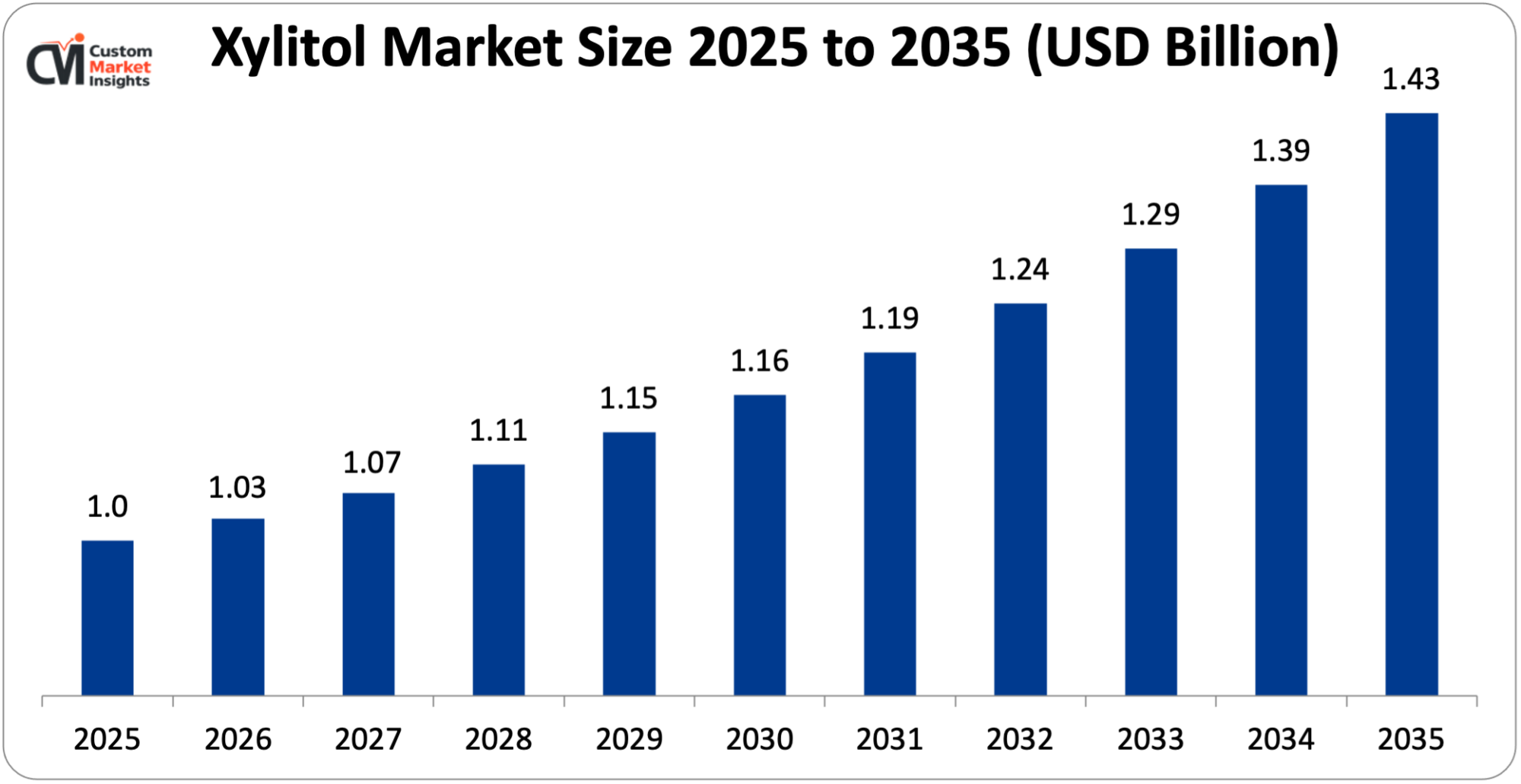
The market size of global xylitol will be estimated at USD 1.0 billion in 2025 and is expected to grow to between USD 1.03 billion in 2026 and about USD 1.43 billion by 2035, with a current CAGR (compound annual growth rate) of 3.7% during the period of 2026 to 2035. Xylitol is a naturally occurring polyalcohol used as a low-calorie sweetener in an abundance of food, pharmaceutical, and oral care products. Industrial xylitol can be extracted from plant materials such as birch and other trees, corn cobs, or by-products from wood and paper industries by chemical processes.
Xylitol has 2.4 calories/gram and a low glycemic index, which makes it acceptable to diabetics and those on a low-sugar diet. Because it inhibits the bacteria that cause tooth decay, xylitol is used in many chewing gums and confections, as well as in toothpaste and mouthwashes. The dental claims of 14 studies have led to the inclusion of xylitol in even more products.
Market Highlight
- In 2025, the Asia Pacific will dominate the global market with an estimated market share of 42%. The rising innovative product launch and the highest producer of xylitol drive the regional market growth.
- Europe is growing at the highest CAGR over the analysis period. The increasing food & beverage sector drives the market growth.
- By form, the powder segment dominated the market in 2025.
- By application, the chewing gum segment captures the largest market share over the projected period.
Significant Growth Factors
The xylitol market trends present significant growth opportunities due to several factors:
- Rising Demand For Sugar Substitutes And Low-Calorie Sweeteners: The increasing demand for sugar substitutes and low-calorie sweeteners is one of the key factors contributing to the expanded xylitol market growth. Consumers are becoming more aware of the adverse side effects of excess sugar intake in their diets, such as obesity, diabetes, and health problems related to the heart and blood circulatory system. Consumers are opting for healthy alternatives that are lower in carbohydrates and calories. Xylitol gives the same sweetness as granulated sugar but with a far lower kilojoule content, as it has a low glycemic index and can therefore be used in diabetic and low-carbohydrate diets. The current focus on lower-calorie and sugar-free products in the food and drink industry will also help to increase the use of xylitol in the market.
- Expanding Applications In Food, Pharmaceutical, And Oral Care Industries: Rising demand for multiple applications in the food, pharmaceutical, and oral care industries is fueling the market growth. The production of xylitol in food & beverage applications is used as a sugar replacement in multiple applications of chewing gum, candies, baked goods, and sugar substitutes because of its flavor and low-calorie nature. In pharmaceutical applications xylitol finds its application in tablets, syrups, and dietary supplements because of its more stable nature and flavorful taste. In addition to this, xylitol finds its application in oral care products such as toothpaste, mouthwashes, and chewing gums, as it prevents the absorption of the acid-forming bacteria. Growing production and consumption in these industries is enhancing total market growth.
What are the Major Advances Changing the Xylitol Market Today?
- Biotechnological Production Methods: The application of biotechnological production methods has emerged as a new innovation for the growth of the xylitol market. The already existing chemical conversion process for the manufacturing of xylitol from xylopyranose involves the hydrogenation of xylose. This traditional method of manufacturing the xylitol is energy intensive and involves expensive processing conditions. The biotechnological manufacturing process utilizes micro-organisms and enzymatic catalysis to convert plant-derived sugars from biomass into xylitol under mild and sustainable conditions. Using such pathways, the manufacturers can enhance the efficiency of their manufacturing process and also can benefit from the reduction in environmental impact and the advantage of the renewable raw materials used, such as agricultural biomass.
- Sustainable and Clean-Label Ingredient Trends: Sustainable and clean-label ingredient trends are to play a key role in fostering the growth of the xylitol market. Consumers are increasingly demanding food and beverage items without chemicals, artificial preservatives, or other unnatural ingredients; hence, the market for clean label formulations has grown as food and beverage companies try to meet those demands. As an example, xylitol is derived from multiple renewable sources such as birch wood, corn cobs, and other plant biomass; due to its sustainability, consumers’ interest has been increased. Being naturally derived and having fewer calories, it has become an attractive substitute for refined sugar and artificial sugars. Therefore, the increasing demand for more clean-label food and beverage products is support for the overall xylitol market growth.
Category Wise Insights
By Form
Why Powder Hold a Prominent Position in the Market?
The powder segment dominated the market in 2025. The segment growth can be attributed to its wide usability and ease of incorporation in different products. Powdered xylitol is the most preferred product in the food and beverage industry owing to its advantages, such as blending easily with dry ingredients and providing a consistent sweetness level all through the production process. The powdered form is also the preferred product in the pharmaceutical and oral care industries for usage in pharmaceuticals such as chewable tablets and in products like toothpaste and mouth fresheners owing to its stability and ease of formulation. The increase in consumption of low-calorie sweeteners and sugar-free products, along with the rise of health-conscious consumers, is contributing to revenue growth of the global powdered xylitol segment.
The liquid segment is growing at the highest CAGR over the analysis period. The revenue growth for this segment is driven by its growing application in liquid-based product formulations in both the food, beverage & pharma sectors. Liquid xylitol is used in a host of liquid dietary supplements, flavored syrups, pharmaceutical syrups & beverages majorly because of its ease of dissolution & consistent sweetness due to no crystallization. Moreover, its use in oral care products such as mouth rinses & liquid oral care formulations is also increasing rapidly due to its dental benefits & taste enhancement. The future market for liquid xylitol will be supported by more demand for sugar-free liquid formulations and new developments in blends of functional beverages and pharmaceutical syrups, which will further aid segment revenue growth.
By Application
Why Chewing Gum Dominates the Xylitol Market?
The chewing gum segment captures the largest market share over the projected period. The growth is primarily driven by the rising demand for chewing gum among teenagers and the benefit of using xylitol. Besides this, the anti-plaque function and better cariostatic activity of xylitol have made it a popular input for sugar-free chewing gum for prudent general health observers. And at the same time, the trends of sugar-free and low-calorie are creating a new demand for newly launched products and new flavors to cater to different consumer needs. From this aspect, the global Xylitol market is under good growth, and expectations are happening that the application of Xylitol in chewing gum is due to the overwhelming consumption of the entire spectrum of sugar alcohols. This adaptation proves the liking behavior of the consumers, which resulted in the new xylitol industry trends.
The oral care segment is growing rapidly over the projected period. This is mainly due to increasing knowledge about dental health and prevention of oral hygiene. Xylitol is most widely used in oral care products in the form of chewing gum, toothpaste, mouthwash, and dental lozenges because of its effectiveness in preventing the growth of several bacteria responsible for caries and plaque formation. The increase in consumer awareness about the benefits of xylitol towards sustaining oral hygiene and the surge in demand for functional and sugar-free oral care products are prompting manufacturers to incorporate it into new product formulations. Expanding advice from dental professionals and wider usage of oral hygiene products are propelling the overall xylitol market in the oral care segment for revenue augmentation.
Report Scope
| Feature of the Report | Details |
| Market Size in 2026 | USD 1.03 billion |
| Projected Market Size in 2035 | USD 1.43 billion |
| Market Size in 2025 | USD 1.0 billion |
| CAGR Growth Rate | 3.7% CAGR |
| Base Year | 2025 |
| Forecast Period | 2026-2035 |
| Key Segment | By Form, Application and Region |
| Report Coverage | Revenue Estimation and Forecast, Company Profile, Competitive Landscape, Growth Factors and Recent Trends |
| Regional Scope | North America, Europe, Asia Pacific, Middle East & Africa, and South & Central America |
| Buying Options | Request tailored purchasing options to fulfil your requirements for research. |
Regional Analysis
How Big is the Asia Pacific Xylitol Market Size?
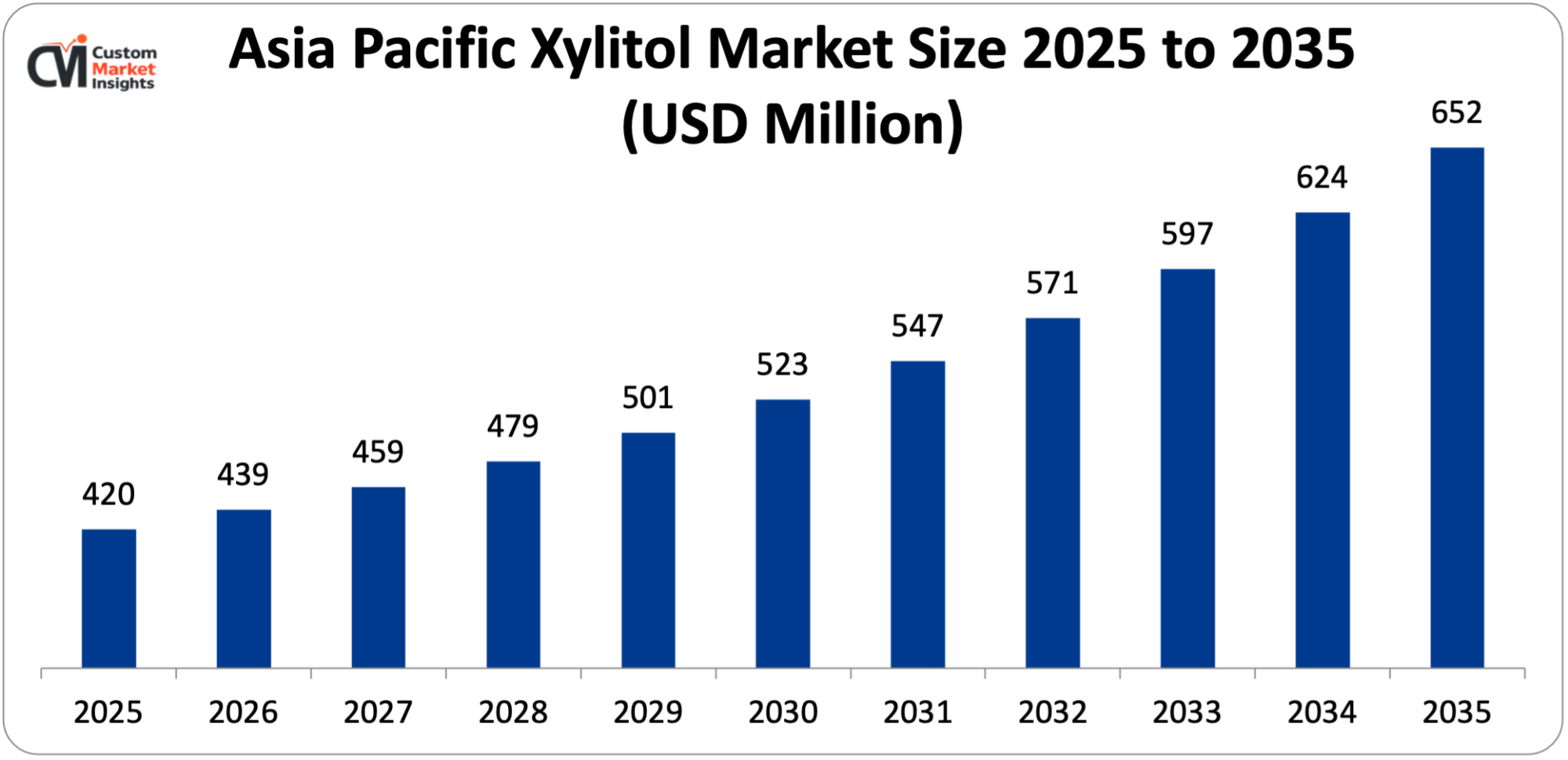
Its market size, in terms of the Asia Pacific xylitol, is projected to be USD 420 million in 2025 with a growth of about USD 652 million in 2035 with a CAGR of 4.5% between 2026 and 2035.
Why did the Asia Pacific Dominate the Xylitol Market in 2025?
In 2025, the Asia Pacific will dominate the global market with an estimated market share of 42%. The industry is seeing growth in the regional markets due to increasing demand for sugar substitutes and increasing awareness about health and the food and beverage industry in the region. Emerging urban markets, evolving eating habits, and increasing prevalence of obesity and diabetes are pushing consumers towards low-calorie sweetening agents such as xylitol. The stable base of chewing gum and confectionery producers in China, Japan, and Korea has increased the usage of xylitol in sugar-free products. Increasing investments in food processing, functional ingredients, and well-developed pharmaceutical and oral care industries around the region are also expected to drive steady growth of the xylitol market in Asia Pacific.
China Xylitol Market Trends
In the Asia Pacific region, China leads the industry expansion over the projected period. The increasing demand for low calorie sweetening agents due to the rising prevalence of diabetes drives the country’s market growth. According to the National Institute of Health, China had the world‘s largest population of diabetics. It was estimated that as many as 140 million adults had diabetes in 2021; that is approximately 25% of the worldwide total.
Why is North America Experiencing a Significant Growth in the Xylitol Market?
North America holds a significant market share in 2025. The growth is attributed to increasing demand for lower-calorie sweeteners and sugar substitutes in the region. Growing customer awareness about the health hazards caused by excessive sugar consumption, obesity, and diabetes has led to increased penetration of the sugar substitute xylitol in food and beverage products.
US Xylitol Market Trends
The US held the dominant position in the market in 2025. The sizable number of functional food producers, the ongoing growth of the sugar-free confectionery and chewing gum markets, and the increased application of xylitol to oral care products such as toothpaste and mouthwash.
Why is Europe Growing at a Rapid Rate in the Xylitol Market?
Europe is expected to grow at the highest CAGR over the projected period. The rising consumer demand for natural and clean-label ingredients in packaged foods and dietary products remains a driving factor for continued growth of the xylitol market in Europe.
UK Xylitol Market Trends
The UK led the European market. Government initiatives to encourage the reduction of sugar in processed food and beverages have persuaded manufacturers to reduce sugar while developing new sweeter products using alternative sweeteners. The increasing consumption of sugar-free chocolates, functional foods, and oral hygiene products containing xylitol, coupled with the increasing clean-label and natural ingredients trend in the UK food industry, are all enabling an increase in the revenue.
Why is the Middle East & Africa Region is growing rapidly in the Xylitol?
The MEA region is growing at a steady rate over the projected period. Increased urbanization, shifting consumer food preferences, and an increasing occurrence of lifestyle-related conditions such as diabetes and obesity are compelling consumers to opt for low-calorie sweeteners such as xylitol. Also, globalization and growth of the food and beverage industry and the growing presence of sugar-free confectionery, chewing gum, and functional food products are aiding market requirements.
UAE Xylitol Market Trends
The UAE is growing at the highest CAGR during the forecast period. The growth is owing to the increasing food & beverage industry and increasing demand for low calorie sugar.
Top Players in the Xylitol Market and Their Offerings
- DFI Corp.
- DuPont Danisco
- Roquette Freres
- ZuChem Inc.
- Thomson Biotech (Xiamen) Co. Ltd.
- NovaGreen Inc.
- Cargill Inc.
- Zhejiang Huakang Pharmaceutical Co. Ltd.
- Jining Hengda Green Engineering Co. Ltd.
- Shandong Biobridge Technology Co. Ltd.
- Shandong Futaste Co. Ltd.
- Foodchem International Corp.
- Mitsubishi Shoji Foodtech Co. Ltd.
- A & Z Food Additives Co. Ltd.
- Herboveda India
- Shandong Lujian Biological Technology Co. Ltd.
- Godavari Biorefineries Ltd.
- Shandong Longlive Bio-Technology Co. Ltd.
- Others
Key Developments
Xylitol market has experienced considerable changes in the last two years as the market players are trying to diversify their technological aspects and develop product portfolios using strategic approaches.
- In September 2025, Ingredion Inc., Westchester, Ill., is developing predictive artificial intelligence (AI) tools to speed innovation and identify new opportunities for growth. Executives speaking at the company’s investor day on Sept. 17 indicated the new tools may one day become a new business model for the ingredient supplier. (https://www.foodbusinessnews.net/articles/29055-ingredion-using-ai-to-accelerate-innovation)
These strategic measures have enabled the companies to reinforce their competitive positions, increase the product line, boost their technological competencies, and also seize growth opportunities in the fast-growing xylitol market.
The Xylitol Market is segmented as follows:
By Form
- Liquid
- Powder
By Application
- Chewing Gum
- Bakery & Other Foods
- Confectionery
- Oral Care
- Others
Regional Coverage:
North America
- U.S.
- Canada
- Mexico
- Rest of North America
Europe
- Germany
- France
- U.K.
- Russia
- Italy
- Spain
- Netherlands
- Rest of Europe
Asia Pacific
- China
- Japan
- India
- New Zealand
- Australia
- South Korea
- Taiwan
- Rest of Asia Pacific
The Middle East & Africa
- Saudi Arabia
- UAE
- Egypt
- Kuwait
- South Africa
- Rest of the Middle East & Africa
Latin America
- Brazil
- Argentina
- Rest of Latin America
Table of Contents
- Chapter 1. Report Introduction
- 1.1. Report Description
- 1.1.1. Purpose of the Report
- 1.1.2. USP & Key Offerings
- 1.2. Key Benefits For Stakeholders
- 1.3. Target Audience
- 1.4. Report Scope
- 1.1. Report Description
- Chapter 2. Market Overview
- 2.1. Report Scope (Segments And Key Players)
- 2.1.1. Xylitol by Segments
- 2.1.2. Xylitol by Region
- 2.2. Executive Summary
- 2.2.1. Market Size & Forecast
- 2.2.2. Xylitol Market Attractiveness Analysis, By Form
- 2.2.3. Xylitol Market Attractiveness Analysis, By Application
- 2.1. Report Scope (Segments And Key Players)
- Chapter 3. Market Dynamics (DRO)
- 3.1. Market Drivers
- 3.1.1. Rising Demand For Sugar Substitutes And Low-Calorie Sweeteners
- 3.1.2. Expanding Applications In Food & Pharmaceutical And Oral Care Industries
- 3.2. Market Restraints
- 3.3. Market Opportunities
- 3.5. Pestle Analysis
- 3.6. Porter’s Forces Analysis
- 3.7. Technology Roadmap
- 3.8. Value Chain Analysis
- 3.9. Government Policy Impact Analysis
- 3.10. Pricing Analysis
- 3.1. Market Drivers
- Chapter 4. Xylitol Market – By Form
- 4.1. Form Market Overview, By Form Segment
- 4.1.1. Xylitol Market Revenue Share, By Form, 2025 & 2035
- 4.1.2. Liquid
- 4.1.3. Xylitol Share Forecast, By Region (USD Billion)
- 4.1.4. Comparative Revenue Analysis, By Country, 2025 & 2035
- 4.1.5. Key Market Trends, Growth Factors, & Opportunities
- 4.1.6. Powder
- 4.1.7. Xylitol Share Forecast, By Region (USD Billion)
- 4.1.8. Comparative Revenue Analysis, By Country, 2025 & 2035
- 4.1.9. Key Market Trends, Growth Factors, & Opportunities
- 4.1. Form Market Overview, By Form Segment
- Chapter 5. Xylitol Market – By Application
- 5.1. Application Market Overview, By Application Segment
- 5.1.1. Xylitol Market Revenue Share, By Application, 2025 & 2035
- 5.1.2. Chewing Gum
- 5.1.3. Xylitol Share Forecast, By Region (USD Billion)
- 5.1.4. Comparative Revenue Analysis, By Country, 2025 & 2035
- 5.1.5. Key Market Trends, Growth Factors, & Opportunities
- 5.1.6. Bakery & Other Foods
- 5.1.7. Xylitol Share Forecast, By Region (USD Billion)
- 5.1.8. Comparative Revenue Analysis, By Country, 2025 & 2035
- 5.1.9. Key Market Trends, Growth Factors, & Opportunities
- 5.1.10. Confectionery
- 5.1.11. Xylitol Share Forecast, By Region (USD Billion)
- 5.1.12. Comparative Revenue Analysis, By Country, 2025 & 2035
- 5.1.13. Key Market Trends, Growth Factors, & Opportunities
- 5.1.14. Oral Care
- 5.1.15. Xylitol Share Forecast, By Region (USD Billion)
- 5.1.16. Comparative Revenue Analysis, By Country, 2025 & 2035
- 5.1.17. Key Market Trends, Growth Factors, & Opportunities
- 5.1.18. Others
- 5.1.19. Xylitol Share Forecast, By Region (USD Billion)
- 5.1.20. Comparative Revenue Analysis, By Country, 2025 & 2035
- 5.1.21. Key Market Trends, Growth Factors, & Opportunities
- 5.1. Application Market Overview, By Application Segment
- Chapter 6. Xylitol Market – Regional Analysis
- 6.1. Xylitol Market Overview, By Region Segment
- 6.1.1. Global Xylitol Market Revenue Share, By Region, 2025 & 2035
- 6.1.2. Global Xylitol Market Revenue, By Region, 2026 – 2035 (USD Billion)
- 6.1.3. Global Xylitol Market Revenue, By Form, 2026 – 2035
- 6.1.4. Global Xylitol Market Revenue, By Application, 2026 – 2035
- 6.2. North America
- 6.2.1. North America Xylitol Market Revenue, By Country, 2026 – 2035 (USD Billion)
- 6.2.2. North America Xylitol Market Revenue, By Form, 2026 – 2035
- 6.2.3. North America Xylitol Market Revenue, By Application, 2026 – 2035
- 6.2.4. U.S. Xylitol Market Revenue, 2026 – 2035 (USD Billion)
- 6.2.5. Canada Xylitol Market Revenue, 2026 – 2035 (USD Billion)
- 6.2.6. Mexico Xylitol Market Revenue, 2026 – 2035 (USD Billion)
- 6.2.7. Rest of North America Xylitol Market Revenue, 2026 – 2035 (USD Billion)
- 6.3. Europe
- 6.3.1. Europe Xylitol Market Revenue, By Country, 2026 – 2035 (USD Billion)
- 6.3.2. Europe Xylitol Market Revenue, By Form, 2026 – 2035
- 6.3.3. Europe Xylitol Market Revenue, By Application, 2026 – 2035
- 6.3.4. Germany Xylitol Market Revenue, 2026 – 2035 (USD Billion)
- 6.3.5. France Xylitol Market Revenue, 2026 – 2035 (USD Billion)
- 6.3.6. U.K. Xylitol Market Revenue, 2026 – 2035 (USD Billion)
- 6.3.7. Russia Xylitol Market Revenue, 2026 – 2035 (USD Billion)
- 6.3.8. Italy Xylitol Market Revenue, 2026 – 2035 (USD Billion)
- 6.3.9. Spain Xylitol Market Revenue, 2026 – 2035 (USD Billion)
- 6.3.10. Netherlands Xylitol Market Revenue, 2026 – 2035 (USD Billion)
- 6.3.11. Rest of Europe Xylitol Market Revenue, 2026 – 2035 (USD Billion)
- 6.4. Asia Pacific
- 6.4.1. Asia Pacific Xylitol Market Revenue, By Country, 2026 – 2035 (USD Billion)
- 6.4.2. Asia Pacific Xylitol Market Revenue, By Form, 2026 – 2035
- 6.4.3. Asia Pacific Xylitol Market Revenue, By Application, 2026 – 2035
- 6.4.4. China Xylitol Market Revenue, 2026 – 2035 (USD Billion)
- 6.4.5. Japan Xylitol Market Revenue, 2026 – 2035 (USD Billion)
- 6.4.6. India Xylitol Market Revenue, 2026 – 2035 (USD Billion)
- 6.4.7. New Zealand Xylitol Market Revenue, 2026 – 2035 (USD Billion)
- 6.4.8. Australia Xylitol Market Revenue, 2026 – 2035 (USD Billion)
- 6.4.9. South Korea Xylitol Market Revenue, 2026 – 2035 (USD Billion)
- 6.4.10. Taiwan Xylitol Market Revenue, 2026 – 2035 (USD Billion)
- 6.4.11. Rest of Asia Pacific Xylitol Market Revenue, 2026 – 2035 (USD Billion)
- 6.5. The Middle-East and Africa
- 6.5.1. The Middle-East and Africa Xylitol Market Revenue, By Country, 2026 – 2035 (USD Billion)
- 6.5.2. The Middle-East and Africa Xylitol Market Revenue, By Form, 2026 – 2035
- 6.5.3. The Middle-East and Africa Xylitol Market Revenue, By Application, 2026 – 2035
- 6.5.4. Saudi Arabia Xylitol Market Revenue, 2026 – 2035 (USD Billion)
- 6.5.5. UAE Xylitol Market Revenue, 2026 – 2035 (USD Billion)
- 6.5.6. Egypt Xylitol Market Revenue, 2026 – 2035 (USD Billion)
- 6.5.7. Kuwait Xylitol Market Revenue, 2026 – 2035 (USD Billion)
- 6.5.8. South Africa Xylitol Market Revenue, 2026 – 2035 (USD Billion)
- 6.5.9. Rest of the Middle East & Africa Xylitol Market Revenue, 2026 – 2035 (USD Billion)
- 6.6. Latin America
- 6.6.1. Latin America Xylitol Market Revenue, By Country, 2026 – 2035 (USD Billion)
- 6.6.2. Latin America Xylitol Market Revenue, By Form, 2026 – 2035
- 6.6.3. Latin America Xylitol Market Revenue, By Application, 2026 – 2035
- 6.6.4. Brazil Xylitol Market Revenue, 2026 – 2035 (USD Billion)
- 6.6.5. Argentina Xylitol Market Revenue, 2026 – 2035 (USD Billion)
- 6.6.6. Rest of Latin America Xylitol Market Revenue, 2026 – 2035 (USD Billion)
- 6.1. Xylitol Market Overview, By Region Segment
- Chapter 7. Competitive Landscape
- 7.1. Company Market Share Analysis – 2025
- 7.1.1. Global Xylitol Market: Company Market Share, 2025
- 7.2. Global Xylitol Market Company Market Share, 2024
- 7.1. Company Market Share Analysis – 2025
- Chapter 8. Company Profiles
- 8.1. DFI Corp.
- 8.1.1. Company Overview
- 8.1.2. Key Executives
- 8.1.3. Product Portfolio
- 8.1.4. Financial Overview
- 8.1.5. Operating Business Segments
- 8.1.6. Business Performance
- 8.1.7. Recent Developments
- 8.2. DuPont Danisco
- 8.3. Roquette Freres
- 8.4. ZuChem Inc.
- 8.5. Thomson Biotech (Xiamen) Co. Ltd.
- 8.6. NovaGreen Inc.
- 8.7. Cargill Inc.
- 8.8. Zhejiang Huakang Pharmaceutical Co. Ltd.
- 8.9. Jining Hengda Green Engineering Co. Ltd.
- 8.10. Shandong Biobridge Technology Co. Ltd.
- 8.11. Shandong Futaste Co. Ltd.
- 8.12. Foodchem International Corp.
- 8.13. Mitsubishi Shoji Foodtech Co. Ltd.
- 8.14. A & Z Food Additives Co. Ltd.
- 8.15. Herboveda India
- 8.16. Shandong Lujian Biological Technology Co. Ltd.
- 8.17. Godavari Biorefineries Ltd.
- 8.18. Shandong Longlive Bio-Technology Co. Ltd.
- 8.19. Others.
- 8.1. DFI Corp.
- Chapter 9. Research Methodology
- 9.1. Research Methodology
- 9.2. Secondary Research
- 9.3. Primary Research
- 9.3.1. Analyst Tools and Models
- 9.4. Research Limitations
- 9.5. Assumptions
- 9.6. Insights From Primary Respondents
- 9.7. Why Custom Market Insights
- Chapter 10. Standard Report Commercials & Add-Ons
- 10.1. Customization Options
- 10.2. Subscription Module For Market Research Reports
- 10.3. Client Testimonials
List Of Figures
Figures No 1 to 41
List Of Tables
Tables No 1 to 41
Prominent Player
- DFI Corp.
- DuPont Danisco
- Roquette Frères
- ZuChem Inc.
- Thomson Biotech (Xiamen) Co. Ltd.
- NovaGreen Inc.
- Cargill Inc.
- Zhejiang Huakang Pharmaceutical Co. Ltd.
- Jining Hengda Green Engineering Co. Ltd.
- Shandong Biobridge Technology Co. Ltd.
- Shandong Futaste Co. Ltd.
- Foodchem International Corp.
- Mitsubishi Shoji Foodtech Co. Ltd.
- A & Z Food Additives Co. Ltd.
- Herboveda India
- Shandong Lujian Biological Technology Co. Ltd.
- Godavari Biorefineries Ltd.
- Shandong Longlive Bio-Technology Co. Ltd.
- Others
FAQs
The key players in the market are DFI Corp., DuPont Danisco, Roquette Freres, ZuChem Inc., Thomson Biotech (Xiamen) Co. Ltd., NovaGreen Inc., Cargill Inc., Zhejiang Huakang Pharmaceutical Co. Ltd., Jining Hengda Green Engineering Co. Ltd., Shandong Biobridge Technology Co. Ltd., Shandong Futaste Co. Ltd., Foodchem International Corp., Mitsubishi Shoji Foodtech Co. Ltd., A & Z Food Additives Co. Ltd., Herboveda India, Shandong Lujian Biological Technology Co. Ltd., Godavari Biorefineries Ltd., Shandong Longlive Bio-Technology Co. Ltd., and Others.
Government regulations have a positive influence on the growth of the xylitol market by classifying xylitol as a safe food additive and promoting the use of alternatives to sugar consumption in food, pharmaceuticals, and oral care applications. Regulatory agencies in some of the countries have permitted the use of xylitol as a food additive, which has promoted the addition of xylitol as a food ingredient as an alternative to sugar. Regulations to reduce usage of sugar in general, initiatives taken for addressing health issues such as obesity and diabetes, and government policies related to clean-label and natural ingredients are stimulating manufacturers to integrate such ingredients with xylitol, which in turn aids the growth of the market.
Pricing is an important factor that influences the development and acceptance of the xylitol market. Currently, the price premium of xylitol relative to traditional sugar and some other sweeteners is high as a result of production processes and raw materials costs. Cost is a barrier for adoption in market segments that are price sensitive and for large-scale food manufacturing. As consumers are willing to pay for healthier, low-calorie, and natural sweeteners and foods, and the technology and scale of production efficiencies continue to improve, cost will become less of a barrier and an important factor in driving wider market penetration.
According to the present analysis and forecast modeling, the market of xylitol will witness a significant growth of about USD 1.43 billion in the year 2035 with the growing innovative product launch, increasing investment in the food & beverage sector, and growing demand for low calorie sugar with a CAGR of 3.7% between the years 2026 and 2035.
It is projected that the Asia Pacific will hold the largest market share in the xylitol market in the forecast period, with a share of about 42% of the global market share, which is attributed to the region being the highest producer of xylitol.
Europe is expected to grow at the highest CAGR during the forecast period. The growth in the region is owing to the rising demand from the food & beverage sector.
The market growth of Xylitol is being primarily propelled by the increased demand for sugar replacements with fewer calories. Also, increasing consciousness regarding various health issues like obesity, diabetes, and others is encouraging usage of xylitol in various food, beverage, and pharmaceutical applications. Additionally, the growing recognition of natural and clean ingredients, along with an increased interest in sugar-free and functional foods, is influencing the growth of the global xylitol market.