
Tourism Market Size, Trends and Insights By Type (Domestic, International Tourism), By Purpose (Business, Adventure Tourism, Medical, Seminar, Conference, Religious, Educational Tourism), By Mode of Booking (Direct Booking, OTA Platform), By Travel Type (Group, Solo), and By Region - Global Industry Overview, Statistical Data, Competitive Analysis, Share, Outlook, and Forecast 2026 – 2035
Report Snapshot
CAGR: 4.1%
| Study Period: | 2026-2035 |
| Fastest Growing Market: | Asia Pacific |
| Largest Market: | North America |
Major Players
- Hilton Worldwide Holdings Inc.
- InterContinental Hotels Group PLC
- Hyatt Hotels Corporation
- Accor S.A.
- Others
Reports Description
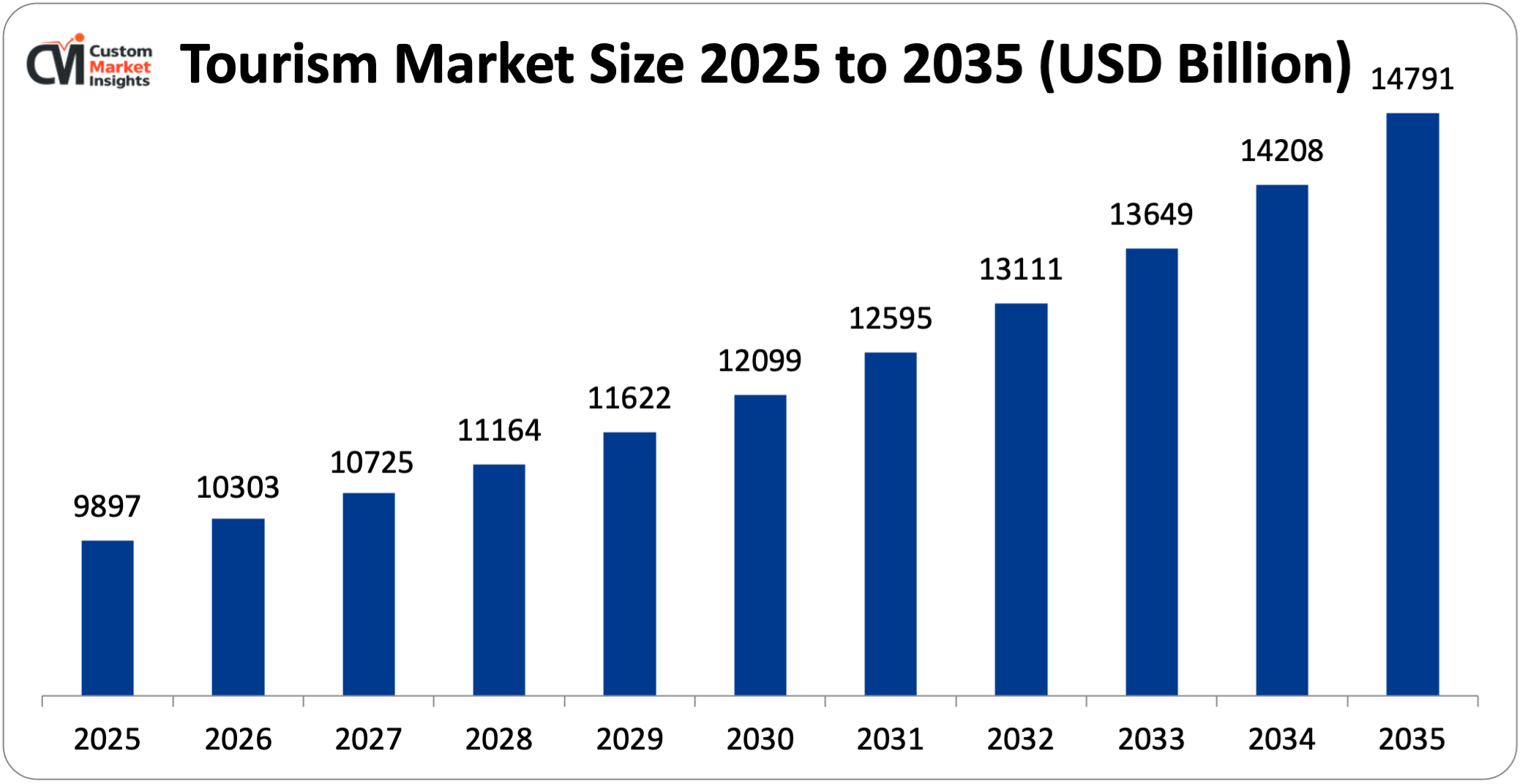
The market size of the global tourism will be estimated at USD 9897 billion in 2025 and is expected to grow between USD 10303 billion in 2026 and about USD 14791 billion by 2035 with a current CAGR of 4.1% during the period of 2026 to 2035. Tourism activities occur when people travel away from their home areas for short stays to participate in recreational activities, business activities, experience different cultures, receive medical care, practice their religious beliefs, and for various other reasons.
The industry provides multiple services for various sectors, including transportation, accommodation, food and beverage services, entertainment, travel agency operations, tour operator activities, and online booking platform functions. The World Tourism Organization (UNWTO) defines tourism as the act of travelers moving to places outside their home area for a period that lasts under one year and who do not intend to work at their travel destination. Tourism functions as an essential driver for economic growth because it creates job opportunities, which increase gross domestic product, enable cultural interactions, and drive infrastructure development in different parts of the world.
Market Highlight
- In 2025, North America will dominate the global market with an estimated market share of 42%. The rising government initiative and the presence of strong infrastructure influence the market expansion.
- Asia Pacific is growing at the highest CAGR of 8.5% over the analysis period. The growing disposable income of the population drives the regional market.
- By type, the domestic travel segment is expected to capture the largest market share over the projected period. The cheap cost of flights is a significant reason for the segment growth.
- By purpose, the medical purpose segment captures the largest market share in 2025. The growing burden of chronic disease and increasing number of conferences in medical sector drives the segment growth.
Significant Growth Factors
The tourism market trends present significant growth opportunities due to several factors:
- Rising Disposable Income & Expanding Middle Class: The worldwide tourism industry experiences continuous growth because both disposable income levels and the population of middle-class people are increasing. When their household income levels increase people select leisure activities as their preferred spending choice. The combination of economic growth and urban development together with job creation has enabled people from Asia-Pacific, Latin America, Africa to move into the middle class, which now enables them to travel more frequently and spend more money on tourism. The expanding middle class leads consumers to prefer spending on experiences instead of purchasing physical items. The millennials and younger generations treat travel as a vital part of their everyday existence. Middle-income travelers can visit all domestic and international locations because of several factors including low-cost air travel, digital booking systems and multiple payment options. The tourism industry benefits from increased booking rates, which enable airlines, hotels, tour operators, and online travel agencies to provide services to customers who seek mid-range and luxury travel options. For instance, personal income increased $30.6 billion (0.1 percent at a monthly rate) in October 2025, followed by an increase of $80.0 billion (0.3 percent) in November 2025, according to estimates released by the U.S. Bureau of Economic Analysis.
- Growth in Medical & Wellness Tourism: The global tourism market now experiences its largest growth because of the fast expansion of medical and wellness tourism. Medical tourism involves individuals traveling abroad to receive healthcare treatments which they can obtain at lower costs and shorter waiting periods compared to their home countries. Wellness tourism provides preventive healthcare services together with comprehensive well-being treatments that include spa therapies and yoga retreats and Ayurvedic treatments and detox programs and mental health experiences. Countries such as India, Thailand and Turkey have developed into leading centers that provide high-quality medical treatments at low costs which attract international patients from North America, Europe and the Middle East. The destinations attract visitors because they offer competitive treatment costs together with internationally accredited hospitals, experienced medical staff and packages that include both treatment and recreational activities. The wellness tourism sector grows because people worldwide now understand the importance of preventive healthcare and because lifestyle diseases become more common and people seek alternative treatments. The government supports this industry expansion through several main activities which include creating specialized medical visas, building healthcare facilities and executing international marketing programs.
What are the Major Advances Changing the Tourism Market Today?
- Digitalization & Online Travel Ecosystems: Digitalization together with online travel ecosystem growth has emerged as the most significant technological shift which impacts the entire worldwide tourism industry. Digital technologies enable travelers to search, compare and book travel services while experiencing their travel journey. The travel industry provides complete trip planning tools to online travel agencies, airline websites, hotel booking platforms and mobile travel applications which customers can use to create their entire journey within minutes. Booking.com, Expedia Group and Airbnb developed unified digital systems which provide users with a complete travel experience through their single interface that presents flights hotels car rentals travel insurance and local activities. The platforms enhance their decision-making procedures by using artificial intelligence systems together with flexible pricing models, user evaluations and current resource status. The market has expanded because travelers who prefer mobile devices can use their smartphones to book tickets check in receive digital boarding passes and get real-time updates. Contactless payments, digital wallets and secure online transactions have enhanced both consumer confidence and convenience. Digitalization enables tourism service providers to improve operational efficiency through data analytics, revenue management systems, automated customer service chatbots and targeted marketing campaigns. The solution enables businesses to reach international customers through reduced distribution expenses while even small businesses can access global markets.
- Rise of the Sharing Economy: The sharing economy which enables people to share their resources with others has become the most important development that transformed worldwide travel. The sharing economy enables digital platforms to connect service providers with travelers who want to use nontraditional hotel and tour operator services. The system provides travelers with better flexibility at lower costs while creating customized travel solutions. The introduction of Airbnb Uber and BlaBlaCar into the market has developed new travel methods which allow users to share their homes and vehicles with other travelers. Travelers can find unique accommodations which include city apartments and countryside homes at prices that compete with traditional hotel rates. Multiple destinations have benefited from ride-sharing services because they provide better last-mile connectivity which helps people reach their final destinations. The sharing economy enables experiential tourism by providing local tours and cultural workshops which let visitors experience real community life. Consumers now prefer to travel because they want to participate in real-world experiences rather than choose between predefined travel options. The sharing economy allows destinations to handle more tourists because it does not need expensive new facilities. The system provides a direct economic benefit to local communities through its distribution of tourist revenue. The system has led to cities which handle both over-tourism and housing problems to begin their regulatory dialogues.
Category Wise Insights
By Type
Why domestic travel holds a prominent position in the market?
The domestic travel segment is expected to capture the largest market share over the projected period. The expansion results from shifting customer demands which drive travelers to choose short journeys, weekend vacations, rural travel and experiential tourism. Many governments have launched domestic tourism campaigns to stimulate economic recovery which supports small businesses and hospitality sectors. Digital booking platforms and mobile travel apps have also made it easier for travelers to plan spontaneous trips within their country. Thus, the aforementioned factor drives the market growth.
The international tourism segment is expected to grow at a significant rate over the projected period. Global travel demand has returned to normal which enables better travel connections and increased international travel to drive business expansion. The World Tourism Organization reports that international tourist arrivals have recovered their previous levels which has resulted in higher foreign exchange earnings for destination countries. The travel industry has experienced revenue growth because travelers now spend more money on their trips to long-distance destinations and in luxury travel and experiential travel markets.
By Purpose
Why Medical Dominates the Tourism Market?
The medical purpose segment captures the largest market share in 2025. Patients are increasingly traveling across borders to access affordable, high-quality medical treatments which include cardiac surgery, orthopedic procedures, fertility treatments, cosmetic surgery and dental care. The World Tourism Organization reports that health-related travel has developed into a strong niche market which helps to diversify tourism and generates foreign exchange revenue. Medical tourism generates revenue growth because emerging healthcare destinations offer patients substantial cost savings. Patients can access internationally accredited medical facilities in India, Thailand and Turkey which provide skilled professionals at costs that are lower than North American and European treatment prices. International patients are drawn to the medical facilities because they offer shorter waiting times for both elective surgeries and specialized procedures.
The business segment is expected to grow at the highest rate over the projected period. The growth of corporate globalization, international trade and cross-border investments have resulted in increased business travel which now requires companies to spend more on premium airfare, hotel accommodations, conference space, transportation and food services. Business travelers typically spend more per trip compared to leisure tourists which strengthens revenue generation across airlines hospitality providers and event management companies. The primary reason business tourism generates revenue growth exists because multinational corporations and international partnerships expand their operations through face-to-face meetings, networking events and industry exhibitions. The development of startup ecosystems, global supply chains and foreign direct investments has expedited corporate mobility. Governments and destination marketing organizations create their cities as global business centers through their investments in convention centers, smart infrastructure and international connectivity.
Report Scope
| Feature of the Report | Details |
| Market Size in 2026 | USD 10303 billion |
| Projected Market Size in 2035 | USD 14791 billion |
| Market Size in 2025 | USD 9897 billion |
| CAGR Growth Rate | 4.1% CAGR |
| Base Year | 2025 |
| Forecast Period | 2026-2035 |
| Key Segment | By Type, Purpose, Mode of Booking, Travel Type and Region |
| Report Coverage | Revenue Estimation and Forecast, Company Profile, Competitive Landscape, Growth Factors and Recent Trends |
| Regional Scope | North America, Europe, Asia Pacific, Middle East & Africa, and South & Central America |
| Buying Options | Request tailored purchasing options to fulfil your requirements for research. |
Regional Analysis
How Big is the North America Tourism Market Size?
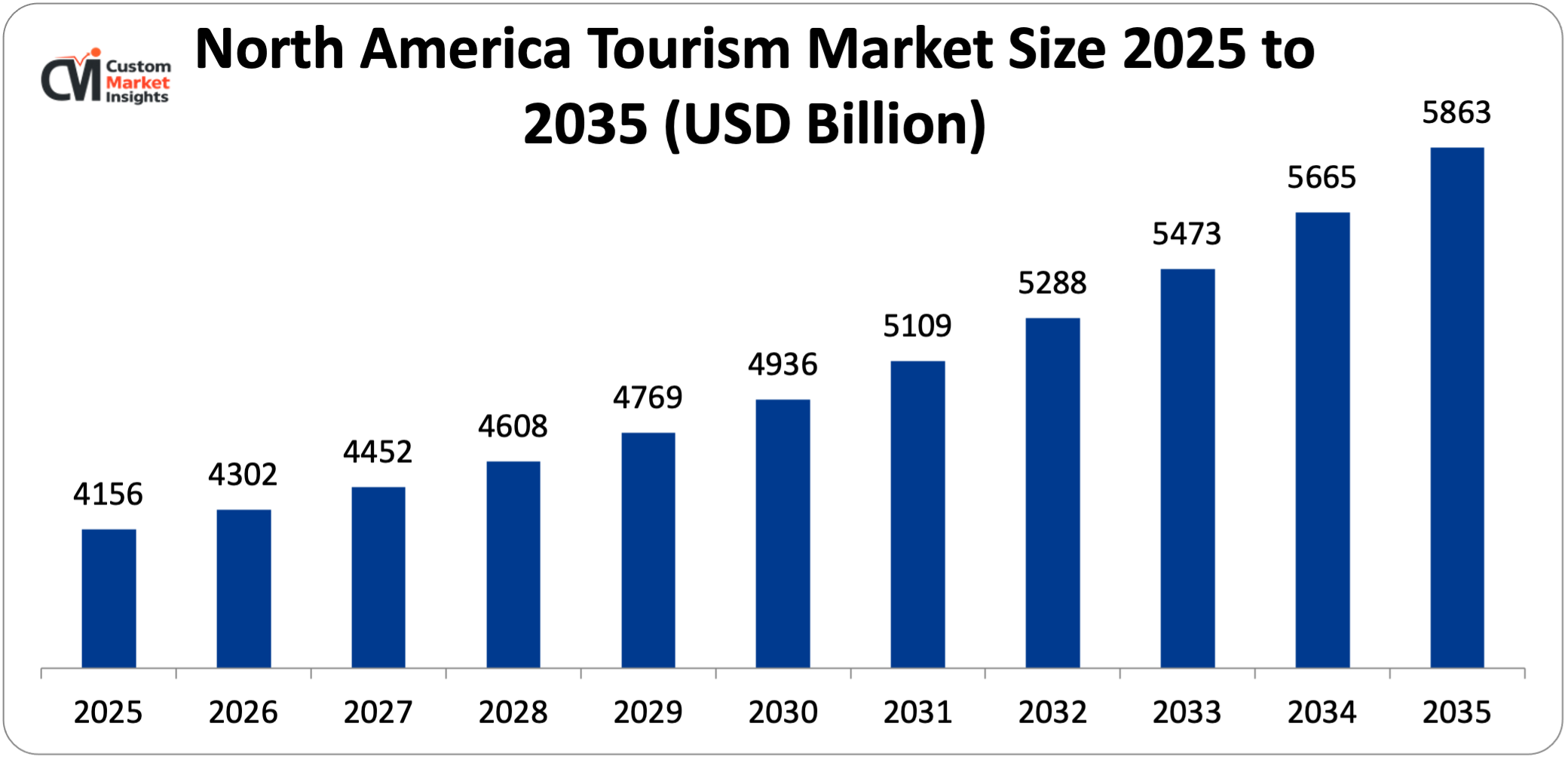
Its market size, in terms of North America tourism, is projected to be USD 4156 billion in 2025 with a growth of about USD 5863 billion in 2035 with a CAGR of 3.5% between 2026 and 2035.
Why did North America Dominate the Tourism Market in 2025?
In 2025, North America will dominate the global market with an estimated market share of 42%. The regional expansion is driven by strong domestic travel demand, high international visitor spending, and robust business tourism activities. The World Tourism Organization reports that the region remains one of the top global earners in international tourism receipts. The United States dominates regional development through its extensive consumer market and famous tourist spots while Canada and Mexico boost tourism through their leisure activities and border crossing travel.
Domestic tourism drives revenue growth because North America has the highest travel spending per person in the world. People continue to spend money on short-distance trips through road trips and visits to theme parks and national parks. The expansion of business travel and MICE activities in major cities such as Las Vegas and New York City and Toronto has increased both hotel occupancy rates and premium airline bookings.
U.S. Tourism Market Trends
In North American region, the US leads the industry expansion over the projected period. The US expansion is owing to the increasing marketing campaign by the marketing brand. For instance, in October 2025, Brand USA, the organization responsible for marketing United States tourist attractions, introduced America the Beautiful, which serves as its most extensive global promotional effort to date. The campaign starts this week at Brand USA Travel Week U.K. which has been running for seven years to show U.S. tourist destinations to international buyers and media from 20 countries. The current announcement comes at a time when international travel continues to create significant economic benefits.
Travel and tourism exports reached $147 billion between January and July 2023, which represents a two percent increase compared to the same period last year. The spending is expected to create approximately $39.6 billion in federal tax revenue by the end of the year, which will create millions of American jobs and result in an economic total of $551 billion by 2025. The campaign’s launch occurs at this moment because it will enhance existing progress and create new growth until 2026, which will bring the FIFA World Cup and America’s 250th anniversary and the Route 66 centennial.
Why is Asia Pacific Experiencing the Fastest Growth in the Tourism Market?
Asia Pacific is growing at the highest CAGR of 8.5% over the analysis period. The expanding middle class in China, India, and Indonesia serves as a major revenue growth driver because their increased disposable income enables them to travel more frequently for domestic and international trips. The Asia Pacific region benefits from its active domestic tourism industry which generates steady revenue streams that withstand global economic downturns.
The expansion of air travel networks through budget airlines, the introduction of visa-free travel and major airport construction projects has resulted in a substantial increase in international visitor numbers. The cities of Bangkok, Tokyo, and Bali draw millions of visitors each year because they offer cultural heritage sites, shopping opportunities, entertainment options and natural attractions.
Japan Tourism Market Trends
Japan is growing at the fastest rate of 5.2% CAGR over the projected period. The growth of the business benefits from increased inbound tourism and strong domestic travel along with promotional efforts which the government implements. According to the Japan National Tourism Organization, international visitor arrivals have rebounded together with increased tourism receipts and higher per-capita spending. The country attracts international visitors because it offers diverse tourism options which include cultural heritage sites, modern urban environments and nature-based attractions.
Why is Europe is growing at a significant rate in the Tourism Market?
Europe holds the substantial market share over the projected period. The European Union and Schengen Area system which enables borderless travel between its member nations has become a vital driver for revenue growth in Europe. The system provides easy access to various destinations which promotes both short-distance leisure travel and short-distance business travel. The cities of Paris, Rome and Barcelona draw millions of international tourists each year who come to experience their cultural sites, architectural landmarks and dining and retail opportunities.
France Tourism Market Trends
France is growing at a highest CAGR of 5.6% during the analysis period. France maintains excellent transportation systems which use high-speed rail (TGV networks), major international airports and European transportation links to connect various regions. Paris serves as a top international conference and exhibition center which generates substantial business tourism revenue for the country. The government uses tourism promotion campaigns together with sustainability programs and smart tourism technology investments to create conditions for sustainable development.
Why is the Middle East & Africa Region is growing rapidly in the Tourism?
The MEA region is growing at a steady rate over the projected period. The Middle Eastern nations such as United Arab Emirates, Saudi Arabia and Qatar are making significant financial commitments to develop major tourism projects, high-end hotels and entertainment centers and global events. The city of Dubai has developed into a worldwide destination for both tourism and business activities because of its international airports, high-end hotels, shopping festivals and extensive airline service. The Vision 2030 plan of Saudi Arabia has boosted tourism growth through its heritage site development initiatives and its visa liberalization policies.
UAE Tourism Market Trends
UAE is growing at the highest CAGR of 5.7% during the forecast period. The rising government initiatives in the area is a major contributor for market development. For instance, The Ministry of Economy and Tourism is implementing digital projects under the UAE Tourism Strategy 2031, which includes establishing electronic links between hotel data and local tourism authorities. The ministry will launch projects in 2026 that will develop new tourism products while they promote digital transformation and sustainability practices throughout tourism operations.
Top Players in the Tourism Market and Their Offerings
- Marriott International Inc.
- American Express Global Business Travel (GBT)
- Hilton Worldwide Holdings Inc.
- InterContinental Hotels Group PLC
- Hyatt Hotels Corporation
- Accor S.A.
- Booking Holdings Inc.
- Expedia Group Inc.
- Delta Air Lines Inc.
- TUI Group
- Wyndham Hotels & Resorts Inc.
- Airbnb Inc.
- The Priceline Group Inc.
- Tata Sons Private Limited
- Amadeus IT Group SA
- Others
Key Developments
Tourism market has experienced considerable changes in the last two years as the market players are trying to diversify their technological aspects and develop product portfolio using strategic approaches.
- In November 2025, the inaugural TOURISE Summit launched the Agentic Tourism Initiative which presented the first-ever Agentic Protocol for Tourism that provides a worldwide digital system which will change all aspects of traveler experience. The Initiative which TOURISE and Globant established develops from their successful whitepaper named Tourism’s AI Takeover: Reinventing Travel through Agentic Tourism to build a groundbreaking artificial intelligence system. The system fulfills the whitepaper requirement for Open Protocol creation in Tourism AI by establishing rules for AI agent interactions which span from inspiration to return. The result: intelligent seamless travel experiences which sustain themselves throughout the worldwide tourism industry. (https://www.businesswire.com/news/home/20251112353634/en/TOURISE-2025-Debuts-Agentic-Tourism-Initiative-Pioneering-the-Protocol-for-Intelligent-Travel)
- In 2025, the Ministry of Culture, Sports and Tourism has just issued a Plan on the implementation of Governement’s Resolution No. 11/NQ-CP and the Tourism Stimulus Program 2025. The plan was created to execute the Government’s Resolution No. 11/NQ-CP which grants visa exemptions to Polish, Czech Republic and Swiss citizens who visit Viet Nam for tourism. The plan includes Resolution No. 25/NQ-CP which establishes growth targets for industries, sectors and localities while mandating improved tourist service quality to boost international visitor arrivals throughout 2025. (https://2025.vietnam.travel/en/mosct-launches-tourism-stimulus-program-2025/)
These strategic measures have enabled the companies to reinforce their competitive positions, increase the product line, boost their technological competencies and also seize growth opportunities in the fast-growing Tourism market.
The Tourism Market is segmented as follows:
By Type
- Domestic
- International Tourism
By Purpose
- Business
- Adventure Tourism
- Medical
- Seminar
- Conference
- Religious
- Educational Tourism
By Mode of Booking
- Direct Booking
- OTA Platform
By Travel Type
- Group
- Solo
Regional Coverage:
North America
- U.S.
- Canada
- Mexico
- Rest of North America
Europe
- Germany
- France
- U.K.
- Russia
- Italy
- Spain
- Netherlands
- Rest of Europe
Asia Pacific
- China
- Japan
- India
- New Zealand
- Australia
- South Korea
- Taiwan
- Rest of Asia Pacific
The Middle East & Africa
- Saudi Arabia
- UAE
- Egypt
- Kuwait
- South Africa
- Rest of the Middle East & Africa
Latin America
- Brazil
- Argentina
- Rest of Latin America
Table of Contents
- Chapter 1. Report Introduction
- 1.1. Report Description
- 1.1.1. Purpose of the Report
- 1.1.2. USP & Key Offerings
- 1.2. Key Benefits For Stakeholders
- 1.3. Target Audience
- 1.4. Report Scope
- 1.1. Report Description
- Chapter 2. Market Overview
- 2.1. Report Scope (Segments And Key Players)
- 2.1.1. Tourism by Segments
- 2.1.2. Tourism by Region
- 2.2. Executive Summary
- 2.2.1. Market Size & Forecast
- 2.2.2. Tourism Market Attractiveness Analysis, By Type
- 2.2.3. Tourism Market Attractiveness Analysis, By Purpose
- 2.2.4. Tourism Market Attractiveness Analysis, By Mode of Booking
- 2.2.5. Tourism Market Attractiveness Analysis, By Travel Type
- 2.1. Report Scope (Segments And Key Players)
- Chapter 3. Market Dynamics (DRO)
- 3.1. Market Drivers
- 3.1.1. Rising Disposable Income & Expanding Middle Class
- 3.1.2. Growth in Medical & Wellness Tourism
- 3.2. Market Restraints
- 3.3. Market Opportunities
- 3.5. Pestle Analysis
- 3.6. Porter Forces Analysis
- 3.7. Technology Roadmap
- 3.8. Value Chain Analysis
- 3.9. Government Policy Impact Analysis
- 3.10. Pricing Analysis
- 3.1. Market Drivers
- Chapter 4. Tourism Market – By Type
- 4.1. Type Market Overview, By Type Segment
- 4.1.1. Tourism Market Revenue Share, By Type, 2025 & 2035
- 4.1.2. Domestic
- 4.1.3. Tourism Share Forecast, By Region (USD Billion)
- 4.1.4. Comparative Revenue Analysis, By Country, 2025 & 2035
- 4.1.5. Key Market Trends, Growth Factors, & Opportunities
- 4.1.6. International Tourism
- 4.1.7. Tourism Share Forecast, By Region (USD Billion)
- 4.1.8. Comparative Revenue Analysis, By Country, 2025 & 2035
- 4.1.9. Key Market Trends, Growth Factors, & Opportunities
- 4.1. Type Market Overview, By Type Segment
- Chapter 5. Tourism Market – By Purpose
- 5.1. Purpose Market Overview, By Purpose Segment
- 5.1.1. Tourism Market Revenue Share, By Purpose, 2025 & 2035
- 5.1.2. Business
- 5.1.3. Tourism Share Forecast, By Region (USD Billion)
- 5.1.4. Comparative Revenue Analysis, By Country, 2025 & 2035
- 5.1.5. Key Market Trends, Growth Factors, & Opportunities
- 5.1.6. Adventure Tourism
- 5.1.7. Tourism Share Forecast, By Region (USD Billion)
- 5.1.8. Comparative Revenue Analysis, By Country, 2025 & 2035
- 5.1.9. Key Market Trends, Growth Factors, & Opportunities
- 5.1.10. Medical
- 5.1.11. Tourism Share Forecast, By Region (USD Billion)
- 5.1.12. Comparative Revenue Analysis, By Country, 2025 & 2035
- 5.1.13. Key Market Trends, Growth Factors, & Opportunities
- 5.1.14. Seminar
- 5.1.15. Tourism Share Forecast, By Region (USD Billion)
- 5.1.16. Comparative Revenue Analysis, By Country, 2025 & 2035
- 5.1.17. Key Market Trends, Growth Factors, & Opportunities
- 5.1.18. Conference
- 5.1.19. Tourism Share Forecast, By Region (USD Billion)
- 5.1.20. Comparative Revenue Analysis, By Country, 2025 & 2035
- 5.1.21. Key Market Trends, Growth Factors, & Opportunities
- 5.1.22. Religious
- 5.1.23. Tourism Share Forecast, By Region (USD Billion)
- 5.1.24. Comparative Revenue Analysis, By Country, 2025 & 2035
- 5.1.25. Key Market Trends, Growth Factors, & Opportunities
- 5.1.26. Educational Tourism
- 5.1.27. Tourism Share Forecast, By Region (USD Billion)
- 5.1.28. Comparative Revenue Analysis, By Country, 2025 & 2035
- 5.1.29. Key Market Trends, Growth Factors, & Opportunities
- 5.1. Purpose Market Overview, By Purpose Segment
- Chapter 6. Tourism Market – By Mode of Booking
- 6.1. Mode of Booking Market Overview, By Mode of Booking Segment
- 6.1.1. Tourism Market Revenue Share, By Mode of Booking, 2025 & 2035
- 6.1.2. Direct Booking
- 6.1.3. Tourism Share Forecast, By Region (USD Billion)
- 6.1.4. Comparative Revenue Analysis, By Country, 2025 & 2035
- 6.1.5. Key Market Trends, Growth Factors, & Opportunities
- 6.1.6. OTA Platform
- 6.1.7. Tourism Share Forecast, By Region (USD Billion)
- 6.1.8. Comparative Revenue Analysis, By Country, 2025 & 2035
- 6.1.9. Key Market Trends, Growth Factors, & Opportunities
- 6.1. Mode of Booking Market Overview, By Mode of Booking Segment
- Chapter 7. Tourism Market – By Travel Type
- 7.1. Travel Type Market Overview, By Travel Type Segment
- 7.1.1. Tourism Market Revenue Share, By Travel Type, 2025 & 2035
- 7.1.2. Group
- 7.1.3. Tourism Share Forecast, By Region (USD Billion)
- 7.1.4. Comparative Revenue Analysis, By Country, 2025 & 2035
- 7.1.5. Key Market Trends, Growth Factors, & Opportunities
- 7.1.6. Solo
- 7.1.7. Tourism Share Forecast, By Region (USD Billion)
- 7.1.8. Comparative Revenue Analysis, By Country, 2025 & 2035
- 7.1.9. Key Market Trends, Growth Factors, & Opportunities
- 7.1. Travel Type Market Overview, By Travel Type Segment
- Chapter 8. Tourism Market – Regional Analysis
- 8.1. Tourism Market Overview, By Region Segment
- 8.1.1. Global Tourism Market Revenue Share, By Region, 2025 & 2035
- 8.1.2. Global Tourism Market Revenue, By Region, 2026 – 2035 (USD Billion)
- 8.1.3. Global Tourism Market Revenue, By Type, 2026 – 2035
- 8.1.4. Global Tourism Market Revenue, By Purpose, 2026 – 2035
- 8.1.5. Global Tourism Market Revenue, By Mode of Booking, 2026 – 2035
- 8.1.6. Global Tourism Market Revenue, By Travel Type, 2026 – 2035
- 8.2. North America
- 8.2.1. North America Tourism Market Revenue, By Country, 2026 – 2035 (USD Billion)
- 8.2.2. North America Tourism Market Revenue, By Type, 2026 – 2035
- 8.2.3. North America Tourism Market Revenue, By Purpose, 2026 – 2035
- 8.2.4. North America Tourism Market Revenue, By Mode of Booking, 2026 – 2035
- 8.2.5. North America Tourism Market Revenue, By Travel Type, 2026 – 2035
- 8.2.6. U.S. Tourism Market Revenue, 2026 – 2035 (USD Billion)
- 8.2.7. Canada Tourism Market Revenue, 2026 – 2035 (USD Billion)
- 8.2.8. Mexico Tourism Market Revenue, 2026 – 2035 (USD Billion)
- 8.2.9. Rest of North America Tourism Market Revenue, 2026 – 2035 (USD Billion)
- 8.3. Europe
- 8.3.1. Europe Tourism Market Revenue, By Country, 2026 – 2035 (USD Billion)
- 8.3.2. Europe Tourism Market Revenue, By Type, 2026 – 2035
- 8.3.3. Europe Tourism Market Revenue, By Purpose, 2026 – 2035
- 8.3.4. Europe Tourism Market Revenue, By Mode of Booking, 2026 – 2035
- 8.3.5. Europe Tourism Market Revenue, By Travel Type, 2026 – 2035
- 8.3.6. Germany Tourism Market Revenue, 2026 – 2035 (USD Billion)
- 8.3.7. France Tourism Market Revenue, 2026 – 2035 (USD Billion)
- 8.3.8. U.K. Tourism Market Revenue, 2026 – 2035 (USD Billion)
- 8.3.9. Russia Tourism Market Revenue, 2026 – 2035 (USD Billion)
- 8.3.10. Italy Tourism Market Revenue, 2026 – 2035 (USD Billion)
- 8.3.11. Spain Tourism Market Revenue, 2026 – 2035 (USD Billion)
- 8.3.12. Netherlands Tourism Market Revenue, 2026 – 2035 (USD Billion)
- 8.3.13. Rest of Europe Tourism Market Revenue, 2026 – 2035 (USD Billion)
- 8.4. Asia Pacific
- 8.4.1. Asia Pacific Tourism Market Revenue, By Country, 2026 – 2035 (USD Billion)
- 8.4.2. Asia Pacific Tourism Market Revenue, By Type, 2026 – 2035
- 8.4.3. Asia Pacific Tourism Market Revenue, By Purpose, 2026 – 2035
- 8.4.4. Asia Pacific Tourism Market Revenue, By Mode of Booking, 2026 – 2035
- 8.4.5. Asia Pacific Tourism Market Revenue, By Travel Type, 2026 – 2035
- 8.4.6. China Tourism Market Revenue, 2026 – 2035 (USD Billion)
- 8.4.7. Japan Tourism Market Revenue, 2026 – 2035 (USD Billion)
- 8.4.8. India Tourism Market Revenue, 2026 – 2035 (USD Billion)
- 8.4.9. New Zealand Tourism Market Revenue, 2026 – 2035 (USD Billion)
- 8.4.10. Australia Tourism Market Revenue, 2026 – 2035 (USD Billion)
- 8.4.11. South Korea Tourism Market Revenue, 2026 – 2035 (USD Billion)
- 8.4.12. Taiwan Tourism Market Revenue, 2026 – 2035 (USD Billion)
- 8.4.13. Rest of Asia Pacific Tourism Market Revenue, 2026 – 2035 (USD Billion)
- 8.5. The Middle-East and Africa
- 8.5.1. The Middle-East and Africa Tourism Market Revenue, By Country, 2026 – 2035 (USD Billion)
- 8.5.2. The Middle-East and Africa Tourism Market Revenue, By Type, 2026 – 2035
- 8.5.3. The Middle-East and Africa Tourism Market Revenue, By Purpose, 2026 – 2035
- 8.5.4. The Middle-East and Africa Tourism Market Revenue, By Mode of Booking, 2026 – 2035
- 8.5.5. The Middle-East and Africa Tourism Market Revenue, By Travel Type, 2026 – 2035
- 8.5.6. Saudi Arabia Tourism Market Revenue, 2026 – 2035 (USD Billion)
- 8.5.7. UAE Tourism Market Revenue, 2026 – 2035 (USD Billion)
- 8.5.8. Egypt Tourism Market Revenue, 2026 – 2035 (USD Billion)
- 8.5.9. Kuwait Tourism Market Revenue, 2026 – 2035 (USD Billion)
- 8.5.10. South Africa Tourism Market Revenue, 2026 – 2035 (USD Billion)
- 8.5.11. Rest of the Middle East & Africa Tourism Market Revenue, 2026 – 2035 (USD Billion)
- 8.6. Latin America
- 8.6.1. Latin America Tourism Market Revenue, By Country, 2026 – 2035 (USD Billion)
- 8.6.2. Latin America Tourism Market Revenue, By Type, 2026 – 2035
- 8.6.3. Latin America Tourism Market Revenue, By Purpose, 2026 – 2035
- 8.6.4. Latin America Tourism Market Revenue, By Mode of Booking, 2026 – 2035
- 8.6.5. Latin America Tourism Market Revenue, By Travel Type, 2026 – 2035
- 8.6.6. Brazil Tourism Market Revenue, 2026 – 2035 (USD Billion)
- 8.6.7. Argentina Tourism Market Revenue, 2026 – 2035 (USD Billion)
- 8.6.8. Rest of Latin America Tourism Market Revenue, 2026 – 2035 (USD Billion)
- 8.1. Tourism Market Overview, By Region Segment
- Chapter 9. Competitive Landscape
- 9.1. Company Market Share Analysis – 2025
- 9.1.1. Global Tourism Market: Company Market Share, 2025
- 9.2. Global Tourism Market Company Market Share, 2024
- 9.1. Company Market Share Analysis – 2025
- Chapter 10. Company Profiles
- 10.1. Marriott International Inc.
- 10.1.1. Company Overview
- 10.1.2. Key Executives
- 10.1.3. Product Portfolio
- 10.1.4. Financial Overview
- 10.1.5. Operating Business Segments
- 10.1.6. Business Performance
- 10.1.7. Recent Developments
- 10.2. American Express Global Business Travel (GBT)
- 10.3. Hilton Worldwide Holdings Inc.
- 10.4. InterContinental Hotels Group PLC
- 10.5. Hyatt Hotels Corporation
- 10.6. Accor S.A.
- 10.7. Booking Holdings Inc.
- 10.8. Expedia Group Inc.
- 10.9. Delta Air Lines Inc.
- 10.10. TUI Group
- 10.11. Wyndham Hotels & Resorts Inc.
- 10.12. Airbnb Inc.
- 10.13. The Priceline Group Inc.
- 10.14. Tata Sons Private Limited
- 10.15. Amadeus IT Group SA
- 10.16. Others.
- 10.1. Marriott International Inc.
- Chapter 11. Research Methodology
- 11.1. Research Methodology
- 11.2. Secondary Research
- 11.3. Primary Research
- 11.3.1. Analyst Tools and Models
- 11.4. Research Limitations
- 11.5. Assumptions
- 11.6. Insights From Primary Respondents
- 11.7. Why Healthcare Foresights
- Chapter 12. Standard Report Commercials & Add-Ons
- 12.1. Customization Options
- 12.2. Subscription Module For Market Research Reports
- 12.3. Client Testimonials
- Chapter 13. List Of Figures
- 13.1. Figures No 1 to 31
- Chapter 14. List Of Tables
- 14.1. Tables No 1 to 51
Prominent Player
- Marriott International Inc.
- American Express Global Business Travel (GBT)
- Hilton Worldwide Holdings Inc.
- InterContinental Hotels Group PLC
- Hyatt Hotels Corporation
- Accor S.A.
- Booking Holdings Inc.
- Expedia Group Inc.
- Delta Air Lines Inc.
- TUI Group
- Wyndham Hotels & Resorts Inc.
- Airbnb Inc.
- The Priceline Group Inc.
- Tata Sons Private Limited
- Amadeus IT Group SA
- Others
FAQs
The key players in the market are Marriott International Inc., American Express Global Business Travel (GBT), Hilton Worldwide Holdings Inc., InterContinental Hotels Group PLC, Hyatt Hotels Corporation, Accor S.A., Booking Holdings Inc., Expedia Group Inc., Delta Air Lines Inc., TUI Group, Wyndham Hotels & Resorts Inc., Airbnb Inc., The Priceline Group Inc., Tata Sons Private Limited, Amadeus IT Group SA, Others.
Government regulations serve as essential factors which determine how the tourism market develops, maintains its stability and competitive edge. The implemented policies for visa regulations, taxation, aviation agreements, environmental protection, safety standards and infrastructure development, directly affect the number of tourists visiting and the growth of the industry. International travel gets encouraged through simplified visa processes which include e-visas and visa-on-arrival systems, while restrictive entry rules can limit visitor numbers. The World Tourism Organization reports that travel facilitation policies serve as major factors which determine how competitive destinations perform in international tourism markets.
The growth of the tourism market depends on price point because travel expenses control discretionary spending and people spend less money on travel when prices increase. Middle-income and first-time travelers can access travel services through affordable airfares, budget accommodations and promotional travel packages which result in increased travel volume. Higher prices which result from inflation, fuel costs and currency fluctuations will lead to decreased booking rates and extended travel decision periods. The market uses tiered pricing strategies which provide budget and luxury options to achieve mass market reach while attracting high-spending travelers, which results in balanced revenue development.
According to the present analysis and forecast modeling, the market of Tourism will witness a significant growth of about USD 14791 billion in the year 2035 with the growing digitalization, increased investing in infrastructure and government initiatives with a CAGR of 4.1% between the years 2026 and 2035.
It is projected that North America will hold the largest market share in the Tourism market in the forecast period, with a share of about 42% of the global market share, which is attributed to the presence of major players and expanding marketing campaign by agencies and government.
The Asia Pacific is expected to grow at a highest CAGR of 8.5% during the forecast period. The growth in the region is owing to the rising disposable income of the population and rising government initiatives. Moreover, the economical airways services propel the industry expansion.
The growing middle-class population in both Asia-Pacific regions and developing countries has resulted in increased travel activities and higher tourism expenditures. The ability to buy more expensive products lets consumers spend their money on entertainment activities which include international travel and high-end travel services.