
Laboratory Information Management System Market Size, Trends and Insights By Deployment (Web-based, Cloud Based, On-Premise), By Component (Software, Services), By End Use (Life Sciences, Chemical Industry, CROs, Environmental Testing Laboratories, Food & Beverage and Agriculture Industries, Petrochemical Refineries and Oil & Gas Industry, Others), and By Region – Global Industry Overview, Statistical Data, Competitive Analysis, Share, Outlook, and Forecast 2026 – 2035
Report Snapshot
| Study Period: | 2026-2035 |
| Fastest Growing Market: | Asia Pacific |
| Largest Market: | North America |
Major Players
- Siemens
- PerkinElmer Inc.
- Abbott
- Autoscribe Informatics
- Others
Reports Description
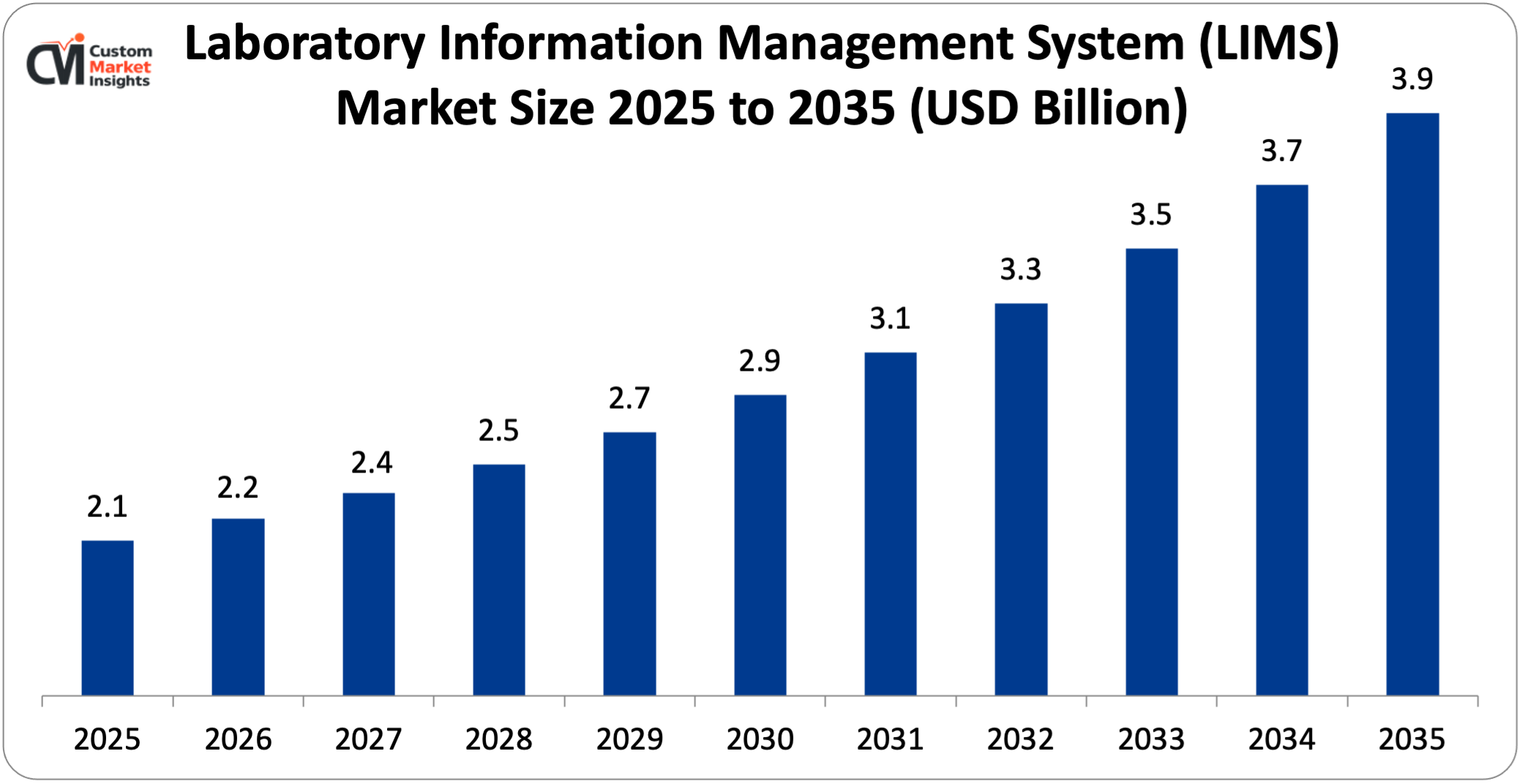
The market size of global Laboratory Information Management Systems (LIMS) will be estimated at USD 2.1 billion in 2025 and is expected to grow to between USD 2.2 billion in 2026 and about USD 3.9 billion by 2035, with a current CAGR (compound annual growth rate) of 6.5% during the period of 2026 to 2035. A Laboratory Information Management System, also known as a LIMS, is a computer software-based application used to manage, track, and automate laboratory operations to help manage data throughout the entire laboratory process.
The purpose of a LIMS is to help laboratories improve productivity and efficiency, avoid duplication of work, and facilitate compliance with regulatory authorities by enabling users to clearly and securely capture, process, and report data in one place. Laboratory information management systems allow the automation of the laboratory, sample and experiment management, and archiving all relevant data securely for future use. Laboratory information management systems are very commonly used to track, collect, and report data from laboratories in a variety of industries such as the pharmaceutical industry, biotechnology, clinical diagnostics and testing, environmental testing, food and beverage, and academia.
Market Highlight
- In 2025, North America will dominate the global market with an estimated market share of 44%. The increasing investment in R&D drives the market growth.
- The Asia Pacific is growing at the highest CAGR over the analysis period. The increasing biopharmaceutical sector.
- By deployment, the cloud-based segment dominated the industry, capturing over 43% of market share.
- By component, the services segment captures the largest market share of 58% in 2025.
- By end use, the life science companies segment captures the largest market share in 2025 of over 40%.
Significant Growth Factors
The Laboratory Information Management System (LIMS) market trends present significant growth opportunities due to several factors:
- Increasing Laboratory Automation: The speed at which the LIMS market has evolved is driven largely by the widespread adoption of laboratory automation technologies. Industry today accounts for a large proportion of samples and test data, through either analytical instrumentation or automated processing equipment, and therefore time-consuming, manual activities such as paper-based sample information management, manually conducting tests, and file-based data management systems are no longer tenable. Automation is therefore heavily relied upon in order to digitally manage workflow, manage integration of laboratory instruments and systems, and enable real-time sample and test result data management. This often reduces human error and increases overall productivity, allowing the laboratory to meet increasing test volumes without compromising data integrity. Today, there is no better practical showcase for this market pattern than clinical diagnostic laboratories. Large diagnostic companies run thousands of blood, genetic, and disease screens daily for a variety of diseases in order to diagnose and promptly treat patients. Preventative screenings are also increasing in response to the rising occurrence of lifestyle-related health issues. Without automation, such large sample sets would create significant logistical hurdles, while manual data entry would risk delays and inaccuracies. With the added benefit of LIMS integrated with automated analyzers plus barcode sample management, laboratories can immediately access testing results, easily track samples at all stages, and produce reports quickly.
- Rising Adoption Of Cloud-based LIMS: The recent adoption of cloud-based LIMS solutions in laboratories is significantly driving the overall growth of the LIMS market as laboratories are increasingly adopting flexible and scalable digital options. Cloud-based LIMS solutions enable laboratories to track data and samples using web-based systems without investing in local servers or infrastructure or IT staff, reducing costs for the labs. Cloud solutions are critical for multi-location laboratories, which need centralized, real-time access to data and samples. Cloud deployment underpins seamless data integration, uniform upgrades, comprehensive security controls, and ease of administration, factors greatly valued by laboratories across large data and documentation sets, such as in the sciences and regulated industries. The market is further stimulated by releases and innovations by leading players specifically targeted at cloud-native LIMS products. For example, while STARLIMS QM Essentials was revealed at the recent release as a cloud-native LIMS solution for small and medium manufacturers for faster laboratory operations, the introduction of LabVantage CORTEX, a multi-tenant cloud platform enabled with artificial intelligence (AI) technology, was cited as a significant development in the direction of a modular, AI-enabled, cloud laboratory platform. Similarly, labV, combining the versatility of cloud computing with upgraded AI-enabled analytics for administering experiments and materials at R&D, manufacturing, and QA laboratories, has been introduced. Such continuous product launches and extensions strengthen the cloud-native, AI-enabled Informatics platform features of laboratories, thus attracting high interest as laboratories seek higher remote availability, integrated data handling, and quicker deployment. These innovations are thus accelerating the adoption of LIMS at neighboring markets such as pharmacology, biotechnology, clinical diagnostics, and environmental diagnostics, among others.
What are the Major Advances Changing the Laboratory Information Management System Market Today?
- Artificial Intelligence (AI) and Machine Learning Integration: AI and Machine Learning (ML) have the ability to leverage Lab Information Management System (LIMS) platforms, representing one of the groundbreaking advances in science technology as essential tools for scientific data analysis that streamline lab processes and decision-making. Usually, traditional LIMS only allow handling end-to-end sample management, data collection, and process management; with AI/ML tools incorporated, the enabling LIMS platform design would have data analysis abilities for processing, analyzing, and visualizing complex, large sets of laboratory data automatically. The LIMS platform with ML-enabled features generates the capability of automatically analyzing experimental data, finding anomalies, reducing experimental errors, and providing early estimators for predictions; this AI/ML-enabled platform would support accelerated laboratory decisions with higher accuracy. The intelligence lab platform built-in with AI/ML applications would empower the scientific worker to predict experimental outputs, deliver suggestions for process optimization, uncover potential systematic errors, and plan new experiments more efficiently. Commonly, this smarter LIMS platform can be applied in the pharmaceutical or biotech laboratories and the diagnostic laboratories. For example, AI-enabled LIMS would help guide new medication design and development by analyzing the experimental datasets and discover water or chemicals by correlating irregular quantities; for tumor studies, ML algorithms incorporated in LIMS would identify typical abnormal cell ratios and improve pathological accuracy.
- Advanced Laboratory Automation and Robotics: Laboratory automation and robotics are another major technological advance for the LIMS markets. Electronic automation in laboratories is becoming more prominent as laboratories integrate more automated laboratory systems and robotics to undertake often routine or complicated laboratory tasks such as sample preparation, liquid handling, automated testing, and data collection. These automated systems are now generating large quantities of laboratory data, which need to be captured, analyzed, and processed on powerful LIMS applications that form the backbone of the laboratory environment. These LIMS applications must be able to manage robotic systems as well as the flow of samples within the laboratory. They must also be able to manage large files of experimental data from robotic systems in order to support the laboratory. Connecting automation instruments to LIMS laboratory automation tools allows laboratories to eliminate human error by using robotic systems and improve efficiency by automating many of the testing procedures. An example can be seen in pharmaceutical and biotechnology laboratories, which use robotic liquid-handling systems and automated screening tools to perform thousands of experiments during the drug discovery process. These robotic applications create vast amounts of data, which can be captured automatically by the LIMS applications, thereby minimizing the risk of user error and making research data accountable. Similarly, clinical diagnostic laboratories use robotic handling systems to automate the sorting and processing of large volumes of patient specimens in order to streamline the testing procedures and record sample statuses. As robotics and automation technology become an increasingly larger part of laboratories, so will the demand for flexible, cross-functional, and adaptable LIMS solutions capable of supporting robotics and automation rise.
Category Wise Insights
By Deployment
Why Cloud Based Hold a Prominent Position in the Market?
The cloud-based segment dominated the industry, capturing over 43% of market share. Cloud-based deployment allows for data to be available over multiple access points. With the advent of a rapidly growing remote-work culture, the benefits of virtual access points and the like help strengthen the prominence of the cloud-based product segment. In addition, the reduction of the IT workforce as well as inexpensive data management and lighter deployment processes further support the segment’s growth. Further, the increasing number of product launches drives the industry’s growth. For instance, in April 2025, the world leader of Laboratory Information Management Systems, LabWare(R), has unveiled LabWare ASSURE a brand-new SaaS platform enabling labs within the food and beverage industry to take full digital control over quality, safety, and compliance. From Ingredients to Products”, LabWare ASSURE offers best-in-class automation, digital traceability, and real-time decision-making.
The web-based segment is growing at the highest CAGR over the analysis period. The reason for this is due to the large number of consumers who use web-hosted LIMS solutions. Web-hosted LIMS solutions are suitable for R&D labs; manufacturing units; public utilities; environmental and chemical, contract, and QC labs.
By Component
Why Services Capture the Highest Market Share the Laboratory Information Management System Market?
The services segment captures the largest market share of 58% in 2025. This is attributed to the rising demand for LIMS implementation, integration, support, validation, and maintenance. Additionally, the strong demand for LIMS outsourcing solutions is projected to propel segment growth. Major pharmaceutical research laboratories often see a dearth of resources and skills needed to deploy analytics and, hence, pay for these services to be outsourced. This outsourcing is expected to include short-term, project-based, or long-term contracts. Further, such services are provided in packages that include compliance of promotional spending, social media analytics, predictive analytics for medical device failure, benchmarking services, etc.
The software segment is growing rapidly over the projected period. The growth in LIMS software that has been seen is hugely driven by the increased all-round digitalization and automation of laboratories, most notably those associated with the pharmaceutical, biotechnology, and clinical research fields. The equipment used in these laboratories produces enormous amounts of data from experiments and clinical diagnoses, which needs storing, analyzing, and outputting from a software platform. It is these functions that LIMS software allows, with the likes of autosample tracking, real-time data viewing, automatic instrument integration, and audit trail administration, among many others.
By End Use
Does the Life Science Companies Dominates the Laboratory Information Management System Market?
The life science companies segment captures the largest market share in 2025 of over 40%. This is due to the dominance of LIMS in the pharmaceutical, biopharmaceutical, and biotechnology firms. Shortage of skilled staff, increasing efficiency due to high productivity and optimization of costs, along with rising demand for biobanks and biorepositories, are anticipated to propel growth in this segment.
The Contract Research Organizations (CROs) segment is growing at the highest CAGR over the projected period. The growth is primarily driven by a rise in the outsourcing demand from pharmaceutical and biotechnological companies. The optimization of cost, the need to stay focused on core competencies, and the advantage to both the contractor and client are some of the associated factors that are expected to propel the segment growth in the coming years.
Report Scope
| Feature of the Report | Details |
| Market Size in 2026 | USD 2.2 billion |
| Projected Market Size in 2035 | USD 3.9 billion |
| Market Size in 2025 | USD 2.1 billion |
| CAGR Growth Rate | 6.5% CAGR |
| Base Year | 2025 |
| Forecast Period | 2026-2035 |
| Key Segment | By Deployment, Component, End Use and Region |
| Report Coverage | Revenue Estimation and Forecast, Company Profile, Competitive Landscape, Growth Factors and Recent Trends |
| Regional Scope | North America, Europe, Asia Pacific, Middle East & Africa, and South & Central America |
| Buying Options | Request tailored purchasing options to fulfil your requirements for research. |
Regional Analysis
How Big is North America Laboratory Information Management System Market Size?
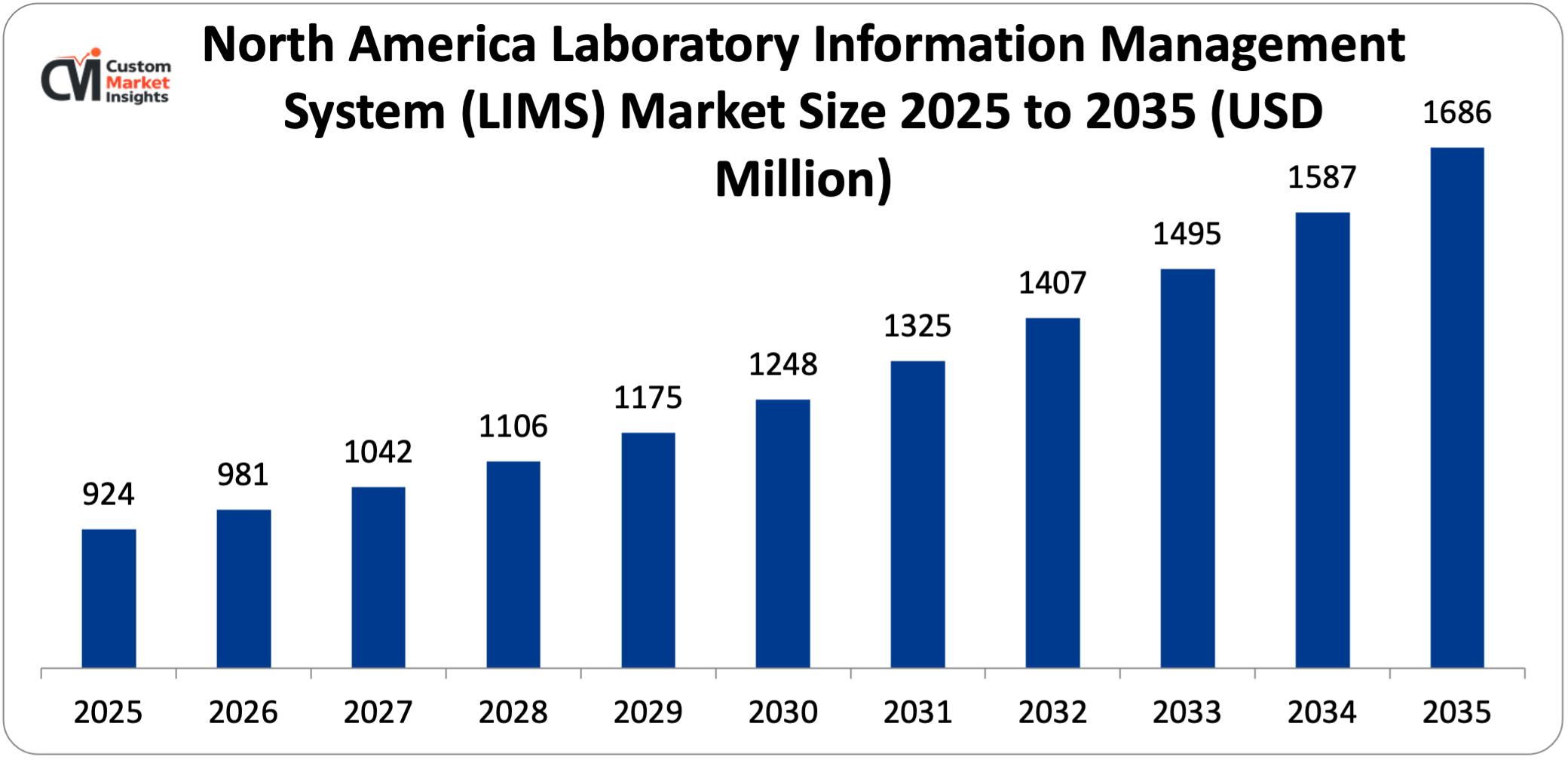
Its market size, in terms of North American Laboratory Information Management System (LIMS), is projected to be USD 924 million in 2025 with a growth of about USD 1686 million in 2035 with a CAGR of 6.2% between 2026 and 2035.
Why did North America Dominate the Laboratory Information Management System Market in 2025?
In 2025, North America will dominate the global market with an estimated market share of 44%. The growth of the region is largely fueled by the demand for extensive laboratory information handling systems by large pharma, biotech, and clinical research companies operating in the region. Moreover, the rise in the number of biobanks, biorepositories, and genomic research programs in the US and Canada is leading to an increased requirement of Laboratory Information Management Systems (LIMS) to keep records of samples and large databases.
US Laboratory Information Management System Market Trends
In the North America region, the US leads the industry expansion over the projected period. Technology development, regulatory requirements, and complex operations contribute to the market growth. Furthermore, the increasing adoption of LIMS for genomics and cancer research studies is also anticipated to support the market growth in the country. For example, in October 2024, the Ellison Institute of Technology, Los Angeles (EIT Los Angeles), implemented the LIMS platform of Sapio Sciences Inc. to improve its cancer research and to optimize its complex research operations.
Why is Europe Experiencing Significant Growth in the Laboratory Information Management System Market?
Europe holds a significant market share in 2025. The drivers leading to market growth are the increasing adoption of LIMS to meet future regulatory requirements and the rising request for automation and technological advancement. A number of companies are partnering with research facilities and deploying these systems to optimize operations and reduce time to intervene in patient healthcare. For instance, Sapio LIMS was established as the primary instrument platform in a multi-year digital lab transformation undertaken by The Wellcome Sanger Institute in December 2025 replacing fragmented existing systems. It integrates genomics workflows across Core Operations utilizing real-time sample tracking, rapid access to QC results, automation of workflows, and instrument integration with cellular/genomic research.
UK Laboratory Information Management System Market Trends
The UK held the dominant position in the market in 2025. The growth is supported by growing government investments, powerful investments in the life science industry, and the increasing need for laboratory automation. For example, in March 2024, all NHS Scotland boards (including NHS Fife, Shetland, and Orkney) went live with Magentus’ Evolution vLab LIMS linking own laboratories in different sites to automate workflows in histopathology, microbiology, and blood sciences.
Why is the Asia Pacific Growing at a Rapid Rate in the Laboratory Information Management System Market?
The Asia Pacific is expected to grow at the highest CAGR over the projected period. Market is growing due to increased acceptance of outsourcing by pharmaceutical manufacturers to bring efficiency and cost reductions. The market is expected to be driven by rising R&D investments, particularly in the pharmaceutical and biotechnology industries; increasing outsourcing to Contract Research Organizations (CROs) and Contract Development and Manufacturing Organizations (CDMOs); and further advancements in laboratory automation.
China Laboratory Information Management System Market Trends
China is growing at a significant rate in the market. Exploding research & development in life sciences, strong existence of life science companies, and new development in technology are some of the factors leading to the growth of the market.
Why is the Middle East & Africa Region is growing rapidly in the Laboratory Information Management System (LIMS)?
The MEA region is growing at a steady rate over the projected period. This can be tracked by the increased utilization of cloud-based solutions, the need for compliance requirements, and technological breakthroughs.
UAE Laboratory Information Management System Market Trends
The UAE is growing at the highest CAGR during the forecast period. The increasing investment in the food & beverage sector is the main factor driving the market growth.
Top Players in the Laboratory Information Management System Market and Their Offerings
- Computing Solutions Inc.
- LabWare
- LabVantage Solutions Inc.
- Siemens
- PerkinElmer Inc.
- Abbott
- Autoscribe Informatics
- Illumina Inc.
- Labworks
- LabLynx Inc.
- Thermo Fisher Scientific Inc.
- com (LabSoft LIMS)
- Ovation
- LABTRACK
- AssayNet Inc.
- Others
Key Developments
The Laboratory Information Management System (LIMS) market has experienced considerable changes in the last two years as the market players are trying to diversify their technological aspects and develop product portfolios using strategic approaches.
- In October 2025, InstantGMP launched a fully integrated LIMS within its GMP manufacturing platform for pharma, biotech, and supplements. Key features include Master/Active Test Protocols, diverse result types (quantitative, qualitative, and images), barcode-based sample tracking, real-time sync of inventory/batch records, automated COA generation, and Part 11 compliance. (https://www.prnewswire.com/news-releases/instantgmp-launches-fully-integrated-laboratory-information-management-system-lims-software-302590792.html)
- In October 2025, STARLIMS launched QM Essentials, a cloud-based SaaS LIMS for small- and mid-sized batch manufacturers in the pharma, food/beverage, and consumer products industries. (https://www.businesswire.com/news/home/20251021778402/en/STARLIMS-Launches-QM-Essentials-LIMS-the-Best-Cloud-LIMS-for-SMB-Batch-Manufacturing)
These strategic measures have enabled the companies to reinforce their competitive positions, increase the product line, boost their technological competencies, and also seize growth opportunities in the fast-growing Laboratory Information Management System (LIMS) market.
The Laboratory Information Management System Market is segmented as follows:
By Deployment
- Web-based
- Cloud Based
- On-Premise
By Component
- Software
- Services
By End Use
- Life Sciences
- Chemical Industry
- CROs
- Environmental Testing Laboratories
- Food & Beverage and Agriculture Industries
- Petrochemical Refineries and Oil & Gas Industry
- Others
Regional Coverage:
North America
- U.S.
- Canada
- Mexico
- Rest of North America
Europe
- Germany
- France
- U.K.
- Russia
- Italy
- Spain
- Netherlands
- Rest of Europe
Asia Pacific
- China
- Japan
- India
- New Zealand
- Australia
- South Korea
- Taiwan
- Rest of Asia Pacific
The Middle East & Africa
- Saudi Arabia
- UAE
- Egypt
- Kuwait
- South Africa
- Rest of the Middle East & Africa
Latin America
- Brazil
- Argentina
- Rest of Latin America
Table of Contents
- Chapter 1. Report Introduction
- 1.1. Report Description
- 1.1.1. Purpose of the Report
- 1.1.2. USP & Key Offerings
- 1.2. Key Benefits For Stakeholders
- 1.3. Target Audience
- 1.4. Report Scope
- 1.1. Report Description
- Chapter 2. Market Overview
- 2.1. Report Scope (Segments And Key Players)
- 2.1.1. Laboratory Information Management System (LIMS) by Segments
- 2.1.2. Laboratory Information Management System (LIMS) by Region
- 2.2. Executive Summary
- 2.2.1. Market Size & Forecast
- 2.2.2. Laboratory Information Management System Market Attractiveness Analysis, By Deployment
- 2.2.3. Laboratory Information Management System Market Attractiveness Analysis, By Component
- 2.2.4. Laboratory Information Management System Market Attractiveness Analysis, By End Use
- 2.1. Report Scope (Segments And Key Players)
- Chapter 3. Market Dynamics (DRO)
- 3.1. Market Drivers
- 3.1.1. Increasing Laboratory Automation
- 3.1.2. Rising Adoption Of Cloud-based LIMS
- 3.2. Market Restraints
- 3.3. Market Opportunities
- 3.5. Pestle Analysis
- 3.6. Porter Forces Analysis
- 3.7. Technology Roadmap
- 3.8. Value Chain Analysis
- 3.9. Government Policy Impact Analysis
- 3.10. Pricing Analysis
- 3.1. Market Drivers
- Chapter 4. Laboratory Information Management System Market – By Deployment
- 4.1. Deployment Market Overview, By Deployment Segment
- 4.1.1. Laboratory Information Management System Market Revenue Share, By Deployment, 2025 & 2035
- 4.1.2. Web-based
- 4.1.3. Laboratory Information Management System (LIMS) Share Forecast, By Region (USD Billion)
- 4.1.4. Comparative Revenue Analysis, By Country, 2025 & 2035
- 4.1.5. Key Market Trends, Growth Factors, & Opportunities
- 4.1.6. Cloud Based
- 4.1.7. Laboratory Information Management System (LIMS) Share Forecast, By Region (USD Billion)
- 4.1.8. Comparative Revenue Analysis, By Country, 2025 & 2035
- 4.1.9. Key Market Trends, Growth Factors, & Opportunities
- 4.1.10. On-Premise
- 4.1.11. Laboratory Information Management System (LIMS) Share Forecast, By Region (USD Billion)
- 4.1.12. Comparative Revenue Analysis, By Country, 2025 & 2035
- 4.1.13. Key Market Trends, Growth Factors, & Opportunities
- 4.1. Deployment Market Overview, By Deployment Segment
- Chapter 5. Laboratory Information Management System Market – By Component
- 5.1. Component Market Overview, By Component Segment
- 5.1.1. Laboratory Information Management System Market Revenue Share, By Component, 2025 & 2035
- 5.1.2. Software
- 5.1.3. Laboratory Information Management System (LIMS) Share Forecast, By Region (USD Billion)
- 5.1.4. Comparative Revenue Analysis, By Country, 2025 & 2035
- 5.1.5. Key Market Trends, Growth Factors, & Opportunities
- 5.1.6. Services
- 5.1.7. Laboratory Information Management System (LIMS) Share Forecast, By Region (USD Billion)
- 5.1.8. Comparative Revenue Analysis, By Country, 2025 & 2035
- 5.1.9. Key Market Trends, Growth Factors, & Opportunities
- 5.1. Component Market Overview, By Component Segment
- Chapter 6. Laboratory Information Management System Market – By End Use
- 6.1. End Use Market Overview, By End Use Segment
- 6.1.1. Laboratory Information Management System Market Revenue Share, By End Use, 2025 & 2035
- 6.1.2. Life Sciences
- 6.1.3. Laboratory Information Management System (LIMS) Share Forecast, By Region (USD Billion)
- 6.1.4. Comparative Revenue Analysis, By Country, 2025 & 2035
- 6.1.5. Key Market Trends, Growth Factors, & Opportunities
- 6.1.6. Chemical Industry
- 6.1.7. Laboratory Information Management System (LIMS) Share Forecast, By Region (USD Billion)
- 6.1.8. Comparative Revenue Analysis, By Country, 2025 & 2035
- 6.1.9. Key Market Trends, Growth Factors, & Opportunities
- 6.1.10. CROs
- 6.1.11. Laboratory Information Management System (LIMS) Share Forecast, By Region (USD Billion)
- 6.1.12. Comparative Revenue Analysis, By Country, 2025 & 2035
- 6.1.13. Key Market Trends, Growth Factors, & Opportunities
- 6.1.14. Environmental Testing Laboratories
- 6.1.15. Laboratory Information Management System (LIMS) Share Forecast, By Region (USD Billion)
- 6.1.16. Comparative Revenue Analysis, By Country, 2025 & 2035
- 6.1.17. Key Market Trends, Growth Factors, & Opportunities
- 6.1.18. Food & Beverage and Agriculture Industries
- 6.1.19. Laboratory Information Management System (LIMS) Share Forecast, By Region (USD Billion)
- 6.1.20. Comparative Revenue Analysis, By Country, 2025 & 2035
- 6.1.21. Key Market Trends, Growth Factors, & Opportunities
- 6.1.22. Petrochemical Refineries and Oil & Gas Industry
- 6.1.23. Laboratory Information Management System (LIMS) Share Forecast, By Region (USD Billion)
- 6.1.24. Comparative Revenue Analysis, By Country, 2025 & 2035
- 6.1.25. Key Market Trends, Growth Factors, & Opportunities
- 6.1.26. Others
- 6.1.27. Laboratory Information Management System (LIMS) Share Forecast, By Region (USD Billion)
- 6.1.28. Comparative Revenue Analysis, By Country, 2025 & 2035
- 6.1.29. Key Market Trends, Growth Factors, & Opportunities
- 6.1. End Use Market Overview, By End Use Segment
- Chapter 7. Laboratory Information Management System Market – Regional Analysis
- 7.1. Laboratory Information Management System Market Overview, By Region Segment
- 7.1.1. Global Laboratory Information Management System Market Revenue Share, By Region, 2025 & 2035
- 7.1.2. Global Laboratory Information Management System Market Revenue, By Region, 2026 – 2035 (USD Billion)
- 7.1.3. Global Laboratory Information Management System Market Revenue, By Deployment, 2026 – 2035
- 7.1.4. Global Laboratory Information Management System Market Revenue, By Component, 2026 – 2035
- 7.1.5. Global Laboratory Information Management System Market Revenue, By End Use, 2026 – 2035
- 7.2. North America
- 7.2.1. North America Laboratory Information Management System Market Revenue, By Country, 2026 – 2035 (USD Billion)
- 7.2.2. North America Laboratory Information Management System Market Revenue, By Deployment, 2026 – 2035
- 7.2.3. North America Laboratory Information Management System Market Revenue, By Component, 2026 – 2035
- 7.2.4. North America Laboratory Information Management System Market Revenue, By End Use, 2026 – 2035
- 7.2.5. U.S. Laboratory Information Management System Market Revenue, 2026 – 2035 (USD Billion)
- 7.2.6. Canada Laboratory Information Management System Market Revenue, 2026 – 2035 (USD Billion)
- 7.2.7. Mexico Laboratory Information Management System Market Revenue, 2026 – 2035 (USD Billion)
- 7.2.8. Rest of North America Laboratory Information Management System Market Revenue, 2026 – 2035 (USD Billion)
- 7.3. Europe
- 7.3.1. Europe Laboratory Information Management System Market Revenue, By Country, 2026 – 2035 (USD Billion)
- 7.3.2. Europe Laboratory Information Management System Market Revenue, By Deployment, 2026 – 2035
- 7.3.3. Europe Laboratory Information Management System Market Revenue, By Component, 2026 – 2035
- 7.3.4. Europe Laboratory Information Management System Market Revenue, By End Use, 2026 – 2035
- 7.3.5. Germany Laboratory Information Management System Market Revenue, 2026 – 2035 (USD Billion)
- 7.3.6. France Laboratory Information Management System Market Revenue, 2026 – 2035 (USD Billion)
- 7.3.7. U.K. Laboratory Information Management System Market Revenue, 2026 – 2035 (USD Billion)
- 7.3.8. Russia Laboratory Information Management System Market Revenue, 2026 – 2035 (USD Billion)
- 7.3.9. Italy Laboratory Information Management System Market Revenue, 2026 – 2035 (USD Billion)
- 7.3.10. Spain Laboratory Information Management System Market Revenue, 2026 – 2035 (USD Billion)
- 7.3.11. Netherlands Laboratory Information Management System Market Revenue, 2026 – 2035 (USD Billion)
- 7.3.12. Rest of Europe Laboratory Information Management System Market Revenue, 2026 – 2035 (USD Billion)
- 7.4. Asia Pacific
- 7.4.1. Asia Pacific Laboratory Information Management System Market Revenue, By Country, 2026 – 2035 (USD Billion)
- 7.4.2. Asia Pacific Laboratory Information Management System Market Revenue, By Deployment, 2026 – 2035
- 7.4.3. Asia Pacific Laboratory Information Management System Market Revenue, By Component, 2026 – 2035
- 7.4.4. Asia Pacific Laboratory Information Management System Market Revenue, By End Use, 2026 – 2035
- 7.4.5. China Laboratory Information Management System Market Revenue, 2026 – 2035 (USD Billion)
- 7.4.6. Japan Laboratory Information Management System Market Revenue, 2026 – 2035 (USD Billion)
- 7.4.7. India Laboratory Information Management System Market Revenue, 2026 – 2035 (USD Billion)
- 7.4.8. New Zealand Laboratory Information Management System Market Revenue, 2026 – 2035 (USD Billion)
- 7.4.9. Australia Laboratory Information Management System Market Revenue, 2026 – 2035 (USD Billion)
- 7.4.10. South Korea Laboratory Information Management System Market Revenue, 2026 – 2035 (USD Billion)
- 7.4.11. Taiwan Laboratory Information Management System Market Revenue, 2026 – 2035 (USD Billion)
- 7.4.12. Rest of Asia Pacific Laboratory Information Management System Market Revenue, 2026 – 2035 (USD Billion)
- 7.5. The Middle-East and Africa
- 7.5.1. The Middle-East and Africa Laboratory Information Management System Market Revenue, By Country, 2026 – 2035 (USD Billion)
- 7.5.2. The Middle-East and Africa Laboratory Information Management System Market Revenue, By Deployment, 2026 – 2035
- 7.5.3. The Middle-East and Africa Laboratory Information Management System Market Revenue, By Component, 2026 – 2035
- 7.5.4. The Middle-East and Africa Laboratory Information Management System Market Revenue, By End Use, 2026 – 2035
- 7.5.5. Saudi Arabia Laboratory Information Management System Market Revenue, 2026 – 2035 (USD Billion)
- 7.5.6. UAE Laboratory Information Management System Market Revenue, 2026 – 2035 (USD Billion)
- 7.5.7. Egypt Laboratory Information Management System Market Revenue, 2026 – 2035 (USD Billion)
- 7.5.8. Kuwait Laboratory Information Management System Market Revenue, 2026 – 2035 (USD Billion)
- 7.5.9. South Africa Laboratory Information Management System Market Revenue, 2026 – 2035 (USD Billion)
- 7.5.10. Rest of the Middle East & Africa Laboratory Information Management System Market Revenue, 2026 – 2035 (USD Billion)
- 7.6. Latin America
- 7.6.1. Latin America Laboratory Information Management System Market Revenue, By Country, 2026 – 2035 (USD Billion)
- 7.6.2. Latin America Laboratory Information Management System Market Revenue, By Deployment, 2026 – 2035
- 7.6.3. Latin America Laboratory Information Management System Market Revenue, By Component, 2026 – 2035
- 7.6.4. Latin America Laboratory Information Management System Market Revenue, By End Use, 2026 – 2035
- 7.6.5. Brazil Laboratory Information Management System Market Revenue, 2026 – 2035 (USD Billion)
- 7.6.6. Argentina Laboratory Information Management System Market Revenue, 2026 – 2035 (USD Billion)
- 7.6.7. Rest of Latin America Laboratory Information Management System Market Revenue, 2026 – 2035 (USD Billion)
- 7.1. Laboratory Information Management System Market Overview, By Region Segment
- Chapter 8. Competitive Landscape
- 8.1. Company Market Share Analysis – 2025
- 8.1.1. Global Laboratory Information Management System Market: Company Market Share, 2025
- 8.2. Global Laboratory Information Management System Market Company Market Share, 2024
- 8.1. Company Market Share Analysis – 2025
- Chapter 9. Company Profiles
- 9.1. Computing Solutions Inc.
- 9.1.1. Company Overview
- 9.1.2. Key Executives
- 9.1.3. Product Portfolio
- 9.1.4. Financial Overview
- 9.1.5. Operating Business Segments
- 9.1.6. Business Performance
- 9.1.7. Recent Developments
- 9.2. LabWare
- 9.3. LabVantage Solutions Inc.
- 9.4. Siemens
- 9.5. PerkinElmer Inc.
- 9.6. Abbott
- 9.7. Autoscribe Informatics
- 9.8. Illumina Inc.
- 9.9. Labworks
- 9.10. LabLynx Inc.
- 9.11. Thermo Fisher Scientific Inc.
- 9.12. CloudLIMS.com (LabSoft LIMS)
- 9.13. Ovation
- 9.14. LABTRACK
- 9.15. AssayNet Inc.
- 9.16. Others.
- 9.1. Computing Solutions Inc.
- Chapter 10. Research Methodology
- 10.1. Research Methodology
- 10.2. Secondary Research
- 10.3. Primary Research
- 10.3.1. Analyst Tools and Models
- 10.4. Research Limitations
- 10.5. Assumptions
- 10.6. Insights From Primary Respondents
- 10.7. Why Healthcare Foresights
- Chapter 11. Standard Report Commercials & Add-Ons
- 11.1. Customization Options
- 11.2. Subscription Module For Market Research Reports
- 11.3. Client Testimonials
- Chapter 12. List Of Figures
- 12.1. Figures No 1 to 28
- Chapter 13. List Of Tables
- 13.1. Tables No 1 to 46
Prominent Player
- Computing Solutions Inc.
- LabWare
- LabVantage Solutions Inc.
- Siemens
- PerkinElmer Inc.
- Abbott
- Autoscribe Informatics
- Illumina Inc.
- Labworks
- LabLynx Inc.
- Thermo Fisher Scientific Inc.
- com (LabSoft LIMS)
- Ovation
- LABTRACK
- AssayNet Inc.
- Others
FAQs
The key players in the market are Computing Solutions Inc., LabWare, LabVantage Solutions Inc., Siemens, PerkinElmer Inc., Abbott, Autoscribe Informatics, Illumina Inc., Labworks, LabLynx Inc., Thermo Fisher Scientific Inc., CloudLIMS.com (LabSoft LIMS), Ovation, LABTRACK, AssayNet Inc., Others.
Government regulations will have a significant influence on the field of LIMS markets, as these are forcing laboratories to preserve the accurate data, quality control, and residue of samples. The regulatory environment in industries such as pharmaceuticals, healthcare, environment, and food safety always tends to have strict compliance regulations to be followed for data processing, handling, and reporting. To ensure adherence to such government mandates, the laboratories tend to seek interest in new LIMS systems that tend to offer standard workflows, automated report writing, built-in audits, and safe data storage.
The pricing of LIMS solutions is crucial in driving the market’s development and utilization. The high cost of installation and maintenance has the potential to restrain small and mid-sized laboratories from utilization, whereas cloud/subscription-based models can promote greater adoption of LIMS. Therefore, with more vendors providing low-cost and scalable LIMS platforms, an increased number of laboratories will be able to adopt them.
According to the present analysis and forecast modeling, the market of Laboratory Information Management Systems (LIMS) will witness a significant growth of about USD 3.9 billion in the year 2035 with the growing innovative product launch, increasing collaboration, and rising food & beverage sector with a CAGR of 6.5% between the years 2026 and 2035.
It is projected that North America will hold the largest market share in the Laboratory Information Management System Market in the forecast period, with a share of about 44% of the global market share, which is attributed to the region’s presence of major players and increasing biotechnology and pharmaceutical sectors.
The Asia Pacific is expected to grow at the highest CAGR during the forecast period. The growth in the region is owing to the growth in pharmaceutical & biotechnology R&D.
The development of the LIMS market has been primarily driven by laboratory automation, increasing laboratory data, and enhanced sample tracking and information management. Pharma, biotech, clinical diagnostics, and environmental testing laboratories use a LIMS to improve workflow, reduce errors, and meet regulatory requirements, which ultimately leads to increased efficiency and better compliance with industry standards.