
Global ISO Tank Container Market Size Likely to Grow at a CAGR of 9.5% By 2035
Key highlights
- The market for the ISO Tank Container is growing rapidly in the world as more and more international trades are conducted and the need for safety and environmental regulations is felt.
- The Asia Pacific held the highest market share in 2025.
- Canada Mexico Rest of North America Europe Germany France U.
Market Size and Growth
The market size of global ISO tank containers will be estimated at USD 2.03 billion in 2025 and is expected to grow to between USD 2.22 billion in 2026 and about USD 5.03 billion by 2035, with a current CAGR (compound annual growth rate) of 9.5% during the period of 2026 to 2035.
To learn more about this report - request a sample report PDF
ISO Tank Container Market Revenue and Trends
An ISO Tank Container, also called Isotank, is a container designed and built in such a way as to facilitate the movement of bulk liquids, gases, and powders across the globe. This container is still regarded as the international standard for the movement of both hazardous and non-hazardous materials, such as food-grade materials, cryogenics, and liquefied gases. ISO is the acronym for the International Organization for Standardization, and the term refers to the ISO 1496/3, which is a set of guidelines for the design, dimensioning, and testing of the tanks to allow them to be easily transferred from one form of transport to another.
Source: Custom Market Insights analysis.
The market for the ISO Tank Container is growing rapidly in the world as more and more international trades are conducted and the need for safety and environmental regulations is felt. With more and more industries such as the chemical, food and beverage, and pharmaceutical industries becoming increasingly dependent on international intermodal logistics, the safe and environmental movement of liquids is more important than ever before—and they are relying on the ISO Tank Container for the safe and easy movement of both hazardous and non-hazardous materials.
What are the Factors That Have a Significant Contribution to the Growth of the ISO Tank Container Market?
As world trade continues to expand, the structural shift toward containerization has been the most important factor affecting the ISO tank container industry. In its Maritime Transport 2025 report, the UNCTAD states, "While the overall growth rate of the volume transported by sea appears to be navigating a period of 'fragile stability' in the range of 0.5% to 2.2%, the segment of containerized trade has demonstrated remarkable strength, growing by some 4.5% in 2025. "The world's shift to using containers is because it is much more efficient, cutting down handling time by 70% to 80% compared to the old way of transporting goods in drums. As the world‘s supply chain is moving toward the principles of “just in time," which is the on-time delivery of goods, and “door to door” systems for the intermodal movement of goods, the ISO tank container has become the preferred means of transport for liquid bulk commodities, reaching an all-time high of 882,023 units in the world fleet on 1 January 2025, with a compounded annual growth rate of 3.96%.
The impact of the containerization trend on the ISO tank container industry can be clearly seen in the mitigation of the recent supply chain disruptions. Due to the geopolitical situation, the shipping routes had to be diverted around the Cape of Good Hope, increasing the distances traveled by 11% or up to 30% in 2025 and 2026. The ISO tank container, due to its standardized dimensions, allows for the easy intermodal movement of goods via sea, rail, or road, thus bypassing the congested shipping routes or the closure of the Strait of Malacca. The WTO also states, "The emergence of the so-called 'emerging markets' in Southeast Asia, Africa, and elsewhere has stimulated demand for standardized infrastructure. " The ISO tank container, due to its ability to avoid the need for secondary packaging or the need for special pumping equipment, reduces the trade costs for the countries involved in the trade, estimated to be 14%. The combination of the growth in world trade and the shift toward containerization has propelled the ISO tank container industry to the projected valuation of USD 2.22 billion by the end of 2026.
Further, the development of infrastructure and improvement in logistics efficiency is a broad-based factor driving the growth of the ISO tank container market, as it helps in making bulk liquid movement more efficient, safer, and cheaper along the entire supply chain. Major investments being made in world-class ports, rail networks, highways, and multimodal logistics hubs have significantly reduced the handling and transit times of individual ISO tank containers. The improved infrastructure through enhanced means of transportation (Integrated port wide and regional rail networks and high-speed trunk routes) leads to seamless intermodal transfers between ships, trains, and trucks without the need to unload cargo and take away product, which results in additional savings of time and handling risks.
Moreover, logistics systems improvements such as digital freight management, optimized routes, integrated planning, and tracking and tracing further increase the efficiency of the supply chain. The various governments, in both emerging and developed economies, are consistently investing in logistics corridors and port modernization projects that form the foundation for the ISO tank usage. With all these factors, infrastructure and logistics efficiency enhance the growth of the ISO tank container market.
Regional Insights
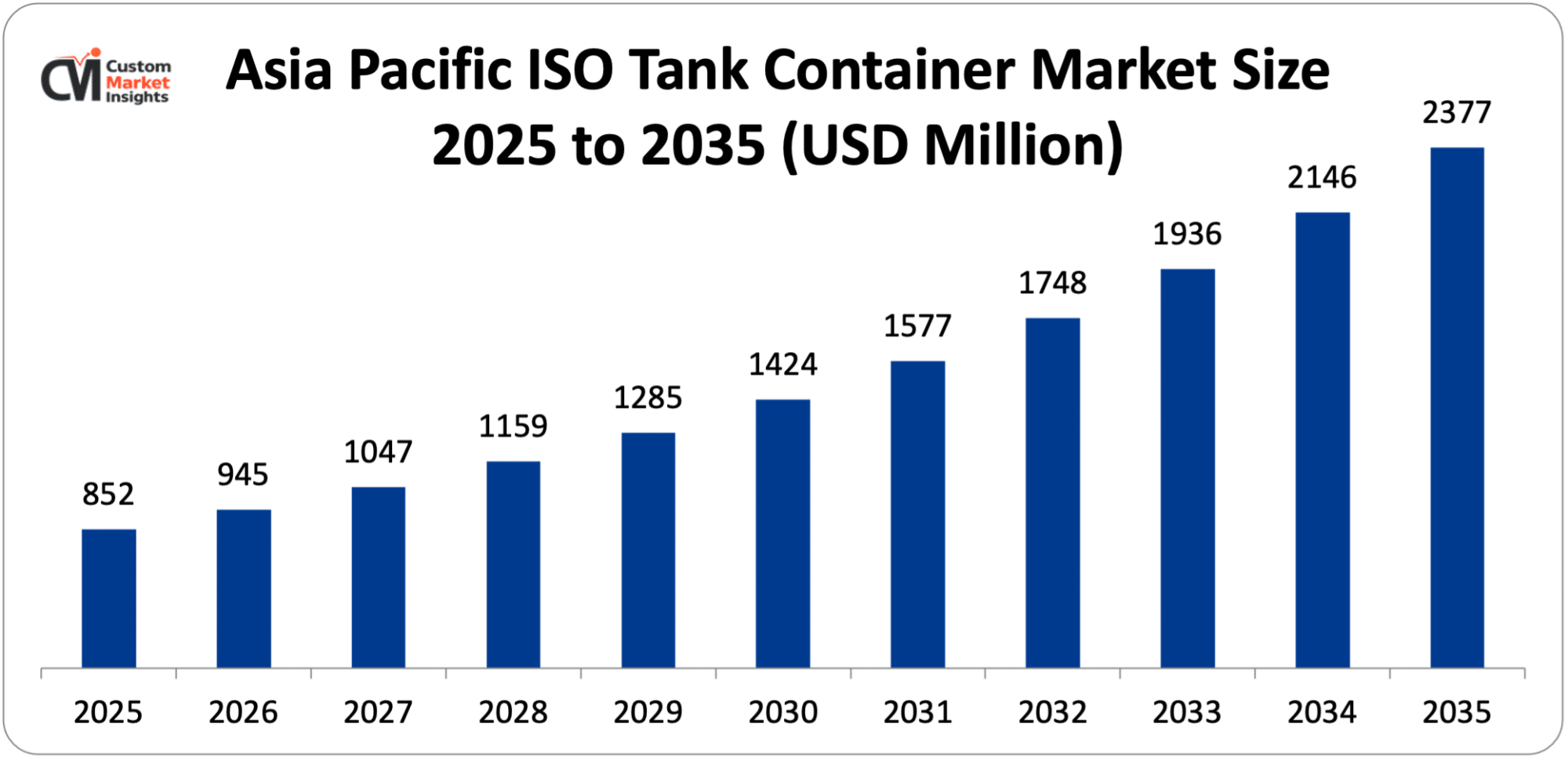
The Asia Pacific held the highest market share in 2025. One of the common growth drivers is the increase in chemical and petrochemical production. As Asia-Pacific accounts for more than 35% of the chemical production in the world, Asian countries like China and India are experiencing growing industrial chemical exports and production investments, which will lead to increased demand for cost-efficient, standardized bulk transportation solutions. Moreover, increased consumption and exports of food-grade liquids, industrial gases, and specialty chemicals are also leading to market acceleration.
Besides, the North American market is expected to grow at the highest CAGR during the forecast period. The growth is led by a solid industrial base, logistics infrastructure, and intense demand for transportation of safe bulk liquids. Prime countries, including the US and Canada, with a strong presence, the US controls the regional market on a large scale of the chemical, petrochemical, and energy industries.
Report Scope
| Feature of the Report | Details |
| Market Size in 2026 | USD 2.22 billion |
| Projected Market Size in 2035 | USD 5.03 billion |
| Market Size in 2025 | USD 2.03 billion |
| CAGR Growth Rate | 9.5% CAGR |
| Base Year | 2025 |
| Forecast Period | 2026-2035 |
| Key Segment | By Container Type, Transport Mode, End User and Region |
| Report Coverage | Revenue Estimation and Forecast, Company Profile, Competitive Landscape, Growth Factors and Recent Trends |
| Regional Scope | North America, Europe, Asia Pacific, Middle East & Africa, and South & Central America |
| Buying Options | Request tailored purchasing options to fulfil your requirements for research. |
Recent Developments
- In March 2024, with the acquisition of H&S Group, one of Europe's largest transporters of food and liquids, Royal Den Hartogh Logistics is expanding its product range to include worldwide transport for chemicals, gas, and foodstuffs.
List of the prominent players in the ISO Tank Container Market:
- Suttons Group
- Singamas Container Holdings
- Intermodal Tank Transport
- Bertschi AG
- Bulkhaul Ltd
- Royal Den Hartogh Logistics
- HOYER GmbH
- Stolt-Nielsen Ltd
- CIMC Tank & Logistics
- Peacock Container
- NewPort Tank
- Sinochain Logistics
- Leschaco Group
- EXSIF Worldwide
- CS Leasing
- VTG Tanktainer GmbH
- Eurotainer SA
- Seaco Global
- Chart Industries
- INOXCVA
- Den Holmsby Tank Leasing
- Others
The ISO Tank Container Market is segmented as follows:
By Container Type
- Multi-Compartment Tank
- Reefer Tank
- Lined Tank
- Cryogenic & Gas Tanks
- Swap Body Tank
- Others
By Transport Mode
- Road
- Marine
- Rail
By End User
- Chemicals
- Petrochemicals
- Food & Beverage
- Pharmaceuticals
- Oil and Gas
- Others
Regional Coverage:
North America
- U.S.
- Canada
- Mexico
- Rest of North America
Europe
- Germany
- France
- U.K.
- Russia
- Italy
- Spain
- Netherlands
- Rest of Europe
Asia Pacific
- China
- Japan
- India
- New Zealand
- Australia
- South Korea
- Taiwan
- Rest of Asia Pacific
The Middle East & Africa
- Saudi Arabia
- UAE
- Egypt
- Kuwait
- South Africa
- Rest of the Middle East & Africa
Latin America
- Brazil
- Argentina
- Rest of Latin America
Rushikesh Dorge
View profile and reportsAbout Custom Market Insights
Custom Market Insights is a market research and advisory company. It publishes syndicated reports across 18+ industries and delivers custom research, feasibility studies and market entry strategy for companies, investors and consultancies.
###