Automation Testing Market Size, Trends and Insights By Component (Solution, API Testing, Performance Testing, Test Management, Code Quality, Others (Agile Testing), Services, Professional, Managed), By Testing Type (Static, Dynamic), By Interface (Desktop Testing, Mobile Testing, Web Testing, Test Design), By Vertical (BFSI, Manufacturing, Retail, IT & Telecom, Healthcare, Government, Others), and By Region - Global Industry Overview, Statistical Data, Competitive Analysis, Share, Outlook, and Forecast 2026 – 2035
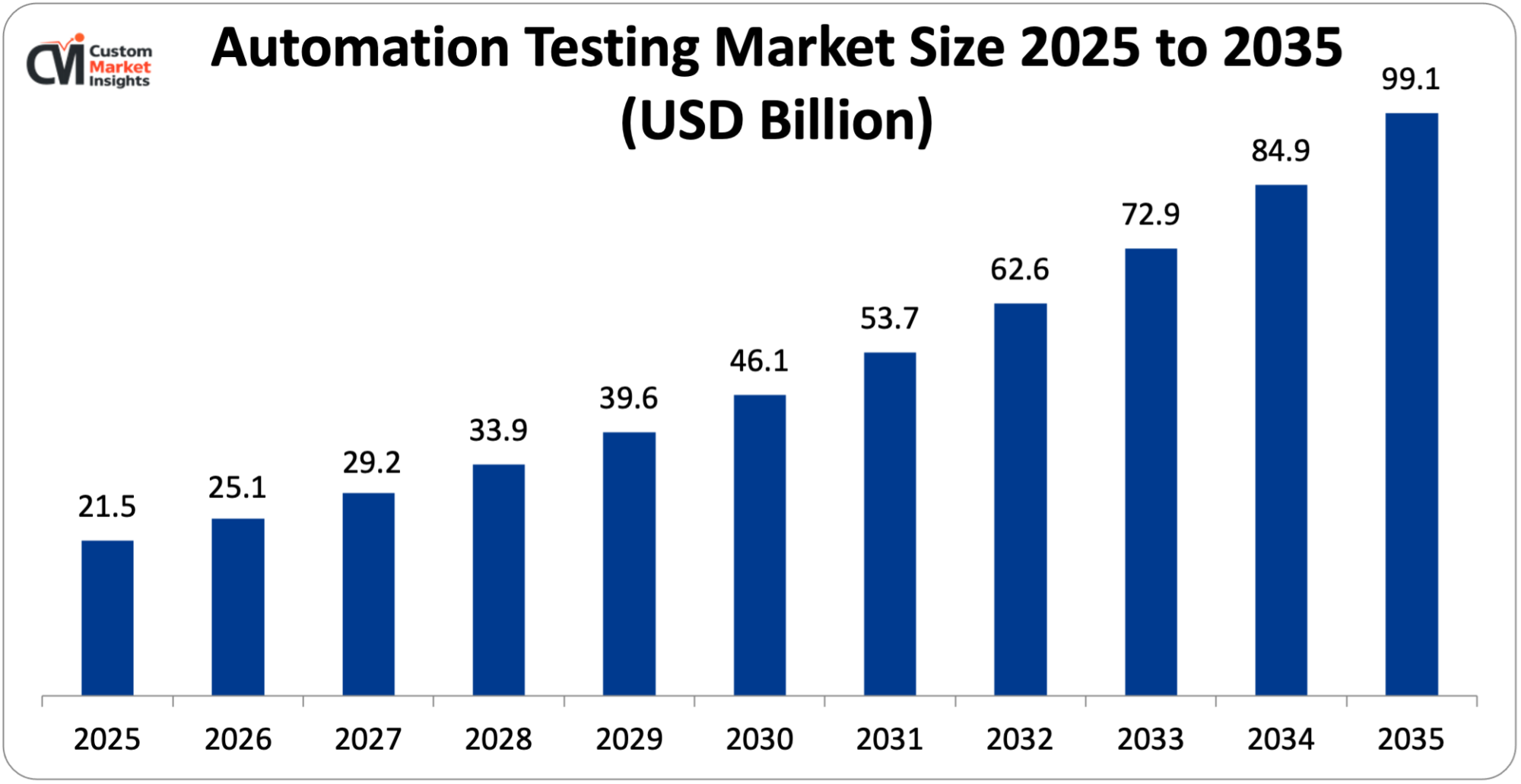
The global automation testing market was valued at USD 25.1 Bn in 2026 and is projected to reach USD 99.1 Bn by 2035, growing at a CAGR of 16.5%. Asia Pacific is the largest regional market and North America is growing fastest.
The market size of global automation testing will be estimated at USD 21.5 billion in 2025 and is expected to grow to between USD 25.1 billion in 2026 and about USD 99.1 billion by 2035, with a current CAGR (compound annual growth rate) of 16.5% during the period of 2026 to 2035. Automation testing is a process of automating the execution of the tests using automated testing tools, scripts, and frameworks, comparing actual results to the expected results, and generating detailed test reports without human intervention. It is one of the most important aspects of modern software development. It is specifically critical for Agile and DevOps methodology-based development work, where redundant testing is a must for releasing software efficiently on a continuous basis. Automation testing contributes to improving software accuracy, efficiency, and coverage by identifying scenarios such as regression, performance, and load testing, which are inherently very suitable for automation, quickly and reliably at varying platforms or environments. Automation saves valuable human resources and transforms a large number of manual testing efforts to be automated, thus exponentially improving software quality.
In 2025, the Asia Pacific will dominate the global market with an estimated market share of 35%. Increasing government initiatives drives the regional expansion.
North America is growing at the highest CAGR over the analysis period. The increasing investment in R&D drives the industry growth.
By component, the services segment dominated the industry in 2025 of more than 50%.
By testing type, the static testing segment would have the highest share of the market in 2025.
By interface, the desktop testing segment would have the highest share of the market in 2025.
By vertical, the healthcare segment dominated the industry of over 25% revenue share in 2025.
Significant Growth Factors
The automation testing market trends present significant growth opportunities due to several factors:
Rapid Adoption of Agile & Devops Practices: The trends toward the use of Agile and DevOps approaches in software development are contributing to the growth of this business as they rely on frequent, constant development, integration, and delivery of working applications. In agile processes, code is constantly changing and giving application in an iterative way; thus, testing of application needs to be performed regularly to maintain application stability and working (manual testing becomes no longer effective). Likewise, the pipeline of DevOps is based on the CI/CD concept; automated testing is a fundamental part of this pipeline as it’s used to evaluate the code always working fine together. Automating testing saves time via faster feedback, reduces human errors, and supports parallel execution of tests, facilitating rapid delivery of software with quality assured. With Agile and DevOps methodologies becoming practices of choice for organizations trying to stay competitive, testing automation solutions are required in significantly larger measure.
Rising Complexity of Applications: The complexity of modern applications is also one of the driving forces behind the automation testing market growth, as applications today are built on newer and more complex architectures using microservices, APIs, cloud-native, multi-device ecospheres, etc. Applications are no longer running on one platform; they need to work across domains and operating environments (web, mobile, IOT, etc.) across multiple OS, browsers, and network environments. Due to increased complexity, manually testing these applications is highly inefficient, slow, and susceptible to errors. Automation testing as a solution allows the organization to cater to a large number of repetitive, complex test cases quickly, accurately, and effectively. Increasing complexity of applications to match ever-growing user expectations is also expected to boost the need for automation solutions and, in turn, boost the market.
What are the Major Advances Changing the Automation Testing Market Today?
AI & machine Learning–driven Testing: AI & machine learning–driven testing is among the most revolutionary developments influencing the automation testing industry today. AI & machine learning models of automation are making the testing process smarter, intuitive, and predictive. Unlike automation, where the tools perform on preprogrammed scripts, intelligent AI-driven testing tools can analyze a large set of data, learn from previous tests, automatically generate and take suggestions to generate task cases, optimize the same, and prioritize execution for faster results. The built-in machine learning models can identify patterns and anomalies and predict the fault-prone areas even before the bug manifests. Tools also come with self-healing test scripts that automatically adjust to UI level modifications or upgrades, thereby saving time and effort and reducing failures. With the adaptive automation in place, organizations can have smarter access to faster coverage, zero overall time, faster execution, and real-time decision-making capacity. This revolution is changing the face of automation testing and bringing much-needed scalability, accuracy, and dynamics to it.
Advanced Analytics & Real-time Reporting: Advanced analytics & real time reporting enhances automation testing by helping businesses search results faster and selecting appropriate solutions during software development. Advanced analytics used in cutting-edge testing solutions collects high-volume test execution data and performs analysis to gain insight into the test performance, defect dynamics, and application quality. Real-time reporting on the progress of test execution through dashboards and monitors allows test teams to observe the failure and issue detection more rapidly so they can focus on significant issues more effectively and lead to improved staffing, resource allocation, and debugging speed. The machine learning and data analytics also, where possible, predict quality and risk problems before they happen. With transparency and insights, businesses can deliver higher-quality software quicker.
Why Services Hold a Prominent Position in the Market?
The services segment dominated the industry in 2025 of more than 50%. This is because organizations use dedicated consulting and implementation services to help them implement and mature their automation. These services are usually delivered by third-party vendors or consulting companies who are specialists on test automation and testing best practices. Therefore, the use of specialist testing services would be advantageous, especially if the organization has no in-house expertise or chooses to speed up their test automation program.
The solution segment is growing at a highest CAGR during the forecast period. Introduction to test automation, test automation solutions help to speak about more rapid test cycles, increased test coverage, and reduced manual effort. Moreover, they allow delivering high-quality releases and converging testing efforts and cost. Hence, suitable test automation solutions based on projects' goals can help to be successful in test automation.
By Testing Type
Why Static Testing Capture the Highest Market Share in the Automation Testing Market?
The static testing segment would have the highest share of the market in 2025 because it allowed users to inspect the documents and identify errors, redundancies, and ambiguities. Moreover, static testing also facilitates better cooperation among team members and results in superior quality of code. This approach consequently provides much more reliable automation testing.
The dynamic segment is growing at a rapid rate over the projected period. It is implemented for detecting errors by execution of the code. These tests increase testing efficiency, accuracy, and the number of test cases executed, which is faster, more efficient software deployment.
What Factor Drives the Desktop Testing Interface in the Automation Testing Market?
The desktop testing segment would have the highest share of the market in 2025. It is used in the actual process of testing applications by using these operating systems (Microsoft Windows, Apple's Mac OS X, Linux, etc.). Hence, it is an integral part of testing the software applications (primarily designed for desktop use). The registration and utilization of these software applications, particularly in the industry of web or cloud applications, may not always be secure and practical enough. Hence, this sort of testing still holds critical importance.
The web testing segment is growing at a rapid rate over the projected period. Is the process of checking web-based applications and websites for their functionality, usability, and compatibility with different web browsers and devices that will give a good user experience? The rise in web-based applications is mainly because of their cross-platform accessibility and ease of deployment. Growing market for web-based applications in various businesses would add to the growth of market players.
By Vertical
Why Healthcare Segment Dominates the Automation Testing Market?
The healthcare segment dominated the industry of over 25% revenue share in 2025. The growth could be attributed to the ongoing major digital transformation aimed at "improved patient care," which includes a greater reliance on software applications, electronic health records (EHR), medical devices, and other technologies to enhance operational efficiency and compliance, thereby facilitating test automation.
The BFSI segment is growing at a rapid rate over the projected period. The organization relies heavily on software applications to provide a wide range of financial services, manage transactions, and comply with regulatory requirements. Besides, automation testing helps BFSI organizations to fasten its testing cycle and unleash faster than normal, which is a crucial factor in the highly competitive and fast-paced environment where ‘speed to market’ becomes a competitive advantage. With many innovations taking place in the industry, such tests would definitely become a strategic imperative to help BFSI organizations to continue their proliferation in the BFSI space.
Report Scope
Feature of the Report
Details
Market Size in 2026
USD 25.1 billion
Projected Market Size in 2035
USD 99.1 billion
Market Size in 2025
USD 21.5 billion
CAGR Growth Rate
16.5% CAGR
Base Year
2025
Forecast Period
2026-2035
Key Segment
By Component, Testing Type, Interface, Vertical and Region
Report Coverage
Revenue Estimation and Forecast, Company Profile, Competitive Landscape, Growth Factors and Recent Trends
Regional Scope
North America, Europe, Asia Pacific, Middle East & Africa, and South & Central America
Buying Options
Request tailored purchasing options to fulfil your requirements for research.
Regional Analysis
How Big is the Asia Pacific Automation Testing Market Size?
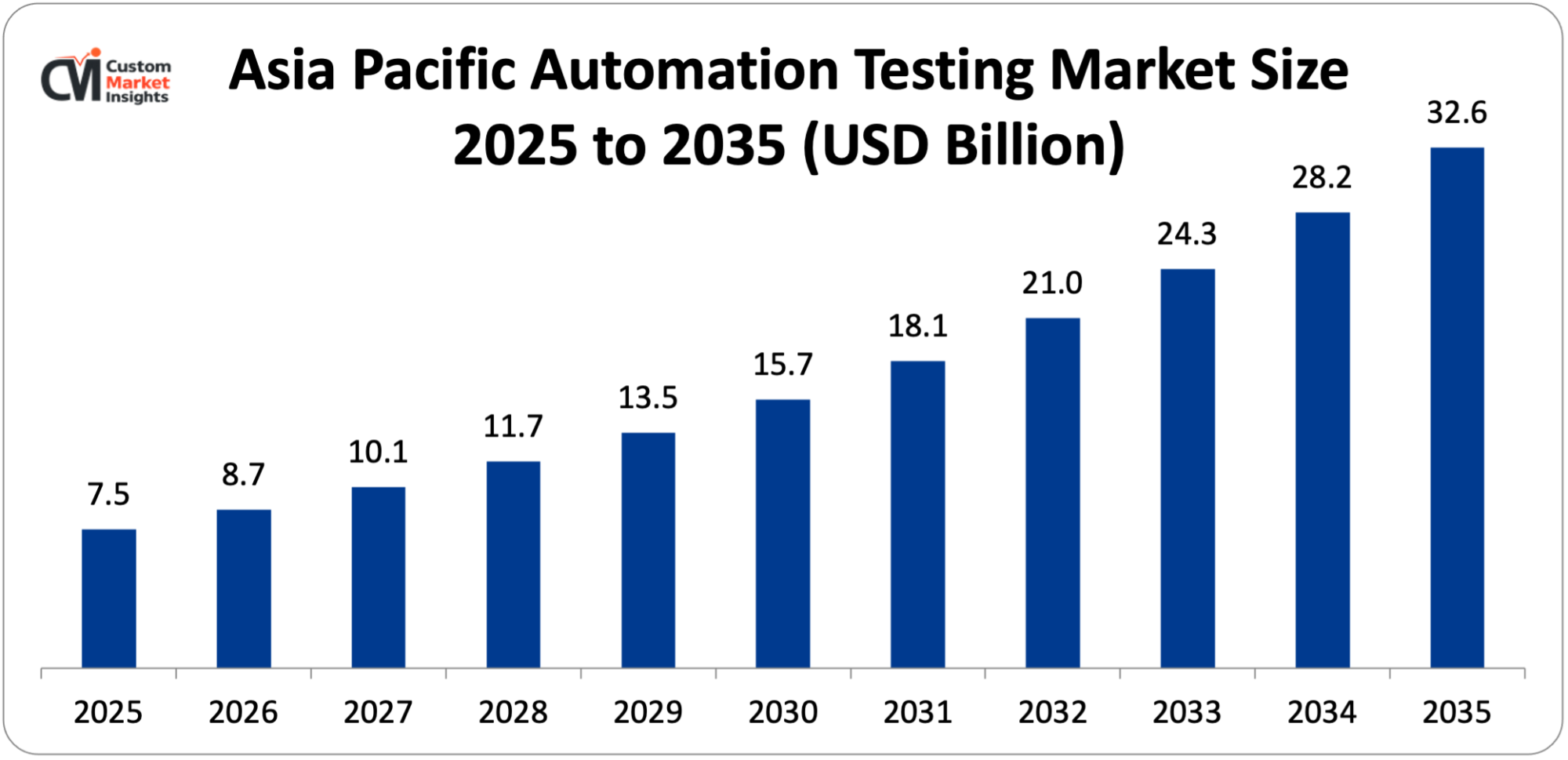
Its market size, in terms of the Asia Pacific automation testing, is projected to be USD 7.5 billion in 2025 with a growth of about USD 32.6 billion in 2035 with a CAGR of 15.8% between 2026 and 2035.
Why did the Asia Pacific Dominate the Automation Testing Market in 2025?
In 2025, the Asia Pacific will dominate the global market with an estimated market share of 35%. The regional market is quite lucrative, and countries such as Singapore, China, India, Japan, New Zealand, and Hong Kong can significantly accelerate the growth of companies that utilize automation analysis. Countries such as China and India have a large number of consumers that would immensely add to the growth of the region. Various regulations are being formed by the governments for quickening the growth of advanced technology such as automation, AI & ML, mobile & online apps, cloud-based services, etc.
India Automation Testing Market Trends
In the Asia Pacific region, India is growing at a significant rate over the projected period. The increasing product launch drives the industry growth. For instance, in September 2025, LambdaTest, a GenAI-native quality engineering platform, announced the launch of general availability for KaneAI, its AI-native test authoring solution. This initiative aims to democratize access to AI-native test automation, allowing users worldwide to experience the full capabilities of KaneAI without committing to a paid subscription.
Why is Europe Experiencing a Significant Growth in the Automation Testing Market?
Europe holds a significant market share in 2025. The growth at a regional level could be credited to multiple government initiatives to facilitate digitization, cloud computing, and automation in several sectors and public sector bodies. Participants in the European testing market seek to employ extensive business policies to promote new tools & software solutions and exhibit vigorous competences vis-à-vis their counterparts.
UK Automation Testing Market Trends
UK held the dominant position in the market in 2025. The increasing government initiatives for automation drives the industry growth.
Why is North America Growing at a Steady Rate in the Automation Testing Market?
North America is expected to grow at a steady rate over the projected period. The increasing advancement in technology and growing R&D expenditure drives the market growth.
US Automation Testing Market Trends
The US holds the prominent market share in the industry. This trend is driven mainly by the extensive adoption of Agile and DevOps practices that promote continuous integration and automated testing for faster software releases.
Why is the Middle East & Africa Region is growing rapidly in the Automation Testing?
The MEA region is growing at a steady rate over the projected period. The growth is supported by accelerating digital transformation and increasing investments in IT infrastructure across the region.
UAE Automation Testing Market Trends
UAE is growing at the highest CAGR during the forecast period. This is driven by the rising demand for high-quality software in sectors such as banking, telecom, retail, and healthcare.
Top Players in the Automation Testing Market and Their Offerings
Sauce Labs Inc.
OpenText Corporation (Micro Focus)
Ranorex GmbH
Tricentis USA Corp
SmartBear Software Inc.
Parasoft Corporation
Cigniti Technologies Ltd.
Keysight Technologies Inc.
IBM Corporation
Accenture plc
Microsoft Corporation
Katalon Inc.
BrowserStack Inc.
LambdaTest Inc.
Leapwork A/S
Applitools Ltd.
Capgemini SE
Worksoft Inc.
Perfecto (Perforce Software Inc.)
Functionize Inc.
Others
Key Developments
Automation testing market has experienced considerable changes in the last two years as the market players are trying to diversify their technological aspects and develop product portfolio using strategic approaches.
In December 2025,Tricentis NeoLoad introduced breakthrough innovations in 2025, from built-in AI analysis to MCP and RealBrowser Core Web Vitals. Our vision for 2026 is to build on this innovation, empowering our customers to identify and eliminate performance bottlenecks faster and more intelligently than ever before. (https://www.tricentis.com/blog/neoload-ai-performance-testing-future)
These strategic measures have enabled the companies to reinforce their competitive positions, increase the product line, boost their technological competencies and also seize growth opportunities in the fast-growing Automation Testing market.
The Automation Testing Market is segmented as follows:
Who are the key players in the Automation Testing market?
The key players in the market are Sauce Labs Inc., OpenText Corporation (Micro Focus), Ranorex GmbH, Tricentis USA Corp, SmartBear Software Inc., Parasoft Corporation, Cigniti Technologies Ltd., Keysight Technologies Inc., IBM Corporation, Accenture plc, Microsoft Corporation, Katalon Inc., BrowserStack Inc., LambdaTest Inc., Leapwork A/S, Applitools Ltd., Capgemini SE, Worksoft Inc., Perfecto (Perforce Software Inc.), Functionize Inc., Others.
What role do government regulations play in shaping this market's development?
Government regulations play a crucial role in shaping the automation testing market by enforcing strict standards for software quality, data security, and compliance, which compels organizations to adopt robust automated testing solutions to ensure reliability, reduce risks, and meet regulatory requirements efficiently.
How does the price point impact market growth and adoption?
The price point significantly impacts market growth and adoption by influencing affordability and ROI, where lower-cost or flexible pricing models (such as subscriptions or cloud-based solutions) enable wider adoption across SMEs, while high upfront costs can limit entry despite long-term benefits.
What is the projected market size by the end of the forecast period?
According to the present analysis and forecast modeling, the market of Automation Testing will witness a significant growth of about USD 99.1 billion in the year 2035 with the growing innovative product launch, increasing collaboration, rising government initiatives with a CAGR of 16.5% between the years 2026 and 2035.
Which region is anticipated to dominate the market during the forecast period?
It is projected that the Asia Pacific will hold the largest market share in the automation testing market in the forecast period, with a share of about 35% of the global market share, which is attributed to the increasing government initiatives for smart technology.
Which region is expected to grow at the fastest CAGR in this market?
North America is expected to grow at a highest rate during the forecast period. The growth in the region is owing to the increasing automation across sector.
What are the key driving factors influencing the growth of the Automation Testing market?
The key factors driving the market are driven by growth in the demand for automation of the testing process and solutions to seamless customer experience & rising usage of AI-enabled cutting-edge technologies for software testing environments.
Ayush Kadam is a Senior Market Research Analyst at Custom Market Insights, with over seven years of experience in syndicated and custom market research. He specializes in market sizing, competitive intelligence, industry trends, forecasting, and strategic insights, helping clients turn complex data into actionable business decisions.