Global Automotive Lane Warning Systems Market 2024–2033
Automotive Lane Warning Systems Market Size, Trends and Insights By Type (Video Sensors, Laser Sensors, Infrared Sensors), By Application (OEMs, Aftermarket), and By Region - Global Industry Overview, Statistical Data, Competitive Analysis, Share, Outlook, and Forecast 2024–2033
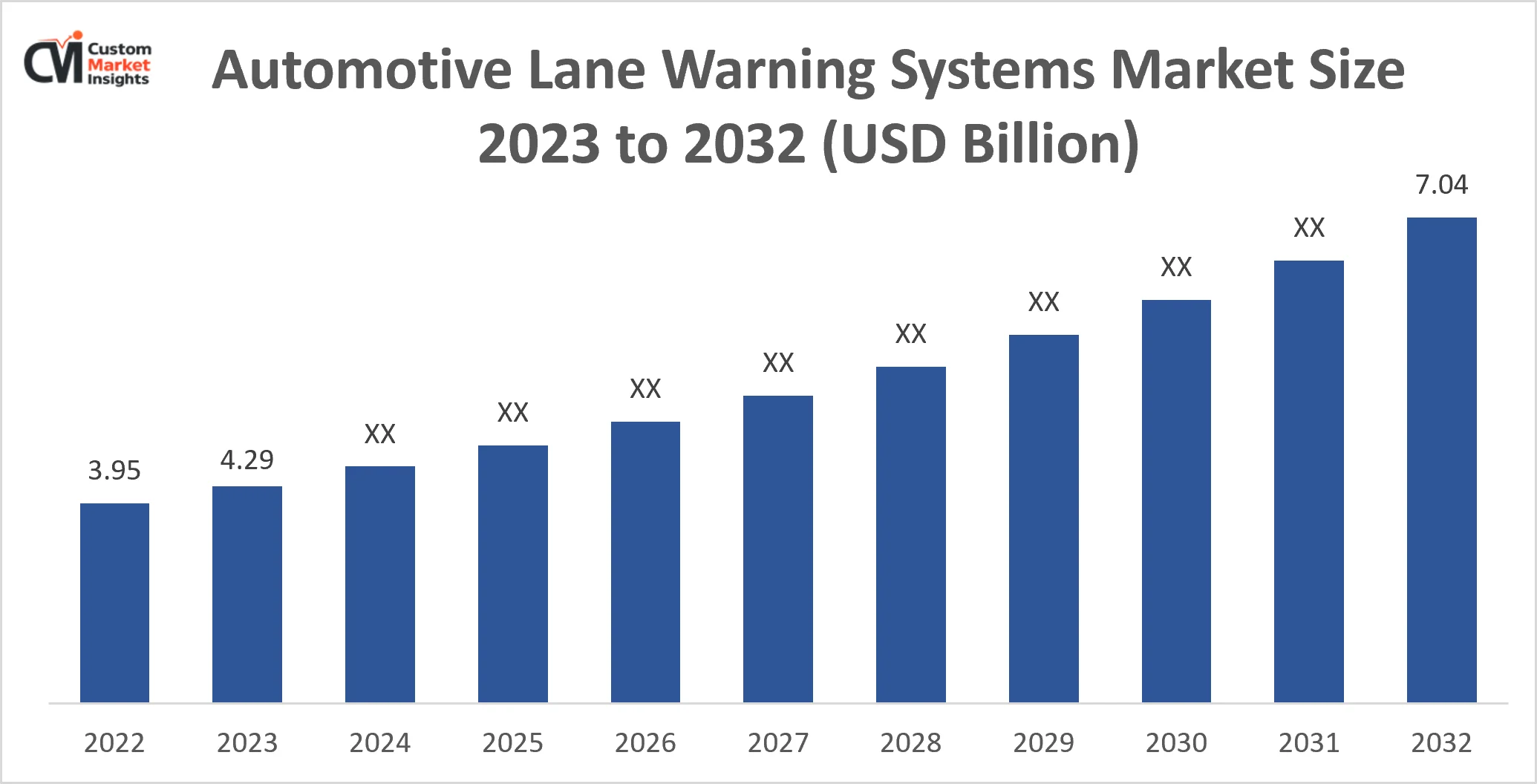
The global automotive lane warning systems market was valued at USD 4.29 Bn in 2023 and is projected to reach USD 7.04 Bn by 2032, growing at a CAGR of 7%. Europe is the largest regional market and Asia-Pacific is growing fastest.
Global Automotive Lane Warning Systems Market 2023–2032 (By Billion)
As per the current market research conducted by CMI Team, the global Automotive Lane Warning Systems Market is expected to record a CAGR of 7% from 2023 to 2032. In 2022, the market size is projected to reach a valuation of USD 3.95 Billion. By 2032, the valuation is anticipated to reach USD 7.04 Billion.
Automotive Lane Warning Systems (LWS) refer to a set of safety technologies designed to help drivers stay within their lane while driving. These systems use various sensors and cameras to monitor the vehicle's position on the road and provide warnings or alerts to the driver if the vehicle unintentionally drifts out of its lane.
The primary goal of LWS is to prevent lane departure accidents, which can occur due to driver distraction, drowsiness, or other factors.
Lane Departure Warning (LDW): LDW systems use cameras or other sensors to detect lane markings on the road. If the vehicle begins to drift out of its lane without the driver activating the turn signal, the LDW system will issue a warning, usually in the form of visual or audible alerts, to prompt the driver to correct their course.
Lane Keeping Assist (LKA): LKA systems take lane departure warnings a step further by actively intervening to help keep the vehicle within its lane. If the driver does not respond to the LDW warning and continues drifting out of the lane, the LKA system may provide gentle steering inputs or apply braking force to guide the vehicle back into the correct lane.
The Automotive Lane Warning Systems market has grown significantly in recent years, driven by increasing awareness of road safety and the adoption of advanced driver-assistance systems (ADAS) in vehicles. Many automakers now offer LWS as a standard or optional feature in their vehicles, especially in higher-end models.
LWS technology is seen as an important step towards the development of autonomous driving capabilities, as it enhances vehicle safety and reduces the risk of accidents caused by lane departure incidents.
Automotive Lane Warning Systems Market - Significant Growth Factors
Rising Focus on Road Safety: Increasing concerns about road safety and the need to reduce accidents and fatalities have driven the demand for advanced driver-assistance systems (ADAS) like LWS. Lane Warning Systems help prevent lane departure accidents, which are a leading cause of collisions, particularly on highways.
Government Regulations and Safety Standards: Governments in various countries have implemented stringent regulations and safety standards, mandating the inclusion of safety features in vehicles. Lane Warning Systems align with these regulations, leading to their widespread adoption by automakers.
Consumer Awareness and Demand: As awareness about the importance of road safety and the benefits of ADAS technologies increases, consumers are actively seeking vehicles equipped with safety features like Lane Warning Systems. This demand has prompted automakers to integrate LWS into their vehicle models.
Integration in Advanced Driver-Assistance Systems: Lane Warning Systems are often part of broader Advanced Driver-Assistance Systems (ADAS) packages, which include various safety and convenience features. The integration of LWS with other ADAS technologies enhances their overall effectiveness and appeal to consumers.
Insurance Discounts and Incentives: Some insurance companies offer discounts and incentives to drivers who own vehicles equipped with ADAS technologies like Lane Warning Systems. These incentives encourage consumers to opt for vehicles with enhanced safety features.
Automotive Industry Advancements: Advancements in sensor technology, camera systems, and artificial intelligence have improved the accuracy and reliability of Lane Warning Systems. These technological advancements have made LWS more efficient and feasible for mass adoption.
Supportive Infrastructure and Roadway Markings: The effectiveness of Lane Warning Systems relies on well-maintained road markings and infrastructure. As governments invest in infrastructure improvement and smart road technologies, the conditions become more conducive to the deployment of LWS.
Potential for Autonomous Driving: Lane Warning Systems are an essential component of the evolution towards autonomous driving. They serve as a building block for higher-level ADAS and self-driving capabilities, making them strategically important for the automotive industry's future.
OEM Integration and Standardization: Many automakers are integrating Lane Warning Systems as standard or optional features in their new vehicle models. The trend towards standardization further boosts the growth of the LWS market.
Automotive Lane Warning Systems Market - Mergers and Acquisitions
Given the increasing importance of safety features and advanced driver-assistance systems in the automotive sector, it is possible that companies involved in the development and production of Lane Warning Systems may have engaged in M&A activities to enhance their capabilities and market presence.
Some potential scenarios where M&A could occur in the Automotive Lane Warning Systems market include:
Established automotive suppliers acquiring smaller companies specializing in ADAS technologies, including Lane Warning Systems, to expand their offerings and strengthen their position in the market.
Collaboration and partnerships between automakers and technology companies to jointly develop and integrate advanced safety systems, including Lane Warning Systems, into their vehicle models.
Technology companies specializing in sensor technology, camera systems, or artificial intelligence acquire companies with expertise in ADAS technologies to bolster their presence in the automotive industry.
Consolidation among existing Lane Warning System providers to gain a larger market share and compete more effectively in the rapidly evolving ADAS market.
Automotive Lane Warning Systems Market - Significant Threats
Consumer Acceptance and Adoption: While LWS technology offers safety benefits, its effectiveness relies on driver acceptance and proper usage. Some drivers may find the system's warnings intrusive or may override the system, reducing its overall impact on preventing lane departure accidents.
False Positives and Negatives: LWS relies on camera and sensor data to detect lane markings and driver behavior. False positives (incorrect warnings) or false negatives (failure to issue warnings when necessary) can erode driver trust in the system's reliability.
Limited Road Infrastructure Support: The effectiveness of LWS depends on well-maintained road markings and infrastructure. In areas with poor road markings or challenging weather conditions, the system's accuracy may be compromised.
Technology Limitations: Current LWS technology may have limitations in detecting complex or poorly marked road conditions, such as construction zones or winding rural roads, potentially reducing its effectiveness in certain driving scenarios.
Cybersecurity Risks: As LWS systems become more connected and integrated with other vehicle systems, they may be susceptible to cybersecurity threats, such as hacking or unauthorized access, potentially compromising vehicle safety.
Cost and Complexity: The integration of LWS and other ADAS features in vehicles can increase the overall cost and complexity of the vehicle's electronics and software systems, which may deter cost-conscious consumers or manufacturers.
Regulatory Challenges: Different regions and countries may have varying regulations and safety standards related to ADAS technologies like LWS. Compliance with multiple and evolving regulations can pose challenges for automakers operating in international markets.
Liability and Legal Concerns: As ADAS technologies become more prevalent, issues related to liability and legal responsibility in the event of an accident involving LWS-equipped vehicles may arise, potentially leading to legal disputes and increased insurance costs.
Competing ADAS Technologies: The automotive industry is witnessing rapid advancements in ADAS technologies. LWS faces competition from other safety systems, such as Adaptive Cruise Control, Lane Keeping Assist, and Collision Warning, as automakers strive to offer comprehensive safety suites.
Market Saturation: With LWS becoming a standard or common feature in many newer vehicle models, the market may experience saturation, leading to reduced growth opportunities for LWS-specific manufacturers.
Report Scope
Feature of the Report
Details
Market Size in 2023
USD 4.29 Billion
Projected Market Size in 2032
USD 7.04 Billion
Market Size in 2022
USD 3.95 Billion
CAGR Growth Rate
7% CAGR
Base Year
2023
Forecast Period
2024-2033
Key Segment
By Type, Application and Region
Report Coverage
Revenue Estimation and Forecast, Company Profile, Competitive Landscape, Growth Factors and Recent Trends
Regional Scope
North America, Europe, Asia Pacific, Middle East & Africa, and South & Central America
Buying Options
Request tailored purchasing options to fulfil your requirements for research.
The Global Lane Departure Warning System (LDWS) market is segmented into three types: Video Sensors, Laser Sensors, and Infrared Sensors. Among these, Infrared Sensors currently lead in terms of market share due to their widespread adoption in lane-tracking applications, offering high accuracy.
Infrared Sensors are renowned for their precise detection of lane markers, enabling accurate lane departure warnings to be issued to drivers. Alongside Infrared Sensors, Video Sensors and Laser Sensors also hold a significant market share.
Video Sensors utilize advanced image processing techniques to analyze the road ahead and detect lane markers, contributing to their effectiveness in LDWS applications. Laser Sensors, on the other hand, utilize laser beams to detect lane markers, making them another important technology in the LDWS market.
By Application:
The Lane Departure Warning System (LDWS) market is divided into two segments based on application: OEMs (Original Equipment Manufacturers) and Aftermarket. In recent times, there has been a notable surge in the OEM segment, while the aftermarket has gained dominance.
The rise of OEMs in the LDWS market can be attributed to the increasing demand for vehicles equipped with advanced safety features, including LDWS. OEMs are now incorporating LDWS directly into their vehicles during the manufacturing process, making it a built-in feature available from the point of purchase.
This integration enhances the overall safety of the vehicle and provides customers with added peace of mind regarding road safety.
Automotive Lane Warning Systems Market - Regional Analysis
North America: North America, particularly the United States, was a significant market for Automotive Lane Warning Systems. The region's strong automotive industry, stringent safety regulations, and consumer awareness of advanced driver-assistance systems (ADAS) contributed to the adoption of LWS in new vehicle models.
Europe: Europe was another major market for LWS, driven by the region's focus on vehicle safety and technological advancements in the automotive sector. Stringent safety standards and high demand for luxury vehicles with advanced safety features further boosted the adoption of LWS.
Asia-Pacific: The Asia-Pacific region showcased considerable growth potential for Automotive Lane Warning Systems. Rapidly growing economies like China and India witnessed increasing vehicle ownership and rising awareness of road safety. As a result, the demand for ADAS technologies, including LWS, was on the rise.
Latin America: While the adoption of LWS was comparatively lower in Latin America, some countries in the region, such as Brazil and Mexico, witnessed a growing interest in advanced safety features in vehicles. The market for LWS was expected to expand as consumer awareness increased.
Middle East and Africa: The Middle East and Africa were still emerging markets for LWS as of 2021. However, the growing focus on road safety and the adoption of ADAS technologies in commercial fleets and high-end vehicles indicated potential opportunities for LWS adoption in the future.
List of the prominent players in the Automotive Lane Warning Systems Market:
Which are the driving factors of the Automotive Lane Warning Systems Market?
The key factors driving the Market are Rising Focus on Road Safety, Government Regulations and Safety Standards, Consumer Awareness and Demand, Integration in Advanced Driver-Assistance Systems, Insurance Discounts and Incentives, Automotive Industry Advancements, Supportive Infrastructure and Roadway Markings, Potential for Autonomous Driving And OEM Integration and Standardization.
Which type led the Automotive Lane Warning Systems market?
The "Type" category dominated the market in 2022.
Who are the key players in the Automotive Lane Warning Systems market?
The key players in the market are ROBERT BOSCH GMBH, Continental AG, Denso Corporation, Delphi Auto Parts, Magna International Inc., Mobileye, Autoliv Inc., Hitachi Ltd., ITERIS INC., VOLKSWAGEN AG, ZF FRIEDRICHSHAFEN AG, Others.
Which region held the largest market share in the Automotive Lane Warning Systems market?
"North America" had the largest share in the Automotive Lane Warning Systems Market.
What is the growth rate of the Automotive Lane Warning Systems market?
The global market is projected to grow at a CAGR of 7% during the forecast period, 2023-2032.
How much is the Automotive Lane Warning Systems market?
The Automotive Lane Warning Systems Market size was valued at USD 3.95 Billion in 2022.
Ayush Kadam is a Senior Market Research Analyst at Custom Market Insights, with over seven years of experience in syndicated and custom market research. He specializes in market sizing, competitive intelligence, industry trends, forecasting, and strategic insights, helping clients turn complex data into actionable business decisions.